International Journal of Innovative Technology and Exploring Engineering (IJITEE) ISSN: 2278-3075,Volume-8 Issue-11, September 2019
Abstract: The issue of choosing the field of study and specialty becomes especially relevant at the stage of admission to a higher educational institution. This work is dedicated to the means of decision support system for the prospect students who cannot decide on their own what they want to do in the future. At the same time, an innovative approach is considered for evaluation and development of spatial awareness of the students entering the educational establishments specializing in the construction. The focus is on researching methods based on mobile gaming applications and can be used in decision support systems. Modern computer technologies allow not only to evaluate the results of educational games, but also to record the characteristics of the personality that appear during the game and reflect the degree of the ability to study in the appropriate field. The analysis of modern mobile applications, which allows to assess the abilities of prospective students, which are necessary for successful training in the specialty. Because of the analysis, there were selected mobile applications that are expedient to use in intelligent decision support systems and to assess and develop spatial awareness. There was formed a set of criteria for evaluating factors reflecting the level of the prospective student’s spatial awareness. There was proposed an approach to the development of an intellectual system for evaluating the professional abilities of the students entering the educational establishments specializing in building.
Keywords: educational game, evaluation criterion, spatial imagination
I. INTRODUCTION
T
he rapid development of science and technology requires the development and introduction of new methods and means of developing human abilities, which will significantly improve the quality of knowledge gained, reducing the time allocated for learning information. The development of spatial awareness has a key role to play in gaining skills that are necessary for acquiring a number of professions in construction industry. Demand for means of acquiring knowledge, formation and improvement of skillsRevised Manuscript Received on September 05, 2019.
* Correspondence Author
Riabchun Yuliia*, Kyiv National University of Building and Architecture, Kyiv, Ukraine. Email: [email protected]
Honcharenko Tetyana*, Kyiv National University of Building and Architecture, Kyiv, Ukraine. Email: [email protected]
Honta Victoria, Kyiv National University of Building and Architecture, Kyiv, Ukraine. Email: [email protected]
Chupryna Khrystyna, Kyiv National University of Building and Architecture, Kyiv, Ukraine. Email: [email protected]
Fedusenko Olena, Taras Shevchenko National University of Kyiv, Kyiv, Ukraine. Email: [email protected]
encouraged the gaming industry to engage in the development of training programs. The main goal of educational games is the formation of the future specialists’ ability to combine theoretical knowledge with practical activities. That is why the development of intelligent systems that give decision support regarding choice of profession based on the evaluation of the results of the game remains relevant.
Reliability of the means of estimating the prospective students’ spatial awareness is ensured by the adequacy of the models and methods that are used to form a specialist profile during games and are used for:
Choice of the field of study and specialty at the stage of prospective student’s admission to a higher educational institution;
Decision support regarding the choice of the field of study;
Increasing the effectiveness of the organization and quality of the educational process organized by teachers;
Improving quality of learning by students
II. ANOVERVIEWOFTHEMEANSOF
EVALUATIONANDDEVELOPMENTFOR
PROSPECTIVESTUDENTS`PROFESSIONAL
ABILITIES
A. The role of the game in the process of evaluation and development of prospective students professional abilities The process of cognition is a complex and rather contradictory process. Usually, the first experience of knowing the world in toddlers begins with toys and games. The game is one of the most important occupations of the child. Game teaching methods are one of the most effective ways of learning, understanding and assimilating important information for us. Another little baby needs to be driven by the curiosity of complex tasks and non-standard, creative decisions.
Any technology of the game has facilities that activate and intensify the activities of students. The game, along with labor and training, is one of the main types of human activity [1], regardless of age.
Game techniques are multifaceted, and each one of them in one way or another contributes to the development of certain skills. Correctly, selected material will help not only to develop spatial imagination but also to deepen knowledge of the profile item.
Methods and Means of Evaluation and
Development for Prospective Students’ Spatial
Awareness
The analysis of the phenomenon of the game has shown that previous generations can be reproduced in the game through the simulation of different situations [2, 3]. Thus, the game is one of the means of self-actualization and search for a model of self-affirmation, which is determined in a certain conditional construction of reality. When forming professional skills and competencies, gaming technologies allow consolidating practically and developing the acquired theoretical knowledge, transforming them into the necessary qualifications and human qualities. Application of the game at each stage of development of personality has its tasks and
consequences [4].
Game-based learning is a game with defined learning outcomes [5]. Under the game is not always a digital or computer game. The process of developing games for training involves balancing the need to cover the subject with the desire to set the priority of the game [6].
In the transition from pre-university education to studying in a higher education institution, it is envisaged to make a decision regarding professional identification, which can take place during different time intervals (Fig. 1), and can be supported by various decision support systems (DSS).
Fig.1. The main stages of personality development: Σ - symbolizes a mixture of indicators that characterize the prospective student’s abilities and achievements.
An assessment of the person's natural abilities requires the use of tools, which are based on intellectual and psycho diagnostic tests and game technologies in addition to tests of achievements and skills. The development of mobile gaming applications is related to the need to select natural abilities from a fuzzy array data that reflect the profile of a specialist at the pre-university stage preparation [3, 5].
The importance of using gaming technologies at the stage of choosing a specialty is due to the age-related feature of the vast majority of prospective students aged from 16 to 17 years when the teenager faces new social requirements and roles. The task of differentiation in the education system requires the development and application of such diagnostic techniques, which allow identifying and assessing the mental properties necessary for the successful assimilation of different systems of knowledge and mastery of different professions. The use of gaming educational technologies has a significant potential to cope with this challenge of modern education.
The demand for tools for assessing the individual’s professional abilities provides the need for the development of professionally-oriented gaming tools that make it possible to evaluate and develop the future specialist’s personal qualities. Modern computer technologies allow not only to evaluate the results of educational games, but also to capture the characteristics of the personality that appear during the game and reflect the degree of the ability to study in the corresponding field of study.
B. Review of mobile gaming applications for the development of professional abilities of prospective students entering the educational establishments specializing in building
There are plenty of specialties for which certain skills are needed to learn graphic disciplines. Among them there are a lot of fields regarding building studies. However, there is still no clear classification of simple games that is necessary for
the assessment and development of the individual, which is necessary for the acquisition of various training courses in technical, architectural and artistic specialties. That is why this section is devoted to the study of mobile gaming applications, which can give decision support when the prospective students enter the educational establishments specializing in building [4, 5].
The main focus was on the study of mobile applications that provide an opportunity to evaluate the player’s spatial awareness.
Monument Valley. The game is based on Maurits Escher's
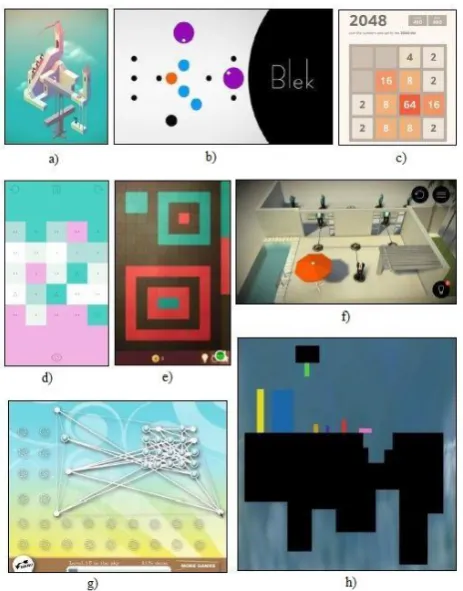
graphic work and the rules of perspective: the game world is such that the user sees it in isometrics (Fig. 2, a). The main features of the game are the gradually increasing complexity of game levels and a short (10 levels) duration.
The user needs to move, rotate and flip parts of high-rise buildings so that the character can move in the right direction.
Blek. The main point of the game is a set of complex and
complicated algorithms for the movement in one line (Fig. 2, b).
The user needs to predict different route options, with only one line segment possible.
2048. The point of the game is that in each round there is a
tile of face value "2". By pressing the arrow the player can direct all the tiles of the playing field to one of the 4 sides. When putting together two tiles of the same face value, the tiles are united in one, the face value of which is equal to the sum of two united ones. The game ends if, after the move, it is not possible to act (Fig. 2, c).
The user needs to think up options for combining existing cells on a variety of possible options, taking into account the appearance of a new number.
Formation Assessment of abilities
Research of the results of
studying regarding the
vocational
subjects Choice of the
field of study
навчання
Realization of abilities
Work in the field
Prospective student’s decision support Game Game
International Journal of Innovative Technology and Exploring Engineering (IJITEE) ISSN: 2278-3075,Volume-8 Issue-11, September 2019
Harmony. There is a puzzle game in which you need to
[image:3.595.48.280.110.406.2]move colored squares in accordance with a given palette (Fig.2, d). The user needs to predict own actions in two-dimensional space, provided that the number of moves is reduced.
Fig.2. Fragments of the games: a) Monument Valley; b) Blek; c) 2048; d) Harmony; e) KAMI; f) Hitman GO; g)
Vtangle Galaxy by GavApps; h) Thomas was alone.
KAMI. It is an origami puzzle where in turn sheets are
provided with multicolored patterns of varying complexity.
The object is to paint a sheet in one color with a minimum number of moves (Fig. 2, e).
Hitman GO. The main point of the game is to plan the
movements of the hero in two- or three-dimensional spaces, at the same time the user has to take into account the possibility of uncontrolled movement made by secondary characters (Fig. 2, f).
Vtangle Galaxy by GavApps. The object of the game is to
reform the two-dimensional geometric multifaceted figure to the state when its edges do not cross. To achieve the goal, relocatable tops of the figure are used. The number of steps is not limited, but it affects the score (Fig. 2, g).
Thomas was alone. The purpose of the game process is to
manage two-dimensional geometric shapes for finding a route through a maze with obstacles and tasks of different degrees of complexity (Fig. 2, h).
By comparing the performance characteristics of the spatial imagination (Tab. 1) in the above-mentioned mobile gaming applications, it should be noted their versatility in activating cognitive activity, the formation and improvement of additional abilities. Among the additional skills one should highlight such as: combinatorial thinking [6], memory, reaction rate, concentration, planning process and accurate calculation of actions.
Table 1. Comparative characteristic of gaming mobile applications
M
o
b
il
e
ap
p
li
ca
ti
o
n
S
p
a
ti
a
l
a
wa
re
n
ess
C
o
m
b
in
ato
rial
an
d
lo
g
ica
l
th
in
k
in
g
Pl
a
n
n
in
g
p
ro
ce
ss
Ex
ac
t
ca
lcu
latio
n
M
em
o
ry
Re
ac
ti
o
n
ti
m
e
Co
n
ce
n
tratio
n
Monument Valley +++ +++ +++ +++ ++ + +
Hitman GO +++ +++ +++ +++ +++ ++ ++
КАМІ +++ +++ ++ + ++ - ++
Thomas was alone +++ + + ++ + +++ +++
Harmony ++ +++ ++ + ++ - ++
Blek ++ ++ +++ +++ ++ ++ +
Vtangle Galaxy by GavApps ++ ++ ++ ++ + - ++
2048 ++ ++ +++ +++ + +++ +
The comparative characteristic of the development of spatial awareness of the researched mobile gaming applications is shown in Тab.1.
When comparing the characteristics of the mobile gaming applications, four levels of assessment of the need to use such qualities of a specialist were used [8]:
1. "+++" - the ability that is necessarily used during the game;
2. "++" - it should be used; 3. "+" - it is desirable to use; 4. "-" – it is not used.
Game techniques are multifaceted, and each one of them in one way or another contributes to the development of certain skills. Correctly, selected material will help not only to develop spatial imagination but also to deepen knowledge of the profile item.
C. An overview of modern tools for assessment professional
The online research of existing information systems (IS) identifying the abilities of prospective students for the request "prospective student’s vocational testing" recommend consulting the automated system "Integration vocational testing "Prospective student" [9].
Integrated vocational guidance diagnostics "Prospective student" program includes a number of such techniques: the use of the principle of a system perspective that allows you to explore the field of professional abilities and interests. The use of the adapted to the national educational system of the MDTPSHSS test in Ukrainian (mental development test for prospective students and high school students) allows us to determine the degree of readiness of the applicant for admission to higher education institutions and reveals an educational profile that corresponds to the abilities.
The diagnostic program "Prospective student" consists of the author's development, which includes the modification of the method of professional orientation invented by J. Hollande [10]. The advantage of this technique is the introduction of two professional categories such as risk and nature. In addition, the methodology provides an opportunity to analyze the results of testing based on the individual’s age and sex and get acquainted with the full-scale description of the personality, which includes 16 texts and recommendations (in the case of identifying psychological problems).
[image:4.595.101.513.348.438.2]Recommendations regarding the choice of a specialist’s profile provided by the system are based on the study of the structure of the individual, the degree of interest in the profession, including the assessment of the degree of interests, prediction of success and personality and motivational peculiarities. In the work [8], it is shown that the results of testing are often characterized by fuzzy conclusions that reflect the structure of the individual at the transition from one level of education to another.
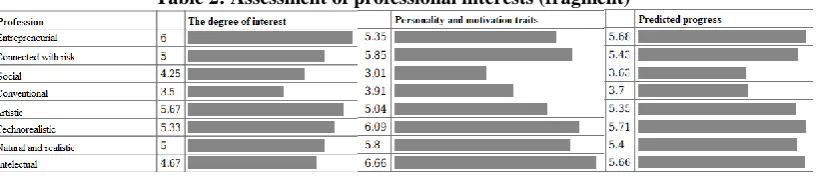
Table 2: Assessment of professional interests (fragment)
In Table 2 it is possible to see a fragment of the assessment of professional interests on the basis of degree of interest, personality and motivational peculiarities and predicted
success [9, 10].
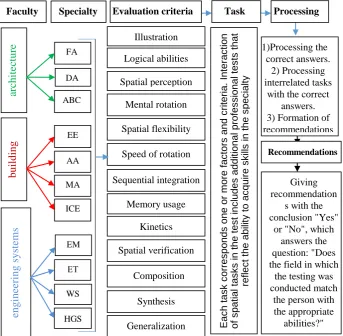
[image:4.595.139.473.487.626.2]The organization of assessment in the relevant industry on the basis of communication with the system is shown in Fig. 3.
Fig.3. Scheme of the introduction of a system for assessing the professional abilities of applicants in the work of educational institutions
The disadvantage of the program "Prospective student" is an inability to clearly identify professional preferences of the individual, taking into account their knowledge and skills, and to recommend specific fields of study and specialties in the future. Obtaining a clear conclusion is hampered by the unclear nature of the recommendations regarding the possibilities of the prospective student in the existing categories of professions (Tab. 2).
Table 3 shows a fragment of the assessment of factors reflecting the structure of the personality [8, 9].
The personality structure is also reflected by factors that may have the same degree of intensity:
- Factors of ability to learn, self-esteem, ambitiousness, innovation, radicalism are estimated "8";
- Factors of emotional senility, self-affirmation are estimated "7";
- Factors of stress resistance,
dreaminess, fantasies,
International Journal of Innovative Technology and Exploring Engineering (IJITEE) ISSN: 2278-3075,Volume-8 Issue-11, September 2019
In various cases, such evaluation results may lead to fuzzy conclusions. That is why, for estimating the person's professional abilities, increasing the efficiency of decision-making, the most successful are fuzzy models as deterministic and stochastic models require accurate, distributed information, which in such cases is usually absent [11, 12].
Modern computer technologies allow not only to evaluate the results of educational games, but also to capture personality characteristics that appear during the game and reflect factors such as spatial awareness, planning process and other factors that are necessary for learning graphic subjects in the educational establishments specializing in building.
Table3. Personality Structure (fragment)
III. SETTINGTHETASK
Providing prospective students with the opportunity to use the distance graphic learning and assessment course with recommendations regarding the choice of a specialty in accordance with the revealed spatial abilities will simplify the task of choosing a profession. The development of a learning and evaluation computer game using game models and methods for the development of spatial awareness based on the games "Monument Valley", "Hitman GO" (Tab. 1) provides an opportunity to evaluate the prospective students’ spatial awareness. However, in order to provide guidance and decision support regarding the choice of a specialty, it is necessary to develop a system of assessment criteria that will reflect the peculiarities and abilities for further education in the chosen specialty in the educational establishments specializing in building.
IV. MATERIALS,METHODSANDSCHEMEOF
FORMATIONOFASSESSMENTOFSPATIAL
AWARENESS The materials for the study are:
- tasks and results of testing the spatial awareness of prospective students and academic performance of students in the corresponding specialties;
- the criteria for assessing the spatial awareness.
For the testing and assessment of spatial abilities of
prospective students when entering Kiev National University of Building and Architecture, a distance graphic learning course "PROSTIR-UA" was developed.
The course "PROSTIR-UA" contains:
- reference information about the specialties of the university;
- tests to determine the level of development of spatial awareness;
- tests of special abilities for the selection of entrants, which reflect requirements to specialists of a certain branch.
The main task of the educational-assessment course is to provide recommendations regarding the choice of the specialty of the university based on the results of the test of the development of the spatial awareness of prospective students, which contains the elements of the game.
The training of spatial attention is performed on the basis of the research [13].
To evaluate abilities, methods of fuzzy mathematics are used. At the same time, it is assumed that the input data of university testing contain information that is presented in a textual form and needs formalization. At this stage, the test results are evaluated by experts from 0 to 100 points. After that, a linguistic variable is set [0; 100] that takes on values "high level", "middle level", "low level", "above average level", "lower than average
To create a scheme for the assessment of spatial abilities, the initial parameter must take a value that reflects the ability to study in a specialty (Fig. 4).
The scheme includes such units: "faculty", "specialty", "evaluation criteria", "task", "processing", "recommendations". Each block contains sub-blocks with a detailed description or explanation of the main functions of the performed tasks with further processing of the received information and the creation of recommendations. The basis for recommending the choice of specialty is the results of the studying of the students obtained during the control of the
quality of education.
[image:6.595.133.477.211.547.2]These results form the training sample of the intellectual decision support system based on the Takagi-Sugeno-Kang fuzzy neural network [14]. The structure and algorithm of learning of the intellectual system, which was developed to answer the question: "Does the field in which the testing was conducted match the person with the appropriate abilities?" are described in detail in [4]. The trained network is able to provide prospective students with recommendations regarding the choice of the field of study.
Fig. 4. A fragment of the scheme for forming the assessment of the spatial abilities of the prospective students: FA - fine arts, DA - decorative art, R - restoration, ABC - architecture of buildings and constructions, UP - urban planning, ED – environmental design, EE – economics of enterprise, AA - accounting and auditing, MA - management and administration, ICE
- industrial and civil engineering, EC - ecology, EM - energy management, ET - environmental technology, WS - water and sanitation, WE – water engineering, HGSV - heat and gas supply and ventilation
V. EXPERIMENT
The experimental part of the work consists in studying the results of the testing of prospective students and students of various specialties of Kiev National University of Building and Architecture.
During the development and selection of basic test tasks, the main attention was paid to:
- three-dimensional tests - 3DW [15]; - differential ability test - DAT [16] - mental rotation test - MRI [17];
- Sensory Organization Test - SOT spatial orientation test [18].
3DW-test (Fig. 5a). Jeder Würfel hat sechs verschiedene
Muster, nur drei davon kann man sehen. Prüfen Sie, ob einer der Würfel A bis F derselbe Würfel sein kann, wie der links gezeigte Würfel X, oder ob die Antwort G „kein Würfel richtig“ zutreffend ist. Sollte eine Aufgabe zu schwierig sein, dann wählen Sie die Antwort H „Ich weiß die Lösung nicht“.
The DAT test (Fig. 5b), the tasks of this test consists of
composed samples with shades or patterns. These complex samples can be compiled into three-dimensional figures. Each task displays a complex sample and four three-dimensional figures.
bui
ldi
ng
ar
chi
tec
tur
e
engi
nee
ri
ng sys
tem
s
FA EM AA MA ICE DA ABC ЕT WS EE Faculty Illustration Logical abilities Spatial perception Mental rotation Spatial flexibilitySpeed of rotation
Sequential integration Memory usage Kinetics Spatial verification Composition Synthesis
Generalization Eac
h t as k c orr es po nd s on e o r mo re f ac tors an d c ri teri a . In terac ti on of s pa ti al ta s k s i n t he te s t i nc lud es ad di ti on al profes s ion al te s ts th at refl ec t th e a bi lity to ac qu ir e s k ill s i n t he s pe c ial ty HGS VV 1)Processing the correct answers. 2) Processing interrelated tasks
with the correct answers. 3) Formation of recommendations
Giving recommendation
s with the conclusion "Yes"
or "No", which answers the question: "Does the field in which
the testing was conducted match
the person with the appropriate
International Journal of Innovative Technology and Exploring Engineering (IJITEE) ISSN: 2278-3075,Volume-8 Issue-11, September 2019
Fig.5. Example of a three-dimensional cube test task
One of the answer options A, B, C, or D must be identified, that is, it can be created on the basis of the build-up sample. Rapid performance of Test 3b indicates a high level of professional qualities such as spatial perception, spatial
flexibility, spatial integration and composition. A prospective student who will receive a high grade of these criteria will be recommended to study at the building faculty. The mental rotation test (MRT), it is given a basic object in this task. The user must select one of the four images that reproduce the given object (Fig. 5c). Using of the checked test tasks provides an opportunity to assess the scientific validity of the assessment of spatial abilities of prospective students. A properly performed test task for mental rotation (Fig. 5c) shows the developed factor of spatial rotation required during the development of systems of water and sanitation in specialty 192 "Building and civil engineering" of the specialization "Water and Sanitation (WS)".
Spatial orientation test (SOT) measures the ability to
imagine the spatial orientations that is required for studying in the "Architecture" field. Each task has the same pattern as the starting point. It is necessary to determine in which direction the third object from this position lies and specify this direction as the number in the picture below during the test (Fig. 6).
Fig.6. Fragment of the task in the differential ability test (DAT)
VI. RESULTSANDDISCUSSION
Obviously, the proposed experimental course "PROSTR-UA" does not solve all the problems of the development of spatial imagination. A number of factors that influence the increase of spatial abilities of the individual are
hor-2 Photo In various cases, decision support involves the use of
appropriate systems, whose work is based on various knowledge bases [19]. The intellectual knowledge is based on the intellectual system that is developed in [8] basis of the formal expert assessments. The usage of the principles of fuzzy mathematics to formalize expert knowledge is described in detail in work [8].
Further researches are planned in the direction of learning the Takagi-Sugeno-Kang Network. The network topology that adapts to the problem-solving of matching of the prospective students’ abilities to the possibility of acquiring knowledge and skills in a particular specialty is shown in [4]. The development of input and formalization of output data for the formation of a fuzzy knowledge base on the system at this stage is left to the specialist of the pre-university training, taking into account the experience of teachers of higher education institutions, qualification requirements for the profile of a specialist and predicted demands of the labor market on basis of the experience of Kiev National University of Building and Architecture.
Also, a good addition to science will be the creation of a modernized spatial specialty course based on the game, which will greatly increase the demand and interest of the product among the students, speed up the tasks and simplify the work of the teaching staff.
VII. CONCLUSIONS
Nowadays the acquiring of a number of professions in the field of building requires a high level of ability to gain knowledge and skills in applied geometry and engineering graphics. In addition, there is an urgent need for the manipulation of spatial graphic images, which is carried out in the context of performing graphic tasks, caused by professional needs and the level of modern graphic techniques. As a result, the need for means of developing spatial awareness increases due to the integration of new automated means of designing and construction of building structures. In addition to its entertainment functions, the gaming industry is a means of activating and improving various human abilities [20], which must be used methodically and purposefully in various training courses related to the development of spatial imagination [21]. Necessity of classification of spatial games that could meet the needs and theoretically substantiate expediency of the use of a specific gaming product in the training courses of technical specialties.A comparative analysis of gaming software products made it possible to evaluate human abilities that facilitate the passage of the game and, in parallel, develop the human capabilities needed in professional activities.
Providing prospective students with the opportunity to use the distance graphic learning course with recommendations regarding choosing a specialty in accordance with the revealed spatial abilities will simplify the task of choosing profession and studying.
REFERENCES
1. Aylaamazyan A.M. The current methods of education and training: business game: Uch. way. d. student, 2005, Moscow State University. 2. Shaffer, D.W., Squire, K.R., Halverson, R., & Gee, J.P. Video games
and the future of learning. Phi Delta Kappan, 2005, 87(2), 104-111
3. Wenher, L.A. Game as activity. Notebook of Psychology. 2008,.№3. 4. Yeremenko, B., Riabchun, Yu., Ploska, A. The introduction of
intellectual system for evaluating professional abilities of applicants into the activities of educational institutions. Technology audit and production reserves. 2018, № 6/2(44). P. 22–26.
5. Viktoria Honta. Algorithmization tests development Algorithmization tests development orithmization tests development of spatial imagination. Motrol. Commission of motorization and energetics in agriculture, 2015, Vol.17, No. 8, 61-66
6. Makalaty A.G. Motivation in computer games. 3rd Russian Conference on Environmental Psychologists. Moscow, September 15-17, 2003: Thesis. - M. p.358-361.
7. Plass, J. L., Perlin, K., Nordlinger, J., Isbister, K. Research on design patterns for effective educational games. In Game Developers Conference. (2010, March 9-13). San Francisco, CA. Retrieved from. 8. Yeremenko, B.M., Riabchun, Y.V., Pashko, A.O., Ploska, H.V.
Development of an intellectual system for assessing the professional abilities of applicants. Building, material science, mechanical engineering. Edition 101/2018. P. 215-222.
9. Available at: http://cleverdia.com/index.php?lang=uk 10. Available at: https://studopedia.org/10-65554.html
11. Tsidylo, I.M.. Model of fuzzy expert system of forecasting the content of education. Information technology and teaching aids. 2012, №6(32). 12. Blum, C., Puchinger J., Raid, J.R., Roli A. Hybrid metaheuristics in
combinatorial optimization: A survey. Applied Soft Computing. 2011 – 11, 6. – P. 4135-4151.
13. Hegarty, M., Waller, D. A dissociation between mental rotation and perspective-taking spatial abilities. In Intelligence, 2004, 32, 175-191. 14. Tanaka, K., Yoshida, H, Ohtake, H., & Wang, H. O. A sum-of-squares approach to modeling and control of nonlinear dynamical systems with polynomial fuzzy systems. IEEE Transactions on Fuzzy systems, 2009, 17(4), 911-922
15. Hegarty, M., Waller, D. Shah, P., Miyake, A.Individual differences in spatial abilities. The Cambridge Handbook of Visuospatial Thinking, Cambridge: Cambridge University Press, 2005, 121-169.
16. Gittler, G. Entwicklung und Erprobung eines neuen Testinstruments zur Messung des räumlichen Vorstellungsvermögens. In Zeitschrift für Differentielle und Diagnostische Psychologie, 1984, 2, 141-165. 17. Bennett, G. K., Seashore, H. G., Wesman, A. G. Differential aptitude
tests, forms. S and T. New York: 1973, The Psychological Corporation 18. Peters, M., Laeng, B., Latham, K., Jackson, M., Zaiyouna, R.,
Richardson, C. A Redrawn Vandenberg & Kuse Mental Rotations Test: Different Versions and Factors that affect Performance. In Brain and Cognition, 1995, 28, 39-58.
19. Lytvyn, V.V., Lenko, V. S., Pasichnyk, V.V., Shcherbyna, Y.M. Knowledge representation MODELS. Visnyk Natsionalnoho universytetu "Lvivska politekhnika". Serie: Kompiuterni nauky ta informatsiini tekhnolohii. Lviv: Vydavnytstvo Lvivskoi politekhniky, 2017, No 864. P. 157–168.
20. Burlakov I.V. Psychology of computer games. M.: Independent firm "Class", 2000, 223 p.
21. Kolyada M.G. Scientific works of DonNTU. Series: "Pedagogy, Psychology and Sociology." 2013, No. 2 (14).
AUTHORSPROFILE
Yuliia Riabchun, Kiev National University of Construction and Architecture, graduate student, department of information technology design and applied mathematics. Research interests: identification of abilities, assessment criteria, spatial imagination
International Journal of Innovative Technology and Exploring Engineering (IJITEE) ISSN: 2278-3075,Volume-8 Issue-11, September 2019
Author-3 Photo
Victoria Honta, Kiev National University of Construction and Architecture, graduate student, department of information technology design and applied mathematics. Research interests: identification of abilities, assessment criteria, spatial imagination
Khrystyna Chupryna, Kyiv National University of Construction and Architecture, PhD in Computer Science, Associate Professor, Department of Construction Management. She has published many research papers in national, international journals and conferences. She takes part in the innovative project “Energy-efficient schools: new generation” which is an educational project on energy efficiency in Ukraine. Scientific interests: Computer Aided Design, Building Information Modeling, energy-saving technologies in construction, digital economy.