Abstract: The work presented in this paper aims at applying a new complementary computer methodology to the teaching of chemical science including the use of a virtual environment laboratory that has an alternative value for the simulation of practical experiments in chemistry. This study is based on two axes, the first deals with the implementation of a laboratory for simulation that helps to carry out various practical work of chemistry. The second axis aims to demonstrate the pedagogical impact of the use of virtual learning environments on the teaching-learning process in the university curriculum. To study the necessity and the feasibility of this technological tool we took as a case study the exploitation of the periodic table in the descriptive chemistry and the practical works of chemical kinetics. In this article we used a strategic methodology to meet the validation constraints of our computer tool thenwe conducted a qualitative study on a sample of students from the Physical Chemistry of Materials Laboratory at the Ben M'sik Faculty of Science to identify the didactical factors influencing the progress of the practical work using our computer solution.
Keywords: Chemistry, Practical works, Simulation, Virtual Reality
I. INTRODUCTION
In experimental science didactics a new strategy based on emerging technologies in education has been used in recent years to provide the necessary educational resources to create an intuitive environment, the goal of which is to increase students' cognitive engagement through educational software,
Revised Manuscript Received on September 06, 2019
* Correspondence Author
Jabran Daaif*, Laboratory of Physical Chemistry of Materials, Faculty of Sciences Ben M’sik, Hassan II University of Casablanca, BP 5366 Maarif, Casablanca, Morroco.
Siham Zain, Gids-se ENS, Lapstice Faculté des sciences Ben M’sik, Casablanca, Morroco.
Soufiane Zerraf, Laboratory of Physical Chemistry of Materials, Faculty of Sciences Ben M’sik, Hassan II University of Casablanca, BP 5366 Maarif, Casablanca, Morroco.
Malika Tridane, Laboratory of Physical Chemistry of Materials, Faculty of Sciences Ben M’sik, Hassan II University of Casablanca, BP 5366 Maarif, Casablanca, Morroco. Regional Center of Education and Formation in Professions. Boulevard Bir-Anzarane Anfa, Casablanca Morroco. Abderrahim Khyati, Gids-se ENS, Lapstice Faculté des sciences Ben M’sik, Casablanca, Morroco.
Said Benmokhtar, Laboratory of Physical Chemistry of Materials, Faculty of Sciences Ben M’sik, Hassan II University of Casablanca, BP 5366 Maarif, Casablanca, Morroco.
Said Belaaouad, Laboratory of Physical Chemistry of Materials, Faculty of Sciences Ben M’sik, Hassan II University of Casablanca, BP 5366 Maarif, Casablanca, Morroco.
Such as modeling and simulation software in the form of virtual laboratories developed as software and computer applications to make the human-machine interaction more enjoyable and productive from a pedagogical point of view.
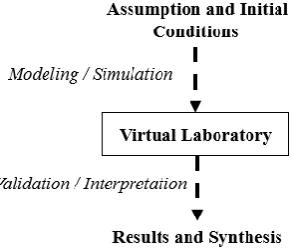
[image:1.595.358.505.412.537.2]In chemistry, experiments carried out in a virtual environment lab are used to familiarize students with the procedures and the techniques of scientific phenomena to adapt to the basic laboratory, in order to conduct similar or identical experiments in real chemical manipulations, of which the objective is to acquire the necessary skills to manipulate, record, interpret the results and write the reports [1]. The following figure shows the process of simulating a real system from the initial hypothesis to the results and syntheses:
Fig. 1. Simulation process of a real experiment using the virtual laboratory
Researchers and experts in the field of education have found that educational software can create simulation platforms based on the virtual reality principle that are more efficient and able to set up a set of practical constructs that allow interactive learning [2]. The Moroccan university no longer escapes this technological progress and begins to adopt new complementary educational strategies in the experimental sciences generally and in the chemical sciences more precisely.
The present work concerns the chemical sciences and the pedagogical use of computer applications that offer the necessary resources to realize different experiments and manipulations in a virtual environment laboratory which presents itself as a pedagogical tool complementary to the
understanding and
interpretation of results of practical work in the real
Progress of Digital Learning Resources:
Development and Pedagogical Integration of a
Virtual Environment Laboratory for the Practical
Experiments in Chemistry
laboratory by addressing different problems and didactic constraints such as simplicity, adaptability and the necessary resources (software, financing, materials, ...). We took as a case study the exploitation of the periodic table in the descriptive chemistry and practical work of chemical kinetics using the probabilistic method of Monte-Carlo.
II. OVERVIEWANDSTRATEGY
A. Practical work and didactic principles
Experimental teaching, based on practical laboratory work, confirms the theoretical knowledge studied in the course sessions, implements the practical skills of the students, fosters their enthusiasm for scientific discovery and trains the students' integrated capacity for solving the problems. Today, at universities, students can study chemical phenomena using data collection tools and techniques, models and scientific theories in physical laboratories that support interactions with the material world or in laboratories that present a virtual environment.
Through computer simulation experiments, students can learn the use of chemical instruments, process operations and experimental phenomena; they can record the results automatically and obtain conclusions as well. This mode of experimentation is very similar and easy to use from a pedagogical point of view, because it allows to provide educational material, which gives us access to use several tools and multimedia editors such as graphical interfaces that facilitate the visualization of elements and chemicals such as HTML, CSS, which are available to create tutorials for practical work [3].
B. Modeling and simulation software
Technology-assisted teaching is of great benefit to learners at the pedagogical level, so students always have access to a great deal of information that constitutes their knowledge and attitudes to achieve the goals of the scientific subject [4].
1. Educational necessity
In the teaching of chemical experiments, simulator software makes it possible to validate different chemical hypotheses and to overcome various obstacles to education and teaching difficulties; obstacles of abstract thought (imagination of elements and chemical products), obstacles of logical thought (comprehension and analysis of chemical reactions) and obstacles at the level of the communication of information (sharing of results and syntheses).
Since their existence virtual laboratories with virtual components provide the necessary teaching materials with which students can interact to guarantee real experiences [5], without any risk for the user or the equipment. Our goal in this work is to adopt a new teaching mode for chemical experiments, to improve the experimental equipment and the conditions of reaction and use of chemicals, to save a lot of time and to reduce the damage done to people and pollution of the environment.
The idea of creating and integrating a laboratory for simulations of the practical works of different modules of chemistry is a complementary teaching approach that respects the didactic norms of the subject and offers a new environment that allows:
Visualization of chemical elements and different structures in space;
Identification of the parameters and characteristics of
different chemical reactions and their interpretations;
The representation of data in different formats;
Scientific discussion and argumentation.
2. Integration and exploitation
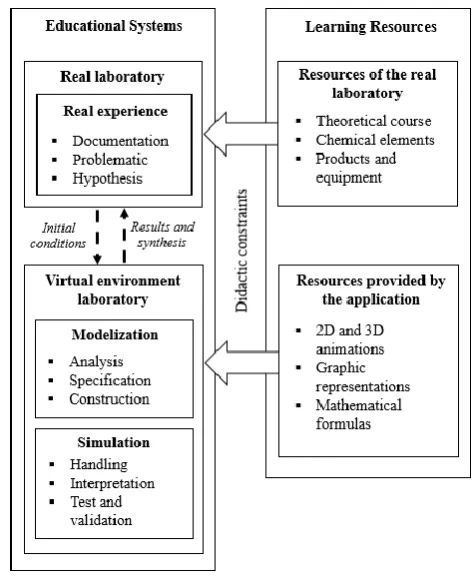
Real experiments are modeled using different two-dimensional and three-dimensional analysis, specification, and construction techniques so that each student can interact with all virtual lab equipment in a manner similar to actual labs, which offers a simulation environment for manipulating, interpreting and validating chemical experiments while respecting the didactic constraints of the taught module in order to communicate the results with the teacher.
[image:2.595.316.553.245.535.2]The following figure shows the integration of different learning resources in the real lab and the virtual environment:
Fig. 2. Learning resources for the real laboratory and for the laboratory with a virtual environment
III. PRACTICALEXPERIENCESINDESCRIPTIVE
CHEMISTRYANDCHEMICALKINETICS
A. Periodic classification of elements
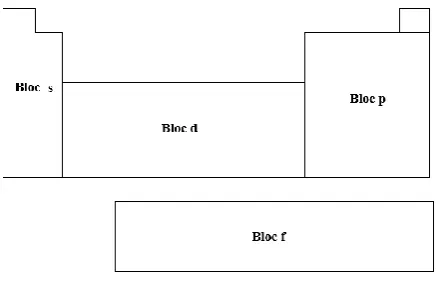
Descriptive chemistry studies the physico-chemical properties of the main chemical elements of the s, p, d and f blocks and their periodic classification (Figure 3) as well as their derivatives: hydrogen, compounds of hydrogen (hydrides), oxygen, sulfur, alkalis, halogens, nitrogen, phosphorus, carbon.
Fig. 3. Modern periodic classification
The manipulations of the practical works of the descriptive chemistry are prepared by the professors of the department of chemistry of the faculty of sciences Ben M'sik, they are intended for the students of the third semester (S3) of the first cycle of chemistry.
The purpose of this lab is to study:
The properties of blocks s, p, d and f of the periodic table;
The constitution, preparation, physical and chemical properties of hydrogen (its reactivity and its hydrogenated compounds);
The chemical reactivity of oxygen, oxides and their classification, peroxides and superoxides, methods of preparation of oxides and crystalline structure of ionic oxides;
Properties and oxides of phosphorus, oxyacids, study of phosphoric acid and phosphates and their classification;
Nitrogen oxidation levels, nitric acid, some generalities of the chlorine element and gaseous chlorine;
The physical and chemical properties of water;
Silicon, titanium, carbon, sulfur, alkalis and halogens. The virtual laboratory developed within this work provides graphical interfaces that contain all the necessary tools to locate in the table, the families described above as well as the list of elements of each family.
B. Estimation of kinetic parameters for chemical reactions
The fundamental laws of chemical kinetics make it possible to determine the speed proper to a chemical reaction and to know the order of such a reaction (order 1 or order 2). The objective of the practical works of the chemical kinetics is the study of the evolution with respect to the time of the chemical systems and the speed of the various reactions, car, during a chemical reaction, the transition from an initial state to a final state is not done instantly.
In a chemical reaction between two reagents A and B:
which give two products C and D, the speed of a simple reaction is given by:
(1)
- are the partial orders with respect to A and B
- represents the overall order of the reaction - is the kinetic constant.
The manipulations proposed in the practical works of chemical kinetics are prepared by a group of professors of the laboratory of physical chemistry of materials at the faculty of sciences Ben M'sik and they are intended for the students of
the fifth semester (S5) enrolled in the department of chemistry.
The goal of these manipulations is to use the Monte-Carlo method, which proposes solving the problem of chemical kinetics without resorting to calculations based on the randomness of the reaction at the microscopic (elementary) level. , according to the models proposed in the practical experiments: reaction of order 1: and reaction of order 2: . This method considers the analogy between the probability that an effective shock occurs in a real reaction medium and the probability that two elements will be selected simultaneously from a large number of other elements during a draw.
For a reaction of order 1, it is considered that there is an effective reaction when during a drawing of a single element only the reagent is extracted. We shoot an element in a first draw and we replace it with a second element, we do after a finite number of prints. In the case where an element A has been extracted, it is considered that the reaction occurs; the element is then replaced by the product of the reaction, that is an element B, before the next draw is made. In the opposite case, we replace the element drawn.
In the second case it is considered that a constant time interval flows between two successive draws, and by taking the number of prints made, we will have a representation of the evolution of the concentrations of the different products as a function of time.
The final result obtained after a theoretical demonstration is:
(2)
-
represent the initial
concentrations
Our computer tool allows students to calculate velocities and determine the orders of reactions of different manipulations of chemical kinetics.
IV. METHODOLOGY
A. Analysis and specification
Our goal is to develop a computer application presenting a virtual environment laboratory that operates according to a client-server architecture that will be specified later for a pedagogical use to carry out the practical works defined above.
The application allows to create a periodic table according to the classification of Mendeleev [6] for the modeling of different chemical elements (element name, atomic number, chemical symbol) to identify their physicochemical properties (properties of the blocks, p, d and f) by answering the questions presented by the application to generate files representing the results for each student after authentication to access the system.
The steps to follow to perform the various manipulations after authentication according to the two previously defined models (orders 1 and 2) are explained in the following figures:
[image:4.595.52.270.110.338.2]Fig. 4. Manipulation of the first model (order 1)
Fig. 5. Manipulation of the second model (order 2)
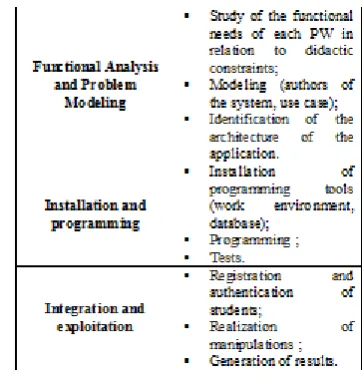
B. Software architecture and computer instruments The design of an educational program is a process that aims to formalize all the steps of the problem specification, programming and integration of the solution, in order to make the development more faithful to the needs of the users
The design of the application developed within this work has followed three major phases:
Table- I: Design phase of the simulation application
[image:4.595.360.511.301.546.2]The architecture of our application is based on a client-server environment, and it is divided into three layers:
Fig. 6. Software architecture of the application
The presentation layer modeled by a set of graphical "WinForms" interfaces that are included in the .NET framework. The second tier is the business layer that ensures the communication between the lowest and highest layer, developed by C # included in the Visual Studio environment. The third layer of this architecture is the persistence layer which provides access to the database created and managed by Oracle using SqlServer which is a database management system in SQL language including among others a RDBMS developed and marketed by the Microsoft company.
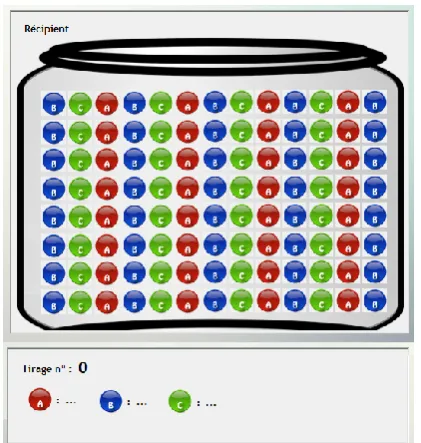
[image:4.595.61.289.370.614.2]Fig. 7. Container filled with elements and their numbers
Fig. 8. Math formula calculated by the system
V. RESULTSANDDISCUSSION
The evaluation process for the use of the virtual environment laboratory developed in this work consists of selecting a sample of SMC students enrolled in the second year of the Ben M'sik Faculty of Science to perform different manipulations in order to capture the impact of this new tool as well as the perceptions of teachers.
A. Evaluation and experience
After authentication to the system, it is proposed for S3 students in a first page to create a new periodic table of chemical elements in order to classify them according to Mendeleev's classification. Students were able to participate in answering a questionnaire that deals with:
The families to which the different chemical elements belong;
Electronic layers;
The atomic masses;
The number of electrons and protons.
The procedure to perform a simulation of order 1: is defined as follows:
1)Place 70 elements of type A;
2)Make 70 prints;
3)Plot the simulated concentration curve as a function of time;
4)Save the PDF file containing the results (the curve) to conclude.
To perform a second-order reaction simulation:
students followed the following procedure:
1)Fill the container displayed on the first page with 70 type A and 70 type B elements;
2)Make the first draw:
- If the displayed result is 2A or 2B put the two elements back into the container;
- If the result is an element A and an element B replace the two elements A and B by two elements C which must be put back in the container.
3)Proceed in the same way during 70 draws;
4)The number of elements A and B and the number of elements C obtained is automatically recorded in a table according to the printing number;
5)The mathematical formula which makes it possible to make the change of variable on the number of marbles and on the time is computed and is recorded;
6)plot the curves representing the concentrations of the chemical elements as a function of time;
7)Save the PDF file that represents the results found in order to interpret them.
B. Student interaction and teacher perceptions We were able to collect the results of various manipulations written in the form of reports to record the student experiment data and process it to analyze the pedagogical effect of different virtual experiments.
We selected a sample of 250 students (S3 and S4) and 4 chemistry teachers to interview and establish a survey of the experimental practice of our virtual laboratory, with the aim of describing the comparison between the old methods and the modern method, who uses our educational computer solution. The statistics collected gave that almost 90% of the students who used the virtual laboratory to do the various practical works gained more than one third of the overall time of the session, which allowed to benefit from the remaining time by communicating the results with the teacher and other groups of students.
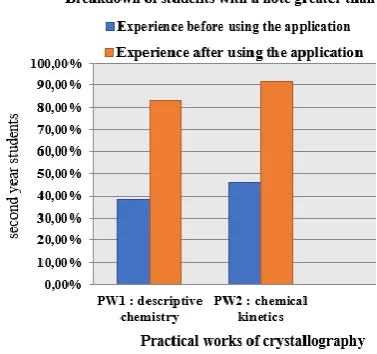
A percentage of 87.32% of the students could have a favorable note higher than 15/20 at the level of the reports. The following diagram shows the distribution of students according to the two experimental modalities:
Table- II: Total number of students scoring above and below 15/20
Students with a note greater than 15/20
Students with a note below 15/20 Number of
students 218 32
Fig. 9. Distribution of students before and after using the virtual laboratory
The perceptions of teachers were benevolent, they mentioned that the integration of such a computer tool is beneficial and beneficial to the educational level since the majority of students according to the survey have really tried to interact with the practical work of the chemistry, and argue the results.
From the didactic point of view of the experimental sciences this new method could:
Improve the learning process;
Simulate practical experiences to formulate and understand scientific problems and situations;
Interpret the results more effectively;
Make use and manage time more efficiently;
Facilitate mathematical calculation in the teaching of chemical phenomena.
VI. CONCLUSION
This study focuses on the incorporation of educational software into chemistry teaching in order to optimize teaching practices in a didactic context. The objective was to develop and integrate a virtual environment laboratory using a computer application developed for educational use thanks to a graphic platform suitable for various practical work in the laboratory of physical chemistry of materials at the faculty Ben M'sik Science. The results were benevolent to improve the learning process, to simulate practical experiences to formulate and understand scientific problems and situations, and to make more efficient use and management of time, this thanks to the algorithm used in an educational context.
In summary, the use of such a virtual laboratory was advantageous which can lead us to develop other modeling and simulation applications of practical work in future studies.
ACKNOWLEDGMENT
This work was made possible and possible thanks to all the staff of the Laboratory of Physical Chemistry of Materials and the Department of Chemistry within the Faculty of Sciences Ben M'sik who ensured the operation and maintenance of our software educative.
The authors therefore thank the teachers and
administrative officers of the chemistry department for their financial support for the adoption of this new teaching tool for the development of learning resources at the faculty.
REFERENCES
1. Barney Dalgarno, Andrea Bishop and Danny Bedgood, “The potential of virtual laboratories for distance science education teaching: reflections from the initial development and evaluation of a virtual chemistry laboratory”, Proceedings of the Improving Learning Outcomes Through Flexible Science Teaching, Symposium, The University of Sydney, October 3, 2003, pp. 90-95.
2. Christian M. Stracke, Esther Tan, António Moreira Texeira, Maria do Carmo Texeira Pinto, Bill Vassiliadis, Achilles Kameas, Cleo Sgouropoulou. Gap between MOOC designers' and MOOC learners' perspectives on interaction and experiences in MOOCs: Findings from the Global MOOC Quality Survey. 2018 IEEE 18th International Conference on Advanced Learning Technologies.
3. H. J. W. Spoedler, Virtual instruments and virtual environments, IEEE Instrum Meas Mag 2 (1999), 1419
4. Stracke, C. M. (2017a). The Quality of MOOCs: How to improve the design of open education and online courses for learners? Proc. 4th International Conference, Learning and Collaboration Technologies (HCII 2017).
5. Report of project on virtual laboratoty. “Virtual laboratory for Gas and Petroleum Engineering”, School of Geology and Petroleum Engineering wirh cooperation of School of Power Engineering, December, 2010.
AUTHORS PROFILE
Jabran Daaif, PhD student researcher in engineering education and didactics of science and technology and member of the association of scientific research and doctoral studies in Morocco. I am working on the computerization of physics-chemistry practical work and the development and pedagogical integration of simulation and modeling software. I participated in national and international conferences and conferences in education and computer science and new technologies.
Siham Zain, PhD student researcher at Gids-se ENS, Lapstice Faculty of Sciences Ben M'sik Casablanca. I attended scientific conferences in Moroccan and foreign universities in the field of didactics and sciences of education
Soufiane Zerraf, PhD student researcher at the physico-chemistry of materials laboratory, I participated in scientific congresses in Moroccan and foreign universities. I studied the physicochemical properties of condensed phosphates and also the didactics of science and technology. I worked as a contract teacher at the Ben M'sik Faculty of Science.
Said Benmokhtar, Research professor at Hassan II University of Casablanca, Ben M'Sik Faculty of Sciences. Very strong skills in X -ray Diffraction, Crystal Chemistry, Crystallography on powder. Competent in Rietveld method for structural
refinements (in-house X-ray and neutron data).
* Raman and Infrared Spectroscopies, and Factor group analysis.
Malika Tridane, Professor at the Regional Center for Education and Training of the Casablanca Region (CRMEF) · Physics Chemistry teacher researcher in education and didactics.