Int. J. Electrochem. Sci., 10 (2015) 2921 - 2930
International Journal of
ELECTROCHEMICAL
SCIENCE
www.electrochemsci.org
Effect of Ionic Liquid on the Performance of Li-O
2Cell with
LiTFSI in TEGDME Electrolyte
Jae-Seok Kim, Eunsaem Ahn, and Yongsug Tak*
Department of Chemical Engineering, Inha University, 253 Yonghyun-dong, Nam-ku, Incheon 402-751,Republic of Korea.
*
E-mail: [email protected]
Received: 30 December 2014 / Accepted: 3 February 2015 / Published: 24 February 2015
Effect of ionic liquids, 1-ethyl-3-methylimidazolium bis(trifluoromethylsulfonyl)imide (EMITFSI) and 1-butyl-2,3-dimethylimidazolium bis(trifluoromethanesulfonyl)imide (BDMITFSI), on the Li-O2 cell
performance was investigated by mixing ionic liquids with LiTFSI in TEGDME electrolyte at a specific volume ratio. Addition of ionic liquids improved the discharge/charge cycleability and optimum mixing ratio of LiTFSI in TEGDME to ionic liquid was 9 to 1. EMITFSI and BDMITFSI ionic liquids reduced the overpotential of oxygen evolution reaction occurred during charging process and BDMITFSI is more effective than EMITFSI. Successive linear sweep voltammetry is in agreement with the observed discharge/charge cycleability.
Keywords: Li-air battery, ionic liquid, Tetraethylene glycol dimethyl ether(TEGDME), 1-ethyl-3-methylimidazolium bis(trifluoromethylsulfonyl)imide(EMITFSI), 1-butyl-2,3-di1-ethyl-3-methylimidazolium bis(trifluoromethanesulfonyl)imide(BDMITFSI),
1. INTRODUCTION
Li-air rechargeable battery has drawn a significant attraction as a high energy storage device for electric vehicles (EVs) and hybrid electric vehicles (HEVs) due to their large theoretical energy density. [1-2] However, practical Li-air battery systems have many technical difficulties such as a high overpotential during charging and discharging, [1,3-4] and decomposition of electrolytes, which resulted in poor cycleability and low efficiency of the cell. It has been known that characteristics of both oxygen reduction reaction [ORR] during discharging and oxygen evolution reaction [OER] during charging are affected by the kinds of Li salt and solvent. In the presence of strong Lewis-acid, Li+, reaction intermediate O2- during ORR forms insoluble discharge products, Li2O and Li2O2, which
oxides are remained onto air cathode and finally deteriorate the activity of cathode. Aforementioned reaction characteristics required the optimization of electrolyte composition.
Recently, strong Lewis-base solvent dimethyl sulfoxide (DMSO) and tetraethylene glycol dimethyl ether (TEGDME) were used as a solvent because they can mitigate the acidity of Li+ and enhance the reversibility of ORR and OER. [7-8] As a Li salt, lithium bis(trifluoromethanesulfonyl)imide (LiTFSI) was suggested as an alternative because of its high electrochemical stability and hydrophobicity. Hydrophobic ionic liquids can be used as an ingredient to electrolyte since they have high conductivity, low flammability and volatility, wide potential range and operating temperature range, and high thermal stability. [1,9-12] However, ionic conductivity, diffusion coefficient of oxygen and oxygen solubility in ionic liquids are lower than those of organic electrolytes because ionic liquids have higher viscosity. [13]
In this work, we prepared mixed electrolytes with 1M LiTFSI in TEGDME and ionic liquid for Li-air batteries to take synergetic effect of electrochemical stability and cycle performance. Based on physicochemical properties, two different ionic liquids, 1-ethyl-3-methylimidazolium bis(trifluoromethylsulfonyl)imide (EMITFSI) and 1-butyl-2,3-dimethylimidazolium bis(trifluoromethanesulfonyl)imide (BDMITFSI), were selected and mixed with LiTFSI in TEGDME solvent at a specific volume ratio. Performance of Li-air cell with different electrolyte compositions was investigated with discharging and charging behaviors and linear sweep voltammetry.
2. EXPERIMENTAL
Lithium air battery for electrochemical analysis was based on a Swagelok-type Teflon container, similar to the one reported by Beattie et al. [14]. Cell was assembled in argon-filled glove box in which the moisture and oxygen concentration were less than 1ppm. Swagelok type lithium air cell is composed of a lithium metal anode (Sigma Aldrich, 0.38mm), LiTFSI as Li salt with TEGDME solvent impregnated into a glass fiber separator (Whatman, GF/B), and a porous carbon air-cathode. Ionic liquids such as EMITFSI, BDMITFSI are mixed with 1M LiTFSI in TEGDME solution at a specific ratio of 9:1 and 8:2.
Air-cathode was formed by casting the mixture of Ketjen black (EC600JD, Akzo Nobel, ~1420m2//g) and poly vinylidene fluoride as binder (Alfa Aesar) with a weight ratio (7:2:1) onto carbon sheet (GDL, 10BC) current collector by spray method. Then, the air-cathode was dried at 60℃ for 6 hours.
[image:3.596.110.464.132.406.2]
3. RESULTS AND DISCUSSION
Figure 1. Discharge and charge profiles of Li-O2 cell at 0.2 mA/cm2 at room temperature. electrolyte:
1M LiTFSI in TEGDME
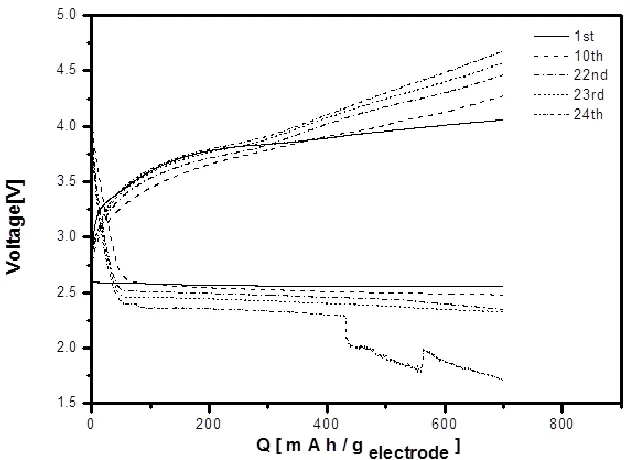
Figure 1 shows the discharge/charge cycles of Li-O2 cell at 0.2 mA/cm2 with 1M LiTFSI in
TEGDME. Capacities are expressed as per gram of carbon in the electrode and cycling was achieved with a limited capacity of 700 mAh/g. Discharge potential was maintained at 2.5~2.6V for 16cycles but dropped to 1.7V at 17th discharge cycle. After 10th cycle, discharging potential started to decrease and charging potential increased. After a sudden drop of discharge potential, the following charge potential increased rapidly over 5.0V, which indicated the death of the cell. Since electrolyte composition affects significantly the stability of the cell during cycling, ionic liquid (IL), which has a high thermal and electrochemical stability, was employed to improve cycleability and cell efficiency. It has been reported that EMITFSI IL has a good stability at highly anodic potentials up to 5.3V vs Li/Li+ and BDMITFSI IL has a lower viscosity and better thermal stability than EMITFSI IL.[10,16] Instead of TEGDME solvent, EMITFSI and BDMITFSI were mixed with 0.5M LiTFSI salt and tested as an electrolyte for Li-O2 cell. Figure 2 illustrates the 2nd discharge-charge cycle of the cell with IL
Figure 2. 2nd charge-discharge profiles of Li-O2 cell with different electrolytes at 0.2 mA/cm2 at room
[image:4.596.116.465.99.369.2]temperature.
Figure 3. Discharge and charge profiles of Li-O2 cell with the addition of EMITFSI at 0.2 mA/cm2 at
[image:4.596.128.443.451.681.2]
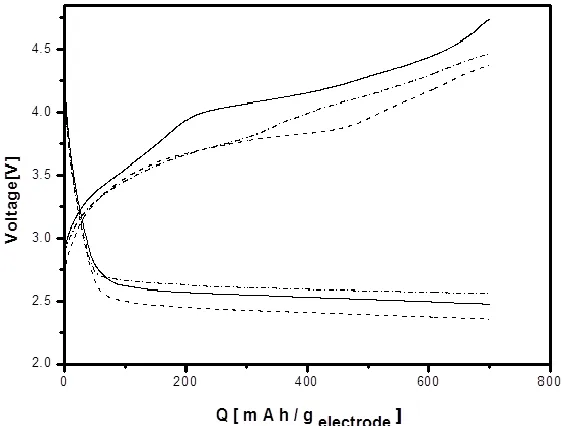
In order to utilize chemical stability of IL, 1M LiTFSI in TEGDME was mixed with EMITFSI at a specific volume ratio. With the 9:1 mixed electrolyte, i.e., 1M LiTFSI in TEGDME:EMITFSI=9:1, Figure 3 indicated that EMITFSI addition brought the significant reduction of overpotential during charging and prolonged cycling behaviors from 16 to 24. As the number of cycle increases, charge potential increases and discharge potential decreases, which reflects the presence of irreversibility accumulated during cycling. Addition of ionic liquid in the form of EMITFSI may be responsible for the facile dissociation during charging.[2] Increase of the EMITFSI from 9:1 to 8:2 lowered ORR overpotential, as shown in Figure 4 and this behavior can be attributed to higher conductivity of IL mixed electrolyte.[1] However, only 17 stable cyclings were obtained before the discharge potential fell below 2.0V and it may suggest that the certain amount of TEGDME solvent are needed to keep from the attack of superoxide O2-.[15]
Figure 4. 15th Discharge and charge profiles of Li-O2 cell with the addition of EMITFSI at 0.2
mA/cm2 at room temperature. base electrolyte: 1M LiTFSI in TEGDME ( ) . mixing ratio of base electrolyte to EMITFSI in volume was varied from 9:1( ) to 8:2( ) .
Table 1. Number of discharge/charge cycles before the discharge voltage falls below 2.0 V. Either EMITFSI or BDMITFSI was mixed with 1M LiTFSI in TEGDME at a specific volume ratio.
Electrolyte
1M LiTFSI + TEGDME
EMITFSI BDMITFSI
9 : 1 * 8 : 2 * 9 : 1 * 8 : 2 * Number of
cycles 16 23 17 28 23
[image:5.596.152.433.284.497.2] [image:5.596.112.480.634.733.2]
As another ionic liquid cation, BDMI+ is considered due to low reduction ability and thermal stability. Electrolyte was prepared by mixing 1M LiTFSI in TEGDME with BDMITFSI IL at a ratio of 9:1 and 8:2.
Table 1 summarizes the number of discharge/charge cycle before the discharge voltage falls below 2.0V for mixed electrolytes. BDMITFSI mixed electrolyte shows more stable charging voltage than EMITFSI mixed electrolyte and the mixing ratio of 9 to 1 recorded the highest cycling number of 28.
Figure 5. 15th Discharge and charge profiles of Li-O2 cell with the addition of BDMITFSI at 0.2
mA/cm2 at room temperature. base electrolyte: 1M LiTFSI in TEGDME ( ) . mixing ratio of base electrolyte to BDMITFSI in volume was varied from 9:1( ) to 8:2 ( ) .
[image:6.596.161.427.212.415.2] [image:6.596.131.436.491.711.2]
B Figure 6. Terminal (a) discharging voltage and (b) charging voltage of Li-O2 cell according to
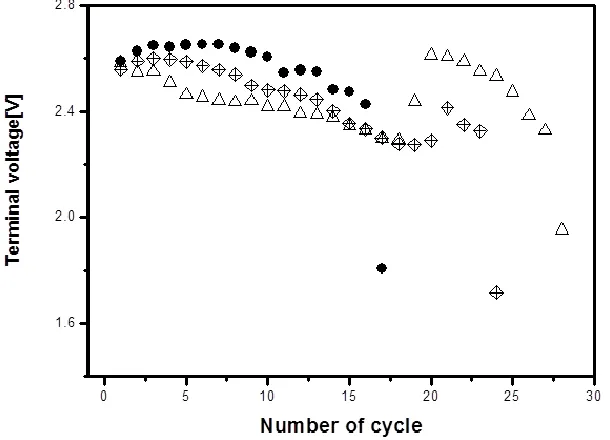
different electrolyte at 0.2 mA/cm2 at room temperature. base electrolyte: 1M LiTFSI in TEGDME( ), Ionic liquid: BDMITFSI( ), : EMITFSI ( ). mixing ratio of base electrolyte to different ionic liquids in volume, 9:1.
Figure 5 shows the 15th cycle for different mixing ratio and compares them with 1M LiTFSI in TEGDME only. Although the discharging voltage is slightly lower for mixed electrolyte, more stable and longer cycle life can be directly related with the improvement of reversibility during charging process by BDMITFSI IL. However, increase of the BDMITFSI amount overshadowed this effect by reducing the role of TEGDME solvent, as explained in the addition of EMITFSI. Figure 6(a) and 6(b) indicate the terminal voltages during discharging and charging for different mixing electrolytes. Although discharging voltage is slightly low, charging voltage is significantly lower for entire cyclings, which suggests the low overpotential for the oxygen evolution reaction during charging process.
Gradual or sudden potential drop below 2.0V can be interpreted as the death of Li-O2 cell. In
[image:7.596.106.455.99.364.2]
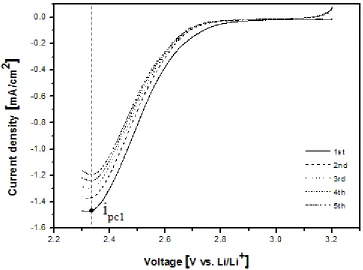
Figure 7. Successive linear sweep voltammetry of air cathode at 20 mV/s in a mixed electrolyte of base electrolyte and EMITFSI. base electrolyte: 1M LiTFSI in TEGDME. mixing ratio of base electrolyte to EMITFSI in volume, 9:1. rotation speed: 1600 rpm.
[image:8.596.118.475.79.348.2] [image:8.596.121.484.436.706.2]
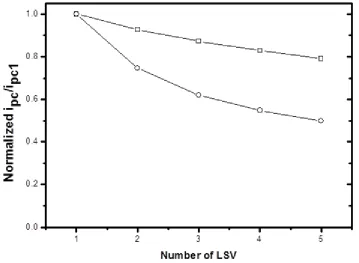
Figure 7 and 8 indicated that first cathodic cycle from 3.2V to 2.3V vs. Li/Li+ showed highest current when either EMITFSI or BDMITFSI is individually added in 1M LiTFSI in TEGDME. With the increase of LSV iterations, cathodic current decreases because of the reduction of effective cathode surface area for oxygen reduction reaction. On the other hand, small anodic currents above 3.1V arise by oxygen evolution reaction, which is the partial dissociation of discharge products formed during previous potential scan. This anodic current does not appear at the first LSV. In order to quantify the active surface area reduction, peak current density, ipc, was normalized based on the first peak current,
ipc1 and the variation of ipc/ipc1 is plotted in Figure 9.
Figure 9. Normalized peak current ratio (ipc/ipc1) with the progress of linear sweep voltammetry in
Figure 7 and 8. base electrolyte: 1M LiTFSI in TEGDME, ionic liquid: BDMITFSI (□), EMITFSI (○ ). mixing ratio of base electrolyte to different ionic liquids in volume, 9:1.
For EMITFSI mixed electrolyte, fading of ipc/ipc1 takes place rapidly and its value reduces to
0.5 within 5 runs of LSV, which suggests that 50% of active surface turns into inactive. However, ipc/ipc1 for BDMITFSI mixed electrolyte fades slowly and reaches 0.8 after 5 runs of LSV. 80% of
initial active surface area remains still active. It coincides with the observations that discharge/charge cycleability with BDMITFSI is better than EMITFSI.
4. CONCLUSION
In order to improve the discharge/charge cycleabilty of Li-O2 battery, versatile compositions of
BDMITFSI. EMITFSI and BDMITFSI were mixed with LiTFSI in TEGDME electrolyte at a specific volume ratio. Ionic liquids improved the discharge/charge cycleability and optimum mixing ratio of LiTFSI in TEGDME to ionic liquid was 9 to 1. When LiTFSI in TEGDME is only used as an electrolyte, number of discharge/charge cycles was 16 before the terminal discharge voltage fell below 2.0V. However, it increased to 23 when EMITFSI is added, to 28 with BDMITFSI. Improvement of cycleability can be ascribed to the effect of ionic liquids on the overpotential reduction for oxygen evolution reaction occurred during charging process. Ionic liquid favors the dissociation of solid discharge products and BDMITFSI is more effective than EMITFSI. Five runs of successive linear sweep voltammetry indicate that only 50% of active air cathode surface remained with EMITFSI addition and its value increased up to 80% with BDMITFSI addition. Observation of active surface variation with ionic liquids is in agreement with the result of discharge/charge cycleability test.
ACKNOWLEDGEMENT
This work was supported by the National Research Foundation of Korea Grant Funded by the Korean Government (MEST) (NRF-2012-M1A2A2671765).
References
1. L. Cecchetto, M. Salomon, and B. Scrosati, F. Croce, J. Power Sources, 213 (2012) 233 2. F. D. Giorgio, F. Soavi, and M. Mastragostino, Electrochem. Commun., 13 (2011) 1090. 3. K.M. Abraham, Z. Jiang, J. Electrochem. Soc. 143 (1996) 1
4. T. Ogasawara, A. Debart, M. Holzapfel, P. Novak, and P. G. Bruce, J. Am. Chem. Soc., 128 (2006) 1390
5. W. Xu, V. V. Viswanathan, D. Wang, S. A. Towne, J. Xiao, Z. Nie, D. Hu, and J. G. Zhang, J. Power Sources, 196 (2011) 3894
6. F. Mizuno, S. Nakanishi, Y. Kotani, S. Yokoishi, and H. Iba, Electrochemistry, 78 (2010) 403 7. S. A. Freunberger, Y. Chen, N. E. Drewett, L. J. Hardwick, Barde, and P. G. Bruce, Angew. Chem.,
50 (2011) 8609
8. C. O. Laoire, S. Mukerjee, E. J. Plichta, M. A. Hendrickson, and K. M. Abraham, J. Electrochem. Soc., 158 (2011) A302
9. C. J. Allen, S. Mukerjee, E. J. Plichta, M. A. Hendrickson, and K. M. Abraham, J. Phys. Chem. Lett., 2 (2011) 2420
10. B. Garcia, S. Lavallee, G. Perron, C. Michot, and M. Armand, Electrochim. Acta, 49 (2004) 4583 11. A. Fernicola, F. Croce, B. Scrosati, T. Watanabe, and H. Ohno, J. Power Sources, 174 (2007) 342 12. J. H. Shin, E. J. Cairns, J. Power Sources, 177 (2008) 537
13. K. Cai, W. Pu, Y. Gao, J. Hou, C. Deng, C. Wang, and Z. Mao, International J. Hydrogen Energy, 38 (2013) 11004
14. S. D. Beattie, D. M. Manolescu, and S. L. Blair, J. Electrochem. Soc., 156 (2009) A44
15. R. Black, S.H. Oh, J-H Lee, T. Yim, B. Adams, and L. F. Nazar, J. Am. Chem. Soc., 134 (2012) 2902