R E S E A R C H A R T I C L E
Open Access
The impact of disseminating the whole-community
project
‘
10,000 Steps
’
: a RE-AIM analysis
Ragnar Van Acker
1*, Ilse De Bourdeaudhuij
1, Katrien De Cocker
1, Lisa M Klesges
2, Greet Cardon
1Abstract
Background:There are insufficient research reports on the wide-scale dissemination of effective whole-community physical activity (PA) programs. The purpose of this paper is to evaluate the impact of the wide-scale dissemination of‘10,000 Steps’, using the RE-AIM framework.
Methods:Dissemination efforts targeted a large region of Belgium and were concentrated on media strategies and peer networks of specific professional organizations, such as local health promotion services. Heads of department of 69 organizations received an on-line survey to assess project awareness, adoption, implementation and intended continuation of‘10,000 Steps’. On the individual level, 755 citizens living in the work area of the organizations were interviewed for project awareness and PA levels. Measures were structured according to the RE-AIM dimensions (reach, effectiveness, adoption, implementation, maintenance). Independent sampletand chi-square tests were used to compare groups for representativeness at the organizational and individual level, and for individual PA differences.
Results:Of all organizations, 90% was aware of‘10,000 Steps’(effectiveness - organizational level) and 36% adopted the project (adoption). The global implementation score was 52%. One third intended to continue the project in the future (maintenance) and 48% was still undecided. On the individual level, 35% of citizens were aware of‘10,000 Steps’ (reach). They reported significantly higher leisure-time PA levels than those not aware of ‘10,000 Steps’(256 ± 237 and 207 ± 216 min/week, respectively;t = -2.8; p < .005) (effectiveness - individual level). When considering representativeness, adoption of‘10.000 Steps’ was independent of most organizational
characteristics, except for years of experience in PA promotion (7.6 ± 4.6 and 2.9 ± 5.9 years for project staff and non-project staff members, respectively;t= 2.79; p< 0.01). Project awareness in citizens was independent of all demographic characteristics.
Conclusions:’10,000 Steps’shows potential for wide-scale dissemination but a supportive linkage system seems recommended to encourage adoption levels and high quality implementation.
Background
Translating research findings into evidence-based public health practices that are widely disseminated and adopted has been identified as one of the biggest challenges facing contemporary health promotion [1,2]. Effective evidence-based physical activity [PA] intervention studies in adults are available [3,4]. However, information on the wide-scale dissemination of evidence-based PA interventions into practice is also needed [5]. This dearth of dissemina-tion evidence [1], as well as the growing concerns among
policy-makers, researchers, and practitioners about the gap between research and practice have led to an increas-ing interest in dissemination and implementation research [6,7].
To support translation of evidence-based PA interven-tions into practice, generalizability or external validity characteristics of basic and community-based PA inter-ventions should be addressed [6,8]. However, systematic reviews document that generalizability characteristics are not consistently reported in research reports on PA interventions [9,10]. Reports of community-wide PA intervention lack vital external validity information, especially related to the uptake and delivery of programs * Correspondence: [email protected]
1
Department of Movement and Sports Sciences, Ghent University, Watersportlaan 2, 9000 Gent, Belgium
Full list of author information is available at the end of the article
by community practitioners, important for determining a programs’public health impact [9].
Acknowledging this practical need for dissemination of evidence-based PA programs, the Government of Flanders (Dutch speaking part of Belgium) provided funding in 2007 to study the dissemination and imple-mentation of a whole-community project called‘10,000 Steps’in the entire region of Flanders. The proto-type project of ‘10,000 Steps’ was originally developed in Australia [11,12], and was tested in 2005-2006 for Eur-opean communities in the Flemish city of Ghent (for full description see [13]). The‘10,000 Steps Ghent’ pro-ject included multiple community-based strategies to promote PA in the adult population and was guided by the socio-ecological model [14], designed to intervene at the personal (e.g. pedometer sale and loan), social (e.g. dissemination of information through all partner-associations), and environmental (e.g. walking circuits) levels [13]. An increase of 8% in the number of people reaching the “10,000 steps” standard was seen after a year, compared with no increase in the comparison community. Significant intervention effects were also found for self-reported minutes of walking, and moder-ate, work-related, and leisure-time PA. However, the wide-scale dissemination of ‘10,000 Steps’ outside the pilot project area requires further study.
Therefore, this paper reports on the impact of the wide-scale dissemination of‘10,000 Steps’to the entire region of Flanders.‘Dissemination’was considered as an active approach of spreading an evidence-based inter-vention (i.e. ‘10,000 Steps’) to the target audience via determined channels using planned strategies [15]. Rogers’ Diffusion of Innovations theory [6,7,16] was used to guide dissemination efforts and the RE-AIM fra-mework to evaluate and analyze the impact of ‘10,000 Steps’[17]. The RE-AIM framework has previously been applied to evaluate dissemination efforts for PA pro-grams [5]. It assesses the reach, effectiveness, adoption, implementation, and maintenance of a project in order to estimate its public health impact. Moreover, this fra-mework is compatible with a socio-ecological model and applied public health interventions [17], making it a par-ticularly suitable framework for the evaluation of‘10,000 Steps’.
Methods
Development
This study tests a third phase of‘10,000 Steps’adapted from the original ‘10,000 Steps Rockhampton’ study from Australia [11,12] and the subsequent pilot study
‘10,000 Steps Ghent’ [13]. Based on these two local intervention studies, intervention guidelines for‘10,000 Steps’were formulated and disseminated in the present study in Flanders. These guidelines were addressed to
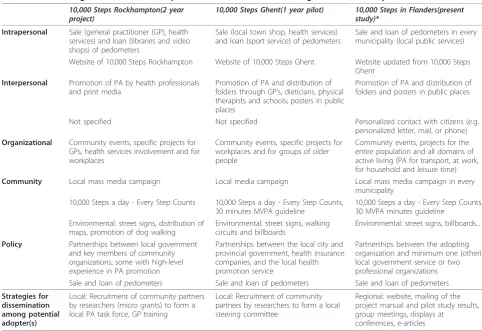
potential adopters of‘10,000 Steps’and several interven-tion components were recommended. Table 1 provides an overview of the intervention components that were recommended to potentially adopting organizations in the present study in Flanders compared to the imple-mented intervention components of‘10,000 Steps Rock-hampton’and‘10,000 Steps Ghent’.
The intervention components across all three phases of testing represent a socio-ecological approach to PA promotion in adults, with some small adaptations throughout the phases [18]. Main adaptations included less focus on delivery via general practitioners and dog walking, and a stronger focus on promoting public places in both ‘10,000 Steps Ghent’ and the present study in Flanders. To emphasize the importance of the interpersonal dimension of PA promotion, wide ranging personal contact with citizens (e.g. personalized letter, mail, or phone) was included as an additional interven-tion guideline in the present study in Flanders. Further-more, in‘10,000 Steps Ghent’ and the present study in Flanders the guideline of 30 minutes moderate to vigor-ous PA on most, preferably all days, of the week [19] was added to the main project theme of ‘10,000 Steps a Day, Every Step Counts’. A final adaptation in the pre-sent study in Flanders was the more general guideline of promoting PA in the entire population and all domains of active living (PA for transport, at work, for household and leisure time), while‘10,000 Steps Ghent’and‘10,000 Steps Rockhampton’focused on specific projects for pri-mary care, workplaces, and older people (Table 1). This more general recommendation was believed to be less rigid and would facilitate more widespread dissemina-tion and implementadissemina-tion.
Dissemination efforts for the present study in Flanders
Dissemination efforts for the present study in Flanders (population: 6,160,600 inhabitants, surface: 13,521 square km, density: 456 inhabitants/square km) were initiated at the end of 2007. Considering the limited funding for dis-semination (one researcher part-time allocated to the project), the local engagement of potential adopters and the formation of local steering committees could not be established by researchers themselves as was the case in the local projects of ‘10,000 Steps Rockhampton’and
‘10,000 Steps Ghent’(Table 1). Dissemination efforts related to the present study in Flanders focused primarily on the use of media and interpersonal contacts with spe-cific professional organizations (e.g. local health promo-tion services) based on the principles of Rogers’Diffusion of Innovations [7].
included updated project implementation manuals for the implementation of ‘10,000 Steps’in communities and workplaces, downloads of intervention materials (e.g. logo, flyers, posters, billboards), project and com-munity contacts, and web space for announcing project activities and events. Main web content for citizens included information about the‘10,000 Steps’ philoso-phy, PA and health, tips on how to increase daily activ-ity, contacts, an online diary for recording personal step counts, and reports on planned or completed activities. Two emails containing the publication on the effective-ness of‘10,000 Steps Ghent’[13], the project implemen-tation manual and links to the website’s content were sent to municipal sports services, local health promotion services, and health insurance organizations. These orga-nizations were identified by contacting their respective national or provincial agency and by consulting inter-ested opinion leaders within the agency.
For the interpersonal component, these opinion lea-ders subsequently helped analyze peer networks within the organizations by mapping dates, meeting locations and sponsoring organizations of upcoming supra-local
group meetings. These group meetings were formal plat-forms where representatives of the organizations and their peers from other municipalities/provinces regularly joined to discuss professional matters of common inter-est. A total number of 26 group meetings provided a social platform for presentations with illustrative project materials that accentuated the positive scientific findings of‘10,000 Steps Ghent’, the compatibility of the current program with the organizations’mission and local con-texts, and its easy access through the website. The web-site and its online support materials for implementing
‘10,000 Steps’were demonstrated. Present organizations were advised to take advantage of this project support (project implementation manual, downloads of interven-tion materials, contacts), to form a local steering com-mittee independently, and to implement‘10,000 Steps’ according to the guidelines and intervention compo-nents described in the project implementation manual.
[image:3.595.55.538.97.428.2]Finally, displays at regional conferences and articles for professional e-magazines also referring to the web-site were periodically provided between 2007 and the start of data collection.
Table 1 Socio-ecological intervention components and dissemination strategies of‘10,000 Steps’studies
10,000 Steps Rockhampton(2 year project)
10,000 Steps Ghent(1 year pilot) 10,000 Steps in Flanders(present study)*
Intrapersonal Sale (general practitioner (GP), health services) and loan (libraries and video shops) of pedometers
Sale (local town shop, health services) and loan (sport service) of pedometers
Sale and loan of pedometers in every municipality (local public services)
Website of 10,000 Steps Rockhampton Website of 10,000 Steps Ghent Website updated from 10,000 Steps
Ghent Interpersonal Promotion of PA by health professionals
and print media
Promotion of PA and distribution of folders through GP’s, dieticians, physical therapists and schools; posters in public places
Promotion of PA and distribution of folders and posters in public places
Not specified Not specified Personalized contact with citizens (e.g.
personalized letter, mail, or phone) Organizational Community events, specific projects for
GPs, health services involvement and for workplaces
Community events, specific projects for workplaces and for groups of older people
Community events, projects for the entire population and all domains of active living (PA for transport, at work, for household and leisure time) Community Local mass media campaign Local media campaign Local mass media campaign in every
municipality
10,000 Steps a day - Every Step Counts 10,000 Steps a day - Every Step Counts,
30 minutes MVPA guideline
10,000 Steps a day - Every Step Counts, 30 MVPA minutes guideline
Environmental: street signs, distribution of maps, promotion of dog walking
Environmental: street signs, walking circuits and billboards
Environmental: street signs, billboards...
Policy Partnerships between local government and key members of community organizations, some with high-level experience in PA promotion
Partnerships between the local city and provincial government, health insurance companies, and the local health promotion service
Partnerships between the adopting organization and minimum one (other) local government service or two professional organizations
Sale and loan of pedometers Sale and loan of pedometers Sale and loan of pedometers
Strategies for dissemination among potential adopter(s)
Local: Recruitment of community partners by researchers (micro grants) to form a local PA task force, GP training
Local: Recruitment of community partners by researchers to form a local steering committee
Regional: website, mailing of the project manual and pilot study results, group meetings, displays at
conferences, e-articles
Data collection and sample
Data were collected at individual (i.e. citizens) and orga-nizational (i.e. professional organizations) levels.
Individual level measures included telephone inter-views (March 2009 to April 2009) where all adult citi-zens living in the work area of the sample organizations that adopted ‘10,000 Steps’ as a whole-community
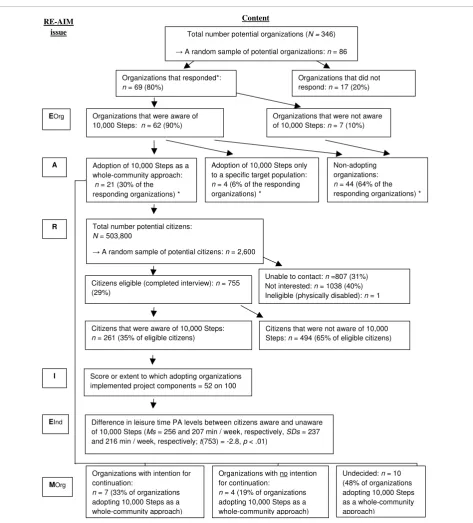
approach (see measures -adoption section) were poten-tial candidates to be included in the study (N = 503,800). To establish reach, population telephone regis-ters were consulted and a random sample of 2,600 adults was drawn from the target area of the organiza-tions adopting ‘10,000 Steps’ as a whole-community approach (Figure 1). At least three attempts were made
Organizations that responded*: n = 69 (80%)
Organizations that did not respond: n = 17 (20%)
Adoption of 10,000 Steps as a whole-community approach: n = 21 (30% of the responding organizations) *
Adoption of 10,000 Steps only to a specific target population: n = 4 (6% of the responding organizations) *
Total number potential citizens: N = 503,800
ĺ A random sample of potential citizens: n = 2,600
Citizens eligible (completed interview): n = 755 (29%)
Unable to contact: n =807 (31%) Not interested: n = 1038 (40%) Ineligible (physically disabled): n = 1 R
Citizens that were aware of 10,000 Steps: n = 261 (35% of eligible citizens)
Citizens that were not aware of 10,000 Steps: n = 494 (65% of eligible citizens)
Score or extent to which adopting organizations implemented project components = 52 on 100 I
Difference in leisure time PA levels between citizens aware and unaware of 10,000 Steps (Ms = 256 and 207 min / week, respectively, SDs = 237 and 216 min / week, respectively; t(753) = -2.8, p < .01)
EInd
MOrg
Non-adopting organizations: n = 44 (64% of the responding organizations) *
Organizations with intention for continuation:
n = 7 (33% of organizations adopting 10,000 Steps as a whole-community approach)
Organizations with no intention for continuation:
n = 4 (19% of organizations adopting 10,000 Steps as a whole-community approach)
Undecided: n = 10 (48% of organizations adopting 10,000 Steps as a whole-community approach)
Organizations that were aware of 10,000 Steps: n = 62 (90%) EOrg
A
Organizations that were not aware of 10,000 Steps: n = 7 (10%) Total number potential organizations (N = 346)
ĺ A random sample of potential organizations: n = 86 RE-AIM
issue
[image:4.595.62.536.183.707.2]Content
before recording individuals as“unable to contact”. This resulted in a total of 755 respondents (29% of the initial sample, response rate 42%) that completed the inter-view. Citizens were asked to complete the telephone-administered long version of the International Physical Activity Questionnaire (IPAQ) and a questionnaire related to the awareness of‘10,000 Steps’.
Organizational level measures were collected using an online survey which was sent to the heads of depart-ment of professional organizations (January 2009 to March 2009). As shown in Figure 1, the total number of potential organizations to be included in the study was 346. Of a random sample of 86 contacted organizations, 69 organizations responded (80% response rate).
The study protocols were approved by the Ethical Committee of the Ghent University.
Measures
Questionnaires (see Additional file 1) assessed individual project awareness and included the following questions: Have you heard of‘10,000 Steps’? (yes/no); Where did you hear about‘10,000 Steps’? (radio, TV, print media, Internet, street signs or other objects in the street scene, workplace, health service, (para)medic, society, family, friends, other); Are you aware of any of the following activities related to‘10,000 Steps’?: sale of pedometers, loan of pedometer, walk circuits between public places or in local town parks? (yes/no). The IPAQ assessed PA in a usual week, including PA at work, transport related PA, domestic and gardening activities, and PA during leisure time. The IPAQ has been proven to be a reliable and valid instrument for assessing PA at the population level in Europe and in Flanders, Belgium [20,21]. Total time for PA in the four domains and total time for walking, moderate, and vigorous PA, all expressed in minutes/week, were computed http://www.ipaq.ki.se.
The online organizational survey (see Additional file 2) was structured in four main parts assessing: 1) an orga-nization’s general characteristics and awareness of
‘10,000 Steps’, 2) adoption of‘10,000 Steps’and reasons for adopting or declining the project, 3) program imple-mentation, exploring the delivery of the different project components, the frequency of implementation if rele-vant, resources, targeted domains of active living and project duration, and 4) long-term maintenance of the project.
RE-AIM Evaluation
Measures of the RE-AIM dimensions were used to cal-culate summary metrics and are illustrated in Figure 1.
ReachReach was defined as the proportion of eligible
citizens that reported being aware of ‘10,000 Steps’ (Have you heard of ‘10,000 Steps’?) [8,17]. Representa-tiveness was estimated by comparing differences in age, gender, education and employment status between those
reporting awareness of‘10,000 Steps’versus those not aware.
Effectiveness Individual effectiveness compared PA
levels of citizens who were aware of ‘10,000 Steps’ (reached individuals) with those who were not aware of it (individuals not reached) and within the four domains of active living (PA for transport, at work, for household and leisure time) [22]. Because an important focus of this dissemination study was to make professional orga-nizations aware of ‘10,000 Steps’while using limited resources, effectiveness was also measured on the orga-nizational level by comparing the proportion of the stu-died sample of organizations that was aware of ‘10,000 Steps’(Is your organization familiar with ‘10,000 Steps’?) based on prior applications of the RE-AIM framework in studies with smaller settings [23].
AdoptionAdoption was evaluated as the proportion and
representativeness of organizations that had delivered a whole-community project based on ‘10,000 Steps’(Did your organization adopt ‘10,000 Steps’up till this day?). Representativeness was assessed as differences in num-ber of staff memnum-bers, type of organization and working context between the organizations adopting and not adopting‘10,000 Steps’[24]. Representativeness of deliv-ery agentswithin adopting organizations was explored by comparing project and non-project staff members on age, years of expertise and gender [9].
ImplementationImplementation was measured as the
extent to which several intervention components for PA promotion were applied by organizations that adopted
promotional materials of ‘10,000 Steps’ in the street scene?) and 9) the initiation of partnerships with local authorities and other associations (Did your organization have any partnerships with municipal services, associa-tions or societies to implement ‘10,000 Steps’?). As advised by Glasgow and colleagues, the median imple-mentation score (score on 100) across all nine project components was taken as the global implementation score [25]. Organizations acquired a maximum imple-mentation score if a component was recurrently pro-moted in public places, received half of the maximum score if they presented a component only once, and zero if no component was implemented. Scoring was applied to the following components: pedometer loan or sale, use of the website, dissemination of flyers or var-iants, posters, community events, use of the media and street signs or similar street scene objects. For the implementation of personal contact, a maximum com-ponent score was granted if an attempt was made to contact more than half of the adult citizens through per-sonal correspondence or telephone, half of the score if fewer were contacted, and zero if no efforts were under-taken. For the partnership component a maximum score was obtained when a multidisciplinary partnership was initiated with at least one municipal public service or two other professional organizations, half of the score was obtained if the partnership was less extensive, and zero if no partnership was initiated. Additional measures included the duration and investment of the delivered projects as well as the number of domains of active liv-ing that was targeted.
MaintenanceThe proportion of organizations’
intend-ing to continue the delivery of‘10,000 Steps’(Does your organization have the intention to continue ‘10,000 Steps’in the future?) evaluated the potential sustainabil-ity of the intervention [26]. Due to the limited time span between the structured dissemination efforts for
‘10,000 Steps’ and the present study’s data analysis, it was too early to report data on the potential long-term maintenance at both the individual and organizational level.
Data analysis
The proportion of citizens aware of ‘10,000 Steps’ was calculated and independent sample t tests and chi-square tests were used to compare those aware versus not aware of‘10,000 Steps’on demographic characteris-tics (reach) and for differences in PA levels (effective-ness-individual level). Effect sizes for PA were computed by subtracting mean PA levels of citizens in both groups (citizens aware and not aware), and dividing this score by the pooled standard deviation of PA levels. Effect sizes were interpreted as negligible (< 0.15), small (0.15 - 0.40), medium (0.40 - 0.75) or large (> 0.75) [27].
The proportion of organizations that was aware of
‘10,000 Steps’ (effectiveness-organizational level) and that had delivered‘10,000 Steps’(adoption) was calcu-lated. Differences between organizations adopting and not adopting ‘10,000 Steps’, as well as differences between project staff and non-project staff were ana-lyzed with independent sample ttests and chi-square tests. Descriptive statistics provided insights in reasons for (not) adopting‘10,000 steps’(adoption).
The global implementation score and the implementa-tion scores of the separate project components were cal-culated and converted to az-score. Descriptive statistics were used to analyze reasons for not implementing components, targeted domains of active living, project duration, and investment (implementation).
The proportion of organizations that had the intention to continue ‘10,000 Steps’was calculated (maintenance). All analyses were conducted using SPSS 15.0 (SPSS, Inc. Chicago, IL).
Results
Those responding to the individual survey had a similar proportion of employed people [60.0% vs. 66.3%, respec-tively;c2(1) = 0.87, p= 0.35], a higher mean age [Ms= 50.6 years vs. 48.0 years, respectively,t(754) = 4.69,p< 0.01], a lower proportion of men [40.9% vs. 49.0%, respectively;c2(1) = 19.78,p< 0.01], and a higher pro-portion of persons with a higher education degree [39.7% vs. 25.0%, respectively;c2(1) = 85.18,p< 0.01] compared to the general population of Flanders. Responding orga-nizations included 25 municipal sports services (of 42 contacted and of 292 total), 18 local health promotion services (of 18 contacted and of 26 total), and 26 health insurance organizations (of 26 contacted and of 28 total).
Figure 1 presents an overview of the main results for all the RE-AIM dimensions and the next section pre-sents results for each separate dimension.
Reach
Of those citizens living in the target area of organiza-tions that adopted ‘10,000 Steps’as a whole-community approach, 35% was aware of ‘10,000 Steps’ (n = 261) with no differences found on demographic variables compared to those not aware of ‘10,000 Steps’ (n = 494); they had similar mean age [Ms = 50.5 years vs. 50.8 years, respectively, SDs= 14.5 vs. 16.0, respectively; t(576) = 0.29, p= 0.66], a similar proportion of men [36.4% vs. 43.3%, respectively; c2(1) = 3.38,p= 0.07], a similar proportion of persons with a higher education degree [39.8% vs. 39.6%, respectively;c2(1) = 0.00,p= 0.963] and a similar proportion of employed people [77.1% vs. 72.4%, respectively;c2(1) = 1.55, p= 0.213].
of the reached respondents, followed by TV (21%), health insurance organizations (18%) and friends or family (13%). Furthermore, more than 22% of reached respondents were aware of the sale or promotional dis-tribution of pedometers, 9% was aware of walking cir-cuits, and 3% was aware of a loan system of pedometers.
Effectiveness
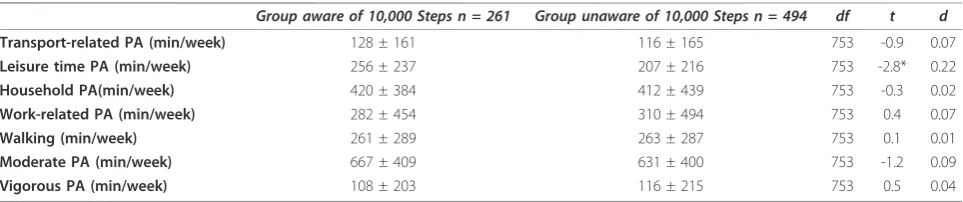
Those individuals aware of‘10,000 Steps’reported sig-nificantly higher leisure time PA levels than those not aware (see Table 2). No other significant differences were found in the other three PA domains or in the dif-ferent categories of PA intensity (walking, moderate and vigorous PA).
Of the targeted professional organizations 90% (n= 62) were aware of‘10,000 Steps’.
Adoption
Of all organizations, 36% reported adoption of‘10,000 Steps’ (n = 25) with 21 (30%) adopting the whole-community approach and four organizations (6%) adapt-ing the approach for specific groups such as personnel of local governments (n = 2), the elderly (n= 1), and schools (n = 1). Comparisons between adopting and non-adopting organizations (n= 44) revealed no signifi-cant differences in the mean number of staff members [Ms =4.1 vs. 5.6, respectively,SDs= 2.9 vs. 11.1, respec-tively; t(63) = 0.60, p = 0.55], type of organization [76.0% vs. 56.8% with a health policy focus, respectively;
c2
(1) = 2.53,p= 0.11] and working context [16.0% only urban, 16.0% only rural and 68.0% both urban and rural vs. 13.6% only urban, 27.3% only rural and 59.1% both urban and rural, respectively;c2(2) = 1.14,p= 0.57].
Delivery agents within the adopting organizations showed no significant differences in mean age compared to non-project staff members [Ms= 39.7 years vs. 36.4 years, respectively,SDs= 8.5 vs. 9.9, respectively;t(39) = 1.16, p= 0.55]. However, those delivering the program reported more years of experience in PA promotion than non participating staff members [Ms= 7.6 vs. 2.9, respectively, SDs= 4.6 vs. 5.9, respectively;t(36) = 2.79,
p< 0.01] and had a bigger proportion of women [71.4% vs. 56.8% female, respectively;c2(1) = 4.06,p< 0.05].
Non-adopting organizations listed reasons for having doubts or not having the intention to adopt ‘10,000 Steps’. These were:‘not having thought about it yet in a concrete manner’ (70%), ‘insufficiently planned resources’(30%), ‘no priority or not suitable’(20%) and
‘need for knowledge support and good-practices’ (15%). Adopting organizations and those that had the intention to do so in the future gave the following main reasons for adoption: ‘10,000 Steps’ is a ready-for-use product’ (40%), ‘assignment given by the organization’s superior’ (35%),‘the scientific evidence of the pilot project’(26%) and‘experience of peers in other organizations’(19%).
Implementation
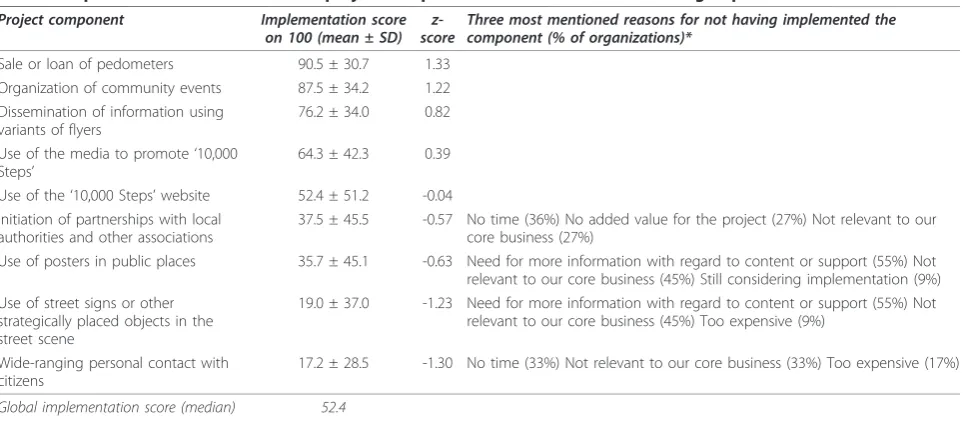
The global implementation score was a median 52 of 100. Four of nine separate components gained less than half of the maximum implementation score (see Table 3 for correspondingz-scores). Most reported reasons for not having implemented these components are also indicated in Table 3.
Almost half of the organizations reported a project duration of more than one year (48%;n= 10). Fourteen percent reported a project duration of 7 to 12 months (n = 3), 24% a duration of 2 to 6 months (n = 5) and 14% a duration of one month or less (n= 3).
When considering the targeted domains of active liv-ing or PA contexts, leisure time was marked most fre-quently by 95% of the organizations (n = 20), followed by active transport (91%; n= 19), household activities (81%;n= 17), and work-related activities (72%;n= 15).
Organizations devoted an average of 47 (± 72) work-ing days on ‘10,000 Steps’. They estimated a financial investment of 0.026 (SD= 0.018) euros (or 0.032 (SD = 0.022) dollars) per citizen for project implementation.
Maintenance
[image:7.595.57.539.621.722.2]Of all the organizations that adopted‘10,000 Steps’as a whole-community approach, 33% (n= 7) had the inten-tion to continue the project in the future. An addiinten-tional
Table 2 Mean physical activity (PA) levels for respondents who were aware and unaware of 10.000 Steps
Group aware of 10,000 Steps n = 261 Group unaware of 10,000 Steps n = 494 df t d
Transport-related PA (min/week) 128 ± 161 116 ± 165 753 -0.9 0.07
Leisure time PA (min/week) 256 ± 237 207 ± 216 753 -2.8* 0.22
Household PA(min/week) 420 ± 384 412 ± 439 753 -0.3 0.02
Work-related PA (min/week) 282 ± 454 310 ± 494 753 0.4 0.07
Walking (min/week) 261 ± 289 263 ± 287 753 0.1 0.01
Moderate PA (min/week) 667 ± 409 631 ± 400 753 -1.2 0.09
Vigorous PA (min/week) 108 ± 203 116 ± 215 753 0.5 0.04
48% was still undecided (n= 10), while 19% (n= 4) had no intention to continue the project.
Discussion
The current study applied the RE-AIM framework to the evaluation of the wide-scale dissemination of‘10,000 Steps’beyond initial applications (’10,000 Steps Ghent’). The dissemination effort was highly effective in making professional organizations aware of‘10,000 Steps’(90%), with lower scores for adoption (36%), implementation (52%), and the intention of project continuation (33% and an additional 48% of undecided organizations).
The combination of media strategies and interpersonal contact (i.e. peer networks) through supra-local meetings with organizational representatives and opinion leaders seems promising for creating project awareness of
‘10,000 Steps’among a substantial proportion of organi-zations. Diffusion theory supports the current dissemina-tion approach, that relied on media to have an impact in creating knowledge, persuasion and decision, and on interpersonal contact and social networks to be influen-tial in the final stages of trial and adoption of an innova-tion [6,7]. However, adopinnova-tion was problematic since only about one third of the studied organizations adopted
‘10,000 Steps’. According to diffusion theory this may be due to the need for additional time to allow the adoption to occur through the different stages of the innovation-decision process [28]. This reasoning is supported by the high proportion of non-adopting organizations in this study (70%) that reported ‘not having thought about adoption yet in a concrete manner’. Similarly, the state-wide dissemination of the‘Walk Kansas’project showed a time dependent factor, with moderate adoption in its
first year and changing adoption rates in the following years [29]. High external validity was found, with adop-tion rates in the present study found to be independent of organizational characteristics such as staff size, type of organization, working context, and age of staff.
The modest global implementation score was caused primarily by disappointing implementation scores on separate components including partnerships with local authorities and other associations, high visibility compo-nents such as posters in public places and variants of street signs, and wide-ranging personal contact with citi-zens. Community partnerships have proven their impor-tance for effective health and PA promotion before [30,31] and have been recommended as a reinforcing component in other large-scale national PA programs [32,33]. Within the most often mentioned reasons for not initiating partnerships, organizations listed‘no time’and
[image:8.595.58.540.97.308.2]‘no added value’. These findings show similarities with previous reviews of partnerships and experiences in recent community studies reporting the time-consuming and complex formation of multidisciplinary partnerships for PA promotion, as well as the difficulty of engaging stakeholders to invest resources into a PA project that is not considered as their“core business”[32,34,35]. The relative importance of high visibility components such as street signs or similar adaptations has been demonstrated in‘10,000 Steps Ghent’. Mediation analysis showed that the positive behavioural outcomes of ‘10,000 Steps Ghent’were significantly mediated through citizens’ awareness of street signs and workplace projects [36]. The most frequent reported barriers for street signs or variants in this study (’need for more information with regard to content or support’and‘not relevant to our Table 3 Implementation scores for each project component and reasons for not having implemented them
Project component Implementation score
on 100 (mean ± SD) z-score
Three most mentioned reasons for not having implemented the component (% of organizations)*
Sale or loan of pedometers 90.5 ± 30.7 1.33
Organization of community events 87.5 ± 34.2 1.22
Dissemination of information using variants of flyers
76.2 ± 34.0 0.82
Use of the media to promote‘10,000
Steps’
64.3 ± 42.3 0.39
Use of the‘10,000 Steps’website 52.4 ± 51.2 -0.04
Initiation of partnerships with local authorities and other associations
37.5 ± 45.5 -0.57 No time (36%) No added value for the project (27%) Not relevant to our
core business (27%)
Use of posters in public places 35.7 ± 45.1 -0.63 Need for more information with regard to content or support (55%) Not
relevant to our core business (45%) Still considering implementation (9%) Use of street signs or other
strategically placed objects in the street scene
19.0 ± 37.0 -1.23 Need for more information with regard to content or support (55%) Not
relevant to our core business (45%) Too expensive (9%)
Wide-ranging personal contact with citizens
17.2 ± 28.5 -1.30 No time (33%) Not relevant to our core business (33%) Too expensive (17%)
Global implementation score (median) 52.4
core business’) indicate that more efforts are required to inform professional organizations about this component, to support its application, and to stimulate ecologic (multi-strategy and intersectoral) insights in organiza-tions’PA policy. Wide scale personal contact with the target population proved to be the least feasible project component,‘having no time’and‘not relevant to our core business’being the most reported barriers. Only one organization achieved a maximum score on this compo-nent. However, additional research using more structural support could address the question of whether imple-mentation of this component could be enhanced.
Additional research will also allow forming more con-clusive insights regarding maintenance (and local adapta-tion) of‘10,000 Steps’. More than one of three adopting organizations had the intention to continue the project, but an even greater number (more than 4 of 10) was still undecided. The latter finding also represents an opportu-nity for project advocates to increase maintenance of
‘10,000 Steps’, e.g. by providing supportive services or the encouragement of multi-disciplinary work-groups which could foster project maintenance [37].
On the individual level, we found a moderate reach or awareness of‘10,000 Steps’, and those aware of the project reported higher PA levels during leisure time activities compared to those not aware. Citizens’awareness was representative on all studied demographic characteristics. Nevertheless, the proportion of citizens that was aware of
‘10,000 Steps’in this study (35%) was considerably lower than in the studies of ‘10,000 Steps Ghent’ (63%) and
‘10,000 Steps Rockhampton (90%) [11,13]. The most cited information sources about‘10,000 Steps’in the present study were similar to the ones in‘10,000 Steps Ghent’, confirming the general potential of media (print media and TV) and health insurance organizations as informa-tional conduits. However, in contrast with the pilot study, street signs and the work place were not as frequently reported in the present study. In the present study these two information sources represented the least implemen-ted project component (street signs) and PA context (work place). Consistent with socio-ecological principles of health promotion, these findings could imply that environ-mental strategies such as street signs and organizational strategies such as work place interventions are recom-mended to increase project awareness [18].
Implementation outcomes may also be associated with particular findings on PA levels. The leisure time con-text of PA was targeted more intensively by almost all the organizations in the present study and may be related to the significant differences in PA levels during leisure time activities (small but considerable effect sizes for a whole-community project) of citizens.
It appears that ‘10,000 Steps’ has good potential for wide-scale dissemination in particular with the addition
of more in-depth information to organizations and a more effective support structure to encourage project adoption and full implementation. Implementation sup-port was limited to a centralized website, which was probably insufficient to fully support translation of a whole-community project like ‘10,000 Steps’into prac-tice. According to Green and colleagues a centralized approach is unlikely to fill the gap between the centra-lized supply side and the more local demand sides of science [6]. A more participatory approach using a link-age system that connects the developers of a project to the potential users may be a better instrument and has been argued to stimulate the process of diffusion, adop-tion and implementaadop-tion [38-40]. Since this research ended, funding of the Flemish Government is support-ing an intermediate structure of linkage agents so future data on this structure is forthcoming.
Limitations of the current results are noted. Generaliz-ability of results may be limited because no more than half of the contacted citizens agreed to participate and no information was available about the characteristics of the non-participants. This could have led to a positive bias of the results on citizens’project awareness and PA levels. Sole use of self-reported data was another limita-tion. Due to social desirability this may also have led to a positive bias of the results on project implementation (organizational level) and PA levels (individual level). On the organizational level, self-reported data on project implementation could become more valid by adding objective measures [9], such as on-site observations by a team of researchers (which require more resources than available in this study). On the individual level, comple-mentary objective measures of PA levels could include the use of pedometers or accelerometers. Nevertheless, the questionnaire to collect data on PA levels in this study (telephone-administered IPAQ) has proven accep-table validity against accelerometers in several countries [20]. Finally, the study’s outcomes on maintenance are provisional because these are based on adopters’ intentions and not on actual program continuation. Follow-up research is already scheduled to study pro-gram continuation and implementation one year after the present study.
means of disseminating project resources [41]. However, in contrast to our study, the Australian study did not report on the proportion and representativeness of adopting organizations or on the quality of implementa-tion, which makes it more difficult to make compari-sons. Third, the present study reported additional qualitative data related to adoption and implementation, which provided a better understanding of scores on these dimensions. Fourth, an effectiveness dimension on the organizational level was added. This provided an answer to the question if efforts to make organizations aware of ‘10,000 Steps’were effective. It also provided complementary information on adoption rates and to which extent these rates were mediated by the applied dissemination strategy or by the characteristics of the project itself.
Conclusions
In conclusion, ‘10,000 Steps’ shows potential for wide-scale dissemination but a more extensive support struc-ture than the one applied in the present study seems recommended to encourage adoption levels and high quality implementation. Follow-up research that inte-grates such a structure will provide more conclusive insights, also regarding the potential of‘10,000 Steps’for program continuation (sustainability).
Additional material
Additional file 1: Questionnaire for citizens.
Questionnaire_citizens_10000Steps.pdf Questionnaire to assess individual project awareness and PA levels (including IPAQ).
Additional file 2: Organizational survey.
Organizational_survey_10000Steps.pdf Survey to assess organizational project awareness, adoption, implementation and long-term maintenance of‘10,000 Steps’.
Acknowledgements
This study was supported by the Policy Research Centre Culture, Youth and Sport funded by the Flemish Government.
Author details
1Department of Movement and Sports Sciences, Ghent University,
Watersportlaan 2, 9000 Gent, Belgium.2School of Public Health, University of
Memphis, Scates Hall 205, Memphis, USA.
Authors’contributions
RVA designed the study, collected and analyzed the data, and drafted the manuscript. IDB participated in the design of the study and helped to draft the manuscript. KDC and LK also helped to draft the manuscript and interpret data. GC conceived of the study, participated in the design, and helped to draft the manuscript. All authors read and approved the final manuscript.
Competing interests
The authors declare that they have no competing interests.
Received: 15 July 2010 Accepted: 4 January 2011 Published: 4 January 2011
References
1. Kerner J, Rimer B, Emmons K:Introduction to the special section on dissemination: dissemination research and research dissemination: how can we close the gap?Health Psychol2005,24(5):443-6.
2. Brownson RC, Baker EA, Leet TL, Gillespie KN:Evidence-Based Public Health
Oxford: Oxford University Press; 2003.
3. Muller-Riemenschneider F, Reinhold T, Nocon M, Willich SN:Long-term effectiveness of interventions promoting physical activity: A systematic review.Prev Med2008,47(4):354-368.
4. Kahn EB, Ramsey LT, Brownson RC, Heath GW, Howze EH, Powell KE,
Stone EJ, Rajab MW, Corso P:The effectiveness of interventions to increase physical activity - A systematic review.Am J Prev Med2002,
22(Suppl 4):73-108.
5. Owen N, Glanz K, Sallis JF, Kelder SH:Evidence-based approaches to dissemination and diffusion of physical activity interventions.Am J Prev Med2006,31(Suppl 4):35-44.
6. Green LW, Ottoson JM, Garcia C, Hiatt RA:Diffusion theory and knowledge dissemination, utilization, and integration in public health.
Annu Rev Public Health2009,30:151-74.
7. Rogers EM:Diffusion of Innovations.5 edition. New York: NY: Free Press; 2003.
8. Glasgow RE, Emmons KM:How can we increase translation of research
into practice? Types of evidence needed.Annu Rev Public Health2007,
28:413-33.
9. Dzewaltowski D, Estabrooks P, Klesges L, Bull S, Glasgow R:Behavior change intervention research in community settings: how generalizable are the results?Health Promot Int2004,19(2):235-245.
10. Glasgow RE, Klesges LM, Dzewaltowski DA, Bull SS, Estabrooks P:The future of health behavior change research: what is needed to improve translation of research into health promotion practice?Ann Behav Med
2004,27(1):3-12.
11. Brown WJ, Mummery K, Eakin E, Schofield G:10,000 Steps Rockhampton:
Evaluation of a whole community approach to improving population levels of physical activity.JPAH2006,3(1):1-14.
12. Brown WJ, Eakin E, Mummery K, Trost SG:10,000 Steps Rockhampton:
Establishing a multistrategy physical activity promotion project in a Queensland community.Health Promot J Aust2003,14:95-100. 13. De Cocker K, De Bourdeaudhuij I, Brown W, Cardon G:Effects of“10.000
Steps Ghent”A whole-community intervention.Am J Prev Med2007,
33(6):455-463.
14. Stokols D:Translating social ecological theory into guidelines for community health promotion.Am J Health Promot1996,10:282-298. 15. Rabin BA, Brownson RC, Haire-Joshu D, Kreuter MW, Weaver NL:A glossary
for dissemination and implementation research in health.J Public Health
Manag Pract2008,14(2):117-123.
16. Rabin BA, Glasgow RE, Kerner JF, Klump MP, Brownson RC:Dissemination and implementation research on community-based cancer prevention: a systematic review.Am J Prev Med2010,38(4):462-3.
17. Glasgow R, Vogt T, Boles S:Evaluating the public health impact of health promotion interventions: the RE-AIM framework.Am J Public Health1999,
89(9):1322-1327.
18. McLeroy KR, Bibeau D, Steckler A, Glanz K:An ecological perspective on health promotion programs.Health Educ Quart1988,15(4):351-77. 19. American College of Sports Medicine:Guideline for exercise testing and
prescription.6 edition. Philadelphia: Lippincott Williams & Wilkins; 2000.
20. Craig CL, Marshall AL, Sjöström M, Bauman AE, Booth ML, Ainsworth BE, Pratt M, Ekelund U, Yngve A, Sallis JF, Oja P:International Physical Activity Questionnaire: 12-country reliability and validity.Med Sci Sports Exerc
2003,35:1381-95.
21. Vandelanotte C, De Bourdeaudhuij I, Sallis J, Philippaerts R, Sjostrom M:
Reliability and validity of a computerised and Dutch version of the International Physical Activity Questionnaire (IPAQ).JPAH2005,2:63-75. 22. Sallis JF, Cervero RB, Ascher W, Henderson KA, Kraft MK, Kerr J:An
ecological approach to creating active living communities.Annu Rev
Public Health2006,27:297-322.
23. Eakin E, Brown W, Marshall A, Mummery K, Larsen E:Physical activity promotion in primary care Bridging the gap between research and practice.Am J Prev Med2004,27(4):297-303.
24. Green LW, Glasgow RE:Evaluating the relevance, generalization, and applicability of research.Eval Health Prof2006,29(1):126-153. 25. Glasgow RE, Klesges LM, Dzewaltowski DA, Estabrooks PA, Vogt T:
framework to form summary measures for decision making involving complex issues.Health Educ Res2006,21(5):688-694.
26. Klesges LM, Dzewaltowski DA, Glasgow RE:Review of external validity reporting in childhood obesity prevention research.Am J Prev Med2008,
34(3):216-23.
27. Cohen J, ed:Statistical power for the behavioural sciencesHillsdale NJ: Erlbaum; 1988.
28. Rogers EM:Diffusion of preventive innovations.Addict behav2002,
27:989-993.
29. Estabrooks PA, Bradshaw M, Dzewaltowski DA, Smith-Ray RL:Determining the impact of Walk Kansas: applying a team-building apporach to community physical activity promotion.Ann Behav Med2008,36:1-12. 30. World Health Organization Europe:Physical Activity and Health in Europe,
evidence for action[http://www.euro.who.int/], Accessibility verified May 31,
2010.
31. Gillies P:Effectiveness of alliances and partnerships for health promotion.Health Promot Int1998,13(2):99-120.
32. Bors P, Dessauer M, Bell R, Wilkerson R, Lee J, Strunk SL:The Active Living by Design National Program: Community initiatives and lessons learned.
Am J Prev Med2009,37(6S2):S313-S321.
33. Aittasalo M, Miilunpalo S, Stahl T, Kukkonen-Harjula K:From innovation to practice: initiation, implementation and evaluation of a physician-based physical activity program in Finland.Health Promot Int2007,22(1):19-27. 34. Roussos ST, Fawcett SB:A review of collaborative partnerships as a
strategy for improving community health.Annu Rev Public Health2000,
21:369-402.
35. Mummery WK, Brown WJ:Whole of community physical activity
interventions: easier said than done.Br J Sports Med2009,43:39-43.
36. De Cocker K, De Bourdeaudhuij I, Brown W, Cardon G:Moderators and
mediators of pedometer use and step count increase in the“10,000 Steps Ghent”intervention.Int J Behav Nutr Phys Act2009,6:3. 37. Glasgow RE, King DK:Implications of Active Living by Design for broad
adoption, successful implementation, and long-term sustainability.Am J
Prev Med2009,37(6 Suppl 2):S450-S452.
38. Peterson JC, Rogers EM, Cunningham-Sabo L, Davis SM:A framework for
research utilization applied to seven case studies.Am J Prev Med2007,
33(Suppl 1):S21-S34.
39. Klesges LM, Estabrooks PA, Dzewaltowski DA, Bull SS, Glasgow RE:
Beginning with the application in mind: Designing and planning health behavior change interventions to enhance dissemination.Ann Behav Med
2005,29(2):66-75.
40. Bartholomew LK, Parcel GS, Kok G, Gottlieb NH:Intervention mapping:
Designing theory-and evidence-based health promotion programsNew York:
MCGraw-Hill Companies; 2001.
41. Mummery WK, Schofield G, Hinchliffe A, Joyner K, Brown W:Dissemination of a community-based physical activity project: The case of 10,000 steps.J Sci Med Sport2006,9:424-430.
Pre-publication history
The pre-publication history for this paper can be accessed here: http://www.biomedcentral.com/1471-2458/11/3/prepub
doi:10.1186/1471-2458-11-3
Cite this article as:Van Ackeret al.:The impact of disseminating the whole-community project‘10,000 Steps’: a RE-AIM analysis.BMC Public Health201111:3.
Submit your next manuscript to BioMed Central and take full advantage of:
• Convenient online submission
• Thorough peer review
• No space constraints or color figure charges
• Immediate publication on acceptance
• Inclusion in PubMed, CAS, Scopus and Google Scholar
• Research which is freely available for redistribution