JOURNAL OFVIROLOGY, June 2005, p. 7273–7278 Vol. 79, No. 11 0022-538X/05/$08.00⫹0 doi:10.1128/JVI.79.11.7273–7278.2005
Copyright © 2005, American Society for Microbiology. All Rights Reserved.
Genome Replication and Progeny Virion Production of Herpes
Simplex Virus Type 1 Mutants with Temperature-Sensitive
Lesions in the Origin-Binding Protein
Oliver Schildgen, Sascha Gra
¨per,† Johannes Blu
¨mel,‡ and Bertfried Matz*
Institut fu¨r Medizinische Mikrobiologie und Immunologie, Universita¨t Bonn, Bonn, Germany
Received 30 November 2004/Accepted 7 January 2005
Genome replication of herpes simplex viruses (HSV) in cultured cells is thought to be started by the action of the virus-encoded origin-binding protein (OBP). In experiments using two HSV-1 mutants with tempera-ture-sensitive lesions in the helicase domain of OBP, we demonstrated that this function is essential during the first 6 hours of the lytic cycle. Once DNA synthesis has started, this function is no longer required, suggesting that origin-driven initiation of viral DNA replication is a single event rather than a continuous process.
One of the virus-encoded factors essential for herpes sim-plex virus type 1 (HSV-1) DNA replication (5, 6, 9, 42) is the UL9 gene product (13), which due to its affinity for the origins of HSV-1 DNA replication (36, 38) is termed origin-binding protein (OBP). Structural and functional features of OBP have been thoroughly characterized (see, e.g., references 1, 2, 4, 8, 12, 14, 15, 17-19, 23, 28, 29, 31, 40, and 41). Nevertheless, there is but limited information on the temporal requirement for OBP in vivo. It is still unknown whether OBP acts exclusively as an initiator of HSV DNA synthesis or whether it is needed also for elongation and possibly even for the maturation/pack-aging of progeny genomes. To address this question, we used two temperature-sensitive (ts) HSV-1 mutants (tsR,tsS) that had already been characterized partially (7, 25, 27, 37). In an earlier study (3), we identified the mutations responsible for thetsphenotypes within the helicase-encoding portion of the UL9 gene (tsR, V220 M;tsS, A90T), and in an origin-depen-dent plasmid amplification assay, we found that the activity of OBP affected by thetslesions is in fact indispensable during the first 8 h of the lytic cycle in cultured cells.
Since it had been argued that plasmid amplification assays might not faithfully reflect the genuine herpesviral genome replication process and definitely are unsuitable for the assess-ment of potentially late functions of OBP, we scrutinized, refined, and extended our earlier investigations in the follow-ing way. Vero cell cultures were inoculated withtsR ortsS and, for control purposes, withtsH (a temperature-sensitive DNA polymerase mutant, tsPOL [10]); with the non-ts revertants
tsRrev (M220L; 3) or tsSrev (T90A; 3); or with the parental wild-type (wt) HSV-1 17syn⫹(7). Cultures were kept at 33°C (the temperature at which all the viruses inoculated are known to grow) for a defined period of time until being either har-vested or transferred to 39°C (the temperature at which only
the wild-type virus and the non-tsrevertants are able to grow). All cultures at 39°C were harvested simultaneously 30 h posti-noculation (p.i.). Total DNA was isolated from all harvested cell cultures, aliquots were applied in duplicate onto nitrocel-lulose membranes using a filtration manifold (Schleicher & Schu¨ll, Dassel, Germany), and HSV-1-specific DNA was quan-titated by dot hybridization (21) with32P-labeled HSV-1 DNA.
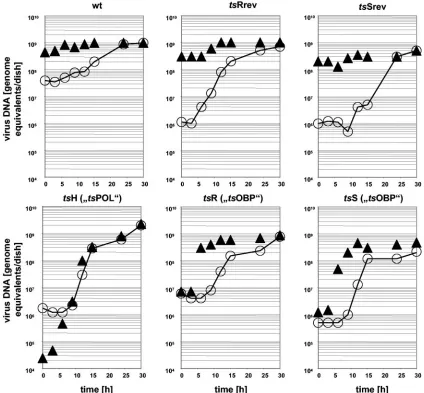
Hybridization signals were calculated as genome equivalents using a dilution series of purified HSV-1 virion DNA. As illustrated in Fig. 1, with all non-tsviruses (wt,tsRrev,tsSrev), temperature elevation from 33°C to 39°C had little influence on the final yields of viral DNA. In contrast, DNA synthesis of
tsH (tsPOL) was abruptly blocked as soon as the temperature was elevated to 39°C. With the tsOBP mutants, viral DNA synthesis could be inhibited by shifting the cultures to the nonpermissive temperature only within the first 6 hours postin-fection. Temperature upshifts at later times had no major effect on the final yields of viral DNA at 30 h p.i. These results indicate that the function of OBP, affected by the mutations in
tsR andtsS, is essential for an early phase of genome replica-tion but irrelevant for the gross synthesis of HSV DNA in the advanced stages of the lytic cycle.
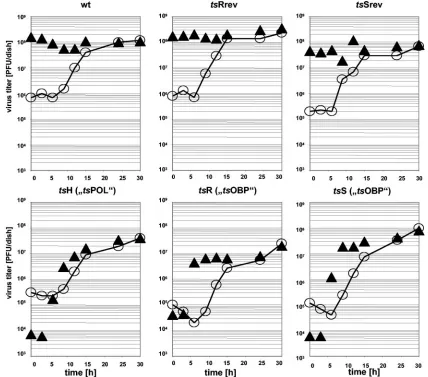
Since it could still be possible that the OBP function were essential for a step in the processing of the newly synthesized progeny genomes, we quantitated the infectious particles in the harvested cell cultures described in the legend to Fig. 1 by plaque assays at 33°C. As expected, in the case of non-ts vi-ruses, temperature upshift had no major influence on the pro-duction of virions (Fig. 2). The virion synthesis oftsH, on the other hand, was severely inhibited by temperature elevation at any stage of the replicative cycle. In the case of the tsOBP mutants, virion production was inhibited by temperature up-shift only within the first 6 hours p.i. Considerable amounts of plaque-forming particles were produced when the cultures had been upshifted later. An active role of the (temperature-sen-sitive) OBP activity in DNA processing thus appears very un-likely.
When the cultures were upshifted between 9 and 24 h postinfection, the yields of infectious particles in the tsOBP virus-infected cultures were marginally (i.e., 0.5 to 1.0 log steps) but reproducibly lower than the final yields in those
* Corresponding author. Mailing address: Institut fu¨r Medizinische Mikrobiologie und Immunologie, Universita¨t Bonn, Sigmund-Freud-Strasse 25, D-53105 Bonn, Germany. Phone: (49)-228-287-5881. Fax: (49)-228-287-4433. E-mail: [email protected].
† Present address: Aventis Pharma, Industriepark Hoechst, Ge-ba¨ude G650, D-65926 Frankfurt a.M., Germany.
‡ Present address: Paul-Ehrlich-Institut, Paul-Ehrlich-Strasse 51-59, D-63225 Langen, Germany.
7273
on November 8, 2019 by guest
http://jvi.asm.org/
cultures held at 33°C for 30 h (i.e., the respective endpoint yields, represented by the last triangles/circles in the graphs in Fig. 2). One possible explanation for this observation seemed to be an inhibitory effect of inactive OBP molecules on late events in the lytic cycle. Since inhibition of DNA replication had previously been observed with genetically engineered mu-tants of OBP (22, 24, 32, 39), it appeared reasonable to test the twotsOBP mutants for a possible dominant negative pheno-type. Cell cultures were inoculated with wild-type HSV-1 at multiplicities of infection (MOI) of 1.0 or 0.1 and coinfected at an MOI of 5 either with one of a group of viruses consisting of
tsR,tsS,tsRrev,tsSrev,tsA (a putative glycoprotein B mutant),
tsH, and tsO (a putative helicase mutant) or with wild-type
[image:2.585.80.504.72.465.2]HSV-1, giving total multiplicities of either 6 or 5.1 PFU, re-spectively, per cell. The infected cultures were incubated at 39°C and harvested after 24 h, and the number of particles able to form plaques at 39°C was determined (Fig. 3A and B). As a control, single infections were carried out at both 33°C and 39°C with all the viruses involved in the experiment, and the yields of infectious particles were quantitated by plaque assays at 33°C (Fig. 3C and D). It is obvious that in coinfections of wild-type viruses with tsOBP virus mutants, the number of infectious wild-type particles was drastically reduced, whereas other temperature-sensitive mutants exhibited no significant inhibitory effects. Thus, under nonpermissive conditions, the temperature-sensitive UL9 gene products of tsR and tsS
FIG. 1. Kinetics of viral DNA synthesis and influence of temperature upshift. A series of petri dishes (10 cm2) with approximately one million Vero cells each was infected with viruses at an MOI of 10. After incubation at the permissive temperature of 33°C for the time in hours shown on the abscissas, cells together with the culture media were harvested and frozen at⫺70°C. Total DNA was isolated, aliquots were applied to nitrocellulose membranes, and HSV-specific sequences were quantitated by dot hybridization (21) with a radioactively labeled HSV-1 DNA probe. Signals were calculated as genome equivalents and are symbolized by open circles (E) in the diagrams, which represent the kinetics of the accumulation of viral DNA at the permissive temperature. A parallel series of cell cultures was infected identically, yet after initial incubations at the permissive temperature for the shown periods of time, individual cultures, instead of being harvested immediately, were transferred to the nonpermissive temperature (39°C). The time points of these transfers (upshift) are symbolized by filled triangles (Œ). The upshifted cultures were finally harvested altogether at 30 h p.i. Total DNA was isolated and HSV-specific DNA was quantitated as described for the aforementioned samples. The HSV genome equivalents of the shift kinetics experiment are also symbolized by the filled triangles.
7274 NOTES J. VIROL.
on November 8, 2019 by guest
http://jvi.asm.org/
seemed to impede the action of unmutated OBP molecules specified by the wild-type virus. One could speculate that at 39°C the mutated variants of OBP, although unable to initiate DNA replication, might still be able to bind (in competition with the wt molecules) to the origins of replication and/or to associate with other essential DNA replication factors.
In spite of the genotypic difference between tsR and tsS, their phenotypes in vivo appeared to be very similar in all experiments. In search for a possible phenotypic correlate for the genotypic difference, we analyzed the kinetics of DNA synthesis and virion production in temperature downshift ex-periments. Multiple cell cultures were infected withtsR ortsS and incubated at 39°C. After 8 h, some cultures were shifted to 33°C and harvested at the time points shown in Fig. 4. The other cultures were further kept at 39°C and harvested at 24 h p.i. From all the harvested cultures, total DNA was isolated. HSV-specific DNA was quantitated by dot hybridization. In the case oftsS, genome replication started almost immediately upon temperature downshift, whereas withtsR a measurable
increase in viral DNA could be detected only as late as 12 h after the downshift (Fig. 4A). The harvested samples were also assayed for plaque-forming particles at 33°C (Fig. 4B). As could be anticipated from the kinetics of genome replication, the synthesis of virions started early withtsS, whereas the onset of virus growth was considerably delayed in the case oftsR. The present data suggest that the structural alteration caused by the mutation V220M in the tsR-OBP, in contrast to the A90T mutation in thetsS-OBP, may be irreversible. For this reason, the initiation of viral DNA synthesis probably has to await de novo synthesis of new OBP that is correctly folded at the permissive temperature (33°C).
Conclusion.The objective of this study was, firstly, to phe-notypically characterize virus mutants which in our opinion are highly useful tools for future studies of HSV DNA replication and, secondly, to investigate the temporal requirement for the UL9 gene product in lytic HSV infection.
These findings furnish experimental evidence for the com-monly accepted opinion that in an initial phase of productive
[image:3.585.77.505.70.447.2]FIG. 2. Kinetics of virion synthesis and influence of temperature upshift. The samples harvested in the experiments described in the legend to Fig. 1 were analyzed for the presence and quantity of infectious particles by plaque titration on Vero cell cultures at 33°C. The open circles (E) represent the kinetics of growth at the permissive temperature, whereas the filled triangles (Œ) indicate the yields of infectious particles reached at 30 h postinfection when the infected culture was first kept at 33°C for the shown period of time (Œ) and then shifted to 39°C (shift kinetics).
VOL. 79, 2005 NOTES 7275
on November 8, 2019 by guest
http://jvi.asm.org/
HSV infection, viral DNA is synthesized in an origin-depen-dent manner under the control of OBP, and that in a later stage, DNA synthesis switches to an origin-independent repli-cation mode, finally giving rise to progeny genomic DNA mol-ecules packaged into capsids (reviewed in references 5 and 34). It is noteworthy that the late phase appears to start relatively early, i.e., by 6 hours postinfection (Fig. 1). When the time required for the expression of the beta genes and the subse-quent assembly of the replication complexes is subtracted, the-oretically just a quite short period remains for but a few ge-nome copies to be synthesized. Consequently, the huge mass of viral DNA accumulated after the switch (shift to
[image:4.585.105.481.67.499.2]nonpermis-sive temperature) must have arisen by some kind of origin-independent replication. A rolling-circle (sigma-like) mecha-nism in a strict sense (i.e., without any kind of reinitiation on the nascent DNA molecules) appears too slow for that rapid burst of progeny genome production. Nor does it explain the occurrence of four isomeric forms of genomic DNA molecules, in any case. It is true that the HSV DNA replication machinery is in fact capable of acting exactly in a sigma-like fashion in generating large concatemeric head-to-tail multimers starting from relatively small monomeric DNA seed units, as observed in defective interfering particles (16) or even for heterologous (i.e., polyomaviral) DNA sequences (11, 26), and yet it is very
FIG. 3. Growth of wild-type virus after coinfection withtsmutants. (A) Vero cells were inoculated withtsR,tsS,tsRrev,tsSrev,tsA,tsO, ortsH at an MOI of 5 and simultaneously coinfected with HSV-1 wild type at an MOI of 1.0, while a control culture was singly infected with wt virus at an MOI of 6.0. After 24 h at 39°C, the cells together with the culture media (3 ml) were harvested and analyzed by plaque assays at 39°C. (B) The experimental protocol is identical to that for panel A, with the exception of the use of a 10-fold lower multiplicity of the wt virus in the double infections and of an MOI of 5.1 in the wt single infection. The infectious virus yields (both assayed at 33°C) obtained 24 h after single infections at the permissive (C) or the nonpermissive (D) temperature, respectively, are shown. Values are means of data from three independent experiments; error bars represent standard deviations.
7276 NOTES J. VIROL.
on November 8, 2019 by guest
http://jvi.asm.org/
unlikely that the majority of HSV genome copies are multi-plied in this way, as is particularly evidenced by the apparent absence or paucity of circular HSV DNA molecules in produc-tive infections (20). Thus, one must postulate some kinds of reinitiation processes occurring concomitantly with the elon-gation of herpesviral DNA chains without the involvement of the origins and/or the origin-binding proteins. The observation of branched DNA molecules in HSV-infected cells (35) and the demonstration of HSV-encoded factors being able to in-duce recombination-dependent DNA replication (30, 33) could explain in a most elegant way the very early switch from origin-dependent to origin-independent DNA replication in our experiments.
We are grateful to H. S. Marsden and J. H. Subak-Sharpe for providing the HSV mutants.
The work was financially supported by Deutsche Forschungsgemein-schaft (grant Ma846/3-1) and by the University of Bonn (grant BONFOR 153/07).
REFERENCES
1.Aslani, A., M. Olsson, and P. Elias.2002. ATP-dependent unwinding of a minimal origin of DNA replication by the origin binding protein and the single-strand DNA binding protein ICP8 from herpes simplex virus type 1. J. Biol. Chem.25:41204–41212.
2.Baradaran, K., C. E. Dabrowski, and P. A. Schaffer.1994. Transcriptional analysis of the region of the herpes simplex virus type 1 genome containing the UL8, UL9, and UL10 genes and identification of a novel delayed-early gene product, OBPC. J. Virol.68:4251–4261.
3.Blu¨mel, J., and B. Matz.1995. Thermosensitive UL9 gene function is re-quired for early stages of herpes simplex virus type 1 DNA synthesis. J. Gen. Virol.76:3119–3124.
4.Boehmer, P. E., and I. R. Lehman.1993. Physical interaction between the herpes simplex virus 1 origin binding protein and single-stranded DNA-binding protein ICP8. Proc. Natl. Acad. Sci. USA90:8444–8448. 5.Boehmer, P. E., and I. R. Lehman.1997. Herpes simplex virus DNA
repli-cation. Annu. Rev. Biochem.66:347–384.
6.Boehmer, P. E., and A. V. Nimonkar.2003. Herpes virus replication. IUBMB Life55:13–22.
[image:5.585.47.539.68.417.2]7.Brown, S. M., D. A. Ritchie, and J. H. Subak-Sharpe.1973. Genetic studies with herpes simplex virus type 1. The isolation of temperature sensitive mutants, their arrangement into complementation groups and recombina-tion analysis leading to a linkage map. J. Gen. Virol.18:329–346. 8.Bruckner, R. C., J. J. Crute, M. S. Dodson, and I. R. Lehman.1991. The
FIG. 4. Viral DNA synthesis and virion production oftsOBP mutants after temperature downshift. Multiple Vero cell cultures were infected at an MOI of 10 withtsR ortsS and kept at 39°C for 8 h. Some of the cultures were left at 39°C for a further 16 h, whereas other cultures were transferred to 33°C and harvested at the time points shown. (A) Total DNA was isolated and HSV-specific DNA was quantitated by dot hybridization. (B) The quantity of infectious particles was determined by plaque assay at 33°C. The open triangles (‚) symbolize genome equivalents (panel A) or infectious particles (panel B) from those cells that were kept at the nonpermissive temperature of 39°C and harvested at the shown time points. The open circles (E) symbolize genome equivalents (panel A) or infectious particles (panel B) from those cells that were infected at 39°C, shifted to the permissive temperature, and harvested at the shown time points.
VOL. 79, 2005 NOTES 7277
on November 8, 2019 by guest
http://jvi.asm.org/
herpes simplex virus 1 origin binding protein: a DNA helicase. J. Biol. Chem. 266:2669–2674.
9.Challberg, M. D.1986. A method for identifying the viral genes required for herpesvirus DNA replication. Proc. Natl. Acad. Sci. USA83:9094–9098. 10.Chartrand, P., C. S. Crumpacker, P. A. Schaffer, and N. M. Wilkie.1980.
Physical and genetic analysis of the herpes simplex virus DNA polymerase locus. Virology103:311–326.
11.Danovich, R. M., and N. Frenkel.1988. Herpes simplex virus induces the replication of foreign DNA. Mol. Cell. Biol.8:3272–3281.
12.Elias, P., and I. R. Lehman.1988. Interaction of origin binding protein with an origin of replication of herpes simplex virus 1. Proc. Natl. Acad. Sci. USA 85:2959–2963.
13.Elias, P., M. E. O’Donnell, E. S. Mocarski, and I. R. Lehman.1986. A DNA binding protein specific for an origin of replication of herpes simplex virus type 1. Proc. Natl. Acad. Sci. USA83:6322–6326.
14.Eom, C. Y., and I. R. Lehman.2002. The human DnaJ protein, hTid-1, enhances binding of a multimer of the herpes simplex virus type 1 UL9 protein to oris, an origin of viral DNA replication. Proc. Natl. Acad. Sci.
USA99:1894–1898.
15.Eom, C. Y., W. D. Heo, M. L. Craske, T. Meyer, and I. R. Lehman.2004. The neural F-box protein NFB42 mediates the nuclear export of the herpes simplex virus type 1 replication initiator protein (UL9 protein) after viral infection. Proc. Natl. Acad. Sci. USA101:4036–4040.
16.Frenkel, N.1981. Defective interfering herpesviruses, p. 91–120.InA. J. Nahmias, W. R. Dowdle, and R. F. Schinazi (ed.), The human herpesviruses, an interdisciplinary perspective. Elsevier Biomedical Press, New York, N.Y. 17.He, X., and I. R. Lehman.2000. Unwinding of a herpes simplex virus type 1 origin of replication (oris) by a complex of the viral origin binding protein
and the single-stranded DNA binding protein. J. Virol.74:5726–5728. 18.He, X., and I. R. Lehman.2001. An initial ATP-independent step in the
unwinding of a herpes simplex virus type 1 origin of replication by a complex of the viral origin binding protein and single-strand DNA-binding protein. Proc. Natl. Acad. Sci. USA98:3024–3028.
19.Isler, J. A., and P. A. Schaffer.2001. Phosphorylation of the herpes simplex virus type 1 origin binding protein. J. Virol.75:628–637.
20.Jackson, S. A., and N. A. DeLuca.2003. Relationship of herpes simplex virus genome configuration to productive and persistent infections. Proc. Natl. Acad. Sci. USA100:7871–7876.
21.Kafatos, F. C., C. W. Jones, and A. Efstratiadis.1979. Determination of nucleic acid sequence homologies and relative concentrations by a dot hy-bridization procedure. Nucleic Acids Res.7:1541–1552.
22.Malik, A. K., and S. K. Weller.1996. Use of transdominant mutants of the origin-binding protein (UL9) of herpes simplex virus type 1 to define func-tional domains. J. Virol.70:7859–7866.
23.Marintcheva, B., and S. K. Weller.2001. Residues within the conserved helicase motifs of UL9, the origin-binding protein of herpes simplex virus-1, are essential for helicase activity but not for dimerization or origin binding activity. J. Biol. Chem.276:6605–6615.
24.Marintcheva, B., and S. K. Weller.2003. Existence of transdominant and potentiating mutants of UL9, the herpes simplex virus type 1 origin-binding protein, suggests that levels of UL9 protein may be regulated during infec-tion. J. Virol.77:9639–9651.
25.Marsden, H. S., I. K. Crombie, and J. H. Subak-Sharpe.1976. Control of
protein synthesis in herpes-virus-infected cells: analysis of the polypeptides induced by wild type and sixteen temperature-sensitive mutants of HSV strain 17. J. Gen. Virol.31:347–372.
26.Matz, B.1987. Herpes simplex virus infection generates large tandemly reiterated simian virus 40 DNA molecules in a transformed hamster cell line. J. Virol.61:1427–1434.
27.Matz, B., J. H. Subak-Sharpe, and V. G. Preston.1983. Physical mapping of temperature sensitive mutations of herpes simplex virus type 1 using cloned restriction endonuclease fragments. J. Gen. Virol.64:2261–2270. 28.McLean, G. W., A. P. Abbotts, M. E. Parry, H. S. Marsden, and N. D. Stow.
1994. The herpes simplex virus type 1 origin-binding protein interacts spe-cifically with the viral UL8 protein. J. Gen. Virol.75:2699–2706. 29.Monahan, S. J., L. A. Grinstead, W. Olivieri, and D. S. Parris.1998.
Inter-action between the herpes simplex virus type 1 origin-binding and DNA polymerase accessory proteins. Virology241:122–130.
30.Nimonkar, A. V., and P. E. Boehmer.2003. Reconstitution of recombination-dependent DNA synthesis in herpes simplex virus 1. Proc. Natl. Acad. Sci. USA100:10201–10206.
31.Olivo, P. D., N. J. Nelson, and M. D. Challberg.1988. Herpes simplex virus DNA replication: the UL9 gene encodes an origin-binding protein. Proc. Natl. Acad. Sci. USA85:5414–5418.
32.Perry, H. C., D. J. Hazuda, and W. L. McClements.1993. The DNA binding domain of herpes simplex virus type 1 origin binding protein is a transdomi-nant inhibitor of virus replication. Virology193:73–79.
33.Reuven, N. B., S. Willcox, J. D. Griffith, and S. K. Weller.2004. Catalysis of strand exchange by the HSV-1 UL12 and ICP8 proteins: potent ICP8 re-combinase activity is revealed upon resection of dsDNA substrate by nucle-ase. J. Mol. Biol.342:57–71.
34.Roizman, B.1979. The structure and isomerization of herpes simplex virus genomes. Cell16:481–494.
35.Severini, A., D. G. Scraba, and D. L. J. Tyrrell.1996. Branched structures in the intracellular DNA of herpes simplex virus type 1. J. Virol.70:3169–3175. 36.Spaete, R. R., and N. Frenkel.1985. The herpes simplex virus amplicon: analyses of cis-acting replication functions. Proc. Natl. Acad. Sci. USA82: 694–698.
37.Stow, N. D., and N. M. Wilkie. 1978. Physical mapping of temperature sensitive mutations of herpes simplex virus type 1 by intertypic marker rescue. Virology90:1–11.
38.Stow, N. D.1982. Localization of an origin of DNA replication within the TRS/IRS repeated region of the herpes simplex virus type 1 genome. EMBO J.1:863–867.
39.Stow, N. D., O. Hammarsten, M. I. Arbuckle, and P. Elias.1993. Inhibition of herpes simplex virus type 1 DNA replication by mutant forms of the origin-binding protein. Virology196:413–418.
40.Tanguy Le Gac, N., and P. E. Boehmer.2002. Activation of the herpes simplex virus type 1 origin-binding protein (UL9) by heat shock proteins. J. Biol. Chem.277:5660–5666.
41.Trego, K. S., and D. S. Parris.2003. Functional interaction between the herpes simplex virus type 1 polymerase processivity factor and origin-binding proteins: enhancement of UL9 helicase activity. J. Virol.77:12646–12659. 42.Wu, C. A., N. J. Nelson, D. J. McGeoch, and M. D. Challberg.1988.
Iden-tification of herpes simplex virus type 1 genes required for origin-dependent DNA synthesis. J. Virol.62:435–443.
7278 NOTES J. VIROL.