Research and Information Service
Briefing Note
Paper 18/13 23rd January 2013 NIAR 908-12
Caroline Perry
Pupil Premium
Summary
Context
The Pupil Premium in England aims to address inequalities between children from disadvantaged backgrounds and their better-off peers. It involves the provision of £600 for each pupil who has had free school meal entitlement (FSME) at any time within the past six years and for looked-after children.In 2013/14 the funding is expected to rise to £900 per pupil.
The recently published Independent Review of the Common Funding Scheme here found that not enough funding is targeted to pupils from disadvantaged backgrounds. It proposed a pupil premium for all pupils with FSME and an additional premium for Traveller, Roma and looked-after pupils.
Initial findings on the Premium
In light of these findings, Ofsted recommended that the Premium is carefully targeted and spent on approaches known to be most effective. It suggested that if the funding is not used effectively, government should consider mechanisms to improve its use.
Potential cost of providing the Pupil Premium in NI
If the Pupil Premium was applied in Northern Ireland at £600 for each pupil with FSME and looked-after children, the cost would have been around £45m in 2011/12 (not taking into account any potential administrative costs). If provided at £900 the cost would have been around £67.5m. It is important to note that there is an upward trend in the number of pupils with FSME.
1
Introduction
This paper provides an overview of the Pupil Premium in England; sets out initial findings on it and estimates the potential cost of introducing the Premium in Northern Ireland.
Northern Ireland context
The Common Funding Scheme is the current means by which the education budget is distributed in Northern Ireland. One of its key principles is to fund schools according to need and to help mitigate the effects of disadvantage.
However, the recently published review of the Common Funding Scheme found that the current system does not sufficiently support children from disadvantaged
backgrounds (the social deprivation factor makes up 2.8% of the Aggregated Schools Budget). The Independent Panel proposed:1
The introduction of a pupil premium for all children with FSME;
An additional social deprivation premium for Traveller, Roma and looked-after pupils;
Social deprivation funding should be tiered so that schools with a higher proportion of disadvantaged pupils receive higher per-pupil funding.
Pupil Premium in England
The Pupil Premium, introduced in England in April 2011, aims to address underlying inequalities between children with free school meal entitlement (FSME) and better-off children by ensuring that funding to tackle disadvantage reaches the pupils in greatest need.2
1
Independent Review of the Common Funding Scheme (2013) Bangor: Department of Education
2
Department for Education (2012) Pupil Premium – what you need to know [online] Available at:
2
Overview of the Pupil Premium
The Pupil Premium is allocated to primary, post-primary and special schools in addition to their main funding. In 2012/13 the Premium is £600 for each pupil who has had FSME at any point in the past six years and for each pupil who has been looked-after continuously for six months or longer (i.e. pupils in the care of a local authority or provided with accommodation by the authority).3 In 2013/14 the Pupil Premium will increase to £900 per pupil.4
Schools have autonomy to decide how to spend the Premium; however, they are accountable for the way in which they use the additional funding to support pupils from disadvantaged backgrounds. In particular:5
New measures are being introduced within league tables to highlight the achievement of pupils covered by the Premium; and
Schools are required to publish online information about how they have used the Premium.
Schools in England received an average of an additional £30,940 in 2011-12 (when the value of the Premium was £488 per pupil). Ofsted notes that an average-sized post-primary school with the average proportion of pupils with FSME would have received around £77,000, while an average primary would have received £23,000.6
Pupil Premium summer school programme
A summer school programme for pupils with FSME and looked-after children first ran during the summer holidays of 2012 (costing £50m). It was open to all post-primary schools and around 2,000 schools took part.7
The aim of the summer school programme is to support disadvantaged pupils in transitioning from primary to post-primary school. Schools are provided with £500 per disadvantaged pupil for a two-week summer school and £250 for a one-week summer school.8
3
Initial findings on the Premium
A recent Ofsted report explored how schools were using the pupil Premium to raise achievement since its introduction in 2011/12 (data was not yet available to assess the
3
Department for Education (2012) Pupil Premium – what you need to know [online] Available at:
http://www.education.gov.uk/schools/pupilsupport/premium/b0076063/pp
4
Department for Education (2012) Cash boost for disadvantaged school children [online] Available at:
http://www.education.gov.uk/inthenews/inthenews/a00214188/cash-boost-for-disadvantaged-school-children
5
Department for Education (2012) Pupil Premium – what you need to know [online] Available at:
http://www.education.gov.uk/schools/pupilsupport/premium/b0076063/pp
6
Ofsted (2012) The Pupil Premium Manchester: Ofsted
7
Department for Education (2012) Summer School Programme [online] Available at:
http://www.education.gov.uk/schools/pupilsupport/premium/summer/a00216636/summerschoolsprogramme
8
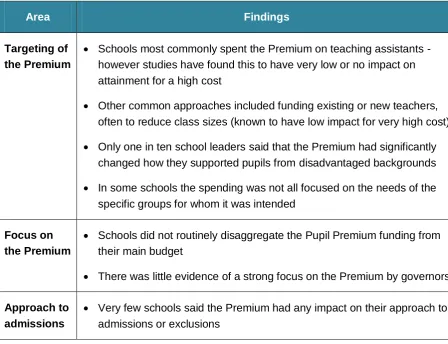
impact on student outcomes). The key findings identified in the report are outlined in the following table.9
Table 1: Key findings on the use of the Pupil Premium
Area Findings
Targeting of the Premium
Schools most commonly spent the Premium on teaching assistants - however studies have found this to have very low or no impact on attainment for a high cost
Other common approaches included funding existing or new teachers, often to reduce class sizes (known to have low impact for very high cost) Only one in ten school leaders said that the Premium had significantly
changed how they supported pupils from disadvantaged backgrounds In some schools the spending was not all focused on the needs of the
specific groups for whom it was intended
Focus on the Premium
Schools did not routinely disaggregate the Pupil Premium funding from their main budget
There was little evidence of a strong focus on the Premium by governors
Approach to admissions
Very few schools said the Premium had any impact on their approach to admissions or exclusions
With regard to targeting the Premium, research from the Sutton Trust has highlighted the importance of targeting resources appropriately to ensure that they have an impact on raising standards. Indeed, there is no direct link between spending on schools and student outcomes.10 In light of these findings, the Ofsted report made a number of recommendations, including:11
School leaders should ensure that the Pupil Premium funding is carefully targeted to the designated children and not simply absorbed into mainstream budgets;
School leaders should evaluate their Pupil Premium spending and spend it in ways known to be most effective in raising attainment;
9
Ofsted (2012) The Pupil Premium Manchester: Ofsted and Higgins, S. et al. (2011) Toolkit of Strategies to Improve Learning- Summary for Schools spending the Pupil Premium Durham University: The Sutton Trust
10
Higgins, S. et al. (2011) Toolkit of Strategies to Improve Learning- Summary for Schools spending the Pupil Premium Durham University: The Sutton Trust
11
If schools do not target Pupil Premium money effectively, government should
consider ring-fencing, payment linked to outcomes, or other mechanisms
to improve its use.
One study suggests that additional funding for disadvantaged pupils must be accompanied by information on which incentives are most effective, as well as incentives for schools to put the money to the most appropriate use.12
Views on the Premium for looked-after children
A recent report highlighted low levels of awareness of the Pupil Premium among professionals working with looked-after children, with only half aware of the Premium. The report concluded that while the introduction of the Pupil Premium for looked-after children was a positive step in itself, initial feedback on its application was not
consistently positive. It recommended that:13
Guidance should be strengthened and there should be better collection of data on the progress of looked-after children; and
Those caring for looked-after children should have direct involvement in the decision-making process around how the Premium is spent.
The latter recommendation includes a suggestion that local authorities in England should pilot using the Pupil Premium in line with arrangements in place within the Fostering Network’s Fostering Achievement model in NI. This model involves a direct link with foster carers who help to decide how the educational needs of the children in their care should be met. Foster carers are supported to enable them to do so.
4
Potential cost of the Pupil Premium in NI
The cost of providing the Pupil Premium in England was £1.25bn in 2012/13. Figure 1 gives an estimation of what the Pupil Premium would have cost in 2011/12 in Northern Ireland if provided for all pupils with FSME and looked-after children at primary, post-primary and special schools (around £45m).14
If the Pupil Premium was provided at £900 per pupil, the total cost would have been around £67.5m. Please note: these estimations are based on the cash value of the Pupil Premium only, and do not take into account any potential costs associated with administering the Premium.
12
Clifton, J. and Cooke, W. (2012) A long division London: Institute for Public Policy Research
13
The Who Cares? Trust (2012) Open Doors, Open Minds: Is the care system helping looked-after children progress into further and higher education? London: The Who Cares? Trust
14
Figure 1: Estimation of the cost of the Pupil Premium in NI (2011/12)
Pupils with FSME
Looked-after
children
Total Pupil Premium
cash value
Total cost
73,605 1,445 75,050 x £600 = £45,030,000
It is important to note that there is a general upward trend in the number of pupils with FSME in Northern Ireland, as outlined in Table 2. In 2007/08 there were 56,705 pupils with FSME (17% of the total school population), while in 2011/12 there were 73,605 pupils (22% of the total school population). If this trend were to continue the potential cost of a Pupil Premium here would increase.
Table 2: Pupils with FSME and looked-after children 2007-2012
2007/08 2008/09 2009/10 2010/11 2011/12
FSME Number 56,705 54,661 58,498 64,423 73,605
% of total enrolment 17.1% 16.6% 17.8% 19.6% 22.2%
Looked-after children
Number 1,002 1,065 1,171 1,263 1,445
[image:6.595.93.532.310.474.2]