This is a repository copy of
Multi-cultural visualization : how functional programming can
enrich visualization (and vice versa)
.
White Rose Research Online URL for this paper:
http://eprints.whiterose.ac.uk/1895/
Book Section:
Borgo, Rita, Duke, David, Wallace, Malcolm et al. (1 more author) (2006) Multi-cultural
visualization : how functional programming can enrich visualization (and vice versa). In:
Vision, Modeling, and Visualization 2006 : Proceedings, November 22 - 24, 2006. AKA
Verlag - IOS Press , pp. 245-252.
[email protected]
https://eprints.whiterose.ac.uk/
Reuse
Items deposited in White Rose Research Online are protected by copyright, with all rights reserved unless
indicated otherwise. They may be downloaded and/or printed for private study, or other acts as permitted by
national copyright laws. The publisher or other rights holders may allow further reproduction and re-use of
the full text version. This is indicated by the licence information on the White Rose Research Online record
for the item.
Takedown
If you consider content in White Rose Research Online to be in breach of UK law, please notify us by
VMV Copyright Notice
Title of Work: Multi-cultural visualization: How functional
programming can enrich visualization (and vice versa)
Author(s): Rita Borgo, David Duke, Malcolm Wallace, Colin
Runciman
Publication in the Proceedings of Vision, Modeling, and
Visualization 2006,
edited by T. Aach, C. Bischof, L. Kobbelt, R. Westermann
Copyright to the above work (including without limitation, the right
to publish the work in whole or in part in any and all forms of media,
now or hereafter known) is owned by the editors of Vision,
Modeling, and Visualization 2005. However, the authors are
permitted to publish author-versions of preprints. They must be
limited to non-commercial and personal use by others. If you agree
to these terms and are eligible for obtaining a copy, you may
Multi-cultural visualization: How functional programming can enrich
visualization (and vice versa)
Rita Borgo†, David Duke†, Malcolm Wallace‡, Colin Runciman‡
†School of Computing ‡Dept. of Computer Science University of Leeds University of York
Leeds, UK York, UK
Email:{rborgo,djd}comp.leeds.ac.uk {\{Malcolm.Wallace,Colin.Runciman}\}cs.york.ac.uk
Abstract
The past two decades have seen visualization flour-ish as a research field in its own right, with ad-vances on the computational challenges of faster algorithms, new techniques for datasets too large for in-core processing, and advances in understand-ing the perceptual and cognitive processes recruited by visualization systems, and through this, how to improve the representation of data. However, progresswithin visualization has sometimes pro-ceeded in parallel with that in other branches of computer science, and there is a danger that when novel solutions ossify into ‘accepted practice’ the field can easily overlook significant advances else-where in the community. In this paper we de-scribe recent advances in the design and implemen-tation of pure functional programming languages that, significantly, contain important insights into questions raised by the recent NIH/NSF report on Visualization Challenges. We argue and demon-strate that modern functional languages combine high-level mathematically-based specifications of visualization techniques, concise implementation of algorithms through fine-grained composition, sup-port for writingcorrect programs through strong type checking, and a different kind of modularity in-herent in the abstractive power of these languages. And to cap it off, we have initial evidence that in some cases functional implementations are faster than their imperative counterparts.
1
Visualization Goals
Visualization as a discipline is a relatively new con-cept. In 1987 the U.S. National Science Foundation (NSF) established a Panel of experts [1] to report
on the state and potential of visualization as a new science, bringing together graphics and computa-tional technologies. This was not the first promi-nent call to focus attention on visualization; as far back as 1966, Sutherland [2], following the tradition common to scientists and mathematicians of creing lists of important open problems to focus at-tention, had compiled a list of ‘unsolved problems’ in computer graphics. Nor was the 1987 NSF re-port the last word; several new lists have been com-piled since: a 1994 special Issue of IEEE Computer Graphics and Applications [17] was dedicated en-tirely to research issues in scientific visualization; in 1999 Hibbard [4] created a list of the top ten visu-alization open problems; and Johnson [5] presented a list of the most important issues crucial to the de-velopment of research in scientific visualization, a subset of which can be found in the recent official NIH/NSF report on Visualization Challenges [19].
Identifying a problem is a prerequisite to its so-lution, and such lists of open problems help to eval-uate the state of the art of a field and suggest new research directions. In the context of this paper we take the 2006 NIH/NSF report as representative of the major issues raised by the visualization commu-nity. The report is broad, and contains questions we do not even consider here. Rather, we focus our at-tention on a subset of the open problems, which we will look at from a perspective that spans research in both visualization and functional languages.
Domain Integration and Collaboration with Neighbouring Disciplines. There is a need at the domain level to focus on real rather than ideal data, addressing aspects like heterogeneity, change over time, error and uncertainty, scale and data scope. Scientific visualization is a cross-disciplinary pro-cess, statistics, data mining and image processing techniques play an important role in the understand-ing of a phenomena. New applications need to be able to easily integrate with techniques and tools coming from other disciplines.
Exploration of Novel Visualization Techniques and Metaphors. As datasets keep growing both in size and complexity, there is a need for ex-ploration of new visualization techniques and ap-proaches. Challenges coming from heterogeneous, multivariate, dynamic data require to easy iden-tify and qualify the design space of visualization techniques. Heterogeneities and complexity apply not only to datasets but also hardware resources. Rapid technology development asks for flexible techniques able to cope with the wide variety of available devices: high resolution and lightweight projectors, flat panel displays, ubiquitous technolo-gies etc.
Systems Evaluation. The field of visualization has unique evaluation challenges. Quantitative evaluation can be easily performed, measuring time and memory required by an application or algorithm, however such metrics do not provide any information about the qualitative impact of a system. Case studies are a means to achieve such an evaluation although they come at a stage where the system design has been already settled and is hard to modify deeply. The ability to develop prototype systems and perform usability studies is a winning quality. Although the outgrowth of these qualities relies in the ontological organization of the visu-alization process itself and in the formvisu-alization of visualization design. Formalization of visualization techniques and approaches (expressiveness of tools and design principles) would help in answering not only ‘whether’ something helps but also ‘why’ and ‘how’.
Scalability, efficiency in utilizing novel hard-ware, multifield visualization, visual abstraction are all requirements to allow visualization to
move from being seen as a postprocessing step of the scientific computing pipeline, to represent a more complex discipline able to merge different aspects of a common target: modeling, simulation and visualization of data. In the spirit of exper-imenting with novel approaches, we present in Section 2 some interesting aspects of functional programming that seem to answer some of the desired requirements outlined throughout the NSF report. We then take surface fitting techniques as an example and show in Section 3 results obtained by applying our approach to a well-known surface extraction algorithm: contour following.
2
Functional Programming Goals
Functional programming has at times been seen as an academic tool, an elegant but computation-ally expensive way of expressing basic problems like the Fibonnaci series or the Towers of Hanoi, or an obscure notation used in esoteric branches of AI such as theorem proving. While this could be partially true for earlier functional languages like Lisp, it no longer holds as a generalization. Modern functional languages such as Haskell [25], Gofer and Clean [24] have expressive polymorphic type systems and are inherently lazy; that is, un-like languages such as Lisp and ML, an expres-sion is evaluated at most once, if its result is re-quired to construct an output. They have been used within scientific domains and in graphics. For example, Chakravarty and Keller [14] develop a Haskell library to solve some of the problems aris-ing from sparse matrix multiplications, while Kar-czmarczuk [7] expresses some of the fundamentals of Quantum Mechanics in Haskell. Both Haskell and Clean have been employed in the development of videogames platforms including texture gener-ation [15] and mapping [8]. We consider visual-ization applications separately. Our concern here is how functional programming provides a view on NSF report challenges, different from the more incremental perspective of the technologies ‘tradi-tionally’ used in visualization.
Functional Languages as a Specification Tool
func-tions, means that type definitions act as a form of machine-checkable documentation. One finds that once a functional program is compile-time correct, there is more likelihood that it is run-time correct than for other classes of language, both because the type system captures more (e.g. constraints on types), and because through fine-grained composi-tion, it is harder to put together two components that don’t make sense. Dually, function specifica-tion deals only in data-flow,whatthe function does; there is no prescription ofhowthe result is com-puted1. Programs expressed in a functional lan-guage are also concise, making it easier to com-prehend significant computational patterns directly. In contrast, description of imperative algorithms re-quire more use of natural languages to distinguish the ‘what’ from the ‘how’; and the pitfalls of natu-ral languages as a specification technique are well known.
Heterogeneity of data and data-structure A
polymorphicfunction is one that is independent of the type of data on which it operates; for example, computing the length of a list is independent of the kind of data held in the list. Polymorphism sup-ports one kind of generic programming, but recent advances in this area make it possible to go further. Apolytypicfunction is generic over the organiza-tion of its data; thus a polytypic ‘size’ funcorganiza-tion can generalize the notion of ‘length’ from just lists to a whole class of data organization that includes trees and queues. Such a function is written only once, defined over the structure of types, and can then be applied to most types. The ability of generic pro-gramming to address heterogeneity issues in visu-alization draws critically on the ‘functional’ aspect of FP. Functions are first-class citizens: they can be passed as parameters, and returned as results, from so-calledhigher-order functions. These ab-stract from common patterns of computation, for example we can map a function over a data struc-ture to produce a new version of the strucstruc-ture but where individual data have been transformed by the function.
System Evaluation Although functional pro-grams can be judged quantitatively just like their
1This applies also to seemingly ‘imperative’ features like IO
and exception handling, which in functional languages are handled through composition ofcommandswithin a mathematical structure called a monad.
imperative counterparts, they also admit to a quali-tative evaluation. The inherent mathematical struc-tures and foundations of systems based on func-tional programming make them amenable to proof of correctness:
• each function in a program corresponds to a referentially transparent equation, i.e. it is in-dependent of any dynamic global state • each side-effect-free equation can therefore be
tested or analysed separately from the rest of the code, with full confidence of completeness.
Functional programs can be used as specification of final products that will be implemented in a proce-dural language thus acting as an executable speci-fication of an algorithm while being a program as well. This property makes them suitable to be used for prototyping, furthermore since they resemble a collection of mathematical equations, functional programs are ruled by the ordinary laws of mathe-matics and thus easier to derive, transform and ver-ify.
3
Merging The Two Views
As a starting benchmark and illustrative exam-ple, we choose a widely used surface extraction algorithm—contour following—and the lazy func-tional language Haskell, to show the benefits of clear and concise expression combined with fine-grained, demand-driven computation. As visualiza-tion provides insight into data, funcvisualiza-tional abstrac-tion provides new insight into visualizaabstrac-tion.
3.1 Contour Following Functionally
Contour following defines a class of algorithms which are capable of preserving both coherence and connectivity of cells. The algorithm’s behaviour can be summarized as follow:
1. choose a cell that intersects with the field value;
2. construct the surface representing the intersec-tion of cell and field;
3. for each face of the cell that intersects with this surface, the adjacent cell must also intersect with the surface;
4. followthe surface into each adjacent cell re-peating steps 2 to 4 for that cell.
The aforementioned process guarantees continuity and topological connectivity of the generated con-tour, cells are reached through a path of neighbours and inspected only if intersected by the contour. The contour following method sketched above pro-duces only a single connected contour, however a single field value usually corresponds to multiple contours and therefore multiple starting cells are needed. Such cells are calledseeds, and a set of cells that represent the starting point from which all possible contours in a field can be generated is called aseed set. A seed cell is traditionally com-posed by three fields: an identifier within the seed set, its (i,j,k) indices within the dataset and the range of spanning values. Our implementation of the seed structure in Haskell looks as follows:
data Seed a = S PostCode Address (Range a) deriving (Eq, Show)
type PostCode = Int
type Address = (Int, Int, Int)
data Range a = Range a a
| Empty deriving (Eq, Show)
A seed cell is represented as analgebraic data type. Algebraic data types in Haskell are intro-duced by the keyworddata, followed by the name of the type (in our exampleSeed), an equal sign and then theconstructors(in our example S) of the type being defined. A constructor builds a record from several other types (here,PostCode,
Address, and Range are the components of a
Seed), and can also be used to pattern-match (or destruct) a record.2 The name of types and of con-structors begin with capital letters. The type vari-able (lower-casea) in theSeedtype indicates that the type of the samples themselves is generic (poly-morphic). Generic programming is an important concept for software development and many mod-ern programming languages provide support for it. Haskell itself provides polymorphic functions and datatypes which together are sufficient to imple-ment polymorphic data structures. As for [16] with respect to generics, modern functional languages provide an expressive power which languages like Java, C# and C++still lack (although language sup-port for generics of these language is continuing to evolve). In the present context genericity is shown in the possibility to reuse the algorithm with bytes, signed words, floats, complex numbers, and so on without change, although it could be pushed much further.
The typesPostCodeandAddressare declared as synonyms for a triple and an integer element.
Rangeis another algebraic data type, polymorphic on the type variablea, as previously explained, and with twoconstructors,RangeandEmpty, which define respectively a proper Range with two ex-tremes (a a) or an Empty range. Thederiving
clause after the Seed (and Range) datatype decla-ration states that the compiler shall implicitly pro-duce an instance of the classesShowandEqfor the newly defined datatype Seed. BothShowandEq
are built-in classes of Haskell;deriving Show
tells the compiler that it can automaticallyderive
a suitable implementation for theshowand read
functions; deriving Eqtells the compiler that it can generate a suitable implementation for equal-ity==. Haskell’s classes have a surface similarity to 2In general, a data definition may introduce several
al-ternative constructors for a given type; for example, a type
object oriented classes, but in fact the system is in-dependent of any specific data representation; only the common behaviours are factorized. This allows to model properties retroactively, currently avail-able only in Haskell and ML derived languages.
Let’s move to the real algorithm specification. In the Haskell implementation we have split the con-tour following algorithm into two main functions:
• Traverse Seeds: which given a seed set and a threshold value, searches the seed set for all the cells that constitute a seed for the given value;
• Grow Contour: which given a seed grows the contour, following the contour path through cells adjacent to the seed.
In Haskell:
traverse_seeds :: Dataset a → a → [Seed a] → [Triangle]
grow_contour :: Dataset a →a →a →[Triangle]
These two declarations represent the type sig-natures of the functions. The first type signature shows thattraverse seeds takes three argu-ments, a dataset, a value and a list of seeds (i.e. the seed set), and returns a list of Triangles approx-imating the surface (the triangles can be directly fed up into OpenGL through the Haskell wrapper HOpenGL for rendering). We skip the trivial def-inition of the Dataset datatype since it is se-mantically similar to the earlier datatype definition for Seed. The second type signature shows that
grow contourtakes three arguments, a dataset and two values, and returns a list of triangles as well. The implementation of the two functions is as follows:
traverse_seeds d thr seeds
= concat $ map (grow_contour d thr) $ filter (contains thr) seeds where
contains thr (Seed _ _ r) = thr ‘inR‘ r
grow_contour d thr (Seed c _ _) = grow_from d thr (enQueue c)
(MS.insert c MS.empty)
In Haskell, application of a function to arguments is by juxtaposition – no parentheses are needed – so in the definition oftraverse seeds, the argu-ments ared(the dataset),thr(the isovalue thresh-old) andseeds (the seed set). Thecontains
function tests if a seed is intersected by the isovalue
checking if the threshold value is ‘in’ (inR) the seed ranger. The underscore keyword is called
wildcard, it is normally used to replace parame-ters that are not needed or that can be replaced by anything, in the present case since only the range field is used on the right-hand side ofcontains, the first two components of Seed (PostCodeand
Address) can be replaced by the wildcard. It is at this point important to introducehigher-order func-tions. From the very name “functional language” one can surely guess that functions are important. Indeed, passing functions as arguments, and receiv-ing functions as results, comes entirely naturally. A function that receives or returns a function is called higher-order. An example of higher-order function ismap, which takes a functionfand applies it to every element of a sequence:
map :: (a→b) → [a] → [b] map f [] = []
map f (x:xs) = f x : map f xs
This definition uses pattern-matching to distin-guish the empty sequence [], from a non-empty sequence whose initial element isx, with the re-mainder of the sequence denoted byxs. Colon:
is used both in pattern-matching, and to construct a new list. Thefilterfunction is another example of a higher-order function; when applied to a pred-icate function and a list, it returns the list of those elements that satisfy the predicate.
In the definition of traverse seeds,
filter removes from the seed set all the seeds that do not contain the given threshold value,
mapthen appliesgrow contourto each of the remaining elements in the filtered seed set. The
$ symbol is a Haskell operator that expresses right-associative binding precedence, in some cases it allows parentheses to be omitted, and to make the code better readable, e.g.
f $ g $ h x = f (g (h x))
visited cells, an imperative implementation might implement a bit-array; here, we can simply draw on a standard generic library for sets, and write
type MarkSet = MS.Set Int
specialising the generic type into one that stores the integers used to refer to cells in the dataset (the
MS prefix is used to qualify definitions imported from the set library and prevent name clashes). The traversal is performed by thegrow fromfunction;
enQueue is a Haskell library function, polymor-phic over the type of element stored in the queue structure (in this case, a PostCode):
grow_from :: Dataset a → a → Queue PostCode
→ MarkSet → [Triangles]
grow_from d thr q marked =case viewList q of
Empty → [] (cell : rear) →
let neighbours = continuations d thr cell unvisited = filter (¬⋅(MS.member
marked)) neighbours q’ = foldl (|>) rear unvisited marked’ = foldl MS.insert marked
unvisited
in (mcube (at g) (address d cell) thr)++ (grow_from d thr q’ marked’)
grow from consumes all the seeds contained
in the postcode queue. The continuations
function given a location within a grid and a contour value, determines the neighbouring (neighbours) locations that will also intersect that contour. A neighbour is valid if the face de-fined by the intersection between it and the current cell has a range that includes the threshold.
continuations :: (Ord a) => Dataset a → a → Int → [Int] continuations d thr code =
map encode $ filter penetrates [ (i>0, [v0,v1,v2,v3], (i−1,j,k))
,(i<isz−2, [v4,v5,v6,v7], (i+1,j,k)) ,(j>0, [v0,v2,v4,v6], (i,j−1,k)) ,(j<jsz−2, [v1,v3,v5,v7], (i,j+1,k)) ,(k>0, [v0,v1,v4,v5], (i,j,k−1)) ,(k<ksz−2, [v2,v3,v6,v7], (i,j,k+1)) ] where
(i,j,k) = address d code
penetrates (non_boundary, vs, _) = non_boundary ∧ thr ≥ minimum vs
∧ thr ≤ maximum vs encode (_, _, addr) = postcode d addr line = isz
plane = isz*jsz v0 = d!(code) v1 = d!(code+line) ...
v7 = d!(code+plane+line+1)
The predicate Ord a constrains the polymor-phism: samples must have ordering operations de-fined over them. Functionpenetratesjust tests if the cell is on the boundary, whileencode re-turns the cell index inside the dataset interpreting its postcode and address; isz, jsz, ksz are the three dimensions of the dataset along the x,y,z axes. The v0 ...v7 represents the indices to the eight neighbouring cells computed sweeping the dataset with a plane (in this case samples are spread over a regular grid). The map function iterates
penetrates over each of the elements within
the list. Note that if one of thenon boundary -tests fails, the remainder of the expression is not evaluated and the corresponding vinot computed.
The aforementioned behaviour allows for clean-ing the code from extra statements like redundant
if . . . then . . . else or extra function or exception guards, making the code much more compact.
unvisitedcontains all the neighbouring cells that have yet not been visited whileq’ contains the new queue to which all the unvisited neigh-bours have been added. marked’ instead repre-sents the new markset to which the indices of the tested (therefore “traversed” in terms of threshold intersection) neighbouring cells have been added. Thefoldl function is another mportant higher-order function in Haskell. A fold applies a func-tion to a list in a similar way to map, but it accu-mulates a single result instead of a list.foldlis a left-associative type of fold which processes the list from left to right:
foldl :: (a → b → a) → a → [b] → a foldl f z [] = z
foldl f z (x:xs) = foldl f (f z x) xs
In the present casefoldlapplies the merging operator (|>) on the two parametersrear(back of the Queue) andunvisited(list of cells belong-ing to the neighbourhood ofcell). An interesting aspect of the present code is themcubefunction which corresponds to the Haskell implementation of the Marching Cubes approach. The Marching Cubes code, implemented in an optimized version in [13], has been easily re-used within the contour following implementation.
mcube :: a → (PostCode→Cell a) → PostCode → [Triangle]
mcube thresh lookup (x,y,z) = group3 (map (interpolate thresh cell
where
cell = lookup (x,y,z)
bools = toByte (map8 (>thresh) cell)
Thecellof vertex sample values is found us-ing thelookupfunction that has been passed in. We derive an 8-tuple of booleans by comparing each sample with the threshold (map8is a higher-order function likemap, only over a fixed-size tuple rather than an arbitrary sequence), then convert the 8 booleans to a byte (bools) to index into the clas-sic case table. The result of indexing the table is the sequence of edges cut by the surface. Usingmap, we perform the interpolation calculation for every one of those edges, and finally group those interpo-lated points into triples as the vertices of triangles to be rendered. The linear interpolation is standard:
interpolate ::Num a => a → Cell a → PostCode
→ Edge → TriangleVertex
interpolate thresh cell (x,y,z) edge = case edge of
0 → (x+interp, y, z) 1 → (x+1, y+interp, z) ...
11 → (x, y+1, z+interp) where
interp = (thresh − a) / (b − a) (a,b) = selectEdgeVertices edge cell
Althoughinterpolatetakes four arguments, it was initially applied to only three in mcube. This illustrates another important higher-order tech-nique: a function of n arguments can be
par-tially appliedto its firstkarguments; the result is
a specialised function of n−k arguments, with
the already-supplied values ‘frozen in’. The predi-cateNum aconstrains the polymorphism: samples must have arithmetic operations defined over them.
3.2 Observations
The code developed so far features some of the interesting properties of a language like Haskell. While code readability can be seen as a matter of personal flavour, expressiveness and abstract power of the language make the code much more com-pact and clean with respect to the original imper-ative coding of the same algorithm. A scientist, researcher or teacher does not always cope easily with high tuned but illegible code: when the desired aspect is the methodology of the computation, a more abstract approach to programming is needed. Haskell syntax is extremely compact, the elegant
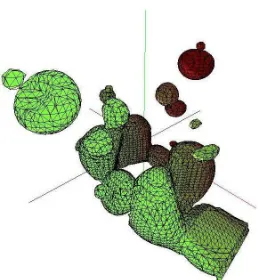
use of layout allows to get rid of redundant key-words and parentheses (i.e. indenting means contin-uation of the previous construction). The possibil-ity to partially “clean” the code from administrative details like verbose loops with dozens of exception guards is a real gain. Support for type aliasing re-stricts the verbosity of complex data structures es-pecially when dealing with generic data. The pro-cesses of thinking, algorithmization and coding are intertwined in our specification: although the above code is high-level and uses simplistic type struc-tures, it is already complete and executable (Fig-ure 1 is the result of applying the given code to a seed set generated for the neghip dataset), and can be used to test the correctness of the specification. The functional specification can be used as an ex-ecutable program specification (formal prototype) even if the final product must be implemented in a procedural language.
4
Considerations
Figure 1: Isosurface Extraction from a Set of Seeds generated for the Neghip dataset. Different colors indicate different seeds.
Marching Cubes and Marching Tetrahedra with a functional approach [13] can outperform the VTK counterparts for certain large datasets. The pur-pose of this work is not claim that functional ap-proaches should replace optimized imperative code. We show instead how functional programming can be successfully applied to face some of the prob-lems peculiar to the visualization field, and how it represents a challenging field worthy of further investigation if we wish to gain useful insight on topics where the integration of results and tech-niques, human collaboration, and a need for general reusable patterns play a master role.
References
[1] B. McCormick and T. DeFanti and M. Brown. Vi-sualization in scientific computing.Journal of Com-puter Graphics,21, 1987
[2] I. E. Sutherland. Ten Unsolved Problems in Com-puter Graphics.Journal of Datamation,12(5):22– 27, 1966
[3] J. Blinn. Keynote Address: SIGGRAPH 98.Journal of Computer Graphics,33(1):43–47, 1999 [4] B. Hibbard. Top Ten Visualization Problems.
Jour-nal of Computer Graphics,33(2):21-22, 1999 [5] C. Johnson. Top Scientific Visualization Research
Problems.Journal of IEEE Computer Graphics and Applications24(4):13–17, 2004
[6] A. U. Frank, and W. Kuhn.Lecture Notes in Com-puter Science,951:184, 1995
[7] Jerzy Karczmarczuk. Scientific computation and functional programming. Comput. Sci. Eng., 1(3):64–72, 1999
[8] M. Wiering and P. Achten and M. J. Plasmeijer, Using Clean for Platform Games. InLecture Notes
in Computer Science: Selected Papers from the 11th Int. Workshop on Implementation of Func-tional Languages1868:1–17, 2000
[9] W.E. Lorensen and H.E. Cline. Marching cubes: A high resolution 3D surface construction algorithm. In. SIGGRAPH,1987, 163–169
[10] C. Elliott. Programming graphics processors func-tionally. InACM SIGPLAN Workshop on Haskell, 2004, 45–56
[11] J. Fokker Functional Specification of JPEG Decom-pression, and an Implementation for Free. InEG Workshop on Programming Paradigms in Graphics 1995, 102-117
[12] R. L. Page and B. D. Moe Experience with a large scientific application in a functional language. In Int. Conf on Functional programming languages and computer architecture1993, 3–11
[13] D. Duke and M. Wallace and R. Borgo and C. Runciman. Fine-grained Visualization Pipelines and Lazy Functional Languages. InIEEE Visualization Conf.,2006, (under final review)
[14] M. Chakravarty and G. Keller. An Approach to Fast Arrays in Haskell. In Advanced Functional Pro-gramming2002, 27–58
[15] J. Karczmarczuk. Functional Approach to Texture Generation. InPADL ’02: Proceedings of the 4th International Symposium on Practical Aspects of Declarative Languages2002, 225–242
[16] R. Garcia and J. Jarvi and A. Lumsdaine and J.G. Siek and J. Willcock. A comparative study of lan-guage support for generic programming. In OOP-SLA ’03: Proceedings of the 18th annual ACM SIG-PLAN conference on Object-oriented Programing, Systems, Languages, and Appl.2003, 115–134 [17] L.J. Rosenblum. Research Issues in Scientific
Visu-alization. InIEEE Computer Graphics and Applica-tionsvol.14, n.2, March/Apr 1994
[18] J. Blinn, What I Like and Don’t Like About the State of Visualization Today. InVIS ’03: Proc. of the 14th IEEE Visualization 2003 (VIS’03), 2003, 68 [19] C. R. Johnson and R. Moorehead and T. Munzner
and H. Pfister and P. Rheingans and T. S. Yoo. NIH-NSF Visualization Research Challenges Re-portIEEE Press, 2006
[20] P. S. Heckbert. Ten Unsolved Problems in Rendering-Workshop on Rendering Algorithms and Systems.1987
[21] A. Moran Report on the First Commerical Users of Functional Programming Workshop, 2004 P. Wadler, University of Edinburgh.
[22] C. L. Bajaj and V. Pascucci and D. R. Schikore Seed Sets and Search Structures for Optimal Iso-contour Extraction.Technical Report 99-35, Austin, TX, 1999
[23] N. Nethercote and A. Mycroft The cache behaviour of large lazy functional programs on stock hard-ware. InMSP ’02: Proceedings of the 2002 work-shop on Memory system performance, 2002, 44–55 [24] Cleanhttp://www.cs.ru.nl/ clean