S T U D Y P R O T O C O L
Open Access
Does neurocognitive training have the
potential to improve dietary self-care in
type 2 diabetes? Study protocol of a
double-blind randomised controlled trial
Victoria Whitelock
1, Arie Nouwen
1*, Katrijn Houben
2, Olga van den Akker
1, Iraida Neira Miller
3, Parth Narendan
4,
Miranda Rosenthal
5and Suzanne Higgs
3Abstract
Background:Dietary self-care is a key element of self-management in type 2 diabetes. It is also the most difficult aspect of diabetes self-management. Adhering to long-term dietary goals and resisting immediate food desires requires top-down inhibitory control over subcortical impulsive and emotional responses to food. Practising simple neurocognitive tasks can improve inhibitory control and health behaviours that depend on inhibitory control, such as resisting alcohol consumption. It is yet to be investigated, however, whether neurocognitive training can improve dietary self-care in people with type 2 diabetes. The aim of this randomised controlled trial is to investigate whether web-based neurocognitive training can improve the ability of people with type 2 diabetes to resist tempting foods and better adhere to a healthy dietary regime.
Methods/design:In a double-blind multicentre parallel-group randomised controlled trial, 48 patients (based on power analysis results) with type 2 diabetes recruited from secondary health care services in Birmingham and London, will be randomly allocated to either 25 online sessions of active or control working memory training. Selection criteria include being overweight/obese, having poor diabetes control and reporting to have difficulty following a healthy diet, but having good general health otherwise. Before, immediately after and 3 months after the training, assessment sessions will be conducted. Primary outcome measures include changes in working memory capacity, lab-based food intake and a 24-h guided food recall. Secondary outcome measures include changes in glycaemic control (HbA1c) and lipids. Participants’experiences of the training will be assessed qualitatively with semi-structured interviews post-training.
Discussion:This is the first trial investigating whether working memory training can improve dietary self-care in people with type 2 diabetes. If effective, this could prove to be a low-cost, easy to do online training that can be used long-term without side effects.
Trial registration:Current Controlled Trials ISRCTN22806944
Keywords:Type 2 diabetes, Working memory, Inhibitory control, Dietary self-care, Food
* Correspondence:[email protected] 1
Department of Psychology, School of Science and Technology, Middlesex University, The Burroughs, Hendon, London NW4 4BT, UK
Full list of author information is available at the end of the article
Background
Dietary self-care is a key element of self-management in people with type 2 diabetes. To reduce the risk of devel-oping both short- and long-term physical complications, patients are encouraged to reduce their energy intake and to adopt a well-balanced diet that is low in fat and sugar and high in fibre. However, many have difficulty following this advice [1]. Moreover, those who do adhere to their dietary recommendations often report feeling deprived and experiencing cravings for foods [2, 3]. The difficulties with following this diet and the burden re-ported by many patients together with treatment dissat-isfaction have a direct effect on patient’s self-reported quality of life [4, 5]. The modern food environment makes adherence to this diet especially difficult, with in-creases in availability, accessibility and convenience of high energy-dense food [6]. Advertising for such foods is also omnipresent and highly persuasive [7]. This pre-sents a major challenge for anyone attempting to main-tain a healthy diet, as exposure to food cues can lead to both cravings and overconsumption of these foods [8, 9]. In order to maintain a healthy diet, it is therefore essen-tial to resist immediate temptation and focus on more distal goals. While dietary changes can be effective in improving glycaemic control [10], dietary self-care is generally poorly performed [11], and simple advice- and motivation-based interventions have had limited effects in improving this [12]. Novel and effective strategies to help people with type 2 diabetes that adhere to dietary recommendations are therefore needed.
Being able to resist tempting food requires adhering to long-term health goals and not giving in to short-term immediate desires. Dual-process theories of behaviour posit that the ability to do this depends on the balance between two different cognitive systems that control be-haviour [13]: the reflective system, which promotes con-trolled, reflective behaviour and the impulsive system which promotes impulsive, automatic behaviour. The reflective system can exert inhibitory control over the impulsive system and is able to suppress its effects on behaviour (although not fully). When this occurs, self-control and resisting tempting foods is more likely to follow. Inhibitory control is therefore an important ex-ecutive function implicated in the control of eating be-haviour. Indeed, inhibitory control has been related to overeating and obesity. People with high impulsivity/ weak inhibitory control are more likely to overeat [14, 15] and be overweight/obese [16, 17]. Other work has specifically demonstrated that when inhibitory control is low, eating behaviour is more strongly guided by impulsivity [18–20]. Suppression of auto-matic, motivational, impulsive responses to food how-ever improves the ability to resist consumption of desirable food items [15, 21].
Neuroimaging evidence has found that people with type 2 diabetes (compared to body weight matched healthy controls) show greater neural activity in subcor-tical areas of the brain in response to food cues [22]. These subcortical areas are part of the brain’s impulsive system [23]. There was also greater activity in response to food pictures in cortical areas including the orbito-frontal cortex and insula [22]. These regions are part of the reflective system and as such are important for in-hibitory control and restraining immediate desires in favour of long-term outcomes [23]. This neuroimaging study further showed that increased activity in cortical areas was associated with better self-reported dietary self-care, whereas activity in subcortical areas was associ-ated with poorer dietary self-care [22]. These findings sug-gest that interventions aimed at maximising inhibitory control may improve dietary self-care in type 2 diabetes.
Working memory capacity is an important executive control ability that has been shown to moderate the role of impulsive processes in predicting health behav-iours. In people with low working memory capacity (compared to those with high working memory capacity), impulsive processes are better predictors of alcohol consumption [24, 25], cigarette use [25] and un-healthy food consumption [26, 27]. Diabetes is associ-ated with a range of cognitive impairments [28], and deficits in executive functioning in particular (including working memory) could be contributing to difficulties in controlling food intake [29]. Evidence from studies of top-down inhibitory control demonstrate that train-ing worktrain-ing memory (WM) can improve inhibitory control and change behaviour in a variety of clinical contexts, including in children with attention-deficit hyperactivity disorder [30, 31], in older people [32], problem drinkers [33] and stimulant drug abusers [34]. For example, working memory capacity increased and alcohol consumption decreased for more than 1 month afterwards in problem drinkers who underwent 25 ses-sions of online WM training [33]. Working memory training is believed to work by increasing activity in the prefrontal cortex, another part of the reflective system [35]. Given that common mechanisms are known to underlie responses to palatable foods and addictive sub-stances like alcohol [36], these data suggest that cogni-tive training could be effeccogni-tive in strengthening the ability to resist tempting foods and hence improve diet-ary control in people with type 2 diabetes.
Aims and hypotheses
Primary outcome measures
It is expected that WM training will enhance working memory capacity and reduce high-energy-dense food in-take. It is important to demonstrate that the WM train-ing effects transfer to other measures of worktrain-ing memory (to help rule out simple practice effects); there-fore, both the trained and novel non-trained tasks will be used to assess working memory and executive func-tioning. Changes in food intake will be measured at a lunch buffet in the laboratory and via a 24-h food recall task to obtain a measure of usual food intake outside of the laboratory.
Secondary outcome measures
It is expected that WM training will reduce lipid and glycated haemoglobin (HbA1c) blood levels. HbA1c is considered a long-term measure of diabetes control, and hence, this will test the longer term effects of the train-ing. Lipid blood levels will act as a biological measure of food intake; if less high-energy-dense food is consumed, lipid blood levels should be lower. Participants’ experi-ences of the training will be assessed qualitatively with semi-structured interviews post-training.
Methods/design
Ethics
This study has been approved by the Middlesex University Ethics Committee and by an NHS Research Ethics Committee. Prior to this, the study was reviewed by the Research Committee of Diabetes UK.
Design and participants
This is a randomised, double-blind 2 (condition: active training, passive control training) × 3 (time point: pre, post, follow-up) factorial design study. This multisite project will run in London and Birmingham, UK. Partici-pants will be a total of 48 NHS patients with type 2 dia-betes recruited from diadia-betes clinics at local hospitals. Patients will be informed about the research by their health care professional initially, and the researcher will be present in clinics to provide further information and answer questions. Upon acceptance to participate, the first pre-training assessment session will be arranged. Assessments will occur at baseline, immediately after and 3 months after completion of the training. Inclusion criteria are (1) have had type 2 diabetes for 2 years or more, (2) poor diabetes control (HbA1c >64 mmol/l), (3) self-reported difficulty following a healthy diet, (4) general good health, (5) overweight with a BMI≥25 and (7) treatment of diabetes can include diet only, tablets or insulin (for at least the last 6 months). Exclusion criteria are (1) neurological or psychiatric disorders, including eating disorders and clinical depression, (2) recent (within the last 6 months) changes in diabetes treatment
(e.g., transfer to insulin), (3) alcohol and/or substance abuse and (4) treatment by GLP-1 or DPP-4 inhibitors. The participants will be reimbursed £10 for travel ex-penses for each of the three assessment sessions.
Power calculation
The power calculation for this study was based on Hou-ben et al.’s working memory training study in problem drinkers [33]. In this study, working memory training re-sulted in a large effect size of 0.27 for the interaction be-tween time and condition. We anticipate a similar large effect size in our sample. Thus, using a 2 (condition: ac-tive, passive control) × 3 (time point: pre, post, follow-up) within-between design and assuming correlations among measures of 0.4 and a non-sphericity correction of 0.6, the estimated sample size should be at least 20 participants per group when power is set at 0.80 andp< 0.05. Based on previous experience with longitudinal stud-ies, we expect an attrition rate of 15–20 %. Therefore, we will recruit a minimum of 24 participants per group to ac-count for possible attrition (total sample sizeN =48).
Randomisation and blinding
The participants will be randomly allocated to either the active or passive control training conditions using an on-line program-generated block randomisation list (blocks of ten, [37]). Condition allocation will take place during the pre-training assessment session when the participant signs up to the online training program. Both partici-pants and the researchers conducting the assessment sessions will be blind to the training condition partici-pants were allocated to.
Training program
There will be two training conditions: active and pas-sive control training. In the active training condition, the difficulty level closely follows the working memory cap-acity of the participant. Following two correct answers, the number of items to remember increases by 1. Fol-lowing two incorrect answers, the number of items to remember decreases by 1. In the passive control condi-tion, the participants complete the same set of three tasks, but the difficulty level remains low so as to not train WM. The active rather than passive control group allows us to control for expectancy effects, as well as any effects that may occur due to repeated use of computers and adhering to a training schedule.
Primary outcome measures
Working memory capacity (trained tasks)
The three tasks used in the training program will also be used in an assessment version. In the assessment ver-sion, the number of items to remember for each task be-gins low (three items) and increases by one following two consecutive correct answers. When two incorrect answers are given, the task is terminated. The longest se-quence of items correctly recalled for each of the three tasks is summed and averaged to provide a measure of WM capacity across the three WM tasks.
Working memory capacity (non-trained tasks)
These will consist of the Cambridge Neuropsychological Test Automated Battery (CANTAB, Cambridge Cogni-tion, Cambridge, UK) Attention Switching Task, Paired Associates Learning, Spatial Span and Spatial Working Memory tasks. The Spatial Span and Spatial Working Memory tasks measure working memory ability/capacity. The Paired Associates Learning task measures visual memory and new learning. The Attention Switching Task measures interference of irrelevant information and hence top-down cognitive control processes. Outcome measures for these tasks will include reaction times, error scores, span length and memory scores.
Lab-based food intake (lunch buffet)
The participants will be provided with a staple lunch food item (egg sandwiches or cheese sandwiches) along with six different snack foods. The weight (in grams) of the snack foods has been calculated so that a similar vis-ual amount of each food is provided. Three of the snack foods are low energy dense (carrot sticks ~110 g, ~44 kcal; plum tomatoes ~139 g, ~28 kcal; salt and vin-egar rice cakes ~10.5 g, ~40 kcal) and three are high en-ergy dense (ready salted crisps ~25 g, ~133 kcal; chocolate chip cookies ~64 g, ~323 kcal and cheese and onion rolls ~93 g, ~283 kcal). The cookies, rice cakes, cheese and onion rolls and the sandwiches will be broken up into smaller pieces to prevent the participants
from counting the number of items they eat and this in-fluencing their intake. The food will be weighed before and after the lunch buffet (out of sight of the partici-pant) and used to calculate how much was eaten by sub-tracting the post-buffet weight from the pre-buffet weight of each food.
Non-lab-based food intake (24-h guided recall)
The participants will be asked to write down everything they ate and drank on the previous day. This is a guided recall procedure which asks the participants about the time, location and eating companions of the meal [39]. While this approach covers only a limited sample of an individual’s food intake, research has shown that this method provides an accurate and representative picture of usual food intake [40]. The number of low- and high-energy-dense food and drink items reported will be totalled as a measure of food/drink intake. The par-ticipants will also be asked how many junk food items and portions of fruits and vegetables they usually eat per day.
Secondary outcome measures HbA1c and lipids
HbA1c and lipid levels will be assessed by taking blood samples which will be sent for analysis at the hospital laboratories.
Semi-structured interviews
The semi-structured interviews will take place at the end of the post-training assessment session. The purpose of this is to understand people’s experiences of the training. The participants will be asked about what they had hoped to gain from the training, their experiences of it, how they managed to include it into their life and how the training affected their eating habits and the control of their diabetes.
Other measures
of diabetes diagnosis, how the diabetes is controlled, exist-ence of co-morbid conditions). Illness-related information will be collected at each of the three assessment sessions to track any changes in co-morbid conditions and diabetes treatment. Mood and hunger will be measured both be-fore and after the blood tests, computer tasks and lunch buffet, as these could influence task performance [49–51]. Food-specific inhibition will be assessed using a food go/ no-go task. This task consists of 200 trials split across four blocks. In blocks one and two, the participants are instructed to respond (press the space bar on the key-board) when they see a picture of toiletries and to with-hold a response when they see sports-related pictures. In blocks three and four, the participants are instructed to re-spond to pictures of stationary and withhold responses to food-related pictures. Fewer commission errors (respond-ing to no-go trials) on no-go food picture trials compared to no-go sports objects trials will indicate greater baseline food-specific inhibitory control ability.
Procedure
Assessment sessions
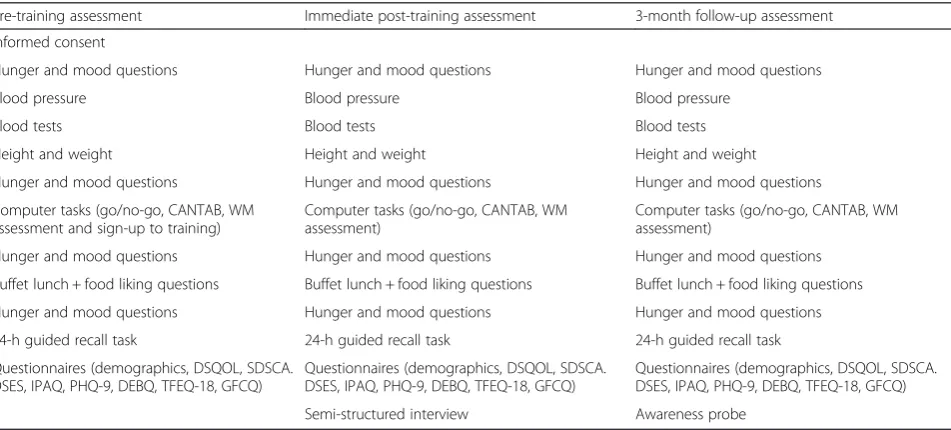
Assessment sessions will last approximately 2.5 h. The participants will provide informed consent at the begin-ning of the pre-traibegin-ning assessment session. See Table 1 for the order of completion of the tasks. For the lunch buffet, the participants will be given 15 min to eat (alone) and will be told to eat as much or as little as they wish. Questionnaires regarding eating habits will be completed last to avoid any influence on other re-sponses. The post-training and follow-up assessment sessions will be the same as the pre-training assessment
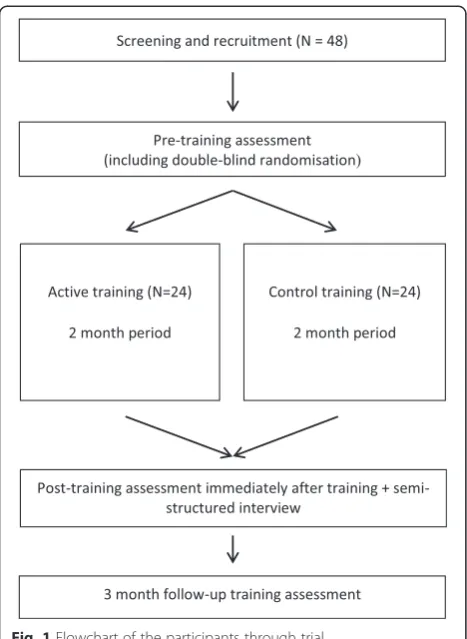
session, except that consent will not need to be re-taken, and in addition, the semi-structured interview will be conducted (post-training assessment) and the partici-pants will be probed about their awareness of the pur-pose of the lunch buffet (follow-up assessment). See Fig. 1. for a flowchart of how the participants will pro-gress through the trial.
Training
The training starts the day after the pre-training assess-ment session and is completed online in the comfort of the participants’ own homes. The participants will complete 25 online training sessions over a minimum of 25 days and a maximum of 50 days. Only one session can be completed per day, and the participants have 2 days to complete each session. Up to five sessions can be missed before they are excluded from the study.
Interviews
Sixteen interviews will be conducted (lasting a max-imum of 30 min each), 8 with participants from the Bir-mingham site and 8 from the London site. Those interviewed will be targeted to represent the range of genders, age and ethnicities taking part in the study. At the beginning of the interviews, the participants will be reminded that their responses will be kept confidential and encouraged to be as honest as possible in their answers.
Analyses
[image:5.595.61.537.493.708.2]Baseline group differences on demographic and bio-graphic data will be assessed using ANOVAs. Any found
Table 1Measures used at each time point and the order in which they are used
Pre-training assessment Immediate post-training assessment 3-month follow-up assessment
Informed consent
Hunger and mood questions Hunger and mood questions Hunger and mood questions
Blood pressure Blood pressure Blood pressure
Blood tests Blood tests Blood tests
Height and weight Height and weight Height and weight
Hunger and mood questions Hunger and mood questions Hunger and mood questions
Computer tasks (go/no-go, CANTAB, WM assessment and sign-up to training)
Computer tasks (go/no-go, CANTAB, WM assessment)
Computer tasks (go/no-go, CANTAB, WM assessment)
Hunger and mood questions Hunger and mood questions Hunger and mood questions
Buffet lunch + food liking questions Buffet lunch + food liking questions Buffet lunch + food liking questions
Hunger and mood questions Hunger and mood questions Hunger and mood questions
24-h guided recall task 24-h guided recall task 24-h guided recall task
Questionnaires (demographics, DSQOL, SDSCA. DSES, IPAQ, PHQ-9, DEBQ, TFEQ-18, GFCQ)
Questionnaires (demographics, DSQOL, SDSCA. DSES, IPAQ, PHQ-9, DEBQ, TFEQ-18, GFCQ)
Questionnaires (demographics, DSQOL, SDSCA. DSES, IPAQ, PHQ-9, DEBQ, TFEQ-18, GFCQ)
Semi-structured interview Awareness probe
to be significant will be included as co-variates on subse-quent analyses. The primary and secondary outcome measures of interest will be assessed using a 2 (condition: active, control) × 3 (time point: pre, post, follow-up) between-within ANOVA, with post hoc tests as necessary. These analyses will be done twice, once taking an Intention to Treat approach and once taking a Per-Protocol approach [52]. In an Intention to Treat approach, all participants are included in the analysis, regardless of training adherence and withdrawal. This provides a more conservative estimate of the effect of the training, com-pared to a Per Protocol approach to analysis which only includes the participants who completed the study.
The qualitative data obtained from the semi-structured interviews will be recorded, transcribed ver-batim and imported into NVivo for analysis. A thematic analysis will be conducted to inductively identify initial codes and ultimately broader themes important to the participants’experiences of the training [53].
Discussion
This is the first trial to investigate whether working memory training can change the eating behaviour of people with type 2 diabetes. This is a highly relevant population for testing the clinical effectiveness of such
training. If successful, online working memory training could prove to be a cost-effective intervention that can be used long-term without side effects, improving the quality of life of people with type 2 diabetes. It could also prevent or delay the need for drugs or insulin to control glycaemic levels. The possible applications would also extend beyond those who have type 2 diabetes. For example, it could be used by people who are overweight/ obese or have “pre-diabetes” (impaired glucose regula-tion) to help prevent/delay the development of type 2 diabetes.
The ideal intervention for any medical condition is one that improves the condition, is easy for patients to do and has no unpleasant short- or long-term side ef-fects. Therefore, the secondary aim of this study is to gain an understanding of patient’s experiences with the training. An online intervention is ultimately only going to be successful if patients are able to incorporate it into their life. The semi-structured interviews will allow us to assess how patients experienced the training, such as how they managed to integrate it into their lifestyle and the effects they think it had on their diet and diabetes control. This will provide future direction for research, such as investigating the effects of fewer or shorter training sessions.
As the participants will not need to attend the clinic for each training session, but rather can do it at home, we hope this will improve adherence rates. The partici-pants can do each training session at any time and in any place suitable to them. This will allow us to assess the effectiveness of a training program that would likely be impossible if the participants had to attend the clinic for every training session. There are shortcomings to an online intervention however. Without a researcher present to ensure that the participants do each training session, patients may be more likely to not complete all sessions. Adherence to the intervention is therefore en-couraged with an email reminder each day that they are now able to complete the next training session, with a URL link that the participants can click on, taking them directly to the training session. Therefore, the partici-pants (1) receive a reminder every day to complete that day’s training session and (2) do not have to remember a username and password in order to do the training. This should ensure good rates of adherence to the train-ing program. Another limitation to online traintrain-ing pro-grams is that it requires the participants to have a computer and internet access. Not all people will have this, especially older people, whom we anticipate will form a large proportion of our sample. However, ac-cording to the Office of National Statistics, 84 % of households in Great Britain have access to the internet in 2014, so we do not anticipate this being a barrier to recruitment [54].
[image:6.595.57.291.87.407.2]Abbreviation WM:working memory.
Competing interests
The authors declare that they have no competing interests.
Authors’contributions
AN, SH and KH conceptualised the study, and all authors contributed to the design of the study. VW and INM conducted data collection, along with PN and MR. VW drafted the manuscript with input from all authors. All authors have read and approved the final manuscript.
Acknowledgements
This study is funded by a Diabetes UK grant awarded to AN, SH and KH.
Author details
1Department of Psychology, School of Science and Technology, Middlesex
University, The Burroughs, Hendon, London NW4 4BT, UK.2Department of Experimental Psychology, Maastricht University, P.O. Box 616, Maastricht 6200 MD, The Netherlands.3School of Psychology, University of Birmingham, Edgbaston, Birmingham, B15 2TT, UK.4School of Clinical and Experimental Medicine, College of Medical and Dental Sciences, University of Birmingham, Edgbaston, Birmingham B15 2TT, UK.5Royal Free Hospital, Royal Free London NHS Foundation Trust, Pond Street, London NW3 2QG, UK.
Received: 25 March 2015 Accepted: 29 May 2015
References
1. Ary DV, Toobert D, Wilson W, Glasgow RE. Patient perspective on factors contributing to nonadherence to diabetes regimen. Diabetes Care. 1986;9:168–72.
2. Hall RF, Joseph DH, Schwartz-Barcott D. Overcoming obstacles to behavior change in diabetes self-management. Diabetes Educ. 2003;29:303–11. 3. Yannakoulia M. Eating behavior among type 2 diabetic patients: a poorly
recognized aspect in a poorly controlled disease. Rev Diabet Stud RDS. 2006;3:11–6.
4. Bradley C, Speight J. Patient perceptions of diabetes and diabetes therapy: assessing quality of life. Diabetes Metab Res Rev. 18 Suppl 2002;3:S64–9 5. Rubin RR, Peyrot M. Psychological issues and treatments for people with
diabetes. J Clin Psychol. 2001;57:457–78.
6. Hill JO, Peters JC. Environmental contributions to the obesity epidemic. Science. 1998;280:1371–4.
7. Swinburn BA, Sacks G, Hall KD, McPherson K, Finegood DT, Moodie ML, et al. The global obesity pandemic: shaped by global drivers and local environments. Lancet. 2011;378:804–14.
8. Sobik L, Hutchison K, Craighead L. Cue-elicited craving for food: a fresh approach to the study of binge eating. Appetite. 2005;44:253–61. 9. Fedoroff IC, Polivy J, Herman CP. The effect of pre-exposure to food cues
on the eating behavior of restrained and unrestrained eaters. Appetite. 1997;28:33–47.
10. Lindström J, Ilanne-Parikka P, Peltonen M, Aunola S, Eriksson JG, Hemiö K, et al. Sustained reduction in the incidence of type 2 diabetes by lifestyle intervention: follow-up of the Finnish Diabetes Prevention Study. Lancet. 2006;368:1673–9.
11. Peyrot M, Rubin RR, Lauritzen T, Snoek FJ, Matthews DR, Skovlund SE. Psychosocial problems and barriers to improved diabetes management: results of the Cross-National Diabetes Attitudes, Wishes and Needs (DAWN) Study. Diabet Med. 2005;22:1379–85.
12. England CY, Andrews R, Jago R, Thompson JL. Changes in reported food intake in adults with type 2 diabetes in response to a nonprescriptive dietary intervention. J Hum Nutr Diet Off J Br Diet Assoc. 2014;27:311–21. 13. Strack F, Deutsch R. Reflective and impulsive determinants of social
behavior. Personal Soc Psychol Rev Off J Soc Personal Soc Psychol Inc. 2004;8:220–47.
14. Guerrieri R, Nederkoorn C, Stankiewicz K, Alberts H, Geschwind N, Martijn C, et al. The influence of trait and induced state impulsivity on food intake in normal-weight healthy women. Appetite. 2007;49:66–73.
15. Guerrieri R, Nederkoorn C, Schrooten M, Martijn C, Jansen A. Inducing impulsivity leads high and low restrained eaters into overeating, whereas current dieters stick to their diet. Appetite. 2009;53:93–100.
16. Nederkoorn C, Jansen E, Mulkens S, Jansen A. Impulsivity predicts treatment outcome in obese children. Behav Res Ther. 2007;45:1071–5.
17. Sutin AR, Ferrucci L, Zonderman AB, Terracciano A. Personality and obesity across the adult life span. J Pers Soc Psychol. 2011;101:579–92.
18. Hofmann W, Friese M. Impulses got the better of me: alcohol moderates the influence of implicit attitudes toward food cues on eating behavior. J Abnorm Psychol. 2008;117:420–7.
19. Hofmann W, Rauch W, Gawronski B. And deplete us not into temptation: automatic attitudes, dietary restraint, and self-regulatory resources as determinants of eating behavior. J Exp Soc Psychol. 2007;43:497–504. 20. Nederkoorn C, Houben K, Hofmann W, Roefs A, Jansen A. Control yourself
or just eat what you like? Weight gain over a year is predicted by an interactive effect of response inhibition and implicit preference for snack foods. Health Psychol Off J Div Health Psychol Am Psychol Assoc. 2010;29:389–93. 21. Houben K, Jansen A. Training inhibitory control. A recipe for resisting sweet
temptations. Appetite. 2011;56:345–9.
22. Chechlacz M, Rotshtein P, Klamer S, Porubská K, Higgs S, Booth D, et al. Diabetes dietary management alters responses to food pictures in brain regions associated with motivation and emotion: a functional magnetic resonance imaging study. Diabetologia. 2009;52:524–33.
23. Bechara A. Decision making, impulse control and loss of willpower to resist drugs: a neurocognitive perspective. Nat Neurosci. 2005;8:1458–63. 24. Thush C, Wiers RW, Ames SL, Grenard JL, Sussman S, Stacy AW. Interactions
between implicit and explicit cognition and working memory capacity in the prediction of alcohol use in at-risk adolescents. Drug Alcohol Depend. 2008;94:116–24.
25. Grenard JL, Ames SL, Wiers RW, Thush C, Sussman S, Stacy AW. Working memory capacity moderates the predictive effects of drug-related associations on susbtance use. Psychol Addict Behav. 2008;22:426–32. 26. Hofmann W, Gschwendner T, Friese M, Wiers RW, Schmitt M. Working memory capacity and self-regulatory behavior: toward an individual differences perspective on behavior determination by automatic versus controlled processes. J Pers Soc Psychol. 2008;95:962–77.
27. Hofmann W, Friese M, Roefs A. Three ways to resist temptation: the independent contributions of executive attention, inhibitory control, and affect regulation to the impulse control of eating behavior. J Exp Soc Psychol. 2009;45:431–5.
28. McCrimmon RJ, Ryan CM, Frier BM. Diabetes and cognitive dysfunction. Lancet. 2012;379:2291–9.
29. Knopman D, Boland LL, Mosley T, Howard G, Liao D, Szklo M, et al. Cardiovascular risk factors and cognitive decline in middle-aged adults. Neurology. 2001;56:42–8.
30. Beck SJ, Hanson CA, Puffenberger SS, Benninger KL, Benninger WB. A controlled trial of working memory training for children and adolescents with ADHD. J Clin Child Adolesc Psychol. 2010;39:825–36.
31. Holmes J, Gathercole SE, Place MLDD, Hilton KA, Elliott JG. Working memory deficits can be overcome: impacts of training and medication on working memory in children with ADHD. Appl Cogn Psychol. 2010;24:827–36. 32. Borella E, Carretti B, Riboldi F, De Beni R. Working memory training in older
adults: evidence of transfer and maintenance effects. Psychol Aging. 2010;25:767–78.
33. Houben K, Wiers RW, Jansen A. Getting a grip on drinking behavior: training working memory to reduce alcohol abuse. Psychol Sci. 2011;22:968–75. 34. Bickel WK, Yi R, Landes RD, Hill PF, Baxter C. Remember the future: working
memory training decreases delay discounting among stimulant addicts. Biol Psychiatry. 2011;69:260–5.
35. Olesen PJ, Westerberg H, Klingberg T. Increased prefrontal and parietal activity after training of working memory. Nat Neurosci. 2004;7:75–9. 36. Kenny PJ. Reward mechanisms in obesity: new insights and future
directions. Neuron. 2011;69:664–79.
37. Sealed envelope: randomisation services. [https://www.sealedenvelope.com/] 38. Klingberg T, Forssberg H, Westerberg H. Training of working memory in
children with ADHD. J Clin Exp Neuropsychol. 2002;24:781–91. 39. Robinson E, Blissett J, Higgs S. Recall of vegetable eating affects future
predicted enjoyment and choice of vegetables in British University undergraduate students. J Am Diet Assoc. 2011;111:1543–8.
40. Armstrong AM, MacDonald IW. Errors in memory for dietary intake and their reduction. Appl Cogn Psychol. 2000;14:183–91.
42. Karlsson J, Persson LO, Sjöström L, Sullivan M. Psychometric properties and factor structure of the Three-Factor Eating Questionnaire (TFEQ) in obese men and women. Results from the Swedish Obese Subjects (SOS) study. Int J Obes Relat Metab Disord J Int Assoc Study Obes. 2000;24:1715–25. 43. Van Strien T, Frijters JER, Bergers GPA, Defares PB. The Dutch Eating
Behavior Questionnaire (DEBQ) for assessment of restrained, emotional, and external eating behavior. Int J Eat Disord. 1986;5:295–315.
44. Bott U, Mühlhauser I, Overmann H, Berger M. Validation of a diabetes-specific quality-of-life scale for patients with type 1 diabetes. Diabetes Care. 1998;21:757–69.
45. Toobert DJ, Hampson SE, Glasgow RE. The summary of diabetes self-care activities measure: results from 7 Studies and a revised scale. Diabetes Care. 2000;23:943–50.
46. Senecal C, Nouwen A, White D. Motivation and dietary self-care in adults with diabetes: are self-efficacy and autonomous self-regulation complementary or competing constructs? Health Psychol. 2000;19:452–7.
47. Spitzer RL, Kroenke K, Williams JBW. Validation and utility of a self-report version of PRIME-MD: the PHQ primary care study. JAMA. 1999;282:1737–44. 48. Booth M. Assessment of physical activity: an international perspective. Res Q
Exerc Sport. 2000;71:114–20.
49. Herman CP, Polivy J. A boundary model for the regulation of eating. In: Stunkard AJ, Stellar E, editors. Eating and its disorders. New York: Raven Press; 1984. p. 141–56.
50. Herman CP, Polivy J. Normative influences on food intake. Physiol Behav. 2005;86:762–72.
51. Macht M, Simons G. Emotions and eating in everyday life. Appetite. 2000;35:65–71.
52. Gupta SK. Intention-to-treat concept: a review. Perspect Clin Res. 2011;2:109–12. 53. Braun V, Clarke V. Using thematic analysis in psychology. Qual Res Psychol.
2006;3:77–101.
54. Office for National Statistics. Statistical bulletin on Internet access—households and individuals 2014. 2014. p. 1–50.
Submit your next manuscript to BioMed Central and take full advantage of:
• Convenient online submission
• Thorough peer review
• No space constraints or color figure charges
• Immediate publication on acceptance
• Inclusion in PubMed, CAS, Scopus and Google Scholar
• Research which is freely available for redistribution