SOLVING KNIGHT’S TOUR PROBLEM USING PADDY FIELD ALGORITHM
Art Harris Lambiase
Bachelor of Electrical Engineering (Control, Instrumentation and Automation)
SUPERVISOR’S ENDORSEMENT
“ I hereby declare that I have read through this report entitle “Solving Knight’s Tour Problem
Using Paddy Field Algorithm” and found that it has comply the partial fulfilment for awarding the degree of Bachelor of Electrical Engineering (Control, Instrumentation and Automation)”
Signature : ...
Supervisor’s Name : ...
SOLVING KNIGHT’S TOUR PROBLEM BY USING PADDY FIELD ALGORITHM
ART HARRIS LAMBIASE
A report submitted in partial fulfilment of the requirement for the Degree of Bachelor in Electrical Engineering (Control, Instrumentation and Automation)
Faculty of Electrical Engineering
UNIVERSITI TEKNIKAL MALAYSIA MELAKA
STUDENT DECLARATION
I declare that this report entitle “Solving Knight’s Tour Problem Using Paddy Field Algorithm” is the result of my own research except as cited in the references. The report has
not been accepted for any degree and is not concurrently submitted in candidature of any other degree.
Signature : ...
Name : ...
ACKNOWLEDGEMENT
There are a number of people I want to thank for their help in putting together this
report.
Firstly, I must pay tribute to Mrs. Ezreen Farina Binti Shair, my supervisor, and her acquaintance Mr. Amar Faiz Bin Zainal Abidin. Both of them shares the wealth of experience, along with their support, was a blessing throughout. Both of these lecturers make a formidable effort in helping me.
Both of them was remarkably easy to work with and a real professional. They kept me on track and I feel they has done a great job of collecting my thoughts and presenting the report in a way that I am more than happy with.
My fellow friends, gave sound guidance over the course of producing the content; they are the most trusted and loyal of advisers and a great friend.
ABSTRACT
The main purpose of this project is to solve the knight’s tour problems (KTP) by using paddy
field algorithm (PFA). KTP is a sub-chess puzzle where the main purpose of the puzzle is to find combination move made by a knight so that it visits every square of the chessboard exactly once. The knight’s tour problem is focusing on the mathematical problem of finding a knight’s tour moving sequence. In approach with this related application is view from the
assembly stability and the number of assembly orientation. KTP is not viewed just from the puzzle it represents, but the concept that can be used in other related fields of engineering application. The objective of this project are to solve the mathematical problem of KTP and design a model using PFA to solve KTP. MATLAB software is used to design the coding to solve the KTP. In this project the size of the chessboard use will be 8x8 as this is to define the moving pattern sequences of the knight. Furthermore, the performance of optimization technique used which is PFA will be evaluate with the performance of Firefly Algorithm (FA). The end result was evaluated in terms of the success rate of finding optimal solution for only 1 locations of the movement made by the knight. There are many method of optimization technique to solve the KTP. The optimization consists of maximizing or
minimizing the value to find the optimal best value. There is other several types and method of optimization algorithm can be used to solve the KTP such as the Binary Magnetic
ABSTRAK
Tujuan utama projek ini adalah untuk menyelesaikan masalah pusingan kesatria atau kuda (KTP) dengan menggunakan kaedah “Paddy Field Algorithm (PFA)”. KTP adalah masalah matematik untuk permainan catur di mana tujuan utama masalah ini adalah untuk mencari langkah gabungan yang dibuat oleh kuda di dalam catur tersebut supaya ia dapat melakukan pusingan di setiap petak catur dalam satu gerakan. Masalah pusingan kuda ini memberi tumpuan kepada masalah matematik bagi mencari pusingan kuda adalah dalam turutan yang bergerak. Dalam pendekatan kepada permasalahan ini, konsep yang boleh digunakan dalam bidang-bidang lain yang berkaitan dengan aplikasi kejuruteraan boleh diaplikasikan daripada projek ini. Objektif projek ini adalah untuk menyelesaikan masalah matematik KTP dan reka bentuk model menggunakan PFA untuk menyelesaikan KTP. Perisian MATLAB digunakan untuk reka bentuk program untuk menyelesaikan KTP. Dalam projek ini saiz penggunaan papan catur adalah 8x8 kerana ini adalah untuk menentukan urutan corak pergerakan bagi kuda. Tambahan pula, prestasi paling optimum bagi teknik yang digunakan iaitu PFA akan dinilai dengan prestasi bagi kaedah “Firefly Algorithm (FA)”. Keputusan akhir telah dinilai dari segi kadar kejayaan mencari penyelesaian optimum bagi hanya 1
lokasi gerakan yang dibuat oleh kuda tersebut. Terdapat banyak kaedah atau teknik pengoptimuman yang telah dikaji untuk menyelesaikan KTP. Pengoptimuman ini terdiri
TABLE OF CONTENTS
CHAPTER TITLE PAGE
ACKNOWLEDGEMENT ABSTRACT
TABLE OF CONTENTS LIST OF TABLES LIST OF FIGURES
LIST OF ABBREVIATIONS LIST OF APPENDICES
i ii iv vi viii x xi
1 INTRODUCTION 1
1.1 Project Background 1
1.2 Problem Statement 4
1.3 Objective 5
1.4 Scope Of Research 5
2 LITERATURE REVIEW 6
2.1 Overview 6
2.2 Previous Research on Solving Knight’s Tour Problem 7
2.3 Summary 14
3 METHODOLOGY 15
3.1 Project Methodology 15
3.1.1 Project Flowchart 16
3.2 Analytical Approach 17
REFERENCES
APPENDICES
3.2.2 Solving Mathematical Problem 18
3.2.3 Design Tools 20
3.2.4 Performance Evaluation 21
4 RESULTS 24
4.1 Results for Mathematical Problem 24
4.2 Results for Parameter Tuning of Paddy Field Algorithm 28
4.2.1 Part A: Tuning the dispersion spread parameter and maximum seed per plant parameter
29
4.2.2 Part B: Tuning Maximum iteration, Initial Number of Seeds and Effects of Maximum Seed per Plant
36
5 ANALYSIS AND DISCUSSION OF RESULTS 48
5.1 Parameter Tuning Analysis 48
5.2 Result Obtained for KTP using PFA Analysis 52
5.3 Performance Evaluation of PFA with the Result of FA Optimization
54
LIST OF TABLES
TABLE TITLE PAGE
Table 2.1 Result obtained for Knight’s Tour Problem using Binary Magnetic Optimization Algorithm
8
Table 2.2 Result obtained for Knight’s Tour Problem using Firefly Algorithm
10
Table 3.1 List of the Knight’s Move Patterns 19
Table 4.1 Overall result for manipulated variable of Dispersion Spread = 1 30 Table 4.2 Overall result for manipulated variable of Dispersion Spread = 2 31 Table 4.3 Overall result for manipulated variable of Dispersion Spread = 3 32 Table 4.4 Overall result for manipulated variable of Dispersion Spread = 4 33 Table 4.5 Overall result for manipulated variable of Dispersion Spread = 5 34 Table 4.6 Overall result for manipulated variable of Initial Number of
Seeds = 10 for Maximum Iteration = 1000
37
Table 4.7 Overall result for manipulated variable of Initial Number of Seeds = 20 for Maximum Iteration = 1000
38
Table 4.8 Overall result for manipulated variable of Initial Number of Seeds = 30 for Maximum Iteration = 1000
39
Table 4.9 Overall result for manipulated variable of Initial Number of Seeds = 40 for Maximum Iteration = 1000
40
Table 5.0 Overall result for manipulated variable of Initial Number of Seeds = 50 for Maximum Iteration = 1000
41
Table 5.1 Overall result for manipulated variable of Initial Number of Seeds = 10 for Maximum Iteration = 3000
42
Table 5.2 Overall result for manipulated variable of Initial Number of Seeds = 20 for Maximum Iteration = 3000
43
Table 5.3 Overall result for manipulated variable of Initial Number of Seeds = 30 for Maximum Iteration = 3000
44
Table 5.4 Overall result for manipulated variable of Initial Number of Seeds = 40 for Maximum Iteration = 3000
Table 5.5 Overall result for manipulated variable of Initial Number of Seeds = 50 for Maximum Iteration = 3000
46
Table 5.6 Optimal Value of best found result obtained for Knight’s Tour Problem using Firefly Algorithm
52
Table 5.7 Result obtained for KTP using PFA 53
Table 5.8 Result obtained for KTP using FA 54
LIST OF FIGURES
FIGURE TITLE PAGE
Figure 1.1 Example of an open knight’s tour of a chessboard and the visited squares shaded
1
Figure 3.1 Flowchart of project 16
Figure 3.2 Possible move patterns for Knight 18
Figure 3.3 Example of Knight movements for 𝒔𝟑= [0, 3, 1,…]T 19 Figure 3.4 One Initial positions of the Knight for experiment 20
Figure 3.5 Stages of the Paddy Field Algorithm 21
Figure 4.1 List of moving pattern that has been written in programming language
25
Figure 4.2 Graph of Optimal Value of Best found vs Maximum Seed per Plant for Dispersion Spread = 1
30
Figure 4.3 Graph of Optimal Value of Best found vs Maximum Seed per Plant for Dispersion Spread = 2
31
Figure 4.4 Graph of Optimal Value of Best found vs Maximum Seed per Plant for Dispersion Spread = 3
32
Figure 4.5 Graph of Optimal Value of Best found vs Maximum Seed per Plant for Dispersion Spread = 4
33
Figure 4.6 Graph of Optimal Value of Best found vs Maximum Seed per Plant for Dispersion Spread = 5
34
Figure 4.7 Graph of Relationship between Optimal Value of Best found and Average Iteration before Global Convergence for Initial Number of Seed = 10
Figure 4.8 Graph of Relationship between Optimal Value of Best found and Average Iteration before Global Convergence for Initial Number of Seed = 20
38
Figure 4.9 Graph of Relationship between Optimal Value of Best found and Average Iteration before Global Convergence for Initial Number of Seed = 30
39
Figure 5.0 Graph of Relationship between Optimal Value of Best found and Average Iteration before Global Convergence for Initial Number of Seed = 40
40
Figure 5.1 Graph of Relationship between Optimal Value of Best found and Average Iteration before Global Convergence for Initial Number of Seed = 50
41
Figure 5.2 Graph of Relationship between Optimal Value of Best found and Average Iteration before Global Convergence for Initial Number of Seed = 10
42
Figure 5.3 Graph of Relationship between Optimal Value of Best found and Average Iteration before Global Convergence for Initial Number of Seed = 20
43
Figure 5.4 Graph of Relationship between Optimal Value of Best found and Average Iteration before Global Convergence for Initial Number of Seed = 30
44
Figure 5.5 Graph of Relationship between Optimal Value of Best found and Average Iteration before Global Convergence for Initial Number of Seed = 40
45
Figure 5.6 Graph of Relationship between Optimal Value of Best found and Average Iteration before Global Convergence for Initial Number of Seed = 50
46
Figure 5.7 Relationship between Dispersion Spread and Optimal Value of Best Found
49
Figure 5.8 Relationship between Initial Number of Seed and Optimal Value of Best Found for Maximum Iteration = 1000
51
Figure 5.9 Relationship between Initial Number of Seed and Optimal Value of Best Found for Maximum Iteration = 3000
LIST OF ABBREVIATIONS
KTP - Knight’s Tour Problem
PFA - Paddy Field Algorithm
FA - Firefly Algorithm
PSO - Particle Swarm Optimization
CSA - Cuckoo Search Algorithm
BMOA - Binary Magnetic Optimization Algorithm
LIST OF APPENDICES
APPENDIX TITLE
A Basic Idea/Concept of Data Collecting
B Initial Result of Paddy Field Algorithm Parameter for Manipulating Dispersion Spread
C Change in the number of Maximum Iteration, Initial Number of Seeds parameter & effects of the Maximum Seed per Plant parameter
CHAPTER 1
INTRODUCTION
1.1 Project Background
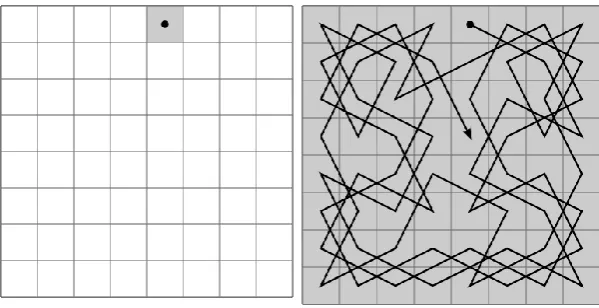
The knight’s tour problem (KTP) is a sub-chess puzzle where the main purpose of the
puzzle is to find combination move made by a knight so that it visits every square of the chessboard exactly once. The KTP is focusing on the mathematical problem of finding a knight’s tour moving sequence. Creating a program to find a knight’s tour is the problem which needs to be solve. There are variations of the knight’s tour problem involve
chessboards of different sizes. An example of engineering application of KTP is the assembly sequence planning. Basically the project’s attempt is to research and experiment
[image:16.595.170.470.528.682.2]the Paddy Field Algorithm (PFA) in solving the KTP.
1.1.1. Optimization
1.2 Problem Statement
The issue that is to be address is to find the right combination moves made by a knight so that it visits every square of the chessboard exactly once. This is to be done by using the Paddy Field Algorithm method. The knight’s tour problem has been widely research by many academicians throughout years. Although the main purpose of solving the knight’s
tour problem is to find the right combination of the moving pattern of the knight moves and the issue needed to address here is to compare different algorithm method towards solving this problem. Basically this whole project aims to solve the knight’s tour problem by using
the paddy field algorithm. Although there have been many algorithms that have been developed throughout the years, the need to find the best solutions or algorithm methods is
still remain as a subjective problem to this issue. One example of engineering application of the knight’s tour problem is the assembly sequence planning. In approach with this related
application is view from the assembly stability and the number of assembly orientation. These changes of the assembly orientation which are a part from the outcome for the optimization used. The approach also could reduce the working time and economic cost of the assembly sequence planning significantly. Thus it will change the performance of the assembly sequence planning in terms of design and manufacturing process and the production process will become more efficient. Assembly sequence planning plays an important role in the manufacturing industry. It is the sequence of coupling operations or system that is carried out to assemble a set of parts which is constrained by the geometric and mechanical properties of the parts to be assembled. This represents one of the most important conditions to assure the future effectiveness and competitiveness of industrial companies. In summary, the knight’s tour problem is not viewed just from the puzzle or
The main objective of this project is to find the combination moves made by a knight so that it visits every square of the chessboard exactly once. Below are the objectives on what to accomplish based on the research work:
1. To solve the mathematical problem of finding the Knight’s Tour moving sequence
2. To design a model using Paddy Field Algorithm into written Matlab source codes to solve the Knight’s Tour Problem.
3. To evaluate the performance for the Paddy Field Algorithm with the result of Firefly Algorithm Optimization in terms of the optimal solution for one location of the knight.
1.4 Scope of Research
The scope of research sets a clear boundary towards achieving the objectives of the project. Below are the scope for the project:
1. The algorithm that will be used is only focusing on the Paddy Field Algorithm (PFA).
2. The size of the chessboard use will be 8x8 to define the moving pattern sequences of the knight.
3. Moving pattern used is based on the algorithm applied on previous researched (Firefly and Binary Magnetic Optimization Algorithm) as different algorithm may consist of different moving pattern.
CHAPTER 2
LITERATURE REVIEW
2.1 Overview
Throughout the project, a feasibility study was performed in order to acquire as much information regarding the project of solving knight’s tour problem (KTP) by using paddy field algorithm. In accomplishment of feasibility study, all the necessary information is needed from several of source. This chapter will provide the review from previous research that is related to this final year project. There are previous research on solving the knight’s tour problem based on different optimization and algorithm method. From literature’s point of view, it can be seen that numerous researches that is related to KTP had been done. Basically optimization is tools or procedure which is to make a system or design as effective or functional as possible applied with the mathematical technique involved. In other words, optimization is to find the ‘best available’ values for functions which is given by many
defined domain. Optimization problem can also be categorized into many other categories such as the Metaheuristic and the combinatorial optimization technique. Metaheuristic optimization technique is among the commonly used as it is easier to implement compared
The knight’s tour problem (KTP) is a sub chess puzzle where the main key is to find
the combination made by a knight so that it visits every square of the chessboard exactly once. Mohd Muzafar Ismail has made a preliminary study on using Binary Magnetic Optimization Algorithm (BMOA) to solve the problem [1].The authors approach is scalable for a standard of 8x8 chessboard setup. The Magnetic Optimization Algorithm was inspired by the attraction of the magnetic force between two magnetic particles. Basically this optimization method has a similar updating particle position to Binary Particle Swarm Optimization (BPSO). The concept use in this optimization is the particles with higher mass will have a greater magnetic force that attracts other particles with smaller mass to move towards it. This is thus applied only in the magnetic field area. Basically other nature-inspired optimization techniques consist of three major parts which is the initialization process, fitness evaluation and improvement agents. Based on the article, the authors use a standard 8x8 chessboard setup to describe the possible moving pattern of the knights. The moving concept here refers that the knight has 8 possible moves from the square of its initial position of the knight. The result of this optimization techniques is altered from other nature– inspired optimization. In this case the improvement agents which is the change in position is no longer linear to the change in velocity of the particle, but it has become linearly
proportional to a sigmoid or tanh function.
The BMOA only found a single optimal solution of the movement made by the knight. The research model here is not too sensitive to the number of computation done. However the research approach used here has a potential solution for further improvement by studying the sensitivity of the parameters towards solving the Knight’s Tour Problem. Table 2.1
Table 2.1: Result obtained for Knight’s Tour Problem using Binary Magnetic Optimization
Algorithm [1]
From Table 2.1, it can be seen that the best value for sigmoid function is better than tanh function in most cases. The similar can be understood for the average fitness of best found for sigmoid function relative to tanh function. Meanwhile, the standard deviation of sigmoid function is smaller than the tanh function at most cases except for locations of 2, 3, 8 and 14. Based on the proposed model here, it is not too sensitive to the number of computation done due to a small standard deviation in average fitness. The highlighted value
Muzafar Ismail has also developed another algorithm method in solving the knight’s tour
problem by using the Firefly Algorithm (FA) [2]. The author has proposed a model by using FA to solve the problem. The FA was inspired based on the mating behaviour of fireflies. The concept use in this optimization is that each firefly represents a possible solution of the problem. Each dimensions of the search space represents 𝑛𝑡ℎ move taken by the knight. The fitness of a firefly is calculated by the number of moves that the knight has taken. The authors
approach is scalable for a standard of 8x8 chessboard setup. Based on the article, the authors use a standard 8x8 chessboard setup to describe the possible moving pattern of the knights. The moving concept here refers that the knight has 8 possible moves from the square of its initial position of the knight. Basically the concept of fitness formulation of this firefly algorithm is that each dimension of the firefly position represents n move made by the knights. Such equation is as follows:
𝒔m = [1𝑠𝑡𝑚o𝑣e, 2𝑛𝑑𝑚𝑜𝑣𝑒,…, 𝑛𝑡ℎ𝑚𝑜𝑣𝑒] T (2.1)
In this equation, n is the total number of squares in the chess boards. For the case of 8x8 chess board, 𝑛 = 8 × 8 = 64. Therefore the equation will be as follows:
𝒔m = [1𝑠𝑡𝑚o𝑣e , 2𝑛𝑑𝑚𝑜𝑣𝑒,…, 64𝑡ℎ𝑚𝑜𝑣𝑒] T (2.2)