Nondemolition Measurement of the Vacuum State or its Complement
Daniel K. L. Oi,1,*Va´clav Potocˇek,1,2and John Jeffers11SUPA Department of Physics, University of Strathclyde, Glasgow G4 0NG, United Kingdom 2Czech Technical University in Prague, Faculty of Nuclear Sciences and Physical Engineering,
Department of Physics, Brˇehova´ 7, 115 19 Praha 1, Czech Republic
(Received 27 November 2012; revised manuscript received 14 March 2013; published 23 May 2013)
Measurement is integral to quantum information processing and communication; it is how information encoded in the state of a system is transformed into classical signals for further use. In quantum optics, measurements are typically destructive, so that the state is not available afterwards for further steps. Here we show how to measure the presence or absence of the vacuum in a quantum optical field without destroying the state, implementing the ideal projections onto the respective subspaces. This not only enables sequential measurements, useful for quantum communication, but it can also be adapted to create novel states of light via bare raising and lowering operators.
DOI:10.1103/PhysRevLett.110.210504 PACS numbers: 03.65.Ta, 03.67.Ac, 42.50.Dv, 42.50.Pq
At first glance, measuring the vacuum is trivial, a perfect photodetector will reveal the vacuum state upon the non-occurrence of a click. However, the converse, i.e., measur-ing the nonvacuum, ideally should preserve this sector for further interrogation—something which is difficult to achieve with direct photodetection. Formally, we would like to implement the following measurement projectors, fj0ih0j;I j0ih0jg, where the latter nonvacuum outcome removes the vacuum component without affecting the relative amplitudes or coherences of the other Fock states. This is crucial for sequential measurement schemes [1–3], and rules out other projective schemes such as quantum nondemolition measurements of photon number [4–7]. Developing methods for nondestructive measurements on optical fields [8,9] is therefore important for quantum information processing systems.
Measurement is also a key element in performing non-Gaussian operations, e.g., for entanglement purification of continuous variable states [10–12]. Recent examples include the implementation of the quantum optical creation and annihilation operators, both of which rely on postse-lection [13–15]. Extending the type of possible operations is crucial for the production of tailored states in quantum information systems. Our method can be simply extended to provide a first realization of the bare photon addition and subtraction operators.
We consider a single mode of an optical cavity in an arbitrary quantum state,, as our system to be measured. To perform the measurement, we introduce a probe which consists of a three level atom in the configura-tion [see Fig. 1(a)]. The cavity mode can be coupled controllably to transitionBwhereas transitionAinteracts with an externally applied laser field [16,17]. In these papers, the general adiabatic mapping of atomic levels to cavities was introduced. Our particularly simple configu-ration is insensitive to all field amplitudes other than the vacuum.
The Hamiltonian of the combined system can be written in the rotating wave approximation (RWA) as
HRWA¼@jeihej þ@AðtÞðjeihgAj þ jgAihejÞ
þ@BðtÞðjeihgBjaþ jgBihejayÞ;
(1)
where the coupling constantsAandBbetween the atom and the two fields depend on the strength of the respective fields at the point where the atom is located. An optional detuning can be applied to both fields in order to sup-press single-photon resonance effects as long as we main-tain the two-photon resonance condition,
EgBEgA ¼@ð!B!AÞ: (2)
The situation is similar to the V-STIRAP scheme for producing single photons [18] where a cavity evolves fromj0i ! j1ithrough a dark state adiabatic evolution of an atomjgAi ! jgBi.
In our measurement procedure we run the V-STIRAP sequence in reverse: the initial state of the atom is jgBi, and the order of the A and B couplings is switched [see Fig.1(b)]. If the cavity field initially contains at least one photon, at the end of the sequence the atom is left injgAi and the field has one photon subtracted. However, if the cavity was originally in the vacuum state, the atom stays in jgBiand the cavity is left unchanged. An initial superpo-sition of the cavity evolves as
jgBiX1 n¼0
njni ! jgBi0j0i jgAiX1 n¼1
njn1i: (3)
If the atom is found in jgAi, the field amplitudes have been shifted by one. The ideal projection ðI j0ih0jÞ results if we replace the subtracted photon, this is simply achieved by running the V-STIRAP procedure forwards. Note that this does not require the initial cavity state to be vacuum, we can add a photon to an arbitrary state of the field. As discussed later, the shifting property of the procedure can be exploited to perform novel operations and generate nonclassical states of light.
The key aspect of the adiabatic process is that the evolution of the system does not rely on the dynamics of the Hamiltonian, provided that the conditions of adiabatic transition are satisfied. In this way, the state of the ancilla atom can be made asymptotically insensitive to the cavity photon number, except for the critical case of the vacuum. In the usual Jaynes-Cummings scenario, the dynamics in each of the combined Fock subspaces proceeds at a rate proportional to the square root of the photon number, leading in general to different states of the atom. In our scheme, the atom does not distinguish between different photon numbers n¼1;2;3;. . ., which allows us to per-form the ideal projection onto the complement of the
vacuum, in contrast to previous proposals for quantum nondemolition measurements of the optical field [6,7].
We can extend the method to project onto the joint n-mode vacuum state or complement, as required in the decoding scheme of [2]. This requires a probe atom with nþ2 levels in an (nþ1)-pod configuration. Let jg0i denote the initial state of the atom, the remaining ground states be denoted jgni for n¼1;. . .; n, and jei be the excited level. Thejei $ jgni(n >0) transitions are driven by lasers with strength jand the jei jg0i transition is selectively coupled in turn to each of the n modes with strengthj. In real atoms, this may be difficult but it may be simpler in engineered systems, e.g., superconducting qudits coupled to transmission lines. We apply in turn the same procedure as for the single mode measurement by sequential pairwise adiabatic variation offj; jg,j¼ 1;. . .; n, after which the population ofjg0iis determined. If the atom is detected injg0i, then thenmodes are projected onto the joint vacuum state j00 . . . 0i, otherwise the atom andnmodes are left in a (generally entangled) state where thejg0ij00 . . . 0istate has been truncated. To disentangle the atom and add back subtracted photons, running the sequence of couplings backwards and in reverse order returns the atom to jg0i which erases any information of the photon number distribution of thenmodes.
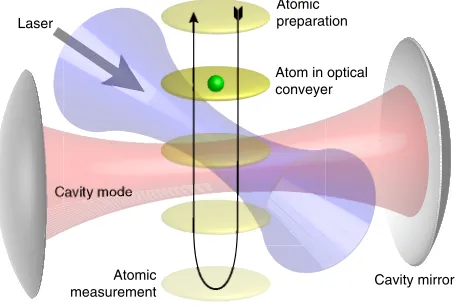
The experimental setup for V-STIRAP [18] can be easily adapted to perform our vacuum measurement (Fig.2). We
Cavity mirror Cavity mode
Laser
Atom in optical conveyer Atomic preparation
Atomic measurement
FIG. 2 (color online). Cavity QED vacuum measurement. The configuration of the cavity mode, driving laser, and trajectory of the atom are similar to the V-STIRAP scheme, except that the laser beam is encountered before the cavity mode. An optical lattice traps and controls the position, hence the coupling, of the atom with both the driving laser and cavity mode. State prepa-ration injgBiis performed before the atom is transported into the cavity. After the atom has crossed the cavity and adiabatically interacted with laser and mode, it is measured, e.g., by fluores-cence shelving [41] or cavity enhanced detection [42], to dis-cover which ground state it is in. To perform the ideal ðI j0ih0jÞoperation in the case of thejgAiresult, the motion of the atom is reversed in order to replace the photon extracted from the cavity.
| |
|
γ γ
(a)
(b)
|
| Σα |
|
[image:2.612.58.291.45.229.2]γ γ
FIG. 1. (a) Lambda atomic system coupled to cavity. A three level atom with two ground states (jgAi, jgBi) and a single excited level (jei) can be used to probe for the vacuum compo-nent of an optical field with annihilation operator a. The A transition is driven by a STIRAP laser and theBtransition can be controllably coupled to the cavity mode to be measured. Initially, the atom is in the state jgBi. The final state of the atomjgAiorjgBidepends on the presence or absence of photons in the field, respectively. (b) Counterintuitive pulse sequence for the couplings. Consider the case where there aren1photons in the field. With the initial state of the combined atom-mode system jgB; ni, couplingA is turned on first. As couplingB is slowly increased, the atom-cavity state adiabatically follows the dark-state manifoldsinjgA; n1i cosjgB; ni,¼0!
[image:2.612.325.553.403.556.2]use a cavity with a long storage time to reduce leakage and decoherence. We also introduce preparation and read-out zones for the atom before and after the cavity, respec-tively. The motion of the atom is reversed in the case of measuring the atom injgAiin order to replace a subtracted photon. There are several experimental challenges, mainly the lifetime of the field compared to the time required to implement the measurement. The cavity field must last long enough for the atom to be adiabatically transported, measured, and returned. We can modify the scheme to allow for a second atom prepared in jgAito immediately replace the photon in parallel with the probe atom mea-surement. In the case of ajgBiresult, we can either subtract the photon again or let natural cavity decay return the cavity to the vacuum state.
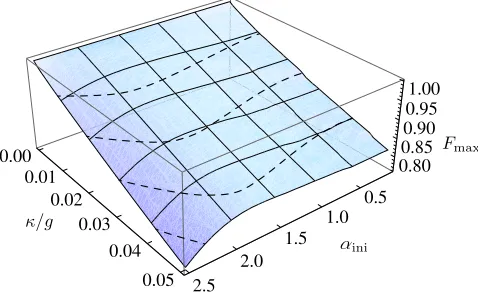
Most important for the scheme is the ratio of the cavity damping to maximum atom-cavity coupling g¼maxB. Both these rates depend upon the effective mode volume of the cavity and balancing these factors will be system dependent. To examine the performance of the protocol under nonideal conditions, we have simulated the measurement of a lossy cavity with finite sweep times with immediate photon replacement, the results displayed in Fig.3. Full details of the simulation can be found in the Supplemental Material [19].
A straightforward application of this measurement is in sequential decoder schemes as discussed in [3]. In the protocol of [2], the state of an n-mode system has to be identified in order to successfully decode the symbol being sent. The state is taken from an ensemble of products of coherent states,fjk1; k2;. . .; knig. A sequence of displace-ments and projections onto the n-mode vacuum or its
complement has been shown to decode the message successfully in the n! 1 limit as long as the rate of transmission is below the Holevo bound.
We can also use the photon number altering properties of our procedure to enact bare raising and lowering operations, in contrast to the creation ayand annihilation operators aas usually considered. The non-Hermitian ay and a operators represent non-Gaussian operations and have been realized probabilistically in experiments [13–15]. ‘‘Subtracting’’ a photon from squeezed light can produce an approximate cat state [20–23], and both pro-cesses have been used in superoptimal optical amplifica-tion protocols [24–27].
Due to Bosonic enhancement however, the ay and a operators do not simply add and subtract photons, but also modify the state amplitudes withpffiffiffinfactors. Pure addition and subtraction of photons are represented by bare raising and lowering operators [28], sometimes known as photon number shifting operators [29],
Eþ¼ X1 n¼0
jnþ1ihnj; E¼ X1 n¼1
jn1ihnj: (4)
These can produce nonclassical states of light, for ex-ample, any state which has Eþ applied to it must violate the Klyshko criterion [29]. ApplyingEþto a coherent state produces a state with sub-Poissonian statistics, whereas applyingE makes the state super-Poissonian.
There has been little study of the bare operators and their effects, mainly because they have not been realized experi-mentally [30]. ImplementingEþ andE requires cancel-lation of the pffiffiffin Bose enhancement factors inherent ina and ay. The nature of the ðI j0ih0jÞ projection and the adiabatic process that we have described does not alter the relative weights of the amplitudes corresponding to differ-ent photon numbers, in contrast to other schemes which rely on ay. The V-STIRAP process therefore implements Eþand the reverse process realisesE. In addressing the problem of quantum optical phase the measurement of moments of bare operators was proposed using a basic scheme similar to that considered here, without a detailed analysis of the effect of reachable experimental parameters [31]. An implementation of the photon subtraction opera-tor has been suggested in superconducting systems [32].
We can also perform a reverse quantum scissors. In the original quantum scissors [33], photon numbers higher than one are truncated from a state, jci ¼P1j¼0cjjji ! c0j0i þc1j1i, up to normalization. This has been extended to make the cut at higher photon numbers [34,35]. In contrast, applying our measurement n times without photon replacement truncates the first n amplitudes, conditioned on not observing the vacuum, jci ¼ P1
j¼0cjjji !P1j¼ncjjjni. By adding n photons, we return the state to its original form but without the first n terms, P1j¼ncjjji. The probability that this will occur is 1Pnj¼01Pj, where Pj¼ jcjj2 is the probability of FIG. 3 (color online). Fidelity of the full measurement
proce-dure, conditioned on probe resultjgAi. The initial cavity field is in a coherent state of amplitudeini. The detuningwas zero and thejeidecay rate was 1% of the maximum cavity coupling
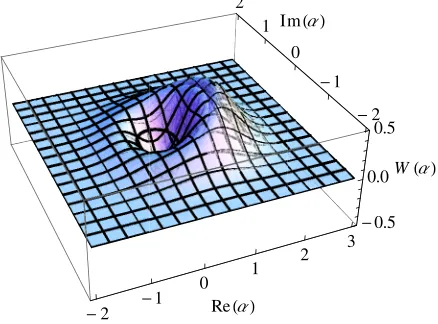
[image:3.612.55.294.451.599.2]observingjphotons. Trivially, we can also use the protocol to resolve photon number in this way. Figure4illustrates the results of ann¼1reverse quantum scissors producing a vacuum stripped coherent state.
The ability to implement ideal projections on a field opens up new possibilities for quantum communication and computation. Adiabatic evolution in our method avoids thepffiffiffinfactors in dynamical schemes and achieves the unusual nonlinearity required. Existing experiments, though not optimized for our measurement, already pos-sess parameters sufficient for a proof of principle demon-stration [36]. Though it will be challenging to engineer systems with even better =g ratios, recent advances in ultrastrong coupling in microwave systems [37], super-mirror coatings [38], high-finesse cavities [39], and micro-resonators [40] all give grounds for optimism for achieving greater fidelities (Supplemental Material [19]). The sim-plicity and utility of the system described here for imple-menting several quantum optical information protocols should be significant drivers towards this goal.
D. K. L. O. acknowledges discussions with Si-Hui Tan. The authors acknowledge support from Quantum Information Scotland (QUISCO), D. K. L. O. and J. J.; the UK EPSRC (EP/G009570/1), J. J. and V. P.; Czech Technical University in Prague (RVO68407700), V. P.
[1] E. Andersson and D. K. L. Oi,Phys. Rev. A77, 052104 (2008). [2] S. Guha, S.-H. Tan, and M. M. Wilde,arXiv:1202.0518. [3] P. Sen,arXiv:1109.0802.
[4] G. J. Milburn and D. F. Walls, Phys. Rev. A 28, 2065 (1983).
[5] N. Imoto, H. A. Haus, and Y. Yamamoto,Phys. Rev. A32, 2287 (1985).
[6] P. Grangier, J. A. Levenson, and J. P. Poizat, Nature (London)396, 537 (1998).
[7] C. Guerlin, J. Bernu, S. Dele´glise, C. Sayrin, S. Gleyzes, S. Kuhr, M. Brune, J.-M. Raimond, and S. Haroche,
Nature (London)448, 889 (2007).
[8] M. G. A. Paris,Phys. Rev. A65, 012110 (2001).
[9] P. Kok, H. Lee, and J. P. Dowling,Phys. Rev. A66, 063814 (2002).
[10] J. Eisert, S. Scheel, and M. B. Plenio,Phys. Rev. Lett.89, 137903 (2002).
[11] J. Fiura´sˇek,Phys. Rev. Lett.89, 137904 (2002).
[12] G. Giedke and J. I. Cirac, Phys. Rev. A 66, 032316 (2002).
[13] V. Parigi, A. Zavatta, M. Kim, and M. Bellini, Science 317, 1890 (2007).
[14] A. Zavatta, V. Parigi, M. S. Kim, H. Jeong, and M. Bellini,
Phys. Rev. Lett.103, 140406 (2009). [15] J. Fiura´sˇek,Phys. Rev. A80, 053822 (2009).
[16] A. S. Parkins, P. Marte, P. Zoller, and H. J. Kimble,Phys. Rev. Lett.71, 3095 (1993).
[17] A. S. Parkins, P. Marte, P. Zoller, O. Carnal, and H. J. Kimble,Phys. Rev. A51, 1578 (1995).
[18] A. Kuhn, M. Hennrich, T. Bondo, and G. Rempe,Appl. Phys. B69, 373 (1999).
[19] See Supplemental Material at http://link.aps.org/
supplemental/10.1103/PhysRevLett.110.210504 for
technical details of theory, simulation, and experimental review.
[20] M. Dakna, T. Anhut, T. Opatrny, L. Knoll, and D. G. Welsch,Phys. Rev. A55, 3184 (1997).
[21] A. Ourjoumtsev R. Tualle-Brouri, J. Laurat, and P. Grangier,Science312, 83 (2006).
[22] J. S. Neergaard-Nielsen, B. M. Nielsen, C. Hettich, K. Molmer, and E. S. Polzik, Phys. Rev. Lett. 97, 083604 (2006).
[23] K. Wakui, H. Takahashi, A. Furusawa, and M. Sasaki,Opt. Express15, 3568 (2007).
[24] P. Marek and R. Filip,Phys. Rev. A81, 022302 (2010). [25] J. Fiura´sˇek,Phys. Rev. A80, 053822 (2009).
[26] A. Zavatta, J. Fiura´sˇek, and M. Bellini,Nat. Photonics5, 52 (2011).
[27] M. A. Usuga, C. R. Mu¨ller, C. Wittmann, P. Marek, R. Filip, C. Marquardt, G. Leuchs, and U. L. Andersen,Nat. Phys.6, 767 (2010).
[28] L. Susskind and J. Glogower, Physics1, 49 (1964). [29] C. T. Lee,Phys. Rev. A55, 4449 (1997).
[30] Y. Ben-Aryeh and C. Brif,arXiv:quant-ph/9504009. [31] X. Zou, J. Shu, and G. Guo, Phys. Lett. A 359, 117
(2006).
[32] L. C. G. Govia, E. J. Pritchett, S. T. Merkel, D. Pineau, and F. K. Wilhelm,Phys. Rev. A86, 032311 (2012).
[33] D. T. Pegg, L. S. Phillips, and S. M. Barnett, Phys. Rev. Lett.81, 1604 (1998).
2 1
0 1
2 3
Re
2 1 0 1 2
Im
0.5 0.0
0.5
W
FIG. 4 (color online). Wigner function of a simulated vacuum-strippedj¼1icoherent state obtained using ann¼1reverse quantum scissors (thick mesh) in comparison to that of the idealised output state ðI j0ih0jÞj¼1i (thin mesh). A loss rate of¼0:033gand an atomic decay rate of¼0:217g, as reported in [36], were used in the simulation, along with the other parameters and pulse shapes specified in Fig.3. The values of time of transitionT¼21:43g1and ratio of the amplitudes of
maxA: maxB¼1:675 were obtained by optimization of the output fidelity. The simulated state shares all the features of the idealised output state, including negativity (the intersection with
[image:4.612.65.284.50.212.2][34] M. Koniorczyk, Z. Kurucz, A. Gabris, and J. Janszky,
Phys. Rev. A62, 013802 (2000).
[35] J. Jeffers,Phys. Rev. A82, 063828 (2010).
[36] T. Kampschulte,Phys. Rev. Lett.105, 153603 (2010). [37] L. DiCarloet al.,Nature (London)460, 240 (2009). [38] K. U. Schreiber, A. Gebauer, and J.-P. R. Well,Opt. Lett.
37, 1925 (2012).
[39] M. Khudaverdyan, W. Alt, I. Dotsenko, T. Kampschulte, K. Lenhard, A. Rauschenbeutel, S. Reick, K. Scho¨rner,
A. Widera, and D. Meschede, New J. Phys.10, 073023 (2008).
[40] D. J. Alton, N. P. Stern, T. Aoki, H. Lee, E. Ostby, K. J. Vahala, and H. J. Kimble,Nat. Phys.7, 159 (2011). [41] A. H. Myerson, D. Szwer, S. Webster, D. Allcock, M.
Curtis, G. Imreh, J. Sherman, D. Stacey, A. Steane, and D. Lucas,Phys. Rev. Lett.100, 200502 (2008).