Theses Thesis/Dissertation Collections
8-2014
A Novel Method for Extraction of Neural
Response from Cochlear Implant Auditory Evoked
Potentials
Daniel Q. Sinkiewicz
Follow this and additional works at:http://scholarworks.rit.edu/theses
This Thesis is brought to you for free and open access by the Thesis/Dissertation Collections at RIT Scholar Works. It has been accepted for inclusion in Theses by an authorized administrator of RIT Scholar Works. For more information, please [email protected].
Recommended Citation
Response from Cochlear Implant Auditory
Evoked Potentials
by
Daniel Q. Sinkiewicz
A Thesis Submitted in Partial Fulfillment of the Requirements for the Degree of Master of Science
in Electrical Engineering
Supervised by
Dr. Behnaz Ghoraani
Department of Biomedical Engineering Kate Gleason College of Engineering
Rochester Institute of Technology Rochester, New York
August 2014
Approved by:
Dr. Behnaz Ghoraani, Assistant Professor
Thesis Advisor, Department of Biomedical Engineering
Dr. Daniel Phillips, Associate Professor
Committee Member, Department of Electrical Engineering
Dr. Sohail Dianat, Department Head - Professor
Rochester Institute of Technology Kate Gleason College of Engineering
Title:
A Novel Method for Extraction of Neural Response from Cochlear Implant Auditory Evoked Potentials
I, Daniel Q. Sinkiewicz, hereby grant permission to the Wallace Memorial Library to
reproduce my thesis in whole or part.
Daniel Q. Sinkiewicz
c
Acknowledgments
First and foremost, I would like to thank my advisor Dr. Behnaz Ghoraani for all of her
support during my research. She was a constant source of guidance and experience,
without which this work would never have been possible. I would like to thank Dr. Daniel
Phillips, one of my favorite professors, for serving as one of my committee members,
providing me with a solid foundation in the field of electrical engineering, and providing a
unique perspective on the world. I would also like to thank Dr. Sohail Dianat for serving
as one of my committee members and for developing an excellent curriculum which is the
basis for my success. Additional thanks to Dr. Tsouri, Dr. Patru, Dr. Amuso, Dr. Hoople,
Dr. Hopkins, and Professor Kellerman who, in addition to Dr. Ghoraani and my
committee members, are responsible for teaching me everything I know. Lastly, I would
like to thank my family and friends for their support and patience; you provided me with
Abstract
A Novel Method for Extraction of Neural Response from Cochlear Implant Auditory
Evoked Potentials
Daniel Q. Sinkiewicz
Supervising Professor: Dr. Behnaz Ghoraani
Cortical auditory evoked potential (CAEP) tests are used to evaluate cochlear implant
(CI) patient auditory pathways, but when the CI device processes sound stimuli it produces
an electrical artifact which obscures the relevant information in the neural response.
Cur-rently there are multiple methods which attempt to extract the neural response from the
contaminated CAEP, but there is no gold standard which can quantitatively confirm the
effectiveness of these methods. To address this crucial shortcoming, this work employs
time-frequency analysis, using the continuous wavelet transform (CWT), to quantify how
much artifact energy remains in the neural response recovered by these methods. The
pro-posed CWT evaluation tool calculates the two-dimensional correlation coefficient between
the time-frequency representations of the extracted neural response and the stimulus
sig-nal envelope, which is a good approximation of the artifact, as a means of quantitatively
assessing how much artifact energy remains in the extracted response. A novel technique
for extracting the neural response from contaminated CAEPs is then proposed. The new
method uses matching pursuit (MP) based feature extraction to represent the contaminated
CAEP in a feature space, and support vector machines (SVM) to classify the components
as normal hearing (NH) or artifact. The NH components are combined to extract the
neu-ral response without artifact energy. The proposed method was applied on two sets of CI
CAEPs generated using tone stimuli, and was shown to extract CAEPs from CI data more
effectively than current artifact removal techniques, as verified using the evaluation tool.
The method was then implemented on a CI CAEP generated by a speech stimulus, which
has not been performed by any existing methods, and successfully extracted the neural
re-sponse. The proposed extraction technique and evaluation tool will allow accurate clinical
evaluation of CI patient auditory pathways by removing artifact energy which obscures the
Contents
Acknowledgments . . . iv
Abstract . . . v
1 Introduction. . . 1
1.1 Problem and Motivation . . . 1
1.2 Purpose of Study . . . 2
1.3 Thesis Organization . . . 2
2 Background . . . 4
2.1 Introduction to the Auditory System . . . 4
2.1.1 The Cochlea . . . 4
2.1.2 Introduction to Cochlear Implants . . . 6
2.1.3 CAEPs . . . 7
2.1.4 Electrical Artifact . . . 8
2.2 Review of Current Methodologiess . . . 10
2.2.1 Subtraction Method [13] . . . 10
2.2.2 Polynomial Method [14] . . . 11
2.2.3 ICA Based Algorithm [12][25] . . . 12
3 Methods . . . 13
3.1 Data Collection . . . 13
3.1.1 Tone 1 . . . 13
3.1.2 Tone 2 . . . 14
3.1.3 Speech . . . 14
3.2 Methodology Background . . . 14
3.2.1 Continuous Wavelet Transform . . . 14
3.2.2 Matching Pursuit . . . 16
3.2.3 Support Vector Machines . . . 18
3.3 Proposed Tool for Artifact Removal Evaluation . . . 20
3.4.1 MP Feature Extraction . . . 23
3.4.2 SVM Training . . . 24
3.4.3 SVM Classification and CAEP Extraction . . . 26
3.5 Summary . . . 26
4 Results and Discussion . . . 27
4.1 Tone 1 . . . 27
4.1.1 Data Analysis Procedure . . . 28
4.1.2 Tone 1 Results . . . 28
4.1.3 N1-P2 Latency . . . 32
4.2 Tone 2 . . . 33
4.2.1 Tone 2 . . . 34
4.2.2 Tone 2 Results . . . 34
4.2.3 N1-P2 Latency . . . 36
4.3 Speech . . . 38
4.3.1 Data Analyisis Procedure . . . 38
4.3.2 Speech Results . . . 39
4.4 Sources of Error . . . 42
4.5 Practical and Clinical Significance . . . 44
4.6 Future Work . . . 45
4.7 Summary . . . 46
5 Conclusion . . . 47
5.1 List of Challenges . . . 47
5.2 List of Contributions . . . 47
5.3 List of Outcomes . . . 47
5.4 Concluding Thoughts . . . 48
List of Tables
4.1 Tone 1 Artifact Correlation Results . . . 30
4.2 Stimulus 1 N1-P2 Latency Results . . . 33
4.3 Tone 2 Artifact Correlation Results . . . 35
4.4 Stimulus 2 N1-P2 Latency Results . . . 38
List of Figures
2.1 Structure of the Human Ear [15]. . . 5
2.2 Cross Section of the Cochlea [16]. . . 6
2.3 Diagram of an Installed Cochlear Implant Device [18]. . . 7
2.4 Functional Diagram of a Standard Cochlear Implant [5] . . . 8
2.5 Normal Hearing CAEP with Marked N1-P2 Complex [21] . . . 9
2.6 Block Diagram of CIS Speech Encoding Strategy [5] . . . 10
3.1 Coiflet4 Wavelet Function and Scaling Function [27] . . . 16
3.2 Example of MP Decomposition. The Bottom Six Plots Show the Atoms Selected to Represent the Signal in the Top Plot. The Second Plot shows the Sum of the 6 Atoms. [29] . . . 18
3.3 Example of Using a Kernel Function to Separate Data in a Higher Dimen-sional Space [30] . . . 19
3.4 Tone 1 (200ms, 1 kHz tone) Stimulus Envelope. A) Time Domain Rep-resentation of Stimulus Envelope B) Time-Frequency RepRep-resentation of Stimulus Envelope. . . 21
3.5 Average NH CAEP Signal for tone 1 in the A) Time Domain and B) Time-Frequency Domain . . . 21
3.6 Example CI CAEP Signal for tone 1 in the A) Time Domain and B) Time-Frequency Domain. CI CAEP has an Artifact Correlation of 0.866. . . 21
3.7 Subtraction Method CAEP Extracted from CI CAEP in Fig. 3.6. A) Time Domain Representation of Signal. B) Time-Frequency Representation of Signal. Recovered CAEP has an Artifact Correlation of 0.658. . . 22
3.8 Polynomial Method CAEP Extracted from CI CAEP in Fig. 3.6. A) Time Domain Representation of Signal. B) Time-Frequency Representation of Signal. Recovered CAEP has an Artifact Correlation of 0.151. . . 23
3.9 CAEP Extraction Technique Block Diagram . . . 23
3.11 SVM Training and Classification in the Feature Space. A) Artifact and NH NC Components used to Train the NC SVM. B) Artifact and NH PC Components used to Train the PC SVM. C) CI CAEP NC Components Classified as NH or Artifact along with the NC SVM Decision Hyperplane. D) CI CAEP PC Components Classified as NH or Artifact along with the PC SVM Decision Hyperplane . . . 25
4.1 Proposed Method Results for Tone 1 Patient 1. Artifact Correlation De-creased from 0.866 to 0.033 . . . 29 4.2 Proposed Method Results for Tone 1 Patient 2. Artifact Correlation
De-creased from 0.827 to 0.001 . . . 30 4.3 Proposed Method Results for Tone 1 Patient 3. Artifact Correlation
De-creased from 0.817 to 0.001 . . . 31 4.4 Proposed Method Results for Tone 1 Patient 4. Artifact Correlation
De-creased from 0.851 to 0.004 . . . 32 4.5 Proposed Method Results for Tone 1 Patient 5. Artifact Correlation
De-creased from 0.837 to 0.081 . . . 33 4.6 Proposed Method Results for Tone 2 Patient 6. Artifact Correlation Changes
from 0.054 to 0.081 . . . 35 4.7 Proposed Method Results for Tone 2 Patient 7. Artifact Correlation
De-creased from 0.445 to 0.026 . . . 36 4.8 Proposed Method Results for Tone 2 Patient 8. Artifact Correlation
De-creased from 0.373 to 0.061 . . . 37 4.9 Proposed Method Results for Tone 2 Patient 9. Artifact Correlation Changes
from 0.093 to 0.032 . . . 37 4.10 Average NH CAEP for Speech Stimulus. Artifact correlation of 0.001 for
estimated artifact from patient 13. . . 40 4.11 Estimated artifact from patient 13. Taken from channel FT8 and shifted to
match artifact seen on Cz. . . 40 4.12 Proposed Method Results for Speech Patient 10. Artifact Correlation Changes
from 0.093 to 0.077 . . . 41 4.13 Proposed Method Results for Speech Patient 11. Artifact Correlation Changes
from 0.970 to 0.017 . . . 41 4.14 Proposed Method Results for Speech Patient 12. Artifact Correlation Changes
from 0.192 to 0.060 . . . 42 4.15 Proposed Method Results for Speech Patient 13. Artifact Correlation Changes
Chapter 1
Introduction
1.1
Problem and Motivation
Cortical auditory evoked potentials (CAEPs) provide a means of objectively evaluating
neural auditory pathways [1] and potentially speech perception [2]. While CAEPs can be
used to track auditory system maturation in normal hearing (NH) patients, they also provide
a means of assessing sound detection and perception by the hearing impaired, specifically
cochlear implant (CI) patients. The analysis of CI patient CAEPs can provide a means of
ensuring the CI devices are programmed correctly and CI patient auditory pathways are
developing properly. CAEP tests provide a means of noninvasively assessing the
function-ality of the auditory system in CI patients, but an electrical artifact generated by the CI
device currently obscures the relevant information within CI CAEPs.
When a CI device processes a sound and stimulates the cochlea, the device also
gen-erates an electrical artifact shaped like the stimulus signal envelope [3]. A CAEP is
char-acterized by the N1-P2 complex, which consists of a negative peak followed by a positive
peak occurring 100ms and 200ms post-stimulus onset respectively [4]. The stimulus
dura-tion is generally longer than the CAEP, so the artifact obscures the neural response to the
stimulus. The CI device modulates a processed version of stimulus signal envelope onto a
biphasic carrier, which in turn stimulates the auditory nerve [5]. During this process, it is
possible the electroencephalogram (EEG) captures charge collecting on stray capacitance
at the electrode-neuron junction or the electromagnetic fields generated by the stimulating
currents, which produces the artifact. In order to make clinical evaluations of CI patient
1.2
Purpose of Study
In this work, a tool for evaluating artifact removal techniques is developed along with
a new method for extracting the neural response from a CI CAEP. Currently there are
methods which claim to remove the electrical artifact from CI CAEPs, but the effectiveness
of these methods has not been assessed. There is no gold standard (i.e. a CAEP from
before and after CI device implantation) which can be used to evaluate the artifact reduction
techniques. In order to judge the success of current artifact removal techniques a tool
must be able to separately identify the electrical artifact from the normal CAEP behavior.
The ability to distinguish between neural response and artifact will provide a means to
quantify how much artifact energy remains in an extracted CAEP. A CI CAEP is a
non-stationary process, so the continuous wavelet transform (CWT) can be used to analyze the
CI CAEP in the time-frequency domain [6], where the differences in the artifact and neural
response spectral content will be apparent. This thesis proposes an evaluation tool which
utilizes the CWT to quantitatively assess the success of techniques which extract the neural
response from CI CAEPs. The proposed CWT evaluation tool is the first contribution
towards quantitative assessment of methods for recovering the neural response from CI
CAEPs
A novel technique which combines matching pursuit (MP) and support vector machines
(SVMs) to extract the N1-P2 complex from CI CAEPs is also proposed. MP and SVM
are powerful tools for classifying data samples as either normal or abnormal [9][10]. Most
current applications of these techniques focus only on classifying data in this manner, rather
than extracting desired information from the data marked as abnormal. Instead of using MP
and SVM to classify a signal (i.e. CAEPs) as normal or abnormal, the proposed technique
will be used to extract desired information from an abnormal signal. Most current methods
for extracting the neural response from CI CAEPs attempt to estimate the artifact present in
the signal and subtract it off to recover the neural response. The proposed method attempts
to identify and extract the neural response components within the CI CAEP
1.3
Thesis Organization
This thesis is organized into five chapters.
the CI device attempts to restore the functionality of the auditory system in hard of
hear-ing subjects. Chapter 2 also describes how CAEPs, which can be used to assess auditory
functionality, are obscured by electrical artifacts generated when the CI device processes
an auditory stimulus. Furthermore, Chapter 2 reviews current methodologies for extracting
the neural response from CI CAEPs.
Chapter 3 (Methods) presents an overview of the background information required to
understand the proposed CWT evaluation tool and artifact extraction technique. This
in-cludes an introduction to the CWT, MP, and SVM. This section then outlines and explains
the CWT evaluation tool implementation and how it is used to assess an extracted CAEP.
Finally, Chapter 3 divides the implementation of the proposed CAEP extraction technique
into three stages, which are discussed individually.
Chapter 4 (Results and Discussion) presents the results of the proposed CAEP
extrac-tion technique, which are assessed using the CWT evaluaextrac-tion tool. The proposed extracextrac-tion
technique was implemented on two sets of CI CAEP data generated using tone stimuli and
one set of CI CAEP data generated using a speech stimulus. The subtraction [13] and
poly-nomial [14] methods for removing the artifact were also implemented on the tone induced
CI CAEPs in order to compare the proposed technique with current methods. For the tone
results, the extracted CAEPs are quantitatively assessed using the CWT evaluation tool and
the N1-P2 complex latencies are used to verify the various methods agree on the extracted
CAEP. The speech CI CAEP results are then analyzed using the CWT evaluation tool to
verify the proposed extraction techniques effectiveness on CAEPs induced with speech
stimuli. Chapter 4 then addresses possible sources of error in the proposed extraction
tech-nique. Additionally, the clinical significance of the presented work is discussed along with
areas for possible improvement within the proposed algorithm.
Chapter 5 (Conclusion) summarizes the work presented in this thesis and provides
Chapter 2
Background
2.1
Introduction to the Auditory System
The human auditory system is comprised of three stages: the outer ear, the middle ear, and
the inner ear (see Figure 2.1). The outer ear is the only visible part of the auditory pathway,
and its function is to receive and amplify sound waves from the environment. The cartilage
structure around the ear canal, named the pinna, reflects and focuses sound pressure on the
ear canal, which amplifies sounds between 3 and 12 kHz. Covering the end of the ear canal
and separating the outer ear from the middle ear is the tympanic membrane, more
com-monly known as the ear drum. The middle ear is an air-filled cavity which translates the
air pressure waves hitting the tympanic membrane to fluid pressure waves in the cochlea.
Within this cavity are three bones: the malleus, incus, and stapes. When the tympanic
mem-brane vibrates, these bones, called the ossicles, propagate the vibration across the middle
ear to a membrane located on the cochlea, named the oval window. During transmission
of the sound vibrations, the ossicles must increase the pressure of the signal to compensate
for the transition from air to the fluid environment in the cochlea. The primary component
of the inner ear is the cochlea, which translates the mechanical sound waves to electrical
signals for the brain to process. The signal transduction provided by the cochlea makes it
an essential portion of the auditory system.
2.1.1 The Cochlea
The cochlea is shell-shaped structure with three fluid-filled chambers: the scala tympani,
the scala media, and the scala vestibule (see Figure 2.2). When the mechanical vibrations
of the ossicles reach the oval window they produce vibrations in the scala vestibule
Auditory System Anatomy
Figure 2.1: Structure of the Human Ear [15].
scala vestibule is superior to the scala media, with only the thin Reissners membrane
sepa-rating the two chambers, so vibrations in the scala vestibule pass through the scala media as
well. The fluid in the scala media is endolymph, which is an extracellular fluid containing
a high concentration of potassium ions. Between the scala media and the scala tympani
is the basilar membrane, which acts as a base for the organ of Corti and is displaced by
vibrations in the scala media. The basilar membrane has a frequency selective response
based on the distance from the oval window. This property allows the cochlea to
differ-entiate between sound frequencies, with high frequencies displacing the membrane close
to the oval window and low frequencies displacing the membrane away from the window.
When the basilar membrane moves, microscopic hair cells residing in the organ of Corti are
displaced and depolarized by an influx of potassium ions in the endolymph. When the hair
cells depolarize they trigger action potentials along the spiral ganglion, which eventually
travel along the auditory nerve to the brain.
The auditory pathway is a complex system, where any number of failures can impair
an individuals hearing. Hard of hearing patients can suffer from conductive hearing loss,
where the ossicles or membranes of the outer ear and middle ear do not function correctly,
or sensorineural hearing loss, where the inner ear does not properly transduce mechanical
signals to electrical signals [17]. Sometimes the malfunctions are minor and the patient can
The Cochlea
Figure 2.2: Cross Section of the Cochlea [16].
enough to overcome the auditory deficiencies. In cases where a component in the auditory
pathway almost completely fails a hearing aid is not enough, because the patient is left
with close to complete hearing loss. As long as the auditory nerve is functioning in these
patients, a cochlear implant (CI) can used to translate acoustic signals to electrical signals
which stimulate the nerve (See Figure 2.3) [5]. In this manner, the malfunctioning part of
the auditory pathway can be skipped and the auditory nerve can be directly stimulated.
2.1.2 Introduction to Cochlear Implants
A CI is a surgically implanted device which mimics the human ear by transducing
mechan-ical sound vibrations to electrmechan-ical signals, which are used to stimulate the auditory nerve. A
standard CI consists of a microphone, a speech processor, a transcutaneous transmitter and
receiver, and a set of up to 22 electrodes placed on the cochlea (see Figure 2.4) [5]. The
mi-crophone picks up sounds from the environment and digitizes them for the CI device. The
external portion of the CI device contains a digital signal processor (DSP), which receives
the digitized sound, extracts the desired features from the signal, and converts the features
into a binary representation for transmission across the skin.
The external unit takes the binary representation of the signal features and transmits
Cochlear Implant
Figure 2.3: Diagram of an Installed Cochlear Implant Device [18].
The system is designed with a radio frequency (RF) transcutaneous communication channel
because a wired connection passing through the skin would compromise the protection
afforded by skin. The internal unit contains an RF receiver and a stimulator circuit, which
is powered by harvesting energy from the RF transmission. The stimulator interprets the
received bit stream and stimulates the cochlear electrodes accordingly. Modern devices
also contain a feedback loop which monitors the electrical activity of the internal unit [5].
While the feedback loop can ensure the CI device is operating properly, a different test
is required to determine if the device is optimally configured for the patient to hear and
perceive sounds correctly.
2.1.3 CAEPs
Cortical auditory evoked potentials (CAEPs) are measurable changes in the electrical
activ-ity of the brain in response to an auditory stimulus, which can be used as a tool to evaluate
auditory pathways. A typical CAEP consists of multiple electrical events, but the important
event in this application is the N1-P2 complex (see Figure 2.5). The N1-P2 complex
con-sists of a negative peak followed by a positive peak occurring at post-stimulus latencies of
100ms and 200ms respectively [4]. Electroencephalography (EEG) is the technique used
CI System
Figure 2.4: Functional Diagram of a Standard Cochlear Implant [5]
potentials are a preferable method for assessing a patients physiology because they are
non-invasive. Some of the current clinical uses for CAEPs include assessing hearing in infants
[19] and tracking auditory system maturation in adolescents [1]. CAEPs might be able to
provide a measure of how well individuals can detect and discriminate speech as well [20].
By observing the amplitude and latency of the N1-P2 complex, important information can
be ascertained about a patients auditory development.
CAEPs would be immensely helpful in evaluating the performance and maturation of
auditory systems in patients with CI devices. The results of these tests would help ensure
the devices are programmed correctly for each patient and could provide insight into the
patients ability to perceive speech correctly. When CI devices process the auditory
stim-ulus and stimulate the auditory nerve, they also generate a large electrical artifact which
obscures the CAEP in EEG recordings. Removing the electrical artifact generated by the
CI device is crucial to evaluating CI patients using noninvasive evoked potentials.
2.1.4 Electrical Artifact
In EEG recordings of CI CAEPs a large electrical artifact obscures the N1-P2 complex,
preventing clinical analysis of the data. The artifact morphology has been shown to closely
follow the shape of the stimulus signal envelope [3]. One study used a high-sample-rate
acquisition system to better understand the artifact, and the results showed the artifact
con-sisted of the stimulus envelope modulated on top of a high frequency carrier [13]. These
CAEP
Figure 2.5: Normal Hearing CAEP with Marked N1-P2 Complex [21]
stimulation. Modern CI devices only extract and encode the coarse features of a sound,
such as the temporal envelope. The temporal envelopes from a limited number of
spec-tral bands have been shown to produce a high level of speech recognition for a given
sound sample [22]. This idea is the basis for a popular method of speech processing called
continuous-interleaved-sampling (CIS), which is still used in modern CI devices to extract
coarse features from speech (see Figure 2.6) [5].
The CIS strategy employs a band pass filter for each electrode implanted on the cochlea.
These filters break the signal into spectral bands, and for each band the temporal envelope
of the filtered signal is obtained. Two methods commonly used to generate the envelopes
are full wave rectification followed by a low pass filter and, more recently, using the Hilbert
transform [5]. These signals cannot be directly applied to the cochlea though, because the
electrical dynamic range of the cochlea is much smaller than the dynamic range of speech
amplitudes. Human speech can have an acoustic dynamic range of 30-50dB, which must be
compressed down to a patients electrical dynamic range of about 5dB [23]. The temporal
envelopes are logarithmically compressed using a function such as the power-law function:
Y =Axp+B (2.1)
WhereAandBare patient specific constants, andpis a variable between 0 and 1 which
controls the steepness of the compression function [23]. The compressed envelopes then
amplitude modulate biphasic pulse carriers, which are used to stimulate the cochlear
electrodes, which can lead to electromagnetic field (EMF) interference between electrodes
and corruption of the signals [5]. The artifact may be the result of charge from these
stim-ulation signals building up on stray capacitances at the electrode neuron junction. Another
possibility is the EEG electrodes detect the EMF generated by the stimulating currents. In
either case, as long as the current stimulation strategy is employed the electrical artifact
will contaminate CI CAEPs.
[image:23.612.162.456.205.394.2]CIS Strategy
Figure 2.6: Block Diagram of CIS Speech Encoding Strategy [5]
2.2
Review of Current Methodologiess
There are currently three main approaches for removing CI electrical artifacts from CAEPs:
the subtraction method, the polynomial method, and ICA based algorithms.
2.2.1 Subtraction Method [13]
The subtraction method takes advantage of the neural refractory period to produce an
es-timate of the electrical artifact. The N1-P2 response amplitude is dependent on the
inter-stimulus interval (ISI), which is the length of time between the offset of the previous
stim-ulus and the onset of the next stimstim-ulus. The N1-P2 complex amplitude increases with
increasing ISI length up to a peak amplitude, which is achieved at an ISI of 10 seconds
or greater [24]. When the ISI is on the order of 500ms the N1-P2 complex amplitude is
by the CI device, which performs the same regardless of the ISI length. CAEPs generated
with small ISIs are dominated by the electrical artifact, making them a good estimate of
the artifact under the specific recording conditions used. By taking two CAEP recordings
from a patient, one with a small ISI and one with a large ISI, the small ISI CAEP can be
used as an estimate for the artifact in the large ISI CAEP. This method is a straight forward
technique, requiring only two CAEP recordings on one electrode to produce a clean signal
for that specific channel. The estimated artifact still contains some neural response though,
so subtracting it from the large ISI CAEP removes additional neural response energy
be-yond the artifact. Since the method requires recording two sets of CAEPs, any changes the
artifacts shape between the two sets can produce inaccurate results. If the EEG cap were to
shift between tests, then the artifact shape could change and the estimated artifact may not
completely remove the artifact form the CI CAEP.
2.2.2 Polynomial Method [14]
The polynomial method uses the recorded CI CAEP along with the stimulus envelope to
estimate the artifact using a polynomial function. This method models the artifact as a
bi-variate polynomial based on both time and the stimulus envelope. The polynomial is fit to
the CAEP using the textitpolyfitn MATLAB function, with time and the stimulus envelope
as the independent variables and the CAEP as the dependent variable. The polynomial is
limited to 3rd, 4th, or 5th order, and the polynomial fitting process is constrained to the
known location of the artifact. In order to prevent the polynomial from fitting the neural
response in addition to the artifact, the CI CAEP within the constrained fit is randomized
first. This process preserves the statistical features of the CAEP. This technique only works
on tone stimuli, because the stimulus envelope of a tone is not time varying and will not be
affected by this randomization. CAEPs generated using speech stimuli cannot be
random-ized in the same way, because the polynomial must be fit to the time-dependent stimulus
envelope within the CI CAEP. In this case, the polynomial will fit both the artifact and the
neural response, which means subtracting the polynomial from the CI CAEP will not yield
the neural response. While tones stimuli are useful because they can generate CAEPs,
nat-urally produced speech stimuli are more representative of everyday speech and can provide
more insight into CI patient speech perception. The polynomial representation of the
ar-tifact for a tone induced CAEP can be subtracted from the CI CAEP to extract the neural
requires one data set to implement, but it is limited to data generated from tone stimuli.
2.2.3 ICA Based Algorithm [12][25]
Independent component analysis (ICA) is a blind source separation technique which is
applied to CI CAEPs to recover the original neural response and electrical artifact. The
primary assumption behind ICA is the chosen signal is a combination of statistically
inde-pendent sources, but the artifact and CAEP are time locked to the stimulus and therefore not
completely independent. This lack of true independence can lead to neural energy being
erroneously removed with the artifact, or artifact energy being left in the recovered CAEP.
According to the central limit theorem, combining independent signals will make a mixed
signal with a more Gaussian distribution than the individual signals had. This means
cor-rectly removing sources would make the mixture less Gaussian. ICA estimates independent
components by finding the signal which, when removed, maximizes the non-Gaussianity
of the remaining mixed signal. ICA will not produce the original neural response and
arti-fact, but rather a set of independent components which can be combined into the response
and artifact. The artifact has been shown to consist of multiple independent components
that must be manually identified and removed by a trained individual. ICA algorithms
usually whiten the data and implement principle component analysis (PCA) to reduce the
dimensionality of the data before applying ICA. This pre-processing causes ICA to produce
slightly different independent components each time it is implemented on the same data set.
ICA also requires more observation points than independent components, necessitating the
use of multichannel EEG data.
There is currently no gold standard against which to compare the results produced by
these methods though. While these techniques may visually appear to remove the artifact,
they have not been tested on a data set containing CAEPs from before and after a patient had
a CI device. Visual inspection cannot definitively confirm whether the neural response was
completely extracted from the CI CAEP, which means the effectiveness of these methods
Chapter 3
Methods
3.1
Data Collection
Three different types of stimuli were used to collect data from CI subjects: a short tone,
a longer tone, and a speech stimulus. The tone stimuli were used to generate two sets
of CAEP data, one set with 500ms ISIs and one set with 3000ms ISIs. The tests with
different ISIs were used to accommodate the subtraction method, which approximates the
artifact as the short ISI CAEP. The 3000ms ISI CAEPs were used to test the polynomial and
proposed methods. While tone stimuli are useful because they can induce a CAEP, speech
stimuli are much more representative of everyday spoken language. CAEPs generated
using speech stimuli can provide a better insight into how CI patients discern and perceive
everyday speech. Spoken words also have much more complex stimulus envelopes than
tones, which means the electrical artifact generated by a speech stimulus is much more
difficult to remove. The proposed artifact removal technique was first tested on CI CAEPs
generated using tone stimuli to verify its effectiveness, and then it was implemented on
speech CI CAEPs to ensure the method extracts the CAEP regardless of the stimulation
source.
3.1.1 Tone 1
Subjects: The subjects for tone 1 consisted of 5 CI patients (54-77 years old) with
Ad-vanced Bionics HiRes 90K CI devices. All patients were native English speakers with no
history of neurological disorders.
Stimulus: The stimulus was a 200ms pulse train, with biphasic pulses of 57us per
phase, generated at 1 kHz. Two homogeneous blocks of 200 instances of the stimuli
with inter-stimulus intervals (ISI) of 500ms or 3000ms were presented directly to the
BEDCS research interface.
Electrophysiological Testing: A Neuroscan data collection system with a 65
chan-nel electrode cap was used to collect the CAEP recordings. Unless otherwise stated, all
analyzed CAEPs were taken from the Cz electrode.
3.1.2 Tone 2
Subjects:The subjects consisted of 4 CI patients (50-55 years old) with Advanced Bionics
HiRes 90k CI devices and 7 NH patients (50-53 years old). All patients were native English
speakers with no history of neurological disorders.
Stimulus: The stimulus was a 656 ms biphasic current pulse train with pulse duration
of 20 us and a pulse rate of 1000 kHz. Two homogeneous blocks of 350 instances of
the stimuli with 500ms or 3000ms ISIs were presented directly to the subjects’ CI at their
MCL, bypassing the speech processor.
Electrophysiological Testing: A Neuroscan data collection system with a 65 channel
electrode cap was used to collect the CAEP recordings.
3.1.3 Speech
Subjects: Subjects consisted of 4 NH individuals (23-31 years old) and 5 CI users (37-57
years old) with Nucleus-24 CI devices. All patients were native English speakers with no
history of neurological disorders.
Stimulus:The stimulus for all subjects was the syllable ’shi’ (656 ms duration), spoken
by a female reader, taken from the ”Nonsense Syllable Test” [26], presented in the sound
field at 65 dB HL for 300 instances.
Electrophysiological Testing: A Neuroscan data collection system with a 32 channel
electrode cap was used to collect recordings.
3.2
Methodology Background
3.2.1 Continuous Wavelet Transform
The CWT is a method for representing a signal in the time-frequency domain, where
fre-quency content can be localized in time [6]. Traditional Fourier analysis maps a signal to
frequencies. These sinusoids are infinite in duration though, so the frequency content of a
signal cannot be localized to a specific time. In a non-stationary process (i.e. a CI CAEP
signal) the spectral properties of the signal are dependent on time and it is often desirable
to locate a specific set of frequencies, such as the electrical artifact spectral content, in the
time domain. The CWT achieves a time-frequency representation by decomposing a
sig-nal into a summation of finite length wavelets of different scales instead of infinite length
sinusoids with different frequencies.
The wavelets are dilated, or scaled, and shifted versions of the same mother wavelet
(MW). The scaling of the wavelet in the time domain determines what frequency the
wavelet corresponds to, with large scale values corresponding to low frequencies and vice
versa. The MW is shifted in position, b, along the chosen signal while maintaining a
con-stant scale value to determine the contribution of the scale to the overall signal. The MW is
then dilated by a scaling factor, a, and shifted along the signal to determine the contribution
of the new scale to the signal. This process is repeated over a desired range of scale values,
and can be mathematically described by Equation 3.1:
T(a, b) = √1 a
Z ∞
−∞
x(t)ψ∗(t−b
a ) dt (3.1)
where
ais the scaling factor of the wavelet.
bis the position of the wavelet.
x(t)is the original signal.
ψ∗(t)is the complex conjugate of the MW function.
The scale factor allows the CWT to localize a signal in the frequency domain, while
the MWs finite length and position allow for time localization. The range of scale values
used during the analysis of CI CAEPs was selected based on the frequency content of the
CAEPs. Fourier analysis determined CI CAEP frequency content is limited to the range
of 1-50Hz. Wavelet scale values do not correspond directly to frequency, but rather to
pseudo frequencies. These pseudo frequencies are calculated using the center frequency of
the chosen MW. For this analysis, the Coiflet4 MW [27] (see Figure 3.1) was found to be
suitable and the frequency range of 1-50Hz was translated to scale values according to this
The CWT also uses a Father Wavelet (FW), called the scaling function, to handle
spec-trum the MW cannot fully cover. In order to handle all frequency values down to zero, an
infinite number of MWs with increasing scale values would be necessary. Instead, the FW
is designed with a low-pass spectrum to cover this frequency range. The FW can then be
decomposed using the MW and the signal can still be fully represented using the MW [28].
This strategy allows the CWT to cover the entire spectrum using a finite number of MWs.
[image:29.612.111.512.224.393.2]Coiflet4 Wavelet
Figure 3.1: Coiflet4 Wavelet Function and Scaling Function [27]
3.2.2 Matching Pursuit
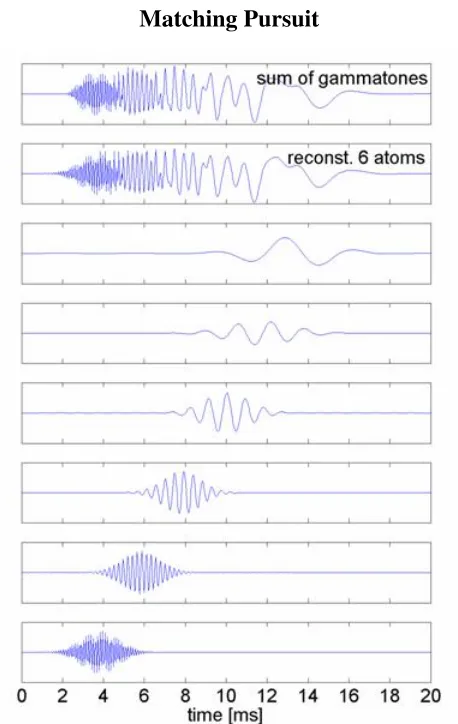
Matching Pursuit (MP) is a process in which a signal is approximated using a redundant
dictionary of atoms,g [7] (see Figure 3.2). Multiple types of atoms, such as pure sinusoids
or MWs, can be used to construct a dictionary. For reference, the CWT can be written
in terms of MP with a dictionary constructed from scaled and shifted versions of a single
MW. MP differs from the Fourier transform and CWT because it can decompose a signal
using different shaped basis functions, rather than uniformly shaped basis functions. The
basic MP algorithm projects the chosen signal onto all the atoms in a dictionary and selects
the atom which produces the maximum absolute inner product with the signal. Out of the
entire dictionary, the chosen atom matches the current signal the best. The atom is scaled
by this inner product and subtracted from the signal to produce a residual,R. One iteration
Rnx=< x, gγn > gγn+R
n+1x (3.2)
where
Rnxis thenth order residual.
xis the original signal.
gγn is the is the atomnin the family gamma.
Rn+1xis the new residual generated from approximatingxin the dimensiong
γn.
For the first iteration, R0x is defined asx. This expression is repeated on the residual
signal generated during subsequent iterations until the desired algorithm stopping criterion
is met. For this application, the stopping criterion was chosen to be a fixed number of
iter-ations. After an experimentally determined number of MP iterations, the subsequent
com-ponents contribute negligible energy to the original signal and can therefore be excluded
without losing information. This expression for a MP signal approximation is shown in
Equation 3.3:
x=
M−1
X
n=0
< Rnx, gγn > gγn+R
Mx
(3.3)
where
xis the original signal.
M is the current number of iterations.
nis the current iteration number.
RMxis theMth order residual.
The basic MP algorithm used to decompose CAEPs is not orthogonal, so the same atom
is placed back in the dictionary and can be used multiple times. The basis functions chosen
by the MP algorithm and their weights can be thought of as components of the original
signal. These components can be plotted into a feature space based on their properties,
such as scale, position and energy, to further analyze the signal.
During MP implementation, a dictionary of atoms was constructed in MATLAB and
Matching Pursuit
Figure 3.2: Example of MP Decomposition. The Bottom Six Plots Show the Atoms Selected to Represent the Signal in the Top Plot. The Second Plot shows the Sum of the 6 Atoms. [29]
3.2.3 Support Vector Machines
Support vector machines (SVMs) are binary classification models which use supervised
learning to determine which category, out of two, new data points fall in. SVMs are initially
trained using examples of data whose category is known. Based on this training sequence,
the SVM will classify new data points as falling into one of the two categories. SVM uses
the training sequence to generate a hyperplane in the data feature space, with each side of
the hyperplane representing a class. When the data is non-separable (i.e. a hyperplane will
not perfectly separate the data) a penalty variable,C, is introduced which places restrictions
on how tolerant of misclassifications the model is [8]. The best hyperplane is chosen to
generalization errors when new data points are presented to the model.
[image:32.612.128.491.114.295.2]SVM Kernel Function
Figure 3.3: Example of Using a Kernel Function to Separate Data in a Higher Dimensional Space [30]
When data cannot be easily separated by a hyperplane in the current feature space, the
data can be mapped to a higher dimensionality where it can be separated (see Figure 3.3).
This remapping is performed using a kernel function. When the SVM training algorithm
searches for the optimal hyperplane, it only uses the dot product to operate on the training
data sets. This is advantageous because the algorithm does not have to remap all data
points to this higher dimensional space. The algorithm only has to compute the dot product
between two of the data points in that space. In this scenario, the kernel only needs to
be used in the training sequence to determine the hyperplane, which can then be brought
back to the original feature space [8]. The kernel trick allows the data to be analyzed in a
higher dimensional space without requiring the explicit remapping of all the data and does
not significantly change the computation time of the model. For this analysis, the Gaussian
radial basis function (RBF) kernel was used because it is a flexible kernel which was found
to fit the CAEP data in the features space well. The formula for the Gaussian RBF can be
seen in Equation 3.4:
K(x, y) = e
−kx−yk2
2σ2 (3.4)
where
xis one data point.
σ is a parameter which controls the overall shape of the SVM hyperplane.
The MATLAB functions textitsvmtrain and textitsvmclassify were used to respectively
train and classify SVMs using the RBF kernel.
3.3
Proposed Tool for Artifact Removal Evaluation
In order to evaluate how well a technique removes the electrical artifact from contaminated
CAEPs, the CAEPs from before and after the artifact removal were analyzed using the
CWT and the correlation function. The artifact shape is directly related to the signal
en-velope of the stimulus, so the CWT of the stimulus enen-velope provides a good estimate of
the artifacts spectral energy. The stimulus envelope of Tone 1 is shown in Fig. 3.4A and its
corresponding time-frequency representation is shown in Fig. 3.4B. In this representation,
the x-axis denotes time, the y-axis denotes frequency, and the color scale denotes
coeffi-cient magnitudes. Coefficoeffi-cient magnitudes are used instead of their signed values because
the representation is meant to convey the spectral energy of the signal. A NH CAEP can
be seen in Fig. 3.5A along with its time-frequency representation in Fig. 3.5B, and a
con-taminated CAEP can be seen in Fig. 3.6A along with its time-frequency representation in
Fig. 3.6B. The artifact, as seen in Fig. 3.4B, can clearly be seen in the CI CAEP
time-frequency plot. By comparing the stimulus envelope time-time-frequency plot to the CI CAEP
before and after artifact removal, the removal process can be evaluated. The magnitude
of the correlation coefficient between a stimulus envelope and its corresponding CAEP in
the time-frequency domain is called the artifact correlation, and it can assess the artifact
removal process. A large artifact correlation for an extracted CAEP can indicate there is
either still artifact energy in the neural signal or CAEP energy was removed with the
arti-fact. The artifact correlation of the average NH CAEP was 0.045, which indicates a small
artifact correlation corresponds with little residual artifact energy.
To determine how successfully the subtraction and polynomial methods, outlined in
[13] and [14] respectively, remove the artifact, the methods were assessed using the
pro-posed CWT evaluation tool. Both methods were implemented on the CI CAEP from tone 1,
shown in Fig 3.6. Fig. 3.7A shows the CAEP extracted by the subtraction method and Fig.
3.7B shows its corresponding time-frequency plot. The resulting CAEP clearly contains
Figure 3.4: Tone 1 (200ms, 1 kHz tone) Stimulus Envelope. A) Time Domain Representation of Stimulus Envelope B) Time-Frequency Representation of Stimulus Envelope.
Figure 3.5: Average NH CAEP Signal for tone 1 in the A) Time Domain and B) Time-Frequency Domain
[image:34.612.99.536.493.632.2]of 0.658. For reference, the original CI CAEP produced an artifact correlation of 0.866.
While the subtraction technique did remove the artifact completely for some patients, it
still left behind energy from the artifact for other patients. This remaining artifact energy
can only be observed using the CWT. Visually, the subtraction method appears to have
extracted what could be the neural response from the CI CAEP, but the evaluation tool
identifies artifact energy in the extracted CAEP. In comparison, the time-frequency
anal-ysis of typical polynomial method results can be seen in Fig. 3.8. The clean CAEP can
be seen in Fig. 3.8A, while its corresponding time-frequency analysis can be seen in Fig.
3.8B. This time-frequency plot produced an artifact correlation of 0.151. The polynomial
method removed most of the artifact spectral energy for this example CI CAEPs produced
by tone 1.
Figure 3.7: Subtraction Method CAEP Extracted from CI CAEP in Fig. 3.6. A) Time Domain Representation of Signal. B) Time-Frequency Representation of Signal. Recovered CAEP has an Artifact Correlation of 0.658.
The proposed evaluation tool provides a quantitative assessment of how successful an
artifact removal process is, along with a graphical representation of what artifact energy
remains in the extracted CAEP.
3.4
Proposed Method for CAEP Recovery
The proposed extraction method is a novel technique which combines MP based feature
extraction with SVM binary classifiers to identify and recover the NH components within
a CI CAEP. A block diagram of the proposed method for extracting the N1-P2 complex is
Figure 3.8: Polynomial Method CAEP Extracted from CI CAEP in Fig. 3.6. A) Time Domain Representation of Signal. B) Time-Frequency Representation of Signal. Recovered CAEP has an Artifact Correlation of 0.151.
Figure 3.9: CAEP Extraction Technique Block Diagram
3.4.1 MP Feature Extraction
MP is implemented on the signals using a redundant dictionary constructed from Gabor
functions, which are generated using the following equation [31]:
G= √1 se
−π(n−u)2
s2 cos(2πω(n−u) +θ) (3.5)
where
Gis the Gabor function.
sis the scale factor of the function.
ω is the normalized frequency.
θ is the phase of the function.
For this analysis, the Gabor atoms were constructed by varying the scale factor from
1 sample to the length of the signal, N, for normalized frequency values of 0 and 0.001.
The phase was set to 0 for all Gabor functions. The stopping criterion was experimentally
determined to be 40 iterations for data from tones 1 and 2 based on the coefficient values
produced after each MP iteration. The coefficient magnitudes, which were first normalized
to the first coefficient value, were less than 0.6% after the 40th iteration, as shown in Fig.
3.10, and therefore contribute little energy to the original signal. The components produced
by the MP algorithm were plotted in a three dimensional feature space, with the three
[image:37.612.146.472.335.493.2]dimensions representing position, scale (as a power of two), and coefficient.
Figure 3.10: MP Coefficients Produced over 60 Iterations for Tone 1 CI CAEP
3.4.2 SVM Training
The estimated artifact and average NH CAEP are decomposed using MP to generate
train-ing data sets. These components are used by SVM to generate a hyperplane which can
separate NH and artifact components. The artifact and NH CAEP components generated
by the MP algorithm are not perfectly separable in the current feature space, so an RBF
kernel function is used to create a hyperplane which will provide more accurate
classifica-tion. Prior to SVM training, the logarithm of the component coefficient magnitudes was
coefficients led the SVM to classify negative peaks from the CAEP incorrectly though, so
in order to retain the coefficient sign the data is split up into two sets: one for components
with positive coefficients (PC) and one for components with negative coefficients (NC).
Figs. 3.11A and 3.11B show an example of artifact and NH training components plotted in
the feature space.
Figure 3.11: SVM Training and Classification in the Feature Space. A) Artifact and NH NC Com-ponents used to Train the NC SVM. B) Artifact and NH PC ComCom-ponents used to Train the PC SVM. C) CI CAEP NC Components Classified as NH or Artifact along with the NC SVM Decision Hyperplane. D) CI CAEP PC Components Classified as NH or Artifact along with the PC SVM Decision Hyperplane
The SVMs use two parameters to control the shape of their decision hyperplanes. The
Gaussian RBF kernels contain a free parameter, σ, which controls the overall shape the
hyperplane takes, with high values producing a smoother hyperplane and low values
pro-ducing a more variable hyperplane. This parameter is similar to the standard deviation
of a normal Gaussian distribution, where a large standard deviation produced a smoother
curve and a small standard deviation produces a sharper curve. The second parameter is the
penalty term, C, which controls the acceptable degree of misclassification [8]. These
pa-rameters determine how closely the SVM fits the hyperplane to the training data. If the
hy-perplane over-fits or under-fits the training data, then the SVM loses generalization and new
for each patient is determined by implementing a grid search over possible combinations of
these two parameters [32], and applying the CWT evaluation tool to the recovered CAEP
from each combination. For each patient, the combination which generates the CAEP with
the lowest artifact correlation is selected. CAEPs can vary significantly between patients
and recording sessions, so different combinations of σ and C will produce hyperplanes
which fit different signals better.
3.4.3 SVM Classification and CAEP Extraction
After training, the SVM hyperplanes are used to classify the CI CAEP components as either
artifact or neural response. Figs. 3.11C and 3.11D show an example of classified CI CAEP
components plotted in the feature space along with hyperplane surfaces for both SVMs
for one subject. The NH components are taken from each SVM and summed together to
produce the extracted CAEP.
3.5
Summary
This chapter outlines the methodology behind the CWT evaluation tool and the novel
tech-nique for extracting the CI CAEP. The CWT evaluation tool requires the stimulus envelope
and extracted CAEP to produce a quantitative assessment of the artifact energy remaining
in the neural response. The tool calculates the two-dimensional correlation coefficient
be-tween the time-frequency representations of both signals to estimate how much residual
artifact energy is present in the extracted CAEP. The novel technique for extracting the
neural response from the CI CAEP using MP and SVM is then outlined. The stimulus
en-velope and average NH CEAP are decomposed using MP with Gabor functions and passed
to the SVMs as training data. The SVMs use Gaussian RBF kernels and a grid search
to determine the optimal parameters for a given CI CAEP. The CI CAEP is then
decom-posed using MP and the components are classified as either artifact or neural response by
the trained SVMs, and the neural response components are combined to extract the CAEP.
This methodology describes the steps which can be followed to implement the proposed
evaluation tool and CAEP extraction technique to produce the results reported in Chapter
Chapter 4
Results and Discussion
The purpose of this chapter is to present figures and tables which demonstrate the
perfor-mance of the proposed artifact extraction technique and CWT evaluation tool. In Section
4.1, the proposed method was implemented on CI CAEPs from tone 1. Section 4.2
con-tains the results from applying the proposed method on tone 2 CI CAEPs. For both tone
CI CAEPs, the subtraction and polynomial methods were also applied to data for
compari-son. The results of each method were assessed using the CWT evaluation tool to determine
how effectively each method extracted the CAEP. Section 4.3 applies the proposed CAEP
extraction technique on CI CAEPs generated using speech stimuli, which have complex
artifacts current methods cannot remove. In Section 4.4, sources of error for both the CWT
evaluation tool and the proposed CAEP extraction technique are considered and analyzed.
Section 4.5 addresses the practical and clinical significance of the proposed work, including
its advantages over current methods for extracting the neural response from CI CAEPs. In
particular, the proposed CWT evaluation tool is the first contribution towards quantitative
assessment of methods for removing the artifact from CI CAEPs. Possible improvements
to the CWT evaluation tool and CAEP extraction technique are also outlined in Section 4.6.
4.1
Tone 1
The proposed artifact removal technique was applied to five CI patients from the tone 1 test
group. The subtraction and polynomial methods were also applied to this data to compare
the proposed method with current CAEP extraction techniques. All results were analyzed
using the CWT evaluation tool to assess how successfully each method extracted the neural
4.1.1 Data Analysis Procedure
The following procedure outlines the process of applying the proposed CAEP extraction
technique to the CI CAEP data.
• The MP algorithm was used to decompose the normalized 200ms, 1 kHz stimulus envelope and normalized average NH CAEP to create artifact and NH CAEP training
components respectively. The MP stopping criterion was set to 40 iterations, resulting
in a total of 80 training components.
• The training components were conditioned and passed to the SVMs. The condition-ing consisted of splittcondition-ing the components into two groups: positive coefficients and
negative coefficients. The logarithm function is then applied to the magnitude of the
coefficients for each group in order to further spread out the components. Both the PC
and NC SVMS used RBF kernel functions to generate the appropriate hyperplanes.
The optimal SVM parameter grid search for tone 1 was experimentally determined to
cover ofσ∈(0.3, 0.5) andC∈(0.01, 0.1, 1, 10, 100).
• For each patient, the SVMs were trained for all ten combinations of SVM parameters and the CWT evaluation tool was used to select the pair which generated the CAEP
with the lowest artifact correlation. The grid search is fully automated, and can be
expanded to include more values of and C at the expense of computation time. To
keep the search from becoming unwieldy, the same parameters were used in the PC
and NC SVMs.
• After the optimal parameters were selected for a given patient, the SVMs were trained
with the chosen parameters and used to classify the CI CAEP components. The NH
components were combined to extract the neural response from the CI CAEP.
4.1.2 Tone 1 Results
The proposed method extracted clear N1-P2 complexes from all five CI CAEPs analyzed
for tone 1. These results were assessed using the CWT evaluation tool. Fig. 4.1 shows the
results of the CAEP recovery process for subject 1 of tone 1. Figs. 4.1A and 4.1B show
the original CI CAEP and its corresponding time-frequency plot respectively, while Figs.
4.1C and 4.1D show the recovered CAEP and its corresponding CWT respectively. The
compares favorably with the NH response of Fig. 3.5B. The CWT evaluation tool measured
the extracted CAEP artifact correlation at 0.033. For reference, the CI CAEPs from tone 1
have an average artifact correlation of 0.840. Based on these results, the recovered CAEP
[image:42.612.100.522.176.430.2]contains almost no spectral energy introduced by the artifact.
Figure 4.1: Proposed Method Results for Tone 1 Patient 1. Artifact Correlation Decreased from 0.866 to 0.033
Figures 4.2 through 4.5 contain the CI CAEPs from patients 2 through 5 before and
after the proposed extraction technique was applied.
Table 4.1 contains the CWT evaluation of the results obtained from applying the
pro-posed method, the subtraction method and the polynomial method on the tone 1 CI CAEPs.
The subtraction method produced an average artifact correlation of 0.344, suggesting
ar-tifact energy remains in CAEPs extracted using this technique. The polynomial method
produced and average artifact correlation of 0.150. These results indicate the polynomial
method extracts a cleaner CAEP, on average, than the subtraction method. The proposed
method produced an average artifact correlation of 0.024, leaving almost no artifact
com-ponents in the recovered CAEPs.
The CWT evaluation tool provides insight into how the methodology behind each
Figure 4.2: Proposed Method Results for Tone 1 Patient 2. Artifact Correlation Decreased from 0.827 to 0.001
Table 4.1: Tone 1 Artifact Correlation Results
Patient CI CAEP Proposed Subtraction [13] Polynomial [14]
1 0.866 0.033 0.658 0.151
2 0.827 0.001 0.140 0.120
3 0.817 0.001 0.140 0.209
4 0.851 0.004 0.137 0.127
5 0.837 0.081 0.643 0.144
Combined 0.840±0.017 0.024±0.031 0.344±0.251 0.150±0.031
correlation generated by the subtraction method results appears to indicate the method does
not extract a particularly clean neural response from CI CAEPs, but the individual
pa-tient results suggest otherwise. For papa-tients 2 through 4, the subtraction method produced
CAEPs with low artifact correlations, which are comparable to the polynomial method
re-sults for the same patients. The average subtraction rere-sults are skewed by patients 1 and 5,
which contained large amounts of artifact energy in the extracted CAEP. The inconsistency
of the subtraction method can be seen in the standard deviation of its results, which is eight
times larger than the standard deviations for the polynomial and proposed methods. These
results demonstrate the primary flaw in the techniques methodology. The subtraction
Figure 4.3: Proposed Method Results for Tone 1 Patient 3. Artifact Correlation Decreased from 0.817 to 0.001
CAEP with a long ISI for the same patient. This is a reasonable assumption if both sets
of CI CAEPs are taken during the same test and have the same recording conditions. If an
element of the recording process changes, such as the EEG electrode cap shifting, the
arti-fact present in the short ISI CI CAEP will differ from the artiarti-fact in the long ISI CI CAEP.
When the incorrect artifact is subtracted from the long ISI CI CAEP, artifact energy will
remain in the resulting neural response. While the subtraction method works comparably
to the polynomial method when the short ISI CI CAEP provides a good estimate of the
artifact, the need for a second recording introduces a source of error which can reduce the
effectiveness of the method.
The polynomial method produces much more consistent results than the subtraction
method, but they are still relatively large with a mean artifact correlation of 0.150. The
polynomial method fits a polynomial to the stimulus envelope and the CI CAEP in order
to estimate the artifact present in the CI CAEP. The CWT evaluation tool results indicate
the polynomial method might be over fitting the CI CAEP though, removing neural energy
in the process. The actual correlation coefficients between the polynomial results and the
Figure 4.4: Proposed Method Results for Tone 1 Patient 4. Artifact Correlation Decreased from 0.851 to 0.004
negative correlation with the stimulus envelope. This negative correlation is caused by
additional energy being removed from the CAEP beyond just the artifact energy, creating
an absence of neural energy where the artifact spectral energy once resided. While the
artifact is completely removed from the resulting CAEP, the N1-P2 complex amplitude
might be affected by the missing neural energy.
The proposed method produces the lowest average artifact correlation out of all tested
methods. This novel technique makes use of MP and SVM to individually identify the
CI CAEP signal components as either neural response or artifact, and selectively extracts
the neural response components. The subtraction and polynomial techniques attempt to
estimate the artifact within a CI CAEP and subtract it off, while the proposed method
identifies neural response components present within the CI CAEP and extracts them. This
approach, on average, extracts CAEPs with very low levels of residual artifact energy.
4.1.3 N1-P2 Latency
In order to verify the applied methods agree on the extracted CAEPs for tone 1, the peak
Figure 4.5: Proposed Method Results for Tone 1 Patient 5. Artifact Correlation Decreased from 0.837 to 0.081
Table 4.2: Stimulus 1 N1-P2 Latency Results
N = 5 Proposed Subtraction [13] Polynomial [14]
N1 (ms) 122±8 122±4 121±10
P2 (ms) 197±7 207±15 200±3
by a negative peak occurring 100ms post-stimulus, followed by a positive peak occurring
200ms post-stimulus. Table 4.2 contains the tone 1 N1-P2 complex latencies as determined
by the various artifact removal techniques. All three methods show good agreement with
the literature on the latencies of the N1 and P2 peaks, placing them around 120ms and
200ms respectively. This agreement indicates all three methods did indeed recover the
N1-P2 complex from the CI CAEPs.
4.2
Tone 2
The proposed artifact removal technique was applied to four CI patients from the tone 2
test group. As with the tone 1 results, the subtraction and polynomial methods were also
were analyzed using the CWT evaluation tool to measure how successfully each method
extracted the neural response.
4.2.1 Tone 2
The following procedure outlines the steps taken to implement the proposed CAEP
extrac-tion technique on the CI CAEPs from tone 2.
• The normalized 656ms, 1 kHz stimulus envelope was decomposed using MP to
gen-erate artifact training components, while the normalized average NH CAEP was
de-composed to generate NH training components.
• The training components were separated based on their coefficient signs, and the
logarithm of their coefficient magnitudes was taken to further spread the data. The
conditioned training data was passed to the NC and PC SVMs, which used RBF
kernels. A grid search was implemented to choose the best SVM parameters.
• The CWT evaluation tool identified the optimal SVM parameters to be = 0.6 and C = 0.01 for all data sets. The grid search was automated and the same parameters were
used for the PC and NC SVMs.
• After the grid search, the SVMs were trained using the optimal parameters for each patient and used to classify the CI CAEP components. The NH components were
combined to extract the neural response from the CI CAEP.
4.2.2 Tone 2 Results
The proposed method extracted clear N1-P2 complexes from the four CI CAEPs analyzed
for tone 2. As with the tone 1 results, these results were assessed using the CWT
eval-uation tool. Figs. 4.6 through 4.9 show the extraction process for patients 6 through 9,
respectively, for tone 2. These figures are set up with the original CI CAEP in plot A
and its time-frequency representation in plot B. Plot C shows the extracted CAEP and its
corresponding time-frequency representation is shown in plot D.
Table 4.3 contains the CWT evaluation of the results from applying the three artifact
removal techniques on the tone 2 CI CAEPs. The subtraction technique produced the
largest average artifact correlation at 0.125, while the polynomial performed better at 0.105.
Figure 4.6: Proposed Method Results for Tone 2 Patient 6. Artifact Correlation Changes from 0.054 to 0.081
with an artifact correlation of 0.050. For comparison, the average artifact correlation of the
[image:48.612.99.520.98.339.2]CI CAEPs was 0.241.
Table 4.3: Tone 2 Artifact Correlation Results
Patient CI CAEP Proposed Subtraction [13] Polynomial [14]
6 0.054 0.081 0.017 0.078
7 0.445 0.026 0.354 0.138
8 0.373 0.061 0.110 0.124
9 0.093 0.032 0.017 0.082
Combined 0.241±0.170 0.050±0.138 0.125±0.026 0.105±0.022
The average results for tone 2 are significantly lowered by patients 6 and 9, which have
raw artifact correlations of 0.054 and 0.093 before any technique is applied. Removing
these two values increases the CI CAEP artifact correlation to 0.410. This also changes the
subtraction, polynomial, and proposed method average artifact correlations to 0.232, 0.131,
and 0.043 respectively. These new values are much more comparable with the pattern
of results from tone 1. The two CI CAEPs with low artifact correlations likely did not
contain much artifact energy. A possible explanation for why these signals contained little
Figure 4.7: Proposed Method Results for Tone 2 Patient 7. Artifact Correlation Decreased from 0.445 to 0.026
mismatches between electrodes and the scalp can reduce the presence of the artifact for
some patients. The proposed method does not significantly change the artifact correlations
of patients 6 and 9 from their raw values, indicating the method does not falsely identify
artifact components where none exist. Figures 4.6 and 4.9 confirm the proposed method
did not incorrectly identify artifact components in these two CI CAEPs because the
time-frequency representation of the signals remained almost identical.
4.2.3 N1-P2 Latency
In order to verify the applied methods agree on the extracted CAEPs for tone 2, the peak
latencies of the N1-P2 complexes can be compared. Table 4.4 contains the tone 1 N1-P2
complex latencies as determined by the various artifact removal techniques. There is a bit
more variance in the latencies of the N1 peaks in
![Figure 2.1: Structure of the Human Ear [15].](https://thumb-us.123doks.com/thumbv2/123dok_us/42882.3863/18.612.188.445.114.306/figure-structure-of-the-human-ear.webp)
![Figure 2.2: Cross Section of the Cochlea [16].](https://thumb-us.123doks.com/thumbv2/123dok_us/42882.3863/19.612.183.438.92.316/figure-cross-section-of-the-cochlea.webp)
![Figure 2.3: Diagram of an Installed Cochlear Implant Device [18].](https://thumb-us.123doks.com/thumbv2/123dok_us/42882.3863/20.612.187.432.86.325/figure-diagram-installed-cochlear-implant-device.webp)
![Figure 2.4: Functional Diagram of a Standard Cochlear Implant [5]](https://thumb-us.123doks.com/thumbv2/123dok_us/42882.3863/21.612.196.424.85.273/figure-functional-diagram-standard-cochlear-implant.webp)
![Figure 2.5: Normal Hearing CAEP with Marked N1-P2 Complex [21]](https://thumb-us.123doks.com/thumbv2/123dok_us/42882.3863/22.612.175.431.88.269/figure-normal-hearing-caep-marked-n-p-complex.webp)
![Figure 2.6: Block Diagram of CIS Speech Encoding Strategy [5]](https://thumb-us.123doks.com/thumbv2/123dok_us/42882.3863/23.612.162.456.205.394/figure-block-diagram-cis-speech-encoding-strategy.webp)
![Figure 3.1: Coiflet4 Wavelet Function and Scaling Function [27]](https://thumb-us.123doks.com/thumbv2/123dok_us/42882.3863/29.612.111.512.224.393/figure-coiet-wavelet-function-scaling-function.webp)
![Figure 3.3: Example of Using a Kernel Function to Separate Data in a Higher Dimensional Space[30]](https://thumb-us.123doks.com/thumbv2/123dok_us/42882.3863/32.612.128.491.114.295/figure-example-using-kernel-function-separate-higher-dimensional.webp)