High Performance Multi-Paradigm Messaging Run Time on Multicore Systems
Xiaohong Qiu Research Computing UITS Indiana University Bloomington
Geoffrey Fox Community Grids Laboratory Indiana University Bloomington
George Chrysanthakopoulos, Henrik Frystyk Nielsen Microsoft Research
Redmond WA
Abstract
Broad deployment of multicore systems in commodity situations has highlighted the need for parallel
environments that support a wider range of application than those on traditional parallel supercomputers.
Further we need to build composite jobs made of heterogeneous applications. A common underlying
runtime that supports multiple programming paradigms appears to be one important part of future parallel
computing environments integrating cluster and multicore parallelism. Here we examine CCR or the
Concurrency and Coordination Run time from Microsoft as a multi-paradigm run time supporting three key
parallel models: full MPI collective messaging, asynchronous threading and coarse grain functional
parallelism or workflow. It is an attractive multi-paradigm candidate as it was designed to support general
dynamic message patterns with high performance and already has a distributed, REST oriented runtime
known as DSS built on top of it. We present results on message latency and bandwidth for two processor
multicore systems based on AMD and Intel architectures with a total of four and eight cores. Generating up
to a million messages per second on a single PC, we find on the AMD based PC, latencies from 4µs in
basic asynchronous threading and point to point mode to 14 µs for a full MPI_SENDRECV exchange with
all threads (one per core) sending and receiving 2 messages at a traditional MPI loosely synchronous
rendezvous. Workflow latencies are measured as less than 40 µs with all results coming from the CCR and
DSS freely available as part of the Microsoft Robotics Studio distribution. We present Intel PC latencies
that are significantly higher but whose optimization has not been studied yet by us. Looking to the future,
we suggest that the ease of programming custom collectives using the CCR primitives make it attractive to
integration with workflow and thread-based programming, a rendezvous and active message mode, support
of managed code (C#) and ability to run on cluster and multicore systems. Although the current CCR has
reasonable performance for MPI primitives, it would be important to improve this and current core CCR
plans should lead to a factor of 2 lower latencies. We also will investigate the origins of the differences
between Intel and AMD results.
1. Introduction
Multicore architectures are bringing parallel computing to a broad range of applications with profound
impact on hardware, systems software and applications [1-3]. The programming models and runtime that
will be used on multicore architectures are the subject of substantial academic and industry research and
development as they must bridge between current commercial desktop and server systems, commercial
parallel databases, distributed Grid environments and the massively parallel supercomputers largely aimed
at science and engineering [4]. Intel [5] has examined classes of possible future desktop applications which
they term RMS – Recognition, Mining and Synthesis. This can be illustrated by a sophisticated datamining
application that first accesses a parallel database and then runs analysis algorithms including perhaps a
multithreaded branch and bound search, and a SVM Support Vector Machine built on parallel linear
algebra followed by sophisticated visualization. This composite application would need to be controlled by
a coarse grain executive similar to Grid workflow [6] or Google MapReduce [7]. The individual
datamining filters could use either the dynamic thread parallelism appropriate for search algorithm or an
MPI style messaging for parallel linear algebra used in the SVM filter. Further we would like this job to run
efficiently and seamlessly either internally to a single CPU or across a tightly coupled cluster or distributed
Grid. In this paper we address a small part of the multicore puzzle – namely what could be the runtime that
could span these different environments and different platforms that would be used by the heterogeneous
composite applications that could be common on future multicore applications for personal, commercial or
research use. Managed code will be important for desktop applications and so C# (used here) and Java
We examine the issues of building a multi-paradigm runtime with a particular example CCR which is a
runtime [8-9] designed for robotics applications [10] but also investigated [11] as a general programming
paradigm. CCR supports efficient thread management for handlers (continuations) spawned in response to
messages being posted to ports. The ports (queues) are managed by CCR which has several primitives
supporting the initiation of handlers when different message/port assignment patterns are recognized. Note
that CCR supports a particular flavor of threading where information is passed by messages allowing
simple correctness criteria. However this paper is not really proposing a programming model but examining
a possible low level runtime which could support a variety of different parallel programming models that
would map down into it. In particular the new generation of parallel languages [12] from Darpa’s HPCS
High Productivity Computing System program supports the three execution styles (dynamic threading,
MPI, coarse grain functional parallelism) we investigate here.
In the next section, we discuss CCR and DSS briefly while section 3 defines more precisely our three
execution models. Section 4 presents our basic performance results that suggest one can build a single
runtime that supports the different execution models. Future work and conclusions are in section 5.
2. Overview of CCR and DSS
CCR provides a framework for building general collective communication where threads can write to a
general set of ports and read one or more messages from one or more ports. The framework manages both
ports and threads with optimized dispatchers that can efficiently iterate over multiple threads. All primitives
result in a task construct being posted on one or more queues, associated with a dispatcher. The dispatcher
uses OS threads to load balance tasks. The current applications and provided primitives support what we
call the dynamic threading model with capabilities that include:
1) FromHandler: Spawn threads without reading ports
2) Receive: Each handler reads one item from a single port
3) MultipleItemReceive: Each handler reads a prescribed number of items of a given type from a
given port. Note items in a port can be general structures but all must have same type.
5) JoinedReceive: Each handler reads one item from each of two ports. The items can be of different
type.
6) Choice: Execute a choice of two or more port-handler pairings
7) Interleave: Consists of a set of arbiters (port -- handler pairs) of 3 types that are Concurrent,
Exclusive or Teardown (called at end for clean up). Concurrent arbiters are run concurrently but
exclusive handlers are not.
One can spawn handlers that consume messages as is natural in a dynamic search application where
handlers correspond to links in a tree. However one can also have long running handlers where messages
are sent and consumed at a rendezvous points (yield points in CCR) as used in traditional MPI applications.
Note that “active messages” correspond to the spawning model of CCR and can be straightforwardly
supported. Further CCR takes care of all the needed queuing and asynchronous operations that avoid race
conditions in complex messaging. For this first paper, we did use the CCR framework to build a custom
optimized collective operation corresponding to the MPI “exchange” operation but used existing
capabilities for the “reduce” and “shift” patterns. We believe one can extend this work to provide all MPI
messaging patterns.
Note that all our work was for managed code in C# which is an important implementation language for
commodity desktop applications although slower than C++. In this regard we note that there are plans for a
C++ version of CCR which would be faster but prone to traditional un-managed code errors such as
memory leaks, buffer overruns, memory corruption. The C++ version could be faster than the current CCR
but eventually we expect that the C# CCR will be within 20% of the performance of the C++ version. CCR
has been extensively applied to the dynamic threading characteristic of today’s desktop application but its
largest use is in the Robotics community. One interesting use is to add an efficient port-based
implementation of “futures” to C#, since the CCR can easily express them with no modifications in the
core runtime. CCR is very portable and runs on both CE (small devices) and desktop windows.
DSS sits on top of CCR and provides a lightweight, REST oriented application model that is particularly
Services are isolated from each other, even when running within the same node and are only exposed
through their state and a uniform set of operations over that state. The DSS runtime provides a hosting
environment for managing services and a set of infrastructure services that can be used for service creation,
discovery, logging, debugging, monitoring, and security. DSS builds on existing Web architecture and
extends the application model provided by HTTP through structured data manipulation and event
notification. Interaction with DSS services happen either through HTTP or DSSP [27] which is a
SOAP-based protocol for managing structured data manipulations and event notifications. The combination of
HTTP and DSSP allows services to expose their UI through traditional Web infrastructure mechanisms
such as a browser as well as interacting efficiently with each other.
3. MPI and the 3 Execution Models
MPI – Message Passing Interface – dominates the runtime support of large scale parallel applications for
technical computing. It is a complicated specification with 128 separate calls in the original specification
[13] and double this number of interfaces in the more recent MPI-2 including support of parallel external
I/O [14-15]. MPI like CCR is built around the idea of concurrently executing threads (processes, programs)
that exchange information by messages. In the classic analysis [16-19], parallel technical computing
applications can be divided into four classes:
a) Synchronous problems where every process executes the same instruction at each clock cycle.
This is a special case of b) below and only relevant as a separate class if one considers SIMD
(Single Instruction Multiple Data) hardware architectures.
b) Loosely Synchronous problems where each process runs different instruction streams (often using the same program in SPMD mode) but they synchronize with the other processes every now
and then. Such problems divide into stages where at the beginning and end of each stage the
processes exchange messages and this exchange provides the needed synchronization that is
scalable as it needs no global barriers. Load balancing must be used to ensure that all processes
execute for roughly (within say 5%) the same time in each phase and MPI provides the messaging
at the beginning and end of each stage. We get at each loose synchronization point a message
pattern of many overlapping joins that is not usually seen in commodity applications and
c) Embarrassingly or Pleasingly parallel problems have no significant inter-process communication and are often executed on a Grid.
d)
Functional parallelism leads to what were originally called metaproblems that consist of multipleapplications, each of which
is of one of the classes a),
b), c) as seen in
multidisciplinary
applications such as linkage
of structural, acoustic and
fluid-flow simulations in
aerodynamics. These have a
coarse grain parallelism.
Classes c) and d) today would
typically be implemented as a
workflow using services to
represent the individual
components. Often the
components are distributed
and the latency requirements
are typically less stringent
than for synchronous and loosely synchronous problems. We view this as functional parallelism in this
paper and will use DSS already developed for Robotics [10] on top of CCR for this case and idealized in
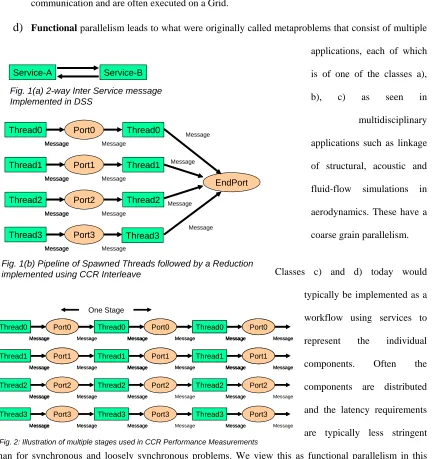
fig. 1(a).
We use CCR in a mode where multiple identical stages are executed and the run is completed by
combining the computations with a simple CCR supported reduction as shown in fig. 1(b). This also
illustrates the simple Pipeline Spawn execution that we used for basic performance measurements of the
Message Thread0 Port0 Message Message Thread0 Message Message Thread3 Port3 Message Message Thread3 EndPort Message Thread2 Port2 Message Message Message Thread2 Message Message Thread1 Port1 Message Message Thread1 Message
Fig. 1(b) Pipeline of Spawned Threads followed by a Reduction implemented using CCR Interleave
Service-A Service-B
Fig. 1(a) 2-way Inter Service message Implemented in DSS
[image:6.612.95.528.98.557.2]Message Thread3 Port3 Message Message Message Thread3 Port3 Message Message Message Thread2 Port2 Message Message Message Thread2 Port2 Message Message Message Thread0 Port0 Message Message Message Thread0 Port0 Message Message Message Thread0 Port0 Message Message Message Thread3 Port3 Message Message Message Thread2 Port2 Message Message Message Thread1 Port1 Message Message Message Thread1 Port1 Message Message Message Thread1 Port1 Message Message One Stage
[image:6.612.96.525.404.534.2]dynamic threading performance. Each thread writes to a single port that is read by a fresh thread as shown
in more detail in fig. 2.
We take a fixed computation that takes from 8 to 17 seconds depending on hardware and execution
environment to run sequentially on the machines we used in this study. This computation was divided into
a variable number of stages of identical computational complexity and then the measurement of execution
time as a function of number of stages allows one to find the thread and messaging overhead. Note that the
extreme case of 107 stages corresponds to a 0.8 to 1.7 µs execution time and a stringent test for MPI style
messaging which can require microsecond level latencies. We concentrated on small message payloads as it
is the latency (overhead) in this case that is the critical problem. As multicore systems have shared
memories, one would often use handles in small messages rather than transferring large payloads.
We looked at three different message patterns for the dynamic spawned thread case choosing structure that
was similar to MPI to allow easier comparison of different execution models. These spawned patterns are
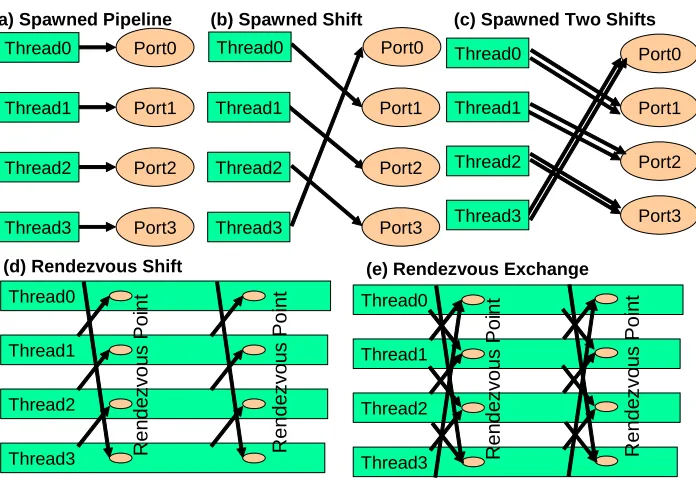
illustrated in fig. 3(a-c) and augment the pipeline of fig. 1(b) and 2 with a “nearest neighbor” shift with Thread3 Port3
Thread2 Port2 Thread0 Port0
Thread1 Port1 (a) Spawned Pipeline
Thread2 Port2 Thread0 Port0 Port3 Thread3 Port1 Thread1
(b) Spawned Shift
(e) Rendezvous Exchange Thread0 Port3 Thread2 Port2 Port1 Port0 Thread3 Thread1
[image:7.612.131.479.80.321.2](c) Spawned Two Shifts
Fig. 3: Five CCR Communication Patterns used to test spawned dynamic threading (a,b,c) and MPI style Rendezvous’s (d,e) and shown for 4 cores (d) Rendezvous Shift
either one or two messages written to ports so we could time both the Receive and MultiItemReceive modes
of CCR. We note that figures 1 to 3 are drawn for 4 cores while our tests used both 4 and 8 core systems.
For our test of the final execution style, namely the MPI style runtime, we needed rendezvous semantics
which are fully supported by CCR and we chose to use patterns corresponding to the MPI_SENDRECV
interface with either toroidal nearest neighbor shift of fig. 3(d) or the combination of a left and right shift,
namely an exchange, shown in fig. 3(e). Note that posting to a port in CCR corresponds to a MPISEND and
the matching MPIRECV is achieved from arguments of handler invoked to process the port. MPI has a
much richer set of defined methods that describe different synchronicity options, various utilities and
collectives. These include the multi-cast (broadcast, gather-scatter) of messages with the calculation of
associative and commutative functions on the fly. It is not clear what primitives and indeed what
implementation will be most effective on multicore systems [2, 20] and so we only looked at a few simple
but representative cases in this initial study. In fact it is possible that our study which suggests one can
support in the same framework a set of execution models that is broader than today’s MPI, could motivate a
new look at messaging standards for parallel computing.
Code Sample 1: MPI Exchange Pattern in CCR Main Routine for Exchange Pseudocode {
Create CCR dispatchers to control threads Create a queue to hold tasks
Set up start ports with MPI initialization data such as thread number Invoke handlers (MPI threads) on start ports
} End Main Routine
MPI logical thread Pseudocode (Arguments are start port contents) {
Calculate nearest neighbors for exchange collective Loop over stages {
Post information to 2 ports that will be read by left and right neighbors
yield return on CCR MultipleItemReceive will wait till this thread’s information is available in its ports and continue execution after reading 2 ports
Do computation for this stage } End loop over stages
Each thread sends information to ending port and thread 0 only does
yield return on CCR MultipleItemReceive to collect information from all threads to complete run after reading from one port for each thread (this is a reduction operation).
An important innovation of the CCR is to allow sequential, asynchronous computation without forcing the
programmer to write callbacks, or continuations, and at the same time not blocking an OS thread. This
allows the CCR to scale to tens of millions of pending I/O operations, but with code that reads like
synchronous, blocking operations. We illustrate the CCR structure with the Pseudocode corresponding to
an MPI exchange pattern given above in Code sample 1.
We performed measurements on 3 machines labeled AMD, INTEL4 and INTEL8. The machine termed
AMD had 2 gigabytes of memory and two AMD Opteron chips – each with two cores running at 2.4 GHz
speed. The INTEL4 machine was a Dell Precision Workstation 670 with two dual-Core Intel® Xeon™
Processors running at 2.80GHz with 2x2MB L2 cache. The INTEL8 machine was a workstation with two
2.64 GHz 4-core Intel® Xeon™ processors and a total of 4 gigabytes of memory. The AMD and INTEL8
run the Windows Vista Enterprise operating system in 32bit and 64bit mode respectively. The INTEL4
machine ran Windows XP Professional 64 bit edition and this was also used on earlier models of AMD and
INTEL8 machines we used in our first tests reported below on the patterns in figs. 3(a-c). This initial AMD
platform had a 2.19 Ghz clock while the INTEL8 ran at 1.86 GHz in our first work. For the final version of
the paper, we will rerun all our measurements on the newer machines which will improve the performances
reported below for pipeline, shift and “2 shifts” dynamic threading modes.
Fig. 4(a): Fixed amount of computation (4.107
units) divided into 4 cores and from 1 to 107
stages on HP Opteron Multicore termed AMD. Each stage is separated by reading and writing CCR ports in Pipeline mode
0 20 40 60 80 100
0 2 4 6 8 10
Stages (millions) Time Seconds
8.04 microseconds per stage averaged from 1 to 10 million stages
Overhead = Computation
Computation Component if no Overhead AMD Opteron with 2-core chips
Fig. 4(b): Fixed amount of computation (4.107units) divided into 4 cores and from 1 to 107stages on Dell Xeon Multicore termed INTEL4. Each stage separated by reading and writing CCR ports in Pipeline mode
0 20 40 60 80 100 120 140
0 2 4 6 8 10
Stages (millions) Time Seconds
12.40 microseconds per stage averaged from 1 to 10 million stages
Dell Xeon with 2-core chips
Overhead = Computation
[image:9.612.99.291.463.651.2] [image:9.612.300.515.464.673.2]4. Performance of CCR in 3 Execution Models 4.1 CCR Message Latency and Overhead
We illustrate our approach by discussing the simple pipeline pattern of fig. 3(a) for the AMD and INTEL4
machines. In figs 4(a) and 4(b), we plot the total execution time for a series of computations. Each ran 4.107
repetitions (107 repetitions on each of
four cores) of the basic 1.4 microsecond
compute activity (it is this long on the
2.19 Ghz AMD, it was 1.5 microsecond
on INTEL4) on 4 cores. The repetitions
are achieved by either a simple loop
inside the thread of basic computation
unit or by splitting into separate stages
separated by writing and reading CCR
ports. This simple strategy ensures that
without threading overhead the execution
time will be identical whether one
divides computation by loops or by CCR
stages; this way we can get accurate
estimates of the overhead incurred by the
port messaging interface.
We first analyze the AMD results where
without overhead the execution time will
be about 14 seconds and is shown as a
dashed line in figure 4(a). The figure
takes these 4.107 repetitions and plots
their execution time when divided into stages of the type shown in figure 2. Each measurement was an
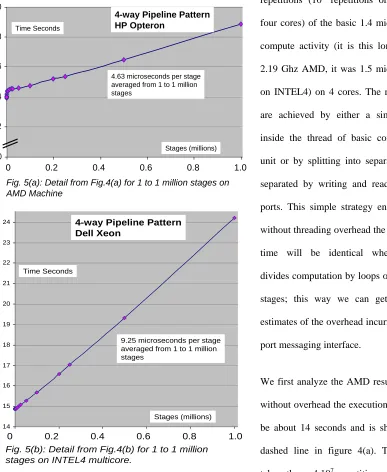
average over at least 10 runs with a given set of parameters. Figure 4 shows the results plotted up to 10 Fig. 5(a): Detail from Fig.4(a) for 1 to 1 million stages on
AMD Machine 10 12 14 16 18 20 10 12 14 16 18 20 0 0 Stages (millions)
0 0.2 0.4 0.6 0.8 1.0
4.63 microseconds per stage averaged from 1 to 1 million stages
Time Seconds
4-way Pipeline Pattern HP Opteron 14 15 16 17 18 19 20 21 22 23 24
0 0.2 0.4 0.6 0.8 1.0
Fig. 5(b): Detail from Fig.4(b) for 1 to 1 million stages on INTEL4 multicore.
Stages (millions) 9.25 microseconds per stage averaged from 1 to 1 million stages
Time Seconds
[image:10.612.95.482.184.656.2] [image:10.612.89.340.190.367.2]million stages while figure 5 shows the detail for up to one million stages. Always we use the term
overhead to represent the actual measured execution time with subtraction of the time that a single stage
would take to execute the same computational load. Overhead corresponds to latency in typical MPI
benchmarking parlance. Figure 4 marks as “overhead=computation”, the point where measured execution
time is twice that taken by a single stage. For 10 million stages the overhead on the AMD is large – almost
85 seconds; this corresponds to a set of loosely synchronous stages lasting 9.9 microseconds which is
mainly overhead as the “real” computation is just 1.4 microseconds per stage. The INTEL4 results show
125 seconds overhead in this extreme case.
Looking at the case of one million stages, the overhead is smaller – about 5 seconds (for AMD and 9
seconds for INTEL4); for the AMD, this corresponds to a set of loosely synchronous stages lasting 19
microseconds where the overhead is about 5 microseconds and the “real” computation is 14 microseconds
(a loop of ten basic computation unit) per stage. Linear fits to the stage dependence leads to an overhead
per stage of 4.63 microseconds from figure 5(a) while the behavior becomes somewhat nonlinear in the
larger range of stages in figure 4(a). This overhead represents the CCR (and system) time to set up threads
and process the ports. Our measurement says this overhead is linear in the number of invocations when the
spawned threads execute for substantially more (14 microseconds) than the basic overhead (4.63
microseconds) but the overhead increases when the thread execution time decreases to a few microseconds.
Turning to the INTEL4 results they are qualitatively similar but with significantly higher overhead. In
figure 4(b), the average has increased from 8.04 for AMD to 12.66 microseconds for INTEL4 with the
execution of 10 million stages taking 40% longer than the AMD even though the execution time with 1
stage is only 7% longer. Comparing figs 5(a) and 5(b), shows the discrepancy between AMD and INTEL4
CCR performance to be exacerbated if one restricts attention to just the first one million stages.
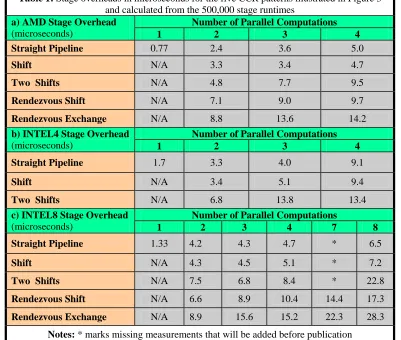
We summarize in Table 1 several styles of runs in terms of the overheads on the case of 500,000 stages
when the stage computations takes approximately 17 (AMD running at 2.4 GHz used in rendezvous
measurements of figs. 3(d-e)) 28(AMD running at 2.19 GHz used in patterns of figs. 3(a-c)) 24(INTEL8
used in patterns of figs. 3(d-e)), 30(INTEL4) or 34(INTEL8 used in patterns of figs. 3(a-c)) microseconds.
the run time. We look at 1-4 way parallelism for AMD and INTEL4 and 1-8 way parallelism for INTEL8.
Not surprisingly when the requested parallelism is less than the maximum of cores, the system is able to
use the “free” cores for port/message operations and reduce the stage overhead. We did use the AMD
thread debugger to verify that the system made efficient use of cores but this did not have the microsecond
resolution needed for an in depth study. Table 1 has all 5 patterns of fig. 3 including the three spawned
thread and two rendezvous style. For the dynamic spawned thread case, shift is very similar to pipeline as
one might expect as both have the same number of port read/write operations. The two shift case of fig.
[image:12.612.106.507.266.606.2]3(c) shows that the overhead roughly doubles as we double the number of reads and writes.
Table 1: Stage overheads in microseconds for the five CCR patterns illustrated in Figure 3 and calculated from the 500,000 stage runtimes
Number of Parallel Computations a) AMD Stage Overhead
(microseconds) 1 2 3 4
Straight Pipeline 0.77 2.4 3.6 5.0
Shift N/A 3.3 3.4 4.7
Two Shifts N/A 4.8 7.7 9.5
Rendezvous Shift N/A 7.1 9.0 9.7
Rendezvous Exchange N/A 8.8 13.6 14.2
Number of Parallel Computations b) INTEL4 Stage Overhead
(microseconds) 1 2 3 4
Straight Pipeline 1.7 3.3 4.0 9.1
Shift N/A 3.4 5.1 9.4
Two Shifts N/A 6.8 13.8 13.4
Number of Parallel Computations c) INTEL8 Stage Overhead
(microseconds) 1 2 3 4 7 8
Straight Pipeline 1.33 4.2 4.3 4.7 * 6.5
Shift N/A 4.3 4.5 5.1 * 7.2
Two Shifts N/A 7.5 6.8 8.4 * 22.8
Rendezvous Shift N/A 6.6 8.9 10.4 14.4 17.3
Rendezvous Exchange N/A 8.9 15.6 15.2 22.3 28.3
Notes: * marks missing measurements that will be added before publication
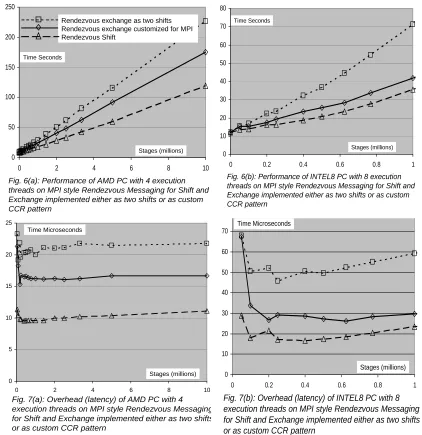
Now we study in detail the Rendezvous measurements which exactly mimic MPI and are depicted in figs.
3(d) and 3(e). Their overheads for 500,000 stages are also recorded in table 1 and the variation of
performance with number of stages is given in figures 6(a) for AMD up to ten million and in fig. 6(b) for
each thread issued writes to the left and right neighboring ports and then waited till its two messages were
available. This uses a new version of CCR’s MultipleItemReceive. The second approach (which is shown in
figs. 6 and 7 but not table 1) simple achieves an exchange as a right shift followed by a left right with no
computation in between. This uses two calls per stage to CCR’s Receive primitive; the same call used once
per stage by spawned pipeline and shift.
It is interesting to see that the special CCR primitive optimized for exchange easily outperforms the simpler
“exchange as two shifts” and demonstrates the value of being to develop new patterns directly in the
managed code environment. 0 50 100 150 200 250
0 2 4 6 8 10
Fig. 6(a): Performance of AMD PC with 4 execution threads on MPI style Rendezvous Messaging for Shift and Exchange implemented either as two shifts or as custom CCR pattern
Stages (millions) Time Seconds
Rendezvous exchange as two shifts Rendezvous exchange customized for MPI Rendezvous Shift 0 10 20 30 40 50 60 70 80
0 0.2 0.4 0.6 0.8 1
Fig. 6(b): Performance of INTEL8 PC with 8 execution threads on MPI style Rendezvous Messaging for Shift and Exchange implemented either as two shifts or as custom CCR pattern Stages (millions) Time Seconds 0 5 10 15 20 25
0 2 4 6 8 10
Fig. 7(a): Overhead (latency) of AMD PC with 4 execution threads on MPI style Rendezvous Messaging for Shift and Exchange implemented either as two shifts or as custom CCR pattern
Stages (millions) Time Microseconds 0 10 20 30 40 50 60 70
0 0.2 0.4 0.6 0.8 1
Fig. 7(b): Overhead (latency) of INTEL8 PC with 8 execution threads on MPI style Rendezvous Messaging for Shift and Exchange implemented either as two shifts or as custom CCR pattern
[image:13.612.95.517.186.621.2]The AMD PC always outperforms INTEL8 in both table 1 and figures 6 and 7 but this is somewhat unfair
as the management of the 8 parallel threads in the INTEL8 case is more demanding than the 4 needed by
AMD and this impacts both CCR and the underlying Windows scheduler. The scaling of multicore chip
performance as the number of cores increase will be an important area for future study.
Figs. 7(a, b) show the messaging overhead as a function of the number of stages which is essentially the
slope of the run time measurements in fig. 6. The AMD results are remarkably constant up to 10 million
stages that illustrates that both CCR and the Windows O/S are able to schedule the 4 AMD cores in an
efficient fashion with no interference between the stages. We note the early results were less good and the
presented results come from optimizing the CCR-Windows scheduling interface. Especially for INTEL8,
there are hints of an anomaly to the left of figs. 7(a, b) around 50,000 stages where the overhead
surprisingly rises. We have understood this as due to non-optimal Windows scheduling and are working
with the responsible Microsoft team on thread scheduling in this unusual (for commodity applications) case
of highly correlated messaging. We believe that the MPI message pattern performance in figs. 6 and 7 and
table 1 are excellent for the AMD and acceptable for INTEL8. We anticipate the results to improve with
further analysis of results and optimizations.
4.2 CCR Message Bandwidth
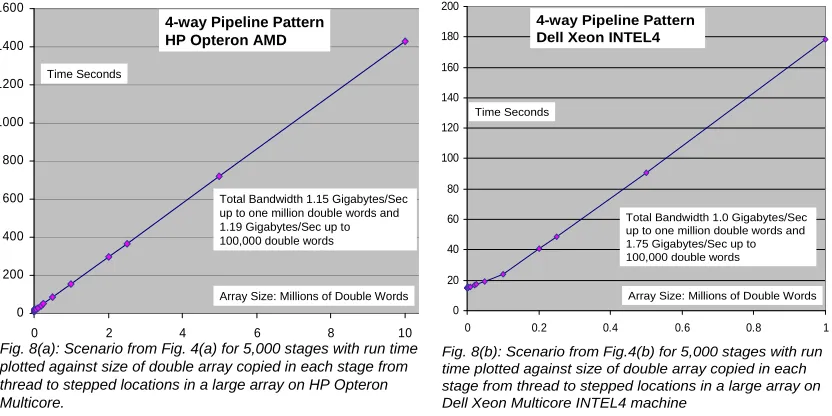
We now briefly discuss some measurements of message bandwidth supported by CCR. We simulated a
typical MPI CALL such as subroutine mpisend (buf, count, datatype, dest, tag, comm) by posting a
structure made up of an array of doubles of length N and a set of six integers (with one extra integer for
CCR control). These all used the full 4-way parallelism of AMD and INTEL4 and typical results are
shown in fig. 8 with more detail available on request. One passes a reference for the data buffer buf and we
used three distinct models for locations of final data termed respectively
b) Outside Thread: The buffer buf is copied using C# Copy To function to a fixed array (with distinct arrays for each core) outside the thread whose size is identical to that of buf.
c) Stepped ArrayOutside Thread: The buffer buf is copied using element by element Copy in C# to a fixed large array outside the thread whose size is two million double floating words. Again
each core has its own separate stepped array.
Note all measurements in this section involved 4-way parallelism and the bandwidth is summed over all
four cores simultaneously copying message buffers.
In this bandwidth investigation, we fix the number of stages and look at the run time as a function of size of
array stored in the port. One finds bandwidths that vary from 0.75 to 2 Gigabytes per second with the
INTEL4 machine claiming both upper and lower values although it typically shows better bandwidth than
the AMD machine. Note the best bandwidths are obtained when the destination arrays are outside the
thread and when of course the copied data is small enough to make good use of cache. Also the bandwidth
is higher for the cases where the computing component is significant; i.e. when it has a value of a few
milliseconds rather than the lower limit of a few microseconds. Figure 8 illustrates our benchmarks with a
stage computation of 2800 (AMD) to 3000 (Intel) microseconds. For the case (c) of a stepped array, the
INTEL4 PC achieves a bandwidth of 1.75 gigabytes/second for 100,000 word messages which decreases to
just 1 gigabyte/second for million word arrays. The AMD machine shows a roughly uniform bandwidth of
0 200 400 600 800 1000 1200 1400 1600
0 2 4 6 8 10
Fig. 8(a): Scenario from Fig. 4(a) for 5,000 stages with run time plotted against size of double array copied in each stage from thread to stepped locations in a large array on HP Opteron Multicore.
Total Bandwidth 1.15 Gigabytes/Sec up to one million double words and 1.19 Gigabytes/Sec up to 100,000 double words Time Seconds
Array Size: Millions of Double Words 4-way Pipeline Pattern
HP Opteron AMD
0 20 40 60 80 100 120 140 160 180 200
0 0.2 0.4 0.6 0.8 1
Fig. 8(b): Scenario from Fig.4(b) for 5,000 stages with run time plotted against size of double array copied in each stage from thread to stepped locations in a large array on Dell Xeon Multicore INTEL4 machine
Time Seconds
4-way Pipeline Pattern Dell Xeon INTEL4
Total Bandwidth 1.0 Gigabytes/Sec up to one million double words and 1.75 Gigabytes/Sec up to 100,000 double words
[image:15.612.96.512.252.460.2]1.17 gigabyte/second independent of array size. Note typical messages in MPI would be smaller than
100,000 words and so MPI would benefit from the performance increase for small messages.
4.3 DSS Message Latency and Overhead
We now examine CCR for the third form of parallelism; namely the functional parallelism model
represented in fig. 1(a). The Robotics release [10] includes a lightweight service environment DSS built on
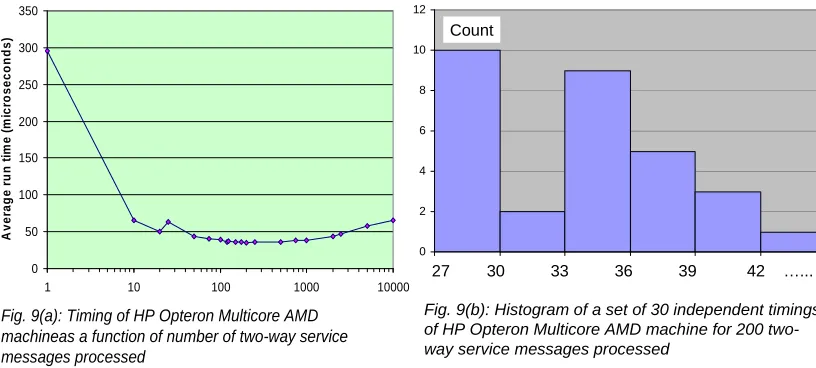
top of CCR and we performed an initial evaluation of DSS on the AMD machine. In fig. 9, we time groups
of request-response two way messages running on (different) cores of the AMD system. For a group of 200
messages we histogram the timings of 30 separate measurements. For low message counts DSS
initialization bumps up the run time and for large groups of messages it increases – perhaps due to
overheads like Garbage Collection. For message groups from about 50-1000 messages, we find average
times of 30-50 microseconds or throughputs of 20,000 to 25,000 two-way messages per second. This result
of internal service to internal service can be compared with Apache Axis 2 where the AMD PC supports
about 3,000 messages per second throughput. This is not a fair comparison as the measurements of fig. 9
are internal to one machine so each service end-point has effectively just two cores. The Axis
measurements used external clients interacting on a LAN so there is network overhead but now the service
can access the full 4 cores. We will complete fairer comparisons later and also examine the important
one-way messaging case.
Fig. 9(a): Timing of HP Opteron Multicore AMD machineas a function of number of two-way service messages processed
0 50 100 150 200 250 300 350
1 10 100 1000 10000
A
v
e
ra
g
e
r
un t
ime
(
m
ic
ro
s
e
c
onds
)
0 2 4 6 8 10 12
Count
27 30 33 36 39 42 …...
[image:16.612.99.507.262.446.2]5. Conclusions and Futures
This preliminary study suggests that CCR and DSS form an interesting infrastructure for parallel
computing. We addressed this by showing they can support the three basic messaging runtime models used
in parallel computing. We found overheads on the AMD machine that varied from about 4 µs for dynamic
threads to less than 40 µs for a flexible functional parallelism model with MPI style rendezvous’ in
between. The AMD machine had a 14 µs overhead for rendezvous exchange (MPI_SENDRECV) that was
little changed as we varied the computation per stage in the range of 1 to 100 µs. This is not as good as the
current best MPI [21-24] but MPI has the benefit of from many years of experience. CCR and the
underlying Windows multicore scheduler have not before been applied to this style of messaging in intense
environments and we expect significant improvements in CCR and DSS performance over the next few
months and would include updated figures in the published version of this paper. We will also complete the
INTEL4 measurements and use our new faster INTEL8 and AMD PC’s for the dynamic thread case. We
are also doing comparable multicore benchmarks on MPICH, OpenMPI and MPJ Express [25] ( and
mpiJava [26]) to cover the very best classic MPI’s with in addition Java implementations giving us another
managed code example. Further details of current analysis can be found in [28].
REFERENCES
1. Jack Dongarra Editor The Promise and Perils of the Coming Multicore Revolution and Its Impact,
CTWatch Quarterly Vol 3 No. 1 February 07,
http://www.ctwatch.org/quarterly/archives/february-2007
2. Herb Sutter, The Free Lunch Is Over: A Fundamental Turn Toward Concurrency in Software, Dr.
Dobb's Journal, 30(3), March 2005.
3. Annotated list of multicore Internet sites http://www.connotea.org/user/crmc/
4. Geoffrey Fox tutorial at Microsoft Research Parallel Computing 2007: Lessons for a Multicore
Future from the Past February 26 to March 1 2007
5. Pradeep Dubey Teraflops for the Masses: Killer Apps of Tomorrow Workshop on Edge
Computing Using New Commodity Architectures, UNC 23 May 2006
http://gamma.cs.unc.edu/EDGE/SLIDES/dubey.pdf
6. Dennis Gannon and Geoffrey Fox, Workflow in Grid Systems Concurrency and Computation:
Practice & Experience 18 (10), 1009-19 (Aug 2006), Editorial of special issue prepared from
GGF10 Berlin http://grids.ucs.indiana.edu/ptliupages/publications/Workflow-overview.pdf
7. Jeffrey Dean and Sanjay Ghemawat, MapReduce: Simplified Data Processing on Large Clusters,
OSDI'04: Sixth Symposium on Operating System Design and Implementation, San Francisco, CA,
December 2004 http://labs.google.com/papers/mapreduce.html
8. “Concurrency Runtime: An Asynchronous Messaging Library for C# 2.0” George
Chrysanthakopoulos Channel9 Wiki Microsoft
http://channel9.msdn.com/wiki/default.aspx/Channel9.ConcurrencyRuntime
9. “Concurrent Affairs: Concurrent Affairs: Concurrency and Coordination Runtime”, Jeffrey
Richter Microsoft
http://msdn.microsoft.com/msdnmag/issues/06/09/ConcurrentAffairs/default.aspx
10. Microsoft Robotics Studio is a Windows-based environment that provides easy creation of
robotics applications across a wide variety of hardware. It includes end-to-end Robotics
Development Platform, lightweight service-oriented runtime, and a scalable and extensible
platform. For details, see http://msdn.microsoft.com/robotics/ with tutorials at
http://msdn.microsoft.com/robotics/learn/On_Demand/default.aspx
11. Georgio Chrysanthakopoulos and Satnam Singh “An Asynchronous Messaging Library for C#”,
Synchronization and Concurrency in Object-Oriented Languages (SCOOL) at OOPSLA October
2005 Workshop, San Diego, CA. http://urresearch.rochester.edu/handle/1802/2105
12. Internet Resource for HPCS Languages http://crd.lbl.gov/~parry/hpcs_resources.html
13. Message passing Interface MPI Forum http://www.mpi-forum.org/index.html
14. MPICH2 implementation of the Message-Passing Interface (MPI)
http://www-unix.mcs.anl.gov/mpi/mpich/
16. “The Sourcebook of Parallel Computing” edited by Jack Dongarra, Ian Foster, Geoffrey Fox,
William Gropp, Ken Kennedy, Linda Torczon, and Andy White, Morgan Kaufmann, November
2002.
17. G. Fox, M. Johnson, G. Lyzenga, S. Otto, J. Salmon, D. Walker Solving Problems in Concurrent
Processors-Volume 1, Prentice Hall, March 1988.
18. Fox, G. C., Messina, P., Williams, R., “Parallel Computing Works!”, Morgan Kaufmann, San
Mateo Ca, 1994.
19. Geoffrey Fox “Messaging Systems: Parallel Computing the Internet and the Grid”, EuroPVM/MPI
2003 Invited Talk September 30 2003
http://grids.ucs.indiana.edu/ptliupages/publications/gridmp_fox.pdf
20. J Kurzak and J J Dongarra, Pipelined Shared Memory Implementation of Linear Algebra Routines
with arbitary Lookahead - LU, Cholesky, QR, Workshop on State-of-the-Art in Scientific and
Parallel Computing, Umea, Sweden, June 2006
http://www.hpc2n.umu.se/para06/papers/paper_188.pdf
21. Richard L. Graham and Timothy S. Woodall and Jeffrey M. Squyres “Open MPI: A Flexible High
Performance MPI”, Proceedings, 6th Annual International Conference on Parallel Processing and
Applied Mathematics, 2005 http://www.open-mpi.org/papers/ppam-2005
22. D.K. Panda “How will we develop and program emerging robust, low-power, adaptive multicore
computing systems?” The Twelfth International Conference on Parallel and Distributed Systems
ICPADS ‘06 July 2006 Minneapolis
http://www.icpads.umn.edu/powerpoint-slides/Panda-panel.pdf
23. Thomas Bemmerl “Pallas MPI Benchmarks Results”
http://www.lfbs.rwth-aachen.de/content/index.php?ctl_pos=392
24. Myricom Myri-10G and Myrinet-2000 Performance Measurements
http://www.myri.com/scs/performance/
25. Mark Baker, Bryan Carpenter, and Aamir Shafi. MPJ Express: Towards Thread Safe Java HPC,
Submitted to the IEEE International Conference on Cluster Computing (Cluster 2006), Barcelona,
26. mpiJava Java interface to the standard MPI runtime including MPICH and LAM-MPI
http://www.hpjava.org/mpiJava.html
27. Henrik Frystyk Nielsen, George Chrysanthakopoulos, “Decentralized Software Services Protocol
– DSSP” http://msdn.microsoft.com/robotics/media/DSSP.pdf
28. Xiaohong Qiu, Geoffrey Fox, and Alex Ho Analysis of Concurrency and Coordination Runtime
CCR and DSS, Technical Report January 21 2007