Giovanni Russello1, Changyu Dong1, Naranker Dulay1, Michel Chaudron2, and Maarten van Steen3
1
Imperial College London 2
Eindhoven University of Technology 3
Vrije Universiteit Amsterdam
Abstract. The deployment of Share Data Spaces in open, possibly hos-tile, environments arises the need of protecting the confidentiality of the data space content. Existing approaches focus on access control mecha-nisms that protect the data space from untrusted agents. The basic as-sumption is that the hosts (and their administrators) where the data space is deployed have to be trusted. Encryption schemes can be used to protect the data space content from malicious hosts. However, these schemes do not allow searching on encrypted data. In this paper we present a novel encryption scheme that allows tuple matching on completely encrypted tuples. Since the data space does not need to decrypt tuples to perform the search, tuple confidentiality can be guaranteed even when the data space is deployed on malicious hosts (or an adversary gains access to the host). Our scheme does not require authorised agents to share keys for in-serting and retrieving tuples. Each authorised agent can encrypt, decrypt, and search encrypted tuples without having to know other agents’ keys. This is beneficial inasmuch as it simplifies the task of key management. An implementation of an encrypted data space based on this scheme is described and some preliminary performance results are given.
1
Introduction
Coordination through Shared Data Spaces (SDS) also called generative commu-nication, forms an attractive model for developing distributed and component-oriented systems as it supports referential and temporal decoupling of processes [9]. Referential decoupling means that components exchange data with-out the need to know each other. Temporal decoupling means that those com-ponents do not even have to be online at the same time. This way, comcom-ponents can be connected to or disconnected from the data space at any time, making it easier to combine or replace. The SDS model was introduced by the coordination language Linda [8]. Storage in Linda takes place in a so-calledtuple space. In a tuple space, data is stored as persistent objects, calledtuples.
The early implementations of SDSes were closed systems, in the sense that they were realised by compiling application and SDS code altogether. Once the system was deployed and executed, it was not possible to add or remove appli-cation components. In such systems, security was not a issue and the original Linda model was conceived without addressing security concerns.
D. Lea and G. Zavattaro (Eds.): COORDINATION 2008, LNCS 5052, pp. 264–279, 2008. c
In contrast, open systems were introduced where the SDS is not bound to an application but is an autonomous process with its own resources. The main advantage of open SDS systems is that persistent data storage can be offered to applications. In this way, applications could dynamically join and leave the computational environment. This is clearly a feature suited to distributed ap-plications. With its small API and the decoupling of communication in space and time, the SDS model provides an effective coordination layer for distributed applications.
Distributed applications are deployed in environments that range from small ad-hoc networks of portable devices (such as Body Area Networks) up to wide area networks (such as the Internet). In such scenarios applications are faced with many security threats that the original Linda model does not address. For instance, de-nial of service attacks could be performed by malicious agents inserting a large number of tuples into the data space. Still, a malicious agent can remove any tu-ples from the space interfering with the other agents that are using the space. This can be even more serious when the tuples contain sensitive information.
Such security deficiencies pose a limitation on the usability of the SDS model for real-world applications. Early work presented by Wood in [20] discusses the introduction of access control mechanisms, such as ACLs and capabilities, that could be used for controlling access to the SDS content. Several other approaches have proposed access control mechanisms that employ secret information asso-ciated with SDSes and their content. In [12], an agent must know the password associated with the space in order to get access to it. In [11,19] the secret informa-tion is represented by locks that are associated with tuple instances. To get access to a tuple, an agent must provide the specific lock associated with the tuple.
Although access control mechanisms are necessary for allowing authorised operations on the data space, they are not always adequate to protect data confidentiality. The common assumption of these approaches is that the host where the data space is deployed is managed by a trustworthy entity that (1) correctly enforces access control mechanisms and (2) isobliviousof the data that is stored in the data space. However, such an assumption does not always hold when sharing data over a wide area network such the Internet.
A solution to enforce the confidentiality of tuples against malicious hosts is to encrypt the tuple content as proposed in [2]. However, because the ciphertexts are not meaningful, it is not possible to perform search operations. A trusted data space can temporarily decrypt the data, perform the search and return the results to the agent. Alternatively, if the data space doesn’t have access to the decryption keys, the encrypted data can be returned to the agent that decrypts the data locally. The first solution cannot protect data confidentiality from malicious hosts, while the second one is potentially very inefficient in com-munications. Moreover, issues related to key management (i.e., key distribution, key revocation, etc.) are not addressed.
without having the data space decrypt the data. Another important property of our encryption scheme is that it does not require agents to share secret keys. Each authorised agent can encrypt, decrypt, and search encrypted tuples with-out having to know other agents’ keys. This greatly simplifies the task of key management. In particular, it avoids re-encrypting the tuple content when a key needs to be revoked. To the best of our knowledge, this is the first approach that proposes such features for the shared data space model. Finally, we integrate the encryption scheme in a SDS implementation and carry out some preliminary performance analysis.
The paper is organized as follows. Section 2 introduces the original SDS model. Section 3 surveys recent developments aiming at providing security in the SDS model. In Section 4, we describe on our encryption scheme. In Section 5, we discuss and evaluate our encrypted SDS implementation. In this paper our main focus to guarantee data confidentiality in case a host is compromised. However, the SDS and its content can face other security threats when its host is compro-mised. In Section 6, we discuss some of those security threats. We conclude in Section 7 with some final thoughts and future research directions.
2
The Shared Data Space Model
The shared data space model was introduced by the coordination language Linda [8]. Linda provides three basic operations:out,inandrd. Theoutoperation inserts a tuple into the tuple space. Theinandrdoperations respectively take (destruc-tive) and read (non-destruc(destruc-tive) a tuple from the tuple space, using a template for matching. The tuple returned must exactly match every value of the template. Templates may contain wildcards, which match any value. Whereas putting a tu-ple inside the tutu-ple space is non-blocking (i.e. the process that puts the tutu-ple re-turns immediately from the call toout), reading and taking from the tuple space is blocking: the call returns only when a matching tuple is found. In the original model two more operations were introduced: theinpandrdp. These operations are predicate versions ofinandrd: they too try to return a matching tuple. However, if there is no such tuple they do not block but return a value indicating failure.
In Linda it is also possible to fork a process inside a tuple space through so-calledlive tuples. To insert a live tuple inside a tuple space theeval operation is used.eval is similar to anout and it is specific for live tuples. Once a live tuple is inserted in a tuple space it carries out the specified computation. Afterwards, a live tuple turns into an ordinary data tuple, and it can be used as such. In the implementation of a SDS presented later on in this paper theinp, rdp, andeval operations are not supported.
3
Related Work
Secure Lime, described in [12], introduces several security extension to Lime [14]. Since Lime’s primary environment is a network of mobile low-resource hosts, the main concern of the developers was to introduce security enhance-ments with low overhead of the original Lime’s model. Security extensions are implemented as two levels of access control: at tuple space level and single tuple level. At the tuple space level, it is possible to protect access to a tuple space by means of a password. An agent will be considered authorized to access a tuple space if it knows the password for the given tuple space. At the tuple level, agents can specify for each tuple that they insert passwords for granting both read and take accesses. Inter-host communication uses unsecured links. For avoiding eavesdropping of messages, each serialized tuple is encrypted using the respective password for accessing the tuple space. It should be noted that it is not a good practice to use a password as an encryption key.
SecOS [19] introduces the notion oflock for controlling access to a tuple. A lock is a labeled value that specifies the key that should be used to grant access to a given tuple. The simplest lock is represented by a symmetric key where the same label can be used for locking and unlocking a tuple. Also, asymmetric locks can be used. In this case, two different keys are necessary for locking and unlocking a tuple. A public key is used for locking a tuple and a private one is used for unlocking it. SecOS also provides finer grained access control at the level of single fields in a tuple. Each field in a tuple can be protected by a separate lock.
SecSpaces [11] provides a similar approach to that of SecOS. In SecSpaces labels are used as an access control mechanism to protect tuples and tuple fields. SecSpace provides two more extensions. The first extension concerns partitioning the tuple space. The partitioning of a tuple space avoids all agents having the same view on the data contained in a tuple space. Instead of a physical separation in different tuple spaces, in SecSpaces the tuple space partitioning is achieved through the introduction of a partition field in the tuples. A template can match a tuple in a given partition only if the correct actual value is given in the partition field. A template with a wildcard value in the partition field is considered not valid. This means that a process has to know the name of the partition for accessing the content. The second extension regards the distinction between consumers that can only execute read operations and consumers that can only execute take operations. This extension is provided via specified fields in the tuples, calledcontrol fields. To be an authorized read consumer, the process has to provide in the template issued by the read operation the exact value on the read control field of a tuple.
more agents have to share the same multicapability that refers to the same set of tuples. In case a multicapability has to be revoked, the authors adopt the common solution of introducingindirect multicapability objects. A multicapabil-ity now refers to the indirection object, which in turn refers to the intended tuple set. The deletion of the indirection object has the effect of removing the multicapability.
In all the approaches presented above, tuples are stored in the data space as plaintext. Indeed, then basic assumption of these approaches is that the data space host is trusted. However, if an adversary gets access to the host where the data space is deployed, tuples could still be retrieved and accessed. The only exception to this is KLAIM [2]. KLAIM provides privacy by means of encryption. In the framework proposed, a key can be used for encrypting the data value contained in a field. The model does not provide any access restrictions to the tuple space. This means that encrypted tuples can be retrieved by agents that do not have the right key for decrypting the content. If a tuple is withdrawn from the tuple space by an agent that cannot access it, it is up to that agent to reintroduce the tuple back to the space. The tuple space API is extended with two operations that execute the decryption process before returning the tuple to the application:ink andreadk. If the decryption fails, then the ink operation inserts the tuple back into the space. It should be made clear that the key used for encrypting the data is not shared between the entities and the data space. The ink and readk operations perform the decryption locally to the node where the entity is deployed. This has a negative impact on the communication utilisation. Although KLAIM is the only approach that encrypts the data when it is stored in the space, it does not support encrypted search. Therefore it is necessary to have in the tuples cleartext fields. Assuming that there is a secure channel between the agent and the data space, an attacker can still gain some information on the matched tuple if it has access to the data space host. However, if the data space supports encrypted search then an attacker can not gather any information about the tuple content by just looking at the ciphertext. Another common drawback of the above approaches is that agents are required to share a secret (either a key or a password). The revocation of the secret in the event that it gets compromised requires the re-distribution of a new secret and the creation and/or modification of the data space to be protected by the new secret. The same needs to be done in case that access privileges have to be removed to an agent.
To protect the confidentiality of shared data spaces from both unauthorised clients and from the SDS host(s) we introduce a novel encryption scheme that supports encrypted searches over encrypted shared data spaces. Furthermore, the scheme does not require agents to share secret keys.
4
Multi-agent Searchable Encryption Scheme
cryptographic details of the scheme and its properties. For a more detailed de-scription refer to [4].
4.1 Cryptographic Preliminaries
Our multi-user searchable encryption scheme employsRSA public-key encryption
[15] andDiscrete Logarithms. RSA involves two asymmetric keys. The key pair is generated as follows: First choose two random large primepand qsuch that
|p| ≈ |q|. Then computen=pqandφ(n) = (p−1)(q−1). Find a random integer e < φ(n) and gcd(e, φ(n)) = 1. Compute d such that ed≡1 mod φ(n). (n, e) is the public key anddis the private key. To encrypt, computec=me mod n.
To decrypt, compute m = cd mod n. In the rest of the paper, we assume all
arithmetic to be mod n unless stated otherwise. Discrete Logarithms in finite fields are one-way functions. Namely, given a primep, a generatorgof the multi-plicative groupZp∗ andgxmodp, it is hard to find x. Discrete Logarithms have
been used in constructing public-key encryption schemes [5], digital signature schemes and zero-knowledge proof protocols.
Both RSA and Discrete Logarithms useModular exponentiation as basic op-erations and the exponents can be split multiplicatively. In RSA, for example we can finde1, e2 such thate1e2≡e mod φ(n). The two shares ofecan be given to two parties, then the two parties can collaboratively encrypt a message. Given a messagem, one party encrypts it asme1 modnand the other party re-encrypts it as (me1)e2 ≡me1e2 ≡memodn. The decryption key can also be split in the same way.
This idea is used inproxy cryptography and was first introduced in [3]. In a proxy encryption scheme, a ciphertext encrypted by one key can be transformed by a proxy function into the corresponding ciphertext for another key without revealing any information about the keys and the plaintext. There are many applications of proxy encryption, e.g. secure email lists [17], access control sys-tems [18] and attribute based publishing of data [19]. A comprehensive study on proxy cryptography can be found in [13].
The encryption schema that we use in our system combines the property of proxy cryptography where each authorised agent has a unique key with the capability of performing tuple matching on encrypted data.
4.2 Architecture
The system has the following components:
– Client: a client is any agent interacting with the data space.
– Key Management Server (KMS): The KMS is a fully trusted server which is responsible for all the key-related operations, e.g. key generation, distribu-tion, and revocation. Although requiring a trusted KMS seems at odds with using a less trusted node where the data space is running, we will show that the KMS is lightweight, it requires less resources and management. Securing the KMS is also much easier. Because of this, the KMS can be offline most of the time.
4.3 System Setup
To initialise the encryption system, the KMS runs the setup algorithm to gen-erate public and secret parameters which will be used for the whole lifetime of the system. The algorithm is described as follows:
The algorithm first takes a security parameterkand runs the key generation algorithm using standard RSA which generates (p, q, n, φ(n), e, d). It then gen-erates {p, q, g, x, h, a, gaha} satisfying the following constraints: p and q are
two large prime numbers such thatq dividesp−1;gis a generator ofGq, the
unique order-q subgroup ofZp∗; andh≡gxmod pwherexis chosen uniformly
randomly fromZq.ais also a random number fromZq.
The parameters needed for encryption/decryption aren, p, q, g, h, gaha and need to be published system-wide. The key material is represented by the pa-rametersp, q, φ(n), e, d, x, aand must be kept secretly. In particular, the (e, d, a) are called “Master Keys” for the system.
4.4 Client Key Generation and Revocation
When a new client is enrolled into the system, the KMS must generate a unique key set for the client. The key set is derived from the key material using the following algorithm:
For a clienti, the KMS generates ei1, ei2, di1, di2, ai1, ai2 such that ei1ei2 ≡ e mod φ(n), di1di2 ≡ d mod φ(n) and ai1ai2 ≡ a mod q. Key generation can be efficiently done in the following way. Let us consider the generation of the ei1, ei2 pair. The KMS randomly choosesei1 < φ(n), where gcd(ei1, φ(n)) = 1. Sinceei1x≡1mod φ(n) has always a solution, then ei2≡ex mod φ(n) always satisfiesei1ei2≡e mod φ(n). The KMS then sends (ei1, di1, ai1) to clientiand (ei2, di2, ai2) to the eSDS through secure channels.
In our system it is possible to authenticate a client and establish a secure channel between the client and the eSDS using the corresponding key pairs. Be-causeei1di1ei2di2≡ed≡1 modφ(n),k1=ei1di1 andk2=ei2di2 form another RSA key pair. This key pair can be used for public key mutual authentication and for establishing a secure channel, e.g. SSL.
4.5 Tuple Encryption
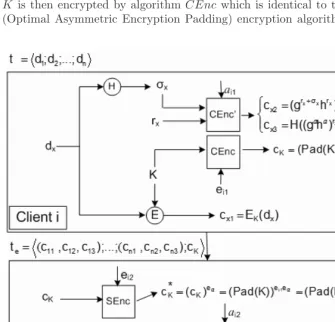
In our system, tuple encryption is performed in two steps. A tuple is first en-crypted by the client using its own private key. The enen-crypted tuple is then sent to the eSDS, where the tuple is re-encrypted using the node’s key that correspond to that client. Client side encryption prevents the eSDS (and its hosting site) from knowing the data in the tuple whereas the eSDS side encryption makes it possible for other authorised clients in the system to retrieve the tuple in clear text. The encryption process for client i is shown in Fig. 1. For a tuple t=d1;...;dn, we denote the value of a field at positionxbydx.
On the client side, a tuple is first encrypted using a semantically secure sym-metric encryption algorithm E [10]. For each tuple, client i randomly picks a keyK from the key space ofE. Each value of the tuple’s fieldsdx is encrypted
under the keyKwhich generates a ciphertextcx1=EK(dx). The symmetric key
[image:8.513.48.383.260.582.2]K is then encrypted by algorithm CEnc which is identical to the RSA-OAEP (Optimal Asymmetric Encryption Padding) encryption algorithm [1] and uses
ei1 as the encryption key. RSA-OAEP enhances RSA by using a probabilistic padding scheme and has been proved to be IND-CCA2 (Indistinguishable Adap-tive Chosen Ciphertext Attack) secure [7]. The ciphertexts of the symmetric keys iscK = (P ad(K))ei1.
During the search for a matching tuple, the data space content is kept en-crypted. The matching is done using an opportunely modified values of the tuple field, called keywords. Keywords are computed as follows by the client using the algorithmCEnc and sent together with the tuple to the eSDS. For each valuedx of a tuple field , the client icomputesσx =H(dx) using a hash
function H. The client also picks a random number rx ∈ Zq and computes
cx2 = (grx+σxhrx)ai1 mod p, cx3 =H((gaha)rx), whereg, h, gaha, p are public parameters in the system and ai1 is the client’s keyword encryption key. The client then sends the encrypted tuple te = (c11, c12, c13);...; (cn1, cn2, cn3);cK
to the eSDS.
After receiving the encrypted tuple, the eSDS retrievesei2 and ai2, the cor-responding encryption keys for the client i. It re-encrypts the symmetric key by computing c∗K = cei2
K using the SEnc algorithm. The eSDS processes the
keywords information that is contained in the tuple using the SEnc algo-rithm. For each filed x, the eSDS computes c∗x2 = c
ai2
x2 = (g
rx+σxhrx)ai1ai2 = (grx+σxhrx)a mod p. The final encrypted tuple stored ist∗
e=(c11, c∗12, c13);...; (cn1, c∗n2, cn3);c∗K).
4.6 Encrypted Search
The searching of a tuple in the data space is done by means of a template. A template may contains wildcard fields, that in our system are represented as null values. When a clientj wants to retrieve a tuple matching the templatetemp=
z1, ..., zn, j first computes the hash value of all actual fields in the template.
Since a wildcard field matches any actual values in a tuple, it is not necessary that our encrypted search algorithm processes wildcard fields of a template. For each non-null fieldxthe client j generates σx∗ =H(zx). Then j encrypts σx∗ as
Qx=g−σ
∗
xaj1. At this point, the encrypted template is temp
e=Q1;...;Qn.j
sendstempeto the eSDS.
The eSDS computes for each field of the received template Qx =Q aj2
x mod
p =g−σ∗xa mod p. During the search, for each encrypted tuple, the data space
computes the following two values for eachx-th non-null field in the template:
yx1=c∗x2Qx= (g
rx+σxhrx)ag−σx∗a= (garx+aσxharx)g−aσx∗ mod p
yx2=H(y1)
We can see that if dx = zx then aσx −aσx∗ = 0, and therefore yx1 = (garxharx) = (gaha)rx mod p. From this follows that the value in the x-th
4.7 Tuple Decryption
When a matching tuple is found, the eSDS computes the following before sending the tuple to the clientj. For each fieldxin the matching tuplet∗e =(c11, c∗12, c13) ;...; (cn1, c∗n2, cn3);c∗K)the eSDS computescK= (c∗K)
dj2 and sends tojthe fol-lowing tuplete=c11;...;cn1;cK). The clientj retrieves the key for encrypting
the data items by computing (cK)dj1 = (c∗
K)d = (K)ed =K. The clientj can
decrypt the value of each field by computingdx=EK−1(cx1).
5
Implementation and Performance
In this section, we discuss the implementation and performance of the eSDS based on the encryption scheme. The prototype is an extension of our imple-mentation of a distributed SDS, called GSpace [16].
Figure 2 provides an overview of the modules that are part of our architec-ture. Clients and the eSDS are different processes that reside in different hosts. A client Ci communicates with the eSDS by means of a proxy, called
eSD-SProxy. The eSDSProxy takes care of hiding from the client all the details for the communication with the eSDS and deals with the cryptographic operations. To connect to an eSDS, a client creates a neweSDSProxy as follows:
eSDSProxy p = new eSDSProxy ("SpaceName");
The argument is used by the proxy to load in itsKeyStore(KS) the appro-priate key pair for tuple encryption and decryption and for establishing a secure connection with the eSDS. The proxy performs tuple encryption and decryption using theProxy Encryption Module (PEM).
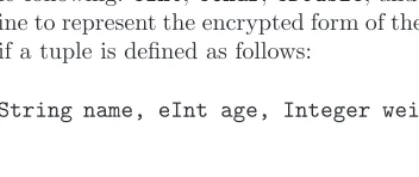
Tuples and templates are subclasses of theTupleclass. A tuple can be defined in such a way that when it is stored in the eSDS it can contain both cleartext and encrypted fields. A field in a tuple will be stored encrypted only when its type is one of the following:eInt,eChar, eDouble, andeString. These are classes that we define to represent the encrypted form of the corresponding Java classes. Therefore, if a tuple is defined as follows:
[image:10.513.108.318.495.583.2]MyTuple(eString name, eInt age, Integer weight)
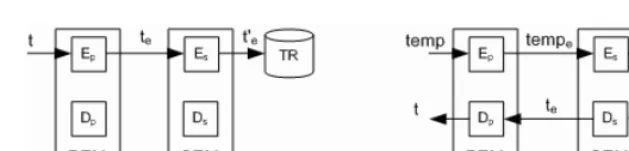
Fig. 3.Encryption steps executed for storing and retrieving a tuple using our scheme
when such a tuple is stored in the eSDS, only the first two fields will be encrypted. Fieldweightwill be stored in cleartext.
A client (by means of its proxy) establishes a secure communication with the eSDS. The eSDS authenticates the client and the corresponding key is loaded into the KS of the eSDS. The eSDS performs tuple encryption, decryption and encrypted search by means of itsSpace Encryption Module (SEM). Tuples are stored in theTuple Repository (TR).
In the implementation, aputoperation is used to insert a tuple in the space.read andtakeoperations are used for retrieving tuples; the former returns a copy of a matching tuple whether the latter destructively removes the matching tuple. When these operations are executed, tuples and templates are transformed according to our encryption scheme. Figure 3 shows the cryptographic operations executed in the PEM and SEM on tuples and templates for aputand aread(ortake) operation. Let us assume that a tuplet has to be stored encrypted (i.e., all of its fields must be encrypted). Figure 3-(a) shows the steps executed for aputoperation. The fields of tuple t are encrypted in the PEM using the submodule Ep 1.
The encrypted tuplete is sent to the eSDS where it is re-encrypted by SEM’s
submoduleEs2. The tuplet
e is stored in the TR.
Figure 3-(b) shows the case of areadoperation. For areadoperation a template tempis used for finding a matching tuple. The non-null fields in the template are encrypted by the submoduleEp that produces the encrypted template tempe.
tempeis sent to the eSDS where it is re-encrypted intemp
e. This is used for
per-forming the encrypted search. When an encrypted tupletematches the template tempe, the tuple must be decrypted before it is returned to the client. First, te is decrypted in the SEM using theDs submodule and it is transformed inte.te
is returned to the client’s proxy that decrypts it usingDp, returning the tuple
in cleartexttto the client.
5.1 Evaluation
The eSDS prototype is implemented in Java using the packages provided in the standard Java 1.5 distribution. We chose AES as the symmetric cipher which 1 This submodule implements the algorithmsCEncandCEnc that we described in
Section 4. 2
encrypts the actual data and SHA-1 as the hash function. For the RSA-based proxy encryption scheme, we used 1024-bit keys. For the keyword encryption scheme,q was 160-bit and p was 1024-bit. The tests were executed on a Intel Pentium IV 3.2 GHz (dual core) with 1 GB of RAM.
The first evaluation consisted of measuring the execution time for the encryption and decryption submodules. In particular, we measured the execution time for:
– Client Encryption: consists in the execution of Ep, that is encrypting
tu-ple fields using the symmetric cipher, encrypting the symmetric key and encrypting the keywords.
– eSDS Encryption: consists in the execution ofEs, that is the re-encryption
of the symmetric key and the keywords using the eSDS keys.
– eSDS Decryption: pre-decryption of the symmetric key by executing Ds.
– Client Decryption: decryption of the symmetric key and the tuple fields by executingDp.
Table 1 provides the results of our test for the execution of the encryption and decryption operations. The time is given in milliseconds for a single execution of each operation calculated on the average time for 10,000 executions. The tuple and template used for the experiments consisted in a single field of typeeString
with 4 chars.
We also measured the time for finding a matching tuple using our encrypted search. In the data space, 10000 encrypted tuple were stored and only one was a match for the template used in the search. We ensured that the matching tuple was the last tuple to be evaluated (worst case scenario). Tuples and template consisted of a singleeStringfiled with 4 chars. Under these conditions, the time required for finding the matching tuple is around 600 milliseconds. Basically, each matching test takes around 0.06 milliseconds.
[image:12.513.132.298.539.599.2]Given the results of this performance analysis, we can say that the use of our scheme is well suited for cases where a large number of tuples need to be searched. The search is performed entirely within the data space and the result that is returned is a tuple matching the given template. In contrast, when executing the same experiment using an approach as in KLAIM, executing cycles and bandwidth would be wasted. In fact, the result that is given back to a client is a partial match to the given template (only the fields not encrypted are used for the matching). The client has to decrypt the tuple and if the values of the encrypted fields are not the intended ones then the client has to re-encrypt the tuple and send it back to the space.
Table 1.Performance of Encryption and Decryption Operations
Execution Step Execution Time (ms) Client Encryption 53
6
Host Attack
In this section, we discuss some of the attacks that can be performed by malicious hosts.
Existing research focused on protecting the data space from attacks performed by malicious clients. The assumption is that hosts where the data space is de-ployed are fully trusted while clients are not to be trusted. As discussed in [6], existing approaches protect the data space against malicious clients that:
1. remove and/or forge tuples from a data space to disrupt the collaboration between genuine clients, and
2. insert into a data space a large number of tuples to consume all resources. Because hosts are fully trusted, there are no mechanisms in place that can guarantee the confidentiality of data stored in the data space against the hosts other than encrypting non-searchable data.
In our attack model, we assume that a host is honest-but-curious. We trust the host to correctly authenticate the clients and to perform the operations as requested by the clients. The confidentiality of the data is protected from the host while supporting search on the protected data. However, in deploying the data space on untrusted hosts other concerns need to be addressed. In the following, we list some of these concerns and the threats to which the data space is exposed to. Our aim is not to provide a concrete solution to each of them, but to highlight possible future research directions that aim to protect the data space from untrusted hosts.
Availability. Clients that try to connect to the SDS hosts may experience some disruptions. For instance, the data space host is not reachable or it requires a long time for replying. These disruptions may be caused maliciously by the attacker. In order to mitigate such attacks, mechanisms that ensure accountability are required. Accountability is the property that allows the participants of a system to determine and expose misbehavior. In this way, clients can determine whether hosts are behaving correctly. Accountable mechanisms have been proposed for network storage as in [21].
Traffic Analysis. By monitoring the timing and frequency of the communication between hosts and clients, an attacker can gather useful information. By moni-toring the execution time of encryption and decryption operations on tuples an attacker can gather enough information to efficiently recover the client key. For instance, in [17] Song shows that it is possible to use such an attack to recover a password exchanged in the SSH protocol 50 times faster than using a brute force attack. The attacker can also built a statistical attack by comparing the templates with the matching tuples.
Collusion. One of the major concerns in proxy encryption schemes comes from a collusion attack. If a client colludes with an attacker that has access to all the EDS side keys, then it is possible to recover the master keys by combining their keys. Collusion-resistant proxy encryption schemes is an open problem. How-ever, we can lower the risk of collusion to an acceptable level by implementing other mechanisms. For example, we can limit the access to the keys by using tamper-proof devices. We can also split the master keys into multiple shares and introduce additional servers, making collusion more difficult. Monitoring and auditing to detect collusion can also help to mitigate the risk.
7
Conclusions and Future Work
In this paper, we presented a novel encryption scheme that ensure tuples confi-dentiality even in the case that the data space is deployed on untrusted hosts.
The scheme supports encrypted search for a matching tuple over the encrypted data space. In this way, the data space never has access to tuples in cleartext protecting the confidentiality of the its content from nosey hosts. Moreover, the scheme does not require the clients to share secret keys. Each client has its own key that can be used for retrieving tuples encrypted by other clients’ keys. This greatly reduces the burden of key management. for instance, when a key of a client is revoked it is not necessary to invalidate all the other clients’ keys and re-encrypt the entire data space content.
We provided an implementation of an encrypted SDS using the presented scheme and performed some preliminary performance analysis.
Information Retrieval (PIR) schemes that would allow a user to retrieve tuples from a data space without revealing to its host which items were searched.
As concluding thought, we would like to point out that although this scheme has been presented in the context of the SDS model, it could be applicable to any other systems where the confidentiality of data shared among several entities must be protected, i.e. databases, publish subscribe systems, email servers, etc.
References
1. Bellare, M., Rogaway, P.: Optimal Asymmetric Encryption. In: De Santis, A. (ed.) EUROCRYPT 1994. LNCS, vol. 950, pp. 92–111. Springer, Heidelberg (1995) 2. Bettini, L., De Nicola, R.: A Java Middleware for Guaranteeing Privacy of
Dis-tributed Tuple Spaces. In: Guelfi, N., Astesiano, E., Reggio, G. (eds.) FIDJI 2002. LNCS, vol. 2604, pp. 175–184. Springer, Heidelberg (2003)
3. Blaze, M., Bleumer, G., Strauss, M.: Divertible protocols and atomic proxy cryp-tography. In: Nyberg, K. (ed.) EUROCRYPT 1998. LNCS, vol. 1403, pp. 127–144. Springer, Heidelberg (1998)
4. http://www.doc.ic.ac.uk/∼cd04/papers/noshare.pdf
5. Elgamal, T.: A public key cryptosystem and a signature scheme based on discrete logarithms. IEEE Transactions on Information Theory 31(4), 469–472 (1985) 6. Focardi, R., Lucchi, R., Zavattaro, G.: Secure shared data-space Coordination
Lan-guages: a Process Algebraic survey. Science of Computer Programming 63(1), 3–15 (2006)
7. Fujisaki, E., Okamoto, T., Pointcheval, D., Stern, J.: Rsa-oaep is secure under the rsa assumption. In: Kilian, J. (ed.) CRYPTO 2001. LNCS, vol. 2139, pp. 260–274. Springer, Heidelberg (2001)
8. Gelernter, D.: Generative Communication in Linda. ACM Trans. Prog. Lang. Syst. 7(1), 80–112 (1985)
9. Gelernter, D., Carriero, N.: Coordination Languages and their Significance. Com-mun. ACM 35(2), 96–107 (1992)
10. Goldreich, O.: Foundations of Cryptography. Basic Applications, vol. II. Cambridge University Press, Cambridge (2004)
11. Gorrieri, R., Lucchi, R., Zavattaro, G.: Supporting Secure Coordination in Sec-Spaces. In: Fundamenta Informaticae, IOS Press, Amsterdam (2005)
12. Handorean, R., Roman, G.C.: Secure Sharing of Tuple Space in Ad Hoc Settings. In: Focardi, R., Zavattaro, G. (eds.) Electronic Notes in Theoretical Computer Science, Elsevier, Amsterdam (2003)
13. Ivan, A.A., Dodis, Y.: Proxy cryptography revisited. In: NDSS, The Internet So-ciety (2003)
14. Picco, G.P., Murphy, A.L., Roman, G.-C.: Lime: Linda Meets Mobility. In: Garlan, D., Kramer, J. (eds.) Proc. 21st Int’l Conf. on Software Engineering (ICSE 1999), Los Angeles (USA), pp. 368–377. ACM Press, New York (1999)
15. Rivest, R.L., Shamir, A., Adleman, L.M.: A method for obtaining digital signatures and public-key cryptosystems. Commun. ACM 21(2), 120–126 (1978)
16. Russello, G.: Separation and Adaptation of Concerns in a Shared Data Space. Ph.D. Thesis, Department of Computer Science, Eindhoven University of Technol-ogy (June 2006)
18. Udizir, N., Wood, A., Jacob, J.: “Coordination with Multicapabilities. In: Jacquet, J.-M., Picco, G.P. (eds.) COORDINATION 2005. LNCS, vol. 3454, pp. 79–93. Springer, Heidelberg (2005)
19. Vitek, J., Bryce, C., Oriol, M.: Coordinating Processes with Secure Spaces. In: Proc. of Conf. on Coordination Models and Languages, Science of Computer Pro-gramming, vol. 46, pp. 163–193 (2003)
20. Wood, A.: Coordination with attributes. In: Ciancarini, P., Wolf, A.L. (eds.) CO-ORDINATION 1999. LNCS, vol. 1594, p. 21. Springer, Heidelberg (1999) 21. Yumerefendi, A.R., Chase, J.S.: Strong accountability for network storage. ACM