City, University of London Institutional Repository
Citation
:
Filho, Gilberto Amado de Azevedo Cysneiros (2011). Software Traceability for Multi-Agent Systems Implemented Using BDI Architecture. (Unpublished Doctoral thesis, City University London)This is the unspecified version of the paper.
This version of the publication may differ from the final published
version.
Permanent repository link:
http://openaccess.city.ac.uk/1115/Link to published version
:
Copyright and reuse:
City Research Online aims to make research
outputs of City, University of London available to a wider audience.
Copyright and Moral Rights remain with the author(s) and/or copyright
holders. URLs from City Research Online may be freely distributed and
linked to.
Software Traceability for
Multi-Agent Systems implemented using
BDI Architecture
Gilberto A. de A. Cysneiros Filho
A thesis submitted in partial fulfilment of the requirements for the
degree of Doctor of Philosophy at City University London
City University London
Department of Computing
June 2011
[2]
Contents
Volume 1
Contents ... 2
Figures... 7
Tables ... 9
Acknowledgements ... 10
Declaration ... 11
Abstract ... 12
Chapter 1 - Introduction ... 13
1.2 Hypotheses ... 20
1.3 Objectives ... 20
1.4 Contributions... 21
1.5 Thesis Outline ... 22
Chapter 2 - Literature Survey on Traceability ... 24
2.1 Traceability Reference Models and Meta-Models ... 27
2.2 Traceability Approaches to Capture Trace Relations ... 33
2.2.1 Formal Approaches ... 34
2.2.2 Process Oriented Approaches ... 34
2.2.3 Information Retrieval Approaches ... 36
2.2.4 String Matching Approaches ... 39
2.2.5 Rule Based Approaches ... 40
2.2.6 Run-time approaches ... 43
2.2.7 Hypermedia and Information Integration approaches ... 44
2.3 Representation, Recording and Maintenance of Traceability Relations ... 45
2.4 Visualisation of Traceability Relations ... 46
2.5 Use of Traceability Relations ... 47
2.6 Traceability Approaches for Multi-Agent Systems ... 49
2.7 Performance Measures ... 50
2.8 Implication of tools that infer trace relations ... 51
2.9 Summary ... 52
Chapter 3 - Traceability Reference Model ... 54
3.1 Overview of the Reference Model ... 54
3.2 Multi-agent Oriented Artefacts ... 56
3.2.1 i* Framework ... 56
3.2.2 Prometheus ... 60
3.2.3 JACK... 67
3.3 Traceability Relations ... 73
3.3.1 Traceability Relations between i* and Prometheus ... 74
3.2.2 Traceability Relations between Prometheus and JACK ... 86
3.4 Summary ... 95
Chapter 4 - Traceability Framework ... 96
4.1. Overview of the Framework ... 96
4.2 Traceability and Completeness Checking Rules ... 101
[3]
Type 2: ... 112
Type 3: ... 114
4.3 Extended Functions ... 116
4.3.1 Completeness checking functions ... 117
4.3.2 XQuery functions ... 119
4.3.3 XQueryJACKFunctions ... 121
4.3.4 XQueryPDTFunctions ... 122
4.3.5 XQuerySimilarityFunctions ... 123
4.3.6 XQuerySynonymsFunctions ... 125
4.3.7 XQueryTAOMFunctions ... 128
4.4 Retratos Tool ... 129
4.5 Discussion ... 139
4.6 Summary ... 140
Chapter 5 - Evaluation and Results ... 141
5.1 Criteria for Evaluation ... 142
5.2 Automatic Teller Machine ... 143
5.2.1 Overview of the Case Study ... 143
5.2.2 Artefacts ... 145
5.2.3 Evaluation ... 146
5.3 Air Traffic Control Environment ... 155
5.3.1 Overview of the Case Study ... 155
5.3.2 Artefacts ... 156
5.3.3 Evaluation ... 157
5.4 Electronic Bookstore ... 164
5.4.1 Overview of the Case Study ... 164
5.4.2 Artefacts ... 165
5.4.3 Evaluation ... 167
5.5 Discussion ... 168
5.6 Threats of Validity ... 170
5.7 Summary ... 172
Chapter 6 - Conclusion and Future Works ... 173
6.1 Overall Conclusions ... 173
6.2 Hypotheses ... 178
6.3 Objectives ... 181
6.4 Contributions... 182
6.5 Future Work ... 183
6.5 Final Remarks ... 186
Bibliography ... 187
Volume 2
Contents ... 2Figures... 7
Tables ... 12
Appendix A - Extended Functions ... 15
A.1.1 Completeness checking functions ... 16
[4]
A.1.3 XQueryJACKFunctions ... 30
A.1.4 XQueryPDTFunctions ... 32
A.1.4.1 ActorHasCapability function ... 34
A.1.4.2 FieldTokenizer function ... 35
A.1.4.3 GetAttributeValue function ... 36
A.1.4.4 GetIncludedFields function ... 37
A.1.4.5 GetInformationCarried function ... 38
A.1.4.6 GetPDTFileName ... 38
A.1.4.7 GetPrometheusElements ... 39
A.1.4.8 GetPrometheusSubElements ... 40
A.1.4.9 GetPrometheusStepScenarios ... 41
A.1.4.10 GetPrometheusSubGoalsElements... 42
A.1.4.11 GetPrometheusSubGoalElements ... 43
A.1.4.12 GetPrometheusUsesData ... 44
A.1.4.13 IsACapabilityThatTheAgentIncludes ... 44
A.1.4.14 IsADataProducedByTheRole ... 44
A.1.4.15 IsADataThatTheAgentReads ... 44
A.1.4.16 IsADataThatTheAgentWrites ... 44
A.1.4.17 IsADataThatTheCapabilityReads ... 45
A.1.4.18 IsADataThatTheCapabilityWrites ... 45
A.1.4.19 IsADataThatThePlanReads ... 45
A.1.4.20 IsADataThatThePlanWrites ... 45
A.1.4.21 IsADataUsedByTheRole ... 45
A.1.4.22 IsADataThatTheAgentAchieves ... 45
A.1.4.23 IsAGoalThatTheCapabilityAchieves ... 46
A.1.4.24 IsAGoalThatThePlanAchieves... 46
A.1.4.25 IsAGoalThatTheAgentAchieves ... 46
A.1.4.26 IsAGoalThatTheCapabilityAchieves ... 46
A.1.4.27 IsAMessageThatTheAgentReceives ... 46
A.1.4.28 IsAMessageThatTheAgentSends ... 47
A.1.4.29 IsAMessageThatTheCapabilityReceives ... 47
A.1.4.30 IsAMessageThatTheCapabilitySends ... 47
A.1.4.31 IsAMessageThatTheReceives ... 47
A.1.4.32 IsAMessageThatThePlanReceives ... 47
A.1.4.33 IsAMessageThatThePlanSends ... 48
A.1.4.34 IsAMessageThatTriggersThePlan ... 48
A.1.4.35 IsAnActionThatTheAgentPerforms ... 48
A.1.4.36 IsAnActionThatTheCapabilityPerforms ... 48
A.1.4.37 IsAnActionThatThePlanPerforms ... 48
A.1.4.38 IsAPerceptThatTheAgentResponds ... 49
A.1.4.39 IsAPerceptThatTheCapabilityResponds ... 49
A.1.4.40 IsAPerceptThatThePlanResponds ... 49
A.1.4.41 IsAPerceptThatTheCapabilityResponds ... 49
A.1.4.42 IsAPerceptThatThePlanResponds ... 49
A.1.4.43 IsAPerceptThatTheCapabilityResponds ... 50
[5]
A.1.4.45 IsAPlanThatTheAgentIncludes ... 50
A.1.4.46 IsAPlanThatTheCapabilityIncludes ... 50
A.1.4.47 IsAPlanTheRoleUses ... 51
A.1.4.48 IsARoleThatTheAgentIncludes ... 51
A.1.4.49 IsTrigger ... 51
A.1.5 XQuerySimilarityFunctions ... 51
A.1.6 XQuerySynonymsFunctions ... 64
A.1.7 XQueryTAOMFunctions ... 69
Appendix B – Automated Teller Machine ... 73
B.1 Introduction ... 73
B.2 Organizational Models ... 74
B.3 Prometheus Models ... 76
B.4 JACK Code ... 78
B.5 JACK Code in XML ... 86
B.6 Evaluation... 95
Appendix C – Air Traffic Control Environment ... 105
C.1 Introduction ... 105
C.2 Organizational Models ... 106
C.3 Prometheus Models ... 107
C.4 JACK Code ... 113
C.5 Code in XML ... 128
C.6 Evaluation... 140
Appendix D – Electronic Bookstore Case Study ... 155
D.1 JACK Agent vs Prometheus Goal ... 155
D.2 JACK Agent vs Prometheus Role ... 157
D.3 JACK Agent vs Prometheus Agent ... 158
D.4 JACK Agent vs Prometheus Capability ... 159
D.5 JACK Agent vs Prometheus Plan ... 160
D.6 JACK Agent vs Prometheus Percept ... 162
D.7 JACK Agent vs Prometheus Action ... 164
D.8 JACK Agent vs Prometheus Message (sends) ... 165
D.9 JACK Agent vs Prometheus Message (receives) ... 166
D.10 JACK Agent vs Prometheus Data (uses) ... 167
D.11 JACK Agent vs Prometheus Data (creates) ... 168
D.12 JACK Plan vs Prometheus Goal ... 168
D.13 JACK Plan vs Prometheus Role ... 169
D.14 JACK Plan vs Prometheus Agent ... 170
D.15 JACK Plan vs Prometheus Capability ... 172
D.16 JACK Plan vs Prometheus Plan ... 174
D.17 JACK Plan vs Prometheus Percept ... 178
D.18 JACK Plan vs Prometheus Action (Sends) ... 179
D.19 JACK Plan vs Prometheus Message (Sends) ... 180
D.20 JACK Plan vs Prometheus Message (Receives) ... 182
D.21 JACK Plan vs Prometheus Data (Uses) ... 184
D.22 JACK Plan vs Prometheus Data (Creates) ... 185
[6]
D.24 JACK BeliefSet vs Prometheus Role (Uses) ... 185
D.25 JACK BeliefSet vs Prometheus Role (Creates) ... 186
D.26 JACK BeliefSet vs Prometheus Agent (Uses) ... 187
D.27 JACK BeliefSet vs Prometheus Capability (Creates) ... 187
D.28. JACK BeliefSet vs Prometeus Capabilitity (Uses) ... 188
D.29 JACK BeliefSet vs Prometheus Plan (Creates) ... 189
D.30 JACK BeliefSet vs Prometheus Plan (Uses) ... 189
D.31 JACK BeliefSet vs Prometheus Data ... 190
D.32 JACK Event vs Prometheus Agent (sends) ... 191
D.33 JACK Event vs Prometheus Agent (receives) ... 192
D.34 JACK Event vs Prometheus Capability (sends) ... 193
D.35. JACK Event vs Prometheus Capability (receives) ... 193
D.36 JACK Event vs Prometheus Plan (sends) ... 194
D.37 JACK Event vs Prometheus Plan (receives) ... 196
D.38 JACK Event vs Prometheus Message ... 197
Appendix E – Introduction to BDI architecture ... 199
E.1 Agent Architectures ... 199
E.2 BDI Architecture ... 199
Appendix F - Traceability Relations between i* and Prometheus ... 202
[7]
Figures
Figure A.1 Calling getPDTFileName extended function in Java ... 16
Figure A.2 List of strings ... 19
Figure A.3 getDocSourceMissingElement function ... 20
Figure A.4 getIDMissingElement function example ... 21
Figure A.5 getNameMissingElement function example ... 21
Figure A.6 getNumberOfMissingElement function example ... 22
Figure A.7 Arrival Sequencing Capability and ATL SD Resource ... 24
Figure A.8 capabilityUsesSDResource function example ... 25
Figure A.9 hasUses function example ... 26
Figure A.10 contains function example ... 27
Figure A.11 Using contains function ... 28
Figure A.12 getAttributeValue function example ... 28
Figure A.13 hasRelation function example ... 29
Figure A.14 stringTokenizer function example... 30
Figure 4.15 stringTokenizerByUpperCase function example ... 30
Figure A.16 getBeliefSetFields function example ... 31
Figure A.17 ActorHasCapability function example ... 35
Figure A.18 fieldTokenizer function example ... 36
Figure A.19 getAttributeValue function example ... 36
Figure A.20 getIncludesFields function example ... 37
Figure A.21 getInformationCarried function example ... 38
Figure A.22 getPrometheusElements function example ... 39
Figure A.23 getPrometheusSubElements function example ... 40
Figure A.24 getPrometheusStepScenarios function example ... 41
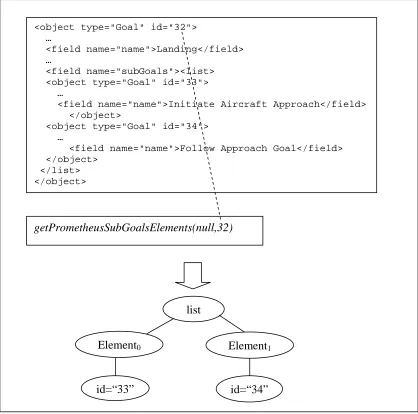
Figure A.25 getPrometheusSubGoals function example ... 42
Figure A.26 getPrometheusSubGoalsElements function example ... 43
Figure A.27 hasUses function example ... 53
Figure A.28 hasUses function example ... 54
Figure A.29 creates function example ... 54
Figure A.30 creates function example ... 55
Figure A.31 overlaps function example ... 56
Figure A.32 overlaps function example ... 57
Figure A.33 isPositiveSimilar function example ... 58
Figure A.34 isSimilar function example ... 59
Figure A.35 isSimilarByOverlaps function example ... 60
Figure A.36 isSimilarDataAndBeliefSet function example ... 61
Figure A.37 isSimilarSDResourceAndMessage function example ... 62
Figure A.38 SomeOverlap function example ... 63
Figure A.39 stringTokenizerByUpperCase function example ... 64
Figure A.40 contains function example ... 65
Figure A.41 isSynonyms function ... 66
Figure A.42 stringTokenizer function example... 67
Figure A.43 isSynonyms function example ... 68
Figure A.44 getSubGoalsAndTask function example ... 70
Figure A.45 getSubGoalsAndTask function example ... 71
Figure A.46 getAttributeValue function example ... 72
Figure B.1 Strategic Dependency model for the Automatic Teller Machine ... 75
Figure B.2 Strategic Rationale Model for the Automatic Teller Machine ... 76
Figure B.3 ATM Goal diagram ... 76
Figure B.4 ATM System Overview diagram ... 77
Figure B.5 – Atm Agent Overview Diagram ... 78
Figure B.6 Bank Agent Overview diagram ... 78
[8]
Figure B.8 BankAgent agent ... 80
Figure B.9 Accounts beliefSet ... 81
Figure B.10 Accounts beliefSet ... 82
Figure B.11 Withdraw event ... 83
Figure B.12 WithdrawResponse event ... 83
Figure B.13 WithdrawRequest event ... 84
Figure B.14 WithdrawApproved plan... 84
Figure B.15 WithdrawCash plan ... 85
Figure B.16 WithdrawRejected plan ... 85
Figure B.17 WithdrawApproved plan... 86
Figure B.18 Atm agent in XML ... 88
Figure B.19 BankAgent in XML ... 88
Figure B.20 Accounts beliefSet in XML ... 90
Figure B.21 Balances beliefSet in XML ... 91
Figure B.22 ProcessWithdraw plan in XML ... 92
Figure B.23 WithdrawApproved plan in XML ... 92
Figure B.24 WithdrawCash plan in XML ... 93
Figure B.25 WithdrawRejected plan in XML ... 93
Figure B.26 Withdraw event in XML ... 94
Figure B.27 WithdrawResponse in XML ... 94
Figure B.29 Fields of the Accounts beliefSet ... 99
Figure B.30 Accounts beliefSet ... 99
Figure B.31 Balances beliefSet ... 99
Figure B.32 Balances descriptor ...100
Figure B.33 ProcessWithdraw plan ...101
Figure B.34 Process Withdraw descriptor ...101
Figure B.35 WithdrawApproved plan...102
Figure B.36 Withdraw Approved descriptor ...102
Figure B.37 WithdrawCash plan ...103
Figure B.38 Withdraw Cash descriptor...103
Figure B.39 WithdrawReject plan ...103
Figure B.40 Withdraw Rejected descriptor ...104
Figure C.1 Strategic Dependency model for Air Traffic Environment ...106
Figure C.2 Strategic Rationale model for Air Traffic Environment ...107
Figure C.3 Goal diagram for Air Traffic Environment ...108
Figure C.4 Traffic Feeding Capability ...109
Figure C.5 Arrival Sequencing Capability ...109
Figure C.6 Runway Assigning Capability ...110
Figure C.7 Flying Capability ...110
Figure C.8 Traffic Feeding Capability ...111
Figure C.9 Arrival Sequencing Capability ...111
Figure C.10 Runway Assigning Capability ...112
Figure C.11 Flying Capability ...113
Figure C.12 Aircraft agent ...113
Figure C.13 Airport agent ...114
Figure C.14 Feeder agent ...114
Figure C.15 Runway agent ...114
Figure C.16 LandingInfo beliefSet ...115
Figure C.17 RunwayInfo beliefSet ...116
Figure C.18 ArrivalSequencing capability ...116
Figure C.19 Flying Capability ...117
Figure C.20 Runway Assigning Capability ...117
Figure C.21 TrafficFeeding capability ...118
Figure C.22 AircraftEvent event ...119
Figure C.23 Approaching event ...120
[9]
Figure C.25 TrafficEvent event ...121
Figure C.26 AssignSlot plan ...121
Figure C.27 FollowApproach plan ...122
Figure C.28 InitialApproach plan ...122
Figure C.29 MonitorAircraft plan ...123
Figure C.30 RequestSlot plan ...124
Figure C.31 RunwayAssign plan ...125
Figure C.32 RunwayRequest plan ...126
Figure C.33 Takeoff plan ...127
Figure C.34 TakeoffDiscard plan ...127
Figure C.35 Traffic plan ...128
Figure C.36 Aircraft agent in XML ...128
Figure C.37 Airport agent in XML ...129
Figure C.38 TrafficFeeding agent in XML ...129
Figure C.39 Runway agent in XML ...129
Figure C.40 LandingInfo beliefSet in XML ...130
Figure C.41 RunwayInfo beliefSet in XML ...131
Figure C.42 AssignSlot plan in XML ...131
Figure C.43 FollowApproach plan in XML ...131
Figure C.44 InitialApproach plan in XML ...132
Figure C.45 MonitorAircraft plan in XML ...132
Figure C.46 RequestSlot plan in XML ...134
Figure C.47 RunwayAssign plan in XML ...134
Figure C.48 Takeoff plan in XML ...135
Figure C.49 TakeoffDiscard plan in XML ...135
Figure C.50 Traffic plan in XML ...135
Figure C.51 RunwayRequest plan in XML ...136
Figure C.52 AircraftEvent event in XML ...136
Figure C.53 Approaching event in XML ...137
Figure C.54 EnterControlArea event in XML ...137
Figure C.55 TrafficEvent event in XML ...138
Figure C.56 ArrivalSequencing capability in XML ...138
Figure C.57 Flying capability in XML ...139
Figure C.58 RunwayAssigning capability in XML ...139
Figure C.59 TrafficFeeding capability in XML ...140
Figure C.60 Air Traffic Control Environment i* model version 1 ...147
Figure C.61 Prometheu goal diagram...147
Figure E.1 A generic BDI architecture ...201
Figure F.1 Prometheus Goal vs SD Goal overlaps dependency ...206
Figure F.2 Monitor Shipment task dependency ...207
Figure F.3 Monitor delivery goal in Prometheus ...207
Figure F.4 Prometheus Goal vs Actor depends on traceability relation ...208
Figure F.5 Prometheus Goal vs SR Goal overlaps traceability relation ...209
Figure F.6 Prometheus Goal vs SR Task overlaps traceability relation ...210
Figure F.7 Prometheus Role vs SD Goal uses traceability relation ...210
Figure F.8 Prometheus Role vs SD Resources uses relation ...211
Figure F.9 Prometheus Role vs SD Task contributes relation ...212
Figure F.10 Prometheus Role vs Actor contributes relation ...213
Figure F.11 Prometheus Role vs SR Goal achieves traceability relation ...213
Figure F.12 Prometheus Role vs SR Resource uses relation ...214
Figure F.13 Prometheus Role vs SR Resource creates relation ...215
Figure F.14 Prometheus Role vs SR Task achieves traceability relation ...215
Figure F.15 Prometheus Agent vs SD Goal achieves traceability relation ...216
Figure F.16 Prometheus Agent vs SR Resource uses traceability relation ...216
Figure F.17 Prometheus Agent vs SD Task achieves traceability relation ...217
[10]
Figure F.19 Prometheus Agent vs SR Goal achieves traceability relation ...218
Figure F.20 Prometheus Agent vs SR Resource uses traceability relation ...219
Figure F.21 Prometheus Agent vs SR Resource creates traceability relation ...219
Figure F.22 Prometheus Agent vs SR Task achieves traceability relation ...220
Figure F.23 Prometheus Capability vs SD Goal contributes traceability relation ...221
Figure F.24 Prometheus Capability vs SD Resource uses traceability relation ...221
Figure F.25 Prometheus Capability vs SD Task contributes traceability relation ...222
Figure F.26 Prometheus Capability vs Actor composed relation ...223
Figure F.27 Prometheus Capability vs SR Goal contributes traceability relation ...223
Figure F.28 Prometheus Capability vs SR Resource uses traceability relation ...224
Figure F.29 Prometheus Capability vs SR Resoource creates traceability relation ...224
Figure F.30 Prometheus Capability vs SR Resource uses traceability relation ...225
Figure F.31 Prometheus Plan vs SD Goal contributes traceability relation ...225
Figure F.32 Prometheus Plan vs SD Resource uses traceability relation ...226
Figure F.33 Prometheus Plan vs SD Task achieves traceability relation ...227
Figure F.34 Prometheus vs Actor creates traceability relation ...228
Figure F.35 Prometheus Plan vs SR Goal achieves traceability relation ...228
Figure F.36 Prometheus Plan vs SR Resource uses traceability relation ...229
Figure F.37 Prometheus Plan vs SR Resource creates traceability relation ...229
Figure F.38 Prometheus Plan vs SR Task achieves traceability relation...230
Figure F.39 Prometheus Percept vs SD Resource overlaps traceability relation ...230
Figure F.40 Prometheus Action vs SR Task overlaps traceability relation ...231
Figure F.41 Prometheus Data vs SD Goal contributes traceability relation ...232
Figure F.42 Prometheus Data vs SD Task contributes traceability relation ...233
Figure F.43 Prometheus Data vs Actor uses traceability relation ...234
Figure F.44 Prometheus Data vs SR Goal uses traceability relation ...235
Figure F.45 Prometheus Data vs SR Resource overlaps traceability relation ...235
Figure F.46 Prometheus Data vs SR Task uses traceability relation ...236
Figure F.47 Order Book Scenario ...237
Figure F.48 Strategic Rationale Diagram for the Electronic Bookstore actor ...238
Figure F.49 Prometheus Scenario vs SD Task depends traceability relation ...239
Figure F.50 Prometheus Scenario vs Actor depends traceability relation ...239
Figure F.51 Prometheus Scenario vs SR Goal compose traceability relation ...240
Figure F.52 Prometheus Scenario vs SR Resource creates traceability relation ...241
Figure F.53 Prometheus Scenario vs SR Resource uses traceability relation ...241
Figure F.54 Prometheus Scenario vs SR Task composed traceability relation ...242
Figure F.55 Prometheus Message vs SD Resource overlaps traceability relation ...242
Figure G.1 JACK Agent vs Prometheus Goal achieves traceability relation ...245
Figure G.2 JACK Agent vs Prometheus Role uses traceability relation ...246
Figure G.3 JACK Agent vs Prometheus Agent overlaps traceability relation ...246
Figure G.4 JACK Agent vs Prometheus Capability uses traceability relation ...247
Figure G.5 JACK Agent vs Prometheus Plan uses traceabilty relation ...247
Figure G.6 JACK Agent vs Prometheus Percept uses traceability relation ...248
Figure G.7 JACK Agent vs Prometheus Action creates traceability relation ...249
Figure G.8 JACK Agent vs Prometheus Message sends traceability relation ...249
Figure G.9 JACK Agent vs Prometheus Message receives traceability relation ...250
Figure G.10 JACK Agent vs Prometheus Message receives traceability relation ...250
Figure G.11 JACK Agent vs Prometheus Date creates traceability relation ...251
Figure G.12 JACK Plan vs Prometheus Goal ...251
Figure G.13 JACK Plan vs Prometheus Role uses traceability relation ...252
Figure G.14 JACK Plan vs Prometheus Agent uses traceability relation ...253
Figure G.15 JACK Plan vs Prometheus Capability uses traceability relation...253
Figure G.16 JACK Plan vs Prometheus Plan overlaps traceability relation ...254
Figure G.17 JACK Plan vs Prometheus Percept uses traceability relation ...254
Figure G.18 JACK Plan vs Prometheus Action creates traceability relation ...255
[11]
Figure G.20 JACK Plan vs Prometheus Message receives traceability relation ...256
Figure G.21 JACK Plan vs Prometheus Data uses traceability relation ...256
Figure G.22 JACK Plan vs Prometheus Data creates traceability relation ...257
Figure G.23 JACK Belief vs Prometheus Role creates relation ...257
Figure G.24 JACK Belief vs Prometheus Role uses traceability relation ...258
Figure G.25 JACK BeliefSet vs Prometheus Agent creates traceability relation ...258
Figure G.26 JACK BeliefSet vs Prometheus Agent uses traceability relation ...259
Figure G.27 JACK BeliefSet vs Prometheus Capability creates traceability relation ...260
Figure G.28 JACK BeliefSet vs Prometheus Capability uses traceability relation ...260
Figure G.29 JACK BeliefSet vs Prometheus Plan creates traceability relation ...261
Figure G.30 JACK BeliefSet vs Prometheus uses traceability relation ...262
Figure G.31 JACK BeliefSet vs Prometheus Data overlaps traceability relation ...262
Figure G.32 JACK Event vs Prometheus Agent receives traceability relation ...263
Figure G.33 JACK Event vs Prometheus Agent sends traceability relation ...263
Figure G.34 JACK Event vs Prometheus Capability ...264
Figure G.35 JACK Event vs Prometheus Capability receives relation ...264
Figure G.36 JACK Event vs Prometheus Plan sends traceability relation ...265
Figure G.37 JACK Event vs Prometheus Plan receives traceability relation ...266
[12]
Tables
Table A.1- Completeness checking functions ... 17
Table A.2 XQuery functions ... 23
Table A.3 XQueryJACKFunctions ... 31
Table A.4 XQueryPDTFunctions ... 34
Table A.5 XQuerySimilarityFunctions... 52
Table A.6 XQuerySynonyms Function example ... 64
Table A.7 XQueryTAOMFunctions ... 69
Table B.1 Traceability relations identified manually ... 96
Table B.2 Traceability relations identified by the tool ... 98
Table B.3 Missing Information ... 98
Table C.1 Traceability relations identified manually ...142
Table C.2 Traceability relations identified by the tool ...144
Table C.3 Missing relations identified by the tool ...145
Table C.4 Missing relations between SD Goal and Prometheus Goal ...146
Table C.5 Missing relations between SR Goal and Prometheus Goal ...146
Table C.6 Missing relations between SR Plan and Prometheus Goal ...147
Table C.7 Missing relations between Prometheus Goal and SD/SR Task or SD/SR Goal ...148
Table C.8 Missing relations between SD Resource and Prometheus Percept ...148
Table C.9 Missing relations between SD Goal and a Prometheus Agent ...149
Table C.10 Missing relation between a SR Goal and an Agent ...149
Table C.11 Missing relations between a SR Task and an Agent ...149
Table C.12 Missing relations between a SD Goal and a Prometheus Plan ...150
Table C.13 Missing relations between a SR Goal and a Prometheus Plan ...150
Table C.14 Missing relations between a SR Task and Prometheus Plan ...150
Table C.15 Missing links between a SD Goal and Prometheus Capability ...151
Table C.16 Missing links between a SR Goal and Prometheus Capability ...151
Table C.17 Missing relations between a SR Task and Prometheus Capability ...151
Table C.18 Traceability relations between i* and Prometheus ...154
Table C.19 Missing relations between JACK and Prometheus ...154
Table D.1 Relations identified manually between Prometheus Goal and JACK Agent ...156
Table D.2 Relations identified by the tool between Prometheus Goal and JACK Agent ...157
Table D.3 Relations identified manually between Prometheus Role and JACK Agent ...157
Table D.4 Relations identified by the tool between Prometheus Role and JACK Agent ...158
Table D.5 Relations identified manually between Prometheus Agent and JACK Agent ...158
Table D.6 Relations identified by the tool between Prometheus Agent and JACK Agent ...158
Table D.7 Relations identified manually Prometheus Capability and JACK Agent ...159
Table D.8 Relations identified by the tool between Prometheus Capability and JACK Agent ...160
Table D.9 Relations identified manually between Prometheus Plan and JACK Agent ...161
Table D.10 Relations identified by the tool between Prometheus Plan and JACK Agent ...162
Table D.11 Relations identified manually between Prometheus Percept and JACK Agent ...163
Table D.12 Relations identified by the tool between Prometheus Percept and JACK Agent ...163
Table D.13 Missing traceability relations between Prometheus Percept and JACK Agent ...164
Table D.14 Relations identified manually between Prometheus Action and JACK Agent ...164
Table D.15 Relations identified by the tool between Prometheus Action and JACK Agent ...165
Table D.16 Relations identified manually between Prometheus Message and JACK Agent ...166
Table D.17 Relations identified by the tool between Prometheus Message and JACK Agent ...166
Table D.18 Relations identified manually between Prometheus Message and JACK Agent ...167
Table D.19 Relations identified by the tool between Prometheus Message and JACK Agent ...167
Table D.20 Relations identified manually between Prometheus Data and JACK Agent ...168
Table D.21 Relations identified by the tool between Prometheus Data and JACK Agent ...168
Table D.22 Relations identified manually between Prometheus Data and JACK Agent ...168
[13]
Table D.24 Relations identified manually between JACK Plan and Prometheus Goal ...169
Table D.25 Relations identified by the tool between Prometheus Goal and JACK Plan ...169
Table D.26 Relations identified manually between JACK Plan and Prometheus Role ...170
Table D.27 Relations identified by the tool between Prometheus Role and JACK Plan ...170
Table D.28 Relations identified manually between JACK Plan and Prometheus Agent ...171
Table D.29 Relations identified by the tool between Prometheus Agent and JACK Plan ...172
Table D.30 Relations identified manually between JACK Plan and Prometheus Capability ...173
Table D.31 Relations identified by the tool between Prometheus Capability and JACK Plan ...174
Table D.32 Relations identified manually between Prometheus Plan and JACK Plan ...175
Table D.33 Relations identified by the tool between Prometheus Plan and JACK Plan ...175
Table D.34 Missing relation ...176
Table D.35 Missing relation ...176
Table D.36 Wrong relation ...176
Table D.37 Missing relation ...177
Table D.38 Wrong relation ...177
Table D.39 Missing relations ...177
Table D.40 Missing relation ...178
Table D.41 Relations not identified by the tool ...178
Table D.42 Relations identified manually between JACK Plan and Prometheus Percept ...179
Table D.43 Relations identified by the tool between Prometheus Percept and JACK Plan ...179
Table D.44 Relations identified manually between JACK Plan and Prometheus Action ...180
Table D.45 Relations identified by the tool between Promehteus Action and JACK Plan ...180
Table D.46 Relations identified manually between JACK Plan and Prometheus Message ...181
Table D.47 Relations identified by the tool between Prometheus Message and JACK Plan ...181
Table D.48 Relations identified manually between JACK Plan and Prometheus Message ...183
Table D.49 Relations identified by the tool between Prometheus Message and JACK Plan ...183
Table D.50 Relations identified manually between JACK Plan and Prometheus Data ...184
Table D.51 Relations identified by tool between JACK Plan and Prometheus Data ...184
Table D.52 Relations identified manually between JACK Plan and Prometheus Data ...185
Table D.53 Relations identified manually between JACK BeliefSet and Promtheus Role ...185
Table D.54 Relations identified by the tool between Prometheus Role and JACK BeliefSet ...185
Table D.55 Relations identified manually between JACK BeliefSet and Prometheus Role ...186
Table D.56 – Relations identified by the tool between JACK BeliefSet and Prometheus Role ...186
Table D.57 Relations identified manually between JACK BeliefSet and Prometheus Agent ...186
Table D.58 Relations identified by the tool between Prometheus Role ...186
Table D.59 Relations identified manually between JACK BeliefSet and Prometheus Agent ...187
Table D.60 Relations identified by the tool between Prometheus Agent and JACK BeliefSet ...187
Table D.61 Relations identified manually between Prometheus Capability and JACK BeliefSet ...188
Table D.62 Relations identified by the tool between Prometheus Capability and JACK BeliefSet ...188
Table D.63 Relations identified manually between Prometheus Capability and JACK BeliefSet ...188
Table D.64 Relations identified by the tool between Prometheus Capability and JACK BeliefSet ...189
Table D.65 Relations identified manually between Prometheus Plan and JACK ...189
Table D.66 Relations identified by the tool between Prometheus Plan and JACK BeliefSet ...189
Table D.67 Relations identified manually between Prometheus Plan and JACK BeliefSet ...190
Table D.68 Relations identified by the tool between Prometheus Plan and JACK BeliefSet ...190
Table D.69 Relations between JACK BeliefSet and Prometheus Data ...191
Table D.70 Relations between Prometheus Data and JACK BeliefSet ...191
Table D.71 Relations between JACK Event and Prometheus Agent ...192
Table D.72 Relations between JACK Event and Prometheus Agent ...192
Table D.73 Relations between JACK Event and Prometheus Capability ...193
Table D.74 Relations identified manually between JACK Event and Prometheus Capability ...194
Table D.75 Relations identified manually between JACK Event and Prometheus Plan ...195
Table D.76 Relations identified by the tool between Prometheus Message and Prometheus Plan ...196
Table D.77 Relations identified manually between JACK Event and Prometheus Plan ...197
Table D.78 Relations identified by the tool between Prometheus Plan and JACK Event ...197
[14]
Table D.80 Relations between Prometheus Message and JACK Event ...198
Table F.1 Relations between Prometheus and i* SD ...204
Table F.2 Relations between Prometheus and i*SR elements ...205
Table G.1 Traceability Relations Types between Prometheus and JACK Artefacts ...244
[15]
Appendix A - Extended Functions
The lists of functions are grouped in seven classes:
XQueryCompletenessCheckingFunctions - contains a list of methods in Java that extend XQuery to perform completeness checking.
XQueryFunctions – contains a list of methods in Java that extend XQuery with general functionalities.
XQueryJACKFunctions - provides a list of methods in Java that that extends XQuery with functions to manipulate elements in the JACK XML file.
XQueryPDTFunctions - provides a list of methods in Java that extends XQuery with functions to manipulate elements created by the PDT tool version 3.2.
XQuerySimilarityFunctions – includes a list of methods in Java that extends XQuery with functions to compare the similarity between elements in the models.
XQuerySynonymsFunctions – contains a list of methods in Java that extends XQuery with functions to verify if names of elements in the models are synonyms.
XQueryTAOMFunctions – provides a list of methods in Java that extends XQuery with functions to manipulate elements in the i* model created using the TAOM tool.
To use an XQuery extended function implemented in a Java class, it is necessary first to declare the class name that includes the function and then call the function wanted. For instance, before to be able to call getPDTFileName function included in the XQueryPDTFunctions class the user has first to define a namespace and associated it with XQueryPDTFunctions class and then call the function wanted using the namespace given. Figure A.1 shows an example when the pdt namespace is associated to the XQueryPDTFunction class in Java (declare namespace pdt = java:retratos.XQueryPDTFunctions). The
[16]
Figure A.1 Calling getPDTFileName extended function in Java
The next sections describe functions implemented in Java to extend XQuery in more detail.
A.1.1 Completeness checking functions
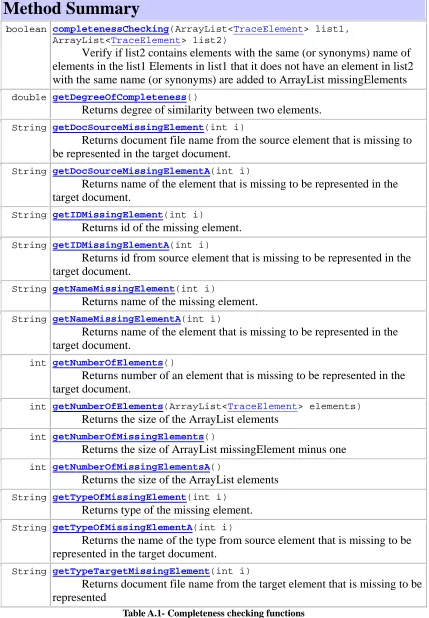
Table A.1 shows a list of methods in the XQueryCompletenessCheckingFunctions class that extend XQuery with functions to perform completeness checking. We are going to describe in detail and give some examples of the most complex and important functions in next sections.
declare namespace pdt = "java:retratos.XQueryPDTFunctions"; ….
[17]
Table A.1- Completeness checking functions
Method Summary
boolean completenessChecking(ArrayList<TraceElement> list1, ArrayList<TraceElement> list2)
Verify if list2 contains elements with the same (or synonyms) name of elements in the list1 Elements in list1 that it does not have an element in list2 with the same name (or synonyms) are added to ArrayList missingElements
double getDegreeOfCompleteness()
Returns degree of similarity between two elements.
String getDocSourceMissingElement(int i)
Returns document file name from the source element that is missing to be represented in the target document.
String getDocSourceMissingElementA(int i)
Returns name of the element that is missing to be represented in the target document.
String getIDMissingElement(int i)
Returns id of the missing element.
String getIDMissingElementA(int i)
Returns id from source element that is missing to be represented in the target document.
String getNameMissingElement(int i)
Returns name of the missing element.
String getNameMissingElementA(int i)
Returns name of the element that is missing to be represented in the target document.
int getNumberOfElements()
Returns number of an element that is missing to be represented in the target document.
int getNumberOfElements(ArrayList<TraceElement> elements)
Returns the size of the ArrayList elements
int getNumberOfMissingElements()
Returns the size of ArrayList missingElement minus one
int getNumberOfMissingElementsA()
Returns the size of the ArrayList elements
String getTypeOfMissingElement(int i)
Returns type of the missing element.
String getTypeOfMissingElementA(int i)
Returns the name of the type from source element that is missing to be represented in the target document.
String getTypeTargetMissingElement(int i)
[18]
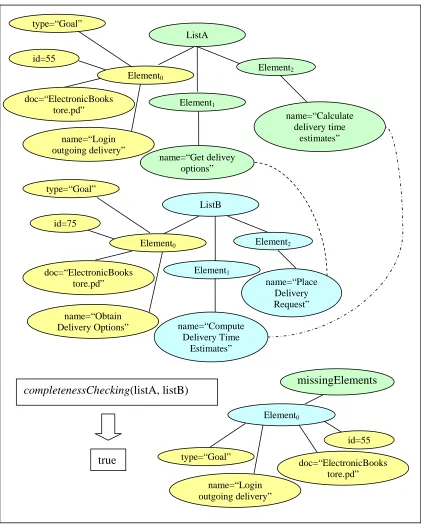
A.1.1.1 CompletenessChecking functions
[19]
Figure A.2 List of strings
A.1.1.2 GetDegreeOfCompleteness function
The getDegreeOfCompleteness function returns the value of degreeOfCompleteness field. ListA
name=“Login outgoing delivery”
name=“Get delivey options”
name=“Calculate delivery time
estimates”
completenessChecking(listA, listB)
true
Element0
Element0
id=55
doc=“ElectronicBooks tore.pd” type=“Goal”
Element1
Element2
ListB
name=“Obtain Delivery Options”
Element0
id=75
doc=“ElectronicBooks tore.pd” type=“Goal”
Element1
Element2
name=“Compute Delivery Time
Estimates”
name=“Place Delivery Request”
type=“Goal”
id=55
doc=“ElectronicBooks tore.pd” name=“Login
outgoing delivery”
[20]
A.1.1.3 GetDocSourceMissingElement
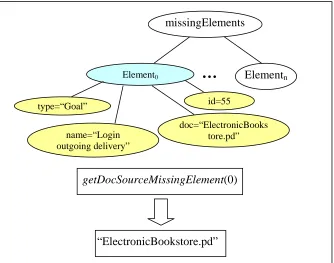
The getDocSourceMissingElement function receives as parameter an integer that represents the index of the missing element and returns a String with the name of the document that contains the element that is missing. For instance, in the Figure A.3 the Element0 (index equal
[image:21.595.141.475.263.526.2]0) is part of the ElectronicBookstore.pd document. If the getDocSourceMissingElement function is called passing the value equal 0 then getDocSourceMissingElement function returns the “ElectronicBookstore.pd” string value.
Figure A.3 getDocSourceMissingElement function
A.1.1.4 GetIDMissingElement
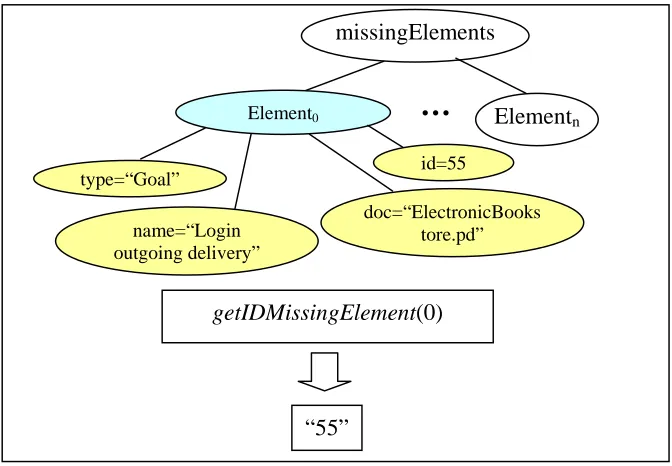
The getIDMissingElement function receives as parameter an integer that represents the index of the missing element and returns a String with the id of the element that is missing. For instance, in the Figure A.4 the Element0 (index equal 0) has id equal to 0. If the
getIDMissingElement function is called passing the value equal 0 then function returns the value 55.
missingElements
Elementn
…
getDocSourceMissingElement(0)
“ElectronicBookstore.pd” Element0
type=“Goal” id=55
doc=“ElectronicBooks tore.pd” name=“Login
[21]
Figure A.4 getIDMissingElement function example
A.1.1.5 GetNameMissingElement
The getNameMissingElement function receives as parameter an integer that represents the index of the missing element and returns a String with the name of the element that is missing. For instance, in the Figure A.5 if the getNameMissingElement function is called passing the value equal 0 then function returns the “Login outgong delivery” string value.
Figure A.5 getNameMissingElement function example missingElements
Elementn
…
getIDMissingElement(0)
“55” Element0
type=“Goal” id=55
doc=“ElectronicBooks tore.pd” name=“Login
outgoing delivery”
missingElements
Elementn
…
getNameMissingElement(0)
“Login outgoing delivery” Element0
type=“Goal” id=55
doc=“ElectronicBooks tore.pd” name=“Login
[image:22.595.146.483.460.696.2][22]
A.1.1.6 GetNumberOfMissingElement
The getNumberOfMissingElement function returns the size of ArrayList missingElement minus one. For instance, in the Figure A.6 the getNumberOfMissingElement function returns the value n-1.
Figure A.6 getNumberOfMissingElement function example
A.1.1.7 GetDocSourceMissingElementA
return XQueryFunctions.sourceMissingElements.get(i).getDoc();
A.1.2 XQuery functions
Method Summary
boolean capabilityUsesSDResource(TinyNodeImpl capability, TinyNodeImpl resource)
Check if the Capability in Prometheus uses a SD Resource in
i*.
boolean capabilityUsesSRResource(TinyNodeImpl capability, TinyNodeImpl resource)
Check if the Capability in Prometheus uses a SR Resource in
i*.
boolean clr()
Reset value of class variables used to perform completeness missingElements
Elementn
…
getNumberOfMissingElement()
n-1 Element0
type=“Goal”
id=55
doc=“ElectronicBooks tore.pd” name=“Login
[23]
Table A.2 XQuery functions
A.1.2.1 CapabilityUsesSDResource function
The capabilityUsesSDResource function checks if a capability uses a SD Resource. The function receives as a parameter TinyNodeImpl capability and TinyNodeImpl resource that represents a XML Node in the Saxon tool. For instance, the Figure A.7 shows the Arrival Sequencing Capability and the ATL SD Resource. The Arrival Sequencial Capability contains the Aircraft Event message. If you call the capabilityUsesSDResource function (see Figure A.8) and pass as argument the Arrival Sequencing Capability TinyNodeImpl and the ATL TinyNodeImpl, the function recovers all messages that the capability contains and then checks if there is some overlaps relation between the id of a message and the id of the SD resource using the isOverlap function.
checking: numberOfElements , missingElements, numberOfMissingElements and sourceMissingElements
boolean contains(ArrayList<String> list1, ArrayList<String> list2)
Check if the ArrayList of Strings list1 contains all the strings in the ArrayList of Strings list2
boolean contains(String word, ArrayList<String> wordList)
Check if the ArrayList of String wordList contains the String word.
String getAttributeValue(TinyNodeImpl node, attributeName)
Returns the value of an attribute of an XML Element in Saxon The method compares if any of the messages that the Capability sends or receives has an overlaps relations with the SR Resource.
String getTraceabilityFileName()
It returns a String of tokens.
boolean hasRelation(elementID, String relationType, String type)
Check if there is a specific type of relations between an element in which the id is equal to elementID and any element with the same type as type
ArrayList<String> stringTokenizer(String str)
It returns a String of tokens.
ArrayList<String> stringTokenizerByUpperCase(String str)
[24]
Figure A.7 Arrival Sequencing Capability and ATL SD Resource Aircraft Event Request Slot Plan
mutex
ATL
Slot Allocated
Information Carried Arrival Sequencing Capability
ATL
[25]
Figure A.8 capabilityUsesSDResource function example
A.1.2.2 CapabilityUsesSRResource function
The capabilityUsesSRResource function checks if a capability uses a SR Resource. The function receives as a parameter TinyNodeImpl capability and TinyNodeImpl resource that represents a XML Node in the Saxon tool. For instance, the Figure A.9 shows the Flying Capability and the Landing Information SR Resource. If you call the
<object type="Capability" id="14"> <base type="Entity">
<field name="name">Arrival Sequencing</field> …
</object>
<TroposClasses
xmi:id="_BHHSkF5wEd6A7vkLk-vUcQ" name="ATL" … />
capabilityUsesSDResource (capability,resource)
call isOverlap (“7”, "_BHHSkF5wEd6A7vkLk-vUcQ”) <object type="Message" id="7"> <base type="Interaction"> <base type="Entity">
<field name="name">Aircraft Event</field> </base>
… </base> </object>
[26]
capabilityUsesSRResource function and pass as argument the Flying Capability TinyNodeImpl and the LandingInformation TinyNodeImpl.
Figure A.9 hasUses function example
A.1.2.3 Contains function
Contains function receives as parameter a String word and an ArrayList of String wordList and check if the Arraylist wordList contains the String word. The function uses the WordNet dictionary to check for synonyms words. Figure A.10 shows that the contains function returns true when it is invoked passing as parameter the String “Get” and the list of Strings wordList that consists of “Obtain”, “Delivery” and “Options”. The list of Strings wordList contains the “Get” string because “Get” and “Obtain” are synonyms.
<Traceability>
<TraceabilityRelation type="uses">
<Element … id="_PsspBiQyEd6fbcmFsKI3Cw"/> <Element … id="40" />
</TraceabilityRelation> …
</Traceability>
hasUses(“PsspBiQyEd6fbcmFsKI3Cw”,”40”,outputDoc,SaxonInterface.xpath
[27]
Figure A.10 contains function example
A.1.2.4 Contains function
Contains function check if the ArrayList of Strings List A contains all the strings in the ArrayList of Strings List B. To each String in the List A the contains function call the other contains function explained in the section A.1.2.3 passing the String in the List A and the List B as parameter. If all the Strings in the List A are contained in the List B then function returns true. For instance, in the Figure A.11 List B does not contain List A. List B contains “Get delivery options”, and “Calculate Delivery time estimates” Strings, but not contain “Login outgoing delivery” string.
wordList
“Delivery”
“Options” “Obtain”
contains (“Get”, wordList)
[28]
Figure A.11 Using contains function
A.1.2.4 GetAttributeValue function
The getAttributeValue function returns the value of an attribute of an XML Element in Saxon. The function receives two parameters a TinyNodeImpl node and String attributeName. The node represents a XML element in the Saxon. For instance, the Figure A.12 shows a TinyNodeImpl node in Saxon that represents the object element in XML. If you call the getAttributeValue function and pass as parameter node and the String “type” then the function returns the value “Agent” as result.
Figure A.12 getAttributeValue function example List A
Login outgoing delivery
Get delivery options
Calculate delivery time estimates
List B
Obtain Delivery Options
Compute Delivery Time Estimates
Place Delivery Request
<object type=”Agent” id = “44”> </object>
node
type = “Agent” id = “44”
getAttributeValue(node,“type”)
[29]
A.1.2.5 GetTraceabilityFileName function
The getTraceabilityFileName function returns the output filename defined in the project definition and that is used to store the traceability relations.
A.1.2.6 HasRelation function
The hasRelation function checks if two elements have a traceability relation. The function receives the id of the elements to be checked and the type of traceability relation. Figure A.13 shows an example when the hasRlation function is called to check if elements with id = "_PsspBiQyEd6fbcmFsKI3Cw" and id = "40" have a uses traceability relation.
Figure A.13 hasRelation function example
A.1.2.7 stringTokenizer function
The stringTokenizer function receives as parameter a String and break down the string into tokens using as delimiters spaces, ‘_’, ‘-‘, ‘(‘, and ‘)’. In the Figure A.14 a list contained “Get”, “Delivery” and “Options” String is returned as result when function stringTokenizer function is called passing as parameter “Get Delivery Options” String.
<Traceability>
<TraceabilityRelation type="uses">
<Element … id="_PsspBiQyEd6fbcmFsKI3Cw"/> <Element … id="40" />
</TraceabilityRelation> …
</Traceability>
hasRelation(“PsspBiQyEd6fbcmFsKI3Cw”,”40”,”uses”)
[30]
Figure A.14 stringTokenizer function example
A.1.2.8 stringTokenizerByUpperCase function
The stringTokenizerByUpperCase function receives as parameter a String and break down the String into tokens using spaces and upper case letters as delimiters. Figure A.15 shows an example when the stringTokenizerByUpperCase function is called and “GetDeliveryOptiions” String is passed as parameter. As result the stringTokenizerByUpperCase function returns a list of Strings that consists of “Get”, “Delivery” and “Options”.
A.1.3 XQueryJACKFunctions
Method Summary
ArrayList<Field> getBeliefSetFields(java.lang.String id)
It returns an ArrayList with the list of fields of a beliefSet. List
“Delivery”
“Options” “Get”
stringTokenizerByUpperCase(“GetDeliveryOptions”)
Figure 4.15 stringTokenizerByUpperCase function example List
“Delivery”
“Options” “Get”
[31] String getJACKFileName()
It returns the name of the file that contains the JACK code in XML.
Table A.3 XQueryJACKFunctions
A.1.3.1 getBeliefSetFields function
The getBeliefSetFields function receives as parameter an id of a beliefSet in Prometheus created using the PDT tool and returns a list of Field elements. Figure A.16 shows an example when the getBeliefSetFields function is called and integer 58 is passed as parameter. The getBeliefSetFields
function returns a list with the included fields.
List
Field1
Field0
<object type="Data" id="58"> <base type="Entity">
<field name="name">landing_info</field> …
</base>
<field name="dataType">LandingInfo</field> <field name="includedFields">
String runway,long ATL
</field> …
</object>
getBeliefSetFields(58)
fieldname=“runway”
fieldType=“String”
fieldname=“ATL”
fieldType=“long”
[32]
A.1.3.2 getJACKFileName function
The getJACKFileName function returns the filename that contains the xml representation of the JACK code. The JACK filename is defined during the creation of project.
A.1.4 XQueryPDTFunctions
Method Summary
boolean actorHasCapability(String actorID, String capabilityID)
Finds all agents in Prometheus that uses the Capability and check if there is an overlaps traceability relation between the Actor and the Agent.
Field fieldTokenizer(String s, String token)
Receives a String token and returns a Field object.
String getAttributeValue(TinyNodeImpl node, String attributeName)
Returns the value of an attribute of an XML Element in Saxon
ArrayList<Field> getIncludedFields(String id)
It returns an ArrayList of Fields with the includedFields of a beliefSet in Prometheus.
ArrayList<String> getInformationCarried(String id)
It returns an ArrayList of Strings with informationCarried of a Percept
String getPDTFileName()
Returns the PDT filename
ArrayList<TraceEl ement>
getPrometheusElements(String id, String type, ArrayList<TraceElement> subElements)
It returns an ArrayList of sub-elements of an element in PDT.
ArrayList<TraceEl ement>
getPrometheusStepScenarios(String id, ArrayList<TraceElement> subElements)
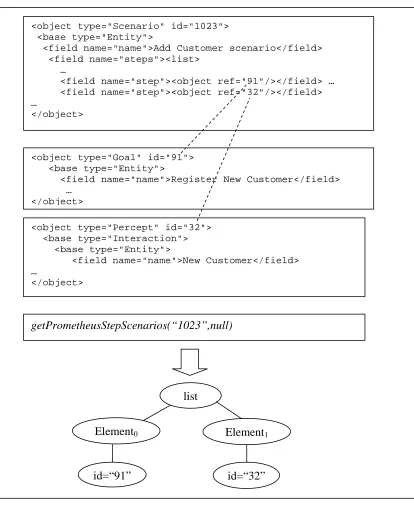
Retrieve steps from a Scenario in Prometheus (e.g.
ArrayList<TraceEl ement>
getPrometheusSubElements(TinyNodeImpl node, String type)
It returns an ArrayList of sub-elements of an element in PDT.
ArrayList<TraceEl ement>
getPrometheusSubGoals(ArrayList<TraceElement> goalsName, String goalID)
Retrieve sub-goals of a goal in PDT
ArrayList<TraceEl ement>
getPrometheusSubGoals(TinyNodeImpl node)
Retrieve sub-goals of a goal in the Prometheus model created by the PDT tool
ArrayList<TraceEl ement>
getPrometheusUsesData(String id, ArrayList<TraceElement> subElements)
Retrieves a list of data used by an element (e.g.
[33] String capabilityID)
Verify if an agent includes a Capability
boolean isADataProducedByTheRole(String dataID, String roleID)
Verifies if a data is produced by a role in Prometheus
boolean isADataThatTheAgentReads(String dataID, String id)
Verifies if an agent reads data in Prometheus
boolean isADataThatTheAgentWrites(String dataID, String id)
Verifies if a agent writes a data in Prometheus
boolean isADataThatTheCapabilityReads(String dataID, String capabilityID)
Verifies if the capability reads a data in Prometheus
boolean isADataThatTheCapabilityWrites(String dataID, String capabilityID)
Verifies if the capability writes data in Prometheus
boolean isADataThatThePlanReads(String dataID, String planID)
Verifies if a data is read by a plan in Prometheus
boolean isADataThatThePlanWrites(String dataID, String planID)
Verifies if a plan writes a data in Prometheus
boolean isADataUsedByTheRole(String dataID, String roleID)
Verifies if a data is used by the role in Prometheus
boolean isAGoalThatTheAgentAchieves(String goalID, String id)
Verifies an agent achieves a goal
boolean isAGoalThatTheCapabilityAchieves(String capabilityID, String goalID)
Verifies if a capability achieves a goal in Prometheus
boolean isAGoalThatThePlanAchieves(String goalID, String planID)
Verifies is a plan achieves a goal
boolean isAMessageThatTheAgentReceives(String messageID, String agentID)
Verifies if an agent receives a message in Prometheus
boolean isAMessageThatTheAgentSends(String messageID, String agentID)
Verifies the agent sends a message in Prometheus
boolean isAMessageThatTheCapabilityReceives(String messageID, String capabilityID)
Verifies the capability receives a message in Prometheus
boolean isAMessageThatTheCapabilitySends(String messageID, String capabilityID)
Verifies if the capability sends a message in Prometheus
boolean isAMessageThatThePlanReceives(String messageID, String planID)
Verifies if a plan receives a message in Prometheus
[34] String planID)
Verifies if the plan sends a message in Prometheus
boolean isAMessageThatTriggersThePlan(String messageID, String planID)
Verifies if the message triggers a plan in Prometheus
boolean isAnActionThatTheAgentPerforms(String actionID, String id)
Verifies an agent performs an action in Prometheus
boolean isAnActionThatTheCapabilityPerforms(String actionID, String capabilityID)
Verifies if a capability performs an action in Prometheus
boolean isAnActionThatThePlanPerforms(String actionID, String id)
Verifies a plan performs an action in Prometheus
boolean isAPerceptThatTheAgentResponds(String perceptID, String id)
Verifies if an agent responds to a percept in Prometheus
boolean isAPerceptThatTheCapabilityResponds(String perceptID, String id)
Verifies if a capability responds to a percept in Prometheus
boolean isAPerceptThatThePlanResponds(String perceptID, String id)
Verifies if the plan responds to the percept in Prometheus
boolean isAPlanThatTheAgentIncludes(String planID, String id)
Verify if an agent includes an plan
boolean isAPlanThatTheCapabilityIncludes(String planID, String capabilityID)
Verifies if a capability includes a plan in Prometheus
boolean isAPlanTheRoleUses(String planID, String roleID)
Verify if role uses a plan in Prometheus
boolean isARoleThatTheAgentIncludes(String roleID, String id)
Verifies is an agent includes a role
boolean isTrigger(String planId, String eventName)
Verifies if a plan triggers an event
Table A.4 XQueryPDTFunctions
A.1.4.1 ActorHasCapability function
The actorHasCapability function checks if an actor in i* has a traceability relation with a capability in Prometheus. The function receives as parameter the id of an actor and the id of a capability then retrieves all agents that implement the capability. If any of the agents that implement the capability has an overlap traceability with the actor then the actorHasCapability
function returns true. In the Figure the actorHasCapability function is invoked by passing 44 and
[35]
includes the capability and then call isOverlap function to check if there is an overlaps traceability relation between the Aircraft agent in Prometheus (id = 43) and the Aircraft actor
i*.
Figure A.17 ActorHasCapability function example
A.1.4.2 FieldTokenizer function
The fieldTokenizer function receives two Strings as parameter, s that contains information about the field and token that contains information how the field is structured and therefore can be divided into tokens. Figure shows an example when the fieldTokenizer function is called using as parameter the Strings “long ATL” and “space” as parameter. The fieldTokenizer function break down the String using spaces as delimiter and returns a Field element.
<object type="Agent" id="43"> <base type="Entity">
<field name="name">Aircraft</field> …
<field name="includedCapabilities"><list> <object type="Capability" id="44">
<base type="Entity">
<field name="name">Flying</field> …
</object>
actorHasCapability(44,"_8pRv4FyvEd6qIOGYcZQlag”)
true
<TroposClasses xmi:id="_8pRv4FyvEd6qIOGYcZQlag"
name="Aircraft" "/>
[36]
A.1.4.3 GetAttributeValue function
The getAttributeValue function returns the value of an attribute of an XML Element in Saxon. The function receives two parameters a TinyNodeImpl node and String attributeName. The node represents a XML element in the Saxon. For instance, the Figure shows a TinyNodeImpl node in Saxon that represents the object element in XML. If you call the getAttributeValue
function and pass as parameter node and the String “type” then the function returns the value “Agent” as result.
Field
type=“long” name =“ATL”
fieldTokenizer(“long ATL”, “space”)
Figure A.18 fieldTokenizer function example
<object type=”Agent” id = “44”> </object>
node
type = “Agent” id = “44”
getAttributeValue(node,“type”)
“Agent”
[37]
A.1.4.4 GetIncludedFields function
The getIncludedFieds function receives the id of an element in Prometheus and returns the included fields Strings as parameter, s contains information about the fields and token contains information how the fields are structured and can be divided into tokens. The shows an example when the getIncludedFields function is called by passing the parameter 35 that is the id of the runway_info Data in Prometheus. The function retrieves the information that contains the included fields of the Data and then call the fieldTokenizer function. The fieldTokenizer function returns a list with the Fields of the Data.
<object type="Data" id="35"> <base type="Entity">
<field name="name">runway_info</field> <field name="description"></field> <field name="uniqueId">35</field> </base>
<field name="dataType">RunwayInfo</field> <field name="includedFields">
long ATL,String aircraft,long ETA,boolean booking </field>
…
</object>
getIncludedFields(35)
call fieldTokenizer(“long ATL,String aircraft,long ETA,boolean booking, “,”)
List
Field0 Field3
fieldType=“long”
fieldName=“ATL”
fieldType=“boolean”
fieldName=“booking”
…
[38]
A.1.4.5 GetInformationCarried function
The getInformationCarriedfunction receives the id of an element in Prometheus and returns the information carried by the element. Figure A.21 shows an example when the
getInformationCarried function is called passing as an argument the id equal 7 that is related to the Aircraft Event message. The function retrieves the information carried by the message and returns a list with the Strings “ATL”, and “Slot Allocated”.
A.1.4.6 GetPDTFileName
The getPDTFileName function returns the name of the PDT filename that has been defined during the creation of the project.
<object type="Message" id="7"> <base type="Interaction"> <base type="Entity">
<field name="name">Aircraft Event</field> <field name="description"></field>
<field name="uniqueId">9</field> </base>
<field name="informationCarried">ATL, Slot Allocated</field>
…
</object>
getInformationCarried(7)
List
[image:39.595.89.507.245.562.2]“ATL” … “Slot Allocated
[39]
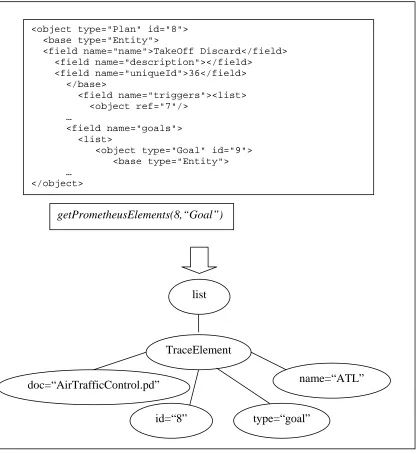
A.1.4.7 GetPrometheusElements
The getPrometheusElements function receives as parameter a String with the id of an element, a String with the types of sub-elements to be retrieved, and a list with sub-elements in case the function has been called recursively or null. The getPrometheusElements function returns an ArrayList of sub-elements of an element in Prometheus created using PDT tool.
<object type="Plan" id="8"> <base type="Entity">
<field name="name">TakeOff Discard</field> <field name="description"></field>
<field name="uniqueId">36</field> </base>
<field name="triggers"><list> <object ref="7"/>
…
<field name="goals"> <list>
<object type="Goal" id="9"> <base type="Entity"> …
</object>
list
name=“ATL”
getPrometheusElements(8,“Goal”)
TraceElement
[image:40.595.91.507.223.677.2]id=“8” type=“goal” doc=“AirTrafficControl.pd”
[40]
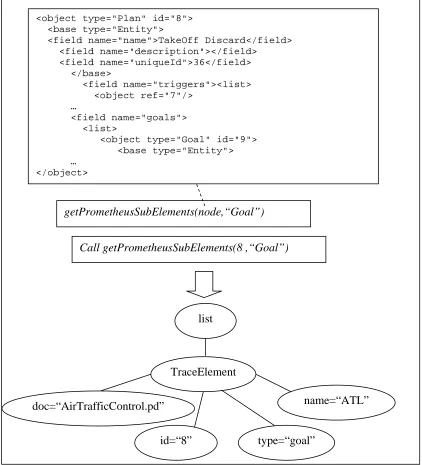
A.1.4.8 GetPrometheusSubElements
The getPrometheusSubElements function receives TinyNodeImpl node that represents an XML Element in Prometheus and a String type that represents the type of subelements to be retrieved. If the type is equal to “step” the getPrometheusStepScenarios function is called. If the type is equal to “readBy” the getPrometheusUsesData function is called, otherwise the
getPrometheusElements function is called. The function returns a list of sub-elements.
<object type="Plan" id="8"> <base type="Entity">
<field name="name">TakeOff Discard</field> <field name="description"></field>
<field name="uniqueId">36</field> </base>
<field name="triggers"><list> <object ref="7"/>
…
<field name="goals"> <list>
<object type="Goal" id="9"> <base type="Entity"> …
</object>
list
name=“ATL”
getPrometheusSubElements(node,“Goal”)
TraceElement
id=“8” type=“goal” doc=“AirTrafficControl.pd”
[image:41.595.103.525.237.702.2]Call getPrometheusSubElements(8 ,“Goal”)