
Rochester Institute of Technology
RIT Scholar Works
Theses
12-2018
Visualizing Resiliency Of Deep Convolutional
Network Interpretations For Aerial Imagery
Bhavan Kumar Vasu
Follow this and additional works at:https://scholarworks.rit.edu/theses
This Thesis is brought to you for free and open access by RIT Scholar Works. It has been accepted for inclusion in Theses by an authorized administrator of RIT Scholar Works. For more information, please [email protected].
Recommended Citation
Visualizing Resiliency Of Deep Convolutional
Network Interpretations For Aerial Imagery
Visualizing Resiliency Of Deep Convolutional
Network Interpretations For Aerial Imagery
Bhavan Kumar Vasu December 2018
A Thesis Submitted in Partial Fulfillment
of the Requirements for the Degree of Master of Science
in
Computer Engineering
Visualizing Resiliency Of Deep Convolutional
Network Interpretations For Aerial Imagery
Bhavan Kumar Vasu
Committee Approval:
Dr. Andreas Savakis Advisor Date
Professor
Dr. Dhireesha Kudithipudi Date
Professor
Dr. Andres Kwasinski Date
Acknowledgments
Firstly, I would like to express my sincere gratitude to my advisor Prof. Andreas
Savakis for the continuous support of my M.S study and related research, for his
patience, motivation, and immense knowledge. His guidance helped me in all the
time of research and writing of this thesis. I could not have imagined having a better
advisor and mentor for my M.S study.
To my life-coach, my father Vasu Narasimhalu: because I owe it all to you. Many
Thanks!
I am grateful to my sister Deepthi and mother Chandrakala , for their moral and
emotional support in life.
A very special gratitude goes out to all down at Kitware Inc. and Air Force
Research Laboratory for helping and providing the funding for my work.
And finally, last but by no means least, also to everyone in the Real time vision
and image processing lab, it was great sharing laboratory with all of you during my
time at Rochester Institute Of Technology.
Abstract
This thesis aims at visualizing deep convolutional neural network interpretations
for aerial imagery and understanding how these interpretations change when network
weights are damaged. We focus our investigation on networks for aerial imagery,
as these may be prone to damages due to harsh operating conditions and are
usu-ally inaccessible for regular maintenance once deployed. We simulate damages by
zeroing network weights at different levels of the network and analyze their effects
on activation maps. Then we re-train the network to observe if it can recover the
lost interpretations. Visualizing changes in the neural network’s interpretation, when
the undamaged weights are retrained, allows us to visually assess the resiliency of a
network.
Our experiments on the AID and the UC Merced Land Use aerial datasets
demon-strate the emergence of object and texture detectors in convolutional networks
com-monly used for classification. We further analyze these interpretations when the
net-work is trained on one dataset and tested on another to demonstrate the robustness
of feature learning across aerial datasets. We also explore the shift in
interpreta-tions when transfer learning is performed from an aerial dataset (AID) to a generic
object dataset (MS-COCO). These results illustrate how transfer learning benefits
the network’s internal representations. Additionally, we explore the effects of various
kinds of pooling operations for class activation map extraction and their resiliency to
coefficient damages.
Finally, we investigate the effects of network retraining by visualizing the change
in the network’s degraded interpretations before and after retraining. Our
visual-ization results offer insights on the resiliency of some of the most commonly used
networks, such as VGG16, ResNet50, and DenseNet121. This type of analysis can
help guide prudent choices when it comes to selecting the network architecture during
Contents
Signature Sheet i
Acknowledgments ii
Dedication iii
Abstract iv
Table of Contents v
List of Figures vii
List of Tables 1
1 Introduction 2
1.1 Motivation . . . 2
1.2 Related Work . . . 3
1.3 Contributions . . . 5
1.4 Organization of The Thesis . . . 6
2 Background work 8 2.1 Datasets . . . 8
2.2 VGG16 . . . 11
2.3 ResNet50 . . . 13
2.4 DenseNet121 . . . 15
2.5 Visualizing Network Interpretations . . . 17
2.6 Class Activation Maps . . . 19
3 Methodology 21 3.1 Aerial-CAM . . . 21
3.2 Class Activation Map Transferability . . . 23
3.3 Evaluation Metrics . . . 24
3.4 Weight Damage . . . 26
3.5 Resilience of network to weight disparities . . . 27
3.6 Retraining . . . 28
CONTENTS
4 Results 31
4.1 Experimental Setup . . . 31
4.2 Aerial-CAM Results . . . 32
4.3 Visualizing CAM Transferability . . . 36
4.4 Comparison of resilience across layers . . . 40
4.5 Comparison of resilience across networks . . . 43
4.6 Effect of Multi-sensor training data on resilience . . . 44
4.7 Retraining Results . . . 45
4.8 Modelling Resiliency of Networks . . . 47
5 Discussion 51 5.1 Future Work . . . 53
Bibliography 54
List of Figures
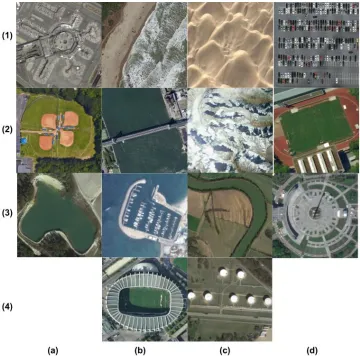
2.1 Sample images from AID dataset for class: (a)(1) Airport, (a)(2)
Base-ball field, (a)(3) Pond, (b)(1) Beach, (b)(2) Bridge, (b)(3) Port, (b)(4) Stadium, (c)(1) Desert, (c)(2) Mountain, (c)(3) River, (c)(4) Storage
Tanks, (d)(1) Parking, (d)(2) Playground, (d)(3) Centre. . . 9
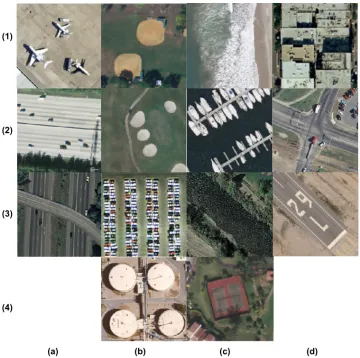
2.2 Sample images from AID dataset for class: (a)(1) Airplane, (a)(2) Free-way, (a)(3)Overpass, (b)(1) Baseball field, (b)(2) Golf course, (b)(3) Parking lot, (b)(4) Storage Tanks, (c)(1) Beach, (c)(2) Harbor, (c)(3) River, (c)(4) Tennis court, (d)(1) Buildings, (d)(2) Intersection, (d)(3) Runway. . . 10
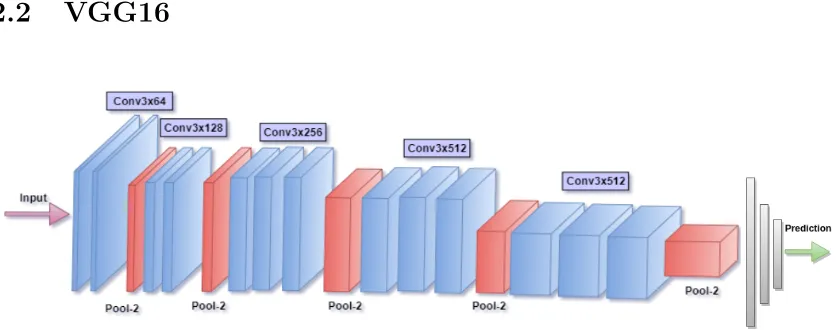
2.3 Graphical representation of the VGG16 architecture . . . 11
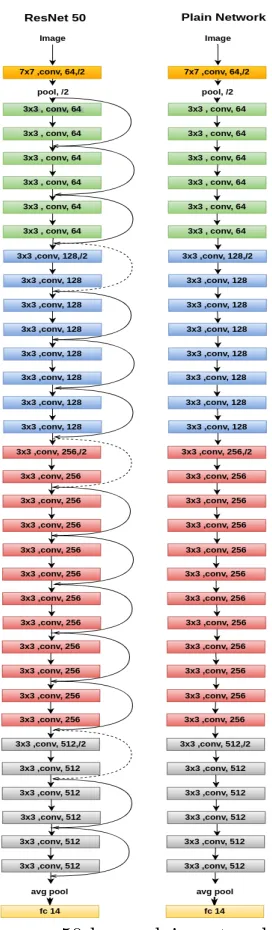
2.4 Difference between a 50 layer plain network (Right) and ResNet50 (Left) 13 2.5 Network architecture variants of ResNet . . . 14
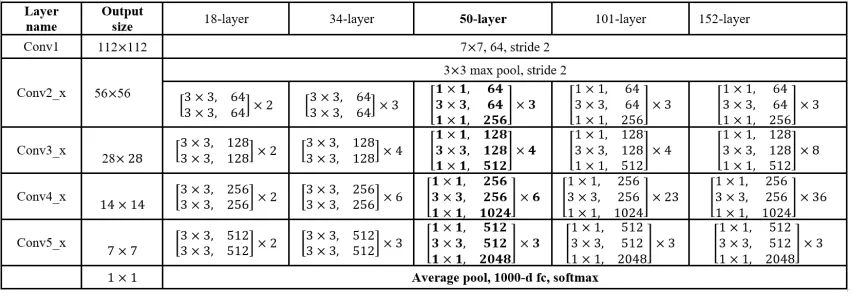
2.6 Structure of each residual blocks in the network . . . 15
2.7 Block diagram for network architecture of DenseNet with three dense blocks . . . 15
2.8 Block diagram of a dense block . . . 16
2.9 Network architeture variants of DenseNet . . . 16
2.10 Visualizing Deep CNN activations in the second and fifth convolution layer of a AlexNet [1] . . . 17
2.11 Visualizing weights after training of an Alexnet from the Initial (Left), Inter-mediate (Center) and Final (Right) convolution layers of an AlexNet [2]. . . 18
2.12 Visualizing activation maps using occlusion [2]. . . 19
2.13 Block diagram for class activation map extraction [3] . . . 20
3.1 Illustration of the Global Average Pooling operation [4] . . . 22
3.2 Block diagram for class activation map extraction [5] . . . 23
3.3 Notation for evaluation metrices p-mAP and cIOU . . . 25
3.4 Illustration of the custom damage layers used to introduce discrepan-cies into the network . . . 27
LIST OF FIGURES
4.1 Examples of CAMs showing the image, its class activation map and
related salient region for the following classes: (a)(1) airport, (a)(2)
storage tanks, (a)(3) desert, (b)(1) baseball field, (b)(2) river, (b)(3)
mountains, (c)(1) beach, (c)(2) center, (c)(3) port, (d)(1) bridge, (d)(2)
stadium and (d)(3) viaduct, using ResNet-50 trained on the AID dataset. 33
4.2 Examples of CAMs showing the image, its class activation map and
related salient region for the following classes: (a)(1) airplane, (a)(2)
intersection, (b)(1) baseball field, (b)(2) overpass, (c)(1) beach, (c)(2)
River, (d)(1) Dense-Residential, (d)(2) Runway and (e)(1) highway,(e)(2)
Storage tanks, (f)(1) Golf course,(f)(2) Tennis court, (g)(1) Harbor and (g)(2) Parking Lot using ResNet-50 trained on the UCM dataset. . . 34
4.3 Comparing of CAMs using LogSumExp (LSE) and Global Average
Pooling (GAP) in a ResNet50 trained on AID: (a) Test Image, (b)
Class Activation Map using LSE, (c) Highest Activation Region (LSE)
(d) Class Activation Map using GAP, (e) Highest Activation Region
(GAP) (1) Beach, (2) Bridge, (3) Storage Tank, (4) Mountain. . . . 35
4.4 CAMs when testing across datasets for known/overlapping classes in
both datasets: (a) baseball field/diamond, (b)(d) beach, (c) river, (e)
ports/harbor and (f) storage tanks. . . 36 4.5 CAMs when testing across datasets for unknown/non-overlapping. Class
activation maps and highest activation regions for classes (a1)(b1) golf
course and (c1)(d1) intersection when trained on AID and testing on
UCM. Column (2) is for classes (a2)(b2) bridge and (c2)(d2) mountains
when training on UCM and testing on AID. . . 37
4.6 Class activation maps for 14 classes in the MS-COCO dataset when
training on AID and processing MS-COCO images before transfer
learning (blocks 1 and 2) and after transfer learning (blocks 3 and 4).
Examples shown from classes (a)(1) tooth brush, (b)(1) pizza, (c)(1) person and giraffe, (d)(1) person skiing, (e)(1) food on table, (f)(1)
per-son playing baseball, (g)(1) train, (a)(2) perper-son furniture, (b)(2) food,
(c)(2) clock and person, (d)(2) clock, (e)(2) giraffe, (f)(2) suitcase and
LIST OF FIGURES
4.7 Class activation maps for 14 classes in the MS-COCO dataset when
training on AID and processing MS-COCO images after transfer
learn-ing (blocks 1 and 2) and after transfer learnlearn-ing (blocks 3 and
4).Ex-amples shown from classes (a)(1) tooth brush, (b)(1) pizza, (c)(1)
son and giraffe, (d)(1) person skiing, (e)(1) food on table, (f)(1)
per-son playing baseball, (g)(1) train, (a)(2) perper-son furniture, (b)(2) food,
(c)(2) clock and person, (d)(2) clock, (e)(2) giraffe, (f)(2) suitcase and
book, (g)(2) food. . . 39
4.8 VGG16 at damage levels 25%,50% and 75% . . . 40
4.9 ResNet50 at damage levels 25%,50% and 75% . . . 41
4.10 DenseNet121 at damage levels 25%,50% and 75% . . . 42
4.11 Comparing resilience across VGG16, DenseNet121 and ResNet50 . . . 43
4.12 Comparing resilience of ResNet50 trained on AID and UCM dataset . 45 4.13 Results for VGG16 before and after retraining from damages . . . 46
4.14 Results for ResNet50 before and after retraining from damages . . . . 47
List of Tables
2.1 Table showing the number of images present in each of the 14 AID
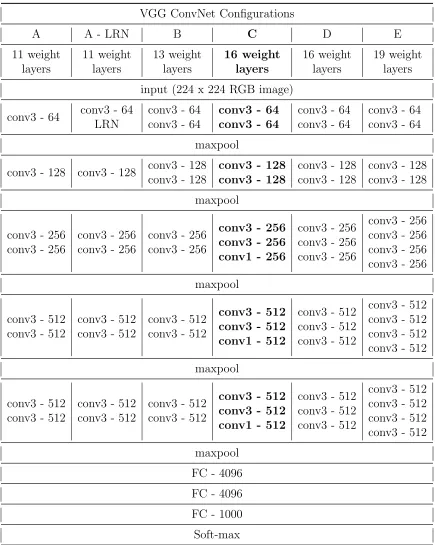
dataset classes . . . 9 2.2 Network architecture variants of VGG. . . 12
4.1 Table showing the training and testing accuracy of VGG16, ResNet50
Chapter 1
Introduction
1.1
Motivation
The ultimate goal of AI is to emulate the capabilities of the brain. Our efforts to
surmount this daunting task considering that we still struggle to understand our own
cognitive mechanism on both scientific and spiritual level. While the worlds most
sophisticated supercomputer can require the energy equal to about 750,000 light bulbs
while our brain can do all of that work on roughly 20 watts of energy, that’s about
what one light bulb uses. Recent cognitive studies on some patients diagnosed with
brain hemorrhage show that the brain can undergo a re-organization phase, where
the functions of the damaged neurons were taken up by the undamaged neurons,
over time. This thesis tries to explore such resiliency capabilities present in some
of the most commonly used convolutional neural networks. A convolutional neural
network is deployed by exporting the graph and weights of the network. The graph
expresses the structure or connectivity and the weights decide the strength of the
connection. Damages to the network weights could make the network useless once
deployed. Studying the effects of such weight damages on network interpretations
plays an important role in finding solutions enabling neural networks to pass on their
features onto the undamaged weights with minimal re-training.
CHAPTER 1. INTRODUCTION
classification [6], [7], [8], the application of deep learning algorithms in the field of
remote sensing has potential to widen the amount of information that can be
ex-tracted from satellite imagery [9], [10]. Using deep CNN architectures can benefit
a variety of applications, such as disaster management, demographic estimation,
ge-ologic research, security, environmental conservation etc. Visualizing CNN internal
representations is a way to better understand the way deep networks interpret images
[2], [11], [3]. However, research in network visualization has been limited to Imagenet
types of datasets [12] without considering aerial imagery, which is growing in volume
and significance. The acquisition and accessibility of aerial and remote sensing images
are steadily increasing due to the proliferation of Unmanned Aerial Vehicles (UAVs)
and commercial satellite systems from companies such as Planet and Digital Globe.
When deep networks are deployed in orbiting satellites or high altitudes platforms,
they may experience damage or failures. Failures can inevitably occur in the network
and it is important to understand their implications. This thesis investigates the
impact of such damages to the inner workings of networks trained on aerial imagery
by visualizing class activation maps and how they change. This method of evaluating
resiliency of networks can be extended to other deep networks expected to operate in
challenging environments. The resiliency of the network connections can be viewed
as its ability to maintain its initial interpretation even after damages or undesirable
change to its connections have occurred. This thesis proposes to map these CNN
inner representations of aerial images for damages that occur at different stages of
the network.
1.2
Related Work
Visualizing how the deep CNN interprets an image and visualizing spatial information
learned by filters at different levels of the network is an important area of research.
tech-CHAPTER 1. INTRODUCTION
niques for the understanding of a CNN. They presented three techniques to make
sense of what CNNs are learning by visualizing activation, visualizing weights and
understanding CNNs using the occlusion experiment. All three methods are described
in Chapter 2. But these methods resulted in low resolution or noisy representations
of the activated features. Cook [13] introduced Global Average Pooling (GAP) for
neural networks, enabling us to compute a single linear vector for all the the feature
maps from the final layer. When used with neural networks, the GAP layer can be
used to get class activation maps as demonstrated in [3]. It uses a weighted sum of
the features maps responsible for classification of the image to class c. The work in
[14] aims to visualize what the network learns using a DeconvNet [15] to get pixel
level predictions for different textures. Alternatively, [3] attempted to visualize the
network representations using linear classifier probes instead of a DeconvNet. Bau
and Zhou adopted a more flexible approach to classifying a broader set of features
by shedding light on how a CNN has remarkable localization abilities despite
be-ing trained on image-level labels trained on ImageNet [12] and other datasets like
Places-365 [14].
The work in [16] proposed a method to train a single CNN on aerial imagery
for efficiently classifies multiple objects using feature maps from the last layer, but
limited its analysis to just roads and buildings. The work in [17] partially addresses
the emergence of object detectors in a network trained for aerial image captioning
using several CNN and Long-Short Term Memory networks (LSTMs) trained on the
UC Merced dataset. This work motivated the application of the network dissection
techniques described in [3], [18], [3] to aerial imagery.
The effect of modifications of network weights on performance was analyzed in
[19], [20], where the weights in the network are altered by introducing a unique stress
function and reduction techniques are used for different kinds of weight drops. In [19]
CHAPTER 1. INTRODUCTION
weights. [21] was the first attempt towards exploring new propagation methods for
retraining networks more resiliently. More recently, the work in [22] established a
framework for estimating resiliency of DCNN’s by understanding the relationship
between fault rate and model accuracy.
Our work differs, as we visualize weight damages from the network’s perspective
using class activation mapping. We draw a clear picture of the resiliency of a network
after checking the class activation maps. Class activation mapping essentially gives us
a picture of the spatial information in the test image that a deep CNN considers most
important as it remembers from its training phase. Visualizing the effect of damages
to these networks allows us to visualize the variability of the network interpretations
as the network weights degrade. Finally, we use retraining propagation techniques
such as Stochastic Gradient Descent (SGD) to efficiently help the network heal by
using a small set of training images trying to recover the lost interpretation hence
quantifying resiliency of several commonly used deep neural network. After gaining
a clear insight into the deep CNN interpretations for aerial imagery, we use these
interpretations as a metric to visually assess the amount of information lost due to
damaged weights in the network.
1.3
Contributions
The main contributions of this thesis are:
• Visualize CNN internal interpretations of remote sensing imagery through class
activation maps and demonstrate the network’s ability to localize its
represen-tations using GAP.
• Quantify and map the resiliency of network interpretations in a CNN to the
cor-responding amount of network weight disparities caused due to damaged/corrupt
CHAPTER 1. INTRODUCTION
• Compare resiliency across the three most widely used deep CNN architectures
in the field of classification.
• Visualize the effect of retraining the network, which helps the healthy weights
to recover the networks lost interpretation after substantial damage.
• Show that CNN representations are transferable from one dataset to other by
evaluating their transfer-ability between dataset with similar classes and data
sets with unknown classes that it has not seen during training.
• Build a statistical model of network interpretations from a damaged and
re-trained network.
• Publications:
– Vasu, Bhavan, Faiz Ur Rahman, and Andreas Savakis. “Aerial-CAM:
Salient Structures and Textures in Network Class Activation Maps of
Aerial Imagery.” 2018 IEEE 13th Image, Video, and Multidimensional
Signal Processing Workshop (IVMSP), 2018.
– Rahman, Faiz Ur, Bhavan Vasu, and Andreas Savakis. “Resilience and
Self-Healing of Deep Convolutional Object Detectors.” 2018 25th IEEE
International Conference on Image Processing (ICIP), 2018.
1.4
Organization of The Thesis
The thesis is organized in five chapters. Brief information about each chapter is
mentioned below:
• Chapter 1. Introduction: explains the motivation behind the work that has been
performed toward completing the thesis, literature review about the proposed
CHAPTER 1. INTRODUCTION
• Chapter 2. Background Work: Overviews previous methods used to visualize
network interpretations and a brief overview of the different architectural styles
and their examples. Later part of this chapter describes the datasets that were
used in this thesis in details.
• Chapter 3. Methodology: describes the methodology to visualize activation
maps in aerial imagery and simulate damages to network weights. Followed
by a detailed explanation of the evaluation metrics used to estimate resiliency.
Re-training protocols followed to heal damaged networks and finally more on
how we plan to model resiliency of network.
• Chapter 4. Results: compares results for each of the methodologies described in
Chapter 3 on AID, UCM, and MS-COCO. This includes comparisons between
the networks and layers within networks.
• Chapter 5. Discussion: mentions a brief summary of the thesis and the obtained
Chapter 2
Background work
This chapter starts by describing the dataset used for our analysis. Section 2.2 to 2.4
gives a brief introduction to the three models VGG16, ResNet50 and DenseNet121,
and their architectural style. Understanding their architecture acts as a base to
interpret their behavior when network weights are damaged.
2.1
Datasets
The networks under investigation were trained on aerial images using a subset of the
publicly available AID Dataset [9] and the UC Merced Land Use Dataset (UCM).
The considered AID subset contains images with a single ground truth for aerial
scene recognition problem for 14 classes such as airports, storage tanks, mountains,
ports, rivers, viaducts, bridges, desert, beaches, baseball field, center, railway stations,
resorts, and stadiums. The AID dataset contains images of size 600×600 and multiple
ground sample distances (GSDs).
The UC Merced (UCM) images are of size 256×256 from 14 classes: airplane,
beach, storage tanks, runway, parking lot, river, overpass, intersection, golf course,
harbor, freeway, dense residential, buildings, and tennis courts, captured at 1-foot
resolution. The UCM contains 100 images for every class in the dataset. The AID
dataset was chosen as the primary dataset for our analysis because of its high
CHAPTER 2. BACKGROUND WORK
Figure 2.1: Sample images from AID dataset for class: (a)(1) Airport, (a)(2) Baseball
[image:21.612.141.501.70.426.2]field, (a)(3) Pond, (b)(1) Beach, (b)(2) Bridge, (b)(3) Port, (b)(4) Stadium, (c)(1) Desert, (c)(2) Mountain, (c)(3) River, (c)(4) Storage Tanks, (d)(1) Parking, (d)(2) Playground, (d)(3) Centre.
Table 2.1: Table showing the number of images present in each of the 14 AID dataset
classes
AID
Class # of images Class # of images
airport 360 storage tanks 360 baseball field 220 viaduct 420
bridge 360 river 410
center 260 port 380
beach 400 square 330
desert 300 stadium 290
CHAPTER 2. BACKGROUND WORK
Figure 2.2: Sample images from AID dataset for class: (a)(1) Airplane, (a)(2) Freeway,
(a)(3)Overpass, (b)(1) Baseball field, (b)(2) Golf course, (b)(3) Parking lot, (b)(4) Storage Tanks, (c)(1) Beach, (c)(2) Harbor, (c)(3) River, (c)(4) Tennis court, (d)(1) Buildings, (d)(2) Intersection, (d)(3) Runway.
unlike single source images in the UC Merced dataset. We also use the MS-COCO
dataset [23] for visualizing resulting Class Activations Maps after performing transfer
learning. The three networks namely: VGG16, ResNet50 and DenseNet achieved
different testing accuracies on the two datasets solely depending on their architecture.
The above three networks were chosen in order to note the difference in resiliency
between VGG and residual type architectures. The comparison between ResNet
and DenseNet further allow us to see the effect of addition and concatenation skip
connections on network performance. The next sections of this chapter are a brief
CHAPTER 2. BACKGROUND WORK
[image:23.612.113.531.82.247.2]2.2
VGG16
Figure 2.3: Graphical representation of the VGG16 architecture
The VGG16 [6] is a neural network that can be expressed as a stack of
convo-lutional layers that contain filters of kernel size 3 in order to maintain the spatial
integrity of features calculated from their input. Care is taken in maintaining the
spatial resolution during convolution by having a spatial padding of 1 pixel for every
convolutional layer with a kernel size 3. Groups of convolutional layers with a fixed
number of filters make up a convolutional block. These convolutional blocks are
fol-lowed by a 2×2 spatial pooling with a stride of 2. The output from this stack of
convolution blocks is fed into a fully connected network with 3 fully connected
con-volutional layers with the first two layers having 4096 filters and the final layer made
up of 1000 filters which is nothing but the number of classes to classify in ImageNet
as shown in Table 4.1. The output from each hidden layer in the network is passed
through a non-linearity in the form of a Rectified Linear Units (ReLU). Figure 2.3
shows an illustration of a 16 layer VGG network with input size 224×224×3.
Fea-tures from the final convolution layer was passed into the fully connected network to
give us a prediction. During the test phase, all the weights are frozen and the input
is passed through the series of hidden layers in a feed-forward manner to classify the
CHAPTER 2. BACKGROUND WORK
VGG ConvNet Configurations
A A - LRN B C D E
11 weight layers 11 weight layers 13 weight layers 16 weight layers 16 weight layers 19 weight layers
input (224 x 224 RGB image)
conv3 - 64 conv3 - 64 LRN
conv3 - 64 conv3 - 64
conv3 - 64 conv3 - 64
conv3 - 64 conv3 - 64
conv3 - 64 conv3 - 64
maxpool
conv3 - 128 conv3 - 128 conv3 - 128 conv3 - 128
conv3 - 128 conv3 - 128
conv3 - 128 conv3 - 128
conv3 - 128 conv3 - 128
maxpool
conv3 - 256 conv3 - 256
conv3 - 256 conv3 - 256
conv3 - 256 conv3 - 256
conv3 - 256 conv3 - 256 conv1 - 256
conv3 - 256 conv3 - 256 conv3 - 256
conv3 - 256 conv3 - 256 conv3 - 256 conv3 - 256
maxpool
conv3 - 512 conv3 - 512
conv3 - 512 conv3 - 512
conv3 - 512 conv3 - 512
conv3 - 512 conv3 - 512 conv1 - 512
conv3 - 512 conv3 - 512 conv3 - 512
conv3 - 512 conv3 - 512 conv3 - 512 conv3 - 512
maxpool
conv3 - 512 conv3 - 512
conv3 - 512 conv3 - 512
conv3 - 512 conv3 - 512
conv3 - 512 conv3 - 512 conv1 - 512
conv3 - 512 conv3 - 512 conv3 - 512
conv3 - 512 conv3 - 512 conv3 - 512 conv3 - 512
maxpool
FC - 4096
FC - 4096
FC - 1000
[image:24.612.107.542.110.655.2]Soft-max
CHAPTER 2. BACKGROUND WORK
[image:25.612.254.390.121.586.2]2.3
ResNet50
Figure 2.4: Difference between a 50 layer plain network (Right) and ResNet50 (Left)
With the huge success of VGG type architectures in image classification, the race
to go deeper had begun. But going deeper gave rise to new problems with vanishing
gradients and global optimal convergence. Even though going deeper decreased the
classification error on ImageNet, as networks got deeper, training them to reach a
CHAPTER 2. BACKGROUND WORK
Figure 2.5: Network architecture variants of ResNet
the gradients becoming insignificant as they propagate deep into the network, forcing
the initial layer to learn redundant features. The classification error also increased
after plateauing at the later stages of training. The solution to this problem came in
the form of residual connections in ResNet type architectures that bypass blocks of
convolutional layers and re-enforce the input of nth layer to some (n+x) th layer,
solving the vanishing gradients problem. In residual learning, instead of trying to
learn class specific features, the network tries to learn some residual that is simply a
subtraction of features learned from the input of that layer. By stacking these layers,
the gradient could theoretically skip over all the intermediate layers and reach the
bottom without being diminished. We use ResNet50 [7] architecture for our analysis.
The ResNet50 is a 50 layer Residual Network as shown in figure 2.2. The other
variants of ResNet type architecture with more than 50 layers include ResNet101 and
ResNet152 also.
The ResNet50 is a version of residual networks with 3 convolution layer with two
1×1 kernels and one 3×3 kernels as shown in the highlighted column of Figure 2.6.
Figure 2.4 shows the difference between a plain VGG style 50 layer network (Right)
and a ResNet50 (Left) architecture with skip connections. These skip connections
helped gradients reach deeper layers, hence allowing network designers to go hundreds
CHAPTER 2. BACKGROUND WORK
Figure 2.6: Structure of each residual blocks in the network
is prevented by the skip connection addition of information entering the block and
leaving the block.
2.4
DenseNet121
Figure 2.7: Block diagram for network architecture of DenseNet with three dense blocks
The Densenet architecture [8] is an extension of the ResNet architecture. The
ResNet architecture has a fundamental identity block that performs addition between
input from a previous layer and a future layer, forcing the network to learn residuals.
Recent studies on ResNets show that many layers contribute very little or redundant
features and can, in fact, be randomly dropped during training. In contrast, the
DenseNet architecture in Figure 2.7 concatenates outputs from the previous layers
instead of adding them given by
[image:27.612.115.520.437.486.2]CHAPTER 2. BACKGROUND WORK
Where x, x−1...x−n are the output of previous layers.
For each layer, the feature-maps of all preceding layers are used as inputs, and
the current layer’s feature-maps are used as inputs into all subsequent layers given
by Equation (2.1). Concatenating feature maps learned by different layers increases
variation in the input of subsequent layers and improves efficiency. This dense
con-nectivity pattern not only solved the vanishing gradient problem but also required
fewer parameters than traditional convolutional networks due to feature reuse and
[image:28.612.123.518.272.411.2]stronger feature propagation.
Figure 2.8: Block diagram of a dense block
Figure 2.9: Network architeture variants of DenseNet
[image:28.612.109.540.455.659.2]CHAPTER 2. BACKGROUND WORK
information and gradients throughout the network, which makes them easy to train.
In a feed forward setting the final layers benefit from the low-level features along
with high level features from the later parts of the network. This enables the network
to learn complex scenes as it can look at both edges and high level features for its
classification. Each layer in a DenseNet has direct access to the gradients from the
loss function and the original input signal, leading to an implicit deep supervision
shown in Figure 2.8. We use the DenseNet-121 for our analysis. Some variants of the
DenseNet style architectures are DenseNet-161, DenseNet-169, DenseNet-201 shown
in Figure 2.9
2.5
Visualizing Network Interpretations
Early attempts to visualize network interpretation were carried out by visualizing the
activation at each layer in the forward pass [2]. For networks using ReLU activation,
studies have shown that activations start out blobby and dense. The activations get
more sparse and localized as training progresses. This method gives us all activations
[image:29.612.125.522.469.652.2]both important and dead ones as shown in Figure 2.10 [2].
Figure 2.10: Visualizing Deep CNN activations in the second and fifth convolution layer
of a AlexNet [1]
CHAPTER 2. BACKGROUND WORK
the network learns during training. For well-trained networks, the trainable weights
tend to be more smooth and noiseless to visualize compared to activations. Visualizing
the network filter weights requires a DeconvNet for switched pooling as described by
Matthew in [2]. We obtain a visual interpretation of the network weights by using
transposed versions of the filter on the recitifed maps. The switch setting in the
max-pool present on the DeconvNet is identical to the max-pooling setting in the convnet to
make sure the projection is consistent. Weights from the initial layers are generally
[image:30.612.123.525.267.414.2]a good representation of the input data as they look at the input image directly.
Figure 2.11: Visualizing weights after training of an Alexnet from the Initial (Left), Inter-mediate (Center) and Final (Right) convolution layers of an AlexNet [2].
We can observe from Figure 2.11 that the network over time builds a dictionary of
low-frequency color filters and high-frequency gray-scale features in the initial layers.
This is a consequence of the network architecture. Since the model is trained
dis-criminatively, they implicitly show which parts of the input image are discriminative
across different classes in the input dataset. We observe that the initial layers learn
low-level features and the abstraction of features increases as we move from initial
to final layers. To visualize a given convnet’s activation, we set all other activations
in the layer to zero and pass the feature maps as input to the attached deconvnet
layer. Then we successively unpool, rectify and filter to visualize filters in the layer
beneath. After visualizing the kind of features neural networks look at, in both high
CHAPTER 2. BACKGROUND WORK
Figure 2.12: Visualizing activation maps using occlusion [2].
part of the image made the network classify a particular test image as belonging to
class c. This also acts as a sanity check for making sure if the model is truly
identi-fying the location of the object in the image, or just using the surrounding context
to classify it. Occlusion sensitivity study helps us answer this question by giving us
a heatmap of the test image signifying the semantic structures of importance. This
activation map is achieved by systematically occluding different portions of the input
image with a grey square. An area of importance can be identified when occlusion
causes the class probability to drop by a huge margin. This process is continued for
all possible occlusions in the test image, resulting low-dimensional heatmaps as shown
in Figure 2.12. The blue regions signify pixels that lead to a low probability when
occluded, in turn signifying high importance.
2.6
Class Activation Maps
The network largely consists of convolutional layers, and a global average pooling
layer just before the final softmax layer. Given this basic architecture, we can extract
CHAPTER 2. BACKGROUND WORK
back the weights of the output layer on to the convolutional feature maps, a technique
called as class activation mapping.
Figure 2.13: Block diagram for class activation map extraction [3]
A Class Activation Map (CAM) [3] is the localized region of the image that most
influences the decision of the network for a class of images. The dimensionality
re-duction layers let us compute a weighted sum of the feature maps from the last
convolutional layer providing the class activation map for the predicted class.
Acti-vated regions are decided by the top contributing weights for the network to make a
decision. For a given feature map, let fk(x, y) represent the activation of unit k in
the last convolutional layer at the x, y location in the test image. The class specific
weights wk
c after the GAP layer is multiplied with k feature maps
P
x,yf
k(x, y) that
signifies the importance of each of the k activations from the final convolution layer.
The CAM, F(x, y) for an aerial scene belonging to class c is given by Equation (2.2).
F(x, y) = X k
wckfk(x, y) (2.2)
Since we already know each unit activates for a particular visual pattern in the input
image. A class activation map can be defined as a simple weighted linear sum of the
Chapter 3
Methodology
3.1
Aerial-CAM
We explore the visualization of Class Activation Maps (CAMs) in aerial images [5]
with the objective of gaining insights on how CNN’s interpret these images for
clas-sification. Class activation maps extracted using the procedure discussed in Section
2.6 are used for all further experiments. Class activation map extraction can be
per-formed on any network if it contains a Global Average Pooling layer as its penultimate
layer. The final layer can be a simple softmax layer used for classification. The Global
Average Pooling was born as a result of researcher’s attempt to prevent over-fitting
caused due to the fully connected layers used before the softmax layer. The softmax
layer takes in K dimension vector and the predicts probability P for the jth class
given a sample vector n and a weighting vectorp, P is given by
P(y=j |n) = e nTp
j
PK k=1en
Tp
k
(3.1)
This over-fitting affects the generalization ability of the network. Whereas Global
Average Pooling (GAP) helps in enforcing correspondences between feature maps
and categories enabling us to interpret feature maps as confidence maps. Since the
CHAPTER 3. METHODOLOGY
Figure 3.1: Illustration of the Global Average Pooling operation [4]
over-fitting.
G(k) = W1∗H P
x,yk(x, y) k∈W ×H×K (3.2)
where W and H are the width and height of the feature map k ∈K features maps.
The output of the GAP layer G at position k is given by the average of each feature
map resulting in 1×Kdimensional vector. The global average pooling can be replaced
by other dimensionality reduction layers such as LogSumExp (LSE) layer given by
Equation (3.4) to generate class activation maps .
LSE(k1, . . . , kn) =x∗+ log (exp(x1−x∗) +· · ·+ exp(xn−x∗)) (3.3)
where,
x∗ = max{x1, . . . , xn}x∗ = max{x1, . . . , xn} (3.4)
The LSE flattens each feature map to obtain vector x that can be used to calculate
the LSE of the features from the final layer of our network using Equation (3.3).
This is due to the fact that LSE also results in a single dimension vector of size
equal to k units in the previous layer, where thekthvalue after reduction is signifying
the importance of the kth unit as shown in Fig 3.1. As illustrated in Fig. 3.2, we
experiment with the Global Average Pooling and LogSumExp layer to demonstrate
CHAPTER 3. METHODOLOGY
Figure 3.2: Block diagram for class activation map extraction [5]
Since the CAMs extracted from GAP and LSE were nearly identical, we only consider
the interpretations extracted using GAP for most experiments as it is native to several
network architectures. We threshold and up-sample these class activation maps to
obtain a mask that can be placed over our input image for better localization of the
highest activating region.
3.2
Class Activation Map Transferability
After procuring knowledge regarding the kind of structures that make a deep CNN
classify a particular aerial scene, this thesis investigates how these interpretations
are affected by some well-known techniques like transfer learning. Transfer learning
is a machine learning method where a model developed for a task is reused as the
starting point for a model on a second task. We study the effect of transfer learning
on class activation maps. Performing transfer learning between two similar tasks and
transfer learning on two completely different tasks gives us insight into the CAM’s
transferability from one dataset to other. The experiment to determine CAM
trans-ferability uses three data sets namely, AID, UCM, and MS-COCO. The AID and
CHAPTER 3. METHODOLOGY
aerial scene classification while the MS-COCO constitutes a dataset for a completely
different task like eye-level image classification.
We test each one of our networks for CAM transferability by formulating the
following three experiments
• Compare Class activation maps for common classes between AID and UCM.
• Compare Class activation maps for classes not shared between AID and UCM.
• Visualize Class activation maps for AID/UCM using a network trained on
MS-COCO and vice versa.
Since the image classes from MS-COCO dataset are completely different compared
to classes from both the AID/UCM, comparing their interpretation should give us an
idea of their adaptability. And comparing CAM between AID and UCM should tell
about their transferability within the same problem domain.
3.3
Evaluation Metrics
We evaluate the quality of the localization after damage using permuted mean average
precision (p-mAP) [24] and cIOU [24]. For each image, the extracted class activation
map after damage is an unnormalized probability mappthat is binarized by selecting
the optimal threshold per image (0.8 times the peak value in p). The resulting image
after multiplying with our binary mask is the activation region. Similarly we compute
the binarized and post-threshold mask m when the network is unharmed. The two
activated regions before and after damage serve as our m and p. The symmetrized
average precision s(m, p) between m and p accounts for the non-activated regions
that might result in a higher accuracy. The symmetrized average precision is given
by Equation (3.6).
s(m, p) = 1
CHAPTER 3. METHODOLOGY
Figure 3.3: Notation for evaluation metrices p-mAP and cIOU
and p-mAP becomes
p-mAP =max(s(m, p), s(1−m,1−p)) (3.6)
Fig 3.3 explains the area of pixels considered astp,fp,tn, and fn when comparing
the two highest activating regions. Even though the p-mAP value does not always
capture the interpretation loss perfectly, it follows a trend that is evident when plotted
at different damage levels D%. Therefore, we also evaluate the model with cIOU, the
mean IOU of two regions of activation, because we only have two classes, that is
the activation below the threshold and above the threshold. This lets us implement
everything in terms of tp, tn,fp, fn by Equation (3.7).
cIOU = (tp/(tp+fp+fn) +tn/(tn+fp+fn))/2. (3.7)
wheretp represents the image pixels present in the union of the regions of the images
that were activated before damage and after damage; fp represents the image pixels
not present in activation before damage but were seen an important part of the image
com-CHAPTER 3. METHODOLOGY
parison before damage and after retraining. Section 3.4 goes over our methodology
to introduce weight damages in the network.
3.4
Weight Damage
Once we understand what the network interpretations for a particular class of
im-ages look like and how they adapt over different datasets, it is time to visualize the
resiliency of these interpretations. Resiliency is the capacity to recover quickly from
damage. We compare resiliency of features extracted in different networks and their
dependence on weights from different layers of the same network. Weight damage
could occur when the network is deployed in a remote location. Studying the
be-havior of activation maps after damages enables us to map the network bebe-havior
during these damage phases so we can have an estimate of its performance without
directly accessing the network. In this work, the damages to the network are spread
randomly among weights at the node of analysis. Following this approach, we
intro-duce weight damage at four levels D1, D2, D3 and D4, for all our three networks
VGG16, ResNet50, and DenseNet121. These selected nodes are all present in the
first convolution layer of each network block. We select nodes starting from the first
layer in case the network has more than 4 blocks in its architecture. For example in
VGG16 we damage weights from the first convolution layer in the first four blocks
and in ResNet50 we do the same every time the number of filters doubles for all 3×3
kernels. If a layer contains N trainable weights, we drop D% of N weights.
Dropping network weights is forcing the selected weights to zero, simulating the
stuck at zero damage. A network weight that is zero signifies a dead node in a graph
as it has no connection leaving the node. We perform this kind of dropping at the
starting of a block. The amount of damage D% is swept from 5% to 95% of the total
number of weights in a given layer across all filters between the convolutional layersk
CHAPTER 3. METHODOLOGY
Figure 3.4: Illustration of the custom damage layers used to introduce discrepancies into the network
nodes is carried out until we get activation maps from the network for all possible
D1, D2, D3 and D4 combinations. The skip connections in both the ResNet50 and
DenseNet121 are not altered.
Once damaged, the network weights are permanently disabled in the test and
re-train phase. Therefore, only the undamaged weights are updated during rere-training,
while gradient flow to the damaged weights is disabled. The locations of weight
dis-ruptions were chosen with the objective to push the networks to their limits. This
approach regulates the amount of information dropped in each stage for all our
ex-periment.
3.5
Resilience of network to weight disparities
After introducing faults in the network architecture, the proposed method tries to
measure their effect on network interpretations.
Damages simulated to the network using the methodology described in Section
3.5 causes degradation of network interpretation, but mapping this degradation in
interpretation allows us to appreciate the resilience of some commonly used networks
CHAPTER 3. METHODOLOGY
Figure 3.5: Block diagram for the methodology to determine visual resiliency
manner and calculate the corresponding cIOU score between the interpretation
ex-tracted from an undamaged network and the degraded interpretation after damage as
shown in Fig 3.5. We continue this process until we have a cIOUdrop associated with
every possible value of D1, D2, D3 and D4 between 5% to 95%. After our analysis
of the damaged network, we attempt the retrain it and compare the cIOU of the
retrained network against the undamaged network to make sense of the effectiveness
of retraining.
3.6
Retraining
Retraining can either help in re-enforcing already existing network interpretation or
adapt to new interpretations with the limited number of weights remaining in the
network after damages to its weights. We believe this rise in new interpretation is
due to the network trying to change its interpretation with respect to the available
number of weights at its disposal. But the new interpretation cannot be scored higher
as it is not the best possible interpretation the network can learn. The retraining is
CHAPTER 3. METHODOLOGY
learning. This is achieved by forcing the damaged weight and gradient value to zero
at every iteration of the network. Retraining a damaged network does not require a
large amount of data, but having a smaller dataset with a good range of examples
belonging to the class is more important.
We put together a smaller subset of the original training data that was used to
train the network. In our experiments, we choose 25% of the original samples in
the training dataset and use the same testing dataset used during training. We use a
standard Stochastic Gradient Descent (SGD) to retrain the network for only 4 epochs.
We extract the CAM of the retrained network one last time in order to compute the
cIOU and p-mAP of the network interpretation over the same test samples.
Com-paring the cIOUdrop after damage and cIOURetrain after retraining should let us judge
the resiliency of different networks and layers in those networks. Since the number of
samples in the UCM dataset were limited, we use the whole training dataset to
re-train the network. This ensured both the rere-training sets for our analysis on AID and
UCM were of comparable size. Since, we have an idea of the network’s performance
before damage, after damage and after retraining, we attempt to model the network
resiliency in the next section.
3.7
Modelling Resiliency
Modeling resiliency is our final experiment that leverages all the knowledge we gained
so far regarding network resiliency and salience of network interpretation by treating
this as a multi-linear regression problem. The compiled data on the amount of damage
at different nodes vs cIOUdropor cIOURetraincan be used to model and predict network
interpretation quality for any given damage level. We perform multi-linear regression
on the damage levels at each node of the network for the different style of architectures
and attempt to model their behavior. Modeling it as a multiple linear regression
CHAPTER 3. METHODOLOGY
and network interpretation. It should also let us isolate the influence of two closely
related damage levels in influencing the cIOU score.
We present different linear equations that relate the amount of damages at each
stage of the network to the final cIOU score. The R2 of the fitted models were closely
monitored to oversee the goodness of fit. We also make sure our residual plot carries
randomly distributed residual data points, indicative of no meaningful structure left
in the data. Equation (3.8) shows a form of the desired data model.
cIOU =b1∗D1 +b2∗D2 +b3∗D3 +b4∗D4 (3.8)
Where coefficientb1,b2,b3 and b4 signify the importance of the damage in nodeD1,
D2,D3 and D4 respectively for calculating cIOU. This cIOU can either be cIOUdrop
or cIOURetrain. This should let us make an informed choice when trying to pick
Chapter 4
Results
4.1
Experimental Setup
We experiment with the layer and amount of damage in different networks. Four
layer locations were chosen for the VGG16 network, one at the beginning of each
convolution block. Similarly, we choose four locations for our experiments with the
ResNet50 and DenseNet121 architecture. The amount of damage at these layers
is independently varied from 5% to 95% in increments of 5% and respective class
activation maps are extracted after damage. The class activation map is observed to
be degraded compared to the original activation map. This extracted activation is
compared to the activation acquired from an unharmed network using a permuted
mean average precision (p-mAP) [24] and cIOU to quantify the resiliency of the
networks.
The ResNet-50 is a narrow 50 layer residual network that was proposed in [7] and
Densenet 121 proposed in [8] was inspired from ResNet but had substantially fewer
trainable parameters whereas VGG16 is a densely connected feedforward network. All
three architectures were trained separately on the AID and UCM datasets to classify
14 classes. We obtained a training accuracy of 96.3% and 94.2% with a validation
accuracy of 92.4% and 91.7% on the AID and UCM dataset respectively using the
CHAPTER 4. RESULTS AID UCM Training Accuracy (%) Test Accuracy (%) Training Accuracy (%) Test Accuracy (%)
VGG16 94.3 94.1 92.2 91.8
ResNet50 96.3 92.4 94.2 91.7
DenseNet121 98.74 96.8 95.6 93.87
Table 4.1: Table showing the training and testing accuracy of VGG16, ResNet50 and
DenseNet on the AID and UCM dataset.
validation accuracy of 96.8% and 93.87%. VGG16 scored a training accuracy of 94.3%
and 92.2% with a validation accuracy of 94.1% and 91.8% respectively, summarized
in Table 4.1.
All three architectures were used to extract class activation maps for classes chosen
from the AID and UC Merced datasets. These class activation maps are extracted
after the network is subjected to weight failure at four levels of the network, i.e. D1,
D2, D3,D4. We score a misclassification at zero on the p-mAP and cIOU scale.
4.2
Aerial-CAM Results
The class activation maps of Figures 4.1 and 4.2 illustrate that the network focuses on
structures and textures for the interpretation of aerial images. For example, textures
emerge for desert, storage tanks, beaches, mountains, etc. Structures are localized
for bridge, baseball field, stadium, center, etc. The network looks for the entry and
exit point of a bridge to classify the image as an aerial bridge scene. Similarly, we can
see that the network looks for the outer ring in an image structure to classify it as a
stadium and irregular patterns along the bank of a river for the class river. The class
activation maps extracted with the help of LSE are not very different from the CAM
extracted using GAP as seen in Figure 4.3. But on comparing highest activating
region for classes such as Bridge and Beach in Fig 4.3 (c1,c2) and (e1,e2), we see that
CHAPTER 4. RESULTS
Figure 4.1: Examples of CAMs showing the image, its class activation map and related
CHAPTER 4. RESULTS
Figure 4.2: Examples of CAMs showing the image, its class activation map and related
salient region for the following classes: (a)(1) airplane, (a)(2) intersection, (b)(1) baseball field, (b)(2) overpass, (c)(1) beach, (c)(2) River, (d)(1) Dense-Residential, (d)(2) Runway and (e)(1) highway,(e)(2) Storage tanks, (f)(1) Golf course,(f)(2) Tennis court, (g)(1) Har-bor and (g)(2) Parking Lot using ResNet-50 trained on the UCM dataset.
all experiments from here were conduction on networks with the GAP layer.
We could also visualize some interesting activating regions for the other classes of
the AID dataset such as:
• Ports: adjacent alignment of boats in the water.
CHAPTER 4. RESULTS
Figure 4.3: Comparing of CAMs using LogSumExp (LSE) and Global Average Pooling
(GAP) in a ResNet50 trained on AID: (a) Test Image, (b) Class Activation Map using LSE, (c) Highest Activation Region (LSE) (d) Class Activation Map using GAP, (e) Highest Activation Region (GAP) (1) Beach, (2) Bridge, (3) Storage Tank, (4) Mountain.
• Airport: maximum density of aircrafts.
• Beach: white froth generated by the waves by the shore.
• Storage tanks: circular shapes of the storage tanks
• Viaduct: the point of divergence for two roads for the viaduct class.
The different kinds of texture-based, structure-based and object-based
interpreta-tions that we observe above illustrate the emergence of structure-based and
texture-based detectors in a network, in addition to object detectors. This offers an expanded
view of previous work where the emergence of objects was reported by [14] when
CHAPTER 4. RESULTS
[image:48.612.187.471.129.504.2]4.3
Visualizing CAM Transferability
Figure 4.4: CAMs when testing across datasets for known/overlapping classes in both
datasets: (a) baseball field/diamond, (b)(d) beach, (c) river, (e) ports/harbor and (f) stor-age tanks.
In this section, we use CAM visualization to examine how well features learned
on one dataset can transfer to another dataset. We perform this experiment between
the AID-UCM dataset as in Figures 4.4, 4.5 and AID-MS-COCO as in Figures 4.6
and 4.7. We show how a network trained on AID responds to images from UCM and
vice versa. We notice (in the first set of columns of Figure 4.4) the CAMs obtained
CHAPTER 4. RESULTS
Figure 4.5: CAMs when testing across datasets for unknown/non-overlapping. Class
activation maps and highest activation regions for classes (a1)(b1) golf course and (c1)(d1) intersection when trained on AID and testing on UCM. Column (2) is for classes (a2)(b2) bridge and (c2)(d2) mountains when training on UCM and testing on AID.
trained and tested on overlapping classes. This demonstrates the network’s ability to
generalize to known classes in other datasets. These transferable interpretations seem
to be richer and generalize better in Figure 4.5 column 1 (a) to (d) when the network
was trained using data that captures a wide variety of GSD or sources. Even though
the network trained on the same classes from UCM dataset has seen the overlapping
classes, the quality of localization is poor in Figure 4.5 column 2 (a) to (d) compared
to column (1). By examining the CAMs of images in classes that are unknown to
the network (in the first and second set of columns of Fig. 4.5), we find that the
representations are not as good as the overlapping classes but they are reasonably
similar. This illustrates that the features learned can transfer to other types of remote
sensing imagery and describe unknown classes fairly well.
CHAPTER 4. RESULTS
Figure 4.6: Class activation maps for 14 classes in the MS-COCO dataset when training
on AID and processing MS-COCO images before transfer learning (blocks 1 and 2) and after transfer learning (blocks 3 and 4). Examples shown from classes (a)(1) tooth brush, (b)(1) pizza, (c)(1) person and giraffe, (d)(1) person skiing, (e)(1) food on table, (f)(1) person playing baseball, (g)(1) train, (a)(2) person furniture, (b)(2) food, (c)(2) clock and person, (d)(2) clock, (e)(2) giraffe, (f)(2) suitcase and book, (g)(2) food.
be used to represent images from a general object dataset (MS-COCO). We explored
the CAMs of our network trained on AID and processing MS-COCO images first
without any further modification, and then after transfer learning. Transfer
learn-ing was performed from 14 AID classes to 91 MS-COCO classes by freezlearn-ing all the
layers except the last convolution layer and the fully connected layer (softmax). A
classification accuracy of 95.7% was achieved using transfer learning on MS-COCO.
In Figure 4.6 we see that without transfer learning the features learned from AID are
CHAPTER 4. RESULTS
Figure 4.7: Class activation maps for 14 classes in the MS-COCO dataset when training
on AID and processing MS-COCO images after transfer learning (blocks 1 and 2) and after transfer learning (blocks 3 and 4).Examples shown from classes (a)(1) tooth brush, (b)(1) pizza, (c)(1) person and giraffe, (d)(1) person skiing, (e)(1) food on table, (f)(1) person playing baseball, (g)(1) train, (a)(2) person furniture, (b)(2) food, (c)(2) clock and person, (d)(2) clock, (e)(2) giraffe, (f)(2) suitcase and book, (g)(2) food.
For example, the network activation for the image of a train in Figures 4.6 and 4.7
row (g) column 1 remains the same before and after transfer learning.
After transfer learning, the representations are more accurate and illustrate the
benefits of transfer learning. This initial relevance might be due to some of the
ImageNet weights that were unaltered during the training for AID classification. A
good example is the activation of the skier from Figure 4.6 (d1) and Figure 4.7 (d1)
where the CAMs shift from the background before transfer learning to the person
CHAPTER 4. RESULTS
Figure 4.8: VGG-16: cIOU v/s D%, where D% is the percentage of weights that are
corrupted at damage level D when rest of the levels are frozen at either 25%,50% or 75% during a sweep of D,indicated by the green, red and blue lines respectively. The figures for: (a)(1) D1={5%∼95%}, while D2,D3 and D4 are frozen; (b)(1) D2={5%∼95%}, while D1,D3 and D4 are frozen; (a)(2) D3={5%∼95%} while D1,D2 and D4 are frozen; (b)(2) D4={5%∼95%}, while D1,D2 and D3 are frozen.
4.4
Comparison of resilience across layers
Introducing damages after different layers of the network and recording its
corre-sponding cIOU and p-mAP score can tell us which stage of the network is most prone
to damage. We look for the best performing 75% curve in Figures 4.8, 4.9 and 4.10.
Fig 4.8 is a plot showing damage level (D% at 25%, 50% and 75%) v/s cIOU for
different layers at the beginning of every convolution block in a VGG16 architecture.
Comparing plots from Figure 4.8 we can infer that among all the different possible
damage levels, the network performs the worst when there are damages in the first
CHAPTER 4. RESULTS
Figure 4.9: ResNet-50: cIOU v/s D%,where D% is the percentage of weights that are
corrupted at damage level D when rest of the levels are frozen at either 25%,50% or 75% during a sweep of D,indicated by the green, red and blue lines respectively. The fig-ures for (a)(1)D1={5%∼95%}, while D2, D3 and D4 are frozen; (b)(1)D2={5%∼95%}, while D1, D3 and D4 are frozen; (a)(2)D3={5%∼95%}, while D1, D2 and D4 are frozen, (b)(2)D4={5%∼95%}, while D1, D2 and D3 are frozen.
curve) scores the lowest among all the 75% (blue) curves in 4.5. This means that
the damages caused in the initial layers (D1 andD2) are much more disruptive than
damages caused in D3 and D4. This can be explained due to the fact that the first
blocks are the only path for the image to travel through and the final layers heavily
depend on the initial layers for low-level activations from the input image.
In the case of ResNet-50, we find that damages in the second block are devastating
as we see the most deviation between the three lines in D2 (in Fig 4.9 (a1)), when
the damage levels in D2 is maximum during its sweep of D2 in Fig 4.9 (b2) the
network has the worst performance in terms of maintaining its interpretability for
CHAPTER 4. RESULTS
Figure 4.10: DenseNet121: cIOU v/s D%, where D% is the percentage of weights that
are corrupted at damage level D when rest of the levels are frozen at either 25%,50% or 75% during a sweep of D,indicated by the green, red and blue lines respectively. The figures for (a)(1)D1={5%∼95%}, while D2, D3 and D4 are frozen; (b)(1)D2={5%∼95%}, while D1, D3 and D4 are frozen; (a)(2)D3={5%∼95%}, while D1, D2 and D4 are frozen, (b)(2)D4={5%∼95%}, while D1, D2 and D3 are frozen.
to damages. An increase in damage level in D2 contributes to the highest drop in
cIOU. In our experiments, the skip connections in both ResNet50 and DenseNet121
are not affected. We suspect this accounts for the ability of ResNet50 to maintain its
interpretation through high levels of damage.
Fig 4.10 shows the cIOU v/s Damage levels D1, D2, D3 and D4 in the first
convolutional layer of each dense block. We observe the Densenet121 scores the least
cIOU score when there are maximum damages in the first and second block. Also,
the last two blocks seem to be more resilient to damages compared to the first two
blocks. This can be observed from the large drop in performance when damages are
CHAPTER 4. RESULTS
fact that the DenseNet layers are very narrow (e.g., 12 filters per layer) and weights
from initial layers once lost cannot be substituted due to lack of redundancy.
4.5
Comparison of resilience across networks
Figure 4.11: Comparing cIOU of VGG-16, DenseNet121 and
ResNet50 for (a)(1)D1%={5%∼95%}, while D2=D3=D4=25%; (b)(1)D2%={5%∼95%}, while D1=D3=D4=25% and; (a)(2)D3%={5%∼95%}, while D1=D2=D4=25%,(b)(2)D4%={5%∼95%}, while D1=D2=D3=25%.
Comparing resiliency across networks involves evaluating them against the cIOU
score they achieve after equal D% damage at similar stages of the network. We
conduct this experiment in order to visualize the effect of network architecture style
on the resiliency of network interpretations. The three networks chosen have network
architectures that are completely different from each other.
CHAPTER 4. RESULTS
finally, the DenseNet121 is a narrow network containing direct connections. Fig.4.8
shows a comparison between VGG16, DenseNet121, and ResNet50 at different
dam-age levels D1, D2, D3 and D4, among which only one of them is varied while the
others are frozen at 25%.
It is evident from Fig 4.11 that a ResNet type architecture is more resilient to
damages than both the VGG16 and DenseNet121. The ResNet50 outperforms the
VGG16 and DenseNet121 when network weights are corrupted at all damage levels.
Although the ResNet50 performs the best in three of the four curves in Fig. 4.11,
VGG16 and DenseNet reach close to ResNet50 network resiliency in Fig 4.11 (a2)
and Fig 4.11 (b2).
4.6
Effect of Multi-sensor training data on resilience
We assess the quality of representation our networks learn with respect to the quality
of training data used to train those networks. This is done by comparing the
re-silience of the same networks trained on two aerial scene classification datasets: AID
and UCM dataset. We consider the best performing ResNet50 from our previous
experiments for comparing networks trained on AID and UC Merced. The nature of
the two datasets is very different as the AID dataset carries images acquired using
multiple sensors at different GSD’s, whereas the UCM is a single source, single sensor
imagery. Our results in Fig 4.12 shows the D% vs cIOU for a ResNet50 trained on
AID and UCM dataset. The ResNet50 trained on the AID dataset clearly outperform
the network trained on UCM. This means that data with a higher variety of samples
give rise to stronger interpretations that can withstand damages at all levels of the
network. This is due to the rich, multi-level features that can be extracted from
multiple source data. The network trained on AID also tends to generalize well since
CHAPTER 4. RESULTS
Figure 4.12: Comparing the quality of interpretations between ResNet50 trained on
multi-sensor data(AID) and single-source data(UCM) when (a)(1)D1={5%∼95%}, while D2=D3=D4=25%; (b)(1)D2={5%∼95%}, while D1=D3=D4=25%; (a)(2)D3={5%∼95%}, while D1=D2=D4=25%,(b)(2)D4%={5%∼95%}, while D1=D2=D3=25%.
4.7
Retraining Results
In this section, we visualize how retraining the damaged network for a short
inter-val of time might help the network regain its original interpretations with just the
undamaged weights. We carry out the retraining by using 25% of training data ( 90
images/class ) for just 4 epochs. Care is taken not to re-initialize the damages weights.
This is done by individually controlling the gradient flow to each weight in the
net-work, blocking any weight update for the damaged weights. From Fig 4.13 (a1) we see
that for VGG16 retraining the initial blocks at greater amounts of damage helps the
network recover the most. It is also important to note that retraining in VGG16 does
CHAPTER 4. RESULTS
Figure 4.13: VGG16: cIOU v/s D% before and after retraining, where D% is the
per-centage of weights that are corrupted at damage level D when rest of the levels are frozen at either 25%,50% or 75% during a sweep of D, indicated by the green, red and blue lines respectively. The figures for (a)(1)D1={5%∼95%}, while D2, D3 and D4 are frozen; (b)(1)D2={5%∼95%}, while D1, D3 and D4 are frozen; (a)(2)D3={5%∼95%}, while D1, D2 and D4 are frozen, (b)(2)D4={5%∼95%}, while D1, D2 and D3 are frozen
This, in turn, forces the network to learn the minimal features required to generalize
the image. We fit a degree 5 polynomial line through our data points, this enables
us to visually note slight deviations between different curves as seen in Figures 4.13,
4.14 and 4.15.
This phenomenon holds true in the case of ResNet50, Fig 4.14, as well, but the
change in cIOU is so small, it is hard to visualize it graphically, therefore we present
a statistical model in the next section.
In the case of DenseNet121, Fig 4.15, we observe that retraining the final two
CHAPTER 4. RESULTS
Figure 4.14: ResNet50: cIOU v/s D% before and after retraining, where D% is the
percentage of weights that are corrupted at damage level D when rest of the levels are frozen at either 25%,50% or 75% during a sweep of D, indicated by the green, red and blue lines respectively. The figures for (a1)D1={5%∼95%}, while D2, D3 and D4 are frozen; (b1)D2={5%∼95%}, while D1, D3 and D4 are frozen; (a2)D3={5%∼95%}, while D1, D2 and D4 are frozen, (b2)D4={5%∼95%}, while D1, D2 and D3 are frozen
deduce this from the low hanging red and blue curves in Fig 4.15 (a2) and 4.15 (b2)
compared to the oth


![Figure 2.10: Visualizing Deep CNN activations in the second and fifth convolution layerof a AlexNet [1]](https://thumb-us.123doks.com/thumbv2/123dok_us/33151.2617/29.612.125.522.469.652/figure-visualizing-activations-second-fth-convolution-layerof-alexnet.webp)
![Figure 2.11: Visualizing weights after training of an Alexnet from the Initial (Left), Inter-mediate (Center) and Final (Right) convolution layers of an AlexNet [2].](https://thumb-us.123doks.com/thumbv2/123dok_us/33151.2617/30.612.123.525.267.414/figure-visualizing-weights-training-alexnet-initial-convolution-alexnet.webp)
