Systems
YAN ZHENG WEI, LUC MOREAU, and NICHOLAS R. JENNINGS University of Southampton
Recommender systems have been widely advocated as a way of coping with the problem of infor-mation overload for knowledge workers. Given this, multiple recommendation methods have been developed. However, it has been shown that no one technique is best for all users in all situations. Thus we believe that effective recommender systems should incorporate a wide variety of such techniques and that some form of overarching framework should be put in place to coordinate the various recommendations so that only the best of them (from whatever source) are presented to the user. To this end, we show that a marketplace, in which the various recommendation methods compete to offer their recommendations to the user, can be used in this role. Specifically, this article presents theprincipleddesign of such a marketplace (including the auction protocol, the reward mechanism, and the bidding strategies of the individual recommendation agents) and evaluates the market’s capability to effectively coordinate multiple methods. Through analysis and simula-tion, we show that our market is capable of shortlisting recommendations in decreasing order of user perceived quality and of correlating the individual agent’s internal quality rating to the user’s perceived quality.
Categories and Subject Descriptors: H.1.m [Models and Principles]: Miscellaneous; H.3.3 [Information Storage and Retrieval]: Information Search and Retrieval—Information filtering; H.3.4 [Information Storage and Retrieval]: Systems and Software—Performance evaluation (efficiency and effectiveness); I.2.11 [Artificial Intelligence]: Distributed Artificial Intelligence— Multiagent systems
General Terms: Algorithms, Design, Economics
Additional Key Words and Phrases: Recommender systems, auctions, marketplace
1. INTRODUCTION
The World Wide Web (the Web) [Berners-Lee et al. 1992] presents us with a vast array of information. Also, regardless of the metric used (i.e., growth in
This research is funded in part by QinetiQ and the EPSRC Magnitude Project (reference GR/N35816).
Authors’ current addresses: Y. Z. Wei, British Telecom, Orion Building (MLB1 pp12), Adastral Park, Martlesham Health, Ipswich, U.K. IP5 3RE; email: [email protected]; L. Moreau, and N. R. Jennings (corresponding author), Intelligence Agents Multimedia Group, School of Electronics and Computer Science, University of Southampton, Southampton, U.K. SO17 1BJ; email:{L.Moreau, nrj}@ecs.soton.ac.uk.
Permission to make digital or hard copies of part or all of this work for personal or classroom use is granted without fee provided that copies are not made or distributed for profit or direct commercial advantage and that copies show this notice on the first page or initial screen of a display along with the full citation. Copyrights for components of this work owned by others than ACM must be honored. Abstracting with credit is permitted. To copy otherwise, to republish, to post on servers, to redistribute to lists, or to use any component of this work in other works requires prior specific permission and/or a fee. Permissions may be requested from Publications Dept., ACM, Inc., 1515 Broadway, New York, NY 10036 USA, fax:+1 (212) 869-0481, or [email protected].
C
the number of networks, hosts, users, or traffic), the Internet is growing at least 10 percent per month and the content of the Web grows by an estimated 170,000 pages daily [Turban et al. 2000, p. 495]. When taken together, these factors make it very hard to know what documents are out there, let alone find the ones that are most suitable for the task at hand. To address this information overload problem, a range of tools to assist with indexing, retrieving, searching, and filtering have been developed [Zamboni 1998; Pinkerton 2000; Howe and Dreilinger 1997; Yan and Garcia-Molina 1995]. However, while these tools can certainly assist in this endeavor, they are typically not personalized to individ-ual users or their prevailing context [Sheth and Maes 1993]. Additionally, such tools still tend to have the weakness of either providing too much irrelevant information or missing relevant information [Goldberg et al. 1992].
To overcome these limitations,recommender systemshave been advocated. Recommender systems help make choices among recommendations from all kinds of sources without the users needing to have sufficient personal ex-perience of all these alternatives [Resnick and Varian 1997]. Thus, in this context a recommendation is viewed as a reference to an item that will be directed to the user who is looking for information. A typical recommender sys-tem aggregates and directs recommendations to appropriate recipients. Given this view, it can be seen that a recommender system’s main value lies in information aggregation and its ability to match the recommendations with people seeking information. It differs from conventional filtering systems in that recommendations are based upon subjective values assigned by people, namely, the quality of items, rather than more objective properties (such as the text content of a document) of the items themselves [Resnick et al. 1994; Shardanand and Maes 1995]. Compared to a system that only has searching or other simple information filtering functionalities, recommender systems re-quire less experience on the part of the user and less effort to specify and restrain their interests when querying and operating the system [Resnick and Varian 1997]. This is because recommender systems provide their users with recommendations that have been recognized as good (based on their pre-viously expressed preferences or the preferences of other users with similar interests).
Against this background, this research is concerned with the problem of information overload on the Web and in how recommender systems can be used to help overcome this problem. In particular, it deals with the “where to go next” problem by presenting recommendations (represented as URLs) that
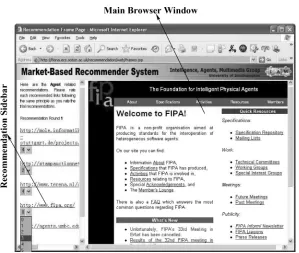
are relevant to the users’ current browsing context. This method is benefi-cial since users often ask questions such as “What else should I read?” and “Where do other people go from here?” By convention, such recommendations are usually displayed in a separate window without interrupting a user’s cur-rent navigation (Figure 1 is an example of the system that we have built for this task).
Fig. 1. Browser with recommendations. The main window displays the user’s current context (the page being viewed). The side bar on the left is the output of the recommender system and displays a list ofURLs in decreasing order of relevance to the user’s current context.
that have previously been marked as liked by the user. The latter makes rec-ommendations by putting forward items that have been deemed appropriate by people who have similar interests to the user. Based on these two techniques, a large number of recommendation filtering methods have been developed (again see Section 2 for more details). However, most conventional recommender sys-tems share two major weaknesses:
(1) Each recommender system typically embeds some specific algorithm to com-pute correlations (the similarity of two relevant objects). However, there is no universally best way of doing this (and nor do we believe that there will ever be such a method). Rather, it is always the case that some methods are better under particular conditions and others are better under other conditions [Breese et al. 1998]. Given this, we believe the solution is to have a suite of recommendation methods available and to have the system automatically detect which one is the most appropriate in the prevailing context. However, such coordination is very difficult to attain, because the outputs from these diverse methods need to be compared.
[image:3.612.164.463.112.365.2]Fig. 2. Different valuations of quality.
Given these observations, we believe the best way forward in this area is to allow the multiple recommendation methods to coexist and to provide an overarching system that coordinates their outputs such that only the best recommendations (from whatever source or method) are presented to the user [Moreau et al. 2002]. To this end, a market-based approach is an effi-cient means of achieving such coordination because the problem of selecting appropriate recommendations to display in the sidebar space can be viewed as one of scarce resource allocation and markets are an efficient solution for this class of problems [Clearwater 1996; Wellman and Wurman 1998]. Moreover, the underlying economic theory provides an analytical framework for predicting ag-gregate behavior and designing individual information providers [Mullen and Wellman 1995]. Specifically, in this article, we report on the design and evalu-ation of a market-based system capable of recommending documents relevant to the users’ current browsing context as a way of dealing with the problem of information overload.1
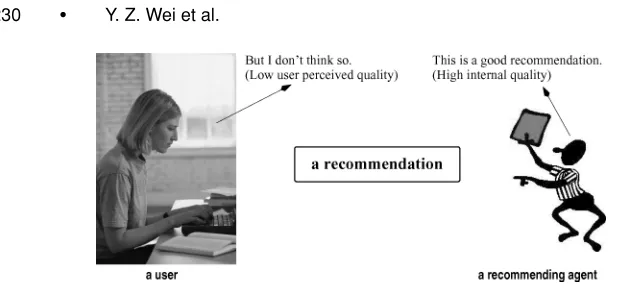
To deal with information overload, all recommender systems share the same objective of improving recommendation quality. However, most of the existing systems lack a means of (i) specifically defining the quality of recommendations from the viewpoint of the user and the various recommendation methods (since these may well differ); (ii) correlating these different qualities in a meaningful manner. In more detail, given a specific recommendation provided by a recom-mending agent with a specific recommendation method, a user’s valuation of the recommendation may differ from that of the agent. For example, in Figure 2, a particular recommending agent might highly rate a recommendation and therefore wish to highlight it to the user. However, the user may see this as a poor-quality recommendation that is not very relevant. Given this situation, the quality of a recommendation can be viewed from two viewpoints. From the viewpoint of the user, how well a recommendation satisfies him (or her) is
1In this work, we arenotconcerned with developing new recommendations methods. Our aim is
[image:4.612.132.441.92.241.2]termed theuser perceived quality(UPQ). From the viewpoint of a recommending
agent with a specific recommendation method, the relevance score it computes for a particular recommendation is termed itsinternal quality(INQ). Moreover,
theINQvalues produced by different methods can vary significantly from one
another (even for the same document). Therefore, without a systematic means of relating theUPQto the recommendation methods’INQs, it is very difficult to
provide high-quality recommendations. In this research, the key challenge is the design of a reward mechanism (which reflects the user’s satisfaction of the recommendations) so that the marketplace can effectively correlate these two values. In sum, the key role of our marketplace is to try to connect the INQ
andUPQvalues by imposing a reward regime that incentivizes different
recom-mending agents to bid in a manner that establishes an appropriate correlation between these values and their bid prices. In this way, the marketplace can be viewed as a black box with recommendations provided by different recommend-ing agents as the input and only a few best recommendations passed through to the user as the output.
In more detail, the work presented in this article advances the state of the art in the following ways. First, the marketplace that we designed for this task pro-vides a method for coordinating the behavior of multiple recommendation meth-ods with diverse measures ofINQ. No other recommender system has attempted
to incorporate multiple approaches in this way. Existing hybrid filtering sys-tems do attempt to combine different techniques into one system. However, they do so in a rigid and predetermined way, rather than in a context-specific manner that depends on the user’s feedback. Second, our market automati-cally optimizes the recommender system’s performance so that it can shortlist recommendations in decreasing order of the user’s preference. Specifically, the market works as a black box, with a large number of recommendations from various methods as the input and a small number of items as the output, and its performance in terms of presenting recommendations is always equivalent to that of the best method inside the black box. Third, the market design forces (incentivizes) the individual recommending methods to adapt their behavior so as to align their suggestions with the feedback received from the user. Thus, the market correlates the agents’ internal valuation and the user’s valuation of the recommendations by invoking a bidding and a rewarding regime. Fourth, the market is highly efficient and effective as an economic system. Specifically, it is Pareto-optimal, maximizes social welfare, and is stable and fair to all com-ponent methods integrated in the system (see Section 3 for details). In making these contributions, our aim is to establish, in principle, the viability of the market-based approach to recommender systems. Given this, the actual con-struction of a real system that operates with actual user inputs is beyond the scope of the current work and is left for the future.
methods’INQs and the user’sUPQs of the recommendations in Section 4. Finally,
we conclude and point to future work in Section 5.
2. RELATED WORK
To date, a large number of recommendation techniques have been developed. These are, however, based mainly oncontent-basedandcollaborativefiltering (although there is also some work on hybridanddemographicfiltering tech-niques). Each of these categories will be examined in turn in the remainder of this section.
Content-based filtering approaches recommend items for the user based on the descriptions of previously evaluated items. Such approaches are widely used in making recommendations of information items. For example, Syskill recom-mends Web documents based on users’ binary ratings (“hot” and “cold”) of their interests [Pazzani et al. 1996] and Newsweeder helps users filter Usenet news articles by learning the user’s profile based on his or her ratings [Lang 1995]. Generally speaking, however, content-based filtering approaches have a num-ber of weaknesses in recommending good items. First, a user’s selection is often based on the subjective attributes of the item [Goldberg et al. 1992], whereas content-based approaches are based on objective information about the items and do not take the user’s perceived valuation of such subjective attributes into account [Montaner et al. 2003]. This makes it impossible to compute the rele-vance of items with no machine-parsable format (such as sound and video files). To this end, our market-based recommender system, by integrating both collab-orative and content-based filtering methods, can meet the user’s subjective re-quirements in the way that when subjective attributes are the user’s interests, recommendations from collaborative (to be discussed in the next paragraph) component recommenders will be at the top of the shortlist (mutatis mutandis for objective attributes). Second, content-based filtering techniques do not have an inherent method for generating serendipitous finds [Shardanand and Maes 1995]. They tend to recommend more of what the user has already seen. In com-parison, again, our market-based approach overcomes this by having different types of recommenders present.
variations in taste are responsible for much of the variation in preference [Burke 2002].
Given these benefits, collaborative recommenders have been developed for many applications. For example, Ringo recommends music album and artists based on the word-of-mouth recommendations by weighting users’ votes [Shardanand and Maes 1995], GroupLens helps people find Usenet news articles on a collaborative basis [Konstan et al. 1997], and MEMOIR assists people in finding other people (rather than documents) with similar interests [DeRoure et al. 2001]. However, collaborative filtering approaches also have a number of shortcomings. First, large numbers of people must participate so as to increase the likelihood that any one person will find other users with sim-ilar interests [Terveen and Hill 2001] (the sparsity problem). The difficulty of achieving a critical mass of participants makes collaborative filtering experi-ments expensive. Second, a user whose interests share little with others’ will receive poor recommendations on a collaborative basis. An extreme case of this phenomenon happens when new users start off with nothing in their profiles of interests and must train a profile from scratch (the “cold start problem” [Resnick and Varian 1997]). Even with a start profile, there is still a training period be-fore the profile accurately reflects the user’s preferences [Maltz and Ehrlich 1995]. Third, these systems suffer from the “early-rater problem” [Montaner et al. 2003]: when a new item appears in the database, there is no way it can be recommended to a user until more information is obtained through another user either rating it or specifying which other items it is similar to.
As can be seen, both content-based and collaborative filtering have weak-nesses. Moreover, these weakness tend to complement one another [Montaner et al. 2003]. Thus, hybrid filtering systems that integrate the two approaches have been advocated [Herlocker et al. 2000]. In a hybrid system, both objec-tive and subjecobjec-tive properties of an item are taken into account in predicting its quality when making recommendations. For example, filterbots integrate content-based filtering techniques to build virtual users in the GroupLens col-laborative system [Sarwar et al. 1998], the Fab colcol-laborative system main-tains user profiles by using content-based analysis [Balabanovic and Shoham 1997], Pazzani’s system involves user collaborations to determine the ratings of predicted items and a content-based profile to compute similarity among users [Pazzani 1999], Popescul’s system uses secondary data (e.g., document contents) to predict users’ preferences in collaborative recommendations when there is a lack of user ratings [Popescul et al. 2001], and Claypoole’s system employs separate collaborative and content-based recommenders and uses an adaptive weighted average of the two in making its selections (as the number of users accessing an item increases, the weight of the collaborative component tends to increase [Claypool et al. 1999]).
no automated way of determining in what circumstances which kind of prop-erties (objective, subjective, or both) are relevant to a particular user in their current context. In contrast, by using the market to reward effective recom-menders (irrespective of whether they use subjective or objective methods, or a combination of the two), our system dynamically tunes the relative importance of the methods according to the feedback received from the users.
The final type of filtering technique that has been used in recommender sys-tems is demographic filtering. This approach uses descriptions of people (such as occupation, age, and gender) to learn the relationship between a single item and the type of people who like it [Krulwich 1997]. For example, a mature, so-phisticated woman is likely to prefer an expensive leather jacket, whereas a teenage school girl may prefer a cheap denim one. However, this method has two principle shortcomings. First, it creates profiles by classifying users using stereotypical descriptions [Rich 1979]. Thus, the same items are recommended to people with similar demographic profiles. However, in many cases, the stereo-types are too general to generate good quality recommendations [Montaner et al. 2003]. Second, if the user’s interests shift over time, demographic filter-ing does not adapt their profile [Koychev 2000]. For these reasons, demographic filtering is rarely used independently of the other filtering techniques.
In terms of combining different recommendation methods using a market-place, the most related work to our own is that of Bohte et al. [2001, 2004]. Essentially, the main purpose of that work was to provide a mechanism for retail businesses to advertise their products. However, this was less concerned with the information retrieval and filtering. Specifically, they used a market to competitively allocate consumers’ attention space in the domain of retailing. Here, the scarce resource is the consumer’s ability to focus on a set of ban-ners or products. This work developed an adaptive bidding strategy that the agents can use to learn the consumer’s preferences. However, this work and our own use the market mechanisms in different ways to solve the resource alloca-tion problem in recommender systems. The market in Bohte et al. [2001] was used only to coordinate agents’ bidding. However, our market is used not only for this purpose, but also to coordinate the objectiveness and subjectiveness of recommendations and to correlate various recommendation methods’ internal valuation of qualities to the user’s actual interests.
medical book or which comedy movie is appropriate for a specific user. Even more importantly, the ranking of recommendations is not oriented to the users. Such systems simply rank recommendations by the price that advertisers are willing to pay. In contrast, our system (through its reward mechanism) incen-tivizes advertisers to modify their behavior in order to make recommendations that better fit with the user’s preferences.
3. DESIGNING THE MARKETPLACE
In this section, we first present an overview of the marketplace architecture (see Section 3.1). Then, we introduce the evaluation metrics that we will use to examine the marketplace’s properties in Section 3.2. We present a detailed market mechanism design (including the auction protocol, the reward mech-anism, and the bidding strategy) in Section 3.3. Finally, we analyze how the market performs from an economic viewpoint in Section 3.4.
3.1 The Marketplace Architecture
At an abstract level, the problem of populating the limited space of the side-bar from the large number of potential recommendations can be viewed as a scarce resource allocation problem. Moreover, one of the best ways of allocating scarce resources is to sell them using free market techniques [Samuelson and Nordhaus 2001; Varian 2003]. Given this, we decided to view our recommender system as a computational economy [Tesfatsion 2002].
More specifically, auctions are an excellent method of distributing resources to those who value them most highly [Reynolds 1996]. Here an auction is simply a market institution with an explicit set of rules determining resource allocation and prices on the basis of bids from the market participants [McAfee and McMillan 1987]. In a typical auction, there is an auctioneer, a seller, and potential bidders. The auctioneer, acting on behalf of the seller, wants to sell the item and get the highest possible price, while the bidders, employing some bidding strategies to place bids, want to buy the item at the lowest possible price [Vickrey 1961; Milgrom 1989; Klemperer 1999]. However, there is no universal auction design that is applicable to every context [Roth 2002; Jennings et al. 2001]. Auctions vary from one another and these variations make the auctions more or less efficient in particular types of application. In our case, the marketplace operates according to the following metaphor (see Figure 3). A user browses the Web in a particular information domain and requests recommendations from the marketplace. We assumethe user does not change his or her browsing context and his or her interests during the course of this browsing activity. The auctioneer agent2 acting on a user’s behalf sells
2Agents are clearly identifiable problem-solving entities with well-defined boundaries and
Fig. 3. The marketplace architecture.
sidebar space where information may be displayed (in our case the sidebar has M slots). Information providers are keen to get their recommendations advertised in the user’s browser, and compete in the marketplace, ready to pay for such advertisements. Such information providers act as bidders. Each recommendation with a bidding price acts as one bid. The marketplace acts as the auctioneer, ranking and selecting the most valuable items and recom-mending them to the user. The user will then choose some of them according to his or her interests as the next documents to be viewed. Those agents who provided such recommendations are the winners in this auction and will receive some reward in return (since such documents are deemed useful). Those documents not chosen by the user are deemed to have no relevance to the current document and will therefore receive no reward.3 Thus, over the
longer term, those agents that make good recommendations become richer and so are able to get their recommendations advertised more frequently than the methods whose recommendations are infrequently chosen by the user.
There are millions of different types of auctions [Wurman et al. 1998]; how-ever, as is often the case in designing computational economies [Dash et al. 2003], none of them are exactly suited to our scenario. Specifically, while stan-dard auctions could probably deal with the shortlisting phase, they do not con-sider the subsequent reward phase. This means we need to design a bespoke auction (as detailed in Section 3.3).
3.2 The Market Evaluation Metrics
Designing market mechanisms is anengineering design task, in which the rules should be developed in order to meet particular objectives, either for certain
3The credits paid by recommender agents for advertising their recommendations and the rewards
[image:10.612.137.481.115.284.2]participants or for society as a whole [Roth 2002]. In seeking to design the market mechanism for our recommender system, therefore, our first step is to identify the properties that we would like our auction to exhibit. This then gives us the requirement against which we can evaluate our design. In particular we would like to design a market that has the following standard properties [Sand-holm 1999; Varian 2003; Dash et al. 2003]:
(1) Pareto efficiency. A solutionx is Pareto efficient if there is no other solu-tionxsuch that at least one agent is better off inxthan inxand no agent is worse off inxthan inx. Pareto efficiency provides us with a way of com-paring alternative mechanisms, and good mechanisms should be designed to maximize allocation efficiency [Roth 2002; Sandholm 1999; Varian 2003]. This is important from the point of view of the individual agents because if a non-Pareto efficient mechanism is chosen then the design could be im-proved upon (for at least one agent) without making any of the other agents worse off.
(2) Social welfare maximization. In our context, social welfare is a numeric measure of the sum of all agents’ utilities. In contrast to Pareto efficiency, social welfare provides a way to rank different social preferences over the various solutions and to indicate which is best for the group of agents as a whole [Kagel and Roth 1995]. This is a supplement to the Pareto efficient criterion. From the viewpoint of individual agents, there may exist many Pareto efficient solutions to the given problem that cannot be distinguished between. In such cases, social welfare maximization provides a way of dif-ferentiating between them by determining which is the best from the social point of view [Sandholm 1999; Varian 2003].
(3) Individually rationality. Participation in an auction is individually ratio-nal for an agent if its payoff in the auction is no less than what it would get by not participating. A mechanism is individually rational if participation is individually rational for all agents [Sandholm 1999]. Individually rational protocols are essential in our context because all agents (representing the various recommendation methods) need a clear incentive to participate in the market so that the best possible recommendations can be picked by the market. Indeed, if the protocol is not individually rational for some agents, they would simply not participate in the auction and their recommenda-tions would be lost.
(4) Convergence. If the prices for the goods being allocated converge after a number of rounds of auctions, the market is said to beconvergent. This is important from the viewpoint of the bidding agents since it enables them to learn to bid rationally at a certain level for a given type of good (charac-terized byUPQlevel in this case) in order to maximize their revenue [Roth
2002]. Without convergence, an agent will never know how much to bid with respect to a given recommendation and therefore the marketplace behavior would be chaotic.
be capable of shortlisting the recommendations in decreasing order of the
UPQafter a number of auction iterations. This is important from the point
of view of the users since they only want a small number of the best recommendations.
(6) Clear incentives. A good mechanism design should give agents incentives to act in particular way, such that the system’s global goals is attained de-spite the individual goals of the self-interested agents [Dash et al. 2003; Sandholm 1999]. In our context, the protocol should be able to incentivize the recommending agents about the user’s interests so that they can bid dif-ferently for differentINQlevels. This is important because a recommender
agent needs to relate its bids to the internal quality of the recommenda-tions through the feedback from the marketplace which reflects the user’s preferences.
(7) Stability. A protocol is stable if it provides all agents with an incentive to behave in a particular way over time. The marketplace should be designed to be stable because, if a self-interested agent is better off behaving in some other manner than desired, it will do so [Sandholm 1999]. Thus, an unstable protocol allows agents to behave with intentions that make the system deviate from the its best potential outcome [Roth 2002]. Therefore, stability is important because without it the system behavior is unpredic-table.
(8) Fairness. A good market mechanism should be fair to all partici-pants [Roth 2002; Dash et al. 2003]. In our context, a protocol is fair if it gives all recommendations equal opportunity of being shortlisted (irre-spective of the agent or method that generates them). This is important because we want the system to shortlist the best recommendations in an unbiased manner.
The first three points of the above criteria are set from a pure economic point of view and, therefore, the marketplace can be evaluated against these metrics at design time. The remaining five items relate to the quality of the system’s output and can only be evaluated by experiments. Hence, the evaluation against the former metrics are discussed when analyzing the market equilibrium in Section 3.4, whereas the evaluations against the latter metrics will be discussed in Section 4.
3.3 The Market Mechanism Design
With the evaluation metrics in place, Sections 3.3.1, 3.3.2, and 3.3.3, respec-tively, detail the auction protocol we designed, the reward mechanism we es-tablished, and the bidding strategies of the individual agents. Section 3.4 then analyzes how the market performs with such a market mechanism and the corresponding bidding strategies in place.
Fig. 4. The auction protocol.
we choose ageneralized first-price sealed-bid auctionin which all agents whose recommendations are shortlisted pay an amount equal to their valuation of the advertisement (meaning we have price differentiation5). We choose a sealed-bid
4We assume the number of recommenders makes the number of recommendations sufficiently large
with respect to the number of sidebar slots such that there is sufficient competition to make the marketplace operate efficiently.
5If there is more than one item to be sold, the items can all be sold at the same price (calledprice
auction (in which agents will typically make a single bid) to minimize the time for running the auction and the amount of communication generated. We choose a first-price auction with price differentiation because the relative ordering of the recommendations effects the likelihood of them being selected by the user. In particular, in the market, each information provider agent is keen to get its recommendations advertised to the user. Each agent has a valuation of the rec-ommendation (which will be different for the different agents) and is willing to pay up to this amount to display its recommendations. When an agent gets its recommendations shortlisted, and therefore advertised to the user’s browser, it has consumed the advertisement service provided by the recommender sys-tem. In return, it needs to pay an amount of credit (at the bidding price) to the system for each of its shortlisted items.
In more detail, the market operates in the following manner. Each time the user browses a new page, the auction is activated. In each such activation, the auctioneer agent calls for a number of bids (M which equals to the number of recommendations being sought). Then each bidding agent submits M bids. After a fixed time, the auctioneer agent ranks all the bids it received by their bid-ding price, and directs theMbids with the highest prices to the user’s browser sidebar (as shortlisted recommendations). Those bidding agents whose recom-mendations are shortlisted pay the auctioneer agent according to how much they bid. Those bidding agents whose recommendations are not shortlisted do not pay anything. The user may then follow up a number of the shortlisted recommendations, in which case the agent that supplied them is rewarded. In the case where multiple shortlisted recommendations use the same document and only one of them is selected by the user, all of them will be rewarded the same amount.
More formally, the protocol for each auction round is defined in Figure 4. It should be noted that: (i) function Generate Bid (Abi,recj,pricej) relates
to the bidding strategy and will be discussed in Section 3.3.3; (ii) function U ser Sel ectsRecs(SU) concerns the user’s behavior of making choices among the shortlisted recommendations and will be discussed in Section 4.1.3; and (iii) functionCompute Reward(bh) concerns the reward mechanism and will be
discussed in Section 3.3.2.
3.3.2 The Reward Mechanism. With the auction protocol in place, we now turn to the reward mechanism. According to our protocol, the user may se-lect multiple recommendations from the shortlist. For each such user-sese-lected recommendation, the suggesting agent is given a reward. In defining the Compute Reward function, our aim is to ensure that it is both Pareto efficient and social welfare maximizing (as per Section 3.2).
Sincethe global objective is to shortlist the most valuable recommendations in decreasing order of user perceived quality, we decided to reward the user-selected recommendations purely based on theUPQ(notINQ). TheUPQs can be
defined asQh(h∈[1· · ·N] andQhis a positive natural number that represents
a user’s ratings or preferences of the interesting recommendations). In practice, however, all user-selected recommendations are ordered in decreasing rank of
UPQsuch thatQ1Q2· · ·QN. Thus,Qhdenotesthe hthrewarded
recom-mendation(user-selected recommendation with thehth highestUPQ). To ensure
different quality recommendations’ bidding prices converge to different levels (so that our marketplace is able to differentiate recommendation qualities), we involved two other variables: Ph (h ∈ [1· · ·N]) and Pm∗ (m ∈ [1· · ·M]). The
former is the bidding price of thehth rewarded recommendation. The latter is the historical average bidding price of themth shortlisted recommendation during the system’s lifetime (note the bidding agents do not actually know this value). By this definition,Pm∗ indicates the price for themth advertisement dis-played in the user’s browser sidebar which is decided by the “invisible hand” (namely the market). With this information, we can define the reward to the hth rewarded recommendation as
Rh=δ·Qh·PM+1− α· |Ph∗−Ph|, (1)
whereδ andαare two system coefficients (δ > 0 andα > 1) and PM+1 is the
highest not shortlisted bid price (the detailed justification for this particular choice is given in Wei et al. [2003b]). The values ofδ and αwill depend upon the specifics of the application (see Section 4.1.1 for details), but they need to be set at suitable values to ensure Rh > Ph so that the rewarded agents can
make profits. We based the reward on PM+1(whose value is not known by the
bidding agents) so that the market cannot easily be manipulated by the par-ticipants [Varian 2003, page 289]. This approach also reduces the possibility of bidding collusions because the reward is based on something that the rewarded agents are unaware of and cannot control.
3.3.3 Designing the Agents’ Bidding Strategies. In our marketplace, three kinds of information are revealed to a bidder with regards to a specific recom-mendation: (i) this recommendation’sINQ, (ii) this bidder’s last bid price (Pl ast),
and (iii) the previous rewards to this recommendation (a bidder actually knows the second piece of information). With this information, a rational bidder seeks to maximize its revenue by bidding sensibly for recommendations based on its knowledge of previous outcomes. Such bids can result in one of the following outcomes occurring: the bid is not shortlisted, it is shortlisted but not rewarded, or it is rewarded. With respect to a givenINQlevel, a bidder’s strategy depends
on the last outcome in the following way (again see Wei et al. [2003b] for a justification for these choices):
—Bid not shortlisted.The only way to increase revenue is to get the recommen-dation shortlisted. Therefore, the agent will increase its bidding price:
Pnext=Y ·Plast (Y >1).
—Bid shortlisted but not rewarded.This means the agent overrated itsINQwith
respect to theUPQand so the agent should decrease its price in subsequent
rounds so as to lose less:
Table I. Price Adjustment and Results
Current price Adjustment |Ph∗−Ph| ξ
Ph<Ph∗ +
P >0
−P <0
Ph>Ph∗ +
P <0
−P >0
—Bid rewarded.These agents have a good correlation between theirINQfor a
recommendation and that of theUPQ. Therefore, these agents have a chance
of increasing their revenue. The profit made by thehth rewarded recommen-dation is
ξh=δ·Qh·PM+1− α· |Ph∗−Ph| −Ph.
However, the agent is unaware ofPh∗(as per Section 3.3.2), so in practice it does not know whetherξh has been maximized. Hence, it must minimize (α· |Ph∗−
Ph| +Ph) so as to maximizeξh. Furthermore, the agent does not know whether
Phis higher or lower thanPh∗. In either case, however, the agent will definitely
make a loss if Ph is not close to Ph∗. Therefore, we find that thehth rewarded
agent can always be aware of whether its price is closer to or farther from the hth historical average market price,Ph∗, by adjusting its bidding prices (see Wei et al. [2003b] for the formal proof).
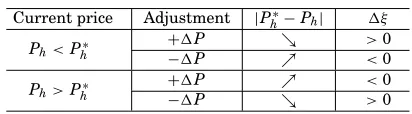
We have previously proved that a rational rewarded bidder will adjust its price in order to the corresponding average market price to maximize its profit [Wei et al. 2003b]. Therefore, a rewarded agent’s practical strategy with respect to certain rewarded recommendations is to bid in the following man-ner: whatever its current price is with respect to the historical average, when adjusting the bid price, if the adjustment results in making less profit, it in-dicates the action is wrong and (Ph ±P) is farther from Ph∗; if it results in
making more profit, it indicates the action is right and (Ph±P) is closer toPh∗
(see Wei et al. [2003b] for more details). This phenomenon is listed in Table I (ξrepresents the possible profit of the next bid compared to that of the current bid). In fact, Table I specifies the strategy for the rewarded agents: chasing the corresponding historical average market price. The actual value ofP will be defined in an application-specific manner.
3.4 The Market Equilibrium and Economic Justifications
According to the strategy for rewarded bidders (Section 3.3.3), such bidders must bid in a manner that aligns their internal view of quality with that of the user. Thus, over time, each individual recommending agent improves its correspondence between its bid price and the user’s preferences for recommen-dations. Only by achieving this can an agent maximize its profit. However, how quickly this convergence occurs depends on the adjustment of priceP.
Fig. 5. Market Equilibrium and Its Change. ((a)The supply curveSis vertical, indicating that whatever the deal is, the supply of thehth advertisement slot is constant. The demand curveD
has a slope indicating that more agents are willing to pay a low price and few agents are willing to pay a high price for the same slot. The cross indicates that at a certain price level the quantity of demand equals that of supply. This cross point represents the market equilibrium.(b)At each price level, more recommendations become available and the demand curve shifts to the right.)
thus, at a certain price, the quantity of demand of thehth advertisement slot equals the quantity of the supply (see Figure 5(a)6).
In the long run, however, these assumptions will not hold and the equilibrium will tend to be broken. However, this new market situation will gradually tend toward another equilibrium and will reach it as long as the changes in the recommending agents are not too frequent with respect to convergence times (see Figure 5(b)). If, for example, there is more demand in the system, the demand curve will shift right compared to Figure 5(a). This means that, at each price level, there are more bidders willing to pay for the same advertisement slot (because, for example, more better recommendations are being produced). At equilibrium, since the bidding prices are aligned with theUPQs, the system
will produce a shortlist of recommendations in decreasing order ofUPQ(see Wei
et al. [2003b] for the proof), which is precisely the objective of the recommender system. Moreover at this point, our reward mechanism (see Formula (1)) ex-hibits Pareto efficiency and social welfare maximization for the recommending agents. Here, we briefly sketch how the mechanism achieves these two proper-ties (see Wei et al. [2003b] for full details and proofs). With our reward mech-anism, the historical average market price, Ph∗, reflects how the majority of bidders value a given advertisement slot and this price becomes the expected equilibrium price. This incentivizes each bidder to iterate itself to the corre-sponding expected equilibrium price. Therefore, the market has a tendency to converge to equilibrium. With the market tending to equilibrium, the second term in Formula (1) tends to zero. Therefore, this mechanism is equivalent to rewarding agents proportionally to their user-selected recommendations’UPQs,
which is precisely what we want to achieve.
6Strictly speaking, the demand curve should be discrete in this case. And the quantity of supply is
[image:17.612.181.445.116.266.2]Additionally, with the market tending to equilibrium, the bidding strategies outlined in Section 3.3.3 are dominant (the best thing to do, irrespective of the actions of any other agents) and so will be adopted by the designers of all rational recommending agents.
4. EVALUATING THE MARKETPLACE
This section reports on the simulation experiments to evaluate the market mechanisms designed for our recommender system in Section 3 with respect to the last five criteria described in Section 3.2. The experimental settings are discussed in Section 4.1. The evaluations of the marketplace are then presented in Section 4.2. Section 4.3 evaluates the market properties and the correlation between the UPQ and the INQ in more general cases when multiple features
of recommendations are considered. Section 4.4 evaluates the system’s ability to seek out the recommendation with the highestUPQvalue from all bids and
recommend it to the user.
4.1 Experimental Settings
Our system is composed of three kinds of agents: the auctioneer agent, the recommending agents, and the user agent (as per Figure 3) (discussed, respec-tively, in Sections 4.1.1, 4.1.2, and 4.1.3). Before we discuss these agents, how-ever, an important system variable, the number of bids called for, M (defined in Section 3.3.1), needs to be decided. Here we use the value of 10 (because our previous study showed this is the number of items that can be managed efficiently in the browser’s sidebar [Moreau et al. 2002]).
4.1.1 Configuring the Auctioneer Agent. The auctioneer agent determines the reward paid to the agents who make recommendations selected by the user. Given that the rewarded mechanism is defined in Formula (1), two sys-tem variables control the auctioneer agent:δ andα(defined in Section 3.3.2). From the reward mechanism, we can see that δ affects the volume of the credit paid to a particular user-selected recommendation. The biggerδ is, the more the recommendation is paid. We can also see that α affects the sensi-tivity of the incentives the marketplace delivers to the recommending agents to make them aware of the equilibrium (because the recommending agents need large alterations to chase the equilibrium price ifαis big). In our exper-iment, we set δ =1.5 andα =1.5 (based on our experience that these values enable the recommending agents to both increase their revenue by making good recommendations over the long term and chase the equilibrium quickly [Wei et al. 2003a]).
4.1.2 Configuring the Recommending Agents. In this subsection, we dis-cuss how a recommending agent generates a bid and how it relates the bid-ding price to itsINQfor a recommendation. Before delving into this discussion,
and sufficient competition in the marketplace). This value is not chosen for ex-perimental expediency and, in practice, it would depend on how many actual bidding agents participate in the marketplace.
Each agent has a set of recommendations available to suggest (typically ordered according to theirINQs). Each such agent needs to compute the relation
between its local perception of relevance and the user’s preference. Having done this, it can then bid an appropriate price to maximize its revenue. Thus, the agent will relate its bidding price to its knowledge about the UPQ (reflected
by the rewards it has received) with respect to differentINQ levels. We term
this relationship between the bidding price and the INQ an agent’s strategy profile. This profile is on a per agent basis. It records an agent’s bidding price for differentINQlevels and indicates how an agent should relate its bid to its INQ.
4.1.2.1 Simulating Recommendation Methods. To assess the broad feasi-bility of our market-based approach, we want our representation of theINQs to
be capable of corresponding to as many recommendation techniques as possi-ble. Moreover, we do not want our results to be skewed by any innate bias in the recommendation methods themselves. Therefore, we take an abstract view on the recommender methods and view them simply as being able to learn a user’s interests based on their internal belief about certain recommendation properties (features or attributes) that the user’s context focuses on. We believe this is a reasonable abstraction because a recommendation method’s ability to adaptively match certain recommendation properties to the user’s actual preferences has been shown to be crucial to making high-quality recommen-dations [Claypool et al. 1999]. Given these observations, we define theINQof
a specific recommendation method to be the sum of the weighted evaluation scores made of different techniques on different properties of a recommenda-tion (see Equarecommenda-tion (2)). This is consistent with the observarecommenda-tion that effective recommendation methods need to combine filtering techniques based on dif-ferent recommendation properties to achieve peak performance [Burke 2002]. To this end, we simulate the recommendation methods’INQs on a linear basis.7
More formally,
q(Rec)=k1·1(Rec)+k2·2(Rec)+ · · · +kI·I(Rec) (I >0), (2)
whereq(Rec) represents theINQof itemRec based on a specific method. This
method evaluates an item from I perspectives (i.e., properties, features, or attributes). The value of I is on a per method basis because different meth-ods evaluate different numbers of properties of an item. Here, each i(Rec)
(i ∈ [1· · ·I]) represents the evaluation score based on a specific property of
7This linear combination is used by several hybrid recommender systems in combining results from
Rec (i(Rec) ∈ [0, 1.0]).8 Such properties can be either objective (such as the
TFIDF [Salton 1989] of a document), subjective (such as customers’ opinions of the tastes of the foods in a restaurant) or a mixture of the two (such as users’ opinions of the textual and graphical descriptions of the products of a store). Variableki (ki >0) specifies the weight ofi(Rec) andk1+k2+ · · · +kI =1.0
in order to ensure 0q1.0.
For example, consider the case where the user’s browsing context is local restaurants. In this situation, an individual recommendation method might base itsINQon the TFIDF of an online restaurant menu with a value between
0 to 1.0, other people’s opinions of the food on the restaurant’s Web Site with an integer voting value of 1· · ·5 (normalization will be used), whether the user has ever consumed the service of the current restaurant with a binary value of 0 or 1, or any other possible properties of the item. In our case, each of these corresponds to a specifici(Rec) and if a particular method uses a combination
of these base terms then appropriate values for the respectiveki’s would be set.
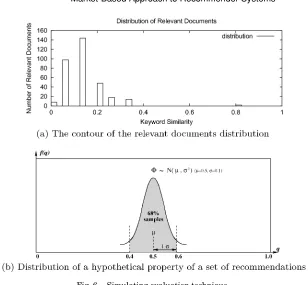
The next step is to determine how to simulate. Based on our previous stud-ies in this area, by randomly collecting 400 different Web pages on the subject of “world news,” we found that the keyword similarity [Moreau et al. 2002] of the 400 documents compared to CNN’s frontpage (www.cnn.com) follows a Gaussian normal distribution (see the contour of the distribution in Figure 6(a)). Hence, we decided to use some Gaussian normal distributions to model the properties () of recommendations in predicting user’s preferences on a probabilistic ba-sis [Popescul et al. 2001; Sharma and Poole 2001]. Specifically, in our experi-ments, we simulated different document properties of one method by different random variables that follow different normal distributions. The probability density function of the normal distribution is defined as9:
N(µ,σ2) : f(q)=√1 2πσe
−(q−µ)2
2σ2 , q∈[0, 1.0], (3)
whereµandσ are the mean value and the standard deviation of the random samples (see Figure 6(b)). The mean of the distribution represents the average value of the INQs of all samples generated by the corresponding method. The
middle range (between one unit of standard deviation on both sides of the mean) of the distribution contains the majority of the samples (about 68% of its total). One of the key objectives of the recommending agents is to build up their strategy profiles so that they can relate their bidding price to theirINQs based
on their knowledge about the reward (which, in turn, reflects the UPQof the
recommendations). In order to learn such characteristics for allINQlevels, each
agent divides its strategy profile into 20 continuous segments. In each auction,
8When evaluating different recommendation methods, we perform a normalization on the results to
fix them into a range of [0, 1.0]. This is because different recommendation methods have different quality (or rating) ranges [Pennock et al. 2000]. This can be achieved in practice by adaptively matching a method’s min and maxINQvalue onto 0 and 1.0, respectively. This makes the values
from different methods meaningful in our market based recommender system in terms ofINQand UPQ.
Fig. 6. Simulating evaluation technique.
a recommending agent needs to compute theINQs of ten recommendations and
make 10 corresponding bids. In the early auction rounds, all the agents’ strategy profiles are empty. With an empty strategy profile, an agent will bid proportion-ally (because it can only expect a highINQrecommendation to receive a highUPQ
and, consequently, more reward than a lowINQrecommendation) to theINQof 10
(value ofM defined in Section 3.3.1) recommendations based on an initial seed-ing price. We set different initial seedseed-ing price values (randomly generated from the range [128, 256]10) for different recommending agents (because different
agents value their recommendations differently with their empty strategy pro-files). After each auction, all strategy profile segments record and update infor-mation about the last bid status (not shortlisted, shortlisted but not rewarded, or rewarded), the last bid price, the last rewarded price, and the last rewarded profit. Based on such information about each segment, and using the appropri-ate bidding strappropri-ategy, an agent can compute its bids in subsequent auctions if there are recommendations that belong to this segment. After a number of it-erations, those segments that cover the majority of samples will have sufficient information to reach the equilibrium price and form a stable strategy profile.
4.1.3 Configuring the User Agent. Again in seeking to evaluate the prin-ciple of a market-based approach to recommendation, we want to work in a
10The exact values of the boundary of the range are not important. What matters is whether such
[image:21.612.158.466.101.386.2]Table II. User’s Decision of Different Modelsa
Shortlisted recommendations Q1 Q2 Q3 Q4 Q5 Q6 Q7 Q8 Q9 Q10
User perceived quality 70 50 75 30 60 82 90 85 65 55
Decision of independent selection 1 0 1 0 1 1 1 1 1 0
Decision of search-till-satisfied 1 0 1 0 1 1 0 0 0 0
aBoth models have the sameATof 60. Search-till-satisfied model has aSTof 80. “1” means the recommendation
is selected to be rewarded, while “0” means not selected.
well-controlled environment. Thus we simulate the users of our recommender system (as others have done when seeking to validate the principle of a new method [Billsus and Pazzani 2000; Bohte et al. 2004; Gonzalez et al. 2004]). Specifically, when a user is faced with a set of shortlisted recommendations, she or he will visit some of the recommendations and will then have a valua-tion of each visited item. Thus, a user assigns a number, Qi (Qi ∈ [0· · ·100],
i ∈[1· · ·M]), to each visited item according to her or his valuation of the rec-ommendation. This number Qi is the UPQvalue. To simulate the choices of a
user in selecting recommendations, we deployed a user model inside the user agent. Building on the user simulation of [Bohte et al. 2001], we adopted the following models:
—Independent selection.The selection of one recommendation is independent of the others. Once theUPQof a recommendation is greater than or equal to
a particularacceptance threshold(AT), the recommendation is accepted and rewarded. Those recommendations withUPQless thanATwill not be selected
and therefore receive no reward.
—Search-till-satisfied Behavior.The selection of one recommendation is depen-dent on other recommendations that are ranked above it in the list. In this case, the user stops searching once he or she discovers a recommendation that has aUPQgreater than or equal to a particular satisfaction threshold
(ST).
By means of an illustration, Table II is an example of a user’s decision under the two different models. All recommendations with UPQ above the AT (60)
are selected to be rewarded in the case of independent selection. However, Q7, Q8, and Q9 are not selected to be rewarded by the search-till-satisfied
behavior though their UPQs are above the AT. Indeed, the user stops
search-ing since a document with a quality of 82 (Q6) has been found above theST
(80).
We simulate the user by a user agent which knows its valuation for each recommendation and assigns theUPQbased on this valuation correspondingly.
Thus, when a real user considers I (I >0) properties of a recommendation (Rec), theUPQofRecis defined as
Q(Rec)=k1·1(Rec)+k2 ·2(Rec)+ · · · +kI·I(Rec), (4)
wherei(Rec) (whose definition is equivalent to that ofi(Rec) in Equation (2),
i(Rec)∈ [0, 1.0],i ∈[1· · ·I]) is the valuation of one of the properties ofRec.
4.1.4 Correlating theUPQto theINQ. From the formal specifications of the
UPQand the INQ of a given item, as given in Equations (2) and (4), it can be
seen whether the properties of the document that the user considers overlap with those that a recommendation method considers. Here, we define the set of properties{1,2,. . .,I}that the user evaluates asϕQ. Likewise, we define
the set of properties{1,2,. . .,I}that a recommendation method evaluates
asϕq. We defineϕ =ϕQ∩ϕq as the recommendation method’seffective factors
in terms of theUPQ. We defineϕ =ϕQ −ϕq as the recommendation method’s ineffective factors. The variableϕis important, because ifϕ =Ø (Ø stands for “empty set”) the method will have some correlation with the UPQsince their
evaluations of the recommendation items share some of the same properties. Otherwise, ifϕ =Ø, a recommendation method cannot correlate itsINQto the UPQsince they evaluate the items from totally different perspectives.11 These
issues will be discussed in detail in Sections 4.2 and 4.3.
By abstracting all recommendation methods as independent learners that predict user’s preferences, all predictions can be seen as composed of effective data and noisy data on a probabilistic basis [Popescul et al. 2001; Sharma and Poole 2001]. This, in turn, simplifies modeling the market-based component recommenders on a high abstraction level. Specifically, by defining a recom-mendation method’s effective and ineffective factors, given a recomrecom-mendation itemRec, itsUPQcan be represented in terms of a method’sINQas follows:
Q(Rec)= (ϕ(Rec))+ (ϕ(Rec)), (5)
where and are two mapping functions that align the coefficients of the elements ofϕ andϕ with the weightings (ki) of the properties (i) of Q (see Equation (4)). For example, assume a user evaluates an item Rec from per-spectives of a, b, and c and the importance of these properties are ka,
kb, and kc, respectively (ka+kb+kc = 100 and ka,kb,kc > 0), theUPQ will
be Q = kaa+kbb+kcc. Assuming a recommendation method evaluates
the item from perspectives ofa,b, andd and their relative importance is
ka, kb, andkd, respectively (ka,kb,kd > 0 and ka+kb+kd = 1.0), its INQis q=kaa+kbb+kdd. Thus, theINQ’s effective factors areϕ= {a, b}and
its ineffective factor isϕ = {c}. Therefore, (a,b) = (k
a
ka
kb
kb)×(k)aakbb
and (c) = (kc)×(c). We find that when a recommendation method’s
effec-tive factors form a major weighting of both itsINQ and the UPQ ( e.g., in the
above example,a andbcontribute kak+ak+bk+bkd of the weighting of theINQand
ka+kb
ka+kb+kc of the weighting of theUPQ), this method can easily correlate itsINQto
theUPQ(see Section 4.3 for more details), and can continuously produce good
recommendations and make profits. Otherwise, if a method has only ineffective
11We assume that one property (
i) is totally independent of another (j) ifi= j. This means any two different properties of a recommendation do not have a relationship to one another. However, this is not limiting because we have defined theUPQand theINQas a linear combination of some
factors, the method cannot correlate itsINQto theUPQand therefore makes poor
recommendations most of the time and will go bankrupt. These properties will be discussed in more detail in Section 4.3.
4.2 Evaluation of the Marketplace
Having outlined the setup of the three kinds of agents specified in Section 4.1, this section will focus on evaluating the system properties. In our case, the mar-ket is the key to coordinating the various recommendation methods. If it does not work effectively, the system will not be able to make good recommendations. Among the five properties we want our market to exhibit, convergence is the most important because it forms the basis of the other four. Therefore, we will start with experiments on market convergence.
4.2.1 Market Convergence.12 We endow our system with 100 documents
ready to be recommended to the user. Every time the user visits a specific rec-ommendation, theUPQof this recommendation is assigned by the user and this
value is independent of the various methods’INQs. To simplify the experiments
on evaluating the properties (i) of a recommendation item, we assume each
recommendation method evaluates items from only one property (but two dif-ferent methods may use difdif-ferent properties). The more general case with more than onei involved in each method is dealt with in Section 4.3. We further
assume the user considers two different properties of the recommendations (0
and1). Thus, the effective and ineffective factors of the recommendation
meth-ods can be easily controlled.13Assuming the weighting of the two properties are k0andk1, respectively, theUPQcan be represented formally as
Q(Rec)=k0·0(Rec)+k1·1(Rec). (6)
To generalize the experiments, nine component recommender agents are placed in our marketplace and each of them is based on one of three different properties (1,2,3) of recommendations (note here1is the same as in Equation (6)),
meaning that some of the recommendation methods contain the effective factors in terms of theUPQand some of them do not. We will use three Gaussian normal
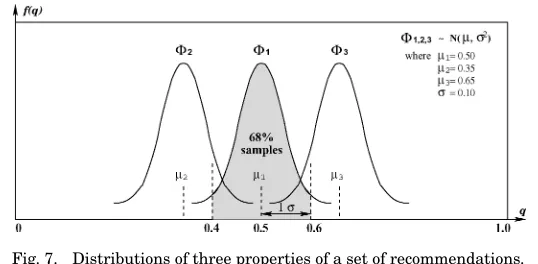
distribution functions (see Equation (3)) to simulate the valuations of the three properties. Each property relates to one of the three distributions:N(0.35, 0.12), N(0.5, 0.12), and N(0.65, 0.12) (see Figure 7). We set the standard deviation
to a value of 0.1, meaning the three different properties share only a small intersection (so as to easily differentiate the different methods). Thus, those
12The working scenario and the configurations of theUPQand theINQin this section will be used
for all experiments in Section 4.2
13We can exemplify this case in a scenario where the user is browsing the local restaurants on the
Web. We assume the user evaluates the recommended restaurant Web sites from two perspectives: whether the restaurant sells some specific foods (0) and other customers’ opinions of the foods in
the restaurant (1). If a recommendation method also computes1, then1is its effective factor
and0is its ineffective factor in terms of theUPQ(mutatis mutandis if the method computes0). If
a recommendation method evaluates the recommendations byx(which is different from1and
Fig. 7. Distributions of three properties of a set of recommendations.
Table III. Configurations of the Three Groups of Experiments
Experiments Configurations
Experiment 1 qi(Rec)=1(Rec) (i∈[1· · ·3]) andqj(Rec)=2(Rec) (j∈[4..6]) andqk(Rec)=3(Rec) (k∈[7· · ·9])
Experiment 2 qi(Rec)=1(Rec) (i∈[1· · ·9])
Experiment 3 q1(Rec)=1(Rec) and andqj(Rec)=2(Rec) (j∈[2..5]) andqk(Rec)=3(Rec) (k∈[6..9])
methods’INQs based on1can be presented formally as
qi(Rec)=1(Rec) (i∈[1..3]). (7)
In this case, theUPQ(Equation (6)) can be represented in terms of theINQwhich
contains the effective factors
Q(Rec)=k1·qi(Rec)+k0·0(Rec) (i∈[1· · ·3]). (8)
Having further configured the experimental settings, we are going to exam-ine the system property from the perspective of market convergence. In Sec-tion 3.4, we showed that the marketplace can reach an equilibrium such that the shortlist prices converge at different levels with respect to differentUPQlevels.
To evaluate this, we arranged 300 auctions with 10 shortlisted recommenda-tions using the independent selection user model (AT = 66) and (k1 = 75, k0=25)14for Equations (6) and (8) to see if the marketplace does indeed have
such a convergence property. We organized three groups of experiments, each of which contains a different number of agents having the effective factors, to see whether the market converges in various cases. The configurations are shown in Table III.
In the first experiment, each of the three properties is shared by three agents; thus only the first three agents contain the effective factor, whereas the other six do not.15From Figure 8(a), we can see that the shortlisted prices converge
14k
1andk0can be set to any other combinations in these experiments. 75 and 25 are chosen to
exhibit the higher importance of1over0.
15In this case, the first three agents can relate their bidding price to their
INQs, since theirINQs
have a relationship with theUPQ(contributing 75% of its total weighting; See Equation (8)). Also
the rewards they received reflect theUPQwith respect to a specific recommendation. The remaining six agents cannot relate their bids to theirINQs because theirINQs have no relationship with the
[image:25.612.161.462.267.335.2]Fig. 8. Convergence of shortlist prices.
(for example, the 4th and 10th bids oscillate around 150 and 130, respectively, which indicateP4∗andP10∗, respectively) after about 100 auctions. We find that, with the search-till-satisfied user model (with ST = 60 and AT = 45), the market also converges (for which we do not provide a figure), but only after a longer time (more auction rounds) compared to the independent selection. This takes longer because fewer agents are rewarded in this case and they need more bids to chase the equilibrium price.
[image:26.612.134.478.93.549.2]see Figure 8(b)), because all agents’INQs are actually the effective factors in
terms of theUPQ. Thus they have a good correlation with the user’s valuation of
the recommendations. Therefore, more recommendations at each quality level can be related to theUPQand the agents receive more signals of the user’s
in-terests. This, in turn, means agents get sufficient chances to alter their price effectively to chase the equilibrium price with respect to eachUPQlevel. This
results in a market that converges quickly.
In the third experiment, only the first agent evaluates1and the other eight
agents evaluate2 or 3. The market still converges but very slowly (after
about 600 auctions; see Figure 8(c)), with the first bid price oscillating around 125. This slow speed can be accounted for by the fact that only one agent can relate its good recommendations’ bidding price to itsINQwith respect to each UPQlevel and there are insufficient good recommendations. Therefore, the agent
needs a longer time to get a sufficient number of high-quality recommendations to be rewarded and to chase the equilibrium price. In this experiment with very few agents taking the effective factor in terms ofUPQ, it is interesting to see that
the 10th bid price decreases till it reaches zero (see Figure 8(c)).16The
expla-nation is that most of the recommendations, from the eight agents with only ineffective factors as theirINQs, cannot relate their bidding prices to theirINQs.
Thus, these agents cannot reason about the relationship between the rewards and theINQs of the rewarded recommendations (since the rewards are based
on theUPQ,noton theINQ). Therefore, the equilibrium price for such bids (if it
exists) has no relationship with the INQ. Such a recommending agent cannot
chase the equilibrium price based on theINQ. Such shortlisted (both rewarded
and not rewarded) recommendations will make negative profit most of the time. Hence, most of the recommendations will bid as low as possible to reduce their loss (this phenomenon continues till the bid prices reach zero, meaning paying nothing). The exception to this is the small number of bids from the only agent with effective factors. Overall, this experiment demonstrates that the market-place deters bad recommendations and only good recommendations can pass through.
When all the experiments are taken together, we find that the shortlisted prices always converge after a number of iterations as long as there is at least one agent that has effective factors. The speed of the convergence depends on the setting of the parametersα,AT, ST,Y, and Z. Since these variables are not our main concern here, we only supply an overview of their effects. Broadly speaking,AT and ST affect the number of recommendations being rewarded (because more agents are rewarded if their values are small). By being rewarded more times, an agent receives more information and therefore can chase the equilibrium faster. The variables Y and Z also affect the speed with which the agent can chase the equilibrium. Specifically, with high values of these variables, an agent alters its price quickly to reach the equilibrium price.
16Actually only the first and second bid prices converge in this experiment. The second bid is