E u r o p e a n I n v e s t m e n t B a n k
BEI EIB
^ ^ * i E ^ \ Den europaeiske Investeringsbank
' ' ' ^ ^ ^
' X Europäische Investitionsbank
\
Ευρωπαϊκή Τράπεζα Επενδύσεων
•lui Banque
Européenne d'Investissement
v
Banca Europea per gli Investimenti
^5^255^ Europese Investeringsbank
No.24Februai7l981
ISSN 0250-3891Financing operations in 1980 reach almost 3.5 billion u.a.
A high concentration of lending for investment in regions worst hit by unemployment plus increased support for energy projects aimed at reducing the European Community's dependence upon oil imports — including lending for energy-saving in industry and other fields — are among the main features of the European Investment Bank's activities in 1980. Total financing for industrial, energy and infrastruc-ture development in the Community reached almost
3 billion units of account (u.a.), 80% of this In Italy, the United Kingdom and Ireland, the three countries with the most difficult structural problems.
Part of the amount (almost 200 million u.a.) came from the resources of the New Community Instrument for borrowing and lending(') — NCI or "Ortoli Facility", for which the Bank handles the lending operations on the EEC's behalf.
Outside the Community, tlie EIB provided close to 550 million u.a. to help the development of countries which have signed association or cooperation agreements with the EEC.
Over 100 million of this was lent in Greece in its last year as an "associ-ated country" prior to joining the Community on 1 January 1981, be-coming at the same time the ElB's 10'" (Viember Country.
Borrowings which the EiB made during the year to fund lending ope-rations totalled about 2.5 billion u.a., mainly in the form of public bond issues.
In this issue
EIB financing in 1980 — in the Community: breal<downs by country and sector
— in IV^editerranean and Lomé Convention countries p. 1-8 Expansion in finance for small and medium-scale industry
p. 8-9 The International Capital Market In 1980 p. 10-16
In the Community
Major alms: to sustain Investment and create employment, to cut oil imports
Financing in the Community totalled 2 950.8 million u.a.(^). This was com-posed of 2 753.2 million u.a. from the Banks own resources (up al-most 2 1 % on the 1979 figure of 2 281.2 million u.a.) plus 197.6 mil-lion from New Community Instru-ment resources (277 million in 1979). The total shows a nominal increase of 15% against the previous year (2 558.2 million) but in real terms — i.e. taking into account the effects of inflation — it was roughly equal. The year was one of consolidating the high level of activity which has built up rapidly in recent years — half the Bank's lending since it began work in 1958 has taken place in the last three years alone — against a difficult climate for in-vestment throughout the Communi-ty coupled with tensions on the capi-tal markets.
Bank action was heavily concen-trated on assisting regional de-velopment, its first task under the EEC Treaty, and investment serving a common interest to several IVIember Countries or the Communi-ty as a whole, in particular in the energy field.
Within this framework, the EIB di-rected its lending to support policies which the European Council has stressed as crucial for the Communi-ty's development over the years ahead: encouraging fresh invest-ment, combating unemployinvest-ment, re-ducing disparities between national economic performances, tackling structural changes and cutting, as far as possible, dependence upon oil imports.
• Investment: the Bank calculates that its financing in 1980 went to-wards fixed Investment In the Com-munity totalling about 8.7 billion u.a. Helping to sustain investment in two countries where needs are high-est — Ireland and Italy — was the application of 3% Interest sub-sidles, paid from the Community budget, on over 60% of the loans (total 1 020 million u.a.) made In these two countries; the subsidies
(') The Commission of the European Com-munities has been authorised by the Council of the European Communities to borrow up to 1 billion ECU in the name of the EEC for the purpose of promoting investment in the Com-munity. The Commission decides the eligibility of projects for a loan within guidelines laid down by the Council of the European Com-munities. The EIB receives the loan applice-tions, examines them in accordance with its customary criteria, decides on the loans to be granted and the terms, and then administers the loans in the name, for the account and at the risk of the Community.
were provided under arrangements agreed when Ireland and Italy joined the European Monetary System('), using resources set aside for this purpose under the 1980 budget plus a small amount left over from 1979.
• Energy: it can be calculated that the projects supported in 1980 — e.g. hydro, coal and nuclear po-wer plant, development of European oil resources, laying of gaslines, in-vestment aimed at energy saving — should represent, when all fully operational, the means to replace 12 million tonnes of imported oil per year. Taking energy investment as-sisted in the last four years (1977-1980), the impact can be put at about 50 million tonnes per year; this will make a substantial contribu-tion towards meeting the target set by the Council of the European Communities of limiting the EEC's net oil imports in 1990 to no more than those in 1978, i.e. 470 million tonnes (the 50 million t.p.a. corres-ponds to 1 1 % of the figure).
• Employment: it is difficult to be precise about the final impact of investment yet to be completed, but it can be estimated that projects supported in 1980 represent the creation or safeguarding of up to 50 000 permanent jobs (mainly in industry and including an expected 16 000 jobs in advance factories which the Bank helped to finance in Ireland).
In addition there are the temporary effects on employment during con-struction (often for lengthy periods) and also on employment involved in supply of necessary services and materials — this mainly concerns large-scale energy and infrastruc-ture works: the total effect of pro-jects assisted in 1980 can be esti-mated at the equivalent of over 600 000 man-years of work, which corresponds to some 120 000-130 000 jobs a year in 1980 and 1981, progressively fewer thereafter. Also, but impossible to quantify, there is, of course, the long-term impact of most infrastructure pro-jects — e.g. water supplies, sewer-age, communications — which crea-te few permanent jobs in themselves but which are necessary as the base for economic growth.
Priority to regions
with most serious problems
Two thirds of lending in the Com-munity went to investment in re-gions which are economically less
developed or confronted with in-dustrial conversion problems, and out of this two thirds again went to areas given special attention under Community regional policy — Ire-land, the Italian Mezzogiorno, North-ern Ireland and Greenland.
High priority was given to invest-ment in areas of substantial unem-ployment: more than 80% of lending for regional purposes went to areas where the jobless total more than 7.5% of the labour force.
Apart from industry and agriculture, lending for regional development concerned mainly telecommunica-tions and transport improvements, water supplies and sewerage infra-structure.
Under the Bank's other main role — financing investment of "common interest" to several Member Coun-tries or the Community as a whole — by far the most important activity was in the energy field (including a substantial amount for investment aimed at energy-saving or restruc-turing consumption, e.g. switching from oil to coal); other loans went to transport links between Member Countries, industrial projects involv-ing cooperation between enter-prises from different countries in high technology fields, environmen-tal protection.
Main sectors
The Bank can point to a 55% in-crease in lending to the productive sectors — principally industry — with loans totalling 585.4 million u.a. against 377.6 million u.a. in 1979, which was itself over 40% up on the previous year.
This was due above all to a virtual doubling in the amount of global loans for financing small and medium-scale ventures (global loans are basically lines of credit which the EIB opens to regional or national financing institutions which then split up the funds, in amounts down to 25 000 u.a., for a series of small investments chosen in agree-ment with the EIB).
Global loans for industrial develop-ment were granted in Italy, Ireland, the United Kingdom, Denmark and Belgium for a total of 265.5 million u.a., compared with 137.1 million in 1979, and 99.9 million the year be-fore.
Credits drawn down from global loans last year helped to finance 518
ventures against 415 in 1979. There was a trend towards assisting smal-ler investments(') than in the pre-vious year and over 90% of them were carried out by small or medium-sized firms(^).
The EIB attaches a particular impor-tance to global loans primarily be-cause the kind of investment which they go to support tends to be rela-tively labour-intensive. A new fea-ture, however, was that three of the global loans (21.2 million u.a. in Italy and Ireland) were granted specifical-ly for investment aimed at rationali-sing energy consumption in small and medium-scale ventures.
Other features of lending for indus-try were the granting of a number of loans to reduce energy consumption in larger industrial plants and, in Ireland, continued support for cons-truction of advance or custom-built factories.
Lending in the energy sector, for a wide range of production and transmission facilities, totalled 1 186.0 million u.a. (of which 108 million from New Community Instru-ment resources), equivalent to over 40% of financing in 1980.
Increased amounts went to nuclear facilities, development of European oil and gas resources, gaslines, coal-fired power stations, energy-saving district heating schemes, peat extraction.
Other main fields of activity were — telecommunications: 366.3
mil-lion u.a. (including 39.8 milmil-lion from New Community Instrument funds)
(') By decision of the Council of the European Communities, 3% interest subsidies paid from the Community budget may be applied to selected loans from the ElB's own resources and from those of the New Community Instru-ment which are made over a period of five years (1979-1983) in less prosperous countries fully participating in the European Monetary System (Ireland and Italy have been designated as such). These subsidised loans are to be concentrated on infrastructure (including energy) projects which help to solve major structural problems in the countries con-cerned, reduce regional disparities and im-prove the employment situation. The Commis-sion is responsible for deciding the eligibility of investment projects for a subsidy.
{') Although the number of ventures assisted last year rose appreciably, the total amount of credits provided stood at 131.6 million u.a. against 131.4 million the previous year. It should be noted that several of the global loans were made towards the end of 1980 and so their impact should be felt as credits are drawn down in the current year.
— transport: 243.6 million u.a. (37.3 million from NCI)
— water supplies and sewerage: 221.4 million
— agricultural development (irriga-tion, drainage, afforestation): 195.2 million.
A point of interest: apart from the global loans for energy saving in industry in Ireland and Italy, the Bank also made a global loan for financing smaller scale investments in district heating systems in Den-mark and granted three global loans to a financial institution in France to help finance small and medium-scale infrastructure works assisting regional development.
Country by country
In Italy lending totalled 1 290.3 mil-lion u.a., worth Lit 1 533.2 bilmil-lion at exchange rates ruling at contract signatures (including 137.8 million u.a./Lit 165 billion from New Com-munity Instrument resources). This represents an increase of over 30% on 1979 (total: 990.4 million u.a./Lit 1 128.5 billion) and accounts for al-most 44% of all the Bank's opera-tions in the Community last year. About two thirds of the total went to investment in the Mezzogiorno. The tragic consequences of the November 1980 earthquakes in Southern Italy place special res-ponsibility on the EIB in the years ahead in channelling Community ef-fort to help the authorities rebuild damaged infrastructure and pro-mote economic recovery. A number of loans were concluded in De-cember (about Lit 200 billion) for investment in the affected areas. Interest subsidies of 3% are being paid from the Community budget on loans totalling 719 million u.a. (Lit 854 billion) under arrangements made when Italy joined the Euro-pean Monetary System (EMS).
A third of all the lending in Italy last year was for energy production and transmission (425.7 million u.a./Lit 502.4 billion). Loans went towards hydroelectric plant at Edolo (Lom-bardy), Alto Gesso (Piedmont) and Presenzano (Campania); develop-ment of oil and gasfields off the Adriatic and Tyrrhenian coasts, and on the mainland near Milan (Lom-bardy), Modena (Emilia Romagna) and in Abruzzi; stretches of the Algeria-Italy gasline in Sicily and Calabria and a connecting link,
run-ning from Emilia Romagna to Ven-eto, with the Trans-Austria gasline; conversion of power stations from oil to coal-firing (Brindisi, Apulia, and Sulcis, Sardinia) plus improved facilities at the port of Savona (Li-guria) for handling more coal im-ports; strengthening of the power networks in Sardinia and Latium; energy-saving improvements to the national grid control system and construction of a district heating system at Brescia in Lombardy. For industrial investment, the Bank made available a total of 223.8 mil-lion u.a./Lit 266.9 bilmil-lion, of which more than half (138.4 million u.a./Lit 166 billion) in the form of global loans for financing investment in small and medium-scale ventures. Most of these global loans are aimed at helping development in the Mez-zogiorno (loans to ISVEIMER, IRFIS, Banca Nazionale del Lavoro and Banco di Napoli), but other global loans (to Mediocredito Centrale and Centrobanca) will benefit assisted areas in the Centre and North of Italy; the last two mentioned institu-tions also contracted global loans to help finance investment directed to-wards rationalising energy con-sumption in small and medium-scale ventures in the Centre-North. Larger industrial projects supported by the Bank came from a wide range of sectors and here again energy saving was an important factor, e.g. loans went to investment aimed at
cutting energy consumption and re-ducing dependence upon oil in FIAT plants in the Turin (Piedmont) area, conversion of four cementworks in Piedmont, Tuscany and Emilia Romagna so that they will be able to burn coal instead of oil, improve-ments at a papermill at Riva del Garda (Trentino-Alto Adige) enabl-ing an increase in productivity with economies in consumption of ener-gy and raw materials, modernisation of a flat glass factory in Abruzzi permitting a substantial cut in natur-al gas consumption.
Among other industrial projects were modernisation of FIAT tractor factories at Modena (Emilia Romag-na) and Jesi (the Marches), exten-sions to a car components plant at Bari (Apulia), a rubber tubing and belt factory at Ascoli Piceno (the Marches), reorganisation of a car-bon products factory in Umbria, and food industry investment in Apulia and Campania.
At the same time the Bank tried to improve conditions for industrial growth by making available 60.7 mil-lion u.a./Lit 72.2 bilmil-lion for various works to develop industrial zones or expand their facilities in the areas of Sangro-Aventino (Abruzzi); Acerra, Battipaglia, Mercato S. Severino (Campania); Prosinone, Cassino and Anagni (Latium); Pantano d'Arci and Syracuse (Sicily) and for a new industrial zone at Prato, near
Flor-Table 1: EIB lending within the Community in 1980 Breakdown by project location
Belgium Denmarl« Germany France Ireland Italy
United Kingdom Non-Member Countries (')
Total
Own resources million u.a.
153.2 81.1 14.2 279.0 334.3(2) 1 152.5(a)
688.0 50.9
2 753.2(2)
%
5.6 3.0 0.5 10.1 12.1 41.9 25.0 1.8
100.0
NCI resources million u.a.
18.1
41.7(3) 137.8(5)
197.6(5)
million u.a. 153.2
99.2 14.2 279.0 376.0 1290.3 688.0 S0.9
2 950.8
Combined
%
5.2 3.4 0.5 9.5 12.7 43.7 23.3 1.7
100.0
(') Loans made In accordance with the second paragraph of Article 18 (1) of the Bank's Statute empowering the Board of Governors to authorise the Bank to contribute towards financing projects outside, but of direct interest to, the Community.
(') of which EMS subsidised toans from EIB own resources : Ireland: 259.3 m u.a, — Italy: 631.0 m u.a. : Total: 890.3 m u.a. (3) of which EMS subsidised loans from NCI resources :
enee, which will help ili raising pro-ductivity and restructui^ing part of the area's textiles industry:
Loans worth 253.3 million u.a./Lit 304 billion went to a number of irrigation schemes — covering 150 000 ha in Foggia and Taranto provinces (Apulia); ihe Campidano, Oristano and Chilivani plains in Sar-dinia, the Peligna valley in Abruzzi — and water supply schemes serv-ing the provinces of Bari (Apulia), Matera and F'otenza (Basilicata), Cosenza (Calabria),· Teramo and Chieti (Abruzzi), Ascoli Piceno (the Marches), and the Cagliari zone in Sardinia.
Other main fields were telecom-munications development (219.2 million u.a./Lit 259 billion) in the Mezzogiorno, mainly in Apulia and Campania, and European transport schemes (107.6 million u.a/Lit 128.7 billion) with loans for approach roads to the France-Italy Alpine road tunnel at Frejus, the strengthening of air links with other Member Coun-tries through purchase of eight European Airbus jetliners, and con-struction of part of the Friuli motor-way (this connects the Italian, Aust-rian and German motorways and also constitutes an important ele-ment in helping the recovery of zones hit by the 1976 earthquakes).
In the United Kingdom, lending came to 688 million u.a./£ 417.3 mil-lion — 23% of total operations in the Community — taking EIB operations in the UK, since the country joined the European Community in 1973, comfortably past £ 2 000 million.
Although the year's lending was down on 1979 (844.3 million u.a./ è 553.3 million), mainly because spending limita have reduced de-mand from the public sector, there was a 250% increase in financing for industry, which totalled 166.7 million U.â,/£ 102 million.
Of this. 39.4 million u.a./£ 26 million was provided for small and medium-scale Ventures in assisted areas, to bê made available in two ways; through Öeßartment of Industry reg-ional offices in England, the Scottish Economic Planning Department, Welsh Office Industry Department and Northern Ireland Department of Commerce, each acting as EIB agents, and through a global loan to Industrial and Commercial Finance Corporation Ltd (ICFC), aimed in particular at smaller investments.
Larger industrial projects supported directly by the Bank were in a variety of sectors: in Northern England — modernisation of cable factories in Merseyside, Cheshire and Man-chester, construction of a heavy en-gineering works and extension of a factory producing equipment for nuclear power stations, both in Dar-lington, construction of à packaging machinery factory at Gateshead, modernisation of a glassworks, cut-ting energy consumption, in Wigan; in Scotland — modernisation of an aluminium smelting plant at Fort William (making more efficient use of energy), extension of whisky bottling plants at Dumbarton and Kilmalid, extension of a chipboard factory at Cowie, a new factory in Glasgow producing activated car-bon for the food and pharmaceutical industries, plus a meat processing complex near Edinburgh; in Wales — a domestic appliances factory at Rhyl and an insulation materials fac-tory at Bridgend; in Northern Ireland — extension and modernisation of tyre factories at Belfast and Bally-mena.
This upturn in lending for industry reflects, in large measure, the added attraction of exchange risk cover facilities which the UK Government has been providing since 1978 on EIB loans for private sector develop-ment in assisted areas.
The energy sector accounted for 191.6 million u.a./£ 115 million with loans for construction of the UREN-CO uranium enrichment plant in Cheshire (being built in cooperation with German and Dutch interests) and, in Scotland, for construction of the Torness nuclear station, a ther-mal power station at Peterhead, and uprating generating capacity in the Shetland Islands.
Telecommunications (strengthening of the Northern Ireland network, im-proved links with the Continent) took 85.3 million u.a./£ 51 million; loans for transport schemes (71.9 million u.a./£ 45.2 million) went to-wards high speed trains on the Scot-land — S.W. EngScot-land and London-Teesside/Humberside routes, con-struction of part of the M65 motor-way in Lancashire, extension of the Sullom Voe oil harbour in the Shet-lands and improved cross-channel ferry facilities; water supply and sewerage schemes accounted for 101.9 million u.a./£ 62.1 million (loans for various works, mainly to support industrial development,
throughout the North West, in Ty-neside, Yorkshire and Humberside, East and West Midlands, Devon, Cornwall and in Wales). The Bank also lent 70.5 million u.a./£ 42 million in Scotland to help finance various infrastructure works carried out by regional councils to improve condi-tions for development (e.g. con-struction of the Monkland motorway across Glasgow, extension to Dun-dee airport, various water supply and sewerage works and road im-provements in Strathclyde, Fife, Grampian, Tayside, Dumfries and Galloway regions and in the Shet-lands).
Ireland was again the country in which EIB lending operations were the most heavily concentrated. With roughly 1 % of the Community's population, Ireland accounted for almost 13% of financing operations in 1980. Loans came to 376 million u.a./IR£ 252.8 million, a moderate rise compared with 1979's total of 339.6 million u.a./IR£ 226.1 million. Of the total, 41.7 million u.a./IR£ 28.1 million came from New Community Instrument resources.
Interest subsidies of 3%, under the European Monetary System ar-rangements, apply to loans totalling 301 million u.a./IR£ 202.3 million. Industrial and agro-industrial de-velopment accounts for close to half, with global loans for small and medium-scale ventures granted to the Industrial Credit Company Ltd (ICC) and Agricultural Credit Corpo-ration Ltd (ACC) and a similar agen-cy arrangement with the Industrial Development Authority (IDA) — total 75 million u.a./IR£ 50.5 million; one of the global loans to ICC is aimed at rationalising energy consumption. A series of loans (91.8 million u.a./
IR£ 61.6 million) was made for con-struction of over 500 advance or custom-built factories in all parts of Ireland by the IDA, the Shannon Free Airport Development Company and Udârâs na Gaeltachta, which is con-cerned with development of the Irish language speaking areas.
and sewerage works in most parts of the country, drainage of 60 000 ha of agricultural land in Counties Meath, Limerick and Mayo, forestry de-velopment, improvements to fishing ports (Killybegs and Greencastle, Co. Donegal, and Howth, Co. Dublin) and a new passenger/vehicle ferry to be operated by the British and Irish Steam Packet Company Ltd (B-i-l Line) on routes between Ireland and Great Britain.
In France, lending rose to 279 mil-lion u.a./Ffrs 1 631 milmil-lion, against 222.7 millipn u.a./Ffrs 1 302.1 million in 1979.
The vast majority went to energy (213.9 million u.a./Ffrs 1 250.9 mil-lipn) vyith loans for nuclear power stations (Dampierre-en-Burly, Centre, and Creys-Malville, Rhône-Alpes), expansion of lignite mining near Aix-en-Provence plus a new generating unit at a nearby lignite-fired power station, oil refinery mod-ernisation (Donges, near St Nazaire, Pays de la Loire).
Loans were also made for road con-struction (the Orchies-Valenciennes section of the Lille-Valenciennes motorway, Nord-Pas-de-Calais, and the Nantes-Cholet road. Pays de la Loire). Three global loans were granted to CAEÇL — Caisse d'Aide à l'Equipement des .Collectivités Locales to help finance smaller scale road and other irifrastructure works assisting regipriaj .deyelpp-rnent. The Bank also fielped to fi-nance the construction of a telecom-municatioris satellite launcher (part of the Ariane space cooperation bet-ween European countries) and a new insulation materials factory in Auvergne,
In Belgium loans totalled 153.2 milr lion u.a./Bfrs 6.22 billion (58.4 mil-lion u.a./Bfrs 2.35 bilmil-lion in 1979), the sharp rise due mainly to a loan for development of nuclear power: 123.1 ΓηΙΜίοη u.a./Bfrs 5 billion went towards vyprk on further stages of the Doel (Antwerp) and Tihange
[image:5.588.104.528.46.561.2](Liège) power stations. In addition a Ipan was made for a major gasline between Zeebrugge and Antwerp and a global loan was granted to Société Nationale de Crédit à l'In-dustrie — SNCI / Nationale Maats-chappij voor Krediet aan de Nij-verheid — NMKN to help finance small and medium-scale industrial ventures in regional development areas.
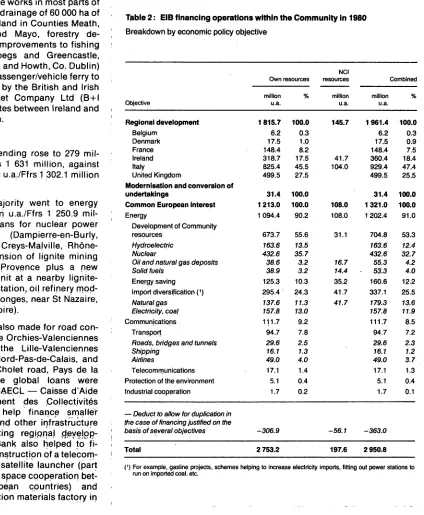
Table 2 : EIB financing operations within the Community in 1980
Breakdown by economic policy objective
Objective
Regional development Belgiunrt
Denmark France Ireland Italy
United Kingdonn
Modernisation and conversion of undertakings
Common European interest Energy
Development of Community resources
Hydroelectric Nuclear
Oil and natural gas deposits Solid fuels
Energy saving Import diversification (') Natural gas
Etectricity, coal Communications
Transport
Roads, bridges and tunnels Shipping
Airlines
Telecommunications Protection of the environment Industrial cooperation
— Deduct to allow for duplication in the case of financing lusHfied on the basis of several objectives Total
Own resources million
u.a. 1 815.7 6.2 17.5 148.4 318.7 825.4 499.5 31.4 1 213.0 1 094.4 673.7 763.6 432.6 38.6 38.9 125.3 295.4 737.6 757.8 111.7 94.7 29.6 76.7 49.0 17.1 5.1 1.7
-306.9 2 753.2
%
100.0 0.3 1.0 8.2 17.5 45.5 27.5 100.0 100.0 90.2 55.6 73.5 35.7 3.2 3.2 10.3 24.3 77.3 73.0 9.2 7.8 2.5 7.3 4.0 1.4 0.4 0.2
NCI resources million u.a. 145.7
41.7 104.0
108.0 108.0 31.1
76.7 74.4 35.2 41.7 47.7
-56.7 197.6
Combined million
u.a. 1961.4 6.2 17.5 148.4 360.4 929.4 499.5 31.4 1 321.0 1202.4 704.8 763.6 432.6 55.3 53.3 160.6 337.1 779.3 757.8 111.7 94.7 29.6 76.7 49.0 17.1 5.1 1.7
-363.0 2 950.8
%
100.0 0.3 0.9 7.5 18.4 47.4 25.5 100.0 100.0 91.0 53.3 72.4 32.7 4.2 4.0 12.2 25.5 73.6 11.9 8.5 7.2 2.3 7.2 3.7 1.3 0.4 0.1
(') For example, gasline protects, schemes helping to increase electricity imports, fitting out power stations to njn on imported coal. etc.
Denmark accounted for loans worth 99.2 millipn u.a./Dkr 772.7 million against 15.6 million u.a./Dkr 112 mil-lion in 1979. The total includes 18.2 million u.a./Dkr 142 million from New Comrnunity Instrument re-sources, the first su,c.f:| l.oans in Den-mark.
Over 80% vyent to energy invest-ment: cphstruction of a coal-fired power station at Randers (East Jut-land), and conversion from oil to coal-f irjng of the main unit at Asnaes power station (West Zealand), de-velopment of energy-saving district heating systems at Herning (West Jutland) and Kalundborg (West Zea-land), and the laying of an underwa-ter cable to supply electricity from Sweden to Bornholm island; a
glob-al loan was granted to Kongeriget Danmarks Hypotekbank og Finans-forvaltning for financing small and medium-scale works on district heating systerris.
The Bank also supported moderni-sation of Narssarssuaq airport in Greenland, the construction of two factories in the Ringkobing area of West Jutland which will extract pro-teins from dairy wastes, and granted two global loans to the State which will be used by the Regional De-velopment Board for financing small and medium-scale ventures in Den-mark's development regions.
sta-tion in Bavaria by guaranteeing a 14.2 million u.a./DM 36 million loan granted by a group of banks.
The ElB's Board of Governors gave special authorisation for the Bank to lend for two energy projects outside the Community but of direct inter-est to the EEC: in Austria 33.6 mil-lion u.a. went to the Zillertal hydro-electric scheme in the Tyrol, half the output of which will be supplied to a German electricity company, and in Tunisia 17.3 million u.a. was lent to an Italian company for construc-tion of part of the Algeria-Italy gas-line.
Cooperation vi/ith EURATOM
During the year EURATOM — Euro-pean Atomic Energy Community lent 184.4 million u.a. for construction of nuclear plant in Belgium and France.
[image:6.589.231.543.45.754.2]These operations were funded from resources borrowed by EURATOM on the capital markets and decided upon by the Commission, the Bank assuring the project appraisal and loan management; they are not in-cluded here in the figures for the Bank's lending operations.
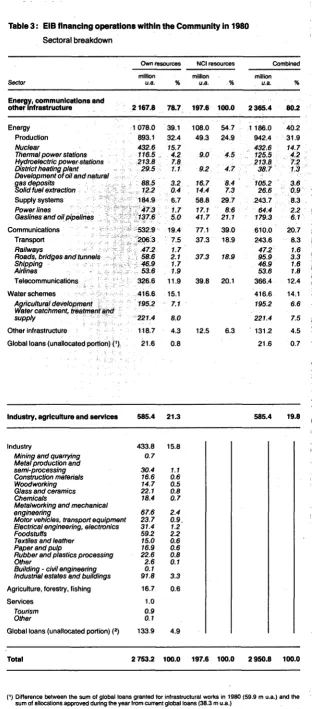
Table 3 : EIB financing operations within the Community in 1980
Sectoral breakdown
Sector
Energy, communications and other irifrastructure
Own resources million
u.a.
2 167.8
%
78.7
NCI resources million
u.a. %
197.6 100.0
Combined million
, u.a. %
2365.4 80.2 Energy
Production Nuclear
Thermal power stations Hydroelectric power stations District heating ptant Development of oil and natural
f
as depositsolid fuel extraction Supply systems Power lines
Gaslines and oil pipelines Communications
Transport Railways
Roads, bridges and tunnels Shipping
Alriines
Telecommun Ications Water schemes
Agricultural development Water catchment, treatment and supply
Other infrastnjcture
Global loans (unallocated portion) (<)
1 078.0 893.1 432.6 776.5 273.8 29.5 88.5 72.2 184.9 47.3 137.6 532.9 206.3 47.2 58.6 46.9 53.6 326.6 416.6 795.2 227.4 118.7 21.6
39.1 32.4 15.7 4.2 7.8 1.1 3.2 0.4 6.7 1.7 5.0 19.4 7.5 1.7 2.1 1.7 1.9 11.9 15.1 7.1 8.0 4.3 0.8
108.0 49.3 9.0 9.2 16.7 14.4 58.8 17.1 41.7 7 7 . \ 37.3 37.3
39.8
12.5 54.7 24.9 : 4 . 5 : [ 4:7 ;
8.4 7.3 29.7 8.6 27.7 39.0 18:9 78.9
20.1
6.3
1 186.0 942.4 432.6 , 7 2 5 . 5 273.8 ; 38.7·
105.2 26.6 243.7 64:4 179.3 610.0 243.6 47.2 95.9 4 6 9 53.6 366.4 416.6 795.2 227.4 131.2 21.6
40.2 31.9 74.7 4.2
• • J . 2
3.6 0.9 8.3 2.2 6.7 20.7 8.3 7.6 3.3 7.6 7.8 12.4 14.1 6.6 7.5 4.5 0.7
Outside the Community Lending in 30 countries
During 1980 the European Invest-ment Bank lent 547.7 million u.a. for development in 30 countries which have signed cooperation or associa-tion agreements with the EEC. This compares with operations in 26 countries, and worth in total 512.9 million u.a., carried out in 1979. Two thirds (371.4 million u.a.) was in the form of loans from the Bank's own resources (usually with interest subsidies paid from the Community budget or by the Member States) with the remainder — 176.3 million u.a. — as finance on special condi-tions (long-term loans at minimal interest rates and various kinds of risk capital operations) provided from budgetary funds which the Bank manages on the Community's behalf.
Industry, agriculture and services 585.4 21.3
Industry
Mining and quarrying hnetal productton and semi-processing Construction materials Woodworking Glass and ceramics Chemicals
t^etalworking and mechanical engineering
Motor vehicles, transport equipment Electrical engineering, electronics Foodstuffs
Textiles and leather Paper and pulp
Rubber and plastics processing Otiier
Building - civil engineering Industrial estates and buildings Agriculture, forestry, fishing Services
Tourism Other
433.8 0.7 30.4 76.6 74.7 22.7 78.4 67.6 23.7 37.4 59.2 75.0 76.9 22.6 2.6 0.7 97.8 16.7 1.0 0.9 0.1
15.8
7.7 0.6 0.5 0.8 0.7 2.4 0.9 1.2 2.2 0.6 0.6 0.8 0.1 3.3 0.6
Global loans (unallocated portion) (») 133.9 4.9
585.4 19.8
Total 2 7S3J2 100.0 197.6 100.0 2950.8 100.0
iMedlterranean region
Lending in the Mediterranean region totalled 402 million u.a., of which 155 million from budgetary re-sources.
(') Difference between the sum of global loans granted lor infrastructural works in 1980 (59.9 m u.a.) and the sum of allocations approved during the year from current global loans (38.3 m u.a.)
In Greece a total of 101 million u.a./ Dr 6 019.7 million was made avail-able, finishing, the financing pro-vided for under the second EEC-Greece Financial Protocol which ex-pired as Greece became the Com-munity's 10th Member on 1 January.
This means that from 1963, when the EIB began operations under the first EEC-Greece Financial Protocol, to end-1980 the Bank made available over 350 million u.a. in Greece. From 1 January this year the ElB's opera-tions in Greece are being carried out on the same basis as in any other Member Country.
Loans granted in 1980 went towards the Sfikia and Assomata hydroelec-tric power stations on the Aliakmon river in Southern Macedonia, im-proved signalling on the Athens-Salonika railway line, irrigation of 38 000 ha in the Evros region (Thrace) sewerage infrastructure on Euboea, modernisation of a cement-works near Patras, plus two global loans to the National Investment Bank for Industrial Development — NIBID and the Hellenic Industrial Development Bank — ETBA to help finance small and medium-scale in-dustrial and tourism ventures.
industrial development; there was also a loan for a paper and card-board mill in Western Anatolia.
Other operations in Mediterranean countries were as follows:
Algeria — 20 million u.a. (first loan in this country) towards improved electricity supplies in five Sahara oasis towns: Adras, Timimoun, El Golea, Ain Salah and Tamanrasset
Tunisia — 20 million u.a.: a railway line to carry phosphate rock exports from the mines at Gafsa to the port of Gabes*
Morocco — 5 million u.a.: a global loan to the Industrial Development Office for small and medium-scale industrial ventures*
Jordan — 4 million u.a.: extension of power supply network in the Amman area
the Lebanon — 3 million u.a. for extension to a power station near Beirut.
Finance was provided towards the following:
Nigeria — 25 million u.a.: streng-thening the power supply system in the Lagos area
Senegal — 18.4 million u.a.: chemi-cal plant (phosphoric acid/ fertilis-ers) at Taiba and M'Boa*; groundnut oil mill at Ziguinchor
Fiji — 11.5 million u.a.: hydro elec-tric power station on Viti Levu island
Upper Volta — 11.5 million u.a.: reopening of a gold mine* at Poura, to the South of Ouagadougou
Zambia — 10.8 million u.a.: im-proved cobalt production facilities at Chambishi; modernisation of a cementworks* near Lusaka
Ivory Coast — 10 million u.a.: two global loans (to Crédit de la Côte d'Ivoire - CCI and Compagnie Finan-cière de la Côte-d'Ivoire - COFINCI) for financing small and medium-scale industrial and tourism ven-tures; construction of a flour mill
In Portugal, currently negotiating Community membership, lending rose to 70 million u.a (46 million in 1979). Funds were provided for de-velopment of the Port of Aveiro, an improved control system for the country's electricity generating and transmission facilities, expansion of a cementworks near Coimbra plus storage and packaging facilities near Oporto. A global loan was made to Caixa Geral de Depositos for financing small and medium-scale industrial and tourism ven-tures.
In Turkey, associated to the Com-munity since 1963, lending more than doubled to 179 million u.a. (82 million in 1979). Funds went mainly to help develop lignite resources and for the construction of a lignite-fired power station near Elbistan (Eastern Anatolia), with power lines to Ankara and Kayseri, and also the construction of a major hydroelec-tric station at Karakaya on the Euph-rates (total 135 million)*. Two global loans were granted to the Industrial Development Bank of Turkey — TSKB and the Industrial Invest-ment and Credit Bank — SYKB for financing small and medium-scale
Lomé Convention countries 1980 was marked by a strong in-crease in operations in the African, Caribbean and Pacific (ACP) coun-tries — 137.9 million u.a. against 86.4 million in 1979. With this activity the EIB was able to exhaust the full amount of finance (total 489 million u.a.) which had been foreseen under the first Lomé Convention for EIB operations in the signatory coun-tries.
In addition the Bank lent 7.8 million u.a. under the Council of Ministers' decision to extend similar develop-ment aid to Overseas Countries and Territories which have special links with EEC Member States.
Parallel to this increase in lending, the Bank last year covered much of the groundwork for a major exten-sion of its work under the second Lomé Convention which came into force on 1 January 1981.
Of the total funds made available in the ACP-OCT in 1980, more than four fifths (124.4 million u.a.) came from the Bank's own resources; 21.3 million was drawn from European Development Fund resources, which the Bank uses under Community mandate to carry out risk capital operations.
Botswana — 8.2 million u.a.: con-struction of a factory at Gabarone to produce vaccines to protect cattle against foot-and-mouth disease*; uprating of a coal-fired power sta-tion
Kenya — 7.5 million u.a.: construc-tion of 10 smallholder tea process-ing factories
Mauritius — 7.5 million u.a.: hydro-electric power station on the east coast; study on possible production of ethanol from molasses*
Malawi — 5.2 million u.a.: global loan to the Investment and Develop-ment Bank of Malawi - INDEBANK for financing small and medium-scale ventures; study on expanding local cement production*
* Mediterranean countries: denotes finance provided either wholly or partly on special conditions, using budgetary resources w/hlch the Bank manages on the Community's behalf (very long-term loans, with extended grace periods, at minimal interest rates).
Barbados — 5 million u.a.: streng-thening of power network
Trinidad & Tobago — 5 million u.a.: global loan to the Trinidad and To-bago Development Finance Corpo-ration — TTDFC for financing small and medium-scale ventures
Guinea —4.6 million u.a.: moderni-sation of an alumina works to the north of Conakry; study on expan-sion possibilities at same plant* Cape Verde — 3.5 million u.a.: re-pair yard for fishing vessels*
Swaziland — 3 million u.a.: two global loans to the National Indust-rial Development Corporation of Swaziland — NIDCS for financing small and medium-scale ventures* A further 1.3 million u.a. was drawn from risk capital, mainly for
prein-vestment studies on industrial, tou-rism, mining and energy sector pro-jects, in the Comoros, Gambia, Gha-na, Lesotho, Somalia, Tanzania, Zaire, and for schemes of regional interest in West Africa.
In the Overseas Countries and Ter-ritories, the Bank lent 7 million u.a. for a hydro electric scheme on the Néaoua river in New Caledonia and 0.8 million u.a. in a global loan* to the Société de Crédit et de Dévelop-pement de l'Oceanie — SOCREDO for small and medium-scale ven-tures in French Polynesia.
Borrowing operations in 1980
To finance its lending activities in 1980, the EIB borrowed a totaj of
2 466.8 million u.a. on the capital niarkets, very slightly less than the previous year (2 481.2 million).
Of the total, 1 509 million u.a. was raised in public issues, 874.5 million in private placings, and 83.3 million from the sale to third parties of participations in EIB loans, guaran-teed by the Bank.
The most important currencies for the Bank's borrowings were the Deutsche Mark (826.2 million u.a., 33.5%), the US$ (687 million u.a., 27.8%), Swiss francs (283.3 million u.a., 11.5%), Guilders (226.2 million u.a., 9.2%), Yen (166.6 million u.a., 6.8%) and French francs (136.6 mil-lion u.a., 5.5%). The Bank also bor-rowed Luxernbourg francs. Sterling and Lire.
Expansion in lending for small and medium-scale
industry
A marked feature of the ElB's lending in 1980 in the Community was the growth in financing of small and medium-scale industry in regional development areas (see page 2 of preceding article).
Over 500 ventures in Belgium, Denmark, Ireland, Italy and the United Kingdom were helped to set up or
expand activities last year with financial support from the EIB. The funds were made available through "global loans" which the EIB grants to regional or national financing institutions which then, acting as intermediaries, on-lend in smaller amounts (down to 25 000 u.a. per loan) for investments chosen in agree-ment with the EIB.
The ventures were mainly in the mechanical engineering sector, food processing and packaging, woodworking, paper and printing, construction materials and rubber and plastics processing, but a varie-ty of other activities were also in-volved. In total they represent the creation of an estimated 9 000 per-manent jobs, concentrated in reg-ions with substantial unemployment problems. This employment-generating aspect is one of the main reasons why the EIB attaches great irriportance to helping smaller-scale industry, jndeed, the Bank calcu-lates that thé investment cost per job in the ventures supported last year averaged 37 00Ö u.a., roughly a quarter of the figure for large-scale industrial projects which it assisted.
A welcome trend is that credits are going to smaller-scale ventures: the average credit amount in 1980 was in the region of 250 000 u.a., against 320 000 in 1979 and 460 000 in 1978. More than 90% of the credits by number and over 75% by amount went to independent firms employ-ing less than 500 people.
The EIB began its global loans sys-tem over 10 years ago in 1969, but it has undergone a particularly rapid expansion in the last two years. At end-1980 more than 1 750 yen-tures had been supported with cre-dits from global loans, compared with 835 at end-19|78.
* •
* *
An innovation last year was the granting of a new kind of global loan, in Ireland and in Italy, aimed at helping to finance investment reduc-ing energy consumption in industry. The scope is considerable. A report issued towards end-1979 by LINIGE — Uniori des Industries de la Corri-munauté Européenne — estimated that, using best technologies cur-rently available, the average indust-rial specific consumption could be brought down by 15 to 30% below the 1975 level, the figures differing from country to country and der pending on the profile and age of the industrial structures.
The new global loans will be used for financing insulation of factory buildings, heat-recuperation equip-ment, modernisation of boilers,
im-proyed electricity circuits and con-trpi systems, etc.
* *
A detailed review of the Bank's glob-al loan system was published in EIB-Inforrnation No. 17 (June 197^) apd further information was given in is-sue No. 21 (May 1980). It is perhaps vyorth repeating a few key points fronn the first article.
One is that the extent to which the EIB can help small and medium-scale ventures is not simply a matter of being ready to offej more funds. While the Bank wants to see the scheme continue expanding, thi% basically ^epepds. ujpon demand a) from ^irms themselves and b) from the financial institutions vyhich act as the intermeidiaries.
ge-rate movements which may be a deterrent in seeking a loan paid at least in part in foreign currencies, e.g. EIB loans.
It is hardly a coincidence that the countries where the global loan sy-stems has been most successfully developed are Italy, essentially in the Mezzogiorno, Ireland and the United Kingdom, vyhere the Governments accept the exchange risk, as is the ease also in Belgium and Denmark. Institutions which currently have EIB funds available for financing small and medium-scale industrial ventu-res are:
Belgium: Société Nationale de Crédit à l'industrie — SNCI — Natio-nale Maatschappij voor Krediet aan de Nijverheid — NMKN
Denmark: Danish Government (Re-gional Development Board)
Ireland: Industrial Credit Company — ICC '"
Agricultural Credit Corporation — ACC
Industrial Development Authority — IDA
Italy: Istituto per lo Sviluppo Econo-mico dell'Italia Meridionale — IS-VEIMER
Mediocredito Centrale '"
Istituto Regionale per il Finanzia-mento alle Industrie in Sicilia — IRFIS
Banca Centrale di Credito Popolare — CENTROBANCA "'
Banca Nazionale del Lavoro Banco di Napoli
United Kingdom: Department of In-dustry (offices covering assisted areas in England)
Scottish Economic Planning ment, Welsh Office Industry Depart-ment, Northern Ireland Department of Commerce
Industrial and Commercial Finance Corporation Ltd — ICFC
(') Including funds specifically for energy-sa-ving investment in industry.
NB
The table alongside, giving a natio-nal and regionatio-nal breakdown of glo-bal loan financing, includes credits to public authorities in France for carrying out small and medium-sca-le infrastructure works assisting regional development. These were provided through the intermediary of Caisse d'Aide à l'Equipement des Collectivités Locales — CAECL; the credits total 50 in number and 42.7 million u.a. in amount (i.e. all the credits provided in France in 1980 plus three — 4.4 million for works {n Aquitaine, Basse Norniandie and Nord-Pas-de-Caiais — granted in. 19J9).
Allocations from gtot>at k>ans within the Community In 1980 and from 1969 to 1980 Breakdown by region and economic policy objective
1980 1969-1980 Region / Objective
Amount Numtier m. u.a.
Amount
Numtjer m. u.a. %
REGIONAL DEVELOPMENT Betgium Antwerp Hainault Liège Limburg Luxembourg Namur Eastern Flanders
Western Flanders , Denmark
The International Capital Market in 1980
The exceptionally heavy stresses to which the inter-national capital market was subjected In 1980 brought about wide fluctuations in market activity at generally high levels of Interest rates and changes in the relative Importance of different forms of borrow-ing. The total of internationally syndicated credits and public issues of eurobonds and foreign bonds, after a series of often substantial Increases in recent years, fell in 1980 by over 2 billion to 73.26 billion ECU
(see Table 1. Opposite for the value of the ECU see note below). Syndicated credits, which had previous-ly grown faster than other forms of borrowing, were some 3 billion ECU down, while foreign bond issues, having been about 1.8 billion ECU lower in 1979, fell by a further 1.6 billion ECU in 1980. Only eurobond issues were higher in 1980 after two indifferent years. Increasing by some 2.6 billion ECU to a little more than the amount raised in 1977 (see Table 2).
Most of the rise on the primary market in eurobonds occurred in new issues of straight bonds launched during the second quarter when tension eased temporarily, but a surge in dollar convertible issues in the closing months of the year under the influence of rising share prices, particularty on the Tokyo arid New York stock exchanges, and a larger amount of floating rate is-sues from the second quarter of the year onwards, also contributed to the market's buoyancy.
The total of finance raised by de-veloping countries in 1980, whether by means of syndicated credits or public bond issues, fell back by some 11 billion ECU. Of this about 2 billion represents a decline in bor-rowing by OPEC countries but the remaining fall of 9 billion ECU re-sulted from a serious reduction in the flow of resources to non-oil de-veloping countries.
Most of the reduction was in syndi-cated credits as banks ran up against their individual limits in lending to particular borrowers and at the same time sought, in the difficult financial circumstances of 1980, to minimise their portfolio risks. Bond issues by developing countries, OPEC and other, were also lower in 1980 for which the generally high cost of borrowing during the year may have been partly responsible. On the other hand a rise of half a billion ECU in borrow-ing by "other international organisa-tions", the bulk of which consists of finance for the World Bank and re-gional development banks, would have increased the ability of these institutions to onlend to developing countries.
Borrowing by Eastern European countries was nearly 2 billion ECU lower in 1980, all of the decline being in syndicated credits. In this, the greater concern of banking
syndicates over the structure of their portfolios again played a part. Thus it was only developed or "industriali-sed" countries which, as a group, borrowed more in 1980 than in 1979. They obtained 9 billion ECU more in syndicated credits, substantially to cover balance of payments deficits attributable to the rise in oil prices, and an additional 1.2 billion ECU from bond issues. Borrowers in EEC countries who took 1.8 billion ECU more than in 1979 accounted for more than the whole of this increase but US financial institutions and corporations operating under severe credit constraints in the USA itself were also more active on the primary eurobond market.
In making these comparisons of market activity, amounts borrowed in various currencies have been
ex-pressed as a matter of statistical convenience in a single currency unit, the ECU. Some distortion is unavoidable, especially when com-parisons are made over a period of several years, though between 1979 and 1980 the differences in the con-version rates applied, with the ex-ception of those for the yen, have been relatively minor.
The bond market
The influence of credit tightening in the USA
Tensions created by developments in the Near and Middle East coupled with the inflationary influence of
Note
Unless otherwise stated, the statistics of bond issues in this article are of public issues on the international market (of eurobonds) or of public issues by foreign borrowers on national markets.
Eurobond Issues are those which are sold through international banl<ing syndi-cates, usually in more than one market including markets outside Europe; they include all issues to which special monetary clauses are attached (ECU, EUA, EURCO, SDR and other multiple currency issues).
Foreign bond issues are those which are sold on a single national niarket on behalf of non-resident borrowers by financial institutions of the country con-cerned. The distinction between eurobond and foreign bond issues, however, is no longer clear cut.
Syndicated credits consist of loans granted by international banking syndicates as publicly reported; they are recorded at the time of signature and not of drawdown.
The classification of developed or "industrialised" and developing countries is based on that of the World Bank, i.e., developing countries are mostly those which had an average income per head in 1978 of less than US$ 3 500. South Africa, however, has been classified as an industrialised country.
For the purpose of comparison, amounts in various currencies have been converted in the summary tables into the European Currency Unit (of which the abbreviation is ECU) consisting of specific amounts of the currencies of EEC Member Countries (excluding the Greek drachma). The rates applied in this article in converting the ECU into the main currencies in use on the international market are as follows:
£
US$ DM Sfrs Yen Ffrs
1979 1980
1 ECU 1 ECU
1.380 1.393
2.511 2.519
2.250
2.332 291.27 319.38
5.816
5.840 0.6519 0.6099
further increases in oil prices had an adverse effect on sentiment on bond markets from the very beginning of the year. In the USA, where the buoyancy of the economy and a strong demand for bank credit aggravated the threat of an accelera-tion in the rate of inflaaccelera-tion, the au-thorities began to introduce a much stricter monetary and fiscal regime in February that had the effect of sending domestic short-term inter-est rates soaring and an ensuing rise in bond yields carried them above the prevailing rate of inflation.
[image:11.588.159.538.63.586.2]As normally happens, this upward movement was followed closely by a similar rise in interest rates on the eurodollar market but, on this occa-sion, the severity of the US measures also contributed to a strengthening of the exchange rate for the dollar against most major currencies. The combination of a rising real return on securities denominated in dollars and a strengthening dollar proved a very strong attraction to interna-tional investors who began to switch increasingly into dollar securities from those denominated in other currencies. At the same time, widen-ing balance of payments deficits on current account, largely induced by rising oil prices, left most industrial-ised countries very sensitive to out-flows of capital. A direct result of the rise in interest rates on dollar mar-kets in March and the concomitant strengthening of the dollar in for-eign exchange markets was a gener-al rise in short and long-term inter-est rates not only in other sectors of the international market but also over a wide range of national capital markets.
Table 1: Total international financing through public Issues of eurobonds, foreign I bonds and syndicated credits, classified according to borrower
]
million ECU
Eurobonds Foreign bonds Total bonds Syndicated credits TOTAL
Borrowers
Developed countries Borrowers in EEC countries (inc. EEC organisations) Other developed countries Developing countries OPEC countries Other developing countries Eastern European countries (Inc. Comecon organisations) Other International organisations Unallocated TOTAL
IStH. 6 027 3 578 9 605 22 376 31981
13 633 6469 7164 15 545 2 758 12 787 2 024
597 182 31981
1979 2ndH.
4 666 4365 9031 34 337 43 368
15 915
7 2^17
8 698 25 052 3417 21635 1454
905 42 43 368
Total 10 693 7943 18636 56 713 75 349
29548 13 686 15862 40 597 6175 34 422 3 478
1502 224 75349
%
14.2 10.5 24.7 75.3 100.0
39.2 18.2 21.0 53.9 8.2 45.7 4.6
2.0 0.3 100.0
IStH. 5433 3122 8555 22335 30 890
15 200 7219 7 981 13 736 1695 12 041 666
1288
30 890
1980 2ndH.
7 879 3214 11093 31274 42 367
24632 9669 14 963
Total 13 312 6336 19 648 53 609 73 257
39832 16 888 22 944 15897 29633
2468 13 429 953
768 117 42 367
4163 25470 1619
2056 117 73257
%
18.2 8.6 26.8 73.2 100.0
54.4 23.1 31.3 40.4 5.7 34.7 2.2
2.8 0.2 100.0
Table 2 : Total international financing 1976-1980 through public bond issues and syndicated credits
million E C U
1976 1977 1978 1979 1980
Eurobonds Foreign bonds Syndicated credits
10415 10932 24 788
13 095 8898 29 764
9310 9 277 52 338
10693 7 943 56 713
13312 6336 53 609
46135 51 757 70925 75349 73 257
The rise which occurred in bond yields on most markets in February and March discouraged borrowers and new issues, except of floating rate notes, tended to fall away as the quarter progressed. However, a sig-nificant easing of tensions in the USA during the latter part of March, inspired by fears that the economy was sliding into a deep recession, led to a sharp fall in US and eurodol-lar interest rates in April as spec-tacular as their rise a few weeks earlier, followed by an easing of credit restrictions in early May and a gentler downward movement that lasted until mid-June. These de-velopments in dollar markets paved the way for a similar, if less exten-sive, decline in short and long-term interest rates in other sectors of the international market and in most
other national markets. New issue activity was consequently stimulated and, with the exception of foreign or "Yankee" bond issues on the New York market, remained vigorous at least until the end of July.
The flood of new issues launched by domestic borrowers on the New York bond market was so extensive that it virtually overwhelmed ap-proaches by foreigners and by end-June appeared to have exceeded the
market's absorptive capacity. With the appearence of signs of renewed buoyancy in the US economy, inter-est rates began to rise again on dollar markets and in late
Sep-tember, when demand for bank cre-dit and price inflation were again threatening to accelerate, the US authorities resorted for the second time in 1980 to a tightening of monetary policy which they inten-sified in November and maintained beyond the end of the year. The resultant rise in short and long-term dollar interest rates proved to be greater and more prolonged than in the spring but a temporary decline in short-term rates at the beginning of October encouraged the dollar sec-tor of the international bond market sufficiently for it to absorb a sub-stantial number of fixed-interest is-sues. During the rest of the year.
however, the launching of fixed-in-terest dollar issues remained very difficult and a number of borrowers resorted to offering special induce-ments such as issuing securities in partly paid form, the attachment of warrants entitling bondholders to subscribe — after an interval in which it was presumed bond prices would rise — to a like amount of the same issue on the same terms, or guaranteeing the yen value at a fixed conversion rate of interest payments and capital reimbursements. In addi-tion, convertible issues gained in popularity towards the end of the year under the influence of rising share prices in a number of stock exchanges and borrowers con-tinued to tap the market with issues of floating rate notes.
On non-dollar markets the tendency of interest rates to follow the rise in rates on dollar markets in the clos-ing months of the year was less marked than in the spring. In view of prospects of slower economic growth in a number of European countries, resistance to a rise in borrowing costs was stronger. With the aim of improving conditions on bond markets, the last quarter of the year saw a suspension, as from mid-November, in Deutsche Mark issues by foreign borrowers other than in-ternational institutions which con-tinued to be allowed to approach the market. On a number of national markets, such as that of Japan from the beginning of March to the end of May and again in the last two months of the year, high interest rates induced most foreign borrow-ers to postpone or withdraw their issues. High interest rates were also the main reason that the domestic market in the United Kingdom, in which controls over borrowing by non-residents had been suspended in October 1979, saw only one for-eign issue, by the Kingdom of Den-mark, in the whole of 1980. In Swit-zerland, on the other hand, the prim-ary market continued to take up new issues throughout the year at rela-tively low offering yields, though not without occasional signs of strain.
The currencies
In spite of the two substantial in-creases in yields experienced last year in dollar markets, the propor-tion of public bond issues denomi-nated in US dollars rose from 51.6% in 1979 to 53.0% in 1980, the total of public bond issues having risen
bet-12
ween the two years from 18.6 billion to 19.6 billion ECU (see Table 3, page 14). The share of the market accounted for by issues in French francs rose from 2.2% in 1979 to 3.9% in 1980 while that of issues in pounds sterling increased from 1.0% also to 3.9%; in both curren-cies most issues were launched on the international sector rather than on the domestic market.
Rather more Dutch guilders were borrowed last year and rather fewer Canadian dollars. The currencies which played a diminished rôle in bond finance in 1980, however, were mainly the Deutsche Mark, down from 19.0% to 17.7%, and the yen which at 5.0% was 1.6% lower than a year earlier. Deutsche Mark issues suffered from the attraction for in-visstors of the higher yields available in other countries while the reduc-tion in foreign borrowing in yen was largely influenced by heavier bor-rowing by the Japanese Govern-ment. The Swiss franc more or less maintained its position in account-ing for about one-eighth of the total.
The borrowers
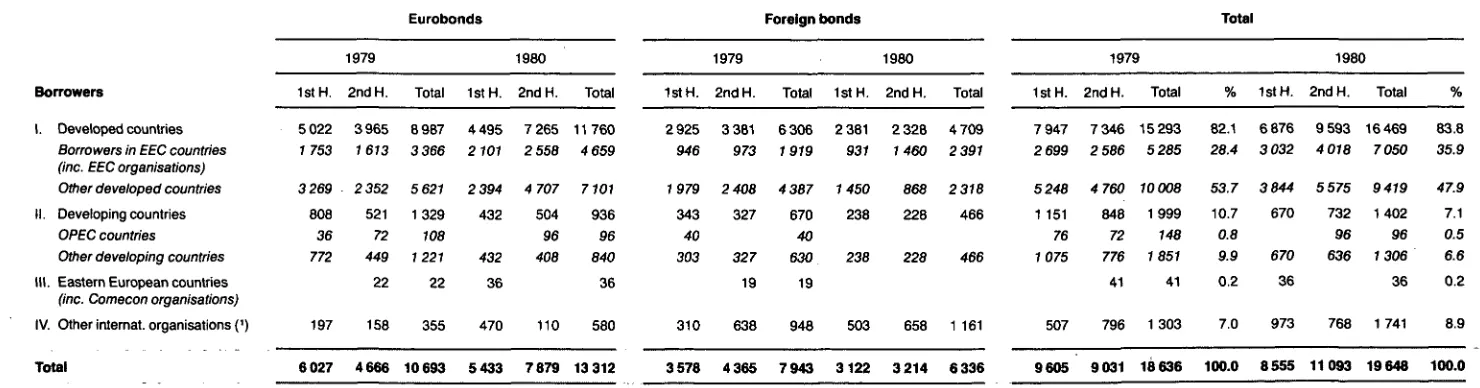
The increase of 1 billion ECU in the total of public bond issues in 1980 was more than accounted for by heavier borrowing on the part of developed countries which raised an additional 1.2 billion ECU last year (see Table 4, page 14). Within the category of developed countries, borrowers in the EEC secured an even larger proportion of bond fi-nance than in 1979. Their share of the total market rose from 28.4% tO 35.9%, while that of borrowers in other developed countries declined from 53.7% to 47.9% despite the more active tapping of external mar-kets by US enterprises and in par-ticular by US banks.
The reasons for the heavier borrow-ing by the EEC were various. The Governments of some Member Countries, for example those of Bel-gium, Denmark and Ireland, sought to fund a part of their borrowing requirements from external sources so as to avoid straining their domes-tic markets too far — though the Belgian borrowing, not being in the form of a public issue, is not covered by these statistics. In a somewhat similar category, public entities in
a number of Member Countries of the European Community raised more finance in 1980 by means of bond issues outside their own na-tional markets. Banks based within the Community also borrowed more internationally in 1980 to finance the expansion of their operations in other currencies, notably in dollars; these banks have all been treated as "borrowers in EEC countries" even where it is known that a part of their equity is held outside the Communi-ty such as by Middle Eastern inters ests.
A substantial part of borrowing by so-called developed countries out-side the EEC was also in the form of issues by national Governments with Sweden figuring prominently. Au-stria, Finland and Australia each launched more than one issue dur-ing the course of 1980 and sdur-ingle issues were made by Norway, New Zealand and South Africa. As men-tioned earlier, US banks and finance corporations were actively seeking finance outside their domestic mar-ket during 1980 and, towards the end of the year, a substantial number of Japanese industrial and commercial enterprises tapped in-ternational and foreign borid mar-kets, taking advantage of a shift of sentiment in their favour inspired by the improving outlook for their economy.
Among "developing countries" as borrowers, the national Govern-ments of the large Latin American countries, Argentina, Brazil, Chile, Mexico and Venezuela, figured prominently but Costa Rica, Thai-land and the Philippines also launched public bond issues. Apart from issues by banks in India, the Ivory Coast, Morocco, Taiwan and Yugoslavia, the remaining opera-tions by developing countries were also carried put on behalf of Latin American borrowers. Capital issues by the World Bank and regional development banks of about 1.45 billion ECU included under "other international organisations" (leaving out borrowing by the Council of Europe Resettlement Fund, Eurofi-ma and the Nordic Investment Bank) should be added to the amount raised on capital markets on behalf of the third world.
Eurobond issues by sector
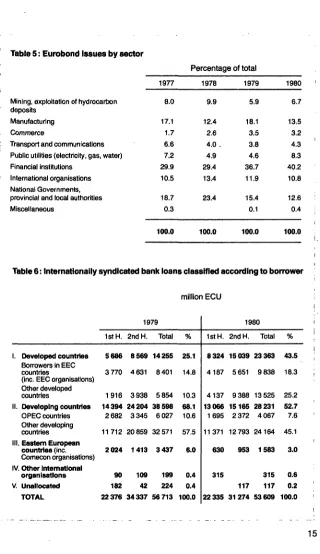
internatipn-al organisations and nationinternatipn-al go vernments and subsidiary au thorities taken together has re mained fairly steady at about two-thirds of the total, though financial institutions have been gaining ground during the last two years mainly at the expense of public au thorities as Table 5, page 15 shows. A fall in finance raised during 1980 by the manufacturing and commer cial sectors, possibly influenced by a clouding of the economic outlook, seems to have had a counterpart in
increased borrowing by public utilities. It would also seem that more finance was being sought on eurobond markets in 1980 than in the previous year for mining ac tivities including the exploitation of hydrocarbon deposits.
Syndicated loans
international lending at medium and long-term by banking syndicates
was relatively subdued in the early months of 1980, partly because of the absence of Japanese banks from the market until the beginning of April — even then their re-entry was limited — and partly because US banks were faced with a strong de mand for credit from their domestic customers. It is also possible that there may have been some reluct ance on the part of borrowers to conclude agreements at a very high initial interest rate as would have happened until about mid-March. Activity rose with a fall in short-term
% 16
15
14
13
12
11
10
Average yields on new bond issues made in selected markets
—:τΐ ^ ^
—'
—^
^
\ ^ _\
,—-1
·
-*^^
Ν
•Si'
_
'>.
-. ,
- — •
s
/
/·
^:
• —
,^
'^.
-— = 1
_
/· / •
^ ^
r-^
—
-Ν 1 ^
J
•
' S »^
-••J
*·
^
Y
- -i
^%
— H
''**l
/
ψ
\
\ ' - 7 ^
V
,.
/ /
ί ι _
• ^
^.· '
•*^
^ >
f • ^
γ-<<
!•
Φ
'
^^
1
---- ' •
" " " Ί
^
>^ ..-^
^
r
• • • ^
Λ\
/ ^ / '
Ν
-•·
r
^ •U^
7 *
" • Ϊ
1>
^
•^
k
• * •
i? Γ
- 4
* " 1
' ^
( f
J
1 '
1
! •
-A
-- '
•^
•»
— • "
^ /
> /
f • /
/
—
[•N
- — .·
/
•v
'*
- ''
f
/ / /
4
/
1
<
*
t
i
f ,'
λ
^
Κ
\y
\ \
1
Ny,\
>5
1
-yf-Γ/
"
μ
\ \
\ >
\ 1 \
ι
1 1 1
S T
-- .,
'
/ / / /
^-^ V ~
t
« 1
% / / /
-·. .
^', /
•
/
•i
/
*^
^ /
A / •
'
f f
/ '
^
r —
-•·
^ ..^
\ /
- }
—#
y —
^^
/ /
— -=
-^.
—
6 — J
J F M A M J J A S
1978
O N D J F M A M J J A S O N D J F M A M J J A S O N D
1979 1980
Euro-$ bond market Euro-DM bond market Swiss market in foreign issues Japanese market in foreign issues
US domestic market (long-term Issues by Aa rated public utilities)
{
bonds with maturities
between 7 and 15 years issued by first-class borrowers Source: EIB
Source: Salomon Brothers
Yields are calculated according to the standard method used by the International Association o\ Bond Dealers - I.A.BD. The sign * indicates the absence of new issues by first-class borrowers.
T a b l e 3: E u r o b o n d a n d f o r e i g n b o n d i s s u e s c l a s s i f i e d a c c o r d i n g t o c u r r e n c y m i l l i o n E C U Currencies US dollars Canadian dollars Deutsctie Mark Pounds sterling Dutch guilders French francs Swiss francs Japanese Yen Other currencies Total IstH. 3 438 248 1641 138 38 160 34 330 6027 1979 2ndH. 3 376 62 786 46 7 110 52 227 4666 Eurobonds Total 6814 310 2427 184 45 270 86 557 10 693 IstH. 3 695 80 1 056 213 34 235 47 73 5433 1980 2ndH. 5 363 104 1395 429 32 346 125 85 7879 Total 9 058 184 2 451 642 66 581 172 158 13 312 IstH.
1 4 3 8
40 49 56 1261 645 89 3 578 1979 2ndH. 1362 1057 55 86 1 113 498 194 4365 Foreign Total 2 800 1097 104 142 2374 1 143 283 7943 bonds 1stH. 951 377 98 120 1 106 363 107 3122 1980 2ndH. 402 655 123 127 69 1311 454 73 3 214 Total 1353 1032 123 225 189 2417 817 180 6336 IstH. 4 876 248 .1681 138 87 216 1261 679 419 9 605 1979 2ndH. 4 738 62 1843 46 62 196 1 113 550 421 9031 Total 9 614 310 3 524 184 149 412 2 374 1229 840 18 636 Tota
%
51.6 1.6 19.0 1.0 0.8 2.2 12.7 6.6 4.5 100.0 IstH. 4 646 80 1433 213 132 355 1 106 410 180 8655 1980 2ndH. 5 765 104 2 050 552 159 415 1311 579 158 11093 Total 10411 184 3 483 765 291 770 2417 989 338 19 648%
53.0 1.0 17.7 3.9 1.5 3.9 12.3 5.0 1.7 100.0T a b l e 4 : E u r o b o n d a n d f o r e i g n b o n d i s s u e s c l a s s i f i e d a c c o r d i n g t o b o r r o w e r m i l l i o n E C U
Eurobonds Foreign bonds Total
Borrowers
I. Developed countries Borrowers in EEC countries (inc. EEC organisations) Other developed countries II. Developing countries
OPEC countries
Other developing countries III. Eastern European countries (inc. Comecon organisations) IV. Other inlemat. organisations (') Total IstH. 5022 7 753 3269 808 36 772 197 6027 1979 2ndH. 3965 1613 2352 521 72 449 22 158
4 6 6 6 Total
8987 3366
5 621 1 3 2 9 108 1221 22 355 10693 IstH. 4 495 2101 2 394 432 432 36 470 5 433 1980 2ndH. 7 265 2 558 4 707 504 96 408 110
7 8 7 9 Total 11760 4 659 7101 936 96 840 36 580 13 312 IstH. 2925 946 1979 343 40 303 310 3 578 1979 2ndH. 3 381 973 2 408 327 327 19 638
4 3 6 5 Total 6306 1919 4 387 670 40 630 19 948 7 943 IstH. 2 381 931 1450 238 238 503 3122 1980 2ndH. 2 328 1460 868 228 228 658 3214 Total 4 709 2 391 2 318 466 466
1 161
6336 IstH. 7 947 2 699 5248 1151 76 1075 507 9605 1979 2ndH. 7 346 2 586 4 760 848 72 776 41 796 9031 Total 15293 5285 10 008 1 9 9 9
748 1851 41 1303 lé 636