Theses
Thesis/Dissertation Collections
2-10-2014
Reconstructing Electrocardiogram Leads From a
Reduced Lead Set Through the Use of
Patient-Specific Transforms and Independent Component
Analysis
Michael H. Ostertag
Follow this and additional works at:
http://scholarworks.rit.edu/theses
This Thesis is brought to you for free and open access by the Thesis/Dissertation Collections at RIT Scholar Works. It has been accepted for inclusion in Theses by an authorized administrator of RIT Scholar Works. For more information, please [email protected].
Recommended Citation
by
Michael H. Ostertag
A Thesis Submitted
in
Partial Fulfillment
of the
Requirements for the Degree of
MASTER OF SCIENCE
in
Electrical Engineering
Approved by:
_________________________________________________ (Gill R. Tsouri, Ph.D. – Advisor)
_________________________________________________ (Daniel B. Phillips, Ph.D. – Committee Member)
__________________________________________________ (Sohail A. Dianat, Ph.D. – Committee Member/Department Head)
ELECTRICAL AND MICROELECTRONIC ENGINEERING DEPARTMENT
KATE GLEASON COLLEGE OF ENGINEERING
ROCHESTER INSTITUTE OF TECHNOLOGY
ROCHESTER, NEW YORK
I would like to give special thanks to my advisor, Dr. Gill
Tsouri, who believed and supported me throughout the
prolonged process. I would also like to thank my loving family,
caring friends, and benevolent muses. All of you played a part in
helping me get where I am today.
ABSTRACT
In this exploration into electrocardiogram (ECG) lead reconstruction, two algorithms
were developed and tested on a public database and in real-time on patients. These algorithms
were based on independent component analysis (ICA). ICA was a promising method due to its
implications for spatial independence of lead placement and its adaptive nature to changing
orientation of the heart in relation to the electrodes.
The first algorithm was used to reconstruct missing precordial leads, which has two key
applications. The first is correcting precordial lead measurements in a standard 12-lead
configuration. If an irregular signal or high level of noise is detected on a precordial lead, the
obfuscated signal can be calculated from other nearby leads. The second is the reduction in the
number of precordial leads required for accurate measurement, which opens up the surface of the
chest above the heart for diagnostic procedures. Using only two precordial leads, the other four
were reconstructed with a high degree of accuracy. This research was presented at the 33rd
International Conference of the IEEE Engineering in Medicine and Biology Society in 2011.1
The second algorithm was developed to construct a full 12-lead clinical ECG from either
three differential measurements or three standard leads. By utilizing differential measurements,
the ECG could be reconstructed using wireless systems, which lack the common ground
necessary for the standard measurement method. Using three leads distributed across the expanse
of the space of the heart, all twelve leads were successfully reconstructed and compared against
state of the art algorithms. This work has been accepted for publication in the IEEE Journal of
Biomedical and Health Informatics.2
These algorithms show a proof of concept, one which can be further honed to deal with
Page 4 of 93
research also revealed the possibility of extracting and monitoring additional physiological
information, such as a patient’s breathing rate from currently utilized ECG systems.
The research is outlined in this thesis as follows. First, the initial research is provided,
which defines the figure of merit and outlines the initial validation of the concept. Then, the first
developed algorithm is presented. It utilizes ICA and cross-correlations to reconstruct precordial
leads from a reduced lead set. This was built upon to create an algorithm to reconstruct a full,
clinical 12-lead ECG from a reduced lead set of either commonly used leads or a set of three
differential measurements. The accuracy of the full reconstruction is compared to similar states of
the art. Lastly, coverage is given to the weakness of the algorithms and paths for future research.
The Matlab code that was instrumental in bringing these ideas to fruition is included in
Appendix A. A Labview application was also developed to showcase the algorithm and an outline
TABLE OF CONTENTS
Abstract ... 3
List of Figures ... 7
List of Tables ... 9
Summary of Contributions ... 10
1. Introduction ... 11
1.1 Introduction to Electrocardiography ... 12
1.2 Independent Component Analysis ... 17
2. Initial Research ... 22
2.1 State of the Art ... 23
2.2 Selection of a Figure of Merit ... 25
2.3 Validation of a Universal Transform Matrix for Vectorcardiograms ... 27
2.4 Validation of the Stationarity of Independent Component Analysis on ECG Leads ... 37
3. Reconstructing ECG Precordial Leads Using Independent Component Analysis ... 39
3.1 Introduction ... 39
3.2 Proposed Method ... 40
3.3 Results ... 45
3.4 Discussion ... 48
Page 6 of 93
4. Reconstructing a Clinical 12-Lead ECG Using Independent Component Analysis ... 51
4.1 Introduction ... 51
4.2 Proposed Method ... 52
4.3 Results ... 57
4.4 Conclusion ... 64
5. Conclusion ... 66
6. References ... 69
Appendix A. Matlab Code for 12-Lead ECG Reconstruction Algorithm ... 72
LIST OF FIGURES
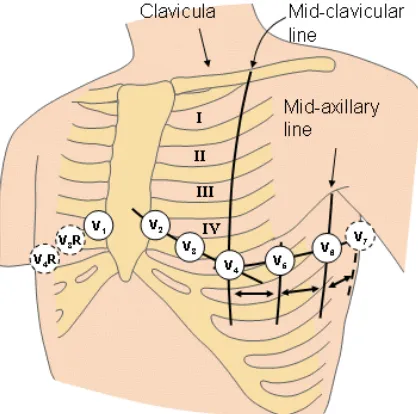
Figure 1-1. Illustration of precordial lead placement on a human subject. ... 15
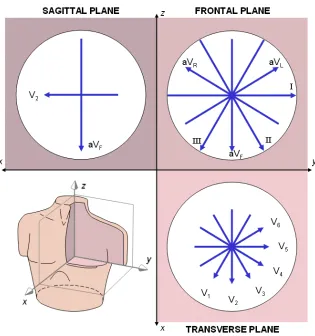
Figure 1-2. Graphical representation of the lead vectors captured with a 12-lead ECG. This model assumes a spherical conductor (white circle) and a centrally located single dipole source for the cardiac signals. ... 17
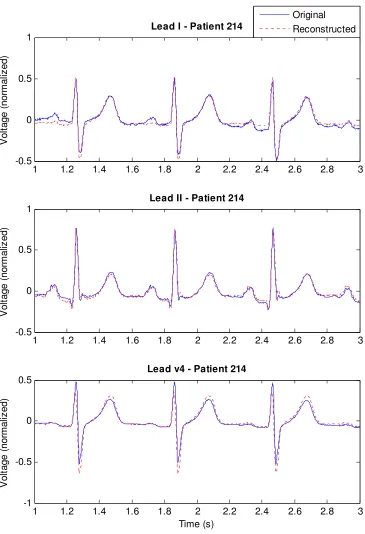
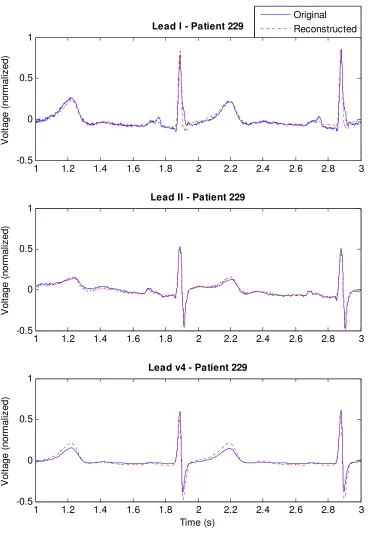
Figure 2-1. Plot of original and reconstructed leads for a male, age 35, of the healthy control group. Leads were reconstructed from Dawson’s transformation on a set of Frank XYZ leads. .. 31
Figure 2-2. Plot of original and reconstructed leads for a male, age 55, of the healthy control group. Leads were reconstructed from Dawson’s transformation on a set of Frank XYZ leads. .. 32
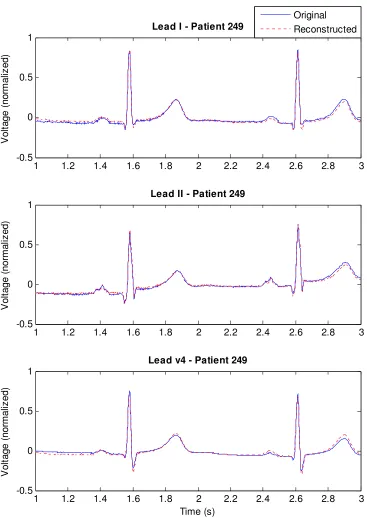
Figure 2-3. Plot of original and reconstructed leads for a male, age 46, of the myocarditis test group. Leads were reconstructed from Dawson’s transformation on a set of Frank XYZ leads. .. 33
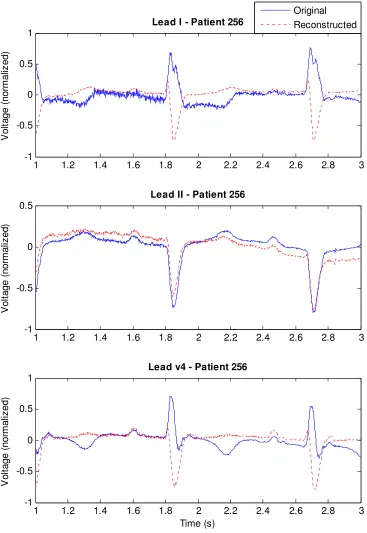
Figure 2-4. Plot of original and reconstructed leads for a female, age 64, of the cardiomyopathy test group. Leads were reconstructed from Dawson’s transformation on a set of Frank XYZ leads. ... 34
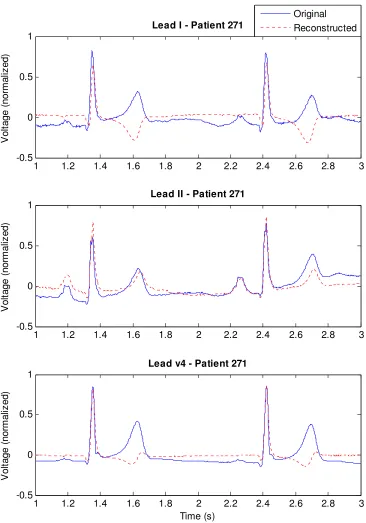
Figure 2-5 Plot of original and reconstructed leads for a male, age 41, of the myocarditis test group. Leads were reconstructed from Dawson’s transformation on a set of Frank XYZ leads. .. 35
Figure 2-6 A graphical display of the correlation between the independent components generated from precordial lead pairs. A high level of correlation between the pairs means that the ICs that were generated from one set could be used to generate the other set of precordial leads. ... 38
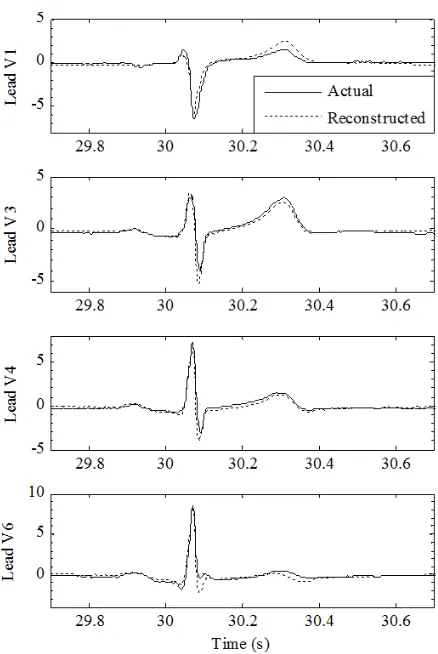
Figure 3-1 Comparisons of actual precordial leads and those reconstructed from the ICs of leads V2 and V5. This patient (s0055) had the closest correlation values across all precordial leads to the mean of the database at 30 seconds after the training period ... 44
Figure 3-2 Histograms of the reconstruction correlation percentages for each of the reconstructed leads. ... 47
Figure 4-1. Flow diagram of proposed method for 12-lead ECG reconstruction from a reduced lead set using ICA ... 53
Page 8 of 93
Figure 4-3. Typical example of reconstructing 12-lead ECG with the proposed method using reduced lead set of X, Y and Z. The blue curves are the original leads of patient S0001 and the red curves are the reconstructed versions. The average percent correlation across all leads is 96.73%. ... 60
LIST OF TABLES
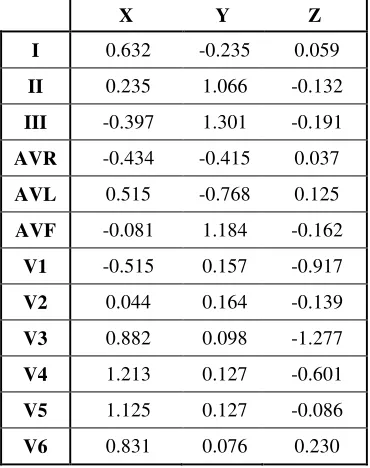
Table 2-1. Coefficients of the Dower Transform for the mixing matrix that computes the standard 12-leads from a VCG lead base. ……… 28
Table 3-1. Statistics of correlations between actual and reconstructed leads for precordial lead reconstruction using the reduced lead set: leads V2 and V5 ………. 46
Table 4-1. Statistics of correlations between actual and reconstructed leads for reconstruction using the reduced lead set: leads I, II, and V2 ………... 58
Table 4-2. Statistics of correlations between actual and reconstructed leads for reconstruction using the reduced lead set: Frank’s XYZ leads……….. 59
Page 10 of 93
SUMMARY OF CONTRIBUTIONS
This research effort focused on reconstructing electrocardiogram (ECG) leads from
reduced lead sets using independent component analysis (ICA) and culminated in the generation
and testing of two algorithms, each of which generated a publication.
1. Precordial lead ECG Reconstruction
An algorithm to reconstruct precordial leads from a two lead set was
developed. Leads V2 and V5 were found to be optimal and generated results with the
highest correlation between original and reconstructed leads.
Ostertag MH and Tsouri GR. Reconstructing ECG Precordial Leads from a Reduced Lead Set Using Independent Component Analysis. 33rd International Conf. of the IEEE Engineering in Medicine and Biology Society (EMBC ’11): 4414-4417, Aug. 30 2011-Sept. 3 2011.
2. Clinical, 12-lead ECG Reconstruction
The precordial lead ECG reconstruction algorithm was expanded and
improved to reconstruct the entire clinical, 12-lead ECG from a three lead set. Leads
I, II, and V2 were found to produce the best results of the standard lead arrangement.
Frank XYZ leads were also used. This algorithm was compared to state-of-the-art
reconstruction algorithms and compared.
Tsouri GR and Ostertag MH. Patient-Specific 12-lead ECG Reconstruction from Sparse Electrodes using Independent Component Analysis. IEEE Journal of Biomedical and Health Informatics, PP(99): 1, December 2013.
1.
INTRODUCTION
For patients released after cardiac surgery, those who have an arrhythmia that only
presents in certain circumstances, athletes seeking ideal training conditions, and medics
overseeing warfighters in the heat of battle all want one capability: remote physiological
monitoring. Remotely monitoring an individual’s electrocardiogram (ECG) can provide critical
information about the health of the subject. Currently, the products for measuring and recording a
patient’s ECG fail to provide a full set of clinically relevant data.
Remote, wireless ECG monitoring is close at hand, though, with only a few technical
hurdles left to overcome. One of these hurdles involves seamlessly incorporating these sensors
into patients’ lives in a non-invasive and foolproof manner. The devices are rapidly becoming
smaller and smaller, making them unobtrusive to the casual observer, and the next step is to
reduce the number of sensors required while keeping the system robust. Even though the number
of sensors that are monitoring the heart is reduced, medical professionals still need to see all
12-leads of the electrocardiogram to make diagnoses. The information is fundamentally missing
without the sensors present to record it, but it can be reconstructed from the other leads with
varying degrees of success.
The three prominent types of lead reconstruction transforms are the universal,
population-specific, and patient-specific transforms. Based on many works in the past, it is widely accepted
that universal transforms, which are developed and intended to work for all people, are not
reliable due to the wide degree of variance across patients and across time. Each patient has a
different composition of chest tissues, different size, shape or location of the heart, and different
levels of aging and disease. Population-specific transforms have proven to be more effective than
Page 12 of 93
classification, the transform becomes much more customized and produces a more accurate
reconstruction of missing leads for that set of patients. The most accurate transform is
patient-specific. Even in carefully selected groups, there still exist anatomical and diagnostic differences
between each person. By generating a transform that is specific to an individual, the best possible
reconstruction occurs. In all cases, the transforms are constant and do not adapt to changes over
time. As with all biological systems, change is a constant; shifting positions, changing activity
levels, and even breathing can affect how well any of the transforms can accurately reproduce the
missing information. Reducing the number of sensors is only half the problem, though. The other
half is maintaining the robustness of the system, which depends on solving a current problem
with ECGs: electrode misplacement.
Electrode misplacement is a common problem in electrocardiography caused typically by
human error. Although an electrode may only be misplaced by a small distance, that misplaced
electrode can change the morphology of a patient’s ECG waveform, leading to a misdiagnosis.
Reducing the effect of this error will not only help hospitals in the accuracy of short- and
long-term monitoring of patients but also increase the convenience of caregivers that place the
electrodes. The goal of this research was to use independent component analysis (ICA) to reduce
this misplacement error and reduce the number of electrodes needed for a clinical 12-lead ECG
measurement.
1.1
I
NTRODUCTION TOE
LECTROCARDIOGRAPHYElectrocardiography provides clinicians with a non-invasive tool that provides detailed
insight into the working of a patient’s heart. Each time the muscles of the heart contract, they
pattern of coordinating contractions, which efficiently move blood throughout the pulmonary and
circulatory systems of the body. Due to the conduction of human tissue, these patterns of
depolarization that originate within the cardiac muscles create small, yet measureable signals on
the surface of the skin that (after being filtered and amplified) provide useful diagnostic
information about the condition of the heart.3
The first prototype system was developed in 1887 by Augustus Désiré Waller, who
placed each limb in a saline solution and used a capillary electrometer to observe the electrical
signals of his own heart.4 It has come a long way since its inception in the late 19th century, both
the technology and the diagnostic capabilities. Today, most cardiologists use a 12-lead system,
which consists of measurements from ten different electrodes. Electrodes placed on the right arm,
left arm, and left leg make up a set of limb leads and a fourth electrode is placed as a reference on
the right leg to either passively or actively reduce noise. The precise placement of the limb leads
is not critical since the limbs are far enough away from the heart that the region is roughly
isopotential. The limb leads provide information of the heart in the frontal plane, which bisects
the body from front to back, and are calculated from the limb electrodes as follows:5
= − (1.1)
= − (1.2)
= − (1.3)
where VI , VII , and VIII represent the three limb leads and φRA , φLA , and φLL represent the potential
at the right arm (RA), left arm (LA), and left leg (LL), respectively. From these leads, a set of
augmented leads was also developed. The augmented leads contain redundant information but
Page 14 of 93
between the one limb electrode and the Wilson’s central terminal, which is the average of the
three limb leads and serves as a reference. While the limb leads provide a look at the activity of
the heart, they are limited to the frontal plane of the body and are typically positioned too distant
from the source to pick up smaller, localized signal irregularities. The addition of precordial leads
solves both of these problems.
The precordial leads consist of a set of six leads placed on the upper thorax as shown in
Figure 1-1. They are spatially close to the front face of the heart and wrap around the chest from
the fourth intercostal space on the right of the sternum to the fifth intercostal space on the left
midline of the torso.4 Due to this spatial proximity, the precordial leads can be used to isolate
signal irregularities that may be difficult to diagnose using the limb leads. The precordial lead
measurements represent the vector from the Wilson’s central terminal to the precordial electrodes
and provide a view of the conduction pathways of the heart in the transverse plane. Without this
information, the dipole movement of the heart cannot be determined in three-dimensional space
and the diagnostic capability of the system is hindered. The six precordial leads (V1 through V6),
the three limb leads, and the three augmented leads form the 12-lead electrograph system, which
aids in diagnosing diseases from atrial hypertrophy to bundle-branch blocks to ventricular
fibrillation.3
Although the electrocardiogram has 12 leads, much of the information is redundant. This
should be readily apparent within the limb leads, which are all based on the difference between
three electrodes, but it also holds for the augmented leads, which are derived from the average of
the limb leads and are based upon the same measurements from the three limb electrodes. The
reason for the redundancy is the ease of recognizing patterns for cardiologists, who can more
easily make a diagnosis by comparing two similar leads at slightly varying angles. This diagnosis
Figure 1-1. Illustration of precordial lead placement on a human subject.5
Using body surface potential distributions as measured on the surface of the skin, the goal
of the inverse problem is to determine the underlying electrical activity of the heart. The actual
source of electrical activity cannot be uniquely determined when the cardiac region is
inaccessible because many different equivalent sources can generate the same set of surface
potentials.6 With the help of modern medicine’s understanding of the anatomy and physiology of
the human heart, the problem can be greatly simplified, and the source of the electrical signals
can be approximated with a high degree of accuracy. This allows for an initial clinical diagnosis
to be made, which typically needs to be verified by other methods, such as auscultation,
angiography, or imaging.4 Geselowitz found that modeling the source of cardiac electrical activity
as a single dipole could account for more than 90% of the activity seen within the heart.7 Using
this approximation, two limb leads and a single precordial lead (V2) contain the vast majority of
information about the contraction pattern of the heart. The information contained in the three
leads can be used to reconstruct the full 12 leads through a series of weighted sum transforms.
[image:16.612.237.446.90.297.2]Page 16 of 93
set of coefficients, which are optimized on a per-patient basis or for a larger population. These
reconstructions have had varying degrees of success, depending on whether the transform was
tailored to the individual or a universal solution.8,9,10,11The success of the reconstruction of
missing leads from a reduced lead set is heavily dependent on the similarity of the ECG
waveform from beat to beat for individual-specific transforms or similarity between patients for
universal or group-specific transforms.
While the variability between patients, termed inter-individual variability, is to be
expected due to varying body compositions and heart location and orientation, the variability
from measurement to measurement of a single patient, termed intra-individual variability, is a
cause for concern for lead reconstruction because of the potential of a misdiagnosis. All current
lead reconstruction techniques rely on the stability of the initial conditions, which were present
during the training of the algorithm. Since the algorithm depends on the coefficients that were
developed during this training period, the reconstruction algorithms can only accurately
reconstruct the missing ECG leads if the relationship between all of the leads remains similar to
the original period. An act as simple as sitting up can change the position of the heart, thereby
fundamentally changing where the electrical sources of contraction are in relation to the
electrodes, which serve as observation points. The intra-individual ECG variability can be
classified into two major categories: beat-to-beat variability and session-to-session variability.
The former is due to changes in respiration rate, heart rate, posture, or noise and the latter is due
mainly to electrode misplacement. A misplaced electrode observes the electrical activity of the
heart from a different angle than an ideally placed electrode. This difference in observation can
result in a change in waveform morphology and potentially a misdiagnosis. In several accuracy
studies, nurses were found to place the electrodes accurately during only 13% to 25% of the
the redundancy of information by reducing the number of leads; by the same token, this makes
them highly susceptible if one lead was misplaced. The error of a misplaced base lead would be
present in each lead that it reconstructed. Both the inter-individual and intra-individual variability
issues may be able to be solved with a statistical method known as independent component
analysis.
[image:18.612.166.481.239.575.2]Page 18 of 93
1.2
I
NDEPENDENTC
OMPONENTA
NALYSISBiomedical signals are typically recorded with a known spatial distribution of multiple
sensors, and the resulting multichannel recording contains temporally and spatially correlated
measurements. The signals of interest are rarely recorded in isolation because as the signals travel
through the body, they become mixed with background activity and noise, which make the
sources within the body challenging to analyze. By applying independent component analysis
(ICA) to these mixed signals, the underlying, independent sources can be uncovered.13
ICA separates out mixed signals into their independent components by exploiting their
independence. This independence is found by focusing on finding sources that are the most
non-Gaussian. When combined, the joint density of Gaussian sources is completely symmetric,
making it impossible to estimate the individual independent sources.14 If there is only one
component with Gaussian distribution, it can be separated from the others, which has been
utilized in ECG noise removal.15 Any number of mixed non-Gaussian sources results in an
asymmetric distribution, which can then be separated as long as there are at least as many
observation points as sources. Each observation consists of a linear combination of the
independent sources; the coefficients of this linear combination form a mixing matrix.
This mixing matrix provides insight into the relative projection strengths of the respective
independent components onto each of the sensors, and by multiplying the underlying independent
sources by the mixing matrix, the original observations can be reproduced. By multiplying the
sensor data by the unmixing matrix that is also obtained at the end of ICA training, a new matrix
will be generated that consists of rows of statistically independent components. The basic linear
models relating the sensor data, independent components, mixing matrix, and unmixing matrix
= and = (1.4)
where the vector represents ‘m’ independent sources, the vector represents an approximation
of , the matrix represents the linear mixing of the sources, the matrix is the linear unmixing
matrix, and the vector is composed of ‘m’ observed signals.13 The mixing matrix is square in
most popular ICA algorithms in order to exploit the inverse matrix to shorten the time of
convergence.
The goal of ICA is to generate the mixing matrix that relates the independent components
to a set of observations; many different methods have been developed to reach this goal. The
research in this paper was done with the FastICA algorithm developed by Hyvärinen and Oja.14
This method seeks to maximize the non-Gaussianity of the resultant independent components by
recursively maximizing both the kurtosis and negentropy of the signals. Kurtosis is the
forth-order cumulant of a signal and is zero for a random Gaussian source. The kurtosis of a signal is
defined as seen in Eq. 1.5.
= !" − 3 $"$ (1.5)
Before calculating the kurtosis of a signal in the FastICA, the signal is preprocessed to have unit
variance, and the algorithm can be simplified to Eq. 6:
= !" − 3 (1.6)
Negentropy has been shown with statistical theory to be a good measure of non-Gaussianity, and
Page 20 of 93
given variance. While it is very useful for determining non-Gaussian sources, it is difficult to
measure without knowledge of the probability distribution function. In the FastICA algorithm, the
negentropy is approximated using formulae developed by Hyvärinen.
% = [ ' − '"($ (1.7)
') =*)+log/0ℎ2) and '$ = − exp 6−7$89 (1.8)
where % is the negentropy approximation for any non-quadratic function ', ') and '$ are
convergent functions used to approximate the negentropy, and 2) is a constant between 1 and 2.
These functions and their derivatives are simple to calculate and are central in converging to
consistent sets of independent sources.
The FastICA algorithm first works by removing the mean from all signals, a process
called centering, and then performing principal component analysis to create a set of orthogonal
signals from the observations. The mixing matrix resulting from these two operations is then run
through a recursive routine that maximizes both the kurtosis and negentropy of the original
sources, thus minimizing the Gaussianity and generating the underlying, independent sources.
The optimized mixing matrix provides a linear transform between the independent sources or
components and the observed signals as seen in Eq. 1.4.
In previous research, ICA has been successfully applied to the electrocardiogram, which
satisfies some of conditions of ICA: the different signal sources of cardiac contraction are linearly
mixed at the ECG electrodes, the time delay in signal propagation is negligible, and there are
generally fewer sources than sensors. The electrocardiogram does violate the ICA assumption of
spatial stationarity, though, since the heart moves during every contraction. This movement may
of ICA to the ECG is the separation of maternal and fetal heartbeats from electrodes placed on the
mother’s chest and abdomen. In the initial signal, the fetal heartbeat cannot be seen, but after
performing independent component analysis, there are clearly two heartbeats, one at 72 bpm and
the other at 106 bpm. By recombining the channels that reflect the mother’s heartbeat separately
from the channels of the fetus and by zeroing out the noisy source, the two heartbeats can be
separated and analyzed independently.16 Other examples include separating noise and artifacts
from the desired signals15 and differentiating mixed biopotentials from each other, such as
separating the interference of the muscle contractions from a blink from an electroencephalogram
(EEG) reading13.
Overall, the concept of applying ICA to ECG monitoring technology is very promising,
and if used properly, can result in reduced noise levels, which commonly plague many
biopotential measurements, and in isolating the independent signals of the heart, allowing for
separation and reconstruction of the cardiac signals. This technology relies heavily on the number
of sources being less than the number of observation points. The sources of the cardiac signal can
be approximated by a dipole model, but in reality, each individual’s heart and specific condition
may have a different number of sources.6 Another potential source of issue is the unordered
nature of the results. ICA may be able to produce independent sources for a set of observations,
but the order is dependent on the convergence of the system to the source that is the least
Gaussian. The unordered independent sources can cause issue for algorithms relying on
consistent convergence to the same components. By imposing spatial and temporal restraints on
the ICA algorithms, more ordered and detailed analysis may be performed and these issues can be
Page 22 of 93
2.
INITIAL RESEARCH
In initial testing, it was quickly shown that static, universal transforms from a reduced set
of stationary leads to the full 12-lead ECG were not effective at reproducing cardiac signals
(Section 2.3). The universal transform relies on the flawed model that all patients are similar.
Patient- and population-specific transforms showed a much better rate of success.11 In addition to
simply reconstructing missing leads, a patient-specific transform utilizing independent component
analysis (ICA) showed promise for developing a method to reduce the error caused by electrode
misplacement, both in clinical and residential settings, by accurately reproducing the same
underlying sources of ECGs from different sets of leads. By using different sets of leads, the
initial experimentation with generating independent sources from standard precordial leads
represented an extreme case of misplaced sets of electrodes (Section 2.4). The following initial
inquiry into using ICA lead to the development of the reconstruction algorithms in Section 3 and
2.1
S
TATE OF THEA
RTFor the reconstruction of missing leads in a reduced lead system, the use of a universal
matrix is not appropriate. The recent work by Dawson10 only marginally improves on the
universal transforms that Dower developed over 40 years ago,9 and the new transformation matrix
that was developed through regression of a linear affine transformation still suffers the problem of
changing the morphology of the waveform. The research done by de Charzal and Celler support
the previous statement that the use of a universal matrix is inappropriate.17 They found that some
applications of the universal transform worked perfectly (correlation of 1.00) but others resulted
in negative correlations as large as -0.63. The future of transformation matrices lies in matching
them to patients through individual adjustments as performed by Man et al.18 or by placing
patients in predefined populations that have population-specific coefficients.11
The traditional 12-lead ECG system produces a substantial amount of redundant
information, which helps at offsetting the effect of electrode misplacement. If one electrode is
misplaced, which happens quite regularly according to Schijvenaars and references,12 the
cardiologists can still make a diagnosis because the information that was contained in that lead is
also present in others. On the other hand, the misplacement of an electrode in a 3-lead VCG
system can invalidate the entire set of measurements. The lack of redundancy and reliability is a
problem in the current reduced lead systems. They are problems that independent component
analysis (ICA) may be able to help solve. ICA can determine the underlying independent sources
of a biosignal, regardless of the placement of the electrodes. In a simple model, the electrical
activity of the heart is a single dipole, which is comprised of three statistically independent,
orthogonal sources. Gulrajani elaborates on the different models that could be used,6 but the
single dipole model is the simplest and only requires a minimum of three leads to unmix to the
Page 24 of 93
noise source could be found with ICA, and with simple statistical algorithms, the noise could be
automatically eliminated for a cleaner, more recognizable signal.15
ICA has not yet been used to compensate for electrode misplacement but this could well
be the future of ECG monitoring. By performing constrained ICA, only one or two electrodes
need to be carefully positioned. These electrodes would be used as references, generating two of
the three sources from a single dipole model, and all subsequent sources could be generated by
haphazardly placed electrodes. Since the position of the initial electrodes is known and assuming
that the patient has a set of patient-specific or population-based transform coefficients, the
traditional 12-lead electrocardiogram can be reproduced in its entirety from a minimal number of
leads without fear of misdiagnosis from the main source of intra-individual variability, electrode
misplacement. This “opportunistic” ECG system is a promising technology of the future, but in
order for it to work, the independent components must be able to be reliably generated with a
2.2
S
ELECTION OF AF
IGURE OFM
ERITIn order to properly compare the results during algorithm development, the first step in
the process was to establish a measure of similarity by which the derived ECG leads can be
compared to the originals. Several different methods already existed and were regularly used for
determining a quantitative measure of error between two signals.
The root-mean-square (RMS) error calculation has been applied across a broad range of
data types and serves as a well-known method of comparison. It was not the most promising
option for comparing sets of independent components or two electrocardiogram (ECG) signals,
though. For one, only portions of the entire signal are utilized by cardiologists for diagnosis. A
small offset error in an irrelevant section of the signal, such as the flat portion between beats,
could contribute a large portion to the RMS error while not affecting the clinical relevance of the
signal. Due to this, a signal with poor performance in the flat region but perfect performance in
the PQRST region could have the same RMS error as a signal with a perfect flat region and a
PQRST region with a changed morphology. The option does exist to selectively perform RMS
calculations, either by using it over specific regions or weighting different regions more heavily
than others.
The next option for a measure of similarity was calculating the cross-correlation between
the signals under question. Correlation was used by de Charzal and Celler for analyzing the
validity of universal linear transformation matrices17 and it could easily be applied to the case of
independent components, which are also linear transforms of the original leads. Cross-correlation
had the benefit of not being affected by a constant offset between the signals and produced
reasonable results when the signals under comparison were negatives of one another as occurs
Page 26 of 93
negative of itself is -1 but the RMS error between the two signals would be unable to represent
the visibly apparent similarity of the signals.
These measures of similarity were compared with others, such as the Kullbeck-Liebler
distance, subjective fidelity comparison, or the peak signal-to-noise ratio, but they were not found
to accurately and quantitatively capture the desired results. Since the best option should perform a
qualitative comparison of the clinical relevance of a modified signal to the original, a metric of
cross correlation percentage was selected. The selected measure was used to compare sets of
independent components that were derived from various lead sets, which consist of two leads for
reconstructing the precordial leads and three leads for reconstructing the full 12-lead set that exist
in a three-dimensional space. The reduced lead sets were drawn from the 12 traditional leads and
the Frank XYZ leads, which were found in various databases such as the Physikalisch-Technische
Bundesanstalt ECG database. The specific figure of merit and its application can be seen in
2.3
V
ALIDATION OF AU
NIVERSALT
RANSFORMM
ATRIX FORV
ECTORCARDIOGRAMSMuch work has been done in recent years to find a universal matrix that could synthesize
a standard 12-lead electrocardiogram from a reduced set of leads. One of the pioneers of creating
reduced lead systems was Dr. Earnest Frank. He researched and mapped body surface potentials
and used this work to create a set of orthogonal leads (X, Y, and Z), which became one of the top
contenders in reduced lead systems, along with the EASI system.8 The Frank leads led to a new
type of electrocardiographic monitoring called vectorcardiography. Ever since Frank popularized
this set of leads, researchers have been attempting to find a universal transform from the
three-lead system to the traditional 12-three-lead, which is most familiar to cardiologists. The pioneering
research was performed by Dower, and the resulting “universal” transform was termed the Dower
transformation matrix.9 In 2009, Dawson and colleagues refined the transformation matrix to
obtain a slightly lower root-mean-square error than the traditional Dower transformation.10They
accomplished this by using an affine linear model as opposed to the strictly linear model used by
Dower. The affine linear model includes a constant that is unrelated to the reduced lead set, and
its inclusion in the model allows the model to compensate for errors introduced by an incorrect
source model or drift biases.
Developing the Transform Matrix
The algorithm for developing Dawson’s affine linear transform proceeds as follows: first,
the Physikalisch-Technische Bundesanstalt Database (PTBDB) patients were divided into healthy
control (HC) and myocardial infarction (MI) patients. The PTBDB contains the standard 12-lead
Page 28 of 93
of each recording were extracted and least-squares fitting was performed on the transform model
seen in Equation 2.1:
: = ; + = = 2> + 2)) + 2$$ + 2?? + = (2.1)
where the vector X contains the three orthogonal leads, the matrix A is the XYX to 12-lead
transformation matrix, and the vector Y contains the calculated 12-lead ECG. In order to obtain
statistically consistent coefficients, at least 25 different patient recordings were needed for both
the HC and MI groups. These coefficients were used to calculate a 12-lead ECG, which was
directly compared with the recorded 12-lead from the database using the R2 metric. The R2 values
resulting from applying Dawson’s transforms were compared to those resulting from applying
Dower’s universal matrix with higher R2 values relating to a closer relationship between the
transformed and original leads. A different method was used for generating the inverse
transforms. Due to the redundancy of the information contained in an 8-lead system, principal
component analysis (PCA) was performed to reduce the redundant information and find a
consistent transformation. The set of coefficients that Dawson et al. obtained by following the
Table 2-1
Coefficients of the Dower Transform for the mixing matrix that computes the standard 12-leads from a VCG lead base.
X Y Z
I 0.632 -0.235 0.059
II 0.235 1.066 -0.132
III -0.397 1.301 -0.191
AVR -0.434 -0.415 0.037
AVL 0.515 -0.768 0.125
AVF -0.081 1.184 -0.162
V1 -0.515 0.157 -0.917
V2 0.044 0.164 -0.139
V3 0.882 0.098 -1.277
V4 1.213 0.127 -0.601
V5 1.125 0.127 -0.086
V6 0.831 0.076 0.230
Performing Morphological Comparisons
The same 15-lead database that was used for developing the transform coefficients was
used to test their validity. Using Matlab 2009, two-second clips of patients ECG recordings were
taken for lead I, lead II, and lead V4. These leads were selected because they offer unique
morphologies and have low (78.30), high (92.27), and medium (89.06) R2 values in comparison
to their transform group.6 For several patients, these three leads were calculated from the Frank
XYZ leads provided using the coefficients in Table 2-1. The original and newly constructed
signals were normalized to have a range of 1 and the mean of each signal was removed. The two
signals were then plotted on the same plot with the original ECG signal in solid blue and the
Page 30 of 93 Results
Five of the patients tested were part of the healthy control group and a representative
sample can be seen in Figure 2-1. and Figure 2-2.. For these patients, the reconstructed lead most
closely matches the original signal for lead II and closely matches for lead V4 with the exception
in the amplitude of the ST region. For the same set of patients, lead I shows significant
morphological changes in the P, Q and S waves between patients.
The next three patients in Figure 2-3. through Figure 2-5 have heart conditions but have
never had a myocardial infarction (MI). Patient 249 has myocarditis but the transform still
produces very accurate reconstructed leads with no significant morphological changes. The next
two patients have cardiomyopathy and myocarditis and the reconstructed leads I and V4 do not
Figure 2-1. Plot of original and reconstructed leads for a male, age 35, of the healthy control group. Leads were reconstructed from Dawson’s transformation on a set of Frank XYZ leads.
1 1.2 1.4 1.6 1.8 2 2.2 2.4 2.6 2.8 3
-0.5 0 0.5 1
Lead I - Patient 214
V o lt a g e ( n o rm a liz e d ) Original Reconstructed
1 1.2 1.4 1.6 1.8 2 2.2 2.4 2.6 2.8 3
-0.5 0 0.5 1
Lead II - Patient 214
V o lt a g e ( n o rm a liz e d )
1 1.2 1.4 1.6 1.8 2 2.2 2.4 2.6 2.8 3
-1 -0.5 0 0.5
Lead v4 - Patient 214
[image:32.612.134.499.95.629.2]Page 32 of 93
Figure 2-2. Plot of original and reconstructed leads for a male, age 55, of the healthy control group. Leads were reconstructed from Dawson’s transformation on a set of Frank XYZ leads.
1 1.2 1.4 1.6 1.8 2 2.2 2.4 2.6 2.8 3
-0.5 0 0.5 1
Lead I - Patient 229
V o lt a g e ( n o rm a liz e d ) Original Reconstructed
1 1.2 1.4 1.6 1.8 2 2.2 2.4 2.6 2.8 3
-0.5 0 0.5 1
Lead II - Patient 229
V o lt a g e ( n o rm a liz e d )
1 1.2 1.4 1.6 1.8 2 2.2 2.4 2.6 2.8 3
-0.5 0 0.5 1
Lead v4 - Patient 229
[image:33.612.133.501.95.628.2]Figure 2-3. Plot of original and reconstructed leads for a male, age 46, of the myocarditis test group. Leads were reconstructed from Dawson’s transformation on a set of Frank XYZ leads.
1 1.2 1.4 1.6 1.8 2 2.2 2.4 2.6 2.8 3
-0.5 0 0.5 1
Lead I - Patient 249
V o lt a g e ( n o rm a liz e d ) Original Reconstructed
1 1.2 1.4 1.6 1.8 2 2.2 2.4 2.6 2.8 3
-0.5 0 0.5 1
Lead II - Patient 249
V o lt a g e ( n o rm a liz e d )
1 1.2 1.4 1.6 1.8 2 2.2 2.4 2.6 2.8 3
-0.5 0 0.5 1
Lead v4 - Patient 249
Page 34 of 93
Figure 2-4. Plot of original and reconstructed leads for a female, age 64, of the cardiomyopathy test group. Leads were reconstructed from Dawson’s transformation on a set of Frank XYZ leads.
1 1.2 1.4 1.6 1.8 2 2.2 2.4 2.6 2.8 3
-1 -0.5 0 0.5 1
Lead I - Patient 256
V o lt a g e ( n o rm a liz e d ) Original Reconstructed
1 1.2 1.4 1.6 1.8 2 2.2 2.4 2.6 2.8 3
-1 -0.5 0 0.5
Lead II - Patient 256
V o lt a g e ( n o rm a liz e d )
1 1.2 1.4 1.6 1.8 2 2.2 2.4 2.6 2.8 3
-1 -0.5 0 0.5 1
Lead v4 - Patient 256
[image:35.612.127.494.100.633.2]Figure 2-5 Plot of original and reconstructed leads for a male, age 41, of the myocarditis test group. Leads were reconstructed from Dawson’s transformation on a set of Frank XYZ leads.
1 1.2 1.4 1.6 1.8 2 2.2 2.4 2.6 2.8 3
-0.5 0 0.5 1
Lead I - Patient 271
V o lt a g e ( n o rm a liz e d ) Original Reconstructed
1 1.2 1.4 1.6 1.8 2 2.2 2.4 2.6 2.8 3
-0.5 0 0.5 1
Lead II - Patient 271
V o lt a g e ( n o rm a liz e d )
1 1.2 1.4 1.6 1.8 2 2.2 2.4 2.6 2.8 3
-0.5 0 0.5 1
Lead v4 - Patient 271
Page 36 of 93 Discussion
While the Dawson’s coefficients may have an average R2 value of 84.79 for the health
control patients, the so-called universal matrix does not accurately reproduce the morphology of
the original ECG waveform for all leads. The results seen below also question the appropriateness
of population-based coefficients. The patients in Figure 2-1. to Figure 2-3. and Figure 2-5 are all
males between the ages of 35 and 55. The first two are healthy controls and the last two have
been diagnosed with myocarditis. These patients are very similar and would likely belong to the
same group classification, but the transform matrix does not perform equally well across them.
The patients in Figure 2-1. and Figure 2-2. demonstrate a reconstructed ECG that is almost
perfectly correlated to the original while the patient in Figure 2-3. through Figure 2-5 shows a
reconstructed ECG that has very poor correlation. This range in correlation using universal
transformations matches the results seen in a previous study by de Charzal and Celler.17
The R2 value for the reconstructed leads is deceptively high for the level of
morphological error seen when performing the lead transforms. Although the RR, QT, and ST
intervals have remained relatively constant through the transform, the claim that the linear affine
transformation matrix should be used for diagnoses requiring use of the waveform morphologies
is strongly questioned. Significant variability in the level and type of introduced error has been
observed and the use of a universal matrix for VCG to 12-lead ECG transforms may be
inappropriate. Patient-specific coefficients have been shown to produce much better results11,17
2.4
V
ALIDATION OF THES
TATIONARITY OFI
NDEPENDENTC
OMPONENTA
NALYSIS ONECG
L
EADSBefore ICA could be applied to reduce the error caused by electrode misplacement, the
spatial stationarity of the independent components (ICs) was validated across the set of standard
12-leads. ICs were generated from varying pairs of leads from the standard 12-lead set using the
FastICA algorithm.14 The ICs were manually ordered such that each set of ICs was matched with
similar looking ICs from the lead sets under consideration. A correlation calculation was
performed between each similar IC pair and the lowest correlation value among all generated ICs
was recorded and displayed in the colorplot in Figure 2-6.
During this process, it was found that the ICs that were generated with any two
combination of leads I, II, III, AVR, AVL, and AVF and a precordial lead had very high
similarities to the ICs generated by any other combination of the aforementioned leads and the
same precordial leads. This finding is supported by the method in which the ECG data is
obtained. Leads I, II, and III are measured using shared points on the torso, which allows any lead
to be calculated from the other two; AVR, AVL, and AVF are augmented leads that are also
calculated based on the limb leads. Since any two leads contain all of the relevant information
about all six, it follows that their independent components should be the same, which was found
to be true.
After the first confirmation of the potential power of ICA, the correlation between ICs of
different precordial lead pairs was examined to determine if a similar sort of spatial independence
existed. The same level of correlation between different lead sets for the limb leads was not seen
in the precordial leads, but there was a relatively high level of correlation between the ICs
generated from proximal lead sets. For example, precordial leads V3/V5 generated similar ICs to
Page 38 of 93
an extreme case of electrode misplacement. The success at generating similar ICs was very
promising and lead to the development of the first algorithm, which reconstructed missing
precordial leads (Section 3).
Figure 2-6 A graphical display of the correlation between the independent components generated from precordial lead pairs. A high level of correlation between the pairs means that the ICs that were generated from one set could be used to generate the other set of precordial leads.
ICs from Precordial Le ad Sets
IC s fr o m P r e c o r d ia l L e a d S e ts
Correlation of Independent Components between Precordial Lead Pairs
[image:39.612.128.576.200.519.2]3.
RECONSTRUCTING ECG PRECORDIAL
LEADS USING INDEPENDENT COMPONENT
ANALYSIS
In this section, precordial lead reconstruction from a reduced set of leads is considered.
We propose the use of independent component analysis to train patient-specific transforms from a
reduced lead set to the six precordial leads of the standard 12-lead electrocardiogram. The
proposed approach is applied to a publicly available database comprising 549 ECG recordings of
patients with varying cardiovascular conditions. The fidelity of reconstruction is measured using
percent correlation between the actual and reconstructed signals following a 30 seconds time
lapse. The mean correlation is over 95% with a standard deviation under 12.7% for all
reconstructed leads. The results demonstrate the potential of the suggested approach to provide a
reliable solution to precordial leads reconstruction. This research was presented at the 33rd
International Conference of the IEEE Engineering in Medicine and Biology Society in 2011.1
3.1
I
NTRODUCTIONThe electrocardiogram (ECG) is the most common procedure for diagnosing
cardiovascular problems and a critical tool for long-term monitoring of patients.19 While most
physicians prefer the diagnostic capabilities of traditional 12-lead systems, it is commonly not
fully implemented for patient comfort and caregiver convenience.
Of the 10 electrodes used in a 12-lead system, the most problematic are the unipolar leads
across the precordium, of which leads V3 and V4 can complicate diagnostic procedures, such as
Page 40 of 93
precordial leads have substantial redundant information due to proximity and since their sources
can be approximated by a dipole, they are prime candidates for reduction by ICA.
In this section, we propose and investigate reconstructing precordial leads in a
patient-specific approach from their underlying sources using ICA. We are unaware of previous attempts
to use ICA for ECG lead reconstruction.
The rest of the section consists of an overview of the Proposed Method in Section 3.2, a
summary of the Results in Section 3.3 when applying the approach to a well-known and publicly
available ECG database, a Discussion in Section 3.4, and the Conclusion in Section 3.5.
3.2
P
ROPOSEDM
ETHODThe proposed precordial lead reconstruction follows a multi-stage approach. First,
preprocessing is performed on the ECG signal to condition it and to locate the QRS complexes.
Next, a training sequence is performed to obtain a set of patient-specific transforms () from the
independent sources of the precordial leads () to the full set () as seen in (3.1). Then, the excess
electrodes may be removed and the algorithm will continue to reconstruct the missing leads. In
what follows, each step is described in more detail.
= (3.1)
ECG Dataset and Preprocessing
The work presented in this paper used the Physikalisch-Technische Bundesanstalt (PTB)
diagnostic ECG database as made available through PhysioNet.21 The database contains 549 ECG
myocardial infarctions, and the remainder with other cardiac diagnoses. For each recording, the
12 traditional and three Frank leads were captured simultaneously at a sampling frequency of
1 kHz.
The preprocessing stage encompasses two steps: filtering and beat detection. A set of
cascading digital filters were used. The first was a high-pass filter with a cutoff frequency (@A) of
0.5 Hz to remove the baseline drift. The second was a low-pass filter with an @Aof 150 Hz to
reduce the amount of noise in the signal. Both filters were developed to meet AHA standards
(outlined in [19]) using the Parks-McClellan algorithm.22 The filtered signal was then put through
a QRS detection algorithm similar to the Pan-Tompkins QRS detection algorithm. A moving
average of 100 samples (100 ms) was taken of the square of the approximate derivative as
obtained with the function seen below:
[B( = −[B − 10( − 2[B − 5( + 2[B + 5( + [B + 10( (3.2)
The resulting function was normalized and the peaks were found that had a value above
the threshold of 0.125 and that occurred at least 200 ms from the previous peak. This length of
time was selected because it is the minimum time between beats due to physiological limitations.
Once the peaks were found, the beat domain was defined as spanning three-eighths the time
between the current and previous peak and five-eighths the time between the current and next
peak.
Transform Training Sequence
Leads V2 and V5 were used to reconstruct the other precordial leads due to their
Page 42 of 93
correlation between the ICs of various sets of precordial leads with those of V2 and V5. Using
ICA over the two leads generated two ICs, which represent the underlying sources as a dipole.
For training, we made use of all six precordial leads. The first valid beat was used as a
training sequence to determine a transform between the ICs of leads V2 and V5 and the missing
precordial leads V1, V3, V4, and V6. First, each lead had the mean removed and was normalized
to unit variance. Then, the 4-by-2 mixing matrix was generated to reconstruct the four missing
leads from the pair of ICs generated from leads V2 and V5. It was obtained by performing
FastICA14 on several sets of lead combinations that had previously shown to produce ICs that
were highly correlated to those of leads V2 and V5. As part of the ICA solving procedure, mixing
matrices are generated that relate the observations and ICs as seen in (3.1). The coefficients that
make up the mixing matrices of (V1,V5), (V3,V5), (V2,V4), and (V2,V6) were used to create a
new mixing matrix that could reconstruct V1, V3, V4, and V6, respectively. For example, the
application of ICA to leads V1 and V5 resulted in the square mixing matrix as seen in (3.3). The
elements relating to V1 were placed into a new 4-by-2 mixing matrix, which can reconstruct all
missing leads from a set of ICs (3.4).
GH)HIJ = K22H) LH)
HI LHIM KNO
)
NO$M
P
H)
H?
H!
HQ
R = S
2H) LH)
2H? LH?
2H! LH!
2HQ LHQ
T KNONO)
$M
Due to the non-ordered and sign-independent nature of ICA, the leads were sorted based
upon the correlations of each lead combination’s set of ICs with the (V2,V5) IC pair. The sorted (3.3)
reconstruction mixing matrix, the original ICs of V2 and V5, and the transform matrix between
the ICs and (V2,V5) were saved for future use.
Reconstruction Sequence
For reconstruction, we used leads V2 and V5 to reconstruct all other precordial leads.
Each beat after the training sequence was handled in the following manner. The mean of the beat
was removed and the variance normalized. Then, ICA was performed on V2 and V5, but instead
of using a random initial mixing matrix for the iterative solving procedure in the FastICA
algorithm, the original transform matrix was provided as an initial guess. This helped direct the
solution to a similar set of ICs and shortened the time of convergence.
Even though an initial guess was provided, the FastICA algorithm occasionally
converged to a switched or negative IC pair, which was sorted in the following manner. The
resulting IC pair and the original ICs that were generated during training were downsampled by a
factor of 5 and compared. A correlation function was formed that was the sum of the absolute
value of the correlations for the two possible configurations of ICs:
Config. 1 Config. 2
K|NO|NO)0|
$0|M ≈ K
|NO)|
|NO$|M K
|NO)0|
|NO$0|M ≈ K
|NO$|
|NO)|M
Since the ICs were expected to match each other, configuration 1 was given a preferential
weight of 1.25. The two functions were compared by the above metric and the set that had a
higher maximum correlation was selected. The index of the maximum and individual correlation
Page 44 of 93
and the sorted reconstruction mixing matrix from the training sequence, V1, V3, V4, and V6 were
[image:45.612.214.433.163.490.2]reconstructed from the ICs of (V2,V5) using (3.4).
Method of Comparison
In order to compare the actual lead signals to the reconstructed signals, a percent
correlation (W) was utilized as the figure of merit, which resembles the similarity coefficient used
in [25]. The percent correlation metric was calculated per lead in the following manner:
W = ∑\Z]+YZY[Z
^∑\Z]+YZ8^∑\Z]+Y[Z8× 100% (3.6)
where the index value a represents the samples within a beat of length b samples, ;c is the
original ECG signal, and ;[c is the reconstructed ECG signal. A value of 100% represents perfect
correlation between the two signals while lower values indicate a worse timing alignment.
Correlation was used instead of other measures such as Root-Mean-Square Error (RMSE)
because correlation speaks to how well the timing of the signals is aligned rather than the absolute
value. In many applications of ECG, these timing features are much more critical than absolute
values.
The original and reconstructed waveforms were compared at several time instances after
the training sequence and the percent correlation values were plotted on a histogram. This
allowed for a direct, visual comparison of the changes in the fidelity of reconstruction over time.
3.3
R
ESULTSWe ran the precordial lead reconstruction algorithm over 548 of the 549 recordings in the
PTB database from the beat immediately following the training sequence (t=0 sec) to the beat that
Page 46 of 93
because the V1 lead was removed mid-recording. The histogram of the correlations can be seen in
[image:47.612.143.503.201.245.2]Figure 3-2 and the statistically summary of the distributions can be found in Table 3-1.
Table 3-1
Statistics of correlations between actual and reconstructed leads for precordial lead reconstruction using the reduced lead set: leads V2 and V5
Time V1 V3 V4 V6
0 sec µ (σ) 91.7 (12.4) 97.5 (4.8) 95.8 (7.6) 96.8 (4.7) 30 sec µ (σ) 91.5 (12.6) 97.0 (7.4) 95.2 (8.9) 96.5 (5.0)
All leads were reconstructed with a high average correlation percentage and low
variance. Leads V3 and V6 had the best reconstructions on average (all above 96.4% for both 0
and 30 sec), followed by lead V4 (above 95.2% for both 0 and 30 sec). Lead V1 was
reconstructed with the lowest average correlation percentage (over 91.5% for both 0 and 30 sec)
and the largest standard deviation (under 12.7% for both 0 and 30 sec). This was expected as
problems in the atrium have a stronger effect on the signal recorded by lead V1 than the other
precordial leads due to V1’s proximity to that region of the heart.20 V1 was the most problematic
Figure 3-2 Histograms of the reconstruction correlation percentages for each of the reconstructed leads.
We found that the algorithm had difficulty accurately reconstructing irregular beats that
were not present in the training sequence. This was due to either a change in ICs or an error in the
sorting process and was most common in patients with dysrhythmia. When the irregular beats
were reconstructed, they looked differently than the typical heartbeat of the patient but did not
necessarily have the exact shape of the actual irregular beat.
Figure 3-1 presents an illustrative case of reconstruction of a patient 30 seconds after the
training sequence occurred. For presenting an unbiased sample, we chose to present a pulse with
reconstruction quality that most closely matches the mean correlation percentages, rather than the
50 60 70 80 90 100
0 0.05 0.1 0.15 0.2 0.25 0.3
Reconst. Lead V1
P er ce n t o f P at ie n ts
50 60 70 80 90 100
0 0.05 0.1 0.15 0.2 0.25 0.3
Reconst. Lead V3
50 60 70 80 90 100
0 0.05 0.1 0.15 0.2 0.25 0.3
Reconst. Lead V4
Correlation Percentage P er ce n t o f P at ie n ts
50 60 70 80 90 100
0 0.05 0.1 0.15 0.2 0.25 0.3
Reconst. Lead V6
Correlation Percentage t = 0 sec
[image:48.612.118.514.101.422.2]Page 48 of 93
best reconstructed pulse. Due to the locations of V2 and V5, the interpolated leads, V3 and V4,
were reconstructed the best and the extrapolated leads, V1 and V6, had larger reconstruction
error. If the patient had been diagnosed with a problem in the atrium rather than an anterior
myocardial infarction, the reconstruction of lead V1 would have been much worse.
3.4
D
ISCUSSIONThe algorithm was tested up to 30 seconds after the training period, but even in that short
amount of time, we were able to observe the adaptive nature of ICA. The reconstruction mixing
matrix from the ICs to the precordial leads remained constant but the transform from (V2,V5) to
their ICs changed with each beat. This feature results in a time-adapting and patient-specific
transform from (V2,V5) to the other precordials that can effectively adapt to changing beat
patterns. This is a clear advantage over static linear transformations.
Although the precordial reconstruction worked on the majority of patients with a high
level of fidelity, the system is susceptible to errors when patients have atrial conditions, which are
most strongly detected in lead V1.20 Since the reconstruction is based on the signals recorded at
V2 and V5, an issue that is present in lead V1 may not be accurately reconstructed. On the other
hand, an error in lead V2 or V5 will cause an error to be propagated across all reconstructed
leads. For patients who have displayed signs of dysrhyhmias or have atrial conditions, it is
suggested that lead V1 is not removed from the patient since it cannot be reliably reconstructed
and is important for accurate diagnosis. This can be checked in the initial training phase when all
six precordial leads are attached. The electrodes for lead V1, V3, V4, and V6 are removed after
Due to a lack in consistent methods and metrics in previously published works, our
reconstruction results are difficult to compare to other studies. Nelwan et al.23 performed
reconstruction of four missing precordial leads from V2 and V5 and found a median correlation
of 0.964 for a general set of coefficients and 0.994 for a patient-specific set. These numbers are
high for several reasons: first, they present the median correlation instead of the average, reducing
the effect of outliers that were present in our results; second, the ECG waveforms that were used
were the median complexes about a certain time; and third, all patients were of the same
diagnostic class and the most difficult to reconstruct, patients with arrhymias and left bundle
branch blocks, were excluded from the reconstruction test. In other work, the improved EASI
coefficients as derived by [26] were used to reconstruct the precordials with varying degrees of
success. The average correlations across the precordials with the improved coefficients range
from 0.919 to 0.941, which fall below our calculated average correlation of 0.950. Also, our
correlation calculations do not include leads V2 or V5, which would have perfect correlation
because they did not need to be r