James Hannan, Editor
•
Contributors To This Volume
Jagdish R. Dalal
Manager, Management Information Systems, Brookhaven National Laboratory, Upton NY
Pat Duran Consultant, Millis MA
Louis Fried SRI International, Menlo Park CA
AI McCready
Manager of Information Systems Consulting, Arthur Young & Company, Salt Lake City UT
Susan H. Nycum
Attorney, Gaston Snow & Ely Bartlett, Palo Alto CA Paul M. Raynault
Computer Financial I ncorporatea , Hackensack NJ William E. Sanders
Vice PreSident, Management Information Systems, Ticor Title Insurers, Los Angeles CA
David Tommela
Assistant Manager, Information Systems, Southern California Edison Company, RosemeadCA
Robert E. Umbaugh
Vice President, Southern California Edison Company, Rosemead CA Raymond P. Wenig
PreSident, International Management Services Incorporated, Framingham MA Larry D. Woods
A
AUERBACH @
~
Data Processing
Management
Edited by James Hannan
AUERBACH Publishers Inc Pennsauken NJ
Library of Congress Catalog Card Number 82-11341
ISBN 0-442-20922-3
All rights reserved. No part of this work covered by the copyright hereon
may
be reproduced or used in any fonn or by any means-graphic,
electronic, or mechanical, including photocopying, recording, taping,
or information storage and·retrieval systems-without written
permis-sion of the publisher.
Printed in the United States of America
Published in the United States in 1982
by Van Nostrand Reinhold Company Inc
135 West 50th Street
New York NY 10020 USA
16 15 14 13 12 11 10 9 8 7 6 5
Library of Congress Cataloging
in
Publication Data
Main entty under title:
A Practical guide to data processing management.
(Auerbach data processing management library; v. 1)
1. Electronic data processing--Management.1. Hannan,
James, 1946-
. ll. Series.
QA76.9.M3P7 1982
658' .054
82-11341
Preface
vii
Introduction
ix
Chapter
1
DP Management: A Modern Challenge
Robert E. Umbaugh
...
2
Long-Range Planning
Louis Fried
...
93
DP Steering Committees
AUERBACH Editorial Staff ... 21
4
DP Policies and Procedures
Robert E. Umbaugh
...
295
Management Control Reporting
Louis Fried
...
536
Financial Alternatives for
Computer Acquisition
Paul M. Raynault ... 67
7
User Chargeback
William E. Sanders
...
838
Problems in Decentralized Computing
Larry D. Woods ... 99
9
A Strategy for Systems Implementation
David Tommela ... III
10
Selecting Software Packages
RaymondP. Wenig ... 127
11
Structured Techniques
12
Protecting Proprietary Interests
in
Software
Susan H. Nycum ... 147
13
Security
In its relatively brief existence, the computer has emerged from the back rooms of most organizations to become an integral part of business life. Increasingly sophisticated data processing systems are being used today to solve increasingly complex business problems. As a result, the typical data processing function has become as intricate and specialized as the business entetprise it serves.
Such specialization places a strenuous burden on computer professionals. Not only must they possess specific technical expertise, they must understand how to apply their special knowledge in support of business objectives and goals. A computer professional's effectiveness and career hinge on how ably he or she manages this challenge.
To assist computer professionals in meeting this challenge, AUERBACH Publishers has developed the AUERBACH Data Processing Management Library. The series comprises eight volumes, each addressing the
management of a specific DP function:
A Practical Guide to Data Processing Management A Practical Guide to Programming Management
A Practical Guide to Data Communications Management A Practical Guide to Data Base Management
A Practical Guide to Systems Development Management A Practical Guide to Data Center Operations Management A Practical Guide to EDP Auditing
A Practical Guide to Distributed Processing Management
Each volume contains well-tested, practical solutions to the most common and pressing set of problems facing the manager of that function. Supplying the solutions is a prominent group of DP practitioners-people who make their living in the areas they write about. The concise, focused chapters are designed to help the reader directly apply the solutions they contain to his or her environment.
AUERBACH has been serving the information needs of computer professionals for more than 25 years and knows how to help them increase their effectiveness and enhance their careers. The AUERBACH Data Processing Management Library is just one of the company's many offerings in
this field.
James Hannan Assistant Vice President AUERBACH Publishers
The extraordinary advances in computer and communications technology during the past 30 years have far exceeded our ability to apply and manage them in the business environment. This state of affairs is more a result of the dizzying rate of technological change than it is of benighted manage-ment; announcements of new and radically improved technologies are made with disquieting regularity. It is not surprising, then, that many of those charged with applying the computer in solving business problems have eagerly adopted new "solutions" and then searched frantically for appropriate "prob-lems."
Although rapid technological change may, in large measure, account for the relatively underdeveloped state of data processing manage-ment, computer professionals themselves bear a good portion of the responsi-bility. Computing machinery has evolved well beyond the early electronic accounting machines that were wired and supervised by technical wizards to perform a limited number of applications for the company controller. Comput-ers have changed, and the array of applications they support has broadened considerably.
For their part, however, computer professionals have been slow to make the transition from technical supervisor to business manager. All too often they have failed to develop the management skills needed to plan, implement, and manage the introduction and use of computers in their organi-zations. Instead of being the masters of the new technology, they have some-times become its unwitting victims.
Thus the challenge for data processing managers in the eighties is to combine technical expertise with general management skills-to feel as comfortable in the upper management councils of their organizations as they do in the data center. This volume of the AUERBACH Data Processing
Manage-ment Library is designed to help OP managers meet that formidable challenge.
We have commissioned an outstanding group ofOP practition-ers to share the benefits of their extensive and varied experience. Our authors have written on a carefully chosen range of topics and have provided proven, practical advice for managing the OP function productively.
In Chapter One, "OP Management: A Modem Challenge," Robert E. Umbaugh comprehensively surveys the challenges facing OP man-agers and discusses the types of training and skills needed to meet them.
One very important management skill is the ability to develop a long-range DP plan that supports the organization's goals. In "Long-Range Planning," Louis Fried details the elements of such a plan and offers practical advice for developing a workable strategy .
DP steering committees have been a mainstay of many organi-zations for some 15 years. Because of the number of pitfalls associated with steering committees, however, few have succeeded. The AUERBACH Edito-rial Staff discusses the' advantages and disadvantages of steering committees and describes a proven strategy for their successful implementation in Chapter Three.
While most DP managers recognize the importance of policies and procedures in enhancing control, promoting consistency in operations, and increasing productivity, few have taken the time to develop and publish such guidelines. Robert Umbaugh describes how to coordinate, administer, inter-pret, and introduce procedures in a DP installation in his "DP Policies and Procedures. " He also provides practical guidelines for controlling the develop-ment of a pt;'OCedures manual, including sample formats and developdevelop-menttools.
In addition to policies and procedures, the DP manager needs a way to measure DP performance if he or she is effectively to control the data processing function. To this end, Louis Fried proposes a comprehensive management control reporting system in Chapter Five.
Expenditures for equipment generally represent a sizable por-tion of any data processing budget. To allocate equipment dollars cost-effectively, the DP manager needs a thorough understanding of the various financial options available. In "Financial Alternatives for Computer Acquisi-tion, " Paul M. Raynault provides explanations and examples of the common alternatives to help the DP manager make informed financial decisions.
DP managers must also be mindful of the costs that arise from providing selVices to user departments. Chargeback systems offer a method of accounting for these costs. Designing and implementing such systems can be complex and have a significant impact on user/DP relations. William E. Sanders addresses the objectives ofDP chargeback systems and offers a seven-step program for their implementation.
Even with an effective chargeback system, providing selVice
to user departments can become problematic if applications backlogs begin to build. Users often attempt to circumvent backlogs by installing their own mini-or microcomputers. In "Problems in Decentralized Computing," Larry D. Woods discusses the many problems that stem from user independence and recommends that the DP and user departments adopt a cooperative approach.
Perhaps the most effective way to obviate user impatience is to shorten the chronically lengthy development times for new applications. In his
"A Strategy for Systems Implementation," David Tommela presents strate-gies for rapid attainment of systems benefits and for improved systems quality with minimal impact on users and reduced pressure on the DP department.
As part of their efforts to meet user demand for new systems, many DP installations have turned to packaged software. Finding, evaluating, and possibly modifying packaged software, however, is an often costly and risky process. Raymond P. Wenig, in "Selecting Software Packages," identi-fies the rewards and risks of using software packages and outlines the requisite steps for their successful acquisition.
For applications developed in-house, many DP managers rely on structured techniques to increase analyst/programmer productivity and user satisfaction. Pat Duran and AI McCready provide a general overview of these techniques, explain the reasons for using them, and outline their benefits in Chapter Eleven.
Whether software is developed in-house or acquired from a vendor, legal issues surround its ownership, use, and disclosure. In a chapter refreshingly free from legalese, Susan H. Nycum discusses the current legal status of software and the types of protection available; she also provides suggestions that can help users and developers of software obtain full legal protection.
Perhaps no other aspect of DP management has gained as much public attention in recent years as computer security. Well-publicized computer-related crimes, disasters, and breaches of privacy have all contrib-uted to heightened public awareness of security and privacy issues and in-creased the pressure on DP managers to protect their organizations' information resources. In his chapter on computer security, Jagdish R. Dalal provides a general overview of security problems and outlines procedures for developing and maintaining a cost-effective security program.
~
DP Management:
A Modern
Challenge
by Robert E. UmbaughINTRODUCTION
Twenty-five years ago, the first general-purpose business computing equipment entered the market. With it came opportunities for significant improvements in productivity.
Initially, the most common application, in business and govemment, was accounting. It was not unusual, therefore, for the computing function to develop in the department of the controller. The equipment, in the fonn of the electronic accounting machine (EAM), frequently appeared before there were enough people qualified to wire and run it. As applications began to extend beyond accounts receivable and payable, the job of EAM room supervisor often fell to the individual most adept at plug board manipulation. He or she had no formal supervisory training-but simply developed along with the job.
Just as the early aircraft leaders were those pilots who survived the experi-ments and crashes of the first planes, the first EAM room supervisors were those who survived the early failures ofDP experimentation. Very often, these imaginative pioneers saw beyond the most obvious first steps in applying this new technology to the business environment.
As the value of the EAM was proven and its applicability transcended the bounds of accounting, new problems arose. For the first time, the self-trained EAM supervisor had to deal with multiple users and the resulting need to allocate resources. Priorities had to be established, user requirements had to be more fonnally documented, and supervisors had to become familiar with such new functions as inventory control. These demands placed new burdens on the EAM supervisors, some of whom were now being called DP managers. Significantly, DP budgets were now beginning to catch the attention of top management. Although some new managers were able to handle these complex demands, many were not.
THE MEANING OF DP MANAGEMENT
at extraordinary rates. From primitive beginnings, it has become one of the central functions in the modern organizational structure, whether in business, academia, or government. Most organizations now depend on the reliable and continuing operation of a computer. Relatively few executives, however, understand the workings of a computer; in fact, most are in awe of it. The DP manager, then, must bear the responsibility for properly applying this technol-ogy to the problems of the organization.
The DP manager has become' 'the man in the middle, " although he is often unprepared for the task. This is a tremendous responsibility and one that many have unwittingly assumed. It is unreasonable to assume that a person can automatically progress from supervisor to manager. A supervisor deals with short-range objectives, a limited mixture of resources, and a limited number of tasks. He or she is usually not concerned with long-range trade-offs or resource acquisition. Supervisor contacts are usually with people at a similar corporate position. Opportunities to investigate the intricacy of the total organization are, therefore, rare. This did not pose a problem when the demands on the DP manager or supervisor were relatively simple and contained; however, this is not the case today.
Information that required a month of processing 25 years ago can now be processed in a matter of minutes. The modern DP staff often numbers in the hundreds; applications are huge, interrelated, time dependent, and critical to the continued operation of an enterprise. Compare the task of processing accounts payable 25 years ago with providing real-time support for a manned lunar landing. This evolution has extended to distributed DP, which enables computertechnology to affect virtually every facet of society. As the cost ofDP hardware continues to decrease and as the number and variety of applications increases, the demands placed on the DP manager will become more intense.
THE MODERN DP MANAGER
Just a few years ago, DP managers could handle their jobs adequately if they could successfully interact with other middle managers, guide the installation of moderate-sized applications systems, and run a batch operation. Because of the complexity of current applications systems and top management's increas-ing awareness of data processincreas-ing, DP managers must now acquire a broad range of managerial and technical skills. They must also consider skills that may be required to qualify them for further advancement.
Certain trends suggest the type of specialized education, varied experience, and managerial ability that are essential to the DP manager's basic job reper-toire.
The DP Manager's Environment
increasing skilled and professional labor costs, management will turn its attention to improving the productivity of clerical and white collar labor. The application of computer technology in productivity improvement will be an obvious choice. We have seen preliminary indications of this in WP and office automation. Word processing is in the first stages of evolution; however, its effective use on a broad basis will require the techniques, discipline, and skills already employed in data processing.
Methods of measuring productivity will also become a DP task. This measurement will be concerned less with work than with the products, services, and goals of the total organization.
Another trend is the increasing limitation of funds available for "discretion-ary" investment. DP managers find themselves competing for funds with other members of the enterprise; this competition will probably become more intense as the cost of capital (interest) continues to be high.
A third trend is the increasing complexity of the business and governmental environments. Addressing of outside issues now occupies a major part of top management's time, and this is more likely to increase than decrease in the future. Top management will have to delegate more responsibility and author-ity to lower levels of the organization, and this will undoubtedly change the nature of daily operations.
Further evidence of a rapidly changing environment can be found in the advances of DP technology. Between 1972 and 1979, the cost of processing one million instructions was reduced by 44 percent, the cost of storing data on direct access devices decreased by 70 percent, the cost of a CRT was reduced by 40 percent, and the cost of mainframe memory decreased by an astonishing 97 percent. In contrast to the decreases in hardware costs during this time, the price of assembly-line machinery increased by 80 percent, the cost of raw materials increased by 120 percent, and construction costs rose by more than 60 percent. It is projected that the cost of labor will increase by 120 percent during the 1980s, but output per man-hour will rise only 15 percent.
JOB SKILLS OF THE DP MANAGER
In a survey [1] recently conducted among West Coast executives who had formerly been DP managers, Fred Held found the following set of characteris-tics:
• Knowledge of the total organization-a comprehensive understanding of organizational operations, objectives, problems, personnel, and man-agement philosophy
• Line and staff experience-a demonstrated ability to manage a line function and to perform in a high-level staff position
• Ability to deal with complex issues-experience with EEO/ Affirmative Action, privacy of data, business ethics, Occupational Safety and Health Administration standards, union requirements, modification of manda-tory retirement policies, environmental concerns, consumerism, and other issues
• Multiple-site experience-working experience with a multilocation or multinational company and an understanding of the communications and logistics problems of a multisite enterprise
• Planning experience-operating experience in developing and execut-ing short-, mid-, and long-range plans; the ability to integrate DP plans with all other functions of the enterprise; and experience in dealing with top management during the planning process
• Large-scale budget experience-ability to assign priorities to proposed projects, allocate discretionary funds, and understand budgeting con-cepts
• Project management experience-ability to conform to predefined budget, schedule, and end-product specifications
• Middle-management experience-demonstrated experience as a pro-ductive and cooperative member of a middle-management team • Technological experience-demonstrated ability in dealing with a
high-technology organization and in directing the resources of that high-technology to solve problems to benefit the organization as a whole
To this list can be added personnel development experience, which can be defined as demonstrated ability in developing subordinates and in training a DP manager replacement.
The Importance of Education
The importance of formal education in the DP profession has been debated for years. It is obvious, however, that the environment in which a DP manager must operate is quite complex. In order to prepare for competition in this environment, the DP manager must be exposed to two formal bodies of knowledge: technology and business.
to subordinates and concentrate on becoming familiar with the general aspects ofDP technology and managerial techniques.
As for managerial education, some people advocate an MBA for all who aspire to executive ranks. While there is a certain value in the knowledge and discipline gained while working toward the degree, it is not, by itself, critical for success. The modem DP manager requires the training provided by courses in finance, business law, governmental regulation, time management, human relations, business modeling, and business ethics. If one were available, a course on survival in corporate politics would be indispensable for an aspiring DPmanager.
Programs containing most of these subjects are available as "executive programs" at many colleges and universities. They are generally four- to eight-week, full-time, live-in study programs where participants meet manag-ers from other organizations as well as faculty. These programs are generally of high quality and are usually expensive. It is the DP manager's responsibility to seek out such a program and convince management that the investment would be worthwhile.
The Value of Experience
Obtaining the varied experience with and exposure to all components of an organization cannot happen by accident. This aspect of the DP manager's executive development likewise requires planning and commitment.
While it may be impracticable to expect to gain actual working experience in all areas of an enterprise, it is possible to become generally acquainted with them. The most common method used by the executives Held surveyed was participation in corporate-level committees or task forces. Being appointed a member of such a committee may require nothing more than an expression of interest. If your organization has an executive committee or similar body, initiate your effort by attending committee meetings that deal with subjects of interest. Another valuable source of corporate information is the formal organi-zational plan, if one exists.
Cross-training is usually difficult to arrange for DP managers because of the limited number of people who can assume their jobs while they are on assign-ment in other departassign-ments or divisions. This fact should not, however, dissuade DP managers from attempting to arrange such cross-training.
COMMUNICATING WITH TOP MANAGEMENT
How often have these words been heard: "Top management doesn't under-stand me," or "We've got to get top management to underunder-stand data process-ing"? The problem is not getting top management to understand DP but rather getting DP to understand top management. The successful DP manager must recognize that he is competing for scarce corporate resources in the form of money and staff and, scarcest of all resources, for top management time and attention. It may come as a shock to some DP managers that DP is not the most important function in all organizations. Data processing is a support function and, as such, exists only to support corporate goals and objectives. If it cannot do this, it does not have a right to exist. Data processing is valued by top management only to the extent that it successfully executes a support role.
Improving communication with top management, although an important area of responsibility for a DP manager, is difficult to discuss in general terms because personalities differ greatly from one organization to another. The management style of the total organization is directly related to the style of top management itself. Few top managers want to be directly involved in the management of data processing. All too frequently, the rare contact between the DP manager and the top executive occurs when the former approaches the latter for a significant budget increase in order to acquire another large com-puter. These sessions usually have decidedly negative overtones. The DP manager must be able to meet top management on a positive basis. This requires careful planning so that such meetings do not appear contrived.
There are, in fact, methods of using these meetings to benefit both parties. Since such opportunities occur only occasionally, the DP manager should make every effort to ensure that his goals are accomplished. He should know in advance what he wants to achieve from the meeting and precisely what he wants to discuss during the session. His presentation should be succinct, businesslike, and terminated clearly and promptly. Most important of all, the DP manager should not oversell. Top-level managers did not achieve their positions by being naive. Those who hold these top positions can usually spot a phony very quickly. The DP manager will be accepted by and considered a member of top management much more quickly ifhe is able to accept top management's point of view on the allocation of resources.
In communicating with top management, the DP manager should avoid using technical terms and jargon, as they only widen the chasm between the two parties. The DP manager should learn to present data processing in terms of return on investment. Present-value analysis should be used when assessing proposed projects; the direct financial impact of such projects on organizational objectives should be stressed. Less time should be spent on justifying the newest piece of computer hardware and more on assessing the long-term contributions that DP can make to corporate goals.
schedules, budgets, and objectives. Objectives should include a narrative of goals, the names of individuals responsible, and the dates by which projects should be completed.
Care should be taken to set realistic objectives. Projections should not be made until specifications for the individual product are known. Just as a builder would not give a cost estimate for a multistoried office building until he knew the proposed size of the building, its location, and its mix of materials, the DP manager should not be tempted to give "ball park" figures for a major new system until he knows fairly precisely what the system is expected to do, how often it will be run, and whom it will serve. General estimates tend to become set objectives, causing inevitable cost and schedule overruns, and succeed only in further reducing the credibility of the entire DP department. .
Style. While on the subject, a few suggestions can be made about the importance of creating a good appearance before top management. First and foremost, remember that top management greatly values time. Be well orga-nized. A DP manager who stumbles through a presentation, shuffling slides or flip charts and handing out reams of exhibits filled with charts, tables, and acronyms, cannot expect to achieve his purpose.
Do not discuss more than one or two major topics during anyone session. Be precise. Tell management what you want, why you want it, and how it helps the enterprise; ask for approval; then conclude the presentation. Be as organized in your departure as in your arrival. If, for instance, you use flip charts or large exhibits during your presentation, leave them in the conference room and then retrieve them after everyone has gone.
If there is one single element that is most influential in separating those who succeed in climbing into executive ranks from those who do not, it is probably public speaking ability-the ability to make a good oral presentation before a group. If you are at all dissatisfied with your speaking skills, begin a program now to improve them. Accept speaking assignments in risk-free or low-risk situations so that when an important presentation comes along (as it will) you will be prepared for it. As a general observation, those who are most likely to succeed are well dressed, conservative in appearance, and self-confident. You should never permit your style of dress to detract from your message.
CONCLUSION
Ifwe were to describe the successful DP manager, one who would be a likely candidate for advancement, he or she would, first, help to develop a corporate policy on data processing. That policy should contain, among other things, a statement of the organization's approach to D P and a concise description of the
DP department, its responsibilities, and how its performance is measured. The
manager should have a formal, written plan for DP, containing statements on applications development, staffing, training, hardware, software, facilities, security, and costs.
needed. He will demonstrate perseverance in implementing the plan while, at the same time, recognizing that the environment in which he operates will change. He will have considered alternative courses of action and have estab-lished contingency plans where appropriate.
He will be flexible enough to overcome short-tenn failures in order to achieve more important long-range goals. He will be generally inquisitive, well-read, and capable of speaking intelligently on subjects other than the speed of his mainframe.
He will have carefully built and protected a reputation for gettjng things done through others and for being able to look beyond the confines of his own department in order to contribute to the growth of the organization. He will be an asset to the corporation, rather than a drain on its resources. He will abstain from playing corporate politics and will remember that a function such as OP operates in a fishbowl for all of the organization to see. Above all, he will conduct himself ethically and avoid procrastination, remembering that putting off until tomorrow what should be done today only guarantees no tomorrows.
Although promotion of the OP manager is not directly guaranteed by outstanding leadership of the OP department, it is certainly more likely to occur as a result of such success. In order to free himself for promotion, the OP manager must select and train a replacement. The person likely to be promoted from OP manager to a higher level must recognize that if guiding the depart-ment is difficult, the next step will probably be even more demanding. He must assure himself that he both wants and can handle the larger responsibility. The wise manager will not accept an appointment in which success is not probable. While the rewards of advancement are great, so, too, are the responsibilities. Not everyone is destined to captain the fleet.
Reference
1. Swvey conducted by Fred Held, Vice President, Operations Planning and Purchasing, Mattei Toys, Hawthorne CA 90250.
22
Long-Range
Planning
INTRODUCTION
by
Louis FriedDespite more than 20 years of experience with computers, corporate and DP management still face unhappy surprises from their DP installations. These surprises frequently result from failures in long-range planning. Principles of strategic planning, which have been adopted by most major corporations, rely heavily on computer sciences; they have, for the most part, not been adopted by the computer managers themselves.
Excuses in support of short-range planning are numerous. They include frequent changes in hardware and software technology, rapid personnel turn-over, constant changes in system requirements, and the frequency of unex-pected user demands. These factors indicate the changing environment of which DP is a part. Many DP managers fail to realize, however, that they themselves are agents of change; consequently, they should help plan how those changes will occur.
A long-range plan for DP should include the following elements: • Systems
• Hardware • Software • Staffing • Control
THE SYSTEMS PLAN
Figure 2-1. DP Planning: Business Flowchart
~
~
"'0
:II
g
mfJ) fJ)
Z
G>
~
Z
~
ms::
m
Each DP system should be reviewed and described in such a manner as to provide a basis for establishing other parts of the plan. These descriptions should contain the following information:
• A brief summary of the application, indicating pertinent features of the system and an idea of the stability of the system and future development plans. Each DP system should be reviewed with its users to determine areas of potential change or enhancement. If, as is frequently the case, users are not familiar enough with computer capabilities to assist in this planning, the planning staff may have to define potential changes and enhancements. These plans should then be reviewed with the users. This section should also indicate the input method and the record volumes of the most critical files. Volumes should be indicated for the current time period and projected for one, two, and five years.
• Equipment requirements for the system. Core requirements should be indicated in bytes or words and should represent the largest core-resident program segment of the system. Peripheral devices should be summa-rized and should represent the combined requirements of all programs in the system. It should be noted whether equipment requirements are for a central computer, a minicomputer operating in a distributed processing environment, an intelligent terminal, or a combination of these. This also applies to all other elements of the system description.
• File sizes stated in terms of characters and representing the greatest number of characters required online in the system at a single time. • Computer hours stated in terms of schedule requirements; a daily figure
representing the hours required during a 24-hour period; a weekly figure representing the hours required for those portions of the system sched-uled to run on a weekly basis, and a monthly figure representing the time required to run jobs scheduled on a monthly basis. Computer time should be divided into activity shifts to permit later analysis of the need for multiprogramming scheduling.
• The number of programs written and the programming languages in which they are written, provided as an aid to estimating future hardware plans.
• Requirements for specialized systems software. Examples should include terminal control software, telecommunications, monitors, data base man-agement systems, data dictionaries, report generators, and similar soft-ware. This information is especially significant when planning a distrib-uted processing environment.
• Telecommunications equipment in use, described in terms of type of equipment, application, line configurations, network layouts, line speeds and loads, and so on.
Planning Systems Support
• A review of potential changes of these functions with the responsible organization units
• An examination of the function for automation potential
• An outline of a systems concept (a brief flowchart and five or fewer pages of narrative)
• A review of the systems concept with potential users • A final technical system concept paper
• A description of system resource requirements prepared in the same manner as for existing systems
• An estimate of the computer resources necessary for developing, test-ing, and converting the new applications
After documenting the potential changes for the existing systems and for anticipated systems, prepare cost estimates for development, implementation, and continuing operation. Considering the current cost of operating the func-tion, current and future capacities of the systems, the systems' flexibility, and the economic effect on current labor-intensive methods, prepare a chart for each application, showing the projected cost of current versus proposed meth-ods over five years. Using the same material, prepare a pay-back analysis for each application.
Isolate potential changes or new applications that do not appear economi-cally feasible and that are amenable to noncomputer solutions.
The result is a descriptive list of financially feasible applications and solutions to problems that cannot be solved without the use of a computer. This document should be reviewed with management.
The selected applications should be examined for priority in terms of cash availability, return on investment, consistency with long-range corporate plans, and anticipated environmental conditions. This is a top-management task.
Experience indicates that the most productive approach to this task is to establish a OP steering committee. This committee should be established by the organization's president, who should also chair the committee, and should include the heads of all major user groups. The steering committee should be responsible for approving the long-range plan, approving individual segments of the plan, and monitoring OP performance. After the committee has estab-lished the priorities of the approved applications, the documentation of this data becomes the basic long-range systems plan.
THE HARDWARE PLAN
The information provided by the control reports, combined with projections of volumes for current systems and information on new systems from the systems plan, provides the basis for forecasting hardware needs.
The hardware plan should include the following items: • Central computer (e.g., model, size, channels)
• Storage devices (e.g., DASD, tape, archival storage) • Tenninals (type, use, location)
• Communications (e.g., modems, multiplexors, lines) • Data entry equipment
• Support equipment (e. g., decollators, tape cleaners) • Facilities (e.g., space, power, air conditioning) • Any other capital or rental equipment requirements
For these items, the plan should include a year-by-year statement of capaci-ties, capabilicapaci-ties, locations, costs, and methods of transition from present configurations to future ones. Transition methods may require that reference be made to the staffing and software plans. In fact, in order to relate properly to each other, the hardware, software, and staffing plans should be developed concurrently.
The long-range plan has one principal feature that distinguishes it from a short-range plan-it is a projection of hardware, software, and cost trends.
Within limits, routine perusal of currently published materials will provide an adequate indication of general trends in hardware and software.
Another useful parameter is business economics. A computer manufacturer will want to obtain sufficient return on investment in a new product line before making it comparatively obsolete. It can be generally assumed that a computer product line will be replaced within eight to ten years by a new offering that has greater capacity and capability, for less money. A company should not plan to acquire a computer at or near the end of its life cycle without prior study and justification. Such justification is possible (e.g., purchasing a used computer near the end of its life cycle can provide substantial savings).
Given various software options and a staffing level consistent with the expense level authorized by top management, a schedule should be developed for implementing the applications on a priority basis. In addition to indicating manpower and software requirements, the schedule should indicate the time necessary for system development and operation. This schedule becomes the basis for the hardware plan.
Since the planned applications represent an extension or replacement of the current work load, a summary of the data shown on the descriptions of present applications must be integrated with the expected additional work load of planned applications and development work. This can be charted by showing a baseline for estimating average computer utilization, considering the net effect of replacement and showing the anticipated impact of future applications (see Figure 2-2). To be consistent, estimates should be made in tenns of the perfonnance of the current hardware. Total anticipated main memory and peripheral unit needs should be estimated on the basis of the needs of the systems that are currently, or are expected to be, operating concurrently in multiprogramming mode.
~
:::J
o 2,000
1,900
1,800
~ 1,700
c::
~
::z:
1,600
1,500
Major Premises: Based on actual data
Forecast is smoothed out. Peak work loads are not shown.
Average actual hours for
first 5 months = 1,589. I Billing
Systems analysis for Cen- Billing
r
Central Banking
tra! Banking and General General Ledger
Ledger has not started.
I
Billing Realty TaxI
General Ledger Subdivision TrustRealty Tax
Subdivision Trust
Personal Trust System
Subdiv
PersTrust
[image:27.414.136.597.52.358.2]Average Level of Computer Utilization
Figure 2-2. DP Planning: Estimated Average Computer Utilization
~
"tI
:II
g
men
en
Z
G>
:s:::
>
z
~
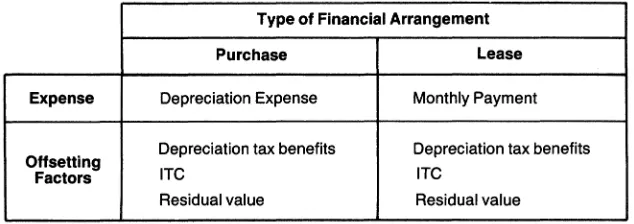
m :s::: mThe purchase versus lease or rent decision should be based on the following factors:
• Present age of the product line being considered (or age of the product line at time of anticipated purchase)
• Estimated sale value of the equipment at time of next anticipated equipment change
• Cost of money
• Cash flow over the expected life of the installation • Present value of future cash flow dollars
• Taxes and investment tax credits • Depreciation schedule
• Lease termination penalties
THE SOFTWARE PLAN
The software plan, developed concurrently with the hardware and staffing plans, will influence and be influenced by both plans.
The characteristics of the operating system will influence hardware selection as well as the training and caliber of the staff required for the installation. Some operating systems require the purchase of several auxiliary packages. On the other hand, an efficient operating system can reduce hardware requirements.
In order to meet the objectives of the systems plan, conversion of the operating systems may be required. Such a conversion will have major impact on staffing and must be considered in the schedule of system implementation and hardware delivery.
Systems software must be selected according to application, development, and operating requirements. The following list is intended to suggest some of the considerations for systems software:
• Application requirements -Data communications monitor -Terminal control software -Data base management system -Inquiry system
-Report generator • Development requirements
-All of the above -Data dictionary system
-Program library management system -Program performance monitor -Online programming system
-Debugging and documentation systems • Operating requirements
-Program library management system -Tape library system
A similar list must be drawn up for any minicomputers in a distributed environment and for any network control software.
Documentation and technical standards must be reviewed and plans devel-oped for their maintenance and enhancement. A change of operating systems, forexample, will require major changes in the standards of the installation.
The software plan creates additional budgetary needs caused by the antici-pated price of software, the anticiantici-pated cost of conversions, and estimated amounts for upgrading and maintaining documentation and technical stan-dards.
THE STAFFING PLAN
A staffmg plan should project specifics for 18 months and show general projections for at least another 12 months. The result should be a chart (see Figure 2-3) and supporting documentation.
On the basis of the software systems selected, the staffing plan should designate the caliber and type of personnel required (development, clerical, or operations). Anticipated salaries should be based on the current market. It may be necessary to consider using outside consultants or temporary personnel for peak loads. A training program should be devised for the continued develop-ment of personnel resources.
The ability to meet staffing requirements will have an effect on the schedule of the hardware, software, and systems plans.
THE CONTROL PLAN
The control plan includes the policies, procedures, and techniques necessary to provide DP and general management with the tools necessary to control the direction and monitor the performance of the DP department.
Many of the elements of a good strategic plan, and a long-range plan, are based on the results of current management techniques and performance evalu-ation methods.
Management control depends on quality reporting that emphasizes perform-ance evaluation and cost-effectiveness. Reports should:
• Evaluate by measuring actual performance against a predetermined standard
• Be oriented toward the function being measured • Cover all functions
• Predict trends
• Enable management to anticipate potential problems or unusual ex-penses
• Be concise and readable and interpret-graphic in presentation, when possible
• Chart a 13-month period to indicate trends
18
-16
14
a; 12
-c: c: 0
I!?
G> 10 D..
'0
lii
.0 8
-E
'"
z
6
-4
2
-~---
---f---l=
Average Staffing Level- - - -
-Billing
I
Equipm~nt f-System Conversion CAS
~
Accounts Payable System
Inventory System
Production Control Study Cost Accounting System Study
Payroll System
I
[image:30.414.67.587.63.325.2]Maintenance of Production Systems
Figure 2·3. DP Planning: Staffing Requirements
z
Ci)
~
ZCi)
m "tJ
>
Z Z
Z
Ci)
...
• Be received by management routinely and promptly enough to pennit timely corrective action
For example, the operations manager should receive the following types of reports:
• System downtime report-This report should track system downtime against perfonnance targets, by reason (e.g., CPU, program, periph-eral, air conditioning, or power failure, operator error).
• Rerun time report-This report should track rerun time chargeable to the data center, by reason. Rerun time is defined as the total time required to complete the job less the time used for the final, good run.
• User-caused rerun time report-This report should track machine time required as a result of user-caused reruns. This is useful in identifying problems in the system or in isolating training deficiencies. In a time-sharing environment, this report helps to trace and correct any repeated abuses of the system by tenninal users.
• Peripheral perfonnance report-This report should contain the fre-quency and duration of and reasons for downtime for each peripheral device. This helps to identify failure-prone units requiring service or replacement. This report should covertenninal devices.
• Data entry performance-This report should compare expected versus actual perfonnance in keystrokes for the data entry group. (The data entry manager needs this infonnation by individual to evaluate perfonn-ance.)
• Data entry volume-This report should show budgeted versus actual work load in tenns of input documents or records keyed by job. • CPU perfonnance reports-A series of reports should be developed to
indicate capacity used versus capacity available in the CPU. Such reports should clearly separate the capacity used in the systems state from that used in the problem state.
• Computer utilization summary-This report should indicate available capacity and its use in productive time, downtime, and rerun time. Trends aid capacity planning.
• DASD capacity summary-This graphic report should track available capacity versus fIle space allocated.
Other reports that may prove useful include perfonnance tracking of tenni-nal response time, channel utilization, communications-line failures, on-time report distribution, and control errors.
These reports detect trouble spots requiring action and provide capacity utilization trends for long-tenn planning. They also indicate long-tenn poten-tial staffing and training needs.
An essential tool for performance monitoring is a system for charging project development and operation costs to users. These charges should include . overhead factors that result in the recovery of all DP costs by the DP
-Corporate Purpose Strategic Plan Familiarization Tactical Plan
Division Plans
Organizational Functio ns
~
-Develop Busi ness Flowchart, Potential Systems Concepts
~
Establish Steering Committee
~
Review Poten-tial Projects & Priorities
+
Develop Systems Plan, Tentative Schedulest 'f t
Develop
r-
Develop-
DevelopHardware Software Staffing
Plan Plan Plan
•
Summarize Costs and Schedules•
•
tSteering Document
Committee Control
Review Plan
J t
Document Long-Range Plan
~
[image:32.414.48.359.61.572.2]Obtain Final Approval from Steering Committee
A steering committee should establish policies for the approval of new projects in a manner similar to approval for capital investment. During the life of a project, various checkpoints should be established at which the steering committee can make go/no-go decisions on continued investment in the proj-ect. The steering committee should also receive regular reports on project progress and should review project priorities every six months or as often as necessary to meet changing conditions.
MAINTAINING THE LONG-RANGE PLAN
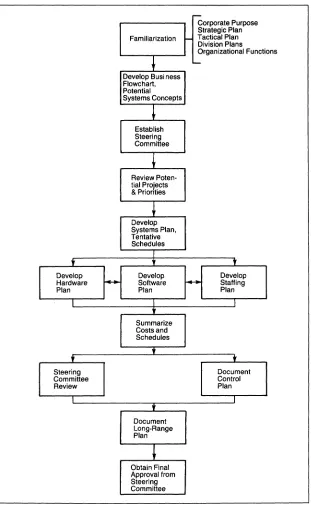
Organizations new to long-range planning (see Figure 2-4) will find that their first long-range plan will take from six months to a year to develop. This means that, prior to publication, some of the information contained in the plan may be as much as a year old. A final prepublication review will be necessary to bring all information and projections up to date.
External conditions may have considerable impact on any long-range plan. For that reason, it is necessary to maintain continuous research and to report project progress regularly. At least every six months, a progress report to the steering committee should indicate accomplishments and deviations from the long-range plan.
The DP manager will benefit from the long-range plan by being able to prevent crises through a deeper understanding of the company's requirements and through a closer liaison with top management.
@
DP Steering
Committees
INTRODUCTION
by the AUERBACH Editorial Staff
An organization's DP function is somewhat like a company within a com-pany. It is a highly complex, technically oriented function that has counterparts to all functions of a manufacturing concern (e.g., engineering, production, quality control). Data processing operates both a job shop and a continuous production shop, and it often provides services to all segments of the organiza-tion.
In many ways DP is an alien body within the host organization and, if not controlled, can cause serious damage to the host. There have been many instances of runaway D P costs caused by lack of control or executive "com-puter fever." In addition, the DP industry is replete with examples of failed projects, dissatisfied users, inappropriate priorities, lack of communication with users, high turnover, and other ills often linked with weak DP manage-ment. Because of these problems, DP sometimes requires control methods that would not be applied to any other internal function.
Some of the problems faced by DP managers result from an improper reporting level for D P, a lack of D P manager involvement in strategic planning for the organization, and less-than-perfect peer relations with other high-level managers in the corporate structure. Steering committees are usually estab-lished to address problems that arise from one or more of these factors and to ensure proper coordination between top-management objectives and DP plans.
THE APPROACH
A steering committee is an advisory group empowered to make top-level decisions for a function for which it is not directly responsible. The committee reports to the top echelon of the organization and is delegated specific executive powers. Each member of the steering committee is partially responsible for the effective use of the resource that the committee oversees.
difference between the DP steering committee and a board of directors is that a board usually contributes to the expansion of an organization, while the steering committee often works to limit and control DP expansion. When the decision is made to limit DP costs, the committee creates for itself the problems of allocating a limited and expensive resource and resolving the political problems arising from contention for this resource.
There are two types of DP steering committees. The permanent steering committee is responsible for the overall guidance of the DP function; the temporary or project steering committee is responsible for the successful completion of individual projects.
PERMANENT STEERING COMMITTEE
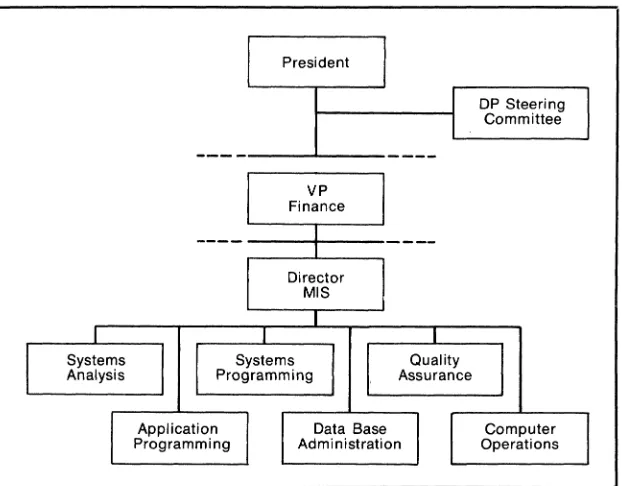
Because DP costs run as high as seven percent of the gross revenues of an organization, the permanent steering committee should include the president or chief operating officer of the organization and those executives whose depart-ments use DP services. Regardless of the DP manager's reporting relationship, he or she should also be a member.
The duties of the permanent steering committee usually include the follow-ing:
• Use the members' knowledge of the organization's strategic and tactical plans to determine appropriate levels of DP expenditure and capability. • Approve specific proposals for acquisition of major DP equipment. • Approve long- and short-range DP plans.
• Determine whether specific projects are to be undertaken. These deci-sions are based on expected return on investments, lack of alternative methods, anticipated impact on the organization, and conformity with corporate long-range plans.
• Determine project priorities.
• Review and approve cost allocation methods. • Review project prog~ss.
• At specific decision points, determine whether projects should be con-tinued or abandoned.
• Resolve territorial and political conflicts arising from the impact of new systems.
Because these duties require ongoing attention, the permanent steering commit-tee should meet regularly-preferably on a monthly basis.
Advantages
The permanent steering committee can enhance the DP function by provid-ing the benefits that follow.
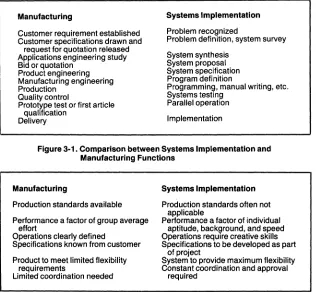
money allocated to program maintenance? Can't you get these programs right the first time? I don't see why you should have to touch a program unless a change is requested. " The problems of program maintenance were explained to the president as clearly as possible, but he still did not seem convinced. Later, two charts (see Figures 3-1 and 3-2) were used as an aid in explaining the problems of systems design and programming. The impact on program perfonnance and stability of changes in the operating system, the compiler, the hardware, and the user environment were also explained.
Manufacturing
Customer requirement established Customer specifications drawn and
request for quotation released Applications engineering study Bid or quotation
Product engineering Manufacturing engineering Production
Quality control
Prototype test or first article qualification
Delivery
Systems Implementation Problem recoQnized
Problem definition, system survey
System synthesis System proposal System specification Program definition
Programming, manual writing, etc. Systems testing
Parallel operation
[image:36.414.46.362.160.452.2]Implementation
Figure 3-1. Comparison between Systems Implementation and Manufacturing Functions
Manufacturing
Production standards available
Performance a factor of group average effort
Operations clearly defined
Specifications known from customer
Product to meet limited flexibility requirements
Limited coordination needed
Systems Implementation Production standards often not
applicable
Performance a factor of individual aptitude, background, and speed Operations require creative skills Specifications to be developed as part
of project
System to provide maximum flexibility Constant coordination and approval
required
Figure 3-2. Dissimilarities between Systems Implementation and Manufacturing Functions
Thus, the pennanent steering committee provides a forum for conveying concepts, while discussing specific issues or projects. These concepts should be conveyed in noncomputer language whenever possible.
allows top management to apply its knowledge of the organization's plans directly to the management of the OP function.
Cost Control. While the OP manager is responsible f0r maintaining control of OP budgets and expenditures, the steering committee is ~sponsible for monitoring expenditure levels and for correcting deficiencies in the control mechanisms used by the OP manager. Annually, the committee should review the OP budget, which should detail OP expenditures as well as their allocation to the user departments. This review allows committee members to determine
I how their operations will be affected by OP costs and provides an opportunity to
explore alternatives that may reduce costs or permit more effective use of funds.
Establishing and Reviewing Priorities. The committee also establishes and reviews project priorities. Inappropriate priority setting is probably second only to project failure as a cause of high OP manager turnover. The steering committee has the broad knowledge and authority to assign effective project priorities. As an adjunct to this function, the committee can also approve additional resource acquisitions to meet commitments or to cancel or delay lower-priority projects if necessary. It is essential that the steering committee regularly review the priorities of all ongoing projects to prevent inappropriate allocation of the organization's resources.
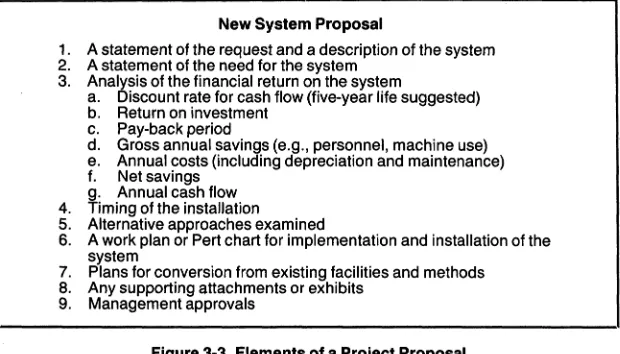
Project Approval and Review. The steering committee also approves new projects and reviews projects in progress to evaluate their viability and to prevent overcommitment of resources without securing adequate return. A new project proposal should contain most of the elements illustrated in Figure 3-3. The detailed proposal is usually prepared by the OP group, but the OP manager should not present the proposal to the steering committee-this task should be performed by the member of the committee for whom the project will be done.
New System Proposal
1. A statement of the request and a description of the system 2. A statement of the need for the system
3. Analysis of the financial return on the system
a. Discount rate for cash flow (five-year life suggested) b. Return on investment
c. Pay-back period
d. Gross annual savings (e.g., personnel, machine use) e. Annual costs (including depreciation and maintenance)
f. Net savings
g. Annual cash flow 4. Timing of the installation 5. Alternative approaches examined
6. A work plan or Pert chart for implementation and installation of the system
7. Plans for conversion from existing facilities and methods 8. Any supporting attachments or exhibits
[image:37.414.59.369.405.582.2]9. Management approvals
Most steering committees require that projects exceeding a minimum dollar cost be submitted for approval (a figure of $40,000 may be appropriate). Any substantial change to the estimated cost of an approved project must be sanctioned by the committee. Monthly reporting of project status can provide the committee with an early warning system to stop potentially unproductive projects. The monthly report can be structured as illustrated in Figure 3-4.
Resolution of Internal Conflicts. The steering committee is responsible for resolving political and economic conflicts at the highest level. The commit-tee meetings provide a forum for resolving such conflicts by group interaction or by presidential guidance, without making the DP manager the "man in the middle."
Executive-DP Manager Interaction. The steering committee continually educates the DP manager concerning the thought processes and operating methods of the top-level executives. Such interaction is a significant benefit for the DP manager. Of course, there is a corresponding risk involved: The DP
Status Report January 1983
1. Name of Project:
2. Project Leader: 3. Project Cost ($):
Current Month: Project-to-Date:
4. Estimated Cost to Complete: 5. Estimated Cost at Completion: 6. Original Estimated Cost:
7. Original Scheduled Completion Date:
8. Estimated Completion Date: 9. Purpose:
Employee Benefit Statements
Joyce Bowland
Period ending January 22, 1983
Labor Computer Total
14,088 2,035 16,123
27,715 4,100 31,815
7,800 1,500 9,300
35,500 5,600 41,100
31,000 6,000 37,000
Installation Completion
1/3111983 2/28/1983 211511983 2/28/1983
The system will provide the capability to produce the annual Employee Benefits Statement ready for mailing during the first week of March every year. An annual $28,000 reduction in operating cost is anticipated.
10. January Results:
By January 22, all programs were in the final stages of program testing. The vari-ous production runs necessary to create the year-end files were proceeding without problems.
11. February Schedule:
Complete testing and verify all programs. If necessary, run special updates to pay-roll and retirement income files to correct data.
Print Annual Benefits Statement.
Complete documentation of the system and all procedures. 12. Problems:
[image:38.414.47.357.256.569.2]Turnaround time continues to be a problem.
manager is also exposed to the evaluation and judgment of executives. This exposure is only a danger for the incompetent, however; a well-prepared, effective OP manager should welcome it.
Disadvantages
Peroaps the most common problem with permanent steering committees is poor attendance. The people who should serve on the committee are the executives with the greatest number of pressing responsibilities. Three strate-gies can help improve attendance:
• The president of the organization should be chairman of the committee and should stress the importance of regular attendance. Without this support, the committee is likely to fail.
• Good staff work is required by the OP manager. Presentations should be precise, clear, pertinent, and should avoid OP jargon at all costs. Visual aids should be developed carefully and in a uniform format. Status reports and proposals for new projects should be distributed in advance. • Meetings should be brief and businesslike. Top management appreci-ates subordinappreci-ates who recognize the value of their time and who act accordingly.
There are other potential disadvantages associated with the steering commit-tee approach. The major problems and recommended corrective actions are discussed in the sections that follow.
Uninformed Action. Occasionally, a steering committee acts precipitously and makes a decision or takes action that is counterproductive. This action can be very difficult to reverse, and the effect can be widespread. Good staff work, proper education, and occasional lobbying can help avoid this pitfall.
Squeaky Wheel Syndrome. This is a well-known I,llalady, usually result-ing in an inappropriate distribution of "grease. " As with most cases of over-lubrication, it usually causes a mess in the long-run. The solution is strong leadership on the part of the chairman. It is his or her responsibility to ensure that the actions taken are in the best interests of the whole organization rather than of a single individual or department.
Insulation. The committee may actually insulate the OP manager from top management if it is not properly structured or if alternates are permitted to sit in for the principal committee members. The purpose of the committee is to involve top management with the OP function rather than to insulate it. The solution to this problem is proper membership on the committee and stringent attendance requirements supported by the chairman.
should specify the decision or action desired and structure the presentation so that it leads logically to a conclusion or a specific recommendation.
The "Picky, Picky" Syndrome. In this syndrome the committee starts out with noble objectives, such as setting high-level priorities and approving major projects and equipment acquisitions; these objectives degrade progressively until the committee is bogged down with choosing modem vendors and inter-viewing applicants for computer operator positions. This may be helpful if the
DP manager's goal is to keep the committee occupied with trivia while he or she runs the show; however, if effective upper management involvement in DP is the goal, then this problem must be avoided. This syndrome is more easily prevented than cured-the DP manager should ensure that the committee has a clearly established charter and should work with the chairman to help the committee follow the charter.
Total Usurpation. In this case the steering committee steers as well as designs, builds, modifies, maintains, and often wrecks the DP function by gradually assuming full management responsibility and turning the DP man-ager into a highly paid, highly frustrated clerk. The only corrective action is to work to abolish the committee and start over or to find another job.
An Alternative
If the organization already has an executive or management committee whose function is to provide overall policy and planning guidance to the organization, this group may be able to oversee the DP function. In this case, however, the committee's involvement must be limited to matters of major significance, such as setting overall priorities and establishing departmental spending limits. The DP manager must be an effective and decisive manager in order to work with this type of committee.
PROJECT STEERING COMMITTEE
As discussed previously, project steering committees can perform some qseful functions at the project level. They can be used whether or not the organization has a permanent DP steering committee. The project steering committee is structured so that the chairman has direct management responsi-bility for the project's success. (The chairman is usually the executive in charge of the user group who initiated the request.) Committee members should include executives from other groups in the organization who may be affected by the system, managers of the user functions that will be involved with the system, the DP manager, and the DP project manager.
The functions of the project steering committee include: