This is a repository copy of Sample Size Determination to Evaluate the Impact of Highway Improvements.
White Rose Research Online URL for this paper: http://eprints.whiterose.ac.uk/2274/
Monograph:
Fowkes, A.S. and Watson, S.M. (1989) Sample Size Determination to Evaluate the Impact of Highway Improvements. Working Paper. Institute of Transport Studies, University of Leeds , Leeds, UK.
Working Paper 282
[email protected] https://eprints.whiterose.ac.uk/ Reuse
See Attached
Takedown
If you consider content in White Rose Research Online to be in breach of UK law, please notify us by
White Rose Research Online
http://eprints.whiterose.ac.uk/
Institute of Transport Studies
University of Leeds
This is an ITS Working Paper produced and published by the University of Leeds. ITS Working Papers are intended to provide information and encourage discussion on a topic in advance of formal publication. They represent only the views of the authors, and do not necessarily reflect the views or approval of the sponsors.
White Rose Repository URL for this paper: http://eprints.whiterose.ac.uk/2274/
Published paper
Fowkes, A.S., Watson, S.M. (1989) Sample Size Determination to Evaluate the Impact of Highway Improvements. Institute of Transport Studies, University of Leeds. Working Paper 282
Working Paper
282
November
1989
(Version 2, May 1997)
SAMPLE SIZE DETERMINATION TO
EVALUATE THE IMPACT OF HIGHWAY
IMPROVEMENTS
AS Fowkes and SM Watson
This work was commissioned by the Transport and Road Research Laboratory.
UNIVERSITY OF LEEDS
Institute for Transport Studies
ITS
Working
Paper
282
November
1989
Sample size determination to evaluate the impact of
highway improvements:
AS Powkes and SM Watson
This work was commissioned by the Transport and Road Research Laboratory.
ITS Working Papers are intended to provide information and encourage discussion on a topic in advance of f o m l publication They represent only the views of the authors, and do not necessarily reflect the views or approval of the sponsors.
This report is one of a series produced during a project: "Feasibility of m e a s k g response to new highway capacity", carried out by a consortium of ITS, TPA and John Bates Services on behalf of TRRL.
The views expressed i n these reports do not necessarily reflect those of TRRL or the Department of Transport.
Reports i n the series are:
The Feasibility of Measuring Responses to New Highway Capacity (by Bonsall PW). TRRL Contractors Report No CR200, due early 1990.
Travellers Response to Road Improvements: Implications for User Benefits (by Mackie PJ and Bonsall PW). Trafiic Engineering and Control 30 (g), 1989. Note that this paper was prepared in advance of the TRRL contract.
User Response to New Road Capacity: A Review of Published Evidence (by Pells SR). ITS Working Paper 283, 1989.
Sample Size Determination to Evaluate the Impact of Highway Improvements (by Fowkes AS and Watson SM). ITS Working Paper 282, 1989.
Measuring Impacts of New Highway Capacity: A Discussion of Potential Sulvey Methods (by Bonsall PW). ITS Working Paper 289, 1989.
Evidence on Ambient Variability and Rates of Change (by Watson SM). ITS Technical Note 257, 1989.
Application of Stated Preference hIethods to IJser Resuonse to New Road Schemes (by Bates J and Wardman MR). ITS Technical Note 258, 1989.
Some Observations on Appropriate Time Scales, Siting and Location of Surveys and on the Use of Panels to Measure Responses to Highway Improvements (by Goodwin PB and Jones PM of TSU, Oxford). ITS Technical Note 259, 1989.
User Response to New Road Capacity: What The Experts Said (by Bonsall PW, Mackie P J and Pells SR). ITS Technical Note 260, 1989.
Calculation of Costs of Surveys to Measure User Response to New Road Capacity -
Abstract
FOWKES, A.S. AND WATSON, S.M. (1989) Sample size determination
to evaluate the impact of highway improvements. Workina Paper
282, Institute of Transport Studies, University of Leeds, Leeds.
This paper was prepared for the Department of Transport, as a
support document to a main report on the feasibility of
measuring responses to highway improvements. The paper
discusses the statistical issues involved, particularly as
regards the determination of suitable sample sizes. Worked
examples are provided, using such data on ambient variability
and adjustment factors as were available to us. Some of the
data is included as an appendix where it was felt to be
otherwise not easily available.
The note asks two sort of questions. Firstly, what is the
minimum sample size to take to be a certain percent confident
that a given quantity lies in a range of a given width.
Secondly, what sample sizes should be taken in Before and After
studies so as to be a certain percent confident that a change in
a quantity by a given amount will be detected as a statistically
significant difference at some chosen significance level.
Three sorts of quantities are discussed:
-
total flows past a point, which may be counted by loops, tubesor manually;
-
partial flows, such as a particular 0-D flow, which requireroadside interviews;
SAMPLE SIZE DETERMINATION TO EVALUATE THE IMPACT OF HIGHWAY
IMPROVEMENTS
1. INTRODUCTION
This note will discuss issues relevant to the determination of
sample size requirements when the objective is to measure the
impact of a highway improvement. Statistical theory will be
presented and indications provided as to where the appropriate
numbers required for the statistical formulae can be obtained.
Worked examples will be provided, on an illustrative basis,
using such data as are to hand. We have included in appendices
a tabular rendering of such data as may not be easily available.
The note will essentially be asking two sorts of questions.
Firstly, what is the minimum sample size to take to be a certain
percent confident that a given quantity lies in a range of given
width. Secondly, what sample sizes should be taken in Before
and After studies so as to be a certain percent confident that
a change in a quantity by a given amount will be detected as a
statistically significant difference at some chosen significance
level.
As well as the two sorts of questions, discussed above, we will
apply these to three sorts of variable of interest, namely:
(i) total flows past a point, which may be counted by loops,
tubes or manual methods;
(he.
4 h K s
AM*-(
Adenl,rdr)
(ii) partial flows, such as a particular 0-D flow, which
require roadside interviews:
(iii) journey times over particular links.
The note does not deal with the case of comparing modelled and
2. SAMPLING THEORY
Suppose X is the name of a particular variable of interest, say
a flow or a speed on a particular link over a particular hour on
a particular day of the year. We can take measurements xi from
this variable and note that they have average value
T
and avariance which we may take as an estimate of the true variance
of X and so denote VAR(X). We shall not worry that our estimate
of variance may not be exact, provided we have large (>30)
-
samples. We shall worry that the estimated mean, X, may not
exactly equal the true mean, which we may denote by E(X) or F .
However, we know that
E
will tend to get closer to E(X) thelarger the sample size, n, we take. Hence we can form
confidence intervals for E(X) which are of desired width by
taking n to be suitably large. A 95% Confidence Interval can be
written as
95% C.1 for E(X) = y + z(0.025)
where n is the sample size, and 0.025 refers to the proportion
of the distribution in each tail outside the Confidence
Interval, i.e. 2+% in each tail, leaving 95% in the middle,
2
\Ld*.eo..hq
c e ~ u ~ ~ p
ti
a a r k d .3 . r b b - h a .
In general, a (1-0) Confidence Interval will have 0/2 in each
tail, and so is denoted as
(1-0) C.I for E(X) =
F +
z(o/~) /VAR(X)When the estimate of VAR(X) is based on a small sample it may be
desirable to use the t distribution rather than the
The above method works as long as the error involved in VAR(X)
can be regarded at random. This will arise as 'sampling error'
which says that each sample of size n from a given population
will have a different mean (except by chance) depending on which
members of the population are chosen. In addition any
measurement error which can be taken as purely random can be
included here.
What cannot be included are systematic forms of variation, say
relating to the day of the week or month of the year, if we are
sampling at a particular time. If we have a Tuesday count in
February we will doubtless find a factor to enable us to
estimate AADT, but there will be an error variance associated
with this factoring which will not be reduced by increasing the
sample taken on the February Tuesday. Consequently we should
try as far as possible to sample from all periods of interest,
and if making comparisons over time (such as in Before and After
studies) we should choose sample periods which are as alike as
possible.
Where factoring has to take place, statistical theory allows
composite variances to be calculated. For example, suppose
that:
F, takes a particular hour to an average hour
F, takes a particular weekday to an average weekday
F3 takes a particular month to an average month F4 has mean 1, but has variance which allows for
unexplained variation which we shall call
AMBIENT VARIABILITY
and that coefficients of variation are known (possibly from
published sources) for these factors. Let our measured average,
-
X, be the average speed for a particular hour on a particularweekday in a particular month. Let Y be our estimate of the
average speed on any weekday in the year. Clearly we apply all
h
The variance of our new estimate, Y, is
A
VAR(Y) = VAR (F, F2 F3 F4
7)
Variances of products of terms can be a bit cumbersome, but can
be handled straightforwardly by repeated use of the formula, for
independent A and B:
Often it will be sensible to make use of an approximate formula
which is much simpler to handle, namely (for independent A and
B whose CVs are less than about 0.2):
where CV denotes 'coefficient of variation', which is defined to
be the ratio of the standard deviation to the mean, hence
In our example we have
&(G)
= &(F,)+
c$(F2)+
c$(F~)+
C$(F4)+
CV2(r)in which, we know that
A
Hence to fix C$ (Y) at some desired value, with all other terms
known, we can find n from this equation. In the simple case
where the CV's of all the F's are zero we have
= c$(x)
n
= VAR(X)3;" ((G)
CV'(?)
So if speeds had a coefficient of variation of 0.2, and we
wanted a 95% C1 of width 1% of mean speed then
This says that we must take a sample of size 1537 individual
speeds, for that hour on that weekday in that month.
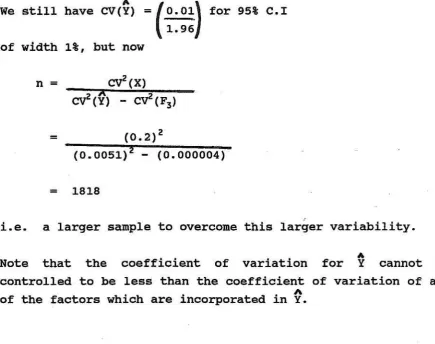
Suppose instead that we wish to estimate the average speed in a
different month, but must sample in the current month only. We
presume there is a factor, F3, available to convert current month
speeds to this other month's speeds, and let us suppose that the
source that gives this F3 value states that CV(F3) = 0.002, which
takes into account that (in the data they studied) the
relationship between months was not exact, the factor being
A
We still have CV(Y) = for 95% C.1
of width l%, but now
i.e. a larger sample to overcome this larber variability.
A
Note that the coefficient of variation for
Y
cannot becontrolled to be less than the coefficient of variation of any
A
of the factors which are incorporated in Y.
3. STUDIES OF TOTAL VEHICLE FLOWS FROM COUNTS
(A) TO DETERMINE AADT TO A GIVEN ACCURACY
Suppose we are counting the flow along a road for 16 hours each
day, and wish to know how many days we need to count to obtain
[image:12.595.71.507.83.427.2]24 hours AADT to within 1%.
Table 4 of Appendix D14 of TAM (March 1985 update) provides 'M-
factors' by road type which factor 16 hour counts in stated
months to 24 hour AADT, giving associated CV figures which are
all 6$%. Clearly the CV for an AADT estimate based on a single
count is bound to be greater than 6 % % . Our suggested approach
here is to derive separate AADT estimates from several days 16-
h
where Y is our estimate of AADT
nd is the number of 16-hour counts used F, is the M factor, CV(F,) = 0.065
X is our count, subject to measurement error such that
We understand that most of the variation accounted for by CV(F,)
is due to 'site-to-site' variation in the data set from which
the F, factors were derived. However, our view is that 'day-to-
day' (or 'ambient') variation is also included in CV(F,)
.
Ifthis portion of variability could be split off then observations
A
on different days would reduce the variance of Y.
Let us therefore split F, into two factors F3 and F4, with F4
having mean unity and merely allowing for ambient variability.
We have F, = F3 F4
We know
&(F,)
= CV~(F~F~)C CV'(F~)
+
CV~(F~)Suppose that we can split the CV(F,) such that
(this is for illustration only, but represents our current best
We shall proceed by combining the ambient variability (over
days) with the measurement error, and attenuate both by counting
over more than one day.
Recapping, we have
We will assume that all the counts are taken at a similar time
of year, or at least at 'neutral' times of year, such that F3 can
be taken as constant over days:
-
Where F,X = 1 C Xi
--.
and denotes the mean value
of
the day's count adjusted for ambient variability.using sampling theory for variances of sample means.
The values we obtained earlier were
A
Clearly, if we know n, we can determine &(Y)
,
or equally we canset a value for CV'(+), provided it is greater than CV'(F,) and
determine sample size n,.
A further refinement is that if there are a fixed number of days,
N,,- in the period under review, we can avoid ambient variation,
Cv2(F4)
,
by sampling all days. The term CV2(~,) will thennd
disappear.
More generally, we can multiply this term by the FINITE
POPULATION CORRECTION FACTOR (FPCF) defined as:
FPCF = N,
-
n,If we sample only one day this term collapses to unity, while if
Hence all cases are covered by
In order to determine sample sizes we solve for nd, so
While, at first sight, this may appear to overcome the
restriction that, for finite nd
this is not the case, since if the above is violated we will
obtain
which is, by definition, impossible.
A
Hence the smallest CV'(Y) can be is, from our earlier guess,
(0.048)'
A
if CV(Y)
-
- 0.048then SD(Q)
-
0.048Y IrA A
and 1.64SD(Y) = 0.0787Y
Hence the smallest 90% confidence interval for Y, true annual
average daily traffic will be
i.e. a 90% confidence interval could not be as accurate as +5%
WORKED EXAMPLE
If the above values for CV(F,), CV(F4) and CV(X) hold true (i.e.
are 0.048, 0.044, and 0.025 respectively) and if there are (Nd=)
30 days in the period on which the F3 factor is to be based, how
big a sample (in terms of number of days sampled) do we need to
take to be 90% sure we know ARDT to within
+
10%?We must start by reviewing our assumptions, the most important
being that the M factor CV (as published in TAM) of 0.065 might
reasonably be split up into 0.044 from not knowing the average
for the survey month exactly from only taking a sample, and 0.048
for the uncertainty in going from this month to an average month
(presumed due to site to site variability in the data sets used
to determine the M factor). Hence if we sample all 30 days of
the month the 0.044 will disappear, and with smaller samples will
be reduced as determined by sampling theory.
To get a 90% C.1 we need Z=1.64, and to be within y10% we need
So a two day count would be needed.
If the question had been to find AADT to within
+
8%, we would have hadIn which case we would need to sample for 19 days.
4. BEFORE AND AFTER STUDIES OF FLOW
An additional problem arises with Before and After studies, in
that secular growth of traffic may occur, by which we mean
traffic growth which would have occurred even in the absence of
the scheme which we may presume to have been implemented between
the 'Before' and 'After' studies. While it is possible to obtain
national average figures for the rate of growth of traffic, the
applicability of these figures to particular sites is, at best,
dubious.
Our proposal here is to use control sites, unaffected (positively
or adversely) by the Scheme. These sites will show what growth
would be expected had the scheme not be implemented. In order
to best choose suitable control sites we would suggest that two
'Before1 surveys are conducted, at a number of sites including
the site of interest. Since we are only measuring flow, these
'surveys' may sometimes only entail inspecting the output from
permanent counters. The subset of sites whose unexplained growth
between the two 'Before' Surveys best matches that of the site
Having made this selection, the variability of growth rates
between sites between the 'Before' and 'After' surveys can be
expected to be at least as great as that observed between the two
'Before' surveys for the selected sites. Let us denote this
variability VAR(F,), with associated coefficient of variation.
Where F, represents the factor to be applied to the site of
interest to take account of secular growth.
In principle, all the other factors discussed in Section 3 as
being relevant to the accuracy of a count at a single point in
time are also relevant here. However, it is clear that we should
avoid the use of such factors wherever possible by sampling at
similar times in both the 'Before' and 'After' surveys. The
simplest case would probably be to sample after one year in
exactly the same month and exactly the same days of the week, and
for exactly the same length of time as in the 'Before' survey.
This leaves only the secular growth factor to take into account.
In this simple case, consider that as in Section 3 we require to
know how many days to sample for, now both before, nb, and after,
na. Suppose we denote the scheme effect as S, which might be a
figure such as 1.2 to denote a 20% increase. We can set out the
situation as follows:-
T&IA&
'
Before'
flow W bIn our estimate of S we will have 'Before' and 'After' flow count
(average) measures
fi,
andyb
and an estimated F, with coefficientof variation as discussed above
-
where
ya
=-
l 1 Xaj and Xb =-
1 C Xbina i=l nb i=l
Such that v A R ( ~ ) = VAR(X)/na
and V=($) = VAR(X) /nb
assuming underlying variability has not increased.
The exact way in which sample sizes will be determined will
depend on the question asked. If we are merely required to have
both Before and After samples each to a given accuracy (so as to
spot a scheme effect) then the theory of Section 3 is sufficient.
However, it is often the case that the question is posed in the
form of requiring Before and After sample sizes so as to be a
certain percentage confident that a given sized change will be
detected as statistically significant at a stated significance
level. Note that the practitioner must now supply the
statistician with three percentages:
(i) the confidence level
-
say 90%(ii) the percentage change to be spotted
-
say 10%(iii) the significance level for the test of difference
-
say5%
In technical statistical terms (i) gives the Type 2 error as 10%;
Suppose that the Before and After samples are taken at identical
times of year and on identical days, then there will be no
factors to apply. We will still have F4 for ambient variability,
having mean 1 and some unknown coefficient of variation. In
Section 3 we have used 0.044 for our CV(F4) and we shall use that
again here, purely for illustration.
Our Null Hypothesis will be that there has been no change, i.e.
H,: P, = P,
Let us take measurements, X, before and after and arrive at
-
Sample means, X, and
q,
from samples of size n, and n,. The variability in these sample means will be determined by theadequacy of each days measurement in reflecting the true value
for that day, and day to day variation. Since ambient
variability and measurement error are usually taken to be
proportional to mean it follows that if the scheme causes an
increase, then variability in absolute terms will be higher for
the After survey than for the Before survey. The coefficient of
variation will be constant, though.
Setting the problem out formally, let us choose (for
illustration)
Null Hypothesis, Ho:
P,
=P,,
Alternative Hypothesis, HI: pa = (1
+
k) p,-
Type I Error: Prob
(Jf,
-
X,>
CIH,) = alFrom the Central Limit Theorem
Skelton (1982) also arrives at this result.
Adding our factors F4 we have
where Z1 and Z2 are the Z values for the Type 1 and Type 2 errors, on one tailed tests, here
to 2.92, and k = 0.1.
- -
Hence VAR(F4Xa
-
F4Xb) --
0.01 p i-
-
As before, we can decompose VAR(F4Xa) etc.-
If we take the accuracy, in terns of CV, to be equal in both the
Before and After surveys, then
We will usually wish to take equal sample sizes, for efficiency,
so we can solve for nd = n, = nb
The test assumes H,: p, = pbr SO we can further simplify
i.e. one should sample for 5 days before and 5 days after.
In this way variance expressions for S could be developed, set
to desired levels and solved for the sample sizes. This will be
greatly facilitated if we can assume sample s m s to be equal in
both the 'Before' and 'After' surveys, i.e. n, = n,. If the
before survey has already been done, the size of the after survey
If other factors, e.g. adjusting for the effects of month (if
both samples cannot be taken in the same month) have to be
included then sample sizes will increase, as in Section 3, and
become infinite if too high an accuracy is required.
5. COUNTING PARTIAL FLOWS
In this section we shall look at the situation where we are only
interested in part of the flow passing a particular site, e.g.
we may be interested only in vehicles with particular origin/
destination characteristics. In this case there will be some
unknown proportion of the flow, P, which we will need to estimate
so as to multiply it by the estimated total flow passing the
site. We may still wish to count for more than one day, in order
to obtain a sufficiently accurate estimate of total flow.
However, the exigencies of carrying out roadside interview
surveys strongly suggests that we should not interview at a given
site on more than one day. This could be very unfortunate for
our sampling, since the OD mix may vary considerably from day to
day.
The best we can probably do is to confine our interest to
specific sorts of days (e.g. 'weekdayst or 'Sundays1) and to
interview accordingly. We will then be in a position to make the
vital assumption that our estimate of P will apply to the total
flow counted. Let p be the true total flow of traffic per day.
Let P be the true proportion of this which has the attribute of
interest (e.g. if for a specific OD pair).
The daily flow of interest = Pp
We can try to get a good estimate of p by surveying over nd days,
and we can try to get a good estimate of P by taking a sample of
size n. The optimal mix of nd and n will depend on the relative
things as how long the interviews each take, and so we cannot
sensibly even give rules of thumb here. We shall merely indicate
the statistical framework involved.
The variance of a sample proportion is given, for the
Hypergeometric distribution as is relevant here with sampling
without replacement, is
A
Here we do not know P, so use our estimate P, and assume that N
is much greater than n.
Our estimate of the flow of interest will be
CV2
(G)
c
CVZ(;) +cv2((F,X)-
-
Ir(l-P) (N-n)
+
VAR (F4X)If we add the complications of possibly wishing to apply a factor
F,, and possibly having a finite number of days Nd to sample
from, we have
6. MEASURING TRAVEL TIMES
The two main methods of measuring journey times are Moving
Observer (MO), and Number Plate Matching (NPM)
.
In the firstcase, a car or cars are driven along the link(s) of interest and
the journey time noted. Common sense dictates that the MO should
try to travel at the average speed of other vehicles using the
road. This is sometimes difficult and corrections for cars
overtaken or overtaking are available. Experience at Leeds
suggestedthey were beneficial, but did not make much difference.
The question is how many runs should be made to adequately
determine the journey time. Currently, the COBA9 manual offers
such advice.
Statistically, the question revolves around how accurate each MO
measurement is. Experience in Leeds suggested that MO's, at 15
minute intervals were sufficient to give values which followed
NPM results very closely through the morning peak. Since NPM
is much more expensive, it is presumed here that it will be used
only when there are special reasons, such as needing to know the
spread of travel times on a given link. The conduct of NPM
surveys is a specialist issue, complicated
by
considerations ofhow much of the traffic will actually match, and what will be the
extent of spurious matching. The matter will not be further
If we wish to use MO's, but want to survey on several days-sb as
to reduce measurement error and allow for day to day variation,
then the problem is similar to that of Section 3.
If Xi, is the speed measured on day i, and F, is a (dummy) factor
to allow for ambient (day-to-day) variability, then our estimate
of average speed for several days runs is
-
-
VAR (F4X)n d ~ 4 2 ~ Z
Where CV(F4) represents day to day variability of speeds, and
CV(X) represents measurement error in that the MO estimate will
not equal the actual average speed on that day. Solving for nd
where the denominator will be determined by the desired accuracy
7. ESTIMATING HOURLY TRAFFIC FLOW
In the preceding sections it has been presumed that we have been
dealing with a day's traffic, e.g. what is AADT?, has AADT
changed etc. We may, however, wish to measure flows in
individual hours, and any d a y l s data can obviously be broken down
into shorter intervals. If we are interested in just one hour
each day (e.g. the 'peak1 hour) then we still have a 'days1
problem since we need to decide on how many days to count this
hour. The basic framework is as set out in Section 3, but
clearly the appropriate factors will differ. Our understanding
is that suitable factors are not readily available to
practitioners.
The best data available to us is from Idris (1981) which may be
interpreted as showing that, duringheavilytrafficked hours, the
day to day (non-systematic) coefficient of variation might be
about 0.05. If we continue to assume a coefficient of variation
of our ATC of 0.025, then we have
CV2 (X)
-
- 0.025~ accuracy of count&(F4)
-
-
0.05~ day to day variability&(F3)
-
- 0 no factors involvedSuppose we wish to measure the true underlying hourly flow (say
between 9 and 10 on weekdays in February 1989) Y, to within 5%
with 90% confidence, then
cv2
(G)
--
--
0.00093Using the formula from Section 3
So we should count the hour's traffic for 3 days, preferably
chosen randomly from the 20 weekdays in February.
IDRIS, M K (1981) "The collection and interpretation of traffic
flow data with particular reference to West Yorkshire and
Pakistan Traffic Countstf. MSc Thesis, Department of Civil
Engineering, University of Leeds
Skelton, N (1982) "Determining appropriate sample size when two
means are to be compared1I, Transport Engineering and Control,
Data A ~ ~ e n d i c e s
Secular Growth
Local evidence from historic traffic counts may be available
giving year on year growth and associated CV's. Otherwise use
evidence from 18similar11 sites, or published sources eg. TAM
(fairly out of date) or Transportation Statistics.
Roadway manual suggests that CV's associated with secular growth
between two years, n years apart, are
Source: Roadwav Manual
Historic Evidence of Secular Growth
Motor vehicle flow at average point (1977 = 100)
can be disaggregated as:
Built up roads 1982 1983 1984
Trunk 104 106 109
Principal 109 110 109
B roads 116 119 12 6
C roads 12 5 125 125
Source: Transportation Statistics
Conversion Factors (examples)
HOURS FACTOR SD
12-16 HRS 1.160 0.037
12-24 HRS 1.233 0.040
16-24 HRS 1.054 0.012
(conversion weekday to average weekday; Trunk, A, B, C roads)
DAYS TABC SD
Monday
Tuesday
Wednesday
Thursday
(conversion to a
MONTHS
January
February
March
April
May June
July
August
September
October
November
December
neutral month)
MAIN
URBAN
Unless otherwise stated, factors refer to trunk roads.
Other tables of factors are also available.
Kent Traffic Flow Information
Monthly average flow levels, (sd), (CV).
Other information also available from Kent County Councili
i) A road factors with
+
1 standard deviation for 1978-1988ii) Monthly factors for M/A/B/C in Kent for 1988 with
+
1standard deviation
IDRIS (using completely infilled data)
Road Code MON TUES WED THUR
D402N 6642 6705 6944 6928 (mean daily flow)
567 540 636 812 (sd)
(8.5) (8.1) (9.2) (11.7) (CV)
C302S 6121 6274 6369 6285
993 834 737 877
(16.2) (13.3) (11.6) (13.9)