Modelling Combinatorial Auctions in Linear Logic
Daniele Porello and Ulle Endriss
Institute for Logic, Language and ComputationUniversity of Amsterdam
Abstract
We show that linear logic can serve as an expressive frame-work in which to model a rich variety of combinatorial auc-tion mechanisms. Due to its resource-sensitive nature, linear logic can easily represent bids in combinatorial auctions in which goods may be sold in multiple units, and we show how it naturally generalises several bidding languages fa-miliar from the literature. Moreover, the winner determina-tion problem, i.e., the problem of computing an allocadetermina-tion of goods to bidders producing a certain amount of revenue for the auctioneer, can be modelled as the problem of finding a proof for a particular linear logic sequent.
Introduction
A combinatorial auction (CA) is a mechanism for one agent (the auctioneer) to sell a set of goods to a number of other agents (the bidders). While there are several different types of CAs, in the standard mechanism each bidder first speci-fies how much they are prepared to pay for any given sub-set of the sub-set of goods on auction, and the auctioneer then chooses an allocation of goods to bidders that will maximise the sum of payments collected. The advantage of a combi-natorial auction over a sequence of simple auctions (one for each individual good) is that it solves the socalled exposure problem: in a sequence of simple auctions it would be dif-ficult for a bidder to decide how much to bid for itemA, if she is only interested in obtainingAandB together; in a CA she can directly express this preference and there is no risk of getting stranded with justA.
While the idea is intuitively appealing, the CA frame-work also raises a number of challenging research questions: How can we incentivise bidders to truthfully declare their valuations (cf. game theory, mechanism design)? How can we solve the combinatorial optimisation problem of com-puting the best allocation given a set of bids (cf. algorith-mics)? How do we best represent the input of the bidders (cf. knowledge representation)? Particularly the first two types of questions have received (and continue to receive) a lot of attention in the literature. The state of the art is reflected in the recent collection edited by Cramton, Shoham, and Stein-berg (2006). In this paper, we shall focus on the challenges for knowledge representation raised by CAs.
Copyright c2010, Association for the Advancement of Artificial Intelligence (www.aaai.org). All rights reserved.
Knowledge representation techniques play an important role in the design of bidding languages. A bid is an en-coding of a bidder’s (declared) valuation function, which maps bundles (subsets of the set of goods on auction) she might receive to the prices she is prepared to pay for them. As the number of conceivable bundles grows exponentially with the number of goods, we require a compact representa-tion language. Several such languages have been proposed, e.g., the socalled XOR- and the OR-languages (Nisan 2006) and languages based on weighted formulas (Boutilier and Hoos 2001). (In fact, as bidding is a form of communicating one’s preferences, much of the recent work on preference modelling (Goldsmith and Junker 2008) is relevant to this problem.) Importantly, all of the aforementioned bidding languages are languages for single-unit CAs, while many real-world auctions are in fact multi-unit CAs, where there may be several indistinguishable copies of the same good.
Our first objective will be to overcome this limitation and to design generalisations of standard bidding languages for multi-unit CAs in a systematic and principled way. A natu-ral basis for such an undertaking is the framework of linear logic (LL). LL is a resource-sensitive logic: to prove a con-clusion from a set of premises, each premise can be used at most once (Girard 1987; 1995). This feature makes it pos-sible to distinguish, for instance, whether a bidder receives one or two copies of the same good, and bidders can quote different prices for these situations.1
In fact, we can do much more than that: LL turns out to provide an appropriate framework in which to model a variety of CA mechanisms—and modelling is not restricted to the representation of bids. Our contribution is threefold:
• We show that LL can serve as a basis for designing pow-erful bidding languages for CAs. Our approach subsumes several existing languages in a single formal framework and adds a number of new features. Specifically, we can model the availability of goods in multiple units and we can distinguish different types of goods, such as goods that are or are not reusable (by the same bidder) or that are or are not sharable (amongst several bidders).
• We show that also the winner determination problem
1
(WDP), i.e., the problem faced by the auctioneer of which goods to award to which bidder so as to maximise rev-enue, has a natural counterpart in the logical framework. Specifically, we show how to build an “allocation se-quent” from the goods owned by the auctioneer, the bids received, and the amount of revenue hoped for, and demonstrate that any proof of this sequent corresponds to an allocation yielding the desired revenue. The WDP then reduces to a series of calls to a LL theorem prover. • Going beyond standard CA mechanisms, we also show
how to model more powerful auction mechanisms in LL. This includes, in particular, mixed auctions (Cerquides et al. 2007), in which bidders and auctioneer exchange transformations of goods rather than plain goods. Gener-alising even further, we sketch what we call formula auc-tions, in which the auctioneer sells arbitrary LL formulas to the bidders (roughly speaking, in standard CAs these formulas are conjunctions of atomic propositions, while in mixed auctions they are certain types of implications).
To exemplify our approach, consider the OR-language. An OR-bid is a list of bundles of goods labelled with a price (socalled atomic bids): hB1, w1iOR· · ·ORhBℓ, wℓi. This
bid encodes a valuation functionv: a bundleX of goods is said to satisfy a set of atomic bids, if it is a superset of each of the bundles of the atomic bids and if those bundles do not overlap;v(X)is defined as the maximal sum of prices of any set of atomic bids satisfied byX. Later, we will show how to map a multi-unit variant of the OR-language into LL. For example, if bidder 5 wants to express that she will pay one monetary unit (u) for two copies ofpand three monetary units for obtaining a copy ofptogether with a copy of q, then she can submit the following bid (the LL connectives, such as⊗and⊸, will be introduced in the next section):
[(p5⊗p5)⊸u] ⊗[(p5⊗q5)⊸(u⊗u⊗u)]
Now, fromp5we cannot prove anything, from two copies of p5we can proveu, fromp5 andq5we can proveu3, from two copies ofp5and oneq5we can still only proveu3, and from three copies ofp5and oneq5we can proveu4.
Let us also briefly sketch our approach for modelling the WDP. Each bid is represented by a formula BIDi, like the
one shown above. The multiset of goods owned by the auc-tioneer can be represented by a (multiplicative) conjunction of these goods, e.g.,GOODS=p⊗p⊗q⊗r⊗r⊗r. We also need a formula that expresses that each of these items can go to (at most) one of the bidders. For example, for (one copy of)pand a group of three bidders, this formula would be(p ⊸p1) & (p ⊸p2) & (p ⊸p3), using the additive
conjunction operator of LL. LetMAPbe the (multiplicative) conjunction of formulas of this kind for each copy of each good. Then the auctioneer can achieve a revenue ofkif and only if there exists a proof for the following sequent:
GOODS,MAP,BID1, . . . ,BIDn⊢uk
Moreover, the allocation achieving that level of revenue can be read off the proof. Solving the WDP then amounts to finding the largest valueksuch that the above sequent can be proved, and then extracting the corresponding allocation
from that proof. We stress that we do not intend to propose LL as an algorithmic framework for solving the WDP. This will continue to require highly specialised combinatorial op-timisation algorithms. Instead, we view this embedding as an attractive conceptual framework in which to model and understand a wide variety of different CA mechanisms and bidding languages in a principled manner.
The remainder of this paper is organised as follows. Af-ter recalling the basic concepts of LL, we first show how to embed (multi-unit variants of) three important bidding lan-guages into LL. We then show how to model the problem of finding a suitable allocation as the problem of finding a proof for a LL sequent of the kind outlined above and we provide a formal proof of this correspondence. Before con-cluding, we discuss a number of possible extensions of the basic framework, including mixed auctions and general for-mula auctions.
Background on Linear Logic
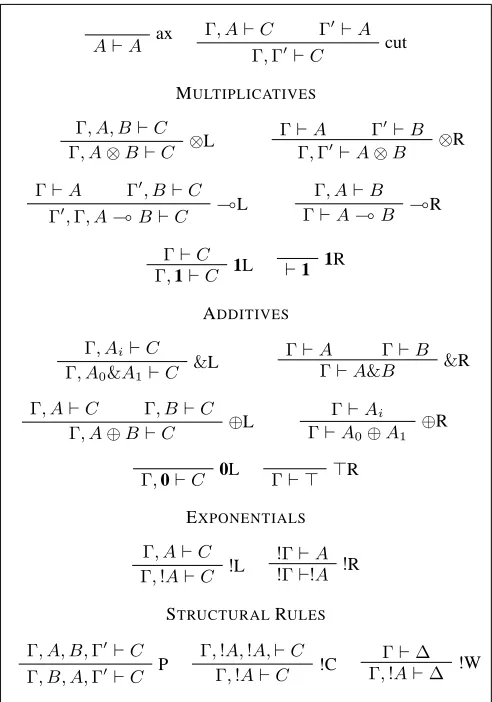
In this section, we review the relevant notions from LL. For full details, the reader is referred to Girard (1995) and Troel-stra (1992). LL provides a resource-sensitive account of proofs by means of a controlled use of the structural rules of weakening and contraction within the sequent calculus:
Γ⊢∆ W
Γ, A⊢∆
Γ, A, A⊢∆ C Γ, A⊢∆
Removing the structural rules, we are lead to split the usual connectives into two classes, since, for example, the follow-ing presentations of rules are not equivalent anymore:
Γ⊢A Γ′⊢B R∧ Γ,Γ′ ⊢A∧B
Γ⊢A Γ⊢B
R∧ Γ⊢A∧B
Without structural rules, sequents behave as multisets of for-mula occurrences and we have to distinguish connectives that take the concatenation of contexts (multiplicatives) and connectives that demand a shared context (additives).
Given a set of positive atoms A, the language of LL is defined as follows (wherep∈ A): L ::=
p|1| ⊥ | ⊤ |0|L⊥ |L⊗L|L L|L⊕L|L&L|!L|?L
Linear negation (·)⊥ is involutive and each formula in LL can be transformed into an equivalent formula where nega-tion occurs only at the atomic level. The conjuncnega-tionA⊗B (“tensor”) means that we have exactly one copy of Aand one copy ofB, no more no less. Thus, e.g.,A⊗B 0 A. We might say that in order to sellAandB, we need some-one who buysAandB, while here there is just a buyer for A. We will not directly use the disjunctionA B (“par”); rather we use linear implication:A⊸B :=A⊥ B.
ax
A⊢A Γ, A⊢C Γ
′⊢A
cut
Γ,Γ′⊢C
MULTIPLICATIVES
Γ, A, B⊢C
⊗L
Γ, A⊗B⊢C
Γ⊢A Γ′⊢B
⊗R
Γ,Γ′⊢A⊗B
Γ⊢A Γ′, B⊢C
⊸L
Γ′,Γ, A
⊸B⊢C
Γ, A⊢B
⊸R
Γ⊢A⊸B
Γ⊢C
1L Γ,1⊢C
1R
⊢1
ADDITIVES
Γ, Ai⊢C &L
Γ, A0&A1⊢C
Γ⊢A Γ⊢B
&R
Γ⊢A&B
Γ, A⊢C Γ, B⊢C
⊕L
Γ, A⊕B⊢C
Γ⊢Ai
⊕R
Γ⊢A0⊕A1
0L
Γ,0⊢C Γ⊢ ⊤ ⊤R
EXPONENTIALS
Γ, A⊢C
!L
Γ,!A⊢C
!Γ⊢A
!R
!Γ⊢!A
STRUCTURALRULES
Γ, A, B,Γ′⊢C
P
Γ, B, A,Γ′⊢C
Γ,!A,!A,⊢C
!C
Γ,!A⊢C
Γ⊢∆
!W
[image:3.612.54.300.52.403.2]Γ,!A⊢∆
Table 1: Sequent Calculus for Intuitionistic LL
side of⊢;?-formulas licence (C) and (W) on the right. Intu-itively, exponential formulas can be copied and erased; they are relieved from their linear status.
We will use the intuitionistic version of linear logic (ILL), obtained by restricting the righthand side of the sequent to a single formula; so for example we will not have?and in the language. In fact, we will mostly use ILL augmented with the global weakening rule (W). The reasons for these choices will become clear later. The rules of the sequent calculus for ILL are shown in Table 1 (Troelstra 1992).
To control complexity, we can restrict attention to certain fragments: intuitionistic multiplicative linear logic (IMLL) using only ⊗and⊸; intuitionistic multiplicative additive
linear logic (IMALL) using only⊗,⊸,&and⊕; and Horn
linear logic (HLL). In the latter, sequents must be of the formX,Γ ⊢ Y (Kanovich 1994), whereX andY are ten-sors of positive atoms, andΓis one of the following (with Xi,Yibeing tensors of positive atoms):
(i) Horn implications:(X1⊸Y1)⊗ · · · ⊗(Xn ⊸Yn)
(ii) &-Horn implications:(X1⊸Y1) &· · ·& (Xn⊸Yn)
For these fragments we can rely on the following proof-search complexity results. MLL is NP-complete and so is
MLL with full weakening (W) (Lincoln 1995). The same results apply for the intuitionistic versions. HLL is NP-complete, and so is HLL + W (Kanovich 1994). MALL and IMALL are PSPACE-complete (Lincoln et al. 1992).
Bidding Languages
In this section, we provide three examples for bidding lan-guages that can be represented using different types of Horn fragments of LL. These are the well-known and widely used XOR- and OR-languages (Nisan 2006), as well as the lan-guage of k-additive valuations (Chevaleyre et al. 2008), which itself is an instance of the framework of bidding lan-guages based on weighted propositional formulas (Boutilier and Hoos 2001; Uckelman et al. 2009). Importantly, while all the works just cited discuss bidding languages for auc-tions in which goods are available in single units, in what follows we shall present languages that are also suitable for multi-unit CAs.
In a multi-unit CA, an auctioneer wants to sell the ele-ments of a finite multiset of goods M (with finite multi-plicity) to a group of bidders. LetM(p)denote the mul-tiplicity of item p in M. We define the set of atoms A = {p1, . . . , pm} as the set of elements of Mignoring
their multiplicity.
There is an isomorphism between multisets and tensor formulas of atoms (up to associativity and commutativity):
{m1, . . . , mk} ∼= m1⊗ · · · ⊗mk
Thus, we can represent each subsetX ⊆Mas a tensor prod-uct. Moreover, ifM ∼= AandN ∼= B, then the (disjoint) union ofM andN is isomorphic toA⊗B.
We now want to define languages to encode valuations v:P(M)→N, mapping subsets ofMto prices.2
Atomic Bids
To model prices symbolically, we assume a finite set of dis-tinct weight atomsW={w1, ..., wp}. In fact, often we will
use just one weight atomu. We writeukfor the tensor
prod-uctu⊗ · · · ⊗u(ktimes). To associate weights with num-bers, we define a functionval:W →N, withval(u) = 1. Let W⊗ be the set of all finite tensor products of atoms inW, modulo commutativity (including the “empty” prod-uct 1). That is,W⊗={1, w
1, w2, w1⊗w2, . . .}. We extend val toW⊗ by stipulating val(1) = 0andval(ϕ⊗ψ) = val(ϕ)+val(ψ). In particular, this means thatval(uk) =k.
Definition 1. An atomic bid is a formula of the formB ⊸
w, whereBis a tensor product of atoms inAandw∈ W.
In a CA, given a bidB ⊸ w, we can work with two
al-ternative assumptions: no free disposal at the bidder’s side, meaning that the bidder will pay wif she receives exactly B, and free disposal at the bidder’s side, meaning that the bid is satisfied whenever the bidder receives at leastB. In the sequel, unless otherwise stated, we will always assume
2
free disposal. To model free disposal, we will use ILL with weakening (W).3
Definition 2. Every bid formulaBIDgenerates a valuation vBIDmapping multisetsX⊆ Mto prices:
vBID(X) = max{val(w′)|w′∈ W⊗andX,BID⊢w′}
Definition 2 applies to atomic bids as well as to the more powerful bidding languages we will define in the sequel. In the case of atomic bidsBID= (B⊸w), it simply says that
vB⊸w(X) = wwheneverX is equal to a superset of the
multiset isomorphic toB, andvB⊸w(X) = 0otherwise. In case the only weight atom used isu, i.e., ifW={u}, then Definition 2 can be simplified and we obtain:4
vBID(X) = max{k|X,BID⊢u
k}
XOR-bids
An XOR-bidhB1, w1iXOR· · ·XORhBℓ, wℓiexpresses that
a bidder would like to get at most one of the bundles she specifies, for the associated price (Nisan 2006). In LL, this idea can be captured via the additive conjunction (&). Definition 3. An XOR-bid is a formula of the form
(B1⊸w1) & ... & (Bℓ⊸wℓ),
where eachBiis a tensor product of atoms inAand each
wiis a weight atom fromW.
Definition 2 provides the semantics for XOR-bids by fixing the valuation functions they generate.
Example 4. Given an XOR-bid (p ⊸ u) & (q ⊸
w) & (p⊗q⊗r ⊸ z), suppose the auctioneer provides
{p, p, q, r, s}. Using these goods, it is possible to satisfy each of the atomic bids in the XOR-bid. For example, the auctioneer can satisfy the bid producingz:
p, q, r, p⊗q⊗r⊸z⊢z W
p, p, q, r, s, p⊗q⊗r⊸z⊢z
&L
p, p, q, r, s,(p⊸u) & (q⊸w) & (p⊗q⊗r⊸z)⊢z However, we have to choose which atomic bid to satisfy, according to the meaning of&.
Example 5. We define two classes of valuation functions, adapting their definitions from Nisan (2006) to the multi-unit case. The simple additive valuation,v(X) = |X|for X ⊆ M, can be expressed via the following formula, which is exponential in size in the number of items in M (we slightly abuse the notation identifying the multisetB with the corresponding tensor formula):
&B⊆M(B⊸u|B|)
The simple unit demand valuation,v(X) = 1forX 6=∅ andv(∅) = 0, can be expressed in the XOR-language via:
(p1⊸u) &· · ·& (pm⊸u)
3
Alternatively, we could use the additive constant of linear logic
⊤and write bidsB⊗ ⊤⊸wto make it explicit in the syntax that a bidder has free disposal.
4
We can defineu0 = 1. Using weakening (to represent free
disposal), from⊢ 1 we getΓ ⊢ 1, for anyΓ. So every bid pro-ducesu0
, since it will always be satisfied by any allocation (also by allocating nothing), e.g.,p, p⊗q⊸uk⊢1 will be provable.
We say that a valuation v : P(M) → N is monotonic if and only if for all X1, X2 ⊆ M, if X1 ⊆ X2, then v(X1) ≤ v(X2). Recall that we can model both free dis-posal or the lack thereof simply by using⊢with and with-out weakening (W), respectively. Following Nisan (2006) and Cerquides et al. (2007) we can easily prove that, also in our framework, the XOR-language without free disposal can express all valuations and the XOR-language with free disposal is fully expressive over the space of monotonic val-uations.
Proposition 6. The following hold:
(1) Every valuation v : P(M) → Nis generated by some XOR-bid without free disposal.
(2) XOR-bids with free disposal generate all monotonic valu-ations and only those.
Proof. (1) Given a functionv: P(M) → N, for each pair (X, h) ∈ v, define an atomic bid (x1⊗ · · · ⊗xℓ ⊸ ¯h)
where x1⊗ · · · ⊗xℓ ∼= X and¯his a weight symbol for
h. Joining all the atomic bids via&, we have a complex bid &iBIDi generating the functionv&iBIDi. Now, for any
Y ⊆ Mwe getv&iBIDi(Y) = v(Y), since the onlyw
′ we
can prove with the sequent Y,&iBIDi ⊢ w′ is the weight
associated withY.
(2) In one direction, if a function v is generated by an XOR-bid BID with free disposal, then, given X1 ⊆ X2, if X1,BID ⊢ w′, by applying weakening, we also have X2,BID ⊢ w′. Hence, {w′ | X1,BID ⊢ w′} ⊆ {w′ | X2,BID ⊢ w′} and therefore v(X1) ≤ v(X2). For the other direction, we can take the construction in the proof of part (1), but now allowing for weakening.
OR-bids
An OR-bidhB1, w1iOR· · ·ORhBℓ, wℓistates that a bidder
agrees to receive any number of disjoint bundles at the sum of their prices (Nisan 2006). The appropriate LL connective for modelling this kind of semantics is the tensor (⊗).
Definition 7. An OR-bid is a formula of the form
(B1⊸w1)⊗...⊗(Bℓ⊸wℓ),
where eachBiis a tensor product of atoms inAand each
wiis a weight atom fromW.
The intended meaning of a tensor/OR-bid is that the bidder would pay the sum of the correspondingwifor each bundle
of goodsBi she gets. The formal semantics of OR-bids is
again given by Definition 2.
Example 8. Given an OR-bid(p⊗q ⊸ v)⊗(q ⊸ w),
suppose the auctioneer provides{p, q}. The OR-bid can be satisfied in two possible ways:
p, q, p⊗q⊸v⊢v W
p, q, p⊗q⊸v,(q⊸w)⊢v ⊗L
p, q,(p⊗q⊸v)⊗(q⊸w)⊢v or:
q, q⊸w⊢w W
p, q, q⊸w⊢w
W
p, q,(p⊗q⊸v), q⊸w⊢w ⊗L
p, q,(p⊗q⊸v)⊗(q⊸w)⊢w
The definition of the valuation generated by OR-bids then lets us take the maximum ofwandv.
Example 9. In the OR-language we can express the simple additive valuation by means of the following formula:
O
i∈{1,...,m}
[(pi⊸u)⊗ · · · ⊗(pi⊸u)
| {z }
M(pi)times
]
Observe that the OR-language is only attractive if we do as-sume free disposal (i.e., weakening); without it, it has the same expressive power as the simple language of atomic bids. For example, without free disposal,(p⊸uk)⊗(q⊸
uk′
)andp⊗q⊸uk+k
′
generate the same valuation. It is interesting to remark that the usual characterisation of the expressivity of the OR-language for single-unit CAs (Nisan 2006) cannot straightforwardly be extended to the multi-unit case. In the single-unit case, OR-expressions gen-erate functionsvsuch thatv(X∪Y)≥v(X)+v(Y), when-everX∩Y =∅. If we try to apply the same condition to the multi-unit case, taking the disjoint union ofX andY, we do not arrive at a correct characterisation of the expres-sivity of the OR-language. Take the expressionOR : (p⊸
u)⊗(p⊗p ⊸ u). We have that the generated function
will provide a value of 1 on{p, p},vOR({p, p}) = 1, which
is less than v({p}) +v({p}) = 2. The problem is con-nected with the interpretation of the marginal value that can be associated with various copies of a same item. Moreover, since we are dealing with multisets of finite multiplicity, the valuations generated by our languages cannot grow arbitrar-ily, so at a certain point the function generated by the OR-expression will provide a constant value.
We leave the full investigation of the expressivity of our tensor language to future work.
K-additive Languages
The language of k-additive valuations (Chevaleyre et al. 2008) is based on the idea of specifying weights for the marginal valuations derived from sets of goods, rather than directly specifying the values of full bundles. LetM[k]be the set of all multisets Y ⊆ M such that |Y| ≤ k. A valuation v is called k-additive if there exists a mapping v′ : M[k] → Z such that v(X) = P{v′(Y) | Y ⊆ X andY ∈ M[k]}. The notion ofk-additivity gives rise to a bidding language: by specifying a (marginal, possibly negative) price for each bundle of size ≤ k (as an atomic bid) we can representv′and thusv.
The class ofk-additive languages are a special case of the family of languages based on weighted propositional for-mulas (Uckelman et al. 2009). Such languages have been widely studied in the AI literature; for the specific use in CAs they have first been proposed by Boutilier and Hoos (2001). A goalbaseGis a set of pairs(ϕ, w), whereϕis a proposition (in classical logic) andwis a weight. G in-duces a valuation that maps any assignment of truth values to atoms to the sum of the weights of the formulas that are satisfied by that assignment (which we can think of as a bun-dle of goods). A characterisation of k-additive valuations in logical terms is provided by Uckelman et al. (2009); the class ofk-additive functions is proved to be equivalent to the class of functions generated by goalbases of positive cubes, i.e., conjunctions of positive literals,(p1∧ · · · ∧pℓ, w).
A difference between the OR-language and goalbase lan-guages (includingk-additive languages) is that the accepted atomic bids may overlap. For example, inG={(p∧q,5), (p,3)}, the allocation of pandq will satisfy both atomic bids. In our framework, this means that the allocated goods are not consumed within a goalbase. We define atomic bids that interpret goods as being reusable as formulas of the form(Bi⊸Bi⊗wi), whereBiis a tensor of atoms.
Definition 10. Ak-additive bid is a formula of the form
(B1⊸B1⊗w1)⊗ · · · ⊗(Bℓ⊸Bℓ⊗wℓ),
where eachBiis a tensor product of atoms inAand each
wiis a weight atom fromW.
The semantics of k-additive bids is given by Definition 2. Note that we can also mix different kinds of bids, e.g., bids that do and do not consume goods (OR- andk-additive bids). We will discuss in more detail the relationship between dif-ferent types of resources later.
Example 11. SupposeG={(p⊗q ⊸p⊗q⊗v),(p⊸
p⊗w)}. If the auctioneer providespand q, then all the atomic bids inGare satisfied:
p⊢p
p, q⊢p⊗q
p, q, v, w⊢v⊗w
⊗L
p⊗q⊗v, w⊢v⊗w
⊸L
p, q, p⊗q⊸p⊗q⊗v, w⊢v⊗w ⊗L
p⊗w, p⊗q⊸p⊗q⊗v⊢v⊗w ⊗R
p, q, p⊸p⊗w, p⊗q⊸p⊗q⊗v⊢v⊗w
Regarding the expressivity ofk-additive bids, it is possible to adapt the relevant results of Uckelman et al. (2009) to the case of multiple units and to our LL framework.
Remark 12. Intuitionistic (and classical) logic can be translated into LL (Girard 1995). Define the translation (·)∗ as follows: p∗ = p, (A∧B)∗ = A∗ &B∗, A → B = !(A∗) ⊸ B∗, (A ∨B)∗ = A∗ ⊕B∗. We have
that: Γ ⊢IL A if and only if !Γ∗ ⊢LL A∗. So we can
The Allocation Problem
In this section, we formulate the problem of computing an allocation producing a certain amount of revenue as the problem of finding a proof for a LL sequent. This allows us, at least in principle, to model the winner determination problem as a series of calls to a LL theorem prover.
LetMagain be a multiset of goods owned by the auction-eer, and letN ={1, ..., n}be the set of bidders. We add to the set of atomsA={p1, . . . , pm}all atomspji to express
that the goodpiis allocated to the individualj. From now
on, we will assume that bids are defined using these indexed names of goods, i.e., bidderj ∈ N must express her bid using the set of atoms{pj1, . . . , pj
m}.
In order to express that each (copy of) a good may be allocated to any of the bidders (but not to more than one), we shall use the following formula:5
MAP := O
p∈A
[&j∈N(p⊸pj)]M(p) (1)
Given bidsBID1, . . . ,BIDn, an allocation yielding revenue
kis a functionα:M → N ∪ {∗}withPivBIDi(Ai) =k,
whereAi =α−1(i)andα−1(∗)are the unallocated goods.
We now define the concept of allocation sequent, which is intended to capture the problem, faced by the auctioneer, of finding a feasible allocation returning a particular revenue. We restrict ourselves to the case ofW ={u}. We takeM andN to be fixed, andMAPto be defined accordingly. Definition 13. The allocation sequent for revenue k and bidsBID1, . . . ,BIDnis defined as the following LL sequent:
M,MAP,BID1, . . . ,BIDn⊢uk
We are now ready to state the relationship between proofs and actual allocations.
Proposition 14. Given n bids in any of the bidding lan-guages introduced (XOR, OR,k-additive), every allocation αwith revenuekprovides a proofπof an allocation sequent fork, and vice versa, every proofπof an allocation sequent forkprovides an allocationαwith revenuek.
Proof. We sketch the main steps of the proof.
(⇒) Let α : M → N ∪ {∗} be an allocation for BID1, . . . ,BIDn yielding revenue k. W.l.o.g. assume the
first l ≤ n are the bidders receiving a nonempty bun-dle. LetA1, . . . , Albe those nonempty subsets ofM, i.e.,
k =Pj≤lvBIDj(Aj). For eachj ≤ l, we defineA
j j as the
multiset of atoms inAj indexed with the name of bidderj.
By definition, ifvBIDj(A
j
j) = val(w), thenA j
j,BIDj ⊢ w.
So we can start building the proofπ, applying (⊗R):
A1
1,BID1⊢w1 . . . All,BIDl⊢wl
a11, . . . , a 1 h1
| {z }
A1 1
, ..., al1, . . . , a l hl
| {z }
Al l
,BID1, . . . ,BIDl⊢w1⊗ · · · ⊗wl
5
Formula (1) is required in order for our approach to work with
k-additive languages, since here we have to model that, on the one hand, goods are reusable within the bid of a single bidder and, on the other, goods are not sharable across the bids of distinct bidders. If we were to restrict attention to XOR- and OR-languages, then we could do without indexed goods and without formula (1).
For eachajj ∈A1
1∪ · · · ∪All, we use axiomsaj⊢aj; so we
get by application of (⊸L):
aj⊢aj a 1 1, . . . , a
1 h1, . . . , a
l 1, . . . , a
l
hl,BID1, . . . ,BIDl⊢wj
a1
1, . . . , aj, aj⊸ajj , . . . , a l
hl,BID1, . . . ,BIDl⊢wj
From eachaj ⊸ ajj we can buildMAP, inferring, byn−1
applications of (&L), the formula&j∈N(aj⊸ajj).
If A1, . . . , Al equals the full multiset of goods M,
then we are done. Otherwise, we can weaken the proof by introducing atoms in α−1(∗) and formulas (c⊸c1) &· · ·& (c⊸cn), for eachc∈α−1(∗).
(⇐) Given any proof π of an allocation sequent, we can transform it as follows. First, we can move the application of weakening down. Then we can also delay the application of &in such a way that every application of (&R) is below any application of (⊗R).6So we obtain a proofπ′such that there is no application of weakening and (&L) above the step:
π′
M′, a
⊸aj, b1, . . . , bq⊢uk
(2)
where M′ ⊆ M, a
⊸ aj are some of the&-conjuncts
composingMAP, and eachbi may be an atomic bid, a part
of a k-additive bid, a part of an OR-bid, or an atom in an XOR-bid. Sinceπ′ is proved without weakening and&,π′ is provable in MLL. Sequents in MLL are balanced (Lincoln et al. 1992): the number of positive and negative atoms oc-curring in the sequent must be the same. So, using step (2), we can define Aj = {aj | aj ∈ π′}, since those are the
goods actually used to satisfy bids inπ′.
In this way, we could import known algorithms for winner determination for CAs into our framework. On the other hand, given a proofπin the fragments we saw, we can trans-form it into a cut-free proof in polynomial time (Girard, Sce-drov, and Scott 1992). In a cut-free proof, each connective is visited exactly once, so given a proof of the allocation se-quent, we can retrieve an allocation in polynomial time.
For the three languages presented, allocation sequents be-long to HLL, so the complexity of checking whether revenue kis attainable is in NP (Kanovich 1994), meaning that our form of modelling the problem does not increase complexity with respect to the standard approach (Cramton, Shoham, and Steinberg 2006). Of course, Proposition 14 only pro-vides a method for solving the decision variant of the WDP. In practice, we will want to find the maximal revenueksuch that uk is provable. This can be achieved by using binary
search over possible values of k and checking the corre-sponding allocation sequents in turn.
Extensions
Next, we discuss several extensions of our basic framework for modelling CAs in LL. We shall restrict ourselves to brief examples illustrating the main ideas.
6
Enriching the Language
In LL, we can distinguish between sharable goods, between bidders, reusable goods, for one bidder, and simple consum-able goods. The idea that LL may be useful in designing bidding languages that can distinguish sharable from non-sharable goods has already been hinted at by Boutilier and Hoos (2001). We can define a bounded form of exponential as!ℓϕ, meaning that we can useϕat mostℓtimes (Girard,
Scedrov, and Scott 1992). We can then define the full avail-ability of a good for the bidders as!ℓpwhereℓis big enough,
so!ℓpcan be shared by all bidders demanding it. In order to
express the reusability of a good for a single bidderj, we can write!ℓpj, which will satisfy only bidderj’s bids. In
or-der to make explicit thatjcan reusepas much as she likes, we can add the formulapj
⊸!ℓpjtoj’s bid formula.
Mixed Auctions
In mixed auctions (Cerquides et al. 2007), bids are encod-ing valuations over multisets of transformations. A transfor-mation is an input-output pair(I, O)of multisets of goods, indicating to the auctioneer that the bidder is willing to pro-duceO if supplied withI (as well as to pay an associated price). An atomic bidh(I, O), wiwill be satisfied by the al-location of transformation(I′, O′)ifI′ is enough to satisfy the bidder’s demandI (I′ ⊇ I) andOis enough to satisfy the auctioneer’s demandO′(O′⊆O). In LL, we can define mixed atomic bids asI ⊸O⊗w. We can define bidding
languages on top of atomic bids as before; and the valuation generated by a complex mixed bidBIDis given by:
vBID(I, O) = max{val(w′)|w′∈ W⊗andI,BID⊢O⊗w′}
Example 15. Suppose the auctioneer’s available input I is{p, q}and she wants to obtain an outputO of (at least) {r, s}, using the following transformations offered by the bidders:p⊸r⊗t⊗v,t⊸s⊗p⊗u. Since the sequent
is provable, there is a feasible allocation:
[q, p]I, p⊸r⊗t⊗v, t⊸s⊗p⊗u⊢[r⊗s]O⊗p⊗u⊗v
As in the work of Cerquides et al. (2007), the XOR-language can be proved to be fully expressive with respect to valua-tions defined over transformavalua-tions. Moreover, an allocation of transformations to bidders in the sense of Cerquides et al. (2007) provides a proofπof the sequent
I,BID1, . . . ,BIDn⊢O⊗uk,
and, vice versa, given a proofπwe can define an allocation as we did in the previous section.
Formula Auctions
We could in principle generalise the languages we saw al-lowing for any kind of formula to be a bid. Generalising even further, we could replaceM(a tensor of atoms) with an arbitrary formulaA. This leads to what we call a for-mula auction, in which, intuitively speaking, the auction-eer owns a “big” formulaA, the bidders submit their bids BID1, . . . ,BIDn(arbitrary formulas, using an indexed
alpha-bet), and the WDP amounts to finding “small” formulas B1, . . . , Bnsuch thatA⊢B1⊗. . .⊗BnandBjj,BIDj⊢wj
(whereBjjis the indexed version ofBj) for all biddersjand
the sum of the values of the weight atomswjis maximal. (If
desired, this can also be combined with the specification of a required output for the auctioneer.)
Interestingly, our approach also extends to this very gen-eral form of one-to-many negotiation. Indeed, it is possible to construct a single sequent that corresponds to the WDP:
A,MAP,BID1, ...,BIDn⊢C[uk] (3)
Here,Cis the output7which may contain a tensor formula
uk representing payments; and MAP is a generalisation of
formula (1) that can be defined by induction on formulas. The provability of sequent (3) entails the feasibility of the exchange (the demands match the supplies). The complex-ity bounds of the proof search for sequent (3) will depend exclusively on the language in which formulas are defined.
Conclusion
We have argued that linear logic provides a powerful formal framework in which to model combinatorial auctions. Not only does LL allow us to extend several of the standard bid-ding languages to the multi-unit case in a generic manner, but we can also model the procedural aspects of auctions inside the logical framework, by relating the winner deter-mination problem of auctions to the notion of provability.
Future work will include (1) the use of proof nets (Girard 1995) to simplify the structure of proofs and to provide a semantic (functional) interpretation of the auction itself, and (2) modelling objective functions other than sum-taking so as to extend the approach from combinatorial auctions (with utilitarian aggregation) to other forms of resource allocation (e.g., fair division with egalitarian aggregation).
Acknowledgements. We would like to thank the review-ers of this paper for their helpful feedback.
References
Boutilier, C., and Hoos, H. H. 2001. Bidding languages for combinatorial auctions. In Proc. 17th International Joint Conference on Artificial Intelligence (IJCAI-2001). Cerquides, J.; Endriss, U.; Giovannucci, A.; and Rodr´ıguez-Aguilar, J. A. 2007. Bidding languages and winner determination for mixed multi-unit combinatorial auctions. In Proc. 20th International Joint Conference on Artificial Intelligence (IJCAI-2007).
Chevaleyre, Y.; Endriss, U.; Estivie, S.; and Maudet, N. 2008. Multiagent resource allocation in k-additive do-mains: Preference representation and complexity. Annals of Operations Research 163(1):49–62.
Cramton, P.; Shoham, Y.; and Steinberg, R., eds. 2006. Combinatorial Auctions. MIT Press.
Galmiche, D., and Perrier, G. 1994. On proof normaliza-tion in linear logic. Theor. Comput. Sci. 135(1):67–110.
7
Girard, J.-Y.; Scedrov, A.; and Scott, P. J. 1992. Bounded linear logic: a modular approach to polynomial-time com-putability. Theor. Comput. Sci. 97(1):1–66.
Girard, J.-Y. 1987. Linear logic. Theor. Comput. Sci. 50(1):1–101.
Girard, J.-Y. 1995. Linear logic: Its syntax and semantics. In Advances in Linear Logic. Cambridge University Press. Goldsmith, J., and Junker, U. 2008. Preference handling for artificial intelligence (editorial). AI Magazine 29(4):9– 12.
Harland, J., and Winikoff, M. 2002. Agent negotiation as proof search in linear logic. In Proc. 1st International Joint Conference on Autonomous Agents and Multiagent Systems (AAMAS-2002).
Kanovich, M. I. 1994. The complexity of Horn fragments of linear logic. Annals of Pure and Applied Logic 69(2-3):195–241.
Kopylov, A. P. 1995. Decidability of linear affine logic. In Proc. 10th Annual IEEE Symposium on Logic in Computer Science (LICS-1995). IEEE Computer Society.
K¨ungas, P., and Matskin, M. 2004. Symbolic negotiation with linear logic. In Proc. 4th International Workshop on Computational Logic in Multiagent Systems (CLIMA IV). Springer-Verlag.
Lincoln, P.; Mitchell, J. C.; Scedrov, A.; and Shankar, N. 1992. Decision problems for propositional linear logic. An-nals of Pure and Applied Logic 56(1–3):239–311.
Lincoln, P. 1995. Deciding provability of linear logic for-mulas. In Proc. Workshop on Advances in Linear Logic. Cambridge University Press.
Nisan, N. 2006. Bidding languages for combinatorial auc-tions. In Combinatorial Aucauc-tions. MIT Press.
Troelstra, A. S. 1992. Lectures on Linear Logic. CSLI Publications.
Uckelman, J.; Chevaleyre, Y.; Endriss, U.; and Lang, J. 2009. Representing utility functions via weighted goals. Mathematical Logic Quarterly 55(4):341–361.