Copyright © 1998, American Society for Microbiology
Identification and Functional Characterization of a High-Affinity
Bel-1 DNA Binding Site Located in the Human Foamy
Virus Internal Promoter
YIBIN KANG,1WADE S. BLAIR,1†ANDBRYAN R. CULLEN1,2*
Department of Genetics1and Howard Hughes Medical Institute,2Duke University Medical Center, Durham, North Carolina 27710
Received 18 August 1997/Accepted 22 September 1997
The transcription of genes carried by primate foamy viruses is dependent on two distinct promoter elements. These are the long terminal repeat (LTR) promoter, which regulates expression of the viral structural proteins,
and a second internal promoter, located towards the 3*end of the env gene, that directs expression of the viral
auxiliary proteins. One of these auxiliary proteins is a potent transcriptional transactivator, termed Bel-1 in human foamy virus (HFV) and Tas or Taf in the related simian foamy viruses, that is critical for foamy virus replication. Previously, it has been demonstrated that the LTR promoter element of HFV contains a DNA binding site for Bel-1 that is critical for transcriptional activation (F. He, W. S. Blair, J. Fukushima, and B. R. Cullen, J. Virol. 70:3902–3908, 1996). Here, we extended this earlier work by using methylation interference analysis to identify and characterize the Bel-1 DNA binding sites located in the HFV LTR and internal promoter elements. Based on these data, we propose a minimal, 25-bp DNA binding site for Bel-1, derived from the HFV internal promoter element, and show that this short DNA sequence mediates efficient Bel-1 binding both in vitro and in vivo. We further demonstrate that, as determined by both in vitro and in vivo assays, the Bel-1 target site located within the HFV internal promoter binds Bel-1 with a significantly higher affinity than the cap-proximal Bel-1 target site located in the LTR promoter. This result may provide a mechanistic explanation for the observation that the internal promoter is activated significantly earlier than the LTR promoter during the foamy virus life cycle.
Primate retroviruses belonging to the foamy virus, or spu-mavirus, subfamily encode not only the structural proteins Gag, Pol, and Env but also a potent transcriptional transacti-vator and at least two auxiliary proteins of currently unknown function (7, 11, 26, 29). The transcriptional transactivator, which is termed Bel-1 in the case of human foamy virus (HFV) and Taf or Tas in the case of simian foamy viruses (SFV), has been shown to be essential for foamy virus replication in cul-ture (1, 24). Foamy viruses contain at least two promoter elements that are highly responsive to the Bel-1/Tas protein. The first is the long terminal repeat (LTR) promoter, which may contain as many as three Bel-1/Tas DNA target sites and which is responsible for transcription of genome-length viral transcripts (8, 18, 20, 28, 30, 33). A second, internal promoter
element is located towards the 39 end of the viral envelope
gene and directs transcription of mRNAs encoding the viral auxiliary proteins, including Bel-1/Tas (5, 22, 25). The internal promoter element is thought to activate expression of these auxiliary proteins early in the viral life cycle and is clearly critical for their efficient expression (21, 23, 25). Therefore, the internal promoter element is required for effective virus rep-lication in culture.
Research into the mechanism of action of the HFV Bel-1 protein has identified an acidic transcription activation domain
located within the carboxy-terminal;40 amino acids (aa) of
this 300-aa viral regulatory protein and has also defined a DNA
targeting domain occupying;120 aa in the core of Bel-1 (3, 12,
16, 32). While the domain organization of the related SFV type 1 (SFV-1) Tas protein appears to be very similar to that ob-served in Bel-1 (27), Tas and Bel-1 both fail to activate tran-scription directed by promoters containing functional DNA target sites specific for the other protein (5, 12).
Although several DNA target sites for Bel-1 have been mu-tationally defined, these have little evident sequence homology (8, 17, 18, 20, 22, 33). Nevertheless, it has been demonstrated that Bel-1 can directly and specifically bind to the major, cap-proximal Bel-1 response element (BRE) located in the viral LTR promoter and also to sequences present in the HFV internal promoter element (15). Similarly, specific Tas binding to the SFV-1 internal promoter, and to a proposed Tas-depen-dent enhancer element located in the SFV-1 gag gene, has also been reported (4, 34). Surprisingly, for both Tas and Bel-1, DNA sequences that are sufficient for DNA binding in vitro were found to be necessary but not sufficient for Tas or Bel-1 function in vivo (15, 34). This observation raises the possibility that other, cellular DNA binding proteins may play a critical role in mediating Bel-1 and Tas function in vivo.
Although target sequences for the Bel-1 protein have been loosely defined both based on functional criteria and by in vitro DNA binding (8, 15, 17, 18, 20, 22, 33), the actual DNA target specificity of Bel-1 remains far from clear. In this study, we attempted to shed further light on the DNA binding specificity of Bel-1 by comparing the interactions of Bel-1 with the HFV internal and LTR promoter elements. These experiments dem-onstrate that Bel-1 binds to the BRE present in the internal promoter with significantly higher affinity than to the major LTR promoter BRE. Using modification interference, we have identified individual bases within both the internal and LTR promoters that are critical for Bel-1 DNA binding in vitro. This analysis has permitted the definition of a minimal, 25-bp DNA
* Corresponding author. Mailing address: Box 3025, Rm. 426 CARL Bldg., Research Dr., Duke University Medical Center, Durham, NC 27710. Phone: (919) 684-3369. Fax: (919) 681-8979.
† Present address: Department of Virology, Bristol-Myers Squibb Pharmaceuticals, Wallingford, CT 06492.
504
on November 9, 2019 by guest
http://jvi.asm.org/
sequence that is sufficient to mediate Bel-1 binding both in vitro and in vivo.
MATERIALS AND METHODS
Construction of molecular clones.The full-length HFV bel-1 gene was ampli-fied by PCR with primers that introduced flanking XbaI sites and then ligated into the XbaI-digested plasmid pYCplacIII (13). pYCplacIII is a single-copy, ARS-CEN based yeast (Saccharomyces cerevisiae) expression plasmid that con-tains ADH1 promoter and terminator sequences. Similarly, Tas coding se-quences from SFV-1 were amplified and cloned between the XbaI and EcoRI sites of pYCplacIII. We have previously described (15) a high-copy-number yeast expression plasmid for Bel-1, based on the 2mm origin of replication, in which Bel-1 expression is directed by the potent phosphoglycerate kinase promoter.
A yeast indicator plasmid containing the complete cap-proximal BRE present in the HFV LTR (positions2112 to231) linked to the cyc promoter and lacZ gene present in the yeast indicator plasmid pJLB has been described previously (10, 15). A similar construct containing the extended internal promoter BRE (2191 to2105) was generated by PCR with primers that inserted XhoI sites at each end of this DNA sequence, followed by insertion into the XhoI site present in pJLB. Wild-type and mutant forms of the HFV internal promoter Bel-1 minimal DNA binding site (2164 to2140,2169 to2140, or2164 to2135), as well as the minimal DNA binding site for Tas in the SFV-1 internal promoter (269 to245), were synthesized as oligonucleotides with flanking XhoI sites, annealed to make them double stranded, and then either cloned into the XhoI site present in the yeast indicator plasmid pJLB (10) or used directly in in vitro binding experiments. The internal promoter with a mutation from2149 to2144 substitutes 59-CTCCCT-39in place of residues 59-AGAAAG-39. The orientation of inserts was screened by PCR and confirmed by DNA sequencing.
The construction of single-copy, ARS-CEN-based yeast expression plasmids encoding the GAL4-VP16(413–490) and GAL4-Bel-1(260–290) fusion proteins has been described (3). An expression plasmid encoding a GAL4-Tas(264–308) fusion protein was constructed in the same manner. Briefly, the ADH1 promoter region as well as the coding sequences of GAL4-Tas(264–308) was amplified from plasmid pY-GAL4-Tas(264–308) (3) by PCR with primers that introduced flanking BglII sites. The resultant DNA fragments were then digested with BglII and inserted into the BamHI site present in the pYCplacIII expression plasmid polylinker.
Gel retardation analysis.A fusion protein consisting of glutathione S-trans-ferase (GST) linked to residues 1 to 228 of Bel-1 was expressed in the protease-deficient XA90 strain of Escherichia coli by using the pGST/Bel-1(1–228) plasmid described previously (15). The fusion protein was purified to homogeneity by glutathione affinity chromatography followed by chromatography with a Bio-Rex 70 anion-exchange column (Bio-Rad).
The LTR probe used for gel retardation and methylation interference analysis was generated by PCR and extends from an XbaI site introduced at2108 to a BamHI site introduced at235 in the HFV LTR. The internal promoter probe extends from a BamHI site introduced at2191 to an XbaI site introduced at
2105 relative to the HFV internal promoter cap site (15). The anti-GST mono-clonal antibody used for supershift experiments was obtained from Santa Cruz Biotechnology.
DNA probes were labeled with [g-32P]ATP and T4 polynucleotide kinase, and
the total isotope incorporation was determined by scintillation counting after column purification. The binding reaction was carried out with;104cpm (;0.2
ng) of the probe and various amounts of GST–Bel-1(1–228) fusion protein in 40
ml of binding buffer as described previously (15). Binding was allowed to proceed for 30 min at 4°C before the reaction products were resolved on a 5% native polyacrylamide gel and visualized by autoradiography. For competition experi-ments, competitor DNAs were incubated with GST–Bel-1 for 10 min prior to addition of the probe. A 154-bp DNA fragment containing the Mason-Pfizer monkey virus constitutive transport element (9) was amplified by PCR and served as a nonspecific competitor DNA. Quantitation of results of competition experiments was performed with a PhosphorImager and the Image QuaNT program (Molecular Dynamics).
Methylation interference analysis.The LTR probe was uniquely end labeled on the coding strand by filling in the recessed 39end at the introduced BamHI site with [a-32P]GTP by using avian myeloblastosis virus reverse transcriptase.
The internal promoter probe was similarly labeled on the coding strand at an XbaI site with [a-32P]CTP. About 106cpm of each probe was methylated with 1 ml of dimethylsulfide for 1 min at room temperature in 200ml of methylation buffer (50 mM sodium cacodylate, pH 8.0; 1 mM EDTA, pH 8.0) (31). The methylation reaction was stopped by adding 40ml of stop buffer (1.5 M sodium acetate, pH 7.0; 1 M 2-mercaptoethanol), and the probe was isolated by ethanol precipitation. The probe was then incubated with 200 ng of the GST–Bel-1(1– 228) fusion protein in 200ml of binding buffer for 20 min at 4°C, and the unbound and bound DNA fractions were resolved by native polyacrylamide gel electro-phoresis, located by autoradiography, excised, and eluted. The purified DNA was dissolved in 30ml of 10 mM sodium phosphate (pH 6.8)–1 mM EDTA and incubated for 10 min at 92°C, and then 3ml of 1 M NaOH was added to the solution and the incubation was continued for 30 min at 92°C. The DNA was precipitated and dissolved in sequencing buffer. The resultant end-labeled DNA fragments were resolved on an 8% sequencing gel.
Yeast transformation and analysis.The Bel-1 and Tas yeast expression plas-mids and pJLB-derived lacZ indicator plasplas-mids were cotransformed into the yeast strain PSY 316 (2). After 3 days of growth selection in media lacking uracil and leucine, yeast cell extracts were prepared and assayed forb-galactosidase (b-Gal) activity as described previously (3). Yeast plasmids expressing fusion proteins consisting of the GAL4 DNA binding domain and the various viral activation domains were transformed into the yeast strain Y190, which harbors an integrated lacZ reporter construct (14). After 3 days of growth selection in medium lacking leucine,b-Gal assays were carried out as described previously (3).
RESULTS
Using DNase I protection analysis, we have previously mapped DNA binding sites for the HFV Bel-1 protein to
between284 and232 relative to the LTR promoter cap site
and between2171 and2135 relative to the internal promoter
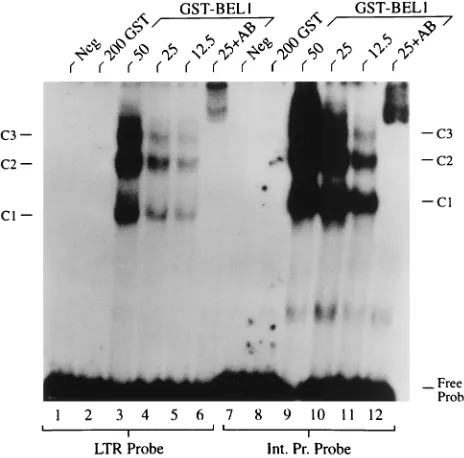
cap site (15). The ability of these HFV DNA sequences to bind the Bel-1 protein specifically in vitro was confirmed in the electrophoretic mobility shift assay (EMSA) shown in Fig. 1, which shows that a recombinant GST–Bel-1 fusion protein is able to interact with both an LTR DNA probe (LTR sequences
2108 to235) (lanes 3 to 5) and an internal promoter DNA
probe (residues 2191 to2105) (lanes 9 to 11). Of interest,
[image:2.612.310.542.70.299.2]under identical assay conditions, and with similar levels of LTR and internal promoter probes labeled to closely comparable specific activities, a significantly higher percentage of the in-ternal promoter probe than of the LTR probe was bound by GST–Bel-1 (compare lanes 5 and 11). The observed probe shifts were due to the Bel-1 protein, in that GST itself failed to bind either probe (lanes 2 and 8). All three observed protein-DNA complexes were supershifted by addition of an anti-GST monoclonal antibody (Fig. 1, lanes 6 and 12), thus demonstrat-ing that these were due to the GST–Bel-1 fusion protein and not to a contaminating DNA binding activity. The fact that at least three distinct protein-DNA complexes, labeled C1, C2,
FIG. 1. Bel-1 binds to target DNA sites located in both the LTR and internal promoters of HFV. EMSA showing binding of increasing levels of a purified, recombinant GST–Bel-1(1–228) fusion protein to an HFV LTR and internal promoter (Int. Pr.) probe. Numbers above the lanes indicate the amounts, in nanograms, of fusion protein used. Controls include no added protein (Neg.) or addition of 200 ng of purified GST. Lanes 6 and 12 show a supershift obtained by addition of an anti-GST monoclonal antibody (;50 ng). C1, C2, and C3 are retarded complexes displaying different electrophoretic mobilities.
on November 9, 2019 by guest
http://jvi.asm.org/
and C3, were observed in this EMSA is of interest, given the previous report that Bel-1 is able to form multimers in vivo (6). However, it should be noted that the linked GST protein can also form dimers.
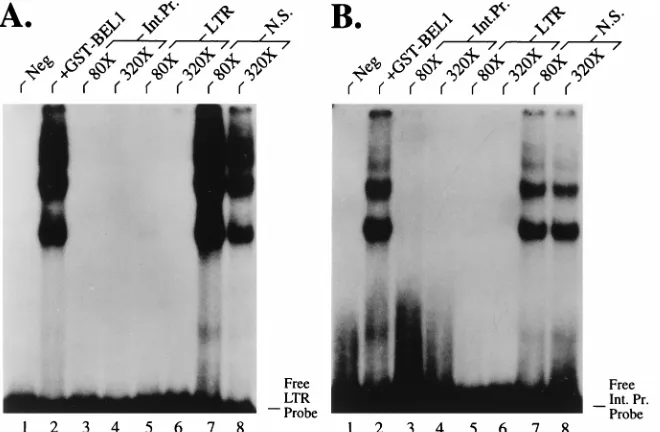
We next sought to confirm that the observed Bel-1–DNA interactions are specific. As shown in Fig. 2, the ability of GST–Bel-1 to bind to either an LTR DNA probe (Fig. 2A) or an internal promoter probe (Fig. 2B) was efficiently competed by an excess of either the unlabeled internal promoter probe (lanes 3 and 4) or the LTR probe (lanes 5 and 6) but was essentially unaffected by the same level of a nonspecific DNA competitor (lanes 7 and 8). Therefore, this DNA binding event is clearly specific and the interactions of Bel-1 with the DNA target sequences are likely to be mechanistically similar.
Bel-1 binds the internal promoter more effectively than the
LTR promoter.As noted above, the GST–Bel-1 fusion protein
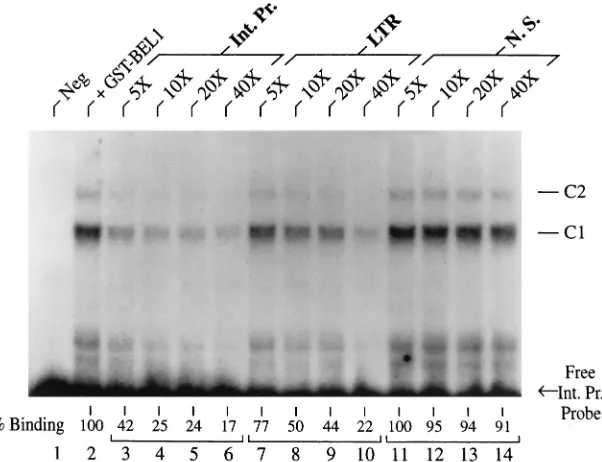
used in these assays bound to a higher percentage of the internal promoter probe than of the LTR promoter probe when incubated under the same assay conditions (Fig. 1). This observation suggests that the internal promoter may contain a higher-affinity binding site for Bel-1 than the one present in the LTR. To address this issue in more detail, we performed a quantitative EMSA with the internal promoter probe and sev-eral different levels of unlabeled internal promoter, LTR, or nonspecific competitor DNAs. As shown in Fig. 3, the internal promoter-derived competitor DNA (lanes 3 to 6) proved a far more effective competitor of the internal promoter probe– Bel-1 binding reaction than did the LTR-derived competitor (lanes 7 to 10). Therefore, it is clear that this internal promoter target sequence is a significantly higher-affinity in vitro DNA binding site for Bel-1 than is the tested HFV LTR target sequence.
Modification interference analysis of Bel-1 DNA binding. We next wished to identify specific residues within the internal promoter and LTR DNA probes required for Bel-1 binding by
modification interference analysis. For this purpose, the2108
to235 HFV LTR probe and the2191 to2105 internal
pro-moter probe were each uniquely end labeled and then incu-bated with dimethylsulfide, which specifically methylates G and
A residues (31). The modified probes were then used for EMSA, and the C1 and C2 complexes (Fig. 1) observed with the internal promoter probe and the C1 complex observed with the LTR probe were excised, purified, and chemically cleaved. The pattern of DNA modification observed in these shifted DNA complexes was then compared to the pattern seen in the free-DNA probes.
As shown in Fig. 4, this experimental approach identified several bases whose modification resulted in an inhibition of interaction with the GST–Bel-1 fusion protein. In the internal promoter DNA probe, marked inhibition of binding was
ob-served upon modification of residues2158G,2157G,2148G,
2144G, and2143A (Fig. 4). More modest interference with
binding was noted upon modification of residues 2152G,
2151G, and2149A. No additional modification interference
was observed in the C2 complex compared to the C1 complex (Fig. 4, compare lanes 2 and 3), thus suggesting either that the lower-mobility C2 complex results entirely from a protein-protein interaction or that any second Bel-1 DNA binding event is relatively nonspecific. Analysis of LTR probe binding by Bel-1 by using modification interference showed significant
inhibition upon modification of residues259G and255G and
modest interference upon modification of residue265G (Fig.
4, lanes 4 and 5).
The analysis presented in Fig. 4 identifies several residues
critical for Bel-1 binding and localizes these between2158 and
2143 in the internal promoter and between265 and255 in
the LTR promoter. Therefore, for both the internal promoter and the LTR promoter, the mapped residues are centered in
the Bel-1 binding sites previously mapped to between 2171
and2135 in the internal promoter and to between284 and
232 in the LTR promoter, using DNase I footprinting. An
alignment of these two Bel-1 binding sites, shown in Fig. 5, suggests that several purine residues identified as important for Bel-1 DNA binding in Fig. 4 are conserved between the high-affinity internal promoter and lower-high-affinity LTR Bel-1 binding sites.
Identification of a minimal Bel-1 DNA binding site.We next
[image:3.612.137.467.70.286.2]wished to determine if the minimal,;25-bp internal promoter
FIG. 2. DNA binding by HFV Bel-1 is specific. The direct interaction of GST–Bel-1 (25 ng) with an HFV LTR (A) or internal promoter (Int. Pr.) DNA probe (B) was specifically blocked by preincubation with an 80- or 320-fold molar excess of unlabeled forms of these same two DNA probes but was not blocked by preincubation with a similar excess of a nonspecific (N.S.) DNA competitor.
on November 9, 2019 by guest
http://jvi.asm.org/
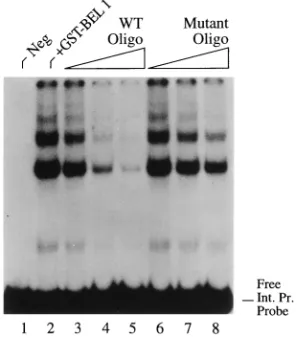
Bel-1 binding site delineated in Fig. 5 is indeed a complete, functional Bel-1 binding site. For this purpose, we prepared synthetic, double-stranded DNA oligonucleotides containing the wild-type 25-bp internal promoter sequence shown in Fig. 4 or containing the same sequence bearing a 6-bp mutation
between residues 2144 and 2149. As shown in Fig. 6, the
wild-type oligonucleotide proved able to effectively compete
for Bel-1 binding to the full-length (2191 to 2105) internal
promoter probe (lanes 3 to 5). However, introduction of a mutation into this minimal DNA binding site blocked this competition (lanes 6 to 8).
Previously, we have demonstrated that Bel-1 is able to bind to the HFV LTR BRE in yeast cells and activate a linked minimal yeast promoter element (15). Importantly, this acti-vation was shown to be dependent on LTR sequences that are also critical for Bel-1 DNA binding in vitro but was indepen-dent of flanking DNA sequences that, while not essential for DNA binding in vitro, are nevertheless critical for Bel-1 func-tion in mammalian cells. We therefore asked whether Bel-1 would also bind the internal promoter BRE in yeast cells and, in particular, whether the minimal 25-bp internal promoter sequence shown to bind Bel-1 in vitro (Fig. 6) would also suffice to bind Bel-1 in vivo. For this purpose, we inserted the
extended HFV internal promoter Bel-1 binding site (2191 to
2105), or various truncated versions thereof, in front of the
minimal cyc promoter element located 59to the lacZ indicator
gene in the yeast indicator plasmid pJLB (10). Shorter se-quences were inserted in both the sense and antisense orien-tations to address the possibility that flanking sequences were contributing fortuitously to any observed Bel-1 binding activity. These indicator plasmids were then introduced into yeast cells along with a previously described (3) high-copy-number Bel-1 expression plasmid or with an appropriate control plasmid.
As shown in Table 1, and also demonstrated previously (15), insertion into the pJLB yeast indicator plasmid of the extended
HFV LTR Bel-1 binding site (2112 to231) results in
activa-tion of the linked lacZ indicator gene upon expression of the Bel-1 protein in trans. Insertion of the extended internal
pro-moter Bel-1 binding site (2191 to2105) also resulted in
ac-tivation of lacZ expression. Remarkably, however, this activa-tion was almost 200-fold higher than the level seen with the equivalent LTR sequence (Table 1). Insertion of the 25-bp
candidate minimal internal promoter Bel-1 binding site (2164
to2140) resulted in a level of activation that was;15% (sense
orientation) or;43% (antisense orientation) of the level seen
with the entire (2191 to 2105) sequence. We next asked
whether a minor, 5-bp extension of the inserted 25-bp internal
promoter sequence in either the 59 (2169 to 2140) or 39
(2164 to2135) direction would enhance the Bel-1 response.
As shown in Table 1, extension in the 59direction enhanced the
level of activation modestly while extension in the 39direction
had no significant effect. Remarkably, however, all of these short internal promoter-derived DNA sequences, including the minimal 25-bp sequence shown in Fig. 5, generated a level of indicator gene activation that was far higher than seen with the full-length HFV LTR-derived Bel-1 target sequence.
[image:4.612.150.451.70.301.2]To examine whether the minimal 25-bp internal promoter Bel-1 binding site defined in Fig. 5 could display functional synergy, and to also more fully demonstrate the specificity of Bel-1-mediated gene activation in yeast cells, we next con-structed pJLB-based indicator plasmids containing two tandem copies of wild-type and mutant forms of the 25-bp internal promoter sequence shown in Fig. 5. We also constructed an indicator plasmid containing a single copy of a 25-bp SFV-1 internal promoter sequence (Fig. 5) centered on residues pre-viously identified by Zou and Luciw (34) as likely to be impor-tant for binding of SFV-1 Tas by DNase I footprinting analysis. In order to maximize the potential for detection of functional synergy, and also because expression of SFV-1 Tas in yeast cells from a multicopy expression plasmid produces significant
FIG. 3. Bel-1 binds the internal promoter DNA target more effectively than the LTR DNA target. This EMSA measures the degree of inhibition of GST–Bel-1 protein (25 ng) binding to an internal promoter (Int. Pr.) DNA probe observed upon preincubation with a 5-, 10-, 20-, or 40-fold molar excess of unlabeled forms of the internal promoter or LTR Bel-1 binding site or a nonspecific (N.S.) DNA competitor. The degree of inhibition seen with each competitor was measured with a phosphorimager and is given at bottom as percent residual binding, with binding in the absence of competitor (lane 2) set at 100%. As can be seen, the internal promoter probe competes more effectively for Bel-1 binding than does the LTR DNA probe. Little competition is observed with similar levels of the nonspecific DNA competitor. Neg., no added protein (control).
on November 9, 2019 by guest
http://jvi.asm.org/
toxicity (reference 3 and data not shown), we introduced these indicator plasmids into yeast cells along with single-copy yeast expression plasmids encoding full-length forms of Bel-1 or Tas.
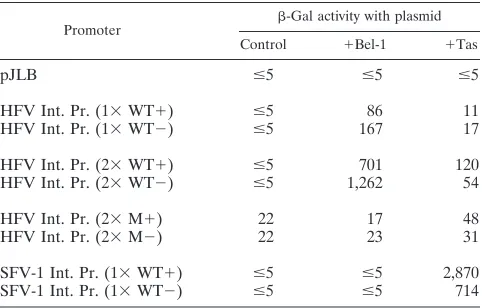
As shown in Table 2, yeast indicator plasmids containing a single-copy of the minimal internal promoter were again found
to give readily detectable levels ofb-Gal activity upon
expres-sion of the Bel-1 protein in trans. The reproducibly lower level of activity reported in Table 2 than in Table 1 likely results from the far lower level of Bel-1 expression generated by the single-copy, ARS-CEN-based Bel-1 expression plasmid used
here than by the high-copy-number, 2mm-based Bel-1
expres-sion plasmid utilized in the experiments whose results are reported in Table 1. Insertion of a second copy of this 25-bp
sequence resulted in the synergistic activation of the linked cyc
promoter element, resulting in an ;10-fold-higher level of
activation than seen with indicator plasmids bearing only a single copy. This activation was dependent on the integrity of the introduced candidate Bel-1 binding site, because mutation of this site, in the context of the double-copy plasmid, blocked the Bel-1 response (Table 2).
The parental pJLB indicator plasmid, lacking any inserted viral sequence, failed to respond to Bel-1 protein expression, as did also a pJLB-derived indicator plasmid containing a single copy of a potential Tas binding site derived from the SFV-1 internal promoter. However, this SFV-1-based indicator plas-mid was strongly activated by expression in trans of the homol-ogous SFV-1 Tas protein. While the Tas protein was able to
only very modestly activateb-Gal expression directed by
plas-mids containing a single-copy of the HFV internal promoter sequence (Table 2), it did prove able to activate the indicator plasmids containing two copies of the wild-type, but not mu-tant, HFV internal promoter sequence (Table 2). Therefore, it appears possible that the HFV and SFV-1 internal promoters may retain some degree of sequence similarity that permits a low-affinity interaction of Tas with the HFV internal promoter sequence. However, these binding sites clearly do not demon-strate any marked homology (Fig. 5).
Comparison of the activation domains of Bel-1 and Tas.A
surprising result reported in Table 2 is that the interaction, in yeast cells, of SFV-1 Tas with a single copy of its minimal
internal promoter binding site resulted in ;12 times more
activation of the linked lacZ indicator gene than did the inter-action of Bel-1 with a comparable single-copy sequence from the HFV internal promoter. One possible explanation for this phenomenon is that the HFV internal promoter binding site used in these constructs is incomplete. However, the observa-tion that an extended internal promoter Bel-1 binding site is only a slightly more effective target for Bel-1 in vivo (Table 1) makes this explanation unlikely. An alternative possibility is that the transcription activation domain of SFV-1 Tas is sig-nificantly more active than the equivalent domain in HFV Bel-1. To examine this possibility, we linked the previously mapped (3, 12, 16, 27, 32) transcription activation domains of Bel-1 and of Tas to the DNA binding domain of GAL4 to determine whether expression of these fusion proteins in yeast cells would induce different levels of activation of a integrated yeast indicator gene bearing GAL4 DNA binding sites. Plas-mids expressing fusion proteins consisting of the GAL4 DNA binding domain (aa 1 to 117) linked to various activation do-mains were introduced into the yeast strain Y190. After 3 days
of selection, b-Gal activity was determined as previously
de-scribed (3). The GAL4 DNA binding domain alone induced a
b-Gal activity of #1 mOD/ml, while the GAL4-VP16 fusion
protein induced had a b-Gal activity of 5,645 mOD/ml. As
previously reported (3), the Bel-1 activation domain, while
clearly functional, is nevertheless;90-fold less active (b-Gal
activity of 61 mOD/ml) than the potent activation domain present in the VP16 transcription factor when tested either in yeast cells, as in this case, or in mammalian cells. In contrast,
the Tas activation domain was found to be ;14-fold more
active than the Bel-1 activation domain when tested in this
yeast assay system (b-Gal activity of 850 milli-optical density
units [mOD]/ml). Therefore, it appears that the;12-fold
[image:5.612.51.291.67.493.2]dif-ference in the activities of Bel-1 and Tas noted in Table 2 is likely primarily caused by a comparable difference in activation domain function. However, this finding does not exclude the possibility that Tas may also bind its internal promoter target site with a somewhat higher affinity than does Bel-1.
FIG. 4. Identification of critical residues for Bel-1 binding in the internal and LTR promoters. Modification interference analysis was used to identify purine residues present in the internal promoter (Int. Pr.) and LTR promoter that are critical for in vitro binding by the GST–Bel-1 fusion protein. Two DNA-protein complexes of different electrophoretic mobilities that form on the internal pro-moter probe, labeled C1 and C2 (Fig. 1), were analyzed independently, with comparable results. Residues showing marked interference are indicated by asterisks.
on November 9, 2019 by guest
http://jvi.asm.org/
DISCUSSION
The expression of genes contained by the primate foamy viruses is regulated by the interplay of two viral promoter
elements, located in the LTR and at the 39end of the env gene,
with the viral Bel-1/Tas transcriptional transactivator (29). Early after infection, the internal promoter is activated, result-ing in the synthesis of mRNAs encodresult-ing the foamy virus ac-cessory proteins, including Bel-1/Tas (21, 25). Subsequently, the LTR promoter is activated, presumably as a result of Bel-1/Tas expression, and mRNAs encoding the Gag, Pol, and Env structural proteins begin to accumulate. Therefore, although foamy viruses are not known to encode posttranscriptional regulatory proteins equivalent to the Rev and Rex proteins found in other primate complex retroviruses (7, 19), they nev-ertheless appear to be similar in that they display a temporal regulation of viral gene expression. However, the basis for this temporal order has been unclear, given that the internal pro-moter does not appear to be significantly more active than the LTR promoter in either the presence or the absence of the relevant Bel-1/Tas protein (5, 22, 25).
In this article, we describe a series of experiments designed to shed further light on the interaction of HFV Bel-1 with both the LTR and internal promoter elements. An interesting result to emerge from this analysis is that the Bel-1 DNA binding site present in the HFV internal promoter element is a significantly higher-affinity binding site for Bel-1 both in vitro and in vivo than is the cap-proximal Bel-1 binding site located in the HFV LTR promoter element. In particular, when analyzed by EMSA under identical assay conditions, Bel-1 was found to shift a higher percentage of an internal promoter probe than of a similar LTR promoter probe (Fig. 1). Similarly, internal promoter sequences also proved able to compete more effec-tively for Bel-1 DNA binding than did LTR promoter se-quences when analyzed in a quantitative EMSA (Fig. 3). Fi-nally, when assayed for in vivo DNA binding in yeast cells by a previously described assay, Bel-1 was able to activate a linked
lacZ indicator gene;200-fold more effectively when targeted to the internal promoter Bel-1 DNA binding site than when targeted to an equivalent LTR-derived Bel-1 binding site (Ta-ble 1). Taken together, these data suggest that activation of the foamy virus internal promoter may precede activation of the LTR promoter during the foamy virus life cycle because the internal promoter acts as a more effective Bel-1 protein bind-ing site when Bel-1 levels are limitbind-ing, as they are predicted to be early in infection. We caution, however, that this analysis only examined binding to the cap-proximal BRE present in the HFV LTR and did not address the affinity of Bel-1 for other proposed LTR BRE elements (8, 20, 33). Although the cap-proximal BRE is fully sufficient to direct essentially wild-type levels of LTR-driven transcription in the presence of the Bel-1
protein in mammalian cells (18), these more 59putative BREs
could potentially play an important role in modulating the level of response of the LTR promoter to Bel-1, particularly given the observation (Table 2) that Bel-1 binding sites can display functional synergy.
Using modification interference and EMSA, we were able to identify several purine residues within both the LTR and in-ternal promoters that are critical for Bel-1 binding in vitro (Fig. 4). We were then able to use this information to align these two sites (Fig. 5) and to propose a potential minimal, 25-bp DNA binding site for Bel-1. This minimal site was then shown to in fact function as an effective Bel-1 DNA binding site both in vitro (Fig. 6) and in vivo (Tables 1 and 2). The identification of this minimal Bel-1 DNA binding site will permit the future mutational definition of individual bases that form a functional binding site and should also allow the identification of residues that attenuate Bel-1 binding to the LTR promoter compared to the internal promoter. It will clearly be of interest to test whether an enhancement in the affinity of the HFV LTR bind-ing site for Bel-1 results in a disruption of the normal temporal order of HFV gene expression.
As part of this analysis, we also tested whether a 25-bp sequence derived from the SFV-1 internal promoter, first iden-tified as important for Tas binding by DNase I footprinting (34), was sufficient to function as an effective Tas binding site
[image:6.612.354.503.483.652.2]FIG. 5. Alignment of possible Bel-1 and Tas minimal binding sites. Candidate minimal binding sites for HFV Bel-1 located in the LTR and internal promoter (Int. Pr.) elements are indicated and aligned. Purine residues that gave rise to detectable inhibition of Bel-1 binding after methylation are indicated. A candidate minimal SFV-1 Tas DNA binding site, based on the DNase I footprinting studies of Zou and Luciw (34), is also given, although the alignment used is largely arbitrary and does not show significant conservation of purine residues shown to be critical for Bel-1 binding. DNA sequences used for subsequent analyses are in capital letters. Boxes define residues whose mutation blocks Bel-1 binding in vitro and function in vivo (15).
FIG. 6. A 25-bp internal promoter sequence competes for specific Bel-1 DNA binding. A double-stranded, synthetic oligonucleotide consisting of the 25-bp internal promoter (Int. Pr.) sequence (2164 to2140) shown in Fig. 5 specifically competed Bel-1 binding to the full-length (2191 to2105) internal promoter probe (lanes 3 to 5). In contrast, a similar internal promoter-derived oligonucleotide containing mutations at residues2149 to2144 (Fig. 5) failed to compete (lanes 6 to 8). This competition experiment used 4-, 20-, and 80-fold molar excesses of each competitor oligonucleotide. WT, wild type; oligo, oligo-nucleotide.
on November 9, 2019 by guest
http://jvi.asm.org/
in vivo. As shown in Table 2, this short sequence indeed proved fully sufficient to bind Tas efficiently. This observation allowed us to determine whether the inability of Tas to function effec-tively via HFV promoter elements in mammalian cells was due to an inability of Tas to bind these HFV DNA sequences or, instead, reflected the absence of a critical Tas cofactor binding site. As shown in Table 2, Tas was able to interact only poorly with the minimal internal promoter Bel-1 target site. It is therefore apparent that Tas and Bel-1 have evolved distinct DNA sequence specificities over time. The future definition of these differences will clearly be of interest.
A final interesting result is that the activation domain
present in SFV-1 Tas was found to be significantly more active than the one present in Bel-1. This finding explains the earlier observation (3) that expression of SFV-1 Tas from a multicopy plasmid in yeast cells is significantly more deleterious for yeast growth than is expression of HFV Bel-1, in that it has previ-ously been shown that the level of toxicity observed in yeast upon overexpression of an acidic transcription activation do-main is a function of the activity of the tested dodo-main (2). This difference also appears to explain the finding that the level of indicator gene expression induced by the binding of Tas to its minimal binding site in yeast cells is significantly higher than the level observed when using Bel-1 and its minimal DNA binding site (Table 2). The question of whether this difference in activation domain function observed in yeast cells is relevant to the effectiveness of transcriptional activation by Tas and Bel-1 in mammalian cells remains to be explored.
ACKNOWLEDGMENTS
This research was supported by the Howard Hughes Medical Insti-tute.
We are grateful to Sharon Goodwin for assistance in preparation of the manuscript.
REFERENCES
1. Baunach, G., B. Maurer, H. Hahn, M. Kranz, and A. Rethwilm. 1993. Functional analysis of human foamy virus accessory reading frames. J. Virol. 67:5411–5418.
2. Berger, S. L., B. Pina, N. Silverman, G. A. Marcus, J. Agapite, J. L. Regier, S. J. Triezenberg, and L. Guarente.1992. Genetic isolation of ADA2: a potent transcriptional adaptor required for function of certain acidic activa-tion domains. Cell 70:251–265.
3. Blair, W. S., H. Bogerd, and B. R. Cullen. 1994. Genetic analysis indicates that the human foamy virus Bel-1 protein contains a transcription activation domain of the acidic class. J. Virol. 68:3803–3808.
4. Campbell, M., C. Eng, and P. A. Luciw. 1996. The simian foamy virus type 1 transcriptional transactivator (Tas) binds and activates an enhancer ele-ment in the gag gene. J. Virol. 70:6847–6855.
5. Campbell, M., L. Renshaw-Gegg, R. Renne, and P. A. Luciw. 1994. Charac-terization of the internal promoter of simian foamy viruses. J. Virol. 68: 4811–4820.
6. Chang, J., K. J. Lee, K. L. Jang, E. K. Lee, G. H. Baek, and Y. C. Sung. 1995. Human foamy virus Bel1 transactivator contains a bipartite nuclear local-ization determinant which is sensitive to protein context and triple multim-erization domains. J. Virol. 69:801–808.
7. Cullen, B. R. 1992. Mechanism of action of regulatory proteins encoded by complex retroviruses. Microbiol. Rev. 56:375–394.
8. Erlwein, O., and A. Rethwilm. 1993. Bel-1 transactivator responsive se-quences in the long terminal repeat of human foamy virus. Virology 196: 256–268.
9. Ernst, R. K., M. Bray, D. Rekosh, and M. Hammarskjo¨ld. 1997. A structural retroviral RNA element that mediates nucleocytoplasmic export of intron-containing RNA. Mol. Cell. Biol. 17:135–144.
10. Finley, R. L., Jr., S. Chen, J. Ma, P. Byrne, and R. W. West, Jr. 1990. Opposing regulatory functions of positive and negative elements in UASG
control transcription of the yeast GAL genes. Mol. Cell. Biol. 10:5663–5670. 11. Flu¨gel, R. M. 1991. Spumaviruses: a group of complex retroviruses. J.
Ac-quired Immune Defic. Syndr. 4:739–750.
12. Garrett, E. D., F. He, H. P. Bogerd, and B. R. Cullen. 1993. Transcriptional trans activators of human and simian foamy viruses contain a small, highly conserved activation domain. J. Virol. 67:6824–6827.
13. Gietz, R. D., and A. Sugino. 1988. New yeast-Escherichia coli shuttle vectors constructed with in vitro mutagenized yeast genes lacking six-base pair re-striction sites. Gene 74:527–534.
14. Harper, J. W., G. R. Adami, N. Wei, K. Keyomarsi, and S. J. Elledge. 1993. The p21 Cdk-interacting protein Cip1 is a potent inhibitor of G1 cyclin-dependent kinases. Cell 75:805–816.
15. He, F., W. S. Blair, J. Fukushima, and B. R. Cullen. 1996. The human foamy virus Bel-1 transcription factor is a sequence-specific DNA binding protein. J. Virol. 70:3902–3908.
16. He, F., J. D. Sun, E. D. Garrett, and B. R. Cullen. 1993. Functional organi-zation of the Bel-1 trans activator of human foamy virus. J. Virol. 67:1896– 1904.
17. Keller, A., E. D. Garrett, and B. R. Cullen. 1992. The Bel-1 protein of human foamy virus activates human immunodeficiency virus type 1 gene expression via a novel DNA target site. J. Virol. 66:3946–3949.
[image:7.612.51.288.88.218.2]18. Keller, A., K. M. Partin, M. Lo¨chelt, H. Bannert, R. M. Flu¨gel, and B. R. TABLE 1. The HFV internal promoter contains a high-affinity
in vivo Bel-1 DNA binding site
Promoter b-Gal activitya
pJLB... #5 (;0) LTR (2112 to231)... 450 (0.6) Int. Pr. (2191 to2105)... 74,960 (100) Int. Pr. (2164 to2140)... 10,930 (15) Int. Pr. (2140 to2164)... 32,530 (43) Int. Pr. (2169 to2140)... 27,420 (37) Int. Pr. (2140 to2169)... 41,090 (55) Int. Pr. (2164 to2135)... 28,630 (38) Int. Pr. (2135 to2164)... 26,472 (35) aSequences derived from the HFV LTR or internal promoter (Int. Pr.) were inserted 59of the minimal cyc promoter element present in the lacZ-based yeast indicator plasmid pJLB. Sense or antisense orientation is indicated by the pro-moter coordinates; e.g., the sequence from2169 to2140 is sense, while that from2140 to2169 is antisense. These reporter plasmids were introduced into yeast cells together with a multicopy Bel-1 expression plasmid (3) or a similar control plasmid. Induced b-Gal activities were measured after selection for cotransformants and are given in mOD/milliliter. No detectable activity was observed with any indicator plasmid in the absence of Bel-1. Activity levels are also given (in parentheses) relative to the extended internal promoter Bel-1 binding site, which is arbitrarily set at 100%. These data are the averages of four independent experiments.
TABLE 2. Binding of Bel-1 and Tas to minimal DNA target sites in yeast cellsa
Promoter b-Gal activity with plasmid Control 1Bel-1 1Tas
pJLB #5 #5 #5
HFV Int. Pr. (13WT1) #5 86 11
HFV Int. Pr. (13WT2) #5 167 17
HFV Int. Pr. (23WT1) #5 701 120
HFV Int. Pr. (23WT2) #5 1,262 54
HFV Int. Pr. (23M1) 22 17 48
HFV Int. Pr. (23M2) 22 23 31
SFV-1 Int. Pr. (13WT1) #5 #5 2,870
SFV-1 Int. Pr. (13WT2) #5 #5 714
aWild-type (WT) or mutant (M) forms of the minimal 25-bp HFV or SFV-1 internal promoter (Int. Pr.) sequence shown in Fig. 5 were inserted in one (13) or two (23) copies into the lacZ-based yeast indicator plasmid pJLB. Orientation is indicated by a plus (sense) or minus (antisense) sign. These reporter plasmids were introduced into yeast cells together with single-copy plasmids expressing Bel-1 or Tas or a similar control plasmid. Inducedb-Gal activity was measured after selection for cotransformants and is given in mOD/milliliter. These data are representative of three independent experiments.
on November 9, 2019 by guest
http://jvi.asm.org/
[image:7.612.50.291.507.661.2]Cullen.1991. Characterization of the transcriptional trans activator of hu-man foamy retrovirus. J. Virol. 65:2589–2594.
19. Lee, A. H., H. Y. Lee, and Y. C. Sung. 1994. The gene expression of human foamy virus does not require a post-transcriptional transactivator. Virology 204:409–413.
20. Lee, K. J., A. H. Lee, and Y. C. Sung. 1993. Multiple positive and negative cis-acting elements that mediate transactivation by bel1 in the long terminal repeat of human foamy virus. J. Virol. 67:2317–2326.
21. Lo¨chelt, M., R. M. Flu¨gel, and M. Aboud. 1994. The human foamy virus internal promoter directs the expression of the functional Bel 1 transactiva-tor and Bet protein early after infection. J. Virol. 68:638–645.
22. Lo¨chelt, M., W. Muranyi, and R. M. Flu¨gel. 1993. Human foamy virus genome possesses an internal, Bel-1-dependent and functional promoter. Proc. Natl. Acad. Sci. USA 90:7317–7321.
23. Lo¨chelt, M., S. F. Yu, M. L. Linial, and R. M. Flu¨gel. 1995. The human foamy virus internal promoter is required for efficient gene expression and infec-tivity. Virology 206:601–610.
24. Lo¨chelt, M., H. Zentgraf, and R. M. Flu¨gel. 1991. Construction of an infec-tious DNA clone of the full-length human spumaretrovirus genome and mutagenesis of the bel 1 gene. Virology 184:43–54.
25. Mergia, A. 1994. Simian foamy virus type 1 contains a second promoter located at the 39end of the env gene. Virology 199:219–222.
26. Mergia, A., and P. A. Luciw. 1991. Replication and regulation of primate foamy viruses. Virology 184:475–482.
27. Mergia, A., L. W. Renshaw-Gegg, M. W. Stout, R. Renne, and O. Herchen-ro¨eder.1993. Functional domains of the simian foamy virus type 1 transcrip-tional transactivator (Taf). J. Virol. 67:4598–4604.
28. Mergia, A., K. E. S. Shaw, E. Pratt-Lowe, P. A. Barry, and P. A. Luciw. 1991. Identification of the simian foamy virus transcriptional transactivator gene (taf). J. Virol. 65:2903–2909.
29. Rethwilm, A. 1995. Regulation of foamy virus gene expression. Curr. Top. Microbiol. Immunol. 193:1–24.
30. Rethwilm, A., O. Erlwein, G. Baunach, B. Maurer, and V. Ter Meulen. 1991. The transcriptional transactivator of human foamy virus maps to the bel 1 genomic region. Proc. Natl. Acad. Sci. USA 88:941–945.
31. Shaw, P. E., and A. F. Stewart. 1994. Identification of protein-DNA contacts with dimethyl sulfate. Methods Mol. Biol. 30:79–87.
32. Venkatesh, L. K., and G. Chinnadurai. 1993. The carboxy-terminal tran-scription enhancement region of the human spumaretrovirus transactivator contains discrete determinants of the activator function. J. Virol. 67:3868– 3876.
33. Venkatesh, L. K., P. A. Theodorakis, and G. Chinnadurai. 1991. Distinct cis-acting regions in U3 regulate trans-activation of the human spumaretro-virus long terminal repeat by the viral bel1 gene product. Nucleic Acids Res. 19:3661–3666.
34. Zou, J. X., and P. A. Luciw. 1996. The transcriptional transactivator of simian foamy virus 1 binds to a DNA target element in the viral internal promoter. Proc. Natl. Acad. Sci. USA 93:326–330.