Copyright © 1998, American Society for Microbiology. All Rights Reserved.
Substitutions in a Major Histocompatibility Complex Class
II-Restricted Human Immunodeficiency Virus Type 1 gp120
Epitope Can Affect CD4
1
T-Helper-Cell Function
CHRISTINE LEKUTIS*
ANDNORMAN L. LETVIN
Harvard Medical School, Beth Israel Deaconess Medical Center,
Boston, Massachusetts 02215
Received 3 December 1997/Accepted 25 March 1998
It has been suggested that the inability of the immune response to control human immunodeficiency virus
type 1 (HIV-1) replication may be due, at least in part, to the capacity of this virus to escape from immune
recognition through mutation. While there is increasing evidence for the importance of HIV-1-specific CD4
1T cells in containing HIV-1 spread in the infected individual, little is known about the consequences of HIV-1
mutation on virus-specific CD4
1T-cell function. The impact of HIV-1 sequence variation on CD4
1T-helper
(Th)-cell function was assessed with a rhesus monkey model for immune recognition of the HIV-1 envelope
(Env) glycoprotein. A series of HIV-1 Env(484-496) variant peptides were shown to retain the ability to bind
to the appropriate rhesus monkey major histocompatibility complex class II DR molecule. Peptides bearing
substitutions at position 490, however, failed to drive the proliferation or cytokine secretion of two
well-characterized HXBc2 Env-specific rhesus monkey CD4
1Th-cell lines. Exogenous costimulation was ineffective
in complementing the ability of the nonstimulatory peptides to induce [
3H]thymidine incorporation by these
cells. Finally, HIV-1 Env(484-496) variant peptides with substitutions at position 490 antagonized the HXBc2
Env peptide-induced proliferative response of the CD4
1Th-cell lines. Thus, HIV-1 variants appear to have the
capacity to neutralize the function of virus-specific CD4
1T lymphocytes.
Human immunodeficiency virus type 1 (HIV-1) rapidly
mu-tates in an infected individual because of its high replication
rate and the infidelity of its reverse transcriptase (11, 12, 29).
The greatest sequence variation in HIV-1 is seen in regions of
the viral envelope (Env) glycoprotein. Most infected
individu-als mount a vigorous immune response against HIV-1.
Never-theless, in the absence of therapeutic interventions, high levels
of viral replication persist and profound deterioration of the
immune system usually occurs. It has been suggested that the
inability of the immune response to contain this viral
replica-tion may be due to the capacity of the mutating virus to escape
immune recognition.
There is increasing evidence for the importance of CD4
1T
cells in containing HIV-1 spread in the infected individual (28).
The extent to which HIV-1 can avoid recognition by
virus-specific CD4
1T lymphocytes has not been well defined. Early
reports suggested that human HIV-1 Env(410-429)-specific
CD4
1T-helper (Th)-cell clones could recognize peptides
cor-responding to divergent viral isolates (3, 31). Similarly, studies
with a large panel of HIV-1 Env(428-443) variant peptides
bearing empirically introduced amino acid substitutions
indi-cated that evasion of H-2E
k-restricted murine Th-cell
recog-nition was an unlikely event (2). In contrast, the absence of
recognition of HIV-1 Env(236-251) variant peptides by human
CD4
1Th-cell clones suggested that significant differences exist
between ubiquitous clade B viruses (20). More recent efforts
have documented the inability of human CD4
1Th-cell clones
to recognize third-hypervariable-loop peptides, HIV-1 Env
(303-338), corresponding to heterologous viral isolates (9, 10,
26). These reports suggest that HIV-1 may be able to escape
from CD4
1Th-cell recognition. Little structural information,
however, has been gathered to define the amino acid
substitu-tions in HIV-1 peptides required to alter their binding to major
histocompatibility complex (MHC) class II molecules or to
T-cell receptors (TCR). Furthermore, the functional
conse-quences of alterations in an HIV-1-specific CD4
1T-cell
epi-tope for Th cells have not been thoroughly examined.
With the development of chimeric simian-human
deficiency viruses containing HIV-1 env on a simian
immuno-deficiency virus backbone, the role of HIV-1 Env in AIDS
pathogenesis can be explored with rhesus monkeys (19, 30).
We previously established HIV-1 Env-specific CD4
1Th-cell
lines from plasmid DNA-vaccinated rhesus monkeys (18). Two
of these CD4
1Th-cell lines were found to recognize the HIV-1
Env(484-496) epitope in an MHC class II DR-restricted
fash-ion (17). In this study, we examined the effect of substitutfash-ions
in this HIV-1-specific CD4
1Th-cell epitope on MHC class II
molecule binding and CD4
1Th-cell recognition and function.
MATERIALS AND METHODS
Cell lines.Rhesus monkey B lymphocytes were transformed with a
superna-tant from an immortalized B-cell line (S594) productively infected with the baboon herpesvirus Herpes papio (23). Transformed rhesus monkey B-lympho-blastoid-cell lines (B-LCL) were expanded and maintained in RPMI 1640 me-dium (GIBCO BRL, Gaithersburg, Md.) supplemented with HEPES (25 mM), L-glutamine (2 mM), penicillin (50 U/ml), streptomycin (40mg/ml), gentamicin (50mg/ml), and 10% fetal calf serum (FCS) (BioWhittaker, Walkersville, Md.). HIV-1 Env-specific CD41Th-cell lines were established from peripheral blood lymphocytes of HIV-1 env DNA-vaccinated rhesus monkeys by stimulation with recombinant gp120 (Intracel, Cambridge, Mass.) followed by expansion with recombinant interleukin 2 (IL-2) (kindly provided by Hoffmann-La Roche, Nut-ley, N.J.) as previously described (18). Cells were maintained in cultures in 24-well plates containing RPMI 1640 medium supplemented with antibiotics and 10% FCS through repeated rounds of antigen restimulation at 7- to 14-day intervals. The HIV-1 Env-specific Th-cell lines were used in functional assays at least 7 days following restimulation.
Rhesus monkey MHC class II DRa- andb-chain cDNAs were cloned into pREP4 (Invitrogen, San Diego, Calif.) after insertion of the encephalomyocar-ditis virus internal ribosomal entry sequence (6). Plasmid DNA was
electropo-* Corresponding author. Present address: Department of
Microbi-ology and ImmunMicrobi-ology, Stanford University Medical Center, D305
Fairchild Building, Stanford, CA 94305. Phone: (650) 723-7296. Fax:
(650) 723-6853. E-mail: [email protected].
5840
on November 9, 2019 by guest
http://jvi.asm.org/
rated into MHC class II-negative, human Epstein-Barr virus-transformed RM3 B-LCL (4). Stable RM3 transfectants expressing rhesus monkey MHC class II DR molecules were isolated through hygromycin B (Calbiochem Novabiochem Corp., La Jolla, Calif.) selection in RPMI 1640 medium supplemented with antibiotics and 10% FCS (17). Cell surface expression of MHC class II DR molecules was confirmed by staining with the phycoerythrin-conjugated, HLA-DR-specific monoclonal antibody L243 (Becton Dickinson Immunocytometry Systems, San Jose, Calif.) followed by flow cytometric analysis on an EPICS XL apparatus (Coulter Corp., Miami, Fla.).
Synthetic peptides.The 20-amino-acid HIV-1 HXBc2 gp120 synthetic
pep-tides used to map epitopes recognized by Env-specific CD41Th-cell lines were kindly provided by the Medical Research Council courtesy of the AIDS Reagent Project (Hertfordshire, United Kingdom). The sequences of the peptides used in this study are as follows: p15/Env(172-191), EYAFFYKLDIIPIDNDTTSY; p22/ Env(242-261), VSTVQCTHGIRPVVSTQLLL; and p46/Env(482-501), ELYKY KVVKIEPLGVAPTKA. The sequences of the 13-amino-acid HIV-1 Env(484-496) variant peptides are listed in Table 3. These peptides were obtained from Quality Controlled Biochemicals (Hopkinton, Mass.).
Mamu-DR*W201-binding assay.The binding of HIV-1 Env(484-496) variant
peptides to the Macaca mulatta leukocyte antigen (Mamu)-DR*W201 molecule expressed on the surface of RM3 transfectants was measured in a cellular competition assay similar to that used by others (3, 33). Briefly, the ability of HIV-1 Env(484-496) variant peptides to inhibit the proliferation of a Mamu-DR*W201-restricted, CD41Th-cell line specific for HIV-1 Env(172-191) was measured. X-irradiated (5,000 rads) Mamu-DR*W201-expressing RM3 cells were incubated in 96-well flat-bottom microtiter plates in the presence of 25mg of the Env(484-496) peptide competitor per ml for 2 h prior to the addition of 0.5
mg of the 191) peptide per ml and an equivalent number of Env(172-191)-specific CD41Th cells. Cultures were pulsed with [3H]thymidine on day 2
and harvested on day 3. The incorporation of [3H]thymidine was counted by
liquid scintillation, as described below.
Proliferation assay.CD41Th-cell lines were cultured at 23104cells/well with
an equivalent number of X-irradiated (5,000 rads) autologous B-LCL in the presence of 0 to 50mg of peptide per ml in 96-well flat-bottom microtiter plates. After 2 days, 1mCi of [3H]thymidine was added per well. The cultures were
harvested onto glass fiber filter mats on day 3 with an automated plate harvester (Tomtec, Orange, Conn.). [3H]thymidine incorporation was determined with
Optiphase Betamix scintillation fluid and a Microbeta 1450 liquid scintillation counter (Wallac, Gaithersburg, Md.).
To reconstitute the ability of HIV-1 Env(484-496) variant peptides bearing substitutions at position 490 to stimulate the proliferation of HXBc2 Env(484-496)-specific CD41Th cells, 40 ng of phorbol myristate acetate (PMA) per ml, 200 ng of ionomycin (ION) per ml, or 100 pg of human recombinant IL-1bper ml was added to cultures containing 5mg of Env(484-496) variant peptides per ml. Both PMA and ION were obtained from Sigma Chemical Co. (St. Louis, Mo.); recombinant human IL-1bwas purchased from Genzyme (Cambridge, Mass.). These studies were in all other respects identical to the proliferation assays already described.
Cytokine secretion.To measure cytokine production by CD41Th-cell lines,
106T cells were cultured with an equivalent number of X-irradiated (5,000 rads)
autologous B-LCL in 24-well plates containing 1 ml of RPMI 1640 medium supplemented with antibiotics and 5% FCS in the presence or absence of 5mg of peptide per ml. Supernatants were harvested after 48 h and frozen prior to analysis. Cytokine measurements were made according to manufacturers’ in-structions with commercially available enzyme-linked immunosorbent assay (ELISA) kits. The human IL-4 kit, the human IL-10 kit, and the rhesus monkey gamma interferon kit were obtained from Biosource International (Camarillo, Calif.), while the human transforming growth factorbkit and the human tumor necrosis factor alpha kit were obtained from Genzyme. The human ELISA kits were selected on the basis of cross-reactivity with cytokines present in the su-pernatants of activated rhesus monkey peripheral blood lymphocytes.
Antagonism assay.The ability of HIV-1 Env(484-496) variant peptides to
antagonize the proliferative response of HXBc2-specific CD41Th-cell lines was examined with a prepulse assay to eliminate peptide competition for MHC class II occupancy (7). Autologous B-LCL were pulsed for 2 h with 0.5mg of the
HIV-1 HXBc2 Env(484-496) index peptide per ml. The B-LCL were then washed extensively and X-irradiated (5,000 rads) prior to a 2-h pulse with a 0.5 to 50mg/ml amount of the index peptide, the Env(484-496) variant peptides, or the nonstimulatory, Mamu-DR*W201-binding Env(172-191) peptide p15. The B-LCL were again washed thoroughly and plated at 23104cells/well in 96-well
flat-bottom microtiter plates with an equivalent number of HXBc2 Env(484-496) peptide-specific CD41Th cells. Cultures were pulsed with [3H]thymidine on day
2 and harvested on day 3. The incorporation of [3H]thymidine was counted by
liquid scintillation, as described above.
RESULTS
Variation of HIV-1 clade B Env sequences in the region of a
CD4
1Th-cell epitope is greatest at amino acid residues 490
and 496.
We previously identified the nonamer YKVVKIEPL
(amino acids 486 to 494) as a minimal HIV-1 Env CD4
1Th-cell epitope by using long-lived Th-cell lines isolated from HIV-1
env DNA-vaccinated rhesus monkeys (18). Although this
CD4
1Th-cell epitope is located in the fifth conserved region
of gp120, some sequence variation has been observed in this
location, both across HIV-1 clades and among clade B isolates
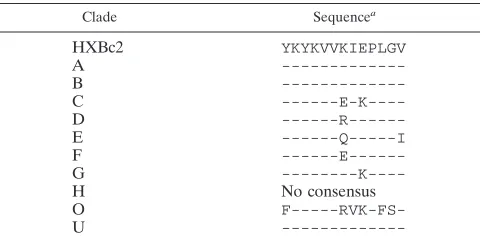
(Tables 1 and 2). In fact, when 92 clade B Env sequences were
compared to the HIV-1 HXBc2 index sequence, two frequent
conservative substitutions were seen: arginine for lysine at
po-sition 490 and isoleucine for valine at popo-sition 496 (21). These
two positions appear to be relative hot spots for viral variation.
HIV-1 Env(484-496) variant peptides retain the ability to
bind to the MHC class II molecule Mamu-DR*W201.
We also
[image:2.612.308.549.587.708.2]previously showed that recognition of both HIV-1
Env(482-501) and HIV-1 Env(172-191) peptides by CD4
1Th-cell lines
is restricted by the same MHC class II DR molecule,
Mamu-DR*W201 (17). It is conceivable that some Env(484-496)
vari-ant peptides may not bind to Mamu-DR*W201 and therefore
may go unrecognized by HIV-1 HXBc2 Env(484-496)-specific,
Mamu-DR*W201-restricted CD4
1Th cells. We used the Env
(171-192)-specific, Mamu-DR*W201-restricted CD4
1Th-cell
line 431.08 in a functional assay to determine whether any of
the Env(484-496) variant peptides could compete with Env
(171-192) peptide binding to a Mamu-DR*W201-expressing
antigen-presenting cell. Specifically, 431.08 Th cells and an
RM3 transfectant expressing Mamu-DR*W201 were
incubat-ed in the presence or absence of Env(484-496) variant
pep-tides, as well as a suboptimal concentration of the
Env(171-192) peptide. As expected, the HXBc2 Env(484-496) peptide,
but not an irrelevant Env(241-262) peptide, inhibited the Env
(171-192) peptide-driven proliferative response of 431.08 (Fig.
1). Interestingly, all of the Env(484-496) variant peptides
tested inhibited Env(171-192) peptide-stimulated [
3H]thymi-dine incorporation, suggesting that the corresponding amino
TABLE 1. Intra-clade B variation in HIV-1 CD4
1Th-cell
epitope Env(484-496) variant peptides
Ya K Y K V V K I E P L G V
R
I
I3
bR15
V2
K
L
I2
I14
Q2
V
L2
T
E
aHIV-1 HXBc2 Env(484-496) index sequence. All HIV-1 Env sequences were
obtained from the Human Retrovirus and AIDS database (21).
bSubscripts indicate the number of times a given substitution was observed in
92 HIV-1 clade B Env sequences.
TABLE 2. Cross-clade variation in HIV-1 CD4
1Th-cell
epitope Env(484-496) variant peptides
Clade SequenceaHXBc2
YKYKVVKIEPLGV
A
---B
---C
---E-K----D
---R---E
---Q---I
F
---E---G
---K----H
No consensus
O
F---RVK-FS-U
---aHIV-1 Env consensus sequences were obtained from the Human Retrovirus
and AIDS database (21). Dashes indicate amino acid identity.
on November 9, 2019 by guest
http://jvi.asm.org/
acid substitutions within these peptides were not sufficient to
abrogate peptide binding to Mamu-DR*W201.
HIV-1 Env(484-496) variant peptides with substitutions at
position 490 fail to drive proliferation and cytokine secretion
by two HXBc2-specific CD4
1Th-cell lines.
Proliferation assays
were then done to determine whether the Env(484-496)
vari-ant peptides, which retained the ability to bind to the
restrict-ing MHC class II DR molecule, were able to stimulate HIV-1
HXBc2 Env(484-496)-specific CD4
1Th cells. As shown in
Table 3, five of the nine Env(484-496) variant peptides tested
stimulated the HXBc2-specific cell lines to proliferate. In
con-trast, the four Env(484-496) variant peptides bearing
substitu-tions at position 490 did not drive [
3H]thymidine incorporation
above what was observed in the presence of medium alone.
Moreover, only Env(484-496) variant peptides capable of
stim-ulating a proliferative response were able to induce the
expres-sion of the high-affinity IL-2 receptor CD25 (data not shown).
Since it has been shown in other systems that a peptide
ligand can trigger cytokine secretion by a T-cell population in
the absence of proliferation, the ability of the Env(484-496)
variant peptides to induce cytokine production was measured
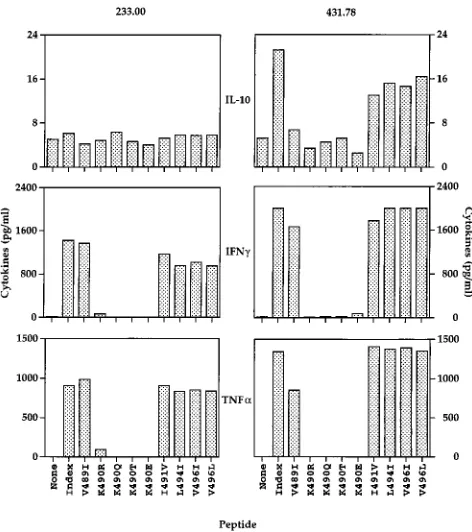
(8). As shown in Fig. 2, only Env(484-496) variant peptides
capable of stimulating [
3H]thymidine incorporation were able
to induce substantial gamma interferon and tumor necrosis
factor alpha production. In addition, the CD4
1Th-cell line
431.78, which produces IL-10 in response to the HXBc2 index
peptide, also did so in the presence of the I491V, L494I, V497I,
and V496L peptides. This cell line, however, did not secrete
IL-10 in the presence of Env(484-496) variant peptides bearing
substitutions at position 489 or 490. Neither of the CD4
1Th-cell lines produced IL-4 or transforming growth factor
b
in
response to either the HXBc2 index peptide or any of the nine
Env(484-496) variant peptides examined (data not shown).
Thus, variation at position 490 of the HIV-1 Env(484-496)
epitope abolished rather than modulated cytokine secretion by
both of the HXBc2-specific CD4
1Th-cell lines.
Exogenous costimulation fails to restore the ability of HIV-1
Env(484-496) variant peptides bearing substitutions at
posi-tion 490 to stimulate HXBc2-specific CD4
1Th-cell lines.
It
[image:3.612.310.546.68.334.2]was formally possible that the K490R, K490Q, K490T, and
K490E peptides, when bound to Mamu-DR*W201, partially
induced Th-cell activation. To assess this possibility, the
phar-macological agent PMA, the calcium ionophore ION, or the
cytokine IL-1
b
was added to cultures in an attempt to
com-plement any T-cell signaling ability of the Env(484-496) variant
FIG. 1. Peptides corresponding to naturally occurring variants of the CD41 Th-cell epitope Env(484-496) compete with the Env(171-192) peptide for bind-ing to Mamu-DR*W201 molecules expressed by RM3-transfected antigen-pre-senting cells. Mamu-DR*W201-expressing RM3 cells were plated at 23104
[image:3.612.107.232.69.210.2]cells/well in 96-well flat-bottom microtiter plates and incubated for 2 h with 25mg of the Env(484-496) variant peptides or an irrelevant Env(241-262) peptide per ml. Approximately 23104431.08 CD41Th cells were then added to each well along with 0.5mg of the Env(171-192) peptide per ml. Cultures were pulsed with 1mCi of [3H]thymidine per well after 2 days and harvested on day 3.
FIG. 2. Peptides corresponding to naturally occurring variants of the CD41 Th-cell epitope Env(484-496) bearing substitutions at amino acid position 490 fail to stimulate cytokine secretion by two CD41Th-cell lines. Approximately 106
[image:3.612.51.290.502.645.2]CD41Th cells were cultured in the presence of an equivalent number of autol-ogous B-LCL in 1 ml of medium in the presence or absence of Env(484-496) variant peptides. After 2 days, supernatants were harvested and frozen. Cytokine content was later measured with commercially available ELISA kits.
TABLE 3. Effects of variation in an HIV-1 Env Th-cell epitope on
the proliferative responses of MHC class II-restricted
CD4
1Th-cell lines
Isolate Sequence Peptidea
Proliferative responsebof Th-cell line:
233.00 431.78
HXBc2
YKYKVVKIEPLGV
Index
111
111
VE3
---I---
V489I
111
11
RF
---R---
K490R
2
2
VE7
---Q---
K490Q
2
2
MN
---T---
K490T
2
2
QZ4589
---E---
K490E
2
2
4995
---V---
I491V
111
111
GUN
---I--
L494I
111
111
SF2B13
---I
V496I
111
111
68A
---L
V496L
111
111
aHIV-1 Env variant peptides were named with the nomenclature X#Y, where X represents the index peptide amino acid residue, # represents the amino acid position within Env, and Y represents the amino acid substitution observed at position #.
bResults are expressed as the concentration of peptide required to give 50% maximal proliferation of the Mamu-DR*W201-restricted rhesus monkey CD41 Th-cell lines:111,#0.5mg/ml;11, 0.5 to 5.0mg/ml;1, 5.0 to 50mg/ml;2, .50mg/ml. In the presence of medium alone, both T-cell lines had a background of less than 100 cpm. Fifty percent maximal proliferation was defined as 2,000 cpm for cell line 233.00 and 11,900 cpm for cell line 431.78.
on November 9, 2019 by guest
http://jvi.asm.org/
peptides bearing substitutions at amino acid 490. PMA, ION,
and IL-1
b
, while able to enhance the proliferative responses of
the two CD4
1Th-cell lines to stimulatory peptides, failed to
induce substantial [
3H]thymidine incorporation by these cell
lines in response to the K490R, K490Q, K490T, and K490E
peptides (data not shown). Thus, if the Env(484-496) variant
peptides with substitutions at position 490 induce a partial
activation signal, this signal is weak at best.
HIV-1 Env(484-496) variant peptides antagonize the
HXBc2-specific proliferative responses of two CD4
1Th-cell lines.
It
has been demonstrated in both murine and human model
systems that altered peptide ligands can inhibit the ability of
wild-type peptide ligands to activate CD4
1Th cells and CD8
1cytotoxic T lymphocytes (13, 15). A prepulse assay was used to
determine whether the Env(484-496) variant peptides with
substitutions at position 490 could antagonize the proliferative
responses of the HXBc2-specific CD4
1Th cell lines driven by
the wild-type peptide. Specifically, autologous B-LCL were
pre-pulsed with a suboptimal concentration of the index peptide.
The index peptide-pulsed antigen-presenting cells were then
washed and pulsed with increasing concentrations of the Env
(484-496) variant peptides for use in a [
3H]thymidine
incorpo-ration assay with HXBc2-specific CD4
1Th cells. As
demon-strated in Fig. 3, at high concentrations the K490R, K490Q,
K490T, and K490E peptides antagonized the index
peptide-driven proliferative responses of HXBc2-specific CD4
1Th cells.
In contrast, another Env peptide whose recognition was
re-stricted by Mamu-DR*W201 had no effect on the index
pep-tide-specific proliferative responses.
DISCUSSION
Certain structural requirements for peptide binding to MHC
class II molecules have been determined through the
charac-terization of naturally processed peptides eluted from purified
MHC class II complexes. As is the case for the MHC class
II-associated invariant-chain peptide, the major anchor residues
of the HLA-DR1, HLA-DR17, HLA-DR4, and H-2E ligands
are located at relative positions 1, 4, 6, and 9 of the bound
peptides (25, 32). This finding suggests that the amino acid
residues of the HIV-1 Env nonamer YKVVKIEPL that are
critical for binding to Mamu-DR*W201 correspond to Y486,
V489, I491, and L494 (18). The only substitutions at these
presumed anchor positions in naturally occurring HIV-1
iso-lates are conservative ones and have little or no effect on MHC
class II binding and CD4
1Th-cell recognition in this system.
Position 5, on the other hand, is the primary TCR contact
residue for two well-characterized H-2E
k-restricted CD4
1Th-cell epitopes (24). In fact, both a T-Th-cell line and a T-Th-cell
hy-bridoma specific for a moth cytochrome c epitope having lysine
at position 5 did not recognize any of the 19 possible amino
acid substitutions introduced at this position into a moth
cyto-chrome c peptide (27). HIV-1 Env peptides synthesized with
each of the four naturally occurring amino acid substitutions
for K490 at position 5 within the rhesus monkey CD4
1Th-cell
epitope were unable to drive proliferation and cytokine
secre-tion by two HIV-1 Env-specific Th-cell lines in the present
study. The inability of peptides with unconservative
substitu-tions (K490Q, K490T, and K490E) to drive T-cell proliferation
and cytokine secretion was not surprising, particularly since
these substitutions were only infrequently observed among
HIV-1 clade B isolates. In contrast, the failure to tolerate the
substitution of one basic residue for another, K490R, was
re-markable. The K490R substitution has been observed in
nu-merous HIV-1 clade B, clade D, and clade O viruses. The
ex-quisite sensitivity of the two rhesus monkey CD4
1Th-cell lines
to substitutions at residue 490 is consistent with the premise
that lysine at position 5 is the primary TCR contact residue of
the HIV-1 Env(484-496) epitope.
The induction of different patterns of cytokine secretion by
CD4
1Th-cells following interactions with altered peptide
li-gands has been documented with both human multiple
sclero-sis and murine experimental autoimmune encephalomyelitis
systems (22, 34). In light of the potential importance of the
cytokine milieu in AIDS immunopathogenesis and the
sug-gested harmful effects of Th2 cytokines in this setting, it was
important to determine whether HIV-1 variation may cause a
shift in Th-cell cytokine secretion from a Th1 to a Th2 profile
(5). None of the HIV-1 Env(484-496) variant peptides tested,
however, induced secretion of IL-4 or increased levels of
IL-10 production by two HIV-1 HXBc2-specific rhesus
mon-key CD4
1Th1-like cell lines. Hence, no evidence of an altered
peptide ligand-induced change in the CD4
1Th-cell cytokine
secretion profile was found in this study.
The ability of empirically chosen altered peptide ligands to
inhibit the activation of murine CD4
1T-cell populations
spe-FIG. 3. HIV-1 Env(484-496) variant peptides with substitutions at position 490 antagonize the recognition of wild-type Env(484-496) as measured in a proliferation assay. Autologous B-LCL were prepulsed with 0.5mg of the index HXBc2 Env(484-496) peptide per ml for 2 h to stimulate the CD41Th-cell lines to the levels indicated by the horizontal broken lines. Prepulsed B-LCL were then pulsed for an additional 2 h with the indicated concentrations of the index peptide, the Env(484-496) variant peptides, or the nonstimulatory, Mamu-DR*W201-binding Env(172-191) peptide p15. Results are expressed as [3H]thymidine incorporation in counts per minute. In
the absence of peptides, the background proliferation of both Th-cell lines was less than 400 cpm.
on November 9, 2019 by guest
http://jvi.asm.org/
cific for the model antigens hemoglobin
b
and moth
cyto-chrome c has been convincingly demonstrated (24). The
sig-nificance of these observations for cellular immune responses
in virus-induced diseases, however, has been unclear.
Interest-ingly, naturally occurring hepatitis B virus and HIV-1 variants
which are capable of inhibiting the lysis of wild-type
peptide-pulsed targets by CD8
1T-lymphocyte populations have been
described (1, 16). In addition, wild-type peptide-induced
acti-vation of an HLA-DR1-restricted CD4
1Th-cell clone specific
for influenza virus hemagglutinin can be hindered by several
variant peptides (7). More recently, an altered peptide ligand
corresponding to the sequence of an HIV-1 isolate obtained
from an infected individual was shown to antagonize the
cyto-lytic and proliferative responses of a vaccine-induced
Env-specific human CD4
1Th2-like clone (14). The ease with which
antagonist sequences were identified suggests that variant
pep-tide antagonism of T-lymphocyte function may be a
wide-spread phenomenon among virus-specific CD4
1Th cells as
well as CD8
1cytotoxic T lymphocytes.
ACKNOWLEDGMENTS
We are grateful to R. E. Bachelder and M. E. Grigg for critically
reading the manuscript. The HIV-1 Env(171-192), Env(241-262), and
Env(481-502) peptides were provided by the AIDS Reagent Project of
the Medical Research Council.
This work was supported by Public Health Service grants AI20729,
AI35351, and CA50139.
REFERENCES
1. Bertoletti, A., A. Sette, F. V. Chisari, A. Penna, M. Levrero, M. DeCarli, F.
Fiaccadori, and C. Ferrari.1994. Natural variants of cytotoxic epitopes are
T-cell receptor antagonists for antiviral cytotoxic T cells. Nature 369:407– 410.
2. Boehncke, W.-H., T. Takeshita, C. D. Pendleton, R. A. Houghton, S.
Sadegh-Nasseri, L. Racioppi, J. A. Berzofsky, and R. N. Germain.1993. The
impor-tance of dominant negative effects of amino acid side chain substitutions in peptide-MHC molecule interactions and T cell recognition. J. Immunol. 150: 331–341.
3. Callahan, K. M., M. M. Fort, E. A. Obah, E. L. Reinherz, and R. F. Siliciano. 1990. Genetic variability in HIV-1 gp120 affects interactions with HLA molecules and T cell receptor. J. Immunol. 144:3341–3346.
4. Calman, A., and B. Peterlin. 1987. Mutant human B cell lines deficient in class II major histocompatibility complex transcription. J. Immunol. 139: 2489–2495.
5. Clerici, M., and G. M. Shearer. 1993. A Th1-to-Th2 switch is a critical step in the etiology of HIV infection. Immunol. Today 14:107–111.
6. Davies, M., and R. Kaufman. 1992. The sequence context of the initiation codon in the encephalomyocarditis virus leader modulates the efficiency of internal translation initiation. J. Virol. 66:1924–1932.
7. DeMagistris, M. T., J. Alexander, M. Coggeshall, A. Altman, F. C. A. Gaeta,
H. M. Grey, and A. Sette.1992. Antigen analog-major histocompatibility
complexes act as antagonists of the T cell receptor. Cell 68:625–634. 8. Evagold, B. D., and P. M. Allen. 1991. Separation of IL-4 production from Th
cell proliferation by an altered T cell receptor ligand. Science 252:1308–1310. 9. Fernandez, M. H., A. Faith, J. A. Higgins, J. Weber, and A. D. M. Rees. 1995. The effect of a single amino acid substitution within the V3 loop of HIV-1 gp120 on HLA-DR1-restricted CD4 T-cell recognition. Immunology 85:176– 183.
10. Fernandez, M. H., S. J. Fidler, R. J. Pitman, J. N. Weber, and A. D. M. Rees. 1997. CD41T-cell recognition of diverse clade B HIV-1 isolates. AIDS 11: 281–288.
11. Fisher, A. G., B. Ensoli, D. Looney, A. Rose, R. C. Gallo, M. S. Saag, G. M.
Shaw, B. H. Hahn, and F. Wong-Staal.1988. Biologically diverse molecular
variants within a single HIV-1 isolate. Nature 334:444–447.
12. Hahn, B. H., G. M. Shaw, M. E. Taylor, R. R. Redfield, P. D. Markham, S. Z.
Salahuddin, F. Wong-Staal, R. C. Gallo, E. S. Parks, and W. P. Parks.1986.
Genetic variation in HTLV-III/LAV over time in patients with AIDS or at
risk for AIDS. Science 232:1548–1553.
13. Jameson, S. C., and M. J. Bevan. 1995. T cell receptor antagonists and partial agonists. Immunity 2:1–11.
14. Kent, S. J., P. D. Greenberg, M. C. Hoffman, R. E. Akridge, and M. J.
McElrath.1997. Antagonism of vaccine-induced HIV-1-specific CD41T
cells by primary HIV-1 infection. J. Immunol. 158:807–815.
15. Kersh, G. J., and P. M. Allen. 1996. Essential flexibility in the T-cell recog-nition of antigen. Nature 380:495–498.
16. Klenerman, P., S. Rowland-Jones, S. McAdam, J. Edwards, S. Daenke, D.
Lalloo, B. Koppe, W. Rosenberg, D. Boyd, A. Edwards, P. Giangrande, R. E.
Phillips, and A. J. McMichael.1994. Cytotoxic T-cell activity antagonized by
naturally occurring HIV-1 Gag variants. Nature 369:403–407.
17. Lekutis, C., and N. L. Letvin. 1997. HIV-1 envelope-specific CD41T helper cells from simian/human immunodeficiency virus-infected rhesus monkeys recognize epitopes restricted by MHC class II DRB1*0406 and DRB*W201 molecules. J. Immunol. 159:2049–2057.
18. Lekutis, C., J. W. Shiver, M. A. Liu, and N. L. Letvin. 1997. HIV-1 env DNA vaccine administered to rhesus monkeys elicits MHC class II-restricted CD41T helper cells that secrete IFNgand TNFa. J. Immunol. 158:4471– 4477.
19. Li, J., C. I. Lord, W. Haseltine, N. L. Letvin, and J. Sodroski. 1992. Infection of cynomolgus monkeys with a chimeric HIV-1/SIVmac virus that expresses the HIV-1 envelope glycoprotein. J. Acquired Immune Defic. Syndr. 5:639– 646.
20. Manca, F., J. A. Habeshaw, A. G. Dalgleish, D. Fenoglio, G. L. Pira, and
E. E. Sercarz.1993. Role of flanking variable sequences in antigenicity of
consensus regions of HIV gp120 for recognition by specific human T helper clones. Eur. J. Immunol. 23:269–274.
21. Myers, G., B. Korber, B. Foley, K.-T. Jeang, J. W. Mellors, and S.
Wain-Hobson.1996. Human retrovirus and AIDS. Los Alamos National
Labora-tory, Los Alamos, N.Mex.
22. Nicholson, L. B., J. M. Greer, R. A. Sobel, M. B. Lees, and V. K. Kuchroo. 1995. An altered peptide ligand mediates immune deviation and prevents autoimmune encephalomylelitis. Immunity 3:397–405.
23. Rabin, H., B. H. Neubauer, R. F. Hopkins III, E. K. Dzhikidze, Z. V.
Shevtsova, and B. A. Lapin.1977. Transforming activity and antigenicity of
an Epstein-Barr-like virus from lymphoblastoid cell lines of baboons with lymphoid disease. Intervirology 8:240–249.
24. Rabinowitz, J. D., C. Beeson, C. Wulfing, K. Tate, P. M. Allen, M. M. Davis,
and H. M. McConnell.1996. Altered T cell receptor ligands trigger a subset
of early T cell signals. Immunity 5:125–135.
25. Rammensee, H.-G., T. Friede, and S. Stevanovic. 1995. MHC ligands and peptide motifs: first listing. Immunogenetics 41:178–228.
26. Ratto, S., K. V. Sitz, A. M. Scherer, L. D. Loomis, J. H. Cox, R. R. Redfield,
and D. L. Birx.1996. CD41T-lymphocyte lines developed from
HIV-1-seropositive patients recognize different epitopes within the V3 loop. J. Acquired Immune Defic. Syndr. 11:128–136.
27. Reay, P. A., R. M. Kantor, and M. M. Davis. 1994. Use of global amino acid replacements to define the requirements for MHC binding and T cell rec-ognition of moth cytochrome c (93-103). J. Immunol. 152:3946–3957. 28. Rosenberg, E. S., J. M. Billingsley, A. M. Caliendo, S. L. Boswell, P. E. Sax,
S. A. Kalams, and B. D. Walker.1997. Vigorous HIV-1-specific CD41T cell
responses associated with control of viremia. Science 278:1447–1450. 29. Saag, M. S., B. H. Hahn, J. Gibbons, Y. X. Li, E. S. Parks, W. P. Parks, and
G. M. Shaw.1988. Extensive variation of human immunodeficiency virus
type-1 in vivo. Nature 334:440–444.
30. Sakuragi, S., R. Shibata, R. Mukai, T. Komatsu, M. Fukasawa, H. Sakai,
J.-I. Sakuragi, M. Kawamura, K. Ibuki, M. Hayami, and A. Adachi.1992.
Infection of macaque monkeys with a chimeric human and simian immuno-deficiency virus. J. Gen. Virol. 73:2983–2987.
31. Siliciano, R. F., T. Lawton, C. Knall, R. W. Karr, P. Berman, T. Gregory, and
E. L. Reinherz.1988. Analysis of host-virus interactions in AIDS with
anti-gp120 T cell clones: effect of HIV sequence variation and a mechanism for CD41cell depletion. Cell 54:561–575.
32. Sinigaglia, F., and J. Hammer. 1995. Motifs and supermotifs for MHC class II binding peptides. J. Exp. Med. 181:449–451.
33. Tsitoura, D. C., A. Verhoef, C. M. Gelder, R. E. O’Hehir, and J. R. Lamb. 1996. Altered T cell ligands derived from a major house dust mite allergen enhance IFNgbut not IL-4 production by human CD41T cells. J. Immunol.
157:2160–2165.
34. Windhagen, A., C. Scholz, P. Hollsberg, H. Fukaura, A. Sette, and D. A.
Hafler.1995. Modulation of cytokine patterns of human autoreactive T cell
clones by a single amino acid substitution of their peptide ligand. Immunity
2:373–380.
on November 9, 2019 by guest
http://jvi.asm.org/