1
ETRP PROGRESS REPORTAddress to:
Director, Environment Technology Office National Environment Agency
40 Scotts Road, #11-00, Environment Building Singapore 228231
Attn: ETRP Secretariat
National Environment Agency Environment Technology Office
40 Scotts Road, #11-00, Environment Building Singapore 228231
Attn: Project Officer, Ms Teresa Cheong
GUIDELINES FOR ETRP PROGRESS/FINAL REPORT
Project Reference No.: ETRP 1201 105 Project Completion Date: June 2014
Project Title: Developing Novel Biorefineries using Food Waste as Substrate
Organization: Nanyang Technological University, NEWRI, AEBC
Officer-in-charge: Joycelyn Tan
Project Period (Please tick the appropriate box)
2
Part A1. PROJECT MANAGEMENT AND EXECUTION
The project is progressing smoothly on schedule as shown below. The projected milestones and
3
Milestones and DeliverablesImplementation Schedule
Year 1 Year 2 Year 3 Remarks
Q1 Q2 Q3 Q4 Q1 Q2 Q3 Q4 Q1 Q2
Literature Review
1: Characterisation of KW
2: Construction of 2 HRs (2-5L)
3: Liquid state fermentation of FW by Aspergillus: characterization of enzymes
Actual Implementation
4: Solid State fermentation of FW by Aspergillus characterization of enzymes
5: Optimization of in-house enzymes production 6: Enzymatic hydrolysis of KW using in-house enzymes cocktail produced by Aspergillus Actual Implementation
7: Mesophilic AD of residues at different solid loadings
8: Thermophilic AD of residues at different solid loadings
9: Use of anaerobically digested solids as soil stabilizers
4
2. RESULTS & DISCUSSION2.1 Food Waste Hydrolysis In 3L Hydrolytic Bioreactors
Mixed food waste collected from a cafeteria at Nanyang Technological University was hydrolyzed with fungal mash produced from waste cakes in 3L bioreactors. The composition of mixed food waste and waste cakes were given in Table 1.
Table 1. Composition of food wastes in one gram of dry mass.
FW Total Carbohydrates (mg)
Starch (mg)
Protein (mg)
Lipid (mg)
Ash (mg)
Cake waste 643±12 458±30 141±8 161±8 39± 2
Mixed FW 768±52 603±38 86±4 153±21 29±2
[image:4.612.72.540.412.671.2]The food waste was hydrolyzed using fungal mash rich in GA. It can be seen in Figure 1 that the glucose concentration increased with time until a plateau of 118.5±5.4 g/L after 12 h hydrolysis. Although similar concentrations (115 g/L) could be obtained in bench scale studies, the hydrolysis time required for complete hydrolysis was 24 h. The time required to complete the hydrolysis in bioreactor experiments is 12 h, which is half of the time required in previous case. This should be related to proper mixing with the agitators in bioreactors. Such a high concentration is more than enough to be used as fermentation feedstock in following fermentation studies to produce value-added products.
5
According to the glucose concentrations obtained, about 80-92% of the initial carbohydrates in FW could be hydrolyzed by the fungal mash produced in this study. This in turn suggests that the fungal mash essentially contains multiple-enzymatic activity required for FW hydrolysis. Moreover, the fungal mash produced in this study has the advantages of no need for enzyme separation and purification, low cost and in-situ massive production, and finally high combined enzymatic activity towards FW hydrolysis.The release of proteins during the hydrolysis of FW by the fungal mash was also determined in terms of Free Amino Nitrogen (FAN). Total FAN content in the hydrolyzates obtained during the FW pretreatment with the fungal mash increased to about 0.81 g/L after 2 hours, and then stabilized at 1.84 g/L after 24 hours. This can be explained by the the protease activity in the fungal mash at the level of 0.41 U/mL. The total nitrogen analysis further revealed that nearly 80% of proteins in FW were solubilized by the fungal mash. Moreover, proteases could also help release of carbohydrates by breaking down binding proteins (Kim et al., 2006). Hence, the release of readily soluble polysaccharides would enhance FW solubilization through the synergistic actions of the various enzymes in the fungal mash. It should be noted that high FAN concentration is essential for subsequent fermentation as it provides a balanced nitrogen source for bacterial metabolism and growth. In this study, the bio-available carbon to nitrogen (C/N) ratio was found to be 27.7 in the hydrolyzate obtained from the FW with the fungal mash
pretreatment. It has been known that a feedstock with a C/N ratio greater than 30 is considered to be deficient in nitrogen for a biological treatment process (Gomez et al., 2005). Therefore, the hydrolyzate obtained from fungal mash would be a good biomedium for subsequent fermentation studies to produce value added products like biofuels and platform chemicals. It should also be noted that 54.1% of
reduction in VS was reached at the end of the fungal mash pretreatment, indicating high efficiency of the fungal mash in food waste volume reduction.
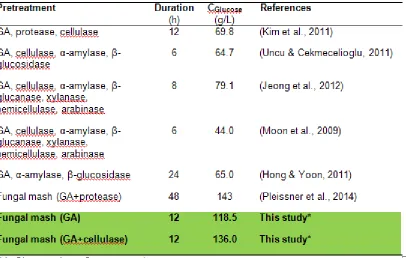
In order to improve the glucose production GA and cellulase rich fungal mashes were used together in 3L hydrolytic bioreactor. The glucose concentration further increased using these two fungal mashes
6
Figure 2. The effect of fungal mashes (GA and GA+Cellulase) on glucose production from food waste in 3L hydrolytic bioreactors.7
Table 2. Glucose concentrations obtained from the hydrolysis of food waste.2.2 Anaeobic Digestion of the solid residues
In order to improve the volume waste reduction and recover energy, AD process was integrated to the hydrolysis system. After the hydrolysis, the medium was centrifuged at 10000 g for 10 min. The glucose rich biomedium was separated; while the solid residues were collected for anaerobic digestion. The residual solids were anaerobically digested using mesophilic secondary sludge as inoculum (Ulu Pandan).
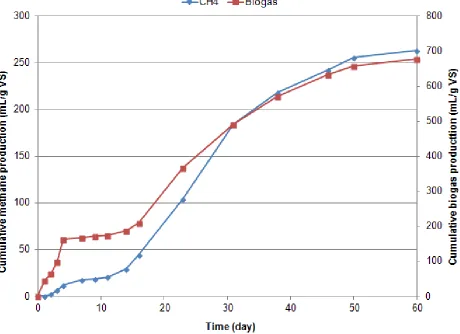
As most of the carbohydrates and proteins hydrolyzed and remained in the liquid biomedium, solid residue is poor in nutrients. Therefore, a long lag phase was observed in methane generation until the 13th day of the AD process (Figure 3). Later on, the methane and biogas production rates increased and the cumulative biogas and methane yields reached to 658 and 256 mL/g VS at the end of the 50 days AD process, respectively. Later on, the production did not increase much most probably due to the
8
Figure 2. Cumulative biogas and methane production from the solid residues.This integrated process is a sustainable alternative to incineration. The toxic ash produced in incineration process is useless and has to be stored in landfills. Moreover, the gases released to the environment causes global warming. Moreover, they contain nanoparticles such as dioxins, which is dangerous to human health. On the other hand, the remaining solid after this integrated process is toxic and non-carcinogenic to human health and can be used as soil conditioner. The main drawback of this integrated AD process is its long duration. In following studies, thermophilic AD process will be conducted.
Moreover, the effect of different solid loadings will be studied to shorten the process time.
2. Plans for the Next 6 Months Period
The effect of different solid loadings will be studied.
Thermophilic AD process will be conducted.
Final report and the project proposal for the continuation of the project will be prepared.
9
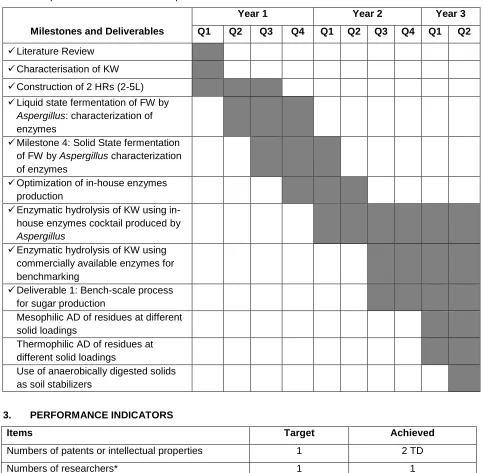
Table 5. Updated Gantt chart with completed tasks
Milestones and Deliverables
Year 1 Year 2 Year 3
Q1 Q2 Q3 Q4 Q1 Q2 Q3 Q4 Q1 Q2
Literature Review
Characterisation of KW
Construction of 2 HRs (2-5L)
Liquid state fermentation of FW by Aspergillus: characterization of enzymes
Milestone 4: Solid State fermentation of FW by Aspergillus characterization of enzymes
Optimization of in-house enzymes production
Enzymatic hydrolysis of KW using in-house enzymes cocktail produced by Aspergillus
Enzymatic hydrolysis of KW using commercially available enzymes for benchmarking
Deliverable 1: Bench-scale process for sugar production
Mesophilic AD of residues at different solid loadings
Thermophilic AD of residues at different solid loadings
Use of anaerobically digested solids as soil stabilizers
3. PERFORMANCE INDICATORS
Items Target Achieved
Numbers of patents or intellectual properties 1 2 TD
Numbers of researchers* 1 1
Numbers of research man-months* 30 24
Numbers of publications in leading journals 2-3 5
*Include researchers, scientists and engineers (RSEs) and research scholars (Masters & PhDs).
We have prepared five articles and two technical disclosures:
Journal Articles:
10
2. Uçkun Kiran, E., Trzcinski, A. P., Ng, W.J., Liu Y. 2014. Enzyme production from food wastes usinga biorefinery concept, Waste and Biomass Valorization 5(6) 903-917.
3. Uçkun Kiran, E., Trzcinski, A. P., Liu Y. 2014. Enhanced glucoamylase production from food waste using solid state fermentation and its evaluation in the hydrolysis of domestic food waste, Biofuel Research Journal (3) 98-105.
4. Uçkun Kiran, E., Trzcinski, A. P., Liu Y. 2014. Biorefineries for platform chemical production from food waste, Journal of Chemical Technology and Biotechnology DOI: 10.1002/jctb.4551.
5. Uçkun Kiran, E., Trzcinski, A. P., Liu Y. 2014. Enhancing the hydrolysis and methane production potential of mixed food wastes by a cost-effective enzymatic pretreatment, Bioresource Technology (Under revision).
Technical disclosures:
1. Uçkun Kiran, E., Trzcinski, A. P., LiuY. 2014. Enzyme production from food waste for sludge and wastewater treatment.
2. Uçkun Kiran, E., Ong, Y.P., Trzcinski, A. P., Liu Y. 2014. Enhancing food waste saccharification by microwave pretreatment.
References
1. Gomez, X., Cuetos, M., Cara, J., Moran, A., Garcia, A. 2005. Anaerobic co-digestion of primary sludge and the fruit and vegetable fraction of the municipal solid wastes: Conditions for mixing and evaluation of the organic loading rate. Renew. Energy, 31(12), 2017-2024.
2. Kim, J.H., Lee, J.C., Pak, D. 2011. Feasibility of producing ethanol from food waste. Waste Manag., 31, 2121–2125.
3. Cekmecelioglu, D., Uncu, O.N. 2013. Kinetic modeling of enzymatic hydrolysis of pretreated kitchen wastes for enhancing bioethanol production. Waste Manag., 33(3), 735-739.
4. Hong, Y.S., Yoon, H.H. 2011. Ethanol production from food residues. Biomass Bioenergy, 35(7), 3271-3275.
5. Jeong, S., Kim, Y., Lee, D. 2012. Ethanol production by co-fermentation of hexose and pentose from food wastes using Saccharomyces coreanus and Pichia stipitis. Korean J. Chem. Eng., 29(8), 1038-1043.
6. Moon, H.C., Song, I.S., Kim, J.C., Shirai, Y., Lee, D.H., Kim, J.K., Sung, O.C., Kim, D.H., Oh, K.K., Cho, Y.S. 2009. Enzymatic hydrolysis of food waste and ethanol fermentation. Internatl. J. Energy Res., 33(2), 164-172.
11
DeclarationI declare that the information of the Development Project as described in the above report is true and to the best of my knowledge.
Prof Liu Yu
Principle investigator Signature
Principle Investigator
Date
Technology Transfer office (or equivalent)
Signature
Technology Transfer office (or equivalent)
Date
Name
Research Director
Signature
Research Director
Date
Research Director
Organization Stamp: ______________________________________________ <Organization’s name>