1 ETRP PROGRESS REPORT
Address to:
Director, Environment Technology Office National Environment Agency
40 Scotts Road, #11-00, Environment Building Singapore 228231
Attn: ETRP Secretariat
National Environment Agency Environment Technology Office
40 Scotts Road, #11-00, Environment Building Singapore 228231
Attn: Project Officer, Dr Taohong Mao
GUIDELINES FOR ETRP PROGRESS/FINAL REPORT
Project Reference No.: ETRP 1201 105 Project Completion Date: 12/2014
Project Title: Developing Novel Biorefineries using Food Waste as Substrate
Organization: Nanyang Technological University, NEWRI, AEBC
Officer-in-charge: Joycelyn Tan
Project Period (Please tick the appropriate box)
X July Progress Report for the period <12/2013> to <07/2014>
2 Part A
1. PROJECT MANAGEMENT AND EXECUTION
The project is progressing smoothly on schedule as shown below. The projected milestones and deliverables have all been achieved as detailed in Section “Results and Discussion”. As of July 2014, we
have completed the optimization of in-house enzyme production. The saccharification of food wastes from cafeteria was investigated with in-situ produced enzymes, while the conditions were optimized. In addition, the solid residuals after saccharification were further used for anaerobic digestion.
Milestones and Deliverables
Implementation Schedule
Year 1 Year 2 Remarks
Q1 Q2 Q3 Q4 Q1 Q2 Q3 Q4
Literature Review
1: Characterisation of KW
2: Construction of 2 HRs (2-5L) 3: Liquid state fermentation of FW by
Aspergillus: characterization of enzymes
Actual Implementation
4: Solid State fermentation of FW by
Aspergillus characterization of enzymes 5: Optimization of in-house enzymes production
6: Enzymatic hydrolysis of KW using in-house enzymes cocktail produced by
Aspergillus
Actual Implementation
2. RESULTS & DISCUSSION
2.1 Optimization of enzyme production
The production of enzyme was studied in both solid state and submerged fermentations inoculated with
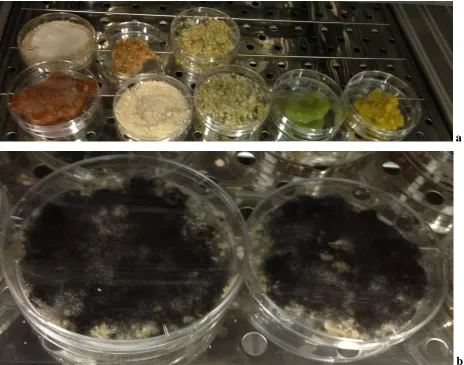
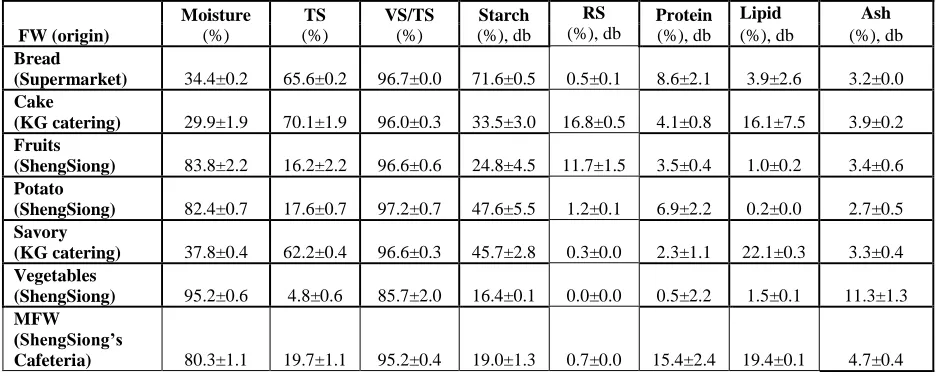
3 wastes were determined (Table 1). For example, the solid content of pastries, like cake, bread and savory, were higher, while higher moisture contents were found in vegetable, potato and fruits. The bread and cake wastes had higher starch content, which eventually might favor better microbial growth and amylolytic enzyme production during fermentation.
a
b
[image:3.612.74.538.157.522.2]4 Table 1. Compositions of different kinds of FWs.
FW (origin) Moisture (%) TS (%) VS/TS (%) Starch (%), db RS (%), db Protein (%), db
Lipid Ash
(%), db (%), db
Bread
(Supermarket) 34.4±0.2 65.6±0.2 96.7±0.0 71.6±0.5 0.5±0.1 8.6±2.1 3.9±2.6 3.2±0.0
Cake
(KG catering) 29.9±1.9 70.1±1.9 96.0±0.3 33.5±3.0 16.8±0.5 4.1±0.8 16.1±7.5 3.9±0.2
Fruits
(ShengSiong) 83.8±2.2 16.2±2.2 96.6±0.6 24.8±4.5 11.7±1.5 3.5±0.4 1.0±0.2 3.4±0.6
Potato
(ShengSiong) 82.4±0.7 17.6±0.7 97.2±0.7 47.6±5.5 1.2±0.1 6.9±2.2 0.2±0.0 2.7±0.5
Savory
(KG catering) 37.8±0.4 62.2±0.4 96.6±0.3 45.7±2.8 0.3±0.0 2.3±1.1 22.1±0.3 3.3±0.4
Vegetables
(ShengSiong) 95.2±0.6 4.8±0.6 85.7±2.0 16.4±0.1 0.0±0.0 0.5±2.2 1.5±0.1 11.3±1.3
MFW (ShengSiong’s
Cafeteria) 80.3±1.1 19.7±1.1 95.2±0.4 19.0±1.3 0.7±0.0 15.4±2.4 19.4±0.1 4.7±0.4
Total Solid, Starch, Reducing sugar (RS) Lipid, Protein and Ash Contents were given in wt% on the basis of dry weight (db). Volatile solid (VS) contents were given as the %VS ratio on total solid basis. Data points show the averages from duplicate analyses.
The incubation time is related to the characteristics of the substrate, inoculum and microbial growth. Enzyme activity was mainly affected by the characteristics and homogeneity of the food waste (FW). Maximum GA production was normally achieved after 2-5 days of incubation in solid state cultures with bacteria and fungi (Melikoglu et al., 2013b; Soni et al., 2003). In this study, the maximum activity of GA was obtained with waste cakes after 4-day fermentation (Figure 2). Cake waste has a more balanced composition with high reducing sugar and protein content, thus the highest GA activity of 85.1±6.8 U/gds was obtained. Therefore, the following experiments were then conducted using cake waste as primary substrate.
5 Figure 2. Effect of substrate on GA production using moisture content of 70% (wb), inoculum loading of 106/g substrate at neutral initial pH and 30oC. Data points show the averages from triplicate analyses.
[image:5.612.74.540.408.666.2]6 Response Surface Methodology (RSM) was also employed to optimize operation parameters (initial moisture content, inoculum loadings, initial pH and duration) for GA production from cake waste. The roles of each variable, their interactions in fermentation were analyzed with a quadratic model. Under the optimal conditions (moisture content of 69.6%, initial pH of 7.9, inoculum loading of 5.2*105/g and incubation time of 6 days), 108.47 U/gds GA activity was obtained, which is 1.4 fold of the yield obtained with cake wastes at 6th day of the fermentation without optimization.
2.2. Saccharification of FWs with the produced enzymes 2.2.1. Optimization of saccharification
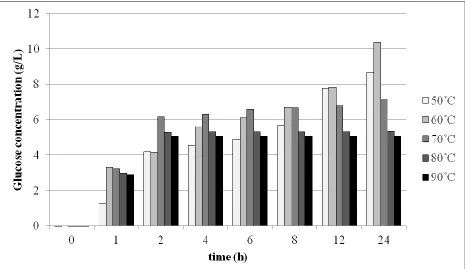
7 Figure 4. Effect of temperature on glucose formation during the hydrolysis of domestic FW with the produced GA preparation. Data points show the averages from duplicate analyses.
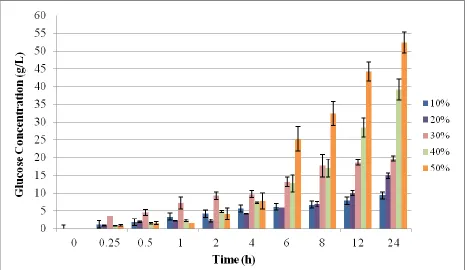
8 Figure 5. The effect of substrate loading on saccharification. The FW loadings studied were 10, 20, 30, 40 and 50% (w/v) using GA loading of 2 U/g substrate for 24 hours at 60oC for 24 hours. Data points show the averages from duplicate analyses.
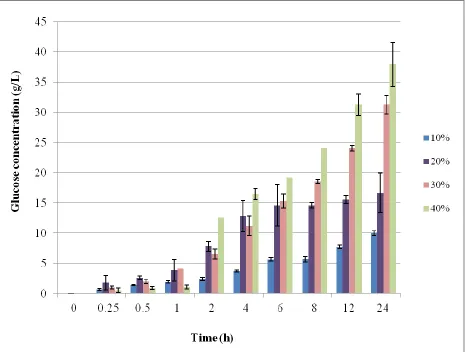
9 Figure 6. The effect of substrate loading on saccharification. The FW loadings studied were 10, 20, 30, 40 (w/v) using GA loading of 5U/g substrate for 24 hours at 60oC for 24 hours. Data points show the averages from duplicate analyses.
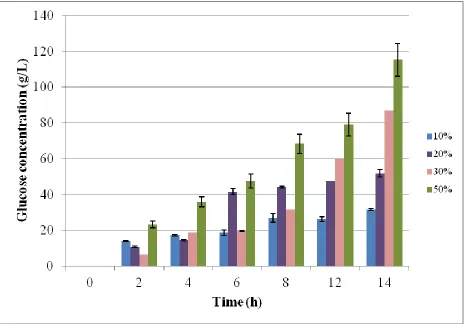
10 Figure 7. The effect of substrate loading on saccharification. The FW loadings studied were 10, 20, 30 and 50% (w/v) using GA loading of 10U/g substrate at 60oC for 24 hours. Data points show the averages from duplicate analyses.
2.2.2. Volume reduction of FW after enzymatic hydrolysis
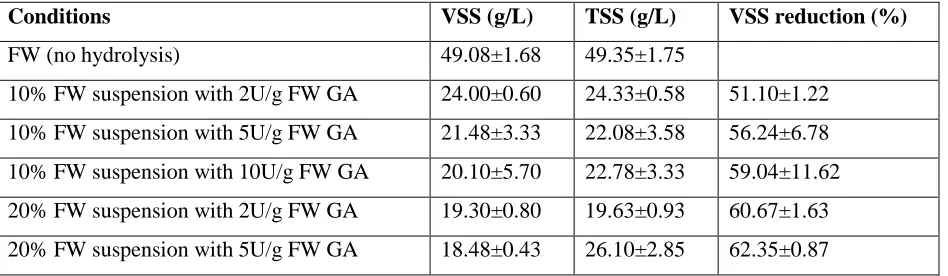
11 Table 2. The effect of enzymatic hydrolysis on VSS & TSS contents and VSS reduction (%).Data points show the averages from duplicate analyses.
Conditions VSS (g/L) TSS (g/L) VSS reduction (%)
FW (no hydrolysis) 49.08±1.68 49.35±1.75
10% FW suspension with 2U/g FW GA 24.00±0.60 24.33±0.58 51.10±1.22 10% FW suspension with 5U/g FW GA 21.48±3.33 22.08±3.58 56.24±6.78 10% FW suspension with 10U/g FW GA 20.10±5.70 22.78±3.33 59.04±11.62 20% FW suspension with 2U/g FW GA 19.30±0.80 19.63±0.93 60.67±1.63 20% FW suspension with 5U/g FW GA 18.48±0.43 26.10±2.85 62.35±0.87
2.2.3. Utilization of different crude enzymes for FW saccharification
FW contains some other carbohydrates like cellulose and hemicellulose other than starch. Therefore, the addition of cellulases and hemicellulases might further improve the final glucose concentration. For this reason, a fungus (Trichoderma reesei) was used to produce crude enzyme for high activity cellulase production.
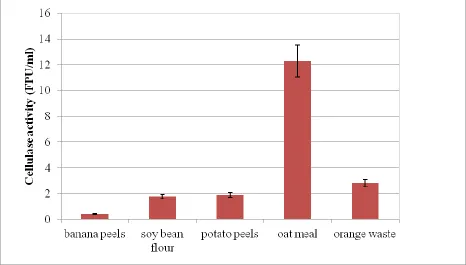
12 Figure 8. The effect of different substrates on cellulase production using T.reesei using SSF at 25oC, 6 days. Data points show the averages from duplicate analyses.
13 Figure 9. The effect of GA and cellulase rich enzymes cocktails on glucose production using FW loading of 50%, at 60oC for 24 hours. Data points show the averages from duplicate analyses.
2.2.4. An integrated process for FW management
14 Figure 1. Glucose and biomethane recovered from 100 g dry FW.
Table 3 presents the potential amounts of the products can be generated and the price of the products using the glucose and FAN rich FW hydrolyzate. The amounts of products can be obtained from 1 ton FW are also presented. As can be seen, the market prices of liquid fuels and platform chemicals are higher than that of methane. Meanwhile, the market prices of platform chemicals are much higher than that of fuels. Therefore, more studies should be conducted to reduce the cost of fuel and/or platform chemical production process costs.
Liquid Solid
Anaerobic digestion 56 g glucose
0.52-1 g FAN
42.4 g solid residue Hydrolysis using
in-situ produced enzymes cocktail
FW 100 g dry
FW
15 Table 3. Some high value products that can be produced using FW hydrolysis and their market prices.
Product Yield Quantity/
ton FW
Price (USD) USD/ ton FW
References Methane 546 mL/g VS 152.9 L 4-6/million
metric BTU
0.011 (Indexmundi, 2014; Uçkun Kiran et al., 2014)
Ethanol 0.49 g/g glucose 173.9 L 2.21/gallon 101.4 (Uçkun Kiran et al., 2014; Wikipedia, 2014)
Butanol 0.19 g/g glucose 53.2 L 3.75/gallon 52.6 (Bankar et al.; Wikipedia, 2014)
Lactic acid 1.29 g/g glucose 361.2 kg 1300-1600/ton 469.6 (Sakai & Yamanami, 2006; Wee et al., 2006) Citric acid 0.80 g/g glucose 224 kg 1300-1600/ton 291.2 (Hamdy, 2013;
Shojaosadati & Babaeipour, 2002) Succinic
acid
1.16 g/g glucose 324.8 kg 3000-5000/ton 974.4 (Leung et al., 2012; RCS, 2014)
PHA 0.44 g/g glucose 123.2 kg 4960-6062/ton 611.1 (PlasticsEngineeringBlog, 2014; Xu et al., 2010)
3. Discussion
Current waste management strategies for food waste (FW) have been facing more and more challenges with strong environmental concerns. Nowadays, landfilling of organic waste still remains the most economic option for waste management (Tatsi & Zouboulis, 2002). However, uncontrolled releases of biogas and leachates may lead to serious environmental problems (Abu-Rukah & Al-Kofahi, 2001). Singapore has practiced incineration of FW for years, and the incineration ashes are disposed off in the Semakau offshore landfill which would be saturated in next 20-30 years due to rapidly increasing waste generation.
Composting has a relatively low environmental impact and a high economic efficiency compared to other treatment methods. However, the high moisture content of FW will lead to substantial release of leachate (Cekmecelioglu et al., 2005). Indeed, compost is more expensive than commercial fertilizers and the current market of compost produced from FW is limited (Aye & Widjaya, 2006).
Incineration is the fastest way to treat FW and the weight can be reduced by 70–80% (Table 4) but it is
16 Anaerobic digestion is another alternative which yields methane and carbon dioxide as metabolic end products and therefore could be feasible from an economic and environmental point of view because methane is used as an energy source (Othman et al., 2013). Hirai et al. (2001) evaluated the environmental impacts of FW treatment and found that utilizing a methane fermentation process prior to incineration reduces approximately 70 kg CO2eq/ton waste of the global warming potential, due to the substitution effect. Food waste is also used as animal feed. The disadvantages are its variable composition and the high moisture content, which favors microbial contamination (Esteban et al., 2007). To prevent this, animal feed is generally dried but greenhouse gas emission increases depending on the energy usage during the drying process, which is related to the water content of FW (Takata et al., 2012).
17 Table 4. Various FW treatment processes.
Process Dry weight reduction,
duration
Products Recycling strategy Disposal in landfill sites a Years Methane, leachate Waste to soil Composting b, c, d, e 43%, weeks to months Fertilizers Waste to soil
Anaerobic digestion b, f, g 80%, weeks Methane, fertilizers Waste to energy/heat and soil
Incineration b, h, i 70-80%, minutes Heat, ash Waste to energy/heat and soil
Enzymatic hydrolysis using commercial enzymes j
66%, hours Sugar monomers, fertilizer
Waste to high value products, feed, soil and energy/heat
Enzymatic hydrolysis using fungal enzymes cocktail
80-90%, days Sugar monomers, amino acids, fertilizer
Waste to high value products, feed, soil and energy/heat
a Kjeldsen et al. (2002), b Arvanitoyannis et al. (2008), c Adhikari et al. (2009), d Zhang and Jahng (2012), e Seo et al. (2004), f Kim et al. (2011), g Zhang et al. (2007), h Pirotta et al. (2013), i Cherubini et al. (2009), j Lam et al. (2013).
2. Plans for the Next 6 Months Period
The final report, publications and project proposal for the continuation of the project will be prepared.
[image:17.612.73.543.395.721.2]The proposed milestones and deliverables are summarized in Table 5.
Table 5. Updated Gantt chart with completed tasks
Milestones and Deliverables
Year 1 Year 2
Q1 Q2 Q3 Q4 Q1 Q2 Q3 Q4
Literature Review
Characterisation of KW
Construction of 2 HRs (2-5L) Liquid state fermentation of FW by
Aspergillus: characterization of enzymes Milestone 4: Solid State fermentation of
FW by Aspergillus characterization of enzymes
Optimization of in-house enzymes production
Enzymatic hydrolysis of KW using in-house enzymes cocktail produced by
Aspergillus
Enzymatic hydrolysis of KW using commercially available enzymes for benchmarking
18
3. PERFORMANCE INDICATORS
Items Target Achieved
Numbers of patents or intellectual properties 1 2 TD
Numbers of researchers* 1 1
Numbers of research man-months* 24 18
Numbers of publications in leading journals 2-3 5
*Include researchers, scientists and engineers (RSEs) and research scholars (Masters & PhDs) We have already prepared five articles and two Technical disclosures:
Journal Articles:
1. Uçkun Kiran, E., Trzcinski, A. P., Ng, W.J., Liu Y. 2014. Bioconversion of food waste to energy: a review, Fuel (134) 389-399.
2. Uçkun Kiran, E., Trzcinski, A. P., Ng, W.J., Liu Y. 2014. Enzyme production from food wastes using a biorefinery concept: a review, Waste and Biomass Valorization (http://link.springer.com/article/10.1007/s12649-014-9311-x ).
3. Uçkun Kiran, E., Trzcinski, A. P., Liu Y. 2014. Enhanced glucoamylase production from food waste using solid state fermentation and its evaluation in the hydrolysis of domestic food waste, Waste Biomass valorization (under review).
4. Uçkun Kiran, E., Trzcinski, A. P., Liu Y. 2014. Biorefineries for chemical production from food waste, (submitted to Journal of Chemical Technology and Biotechnology).
5. Uçkun Kiran, E., Trzcinski, A. P., Liu Y. 2014. Enhancing methane production from food waste using enzymatic pretreatment, (to be submitted to Renewable Energy).
Technical disclosures:
1. Uçkun Kiran, E., Trzcinski, A. P., LiuY. 2014. Enzyme production from food waste for sludge and wastewater treatment.
19 Declaration
I declare that the information of the Development Project as described in the above report is true and to the best of my knowledge.
Prof Liu Yu
Principle investigator Signature
Principle Investigator
Date
Technology Transfer office (or equivalent)
Signature
Technology Transfer office (or equivalent)
Date
Name
Research Director
Signature
Research Director
Date
Research Director
Organization Stamp: ______________________________________________
<Organization’s name>
* Please note that the completeness of the report submitted will help to ensure the efficient processing of
20 References
Abu-Rukah, Y., Al-Kofahi, O. 2001. The assessment of the effect of landfill leachate on ground-water quality – a case study El-Akader landfill site – north Jordan. J. Arid Environ. , 49, 615-630.
Adhikari, B.K., Barrington, S., Martinez, J. 2009. Urban food waste generation: challenges and opportunities. Int. J. Environ. Waste Manage. , 3, 4-21.
Arvanitoyannis, I.S., Kassavetti, A., Ladas, D. 2008. Waste management for the food industry. Elsevier Inc.
Aye, L., Widjaya, E.R. 2006. Environmental and economic analysis of waste disposal options for traditional markets in Indonesia. Waste Management, 26, 1180-1191.
Bankar, S.B., Survase, S.A., Singhal, R.S., Granström, T. Continuous two stage acetone–butanol–ethanol fermentation with integrated solvent removal using Clostridium acetobutylicum B 5313. Bioresource Technology, 106, 110-116.
Cekmecelioglu, D., Demirci, A., Graves, R.E., Davitt, N.H. 2005. Applicability of optimized in-vessel food waste composting for windrow systems. Biosystems Engineering, 91, 479-486.
Cherubini, F., Bargigli, S., Ulgiati, S. 2009. Life cycle assessment (LCA) of waste management strategies: landfilling, sorting plant and incineration. Energy, 34, 2116-2123.
Esteban, M.B., Garcia, A.J., Ramos, P., Marquez, M.C. 2007. Evaluation of fruit, vegetable and fish wastes as alternative feedstuffs in pig diets. Waste Management, 27, 193-200.
Hamdy, H.S. 2013. Citric acid production by Aspergillus niger grown on orange peel medium fortified with cane molasses. Annals of Microbiology, 63(1), 267–278.
Hirai, Y., Murata, M., Sakai, S., Takatsuki, H. 2001. Life cycle assessment on food waste management and recycling. Waste Manag Res, 12(5), 219-228.
Indexmundi. 2014. Henry Hub Natural Gas Futures End of Day Settlement Price, Vol. 2014.
Kim, H.W., Nam, J.Y., Shin, H.S. 2011. A comparison study on the high-rate codigestion of sewage sludge and food waste using a temperature-phased anaerobic sequencing batch reactor system. Bioresour. Technol., 102, 7272–7279.
Kjeldsen, P., Barlaz, M.A., Rooker, A.P., Baun, A., Ledin, A., Christensen, T.H. 2002. Present and long-term composition of MSW landfill leachate: a review. Environ. Sci. Technol. , 32, 297-336.
Lam, W.C., Pleissner, D., Lin, C.S.K. 2013. Production of fungal glucoamylase for glucose production from food waste. Biomolecules, 3, 651-661.
Leung, C.C.J., Cheung, A.S.Y., Zhang, A.Y.Z., Lam, K.F., Lin, C.S.K. 2012. Utilisation of waste bread for fermentative succinic acid production. Biochemical Engineering Journal, 65, 10-15.
Melikoglu, M., Lin, C.S.K., Webb, C. 2013a. Kinetic studies on the multi-enzyme solution produced via solid state fermentation of waste bread by Aspergillus awamori. Biochemical Engineering Journal, 80, 76-82.
Melikoglu, M., Lin, C.S.K., Webb, C. 2013b. Stepwise optimisation of enzyme production in solid state fermentation of waste bread pieces. Food and Bioproducts Processing, 91(4), 638-646.
Othman, S.N., Noor, Z.Z., Abba, A.H., Yusuf, R.O., Abu Hassan, M.A. 2013. Review on life cycle assessment of integrated solid waste management in some Asian countries. Journal of Cleaner Production, 41, 251-262.
Pirotta, F.J.C., Ferreira, E.C., Bernardo, C.A. 2013. Energy recovery and impact on land use of Maltese municipal solid waste incineration. Energy, 49, 1-11.
PlasticsEngineeringBlog. 2014. Where is Metabolix’s PHA biopolymer?, Vol. 2014. RCS. 2014. Biosuccinic acid ready for take off?, Vol. 2014.
21 Sakai, K., Yamanami, T. 2006. Thermotolerant Bacillus licheniformis TY7 produces optically active L-lactic acid from kitchen refuse under open condition. Journal of Bioscience and Bioengineering, 102(2), 132-134.
Schumacher, M., Domingo, J.L. 2006. Long-term study of environmental levels of dioxine and furans in the vicinity of a municipal solid waste incinerator. Environ. Int. , 32, 397-404.
Seo, J.H., Heo, J.S., Kim, T.H., Joo, W.H., Crohn, D.M. 2004. Effect of vermiculite addition on compost produced from Korean food wastes. Waste Manage. , 24, 981-987.
Shojaosadati, S.A., Babaeipour, V. 2002. Citric acid production from apple pomace in multi-layer packed bed solid-state bioreactor. Process Biochemistry 37(8), 909-914.
Soni, S.K., Kaur, A., Gupta, J.K. 2003. A solid-state fermentation based bacterial alpha-amylase, fungal glucoamylase system, its suitability for hydrolysis of wheat starch. Process Biochem., 39, 158-192.
Takata, M., Fukushima, K., Kino-Kimata, N., Nagao, N., Niwa, C., Toda, T. 2012. The effects of recycling loops in food waste management in Japan: Based on the environmental and economic evaluation of food recycling. Science of the Total Environment, 432, 309-317.
Tatsi, A.A., Zouboulis, A.I. 2002. A field investigation of the quantity and quality of leachate from a municipal solid waste landfill in a Mediterranean climate (Thessaloniki, Greece). Adv. Environ. Res. , 6, 207-219.
Tuck, C.O., Pérez, E., Horváth, I.T., Sheldon, R.A., Poliakoff, M. 2012. Valorization of biomass: Deriving more value from waste. Science, 337, 695–699.
Uçkun Kiran, E., Trzcinski, A.P., Ng, W.J., Liu, Y. 2014. Bioconversion of food waste to energy: A review. Fuel, 134, 389-399.
Wee, Y., Kim, J., Ryu, H. 2006. Biotechnological production of lactic acid and its recent applications. Food Technology and Biotechnology(2), 163-172.
Wikipedia. 2014. liquid fuel.
Xu, F., Quinlan, J., Tejirian, A. 2010. Methods for increasing hydrolysis of cellulosic material (Ed.) USPTO, Novozymes, Inc. (Davis, CA) US.
Zhang, L., Jahng, D. 2012. Long-term anaerobic digestion of food waste stabilized by trace elements. Waste Management, 32(8), 1509-1515.