This is a repository copy of
Parametric free-form shape design with PDE models and
reduced basis method
.
White Rose Research Online URL for this paper:
http://eprints.whiterose.ac.uk/80425/
Version: Accepted Version
Article:
Lassila, T. and Rozza, G. (2010) Parametric free-form shape design with PDE models and
reduced basis method. Computer Methods in Applied Mechanics and Engineering, 199
(23-24). 1583 - 1592. ISSN 0045-7825
https://doi.org/10.1016/j.cma.2010.01.007
[email protected] https://eprints.whiterose.ac.uk/
Reuse
Unless indicated otherwise, fulltext items are protected by copyright with all rights reserved. The copyright exception in section 29 of the Copyright, Designs and Patents Act 1988 allows the making of a single copy solely for the purpose of non-commercial research or private study within the limits of fair dealing. The publisher or other rights-holder may allow further reproduction and re-use of this version - refer to the White Rose Research Online record for this item. Where records identify the publisher as the copyright holder, users can verify any specific terms of use on the publisher’s website.
Takedown
If you consider content in White Rose Research Online to be in breach of UK law, please notify us by
Parametric free-form shape design with PDE models and reduced basis
method
Toni Lassilaa,b, Gianluigi Rozzaa,∗
a
Modelling and Scientific Computing, Institute of Analysis and Scientific Computing, ´Ecole F´ed´erale Polytechnique de Lausanne, Station 8, EPFL, CH-1015 Lausanne, Switzerland.
b
Institute of Mathematics, Helsinki University of Technology, P.O. Box 1100, FI-02015 TKK, Finland.
Abstract
We present a coupling of the reduced basis methods and free-form deformations for shape optimization
and design of systems modelled by elliptic PDEs. The free-form deformations give a parameterization of
the shape that is independent of the mesh, the initial geometry, and the underlying PDE model. The
resulting parametric PDEs are solved by reduced basis methods. An important role in our implementation
is played by the recently proposed empirical interpolation method, which allows approximating the
non-affinely parameterized deformations with non-affinely parameterized ones. These ingredients together give rise
to an efficient online computational procedure for a repeated evaluation design environment like the one for
shape optimization. The proposed approach is demonstrated on an airfoil inverse design problem.
Key words: reduced basis methods, free-form deformations, empirical interpolation, engineering design, shape optimization
1. Introduction and motivation
The solution of partial differential equations in domains of arbitrary shape has become an important part
of the computational science and engineering disciplines. A typical application is the simulation and design
of structures, such as airfoils, in computational fluid dynamics. The finite element method [7, 54] is ideal
for solving elliptic and parabolic PDEs on domains of very general shape. However, when the objective is to
solve the same problem repeatedly on different domains, the cost of setting up the problem (meshing, matrix
assembly) every time from scratch is too high. This requires more efficient procedures to be developed.
One of our primary interests for solving partial differential equations in domains of varying shapes is to
perform shape optimization in the computational fluid dynamics setting. To that end we have to first set up
the framework of parametric shapes. Assume that we have a bounded reference domain, which is given to
us in the form of a triangular mesh and its nodal points. We consider small perturbations of this reference
∗Corresponding author
Email addresses: [email protected](Toni Lassila),[email protected](Gianluigi Rozza)
domain. The description of the perturbations of a domain can fall roughly in two categories: variational
[15, 17, 48] or parametric [2, 23, 34]. In this work we consider only parametric deformations, i.e. the
perturbed domain is a function of a finite number of real parameters. The role of the parameters is to allow
the efficient study of several and different configurations and settings for the problem considered (different
shapes for many different target functions and state solutions). Once the shape has been parameterized with
a small number of parameters, our aim is to perform shape optimization w.r.t the parameters by solving a
partial differential state equation on the parametric domain that models some relevant physical phenomena.
One of the goals of this paper is to propose a combined methodology to reduce the geometrical complexity
(i.e. to reduce the number of geometrical parameters needed for shape optimization) as well as to reduce
the dimension of the resulting discretized problem in terms of linear system dimension. The requirements
set for the domain parameterization are that it should be expressive and versatile enough to describe a wide
variety of shapes of interest while at the same time being computationally effective and efficient enough for
real-time solution of the parametric PDEs.
For a review of shape parameterization techniques in engineering design we refer the reader to [23, 43].
Two different but typical approaches for parametric domains are:
• Basis shapes are a well-chosen set of shapes that have relevance to the underlying model – a
pa-rameterization can be obtained by blending smoothly between the basis shapes. For problems, such
as aerodynamic design, where the qualities of the desired target shapes are limited to a small subset
of shapes, this has been a common choice. These parameterizations are usuallylow-dimensional, and consequently the methods will only explore a limited variety of shapes [43, 49].
• Splines can be used to describe smooth boundaries of shapes with arbitrary accuracy [8, 30]. The
approximation properties of splines are well understood and there are several families of splines to
choose from. To obtain a parametric shape we can take the location of the control points and their
weights as the parameters. The drawback to this approach is that the number of parameters used
to describe the shapes is a priori high-dimensional [4, 43] and often outside the practical realm of nonlinear programming techniques such as Sequential Quadratic Programming (SQP) and various
quasi-Newton methods [6]. For this reason many people have turned to pseudo-optimization methods
such as evolutionary algorithms to solve problems of optimal engineering design [4, 12, 32].
Neither the shape bases nor the boundary splines are absolutely the best choice to fulfill our requirements
set for shape parameterization. The shape bases require expert knowledge of the problem in constructing
the basis shapes that might not be available a priori. On the other hand, the high number of degrees of
freedom in a boundary spline based parameterization makes model reduction schemes for efficient solution
of the PDEs not viable. Earlier works on reduced models in shape optimization have been presented in [50]
FFD versatile parameterization of geometry
↓
EIM offline-online computational decomposition
↓
RB efficient reduced order solution for the PDE
↓
[image:4.595.174.418.116.219.2]OPT shape optimization algorithm
Figure 1: The building blocks of our shape design approach
for the structural shape optimization and in [21] for shape optimization of airfoils by Proper Orthogonal
Decomposition (POD).
Our proposed approach to parametric shape design is as follows. First we define the mathematical setting
of the parametric PDE problem. A suitably low-dimensional parameterization of the reference domain is
obtained by considering free-form deformations (FFD) [20, 47] that are independent from the description
of the reference domain and meshes. FFDs are a powerful tool for representing smooth global deformations
of the reference domain and allowing the reduction of a great number of shape parameters. They allow the
construction of a mesh-independent parameterization, since for a given geometry and computational mesh
we can construct a parameterization of arbitary flexibility without the need for remeshing. These
defor-mations lead to non-affinely parameterized transfordefor-mations of the computational domain. The non-affinely
parameterized transformations are then approximated by affinely parameterized transformations obtained
with the recently developed empirical interpolation method (EIM) [5, 13, 22, 25, 26, 40]. This permits an
offline-online computational procedure for the parametric PDE using reduced basis approximations (RB),
which were originally considered in [3, 11, 27, 31], and which have since been treated in more analytical
detail for example in [29, 33, 41]. As the shape optimization problem can be recast into an optimal control
framework, we recall previous works where these kind of problems have been solved by reduced basis
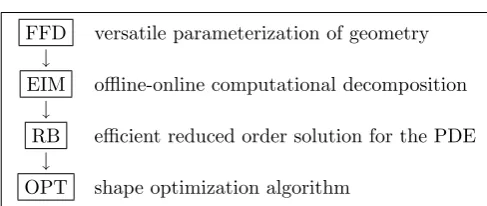
meth-ods, see e.g. [14, 36, 37]. A diagram of our computational “tools” properly linked is displayed in Fig. 1. The
result is an efficient method for shape design, where the parametric deformation of shapes is independent
from the reference geometry, the PDE model, or the chosen mesh. We will demonstrate the efficiency of
the chosen approach with an inverse design problem in the NACA family of airfoil shapes [1]. Recent
works suggest that free-form deformations are a promising approach to airfoil design [32, 44, 45]. In [4] a
thorough investigation into boundary B-spline vs. FFD based parameterizations in airfoil design was made,
and it was observed that with a comparative number of optimization variables the FFD parameterizations
obtained better results. The reduced basis method could however be coupled with other parameterization
methods such as boundary splines [12], radial basis functions [24] etc.
Our approach to shape optimization is related to the surrogate model optimization [38] approach. In
surrogate model optimization an expensive model is replaced with a cheaper reduced model (in this case
the reduced basis approximation), which is then used for evaluations of cost function in the optimization
iteration. The surrogate models proposed in literature are often based on approximation techniques such as
local polynomial fitting, radial basis functions [12, 32], or neural network techniques. The common factor
with all of these is that the state equations still need to be solved using the expensive finite element method
for many different parameter values, typically to the order of 103times, during the course of the optimization
iteration. In contrast, in the reduced basis technique the finite element “truth approximations” are not used
once during the optimization process, owing to the all the “preparation” that has already been done offline
in a precomputation stage. The flexibility of changing the cost functional and the constraints to better suit
the design criteria is therefore greater.
We argue that free-form deformations and the reduced basis framework together can be considered a
combination of basis shapes and spline representations. Free-form deformations have the good expressiveness
of splines, while the reduced basis methodology permits efficient computations by reducing the solution of
the PDE to small number of snapshot configurations, which can be thought of as our set of basis shapes.
By allowing the user to choose the density of the control point grid and the degrees of freedom to be used
we keep the dimension of the parameterization low for practical optimization methods. The reduced basis
framework has to be applicable to the flow model equation in the sense that reliable and sharp a posteriori
error estimates are available for the reduced basis solutions. A posteriori estimates for potential flows
are fairly straightforward [39] using the existing theory for coercive problems, and work on reduced basis
methods for the Stokes [40, 42] and Navier-Stokes [9, 35, 52] equations has been carried out and their use
with a coupled FFD technique is possible and an object of future study.
An alternative approach to parameterizing the domain perturbations is to build piecewise affine geometry
transformations based on domain subdivisions. A detailed description of this technique was given in [41].
The piecewise affine geometry parameterization however suffers from two drawbacks:
• The smoothness of the shape is not necessarily preserved. This is sometimes important, especially in
applications such as aerodynamic design.
• Discontinuities in the transformation tensor mean that the mesh has to conform to the domain
subdi-vision, otherwise we need to perform partial remeshing or at the very least do local refinements near
the boundaries of the subdivisions.
For problems with simple domains and pure sizing optimization the affine parameterizations are workable.
For more complex problems, including shape optimization and inverse design, the geometry and the mesh
take a lot of expert time to construct. If possible we want to avoid remeshing or readjusting the mesh. In
these cases it is beneficial to have a procedure which allows us to parameterize the geometry independently
from the PDE model or its discrete formulation. In this framework we propose an approach based on three
coupled tools: free-form deformations, the empirical interpolation method, and reduced basis methods.
2. Elliptic PDE problem with parametric domain
Let Ω0 ⊂ Rd be a fixed reference domain, and T : Ω0× D → Rd an invertible and continuously
differentiable parametric map, whereD ⊂RP is the admissible parameter range. For any given µ∈ D we
want to solve the elliptic partial differential equation
e
a(eue, v) =fe(v) for allv∈Xe(Ω) (1)
in some Hilbert spaceXe(Ω) defined on the domain Ω(µ) with prescribed boundary conditions. Hereea(·,·)
is a coercive continuous symmetric bilinear form, andfea bounded linear form. Byuee(µ)∈Xe we denote
the exact solution. Without loss of generality we can always transform equation (1) back onto the reference
domain and consider instead theparametric partial differential equation
a(ue(µ), v;µ) =f(v;µ) for allv∈Xe(Ω0), (2)
wherea(·,·;µ) is also a coercive continuous symmetric parametric bilinear form andf(·;µ) a bounded linear
functional for allµ∈ D.
By using finite element discretization with Galerkin projection we arrive at a corresponding
finite-dimensional equation
a(uN(µ), v;µ) =f(v;µ) for allv∈XN ⊂Xe(Ω0), (3)
where the dimensionN of the finite element space XN can be chosen large enough so that the difference
between the exact solutionue(µ) and the finite element solutionuN
(µ) is negligible. We calluN(µ) a “truth
approximation” to be obtained, and forget about the exact solution as it is typically unobtainable. We next
discuss reduced basis methods for obtaining reliable approximate solutions to (3).
3. Reduced basis methods for parametric elliptic PDEs
The reduced basis method is an efficient way to compute approximations to the finite element “truth
approximation” uN(µ) by considering only a small subspace of XN spanned by well-chosen solutions of
equation (3). If the dependence of the bilinear forma(·,·;µ) on the parameterµis smooth the parametric
manifold of solutions inXis smooth. Let us take a relatively small collection of parameter valuesµ1, . . . ,µN
and the corresponding FE solutionsuN(
µ1), . . . , uN(
µN) (called snapshot solutions). From these snapshot
solutions we can construct with Gram-Schmidt orthonormalization (using a suitable inner product, see [29]
Ch. 3.2.1) a basis{ζn}N
n=1spanning anN-dimensional subspaceXNN ⊂X
N, where typicallyN ≪ N. Using
Galerkin projection onto this subspace we obtain the reduced basis formulation to finduN
N(µ)∈X N N s.t.
a(uNN(µ), v;µ) =f(v;µ) for allv∈X N
N (4)
and this reduced basis solution can be written in the basis spanned by the reduced basis functions as
uNN(µ) = N X
n=1
unζn
with coefficients un, n= 1, . . . , N. The choice of the snapshot solutions plays a vital role in the accuracy
of the reduced basis approximation. A parameter-independent inner product and norm can be obtained by
choosing a fixed ¯µ∈ Dand defining as
(u, v)X :=a(u, v; ¯µ) for allu, v∈Xe,
||u||X:= p
(u, u)X for allu∈Xe.
The following greedy algorithm for choosing the basis functionsζn has been proposed [53]. Let Ξtrain⊂ D
be a finite training sample of parameter points chosen according to uniform or log-uniform distribution
containing a sufficiently varied set of training points. Given the first snapshot parameter value µ1 and a
sharp, rigorous, and inexpensive a posteriori error bound ∆n(µ) for the norm|| · ||X such that
||uN(µ)−uNn(µ)||X≤∆n(µ) for all µ∈ D,
we choose the remaining snapshot parameter values as the solutions
µn= arg max µ∈Ξtrain
∆n−1(µ), forn= 2, . . . , N.
The quality of the reduced basis approximation depends crucially on the quality of the a posteriori error
estimator. We introduce the residual as
rn(v;µ) :=f(v;µ)−a(uNn (µ), v;µ)∈X ′
and use the residual-based estimator
∆n(µ) :=
||rn(·;µ)||X′
αLB(µ) , where|| · ||X′ is the dual norm of the residual and is defined as [41]
||rn(·;µ)||X′ := sup
v∈XN
rn(v;µ)
||v||X ,
andαLB(µ) is a computable lower bound for the coercivity constantα0(µ) [19], i.e.
αLB(µ)||u||2X≤α0(µ)||u||2X ≤a(u, u;µ) for allu∈XN.
For efficient and reliable methods of computing both the dual norm of the residual and a lower bound for
the coercivity we refer the reader to [29, 41]. In the greedy basis construction algorithm we usually fix a
priori an error toleranceεRB
tol and then continue the process until the stopping tolerance is achieved
∆N(µ)≤εRBtol for allµ∈Ξtrain.
Once the system (4) has been assembled and solved we want to estimate the error of the solution for a
chosen µ ∈ D. Because of the difficulty of giving a priori error estimates for reduced basis methods for
many problems, we decide to provide a reliable way to compute a posteriori error estimates instead. For
this reason we use the same residual-based estimators. See [41] for details.
We define another concept that is important for the computational efficiency of the reduced basis
ap-proximation; we say that the bilinear forma(·,·;µ) and the form f(·;µ) areaffinely parameterized if they are of the form
a(w, v;µ) =
Ma
X
m=1
Θma(µ)am(w, v)
f(v;µ) =
Mf
X
m=1
Θmf(µ)fm(v)
(5)
for suitable integersMa andMf, and functions Θm
a,Θmf :D → R. This assumption allows us to separate
the computation of solutions for (4) into online and offline stages. By substituting the discrete form of (5)
into (4) we obtain
Ma
X
m=1
Θma(µ)am(u N
N(µ), v) = Mf
X
m=1
Θmf(µ)fm(v) (6)
for allv∈XNN, and asu N N(µ) =
PN
n=1un(µ)ζnfor a unique set of coefficientsun(µ), this equation becomes
N X
n=1
un Ma
X
m=1
Θma (µ)am(ζn, ζn′) = Mf
X
m=1
Θmf(µ)fm(ζn′) (7)
for alln′= 1, . . . , N. We see now that the computational effort is split into two parts: a
µ-independent offline
stage and an online stage for any chosen µ∈ D. The basis functionsζn, the matrix forms of am(ζn, ζn′)
(which we denote from now on asAm), and the vectorsfm(ζn) are computed in the offline stage and stored.
The smallN×N linear system (7) can then be assembled and solved efficiently during the online stage.
Until now we have not discussed the parameterization of the domains, but we have assumed it to be given.
Next we detail one possible way of obtaining a shape parameterization by using free-form deformations that
turns out to have some good properties in shape optimization and engineering design.
4. Free-form deformations for automatic parametric geometries
We consider a free-form deformation (FFD) method [47] based on tensor products of splines. A simple
version of the FFD is defined as follows. For simplicity we cover only the two-dimensional case, extensions
to three dimensions are straightforward. LetD0 ⊃Ω0 be a rectangle that contains the reference domain,
and Ψ : (x1, x2)7→(x′1, x
′
2) an affine map fromD0to the unit square, Ψ(D0) = (0,1)×(0,1). The FFD shall
be defined in the reference coordinates (x′
1, x′2) of the unit square. Select a regular grid of control points
P0ℓ,k∈(0,1)×(0,1) (the unperturbed configuration) whereℓ= 0, . . . , Landk= 0, . . . , K so that
P0ℓ,k=
ℓ/L
k/K .
A perturbation of the control points is given by a set of (L+ 1)(K+ 1) parameter vectorsµℓ,k where the
perturbed positions of the control points are
Pℓ,k(µℓ,k) =P0ℓ,k+µℓ,k.
It is possible that not all the control points are allowed to move freely - typically we fix several
rows/columns of control points to obtain desired levels of continuity and to fix certain parts of the
do-main. It is also possible to allow some control points to move in thex′
1- or x′2-direction, but not both. We
refer to the effectively free scalar-valued parameters using the same variables but different indexing
µ1, . . . , µp, p= 1, . . . , P
and callP the number ofdegrees of freedom. From now on we assume that the parameterization involves only thoseµcorresponding to actual degrees of freedom omitting the parameters that are fixed.
From now on we denote by xthe coordinates on the reference domain Ω0 and by exthe coordinates on
the parametric domain Ω(µ). We construct a parametric domain mapTe :D0→R2 as
e
T(x;µ) = Ψ−1
L X ℓ=0 K X k=0
bL,Kℓ,k (Ψ(x))Pℓ,k(µℓ,k) !
=xe(µ), (8)
where
bL,Kℓ,k (x′1, x
′
2) =
L ℓ K k
(1−x′1)(L
−ℓ)(x′
1)ℓ(1−x
′
2)(K
−k)(x′
2)k
are tensor products of the 1-d Bernstein basis polynomials
bL ℓ(x
′
1) =
L
ℓ
(1−x′1)(L
−ℓ)(x′
1)ℓ,
bK k (x
′
2) =
K
k
(1−x′2)(K
−k)(x′
2)k
defined on the unit square with local variables (x′
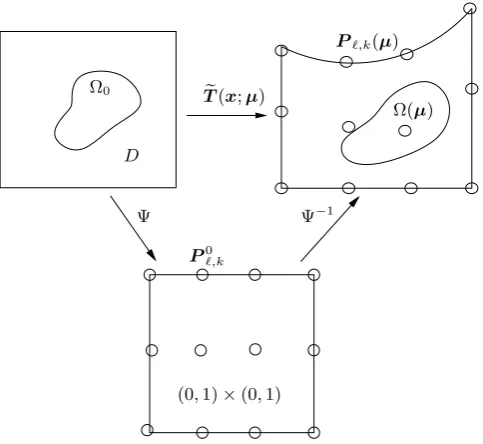
1, x′2)∈(0,1)×(0,1). A diagram of of the process is shown
in Fig. 2.
Bernstein basis polynomials are used because they have the properties ofpartition of unity
L X
ℓ=1
bL ℓ(x
′
1)≡
K X
k=1
bK k (x
′
2)≡1 (9)
andpositivity
bL,Kℓ,k (x′1, x
′
2)≥0 for allx
′
1, x
′
Ω0
Pℓ,k(µ)
Ω(µ)
D
e
T(x;µ)
Ψ Ψ−1
(0,1)×(0,1)
[image:10.595.178.420.110.332.2]P0ℓ,k
Figure 2: Schematic diagram of the control pointsPℓ,k, the free-form deformation mapTe(x;µ), and the resulting deformation
when applied to the reference domain Ω0.
in (0,1)×(0,1). Also, they can be evaluated in a numerically stable fashion by the de Casteljau algorithm
[10]. Extensions of free-form deformations to Non-Uniform and Rational B-Spline (NURBS) basis functions
are available [4, 20, 44, 45, 46]. These permit the exact representation of shapes that are conic sections,
for example. The simple polynomial basis functions have derivatives that are expressible in terms of tensor
products of lower order Bernstein polynomials using the well known derivative formula [10]:
∇bL,Kℓ,k (x′1, x
′
2) =
L[bLℓ−−11(x
′
1)−bL
−1
ℓ (x ′
1)]bKk (x ′
2)
K[bK−1
k−1(x
′
2)−bK
−1
k (x ′
2)]bLℓ(x ′ 1) T . (10)
Denote byJF the Jacobian matrix of any functionF :R2→R2. We compute the Jacobian of the mapTe
by using the gradient formula (10) and the partition of unity property (9) and obtain
JTe(x;µ) =J−Ψ1
" I+ L X ℓ=0 K X k=0
∇bL,Kℓ,k (Ψ(x))µℓ,k
#
JΨ. (11)
Thus not only the map Te but also its Jacobian JTe can be stably evaluated. Finally, the parameterized
domain Ω(µ) is obtained using the restrictionT =Te|Ω0 as Ω(µ) =T(Ω0).
Once the parametric mapT has been obtained we can use its inverse to transform the problem back to
the reference domain. For example, when equation (3) is the Poisson equation with homogeneous Dirichlet
boundary conditions on a parametric domain we use the transformation map T and its Jacobian JT to
define thetransformation tensor of the problem
νT(x;µ) =J −T
T J
−1
T |det(JT)| (12)
and the problem is transformed to the reference domain as
Z
Ω0
νT(x;µ)∇u N
· ∇v dΩ0=
Z
Ω0
f v|det(JT)|dΩ0, (13)
for allv∈XN.
We have now a flexible parameterization method for small deformations of Ω0 that can be adjusted
by the user by choice of the control points and degrees of freedom. Compared to boundary splines, the
parameterization can be chosen to be relatively low-dimensional without sacrificing any of the accuracy in
describing the geometry because the mapT is independent of the reference domain.
The tensorνT is not affinely parameterized in the sense of (5) (nor is |det(JT)|appearing in the RHS
in general), so further work is needed to obtain an efficient computational procedure. Assume that we have
for each componenti, j= 1,2 of the transformation tensor an expansion given by
[νT]i,j=
f
MXi,j
m=1 Θm
i,j(µ)ξmi,j(x) +εi,j(x;µ) (14)
and for the right-hand side an expansion given by
f(x)|det(JT(x;µ))|= f
Mf
X
m=1
Θmf (µ)ξfm(x) +εf(x;µ) (15)
where the error terms are guaranteed to be under some tolerance,
||εi,j(·;µ)||∞≤εEIMtol for allµ∈ D, (16)
||εf(·;µ)||∞≤εEIMtol for allµ∈ D. (17)
We require all the Θm
i,j’s, ξi,jm’s, Θmf’s, and ξfm’s to be efficiently computable scalar functions. We shall
discuss in Sect. 5 a way of approximating the non-affine transformations with affine ones using the empirical
interpolation procedure as proposed in [5, 22]. Substituting into (13) and dropping the error terms we
obtain for the Laplacian
Z
Ω0 h∂uN
∂x1
([νT]1,1 ∂v
∂x1
+ [νT]1,2 ∂v
∂x2 )
+∂u
N
∂x2([
νT]2,1
∂v ∂x1 + [
νT]2,2
∂v ∂x2)
i dΩ0 =X m Z Ω0 {∂u N ∂x1
Θm1,1ξ1m,1
∂v ∂x1
+ Θm1,2ξm1,2
∂v ∂x2 +∂u N ∂x2 Θm
2,1ξm2,1
∂v ∂x2
+ Θm
2,2ξ2m,2
∂v ∂x2
}dΩ0
= 2 X i=1 2 X j=1 f
MXi,j
m=1
Θmi,j(µ)ami,j(u N
, v) = f
Mf
X
m=1
Θmf (µ)fm(v),
for allv∈XN, where the bilinear forms
am
i,j(w, v) = Z
Ω0 ξm
i,j(x) ∂w ∂xi
∂v ∂xj dΩ0
are continuous, as are the linear forms
fm(v) =
Z
Ω0
ξfm(x)v dΩ0.
Now we have an efficient online-offline computational procedure for the matrix assembly. In the offline
stage the matrices Ami,j corresponding to the bilinear formsam
i,j are computed and stored. The complete
stiffness matrix can then be cheaply assembled in the online stage. For any given µwe evaluate the Θm i,j
and Θm
f , and sum together the contributions from eachAmi,j and respectivelyFm. The same thing is done
for the vectors Fm representing the right-hand side. Note, however, that the dimension of the system is
stillN × N, and even with optimal multigrid solvers costsO(N) to solve online. This is too expensive for
a repeated evaluation design environment. The solution is therefore approximated with the reduced basis
method and equation (7), so that the final form of the reduced basis problem with affine parameterization
can be written as
N X
n=1
un
f
MXi,j
m=1 2
X
i=1 2
X
j=1
Θmi,j(µ)ami,j(ζn, ζn′) =
f
Mf
X
m=1
Θmf (µ)fm(ζn′), (18)
for all n′ = 1, . . . , N. In practiceN and theMi,j,f Mff can be chosen to be quite modest and the solution
of this system will still be close to the finite element solution. This is especially true if the number of
parametersP is small (say 10-20), as is the case when we use free-form deformations.
5. Empirical interpolation method for nonpolynomial affine approximations
For many linear PDEs modelling physical phenomena the parametersµenter affinely into the bilinear
form. However, with shape design this is not usually the case unless we are dealing with a pure optimal
sizing problem. The possibility of finding good affine approximations of the form (14) for the coefficients of
generic parametric PDEs has been considered in [5, 13, 22, 25, 26]. Applications of the proposedempirical
interpolation method for reduced basis methods can be found in [16, 40, 51].
The empirical interpolation method has two stages. In the first stage a set of hierarchical interpolation
spaces is constructed. For each term i, j = 1,2 of the transformation tensor [νT]i,j ∈C∞(Ω0× D,R) we
choose an initial parameter valueµ1
i,j and define the first shape function asξ1i,j(x) = [νT(x,µ1i,j)]i,j, and
the interpolation spaceW1
i,j = span{ξi,j1 }. The hierarchical interpolation spaces Wi,jMf,Mf= 2, . . . ,Mi,jf are
then built iteratively by solving the problem
µmi,j= argmax µ∈Ξtrain
inf
w∈Wm−1
i,j
||[νT(·,µ)]i,j−w||L∞(Ω
0) (19)
to obtain the parameter values µm
i,j. Here Ξtrain ⊂ D is a finite training set of parameter values and
thus the problem (19) is a linear programming problem. The Mi,jf ’s are chosen so that the tolerance
criteria (16) is achieved for each component of the tensor νT. We then define the mth shape function
ξm
i,j(x) = [νT]i,j(x,µmi,j) and theMi,jf th interpolation space W
f
M
i,j = span{ξi,jm, m= 1, . . . ,Mi,jf }. By Mc:= P2
i,j=1Mi,jf +Mff we denote the total number of terms in the expansion of the transformation tensor and
right-hand side.
The interpolation spacesWMf
i,j having been constructed, we define a set of Lagrange interpolation points
also known as “magic points”. The first interpolation point is chosen as
z1i,j= argsup
x∈Ω0
|ξi,j1 (x)|
and the corresponding normed basis function as
b ξ1
i,j(x) =ξ1i,j(x)/ξi,j1 (z1i,j).
For 2≤Mf≤Mi,jf we obtain the interpolation points iteratively by solving the interpolation problem at the
already obtained magic points
f
M−X1
m=1
σm
f
M−1,i,jξb m i,j(zm
′
i,j) = [νT]i,j(zm
′
i,j,µ
f
M
i,j) for 1≤m ′
≤Mf−1
for the coefficientsσm
f
M−1,i,j,m= 1, . . . ,Mf−1, and then looking at the residual function
rMf i,j(x) =ξ
f
M i,j(x)−
f
MX−1
m=1
σm
f
M−1,i,jξb m i,j(x).
The other interpolation points are obtained from
zMi,jf= argsup
x∈Ω0
|rMf i,j(x)|
and the corresponding normed basis functions
b ξMf
i,j(x) =r
f
M i,j(x)/r
f
M i,j(z
f
M i,j).
Denote byBi,j the interpolation matrices
[Bi,j]m′
,m=ξbi,jm(zm
′
i,j), 1≤m, m ′≤ f
Mi,j
and byzi,j the vector of all the interpolation points. Finally, the non-affinely parameterized bilinear form
is replaced with an affinely parameterized approximation
a(u, v;µ)≈
2 X i=1 2 X j=1 f
MXi,j
m=1 Θm
i,j(µ)ami,j(u, v), (20)
where the matrix versions of
am
i,j(w, v) = Z
Ω0 b ξm
i,j(x) ∂w ∂xi
∂v
∂xj dΩ0 (21)
are computed once in the offline stage, and the coefficient functions Θm
i,j(µ) can be evaluated by solving f
Mi,j×Mi,jf , 1≤i, j≤2, linear systems of the form
Bi,jΘi,j(µ) = [νT(zi,j;µ)]i,j
for each desired value of µ, where Θi,j(µ) is a vector of the values Θm
i,j(µ), m = 1, . . . ,Mi,jf . The same
treatment can be performed to the right-hand side to obtain expansion (15), which we omit for brevity. The
efficient online-offline decomposition leading to equation (7) is then recovered.
We make some remarks about the empirical interpolation method:
• The interpolation points zm
i,j are chosen by a greedy procedure and are suboptimal, but in effect are
not far away from the optimal interpolations points (in cases where these can be computed); for a
demonstration see [22].
• The basis functionsξbm
i,jonly need to be evaluated offline at the mesh points. Compared to the analytical
expressions for the [νT]i,j’s, which are complicated rational functions1and expensive to evaluate even
with the recursive algorithm, they are also computationally more efficient.
• In our case the transformation tensor νT is constructed with Bernstein polynomials and the
interpo-lation basis functions ξbm
i,j are rational functions. If the greedy procedure for constructing the
inter-polation spaces uses a large enough training set Ξtrain, we can expect that approximation (20) is not
worse than those given by standard rational interpolation techniques.
6. Inverse airfoil design in the NACA family
We provide a possible application of the computational methods presented in the previous sections by
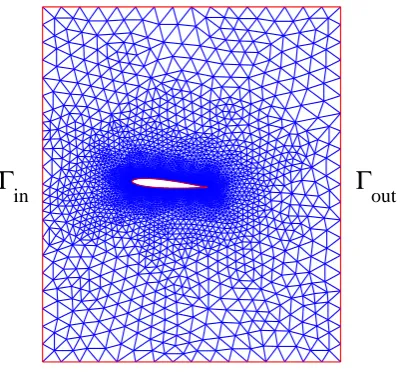
considering an inverse airfoil design problem in 2-d potential flow. Fig. 3 shows one reference domain Ω0
that surrounds a NACA0012 airfoil [1] with 5◦ angle of attack.
The potential flow equation around the airfoil follows from the (unphysical) assumption that the flow
field uis steady and irrotational, i.e. ∂tu= 0 and ∇ ×u= 0. Then there exists a scalar functionϕsuch
thatu=∇ϕ. This is called the flow potential and is given as the solution of the Laplace equation
div(∇ϕ(x)) = 0, on Ω(µ). (22)
1
For our test problem with eight parameters a function that computes the first component [νT]1,1 using the analytical
expression is 20 pages long. While the code that evaluates the same function using the de Casteljau algorithm is much shorter, it is not computationally more effective.
Γ
inΓ
outFigure 3: Initial configuration of a NACA0012 airfoil and the surrounding mesh. The mesh hasN = 8043 nodes.
An equation for the pressure is obtained using the assumptions of incompressibility and irrotationality as
∇p(x) =−∇1
2|∇ϕ(x)| 2
and finally
p(x) =p0−21|∇ϕ(x)|2,
where p0 is a reference pressure. This is the Bernoulli equation [28]. We have the following boundary conditions:
∂ϕ
∂n = 1, on Γin
ϕ= 0, on Γout ∂ϕ
∂n = 0, elsewhere.
The exterior flow velocity is imposed with Neumann conditions, while the Dirichlet condition fixes the
solution of the potential flow problem to be unique.
The inverse design problem of an airfoil involves prescribing some properties of the target airfoil, in our
case the pressure distribution on the airfoil surface, and then trying to generate an airfoil that has the desired
property. We performed two test cases. In Case A the initial guess was the NACA0012 airfoil and the target
airfoil was the NACA4412 airfoil, which is a slightly thicker, nonsymmetric, and has increased camber. In
Case B we took NACA4412 as the initial guess and NACA0012 as the target airfoil. This demonstrates
going from a symmetric initial airfoil to a nonsymmetric target airfoil, and vice versa. The proof-of-concept
solver was implemented in Matlab by using the symbolic toolbox for building the FFDs and constructing
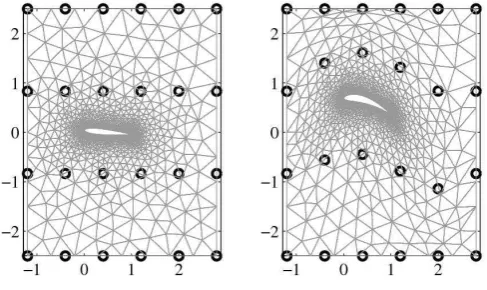
Figure 4: The reference configuration, the control point lattice, and a perturbed configuration in Case A with a NACA0012 initial airfoil.
Table 1: Approximations details
Approximation property Value
Number of mesh nodesN 8043
Lattice of FFD control pointsPℓ,k 6×4
Number of DOFs/design variablesK 8 Error tolerance for the RB greedyεRB
tol 1e-4
Number of reduced basis functionsN 52 Error tolerance for the EIM greedyεEIM
tol 2.5e-3
Total number of EIM basis functionsMc 165 Parameter range for freeµk’s [−0.5,0.5]
on the domain of which the eight central ones were allowed to move in thex′
2-direction, giving a total of
8 degrees of freedom. In Fig. 4 we show the lattice of control points and an example of the deformation
obtained by moving the control points. In reality the mesh remains fixed at all times, thanks to the inverse
transformationT−1 that allows us to return the potential flow problem (22) to the reference domain Ω0.
Table 1 lists the relevant dimensions of the approximation spaces for the finite element, reduced basis, and
empirical interpolation approximations respectively for Case A. The results for the other case are similar
and details are omitted. The tolerances for the greedy algorithm and the empirical interpolation are chosen
such that the error on the interpolation is not dominating over the reduced basis convergence of the greedy
algorithm (see [40]).
In this way, the number of affine termsMcand the size of the reduced basisN are chosen so that the two
tolerances for the empirical interpolationεEIM
tol and reduced basis greedy algorithmεRBtol are satisfied. We also
remark that, since the inhomogeneous boundary condition∂ϕ∂n = 1 was chosen on an edge perpendicular to the
x1-direction, the FFD-parameterization does not enter into the boundary term given by integration by parts
and thus there was no need to perform the EIM on the right-hand side in this particular parameterization.
In theoffline stage we perform all the procedures to prepare the parameter dependent calculations. All the
parameter independent quantities are computed and stored. In more detail, we:
1. Compute the symbolic expression for the transformation tensorνT given by (12);
2. Perform the empirical interpolation to obtain the expansion (20). The stopping tolerance for the greedy
procedure was εEIM
tol = 2.5e-3 and this was satisfied with a combined total ofMc= 165 terms in the
expansion;
3. Perform a greedy procedure for choosing the reduced basis snapshotsµnand compute the corresponding
basis solutionsζn. For this part we have utilized the rbMIT package [18] in order to implement the
reduced basis algorithms, i.e. for basis construction and offline-online computations, as well as the
affine decompositions. The error estimates for the potential are computed according to the methodology
proposed in [19, 39, 41] for coercive problems. The nonaffine parameterization and use of the EIM
together with these estimates leads to error bounds that are not necessarily rigorous. However, as long
as the tolerance for the EIM is chosen small enough that the empirical interpolation error does not
dominate over the reduced basis approximation error, a sufficient guarantee of approximation stability
is obtained in our experience. It is also possible to extend the error estimator for the nonaffine case by
including a correction term coming from the error of the EIM, see e.g. [25]. For potential flows, given
the error bounds on the potential solution, it is possible to get readily error bounds on the pressure
and/or velocity (see [39]) obtained by the Bernoulli equation. In both cases we chose by the greedy
procedureN = 52 basis functions, which was achieved with toleranceεRB
tol = 1e-4 for the noncorrected
error bound.
4. (a) Assemble the finite element matricesAmi,j ∈RN ×N corresponding to the bilinear forms (21) and
the right-hand sidesFm∈RN;
(b) Pre- and post-multiply the matrices with the reduced basis representation to obtain the reduced
size system matricesAmi,j ∈RN×N such that
Ami,j=ZTAmi,jZ
and the reduced right-hand sidesfm∈RN such that
fm=ZTFm,
where
Z =hζ1ζ2 . . . ζni
is aN ×N matrix with the basis vectorsζn as columns.
The offline stage is dependent on the reference domain Ω0, the boundary conditions, and the FFD
setup. Therefore for both Case A and Case B we had to perform the offline stage separately. The FFD
(a) NACA0012
[image:18.595.176.420.109.364.2](b) NACA4412
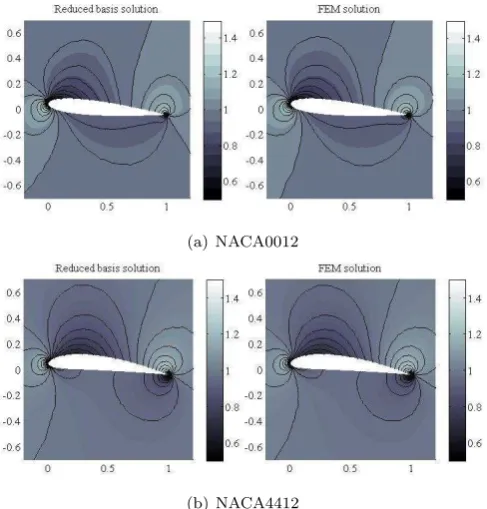
Figure 5: The dynamic pressure field around the airfoils for the FEM and RB solutions forN= 52 basis functions.
these had to be only performed once for both cases. In total the work that had to be done in each case
consisted of matrix assembly and greedy algorithms for snapshot selection, together with the Successive
Constraint Method for estimation of the lower bound of coercivity constant.
Theonline stageis driven by the the optimization algorithm that involves an order of 102evaluations of the cost function and the underlying state equations, and consists of using the stored matricesAmi,j and vectors
fm to assemble and solve the system (7). For the flow potential computation of the snapshot solutions
with the FEM we used linear triangular elements and then performed patch averaging [55] to post-process
the solution and recover the solution gradients in order to compute the dynamic pressure. In Fig. 5(a) we
display the dynamic pressure fields for the reference airfoil (µ=0) for both the FEM and RB solutions in
Case A, and in Fig. 5(b) for Case B. The error between the “truth approximation” FEM solution and its
RB approximation is||ϕN−ϕN
N||X = 1.12e-5 at this parameter value for Case A (relative error 5.56e-7) and
||ϕN−ϕN
N||X = 8.9263e-6 for Case B (relative error 4.44e-7).
To enable the comparison of pressure distributions on the surfaces of two different airfoils, define γµ :
[0,1]→ Γairf oil(µ) to be a closed curve with counterclockwise parameterization such thatγµ′ ≡ constant
almost everywhere. The scaled pressure distribution on a parametric airfoil Ω(µ) is then defined as
e
p(r,µ) :=p0−12|∇ϕ(γµ(r),µ)|2 forr∈[0,1]. (23)
of the flow potential and then using the Bernoulli equation. Using the scaled pressure we can write theL2
-defect functional for the pressure distribution
J(µ) =
R1
0 |pe(r,µ)−ptargete (r)|2dr
R1
0 |ptargete (r)|2dr
+η[α(µ)−5◦]2,
wherepe(r,µ) is the scaled pressure distribution on the perturbed airfoil surface,ptargete is the scaled pressure
distribution on the target airfoil surface given by the finite element method, andα(µ) is the desired angle
of attack of the parametric airfoil. The penalty term was added to ensure that the optimized airfoil has the
desired angle of attack. We used a fixed value ofη = 102 for all tests. The penalty approach works well for
this problem, but is limited to local optimization where the optimal design is close to the initial design. We
also introduce the reduced defect functional
JN(µ) =
R1
0 |pNe (r,µ)−ptargete (r)| 2dr
R1
0 |ptargete (r)|2dr
+η[α(µ)−5◦]2, (24)
where the reduced pressurepNe is computed from (23) by replacingϕwithϕN
N the reduced basis
approxima-tion of the flow potential for the purpose of evaluating the cost funcapproxima-tional (24) in a highly effective fashion.
The classical inverse design optimization problem in the parametric setting is then to findµ∗ the solution
of
min
µ∈D J(µ), (25)
a highly nonlinear programming problem but with relatively few parameters. The reduced version of this
optimization problem uses instead the reduced functional and is to findµ∗N the solution of
min
µ∈D JN(µ), (26)
Both minimization problems were solved using Matlab’s nonlinear programming routines. For problem
(26) the minimization algorithm converged to an optimality tolerance of 1e-6 with 19 SQP iterations using
numerical Jacobians and a total of 192 reduced basis solutions in Case A, and with 20 SQP iterations and
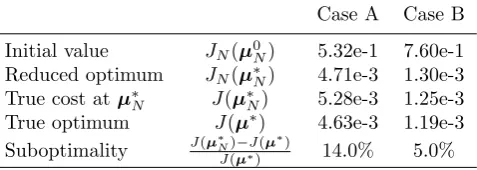
199 reduced basis solutions in Case B. The final value of the reduced cost functional wasJN(µ∗N) = 4.7e-3
in Case A (from an initial value JN(µ0N) = 0.53) and JN(µ∗N) = 1.3e-3 in Case B (from an initial value
JN(µ0
N) = 0.76). When computing with the full cost functional we obtained the final costJ(µ ∗
N) = 5.28e-3
in Case A, andJ(µ∗N) = 1.25e-3 in Case B. Thus it can be observed that for these test problems the reduced
optimization problem (26) was successfully solved and, while the obtained solutions are suboptimal, they
are reasonable also approximations for the solution of the full optimization problem (25). In Table 2 we
give the initial and final values of the reduced cost functional, and measure the suboptimality of the inverse
design by looking at the relative error
J(µ∗N)−J(µ∗)
J(µ∗)
Table 2: Comparison of the reduced optimal solutionµ∗
Nand the true optimal solutionµ∗ Case A Case B
Initial value JN(µ0N) 5.32e-1 7.60e-1 Reduced optimum JN(µ∗N) 4.71e-3 1.30e-3 True cost atµ∗N J(µ∗N) 5.28e-3 1.25e-3 True optimum J(µ∗) 4.63e-3 1.19e-3 Suboptimality J(µ
∗
N)−J(µ
∗
)
J(µ∗) 14.0% 5.0%
between the true optimal value and the value ofJ at the reduced optimum. As we can observe, the reduced
optimization solutions are suboptimal, but only by less than 15%.
The pressure distributions on the surface of the designed airfoil compared to the target are displayed in
Fig. 6(a) and Fig. 6(b). The dynamic pressure fields around the target airfoil and the final inverse design
obtained from the optimization procedure are shown in Fig. 7(a). Both solutions were visualized with the
FEM. Already with eight degrees of freedom the pressure field around the airfoil is qualitatively near the
true one, and the airfoil shape is close to the target airfoil chosen to test the method.
The error of the reduced basis solution for the inverse design was ||ϕN −ϕNN||X = 3.78e-4 in Case
A (relative error 2.03e-5) and ||ϕN −ϕNN||X = 6.44e-5 in Case B (relative error 3.35e-6). While the a
posteriori estimators used to control the greedy basis selection are not strictly rigorous for this nonaffinely
parameterized problem, the obtained approximations are below the specified error tolerance at least for
these parameter points.
A few words about the computational cost are in order. The offline stage of the reduced basis is expensive,
and took several hours of computation time to perform for this single problem. The online stage is much
more effective, taking only 0.06 s for each matrix assembly and solution of the system (18). We estimate this
to be about 300 times faster than assembling and solving the same equations with the FEM. This means
that solving the reduced inverse design problem (26), which typically requires an order of 102 function
evaluations during the nonlinear programming loop, takes only 50 s on a typical desktop computer. In
comparison, solving the inverse design problem (25) with the full FE solutions used to evaluate the pressure
takes about 1.5 hours on the same setup. The reduced optimization is roughly 100 times more efficient (and
not 300 times as expected) due to the fact that in addition to cost functional evaluations we also have to
perform post-processing to recover the pressure and the complexity of this depends onN. The offline stage
is also independent of the target pressure distribution chosen and even the cost functional used. We could
therefore opt to solve other CFD optimization problems, such as lift-drag optimization, without incurring
any additional costs in the offline stage.
0 0.2 0.4 0.6 0.8 1 0.5
1 1.5
Position on airfoil x/chord
Pressure p
(a) Case A (target = NACA4412)
0 0.2 0.4 0.6 0.8 1
0.5 1 1.5
Position on airfoil x/chord
Pressure p
[image:21.595.179.420.110.405.2](b) Case B (target = NACA0012)
Figure 6: Pressure distributions on the airfoil top and bottom surfaces on the target airfoil (solid line) and the inverse design (dashed)
(a) Case A (target = NACA4412)
(b) Case B (target = NACA0012)
Figure 7: The dynamic pressure field around the target airfoil (NACA4412) and the inverse design. Both visualizations were obtained using the FEM.
[image:21.595.175.421.449.696.2]7. Conclusions
We have presented a method for efficient shape design of PDE-modelled systems. We combined
free-form defree-formations to generate the parametric geometry and reduced basis methods to solve the resulting
parameterized PDEs in an inverse problem framework of shape optimization. To demonstrate the
appli-cability of the proposed approach we considered an inverse airfoil design problem in 2-d potential flow. It
was confirmed that using free-form deformations to generate the parametric domain deformations a small
number of design variables is sufficient to solve already quite challenging inverse airfoil design problems. The
reduced basis methods can then be used to obtain an efficient online procedure for shape optimization, where
several iterative evaluations of the state equations are needed and computational efficiency is appreciated.
The free-form deformations are independent of the mesh, geometry, and even the PDE model. Thus we
believe that in the future it will be possible to extend the proposed methods to more realistic and interesting
problems using different viscous flow models.
Acknowledgments
We thank Prof. Anthony T. Patera from MIT for his feedback as well as all the people who have
contributed to the rbMIT software. We also acknowledge Prof. Alfio Quarteroni for his support and
remarks, and thank the referees for their insights and detailed suggestions for improving the manuscript.
References
[1] I.H. Abbott and A.E. von Doenhoff. Theory of Wing Sections: Including a Summary of Airfoil Data. Courier Dover Publications, 1959.
[2] V. Agoshkov, A. Quarteroni, and G. Rozza. Shape design in aorto-coronaric bypass anastomoses using perturbation theory. SIAM J. Numer. Anal., 44(1):367–384, 2006.
[3] B.O. Almroth, P. Stern, and F.A. Brogan. Automatic choice of global shape functions in structural analysis. AIAA J., 16:525–528, 1978.
[4] E.I. Amoiralis and I.K. Nikolos. Freeform deformation versus B-spline representation in inverse airfoil design.J. Comput. Inf. Sci. Engrg., 8, 2008.
[5] M. Barrault, Y. Maday, N.C. Nguyen, and A.T. Patera. An ‘empirical interpolation’ method: application to efficient reduced-basis discretization of partial differential equations. C. R. Math. Acad. Sci. Paris, 339(9):667 – 672, 2004. [6] M.S. Bazaraa, H.D. Sherali, and C.M. Shetty.Nonlinear programming - theory and algorithms (2nd Ed.). John Wiley &
Sons, New York, 1993.
[7] S.C. Brenner and L.R. Scott. The mathematical theory of finite element methods (2nd Ed.). Springer-Verlag, New York, 2002.
[8] C. de Boor. A practical guide to splines. Springer-Verlag, New York, 2001.
[9] S. Deparis. Reduced basis error bound computation of parameter-dependent Navier– Stokes equations by the natural norm approach. SIAM J. Num. Anal., 46(4):2039–2067, 2008.
[10] G. Farin.Curves and surfaces for computer-aided geometric design: a practical guide. Morgan Kaufmann, 2001. [11] J.P. Fink and W.C. Rheinboldt. On the error behavior of the reduced basis technique for nonlinear finite element
approximations. Z. Angew. Math. Mech., 63(1):21–28, 1983.
[12] K.C. Giannakoglou. Design of optimal aerodynamic shapes using stochastic optimization methods and computational intelligence. Progress Aerospace Sci., 38:43–76, 2002.
[13] M.A. Grepl, Y. Maday, N.C. Nguyen, and A.T. Patera. Efficient reduced-basis treatment of nonaffine and nonlinear partial differential equations.ESAIM Math. Modelling Numer. Anal., 41(3):575–605, 2007.
[14] M.A. Grepl and A.T. Patera. A posteriori error bounds for reduced-basis approximations of parametrized parabolic partial differential equations.ESAIM Math. Modelling Numer. Anal., 39(1):157–181, 2005.
[15] M.D. Gunzburger. Perspectives in Flow Control and Optimization. SIAM, 2003.
[16] B. Haasdonk, M. Ohlberger, and G. Rozza. A reduced basis method for evolution schemes with parameter-dependent explicit operators. Technical Report 09/07 - N, FB 10, University of M¨unster, 2007. Accepted by ETNA.
[17] J. Haslinger and R.A.E. M¨akinen. Introduction to shape optimization: theory, approximation, and computation. SIAM, 2003.
[18] D.B.P. Huynh, N.C. Nguyen, A.T. Patera, and G. Rozza. http://augustine.mit.edu, Rapid reliable solution of the parametrized partial differential equations of continuum mechanics and transport (web site).
[19] D.B.P Huynh, G. Rozza, S. Sen, and A.T. Patera. A successive constraint linear optimization method for lower bounds of parametric coercivity and inf-sup stability costants. C. R. Acad. Sci. Paris. S´er. I Math., 345:473–478, 2007. [20] H.J. Lamousin and W.N. Waggenspack. NURBS-based free-form deformations.IEEE Comput. Graph. Appl., 14(6):59–65,
1994.
[21] P.A. LeGresley and J.J. Alonso. Airfoil design optimization using reduced order models based on proper orthogonal decomposition. Proc. Fluids 2000 Conf. Exhibit, 2000.
[22] Y. Maday, N.C. Nguyen, A.T. Patera, and G.S.H. Pau. A general multipurpose interpolation procedure: the magic points.
Commun. Pure Appl. Anal., 8(1), 2009.
[23] B. Mohammadi and O. Pironneau. Applied shape optimization for fluids. Oxford University Press, Oxford, 2001. [24] A.M. Morris, C.B. Allen, and T.C.S. Rendall. CFD-based optimization of aerofoils using radial basis functions for domain
element parameterization and mesh deformation. Int. J. Numer. Methods Fluids, 58:827–860, 2008.
[25] N.C. Nguyen. A posteriori error estimation and basis adaptivity for reduced-basis approximation of nonaffine-parametrized linear elliptic partial differential equations. J. Comp. Phys., 227:983–1006, 2007.
[26] N.C. Nguyen, A.T. Patera, and J. Peraire. A ’best points’ interpolation method for efficient approximation of parametrized functions. Int. J. Numer. Methods Engrg., 73:521–543, 2008.
[27] A.K. Noor and J.M. Peters. Reduced basis technique for nonlinear analysis of structures. AIAA J., 18(4):455–462, 1980. [28] R.L. Panton.Incompressible Flow (3rd Ed). Wiley & Sons, Chichester, 2005.
[29] A.T. Patera and G. Rozza. Reduced Basis Approximation and A Posteriori Error Estimation for Parametrized Partial Differential Equation. Version 1.0, Copyright MIT 2006, to appear in (tentative rubric) MIT Pappalardo Graduate Monographs in Mechanical Engineering.
[30] L.A. Piegl and W. Tiller. The NURBS Book. Springer-Verlag, New York, 1997.
[31] T.A. Porsching. Estimation of the error in the reduced basis method solution of nonlinear equations. Math. Comput., 45(172):487–496, 1985.
[32] C. Praveen and R. Duvigneau. Low cost PSO using metamodels and inexact pre-evaluation: Application to aerodynamic shape design. Comput. Methods Appl. Mech. Engrg., 198:1087–1096, 2009.
[33] C. Prud’homme, D.V. Rovas, K. Veroy, and A.T. Patera. A mathematical and computational framework for reliable real-time solution of parametrized partial differential equations. ESAIM Math. Modelling Numer. Anal., 36(5):747–771, 2002.
[34] A. Quarteroni and G. Rozza. Optimal control and shape optimization of aorto-coronaric bypass anastomoses. Math. Models Meth. Appl. Sci., 13(12):1801–1823, 2003.
[35] A. Quarteroni and G. Rozza. Numerical solution of parametrized Navier-Stokes equations by reduced basis methods.
Numer. Methods Partial Differential Equations, 23(4):923–948, 2007.
[36] A. Quarteroni, G. Rozza, L. Ded´e, and A. Quaini. Numerical approximation of a control problem for advection-diffusion processes. In System Modeling and Optimization, Ceragioli et al.(Eds.), Proc. 22nd IFIP TC7 Conf., Turin, 2005. Springer-Verlag, New York, 2006.
[37] A. Quarteroni, G. Rozza, and A. Quaini. Reduced basis methods for optimal control of advection-diffusion problem. In
Advances in Numerical Mathematics, W. Fitzgibbon, R. Hoppe, J. Periaux, O. Pironneau, and Y. Vassilevski (Eds.), pages 193–216, 2007.
[38] N.V. Queipo, R.T. Haftka, W. Shyy, T. Goel, R. Vaidyanathan, and P.K. Tucker. Surrogate-based analysis and optimiza-tion. Prog. Aerospace Sci., 41:1–28, 2005.
[39] G. Rozza. Reduced basis approximation and a posteriori error bounds for potential flows in parametrized geometries.
Submitted, 2009.
[40] G. Rozza. Reduced basis methods for Stokes equations in domains with non-affine parameter dependence. Comput. Vis. Sci., 12(1):23–35, 2009.
[41] G. Rozza, D.B.P. Huynh, and A.T. Patera. Reduced basis approximation and a posteriori error estimation for affinely parametrized elliptic coercive partial differential equations. Arch. Comput. Methods Engrg., 15:229–275, 2008.
[42] G. Rozza and K. Veroy. On the stability of Reduced Basis methods for Stokes Equations in parametrized domains.
Comput. Methods Appl. Mech. Engrg., 196(7):1244–1260, 2007.
[43] J.A. Samareh. A survey of shape parametrization techniques. Technical Report NASA/CP-1999-209136, NASA, 1999. [44] J.A. Samareh. Novel multidisciplinary shape parameterization approach. J. Aircraft, 38(6), 2001.
[45] J.A. Samareh. Aerodynamic shape optimization based on free-form deformation. InProc. 10th AIAA/ISSMO Multidis-ciplinary Anal. Optim. Conf., volume 6, pages 3672–3683, 2004.
[46] S.S. Sarakinos, E. Amoiralis, and I.K. Nikolos. Exploring freeform deformation capabilities in aerodynamic shape param-eterization. Proc. Int. Conf. Comput. Tool, 1:535–538, 2005.
[47] T.W. Sederberg and S.R. Parry. Free-form deformation of solid geometric models. Comput. Graph., 20(4), 1986. [48] J. Sokolowski and J.-P. Zol´esio. Introduction to shape optimization: shape sensitivity analysis. Springer-Verlag, Berlin,
2003.
[49] W. Song and A.J. Keane. A study of shape parameterisation methods for airfoil optimization. InProc. 10th AIAA/ISSMO Multidisciplinary Anal. Optim. Conf., volume 6, 2004.
[50] N. Thiyagarajan and R.V. Grandhi. 3d preform shape optimization in forging using reduced basis techniques. Engrg. Optim., 37(8):797–811, 2005.
[51] T. Tonn and K. Urban. A reduced-basis method for solving parameter-dependent convection-diffusion problems around rigid bodies. InProc. ECCOMAS CFD, 2006.
[52] K. Veroy and A.T. Patera. Certified real-time solution of the parametrized steady incompressible Navier-Stokes equations: rigorous reduced-basis a posteriori error bounds. Int. J. Numer. Meth. Fluids, 47(8-9):773–788, 2005.
[53] K. Veroy, C. Prud’homme, D.V. Rovas, and A.T. Patera. A posteriori error bounds for reduced-basis approximation of parametrized noncoercive and nonlinear elliptic partial differential equations (AIAA Paper 2003-3847). InProc. 16th AIAA Comput. Fluid Dynamics Conf., June 2003, 2003.
[54] O.C. Zienkiewicz, R.T. Taylor, J.Z. Zhu, and P. Nithiarasu.The Finite Element Method. Elsevier Butterworth Heinemann, Oxford, 2005.
[55] O.C. Zienkiewicz and J.Z. Zhu. The superconvergent patch recovery and `a posteriori estimates. Part 1: The recovery technique. Int. J. Numer. Methods Engrg., 33(7):1331–1364, 1992.