~ \. l
CLINICAL INTERVENTIONS IN AUSTRALIAN
COMMUNITY PHARMACIES
Volume 2 (Chapters Four to Eight)
Peter Tenni M Pharm
Clinical Interventions in Australian Community Pharmacies
4
PROMISE INTERVENTION STUDY
METHODOLOGY
In order to adequately address the aims of this project, a major study was designed to obtain sufficient examples of situations where
community pharmacists identified and resolved DRPs. This chapter outlines the methods used in detail.
4.1
MODIFICATION OF METHODS RESULTING FROM PILOT STUDY EXPERIENCEThe pilot study outlined in Chapter 3 identified a number of
improvements that could be made to various methods and techniques used. The classification system, although structurally sound, required some modification (see below). In addition the larger sample of pharmacies required the construction of an interface with a different dispensing system. Changes were also made to the information collected from pharmacies and pharmacists and also to the methods used for the determination of the value of the intervention.
The following sections outline the different facets of the classification system and how the DOCUMENT DRP classification system was modified for use in the PROMISe intervention Study.
4.1.1
TYPE OF DRP (CATEGORY AND SUBCATEGORY) The first step in classifying an intervention is determining the type of DRP. In the DOCUMENT classification system, there are a range of main categories and subcategories to select from.In the pilot study, a number of sub-categories were used infrequently, and if these were deemed unlikely to be used in a larger study, these subcategories were revised. For example it was found that "Monitoring - Drug Levels" was not used and it was felt that problems that were of the drug level monitoring type could be included in "Monitoring
Clinical Interventions in Australian Community Pharmacies
allocated new codes, titles and definitions. One new subcategory created was "Toxicity evident".
For each of the subcategories detailed scope notes were prepared. These notes include a definition of the subcategory, details and
examples of when the subcategory should be selected and examples of when other categories are more appropriate. For each modification made during the review of the DOCUMENT system, the relevant scope notes were also updated. The scope notes form the basis of the 'help' section in both the online training and the recording interface.
The full version of DOCUMENT including the scope notes used for the PROMISe intervention study can be seen in Appendix 7. An
Clinical Interventions in Australian Community Pharmacies
Drug selection
Problems related to the choice of drug prescribed or taken Duplication (D1)
Drug interaction (D2)
Wrong drug (D3)
Wrong dosage form (D4)
Other drug selection problem (DO)
Over or underdose prescribed
Problems related to the prescribed dose or schedule of the drug Dose too high (01)
Dose too low (02)
Other Dose Problem (00)
Compliance
Problems related to the way the patient takes the medication Taking too little (C1)
Taking too much (C2) Intentional drug misuse (C3)
Difficulty using dosage form (C4)
Other Compliance Problem (CO)
Untreated indications
Problems relating to actual or potential conditions that require management Condition not adequately treated (U1)
Preventive therapy required (U2)
Other Untreated indication Problem (UO)
Monitoring
Problems related to monitoring the efficacy or adverse effects of a drug Laboratory Monitoring (M2)
Non-Laboratory monitoring (M3)
Other Monitoring Problem (MO)
Education or Information
Problems related to knowledge of the disease or its management Patient drug information request (E1)
Confusion about therapy (E2)
Demonstration of device (E3)
Disease management or advice (E4)
Other Education or Information Problem (EO)
Non-clinical
Problems related to administrative aspects of the prescription Toxicity or Adverse reaction
Problems related to the presence of signs or symptoms which are suspected to be related to an adverse effect of the drug
Toxicity caused by dose (T1)
Toxicity caused by drug interaction (T2) Toxicity evident (T3)
Other Toxicity/Adverse Effect problem (TO)
Cltnical Interventions in Australian Community Pharmacies
ACTIONS
During examination of the "Action Investigation: other" category in the PROMISe pilot study, it was found that reviewing the patients' history was a common action. A new code and definition was added for this action for inclusion into the categorisation system used in the PROMISe intervention study. The classifications used for the investigative actions in the PROMISe intervention study are shown in Table 4-2.
Investigation : Written Material Investigation: Software
Investigation: Patient History Investigation: Other
Contacted Prescriber
Discussion with Patient or Carer Corrected without Discussion
TABLE 4-2: ACTION CLASSIFICATIONS USED IN PROMISE INTERVENTION STUDY
RECOMMENDATIONS
Again, modification of the recommendation types was undertaken based on feedback and frequency of selection. Pharmacists who participated in the PROMISe pilot study commented that there was an
extensive list of recommendations to select from. To improve this
aspect of the recording, the recommendations were grouped into five main types;
• a change in therapy • a referral required • provision of information • monitoring
• no recommendation necessary
Clinical Interventions in Australian Community Pharmacies
modification allowed the pharmacist to record which medication they altered, and how. The recommendation selections available for the PROMISe intervention study are outlined in Table 4-3.
A Chanqe in Therapy
Dose change
Drug change
Drug formulation change
Drug brand change
Dose frequency/schedule change
Prescription not dispensed
Other changes to therapy
A referral required Refer to prescriber Refer to hospital
Refer for medication review Other referral required
Provision of information
Education/counselling session
Written summary of medications
Commence dose administration aid
Other written information
Monitor
Monitoring: non-laboratory Monitoring: Laboratory test No recommendation necessary
TABLE 4-3: RECOMMENDATION CLASSIFICATIONS AS USED FOR PROMISE INTERVENTION STUDY
OUTCOME
If a recommendation is made to resolve a DRP, it is appropriate to document whether the recommendation has been accepted (by the doctor or patient) or not (i.e. the outcome of the recommendation). There were no changes made to the categories for acceptance of pharmacist's resolution of the problem (outcome) used in the PROMISe pilot study.
The potential outcomes recorded regarding the recommendations were
Clinical Interventions in Australian Community Pharmacies
• the recommendations were partially accepted (that is, only some of the multiple recommendations are accepted),
• the recommendations were not accepted or
• the uptake of the recommendations was unknown at the time of recording the intervention.
Definitions and scope notes for outcomes are shown in Table 4-4.
Unknown
Definition: When the pharmacist is unaware of what happened after he made the recommendation(s).
Accepted
Definition: When all of the recommendation(s) that the pharmacist makes are accepted
Partially Acceoted
Definition: When the pharmacist makes multiple recommendations, and only some of the recommendations that were made are accepted.
Not acceoted
Definition: When all of the recommendation(s) that the pharmacist makes are rejected
TABLE 4-4: OUTCOME DEFINITIONS USED FOR PROMISE INTERVENTION STUDY
CLINICAL SIGNIFICANCE
C/Jnical Interventions in Australian Community Pharmacies
Nil (SO)
When there is no consequence to the patient.
Low (Sl)
When the consequences to the patient are related to costs or information only
Mild (S2)
When the consequences to the patient are that they have improved a minor symptom, or if the intervention had not occurred they would have developed a minor symptom. The symptom should be such that it does not require a doctor's visit to treat.
Moderate (S3)
When if the intervention did not occur, it was likely that the patient would have had to go to the doctor because of the consequences. Also covers the situation where you need to refer the patient to the doctor because of the seriousness of the situation.
Hiqh (S4)
When if the intervention did not occur, it was likely that the patient would have had to go to a hospital because of the consequences. Also covers the situation where you need to refer the patient to a hospital because of the seriousness of the situation.
TABLE 4-5: SIGNIFICANCE DEFINITIONS USED IN PROMISE INTERVENTION STUDY
IDENTIFICATION OF THE PROBLEM (PROACTIVENESS)
The results from the PROMISe pilot study indicated that a large
proportion of the interventions documented resulted from direct patient requests for information. In this situation, pharmacists would always provide (to a greater or lesser extent) the information
requested. Thus the pharmacist would not have initiated the intervention. This led to the development of a classification of
interventions by whether the intervention was proactive or reactive. Reactive interventions were those that were either not initiated by the pharmacist, or required addressing before the prescription was able to be dispensed (many of the intervention classified as Non-clinical in the pilot study would fall into this category). Proactive interventions were initiated by the pharmacist and were not necessary to be undertaken in order to dispense the medication.
Cltnical Interventions in Australian Community Pharmacies
from the PROMISe pilot study indicated that 33.5% (85) of the interventions were proactive in nature and 66.5% (169) of the
interventions were reactive in nature. Proactive interventions were found to be of higher significance and were likely to be more
"discretionary" in the pilot study.
Given the predicted numbers of interventions for the PROMISe
intervention study, it would not be possible to individually re-code each intervention. Therefore, pharmacists who participated in the PROMISE intervention study were asked to indicate who initially identified the
problem as a guide to the proactiveness of the intervention. Training on this aspect of the classification of the intervention was included in
the on-line DOCUMENT training.
4.1.2
INTERFACE FOR THE WINIFRED® DISPENSING SYSTEMA number of technical changes were made to the "behind the scenes" aspects of the WiniFRED dispense system to accommodate the
PROMISe project requirements. This included the development of a communications interface using a modified version of the messaging components developed for a previous project where secure
transmission was required.
PRELIMINARY STEPS
The basic commencement screen is shown in Figure 4-1. This
consisted of some demographic and patient specific information above a series of tabs regarding the intervention. Where the intervention was
associated with a prescription, information concerning the prescription was imported automatically from the dispensing system (see Figure 4-2). Information that was imported into the intervention module
automatically consists of:
• the patient's name
• the prescriber's name and prescriber number
• the drug involved
Clinical Interventions in Australian Community Pharmacies
• the number of different medications that the patient has had in
the previous six months (medication count)
Other information needed to be manually entered for each
intervention. The recording pharmacist entered :
• the gender of the patient (unless previously stored in the dispensing software)
• the age group of the patient
• who initiated the problem (proactiveness)
• pharmacist identifier (usually done for each prescription) When the clinical activity was not related to a prescription, all of the information was entered manually. For situations where the patient
was not listed in the pharmacy database, an unlisted patient could be
created. This allowed for the documentation of "off the street"
interventions relating to customers who had not received prescriptions
from that particular pharmacy. The adopted "tab" structure allowed this demographic information to be in view while different aspects of
the intervention documentation were completed. The titles on these
Clinical Interventions in Australian Community Pharmacies
UnbtedPotient Gendel:
ol !Female [.]
S\bstit!.tion ModCC>Jrll:
D
013
PiescOOer No:
I
I
o
IMolodr=-
----.
D
Phonnocisl ln<iob: 1. Categories z. Actions ;!. Recommendations & OutcomesIntervention sutrcate o
J {. Significance Intervention cateaorv
D Drug Selection
0 Over or Underdose Prescribed C Compliance
U Untreated Indications
.::.J D1 Duplication D2 Drug interaction 03 Wrong Drug 04 Wrong dosage form M Monitoring 00 Other drug selection problem E Education or Information
N Non-clinical
T Toxicity or Adverse Reaction
Cate o clari!ication notes
New Intervention
SoOlch by SURNAME FIRST NAME ADDRESS"' NlMl\ber or <S>oino or <P>rovious. Abo; <F>OINy S001ch. <A>ddron S001ch. Sur<N>ome Sootch. E<Sciipt No> lo Eat 0t E<X>~ Fred
FIGURE 4-1: INTRODUCTION SCREEN FOR THE WINIFRED INTERVENTION INTERFACE
O Othec'Msg's Olocal ... s
Good.'. ?"~G~'"'-
--,-,---,-,--~-~ • 21-66 yura old (adult)
METFORMIN (CHEM·MART) TAB 860M [J 931611J0008.j11
or
Pieacrb!MNo:1-11
Medeo.rt
m
1. Categortn Z.Adloos
I
J. Recommendations&. Outcomes i. Slgnlllcanar 1n1ervention cate o1=='' - --1 D Drug Selection
0 Over or Undudo1e Prescribed
~----t JC Compliance
U Untreated lnchcat1ons
IL~ - 1 - -•• -1 ~ IAF '#lthO
10A L10A Dono M
l
~T
Monitoring
Educ1.tion or Information Non~llnlcal
T oxlcjty or Adverse Reution
New Intervention
Intervention sut>-cate
U1 Condition not adequatety treated U2 Preventive thuapy required
UO Othtr Untreated indication Problem
c~~rffkatlon.~n~o~"'~·
---Erier Orecllonl ·'I .t start lo lunOlt S'4* Sigs. <0.W> toJt.ri; Em. 'SS'l0t 5¥ne Slgs, Move wilh <Pgl/p> to SIM er <PoDown> lo Erdol OredJOns.
]
FIGURE 4-2: POPULATED INTRODUCTION SCREEN FOR THE WINIFRED INTERVENTION INTERFACE
Clinical Interventions in Australian Community Pharmacies
RECORDING OF CATEGORY AND SUBCATEGORY
The first step in the recording of an intervention in this system was
selection of the main category of the clinical activity. By selecting the main category on the left-hand side the appropriate subcategories appear on the right-hand side of the entry screen. Help screens were available for each of the different selections.
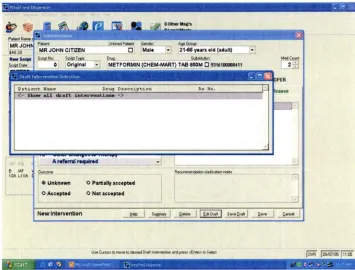
Once the initial category and subcategory has been selected, a draft of the intervention can be saved and completed at a later time. A list of all interventions that are in draft mode can be accessed by selecting
activities; draft interventions (see Figure 4-3).
PER
Patient Name Drug De:icription
<- Sbaw all lk•f't . .i.Dterv.nt..ioa8 ->
J
• Unknown O Partially acc•pt•d O Accepted O Not 1.ccept•d
[image:12.565.120.476.312.583.2]New Intervention
FIGURE 4-3: SAVING AND RE-ACCESSING A DRAFT INTERVENTION
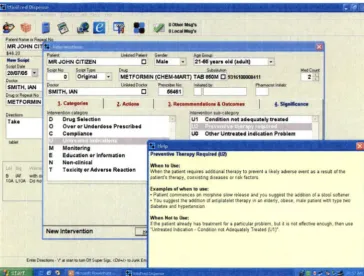
At any time during the recording process, help could be accessed using
Clinical Interventions in Australian Community Pharmacies
. .
"
O°"""
locallllsg's...
PotientNomo °'AIMRJOHN c
~10 _ _
...
_:...:.
::~- ~... _,_: . ·c .. : ..
J...!~ ... -~-~~-.;.. ... : ... :..:!~~_Jx N-Scwipt1. Categories z, Actions Of.c:bonl Intervention cate o
r"T"'•k"'o' " - --1 D Drug Selection
...
M E N
Over or UnderdoH Prescribed
Compliance Monitoring
Education or Information Non-clinical
21~ years old (adult)
1-.clby _ , _ , ...
DI
D
J., Recommendations & Outcomes J Intervention sub-tale o
PrewntJw Therapy lhqulr911 (U2)
When to Use: ,._. ;
B IAf wtth 0 10A L10A Do no
Toxicity or Adv1r11 Reaction
T When the patient requires add~1onal therapy to prevent a likely adverse event as a result of the '--====:-:====--~patient's therapy, coexisting d1seaus or nsk factors
Examples of when to use:
• Patient commences on morphine slow release and you suggeS1 lhe addl11on of a stool softener
• You suggest 1he addnion of an11pla1ele1 therapy man elderly, obese, mate patient wrth type 1wo diabetes and hypertension
When Not to Use:
1-- - - ; : :=f If the patient already has treatment for a particular problem, but 1t 1s not etrectrve enough, then use
t:! "Unlreated Indication -Cond111on not Adequately Tre<ited (U1)"
Now Intervention
[image:13.569.118.483.81.357.2]Enlef Orectiont-·r • tl:$1 toiunOft Supei Sigi. <Ori+J> to Jui:. E
FIGURE 4-4: HELP SCREEN FOR THE WINIFRED INTERVENTION INTERFACE
RECORDING OF ACTION(S}
~
w'
withor ""OA L10A Do not
Cltnical Interventions in Australian Community Pharmacies
oou.r-11sg·1
OLoca&llSg"s
21-N yurs old (•dult)
0 ~
METFORMIN (CHEM-MART) TAB 8GOM 019316100008411
1. C.tego11.. z.. Actions
...
A1 lnve1d9ate, written material
KJ. Investigation: Softwv•
~ lnvestlgatJon: Patient History M Contacted prescriber
M Corrected without dl1cu11lon A7 Other action
New Intervention
Precrbef No: lr.Dlted Phamaast l,...s:
I -11 [[] PHARMACIST @ CRAIG COOPER
I
l. Recommendations & Outcomes t. SlgftfflunceM Ol1cu11lon with patient or carer
1
~
""""-"""'
I
Erter 01ecbons • '' « atM to b.Mn Off Super Siga, <0.W> to Jlri-. E
·~
:
FIGURE 4-5: RECORDING OF ACTIONS ON THE WINIFRED INTERVENTION INTERFACE
RECORDING OF RECOMMENDATION(S) AND OUTCOME
rug related
last lime the s intentional.
cerved or grvmg tact the doclor"
Recommendations made to resolve the drug-related problem were
entered into the system in a similar manner to the actions using a left
-to-right selection arrow in the centre of the screen (see Figure 4-6).
Although multiple recommendations could be recorded against each
intervention, it was not possible to make the same recommendation
more than once. The system was designed to allow for multiple unique
recommendation selections.
Where the recommendation related to a direct change in therapy,
information concerning the before and after situation was collected to
allow for clarification of what changes were recommended. To collect
this information, an 'edit' key was created. So, for example, if a
change in drug was recommended, the drug could be entered with an
C/Jnical Interventions in Australian Community Pharmacies
The outcome of the recommendation was included on this same screen
and the entry related to a composite outcome for all of the
recommendations made.
PatienlNGmSOf No
MR JOHN CIT 146.20
Oiections
Tako
"'
Drug Formulation Change
RA ONg !!rand Chango
~ DoH Frequency/Schedule Ch1119• R6 Prucrlption not Dispensed R7 Other Ch1.n9•1 to Therapy
OCM-. .... s
0 Local MIG'•
Pretaber No: lnb.led Pharmacist lnibols:
I -11 [ [PHARMACIST @E]CRAJGCOOPER
3. Recommendedons & Outcomes J t S .. allunce
• jlJ' R2 Drug Chango
~
[f!)]
B IAF withor
10AL10A Donat A.!!'!_rnl ~ _ _ _ ____.,:,
""""""
O Unknown o AcceptedNow lntorvontion
O PartJally accepted
O Not accepted
ErU Orec:Dorw ·'fat start kl llM"IOll St4>el Sig1. <on.J> toJtft E
rug related
lastl1methe s 1nten11onal
J
corvtd or gMngtact the doctor"
Clinical Interventions in Australian Community Pharmacies
"""""""""
OLocalMq's
Patient Name°' Repeat No
MR JOHN CIT
T•k•
~~·rp
I
B IAF Wlthot10A L10A Do no1
I
Pharmaastlnitielc: @:£]CRAIG COOPER
1. Cat.gorl• 0=~---~ J t. Slgnllunce
A~• In 111 • .._ I i.=. . -...
R1 Dong• Chana• Dieciions ~
~~~~-R3 DNg Formulation C
I
·.1
R4 Drug Brand Ch&ng•R5 Dou Fr•quencylSc
R6 Pr•scriptlon not Dis ' - - - ' " " " '
R7 Other Ch•ngH to T A rofernl re41ulrod _
a"'°'"' O Unknown o Acc1pt1d
New Intervention
0 P&ttlally &ccopt.d o Not accepted
EM Oiecbons ·'I ot st«llo h.mOff S~ Sigs, <OlkJ> toJtd E
rug related
last time the
s intentional.
FIGURE 4- 7: RECORDING RECOMMENDATIONS IN THE WINIFRED INTERVENTION INTERFACE: DETAILS OF DRUG CHANGE
RECORDING OF CLINICAL SIGNIFICANCE AND TIME TAKEN
The clinical significance screen, (see Figure 4-8) allowed for a selection
to be made to indicate the appropriate level of clinical significance for
the activity. For interventions that were rated as moderate or high,
additional information concerning the patient's other medical
conditions was requested. This additional information was collected in
order to enable reconstruction of the clinical situation which, in turn,
would enable adequate examination of the activity by an external
clinical panel. A reminder of the importance of this additional
information was automatically presented when either moderate or high
clinical significance was selected (see red reminder message in Figure
4-9).
The time taken to perform the intervention was also recorded on this
screen. Individual buttons for particular brackets of time were made
U>I 0
B W
1GA L10A
Cltnical Interventions in Australian Community Pharmacies
·-""'
1 -11J l.. Recommendado• & Ovtcom . .
51 Low
S2 Mild
S3 ModerJ.t•
~lg_h _ _ _ _ _ _ _ _ _ _ _ _ __,
Likely WorHnlng of Disease or Symptoms
2m1nl •mini ~ em1nl
1om1nl 15mlnf 20minl JOm!nJ
r•an
lh9lbl cordcntf'helmocititlri:iab: @£)CRAIG COOPER
f..Sl, . . _co
m the last 11me !he gewasmtentional
~ int1n11ntlon e 1ng I contact trtce~d hoe dr goMcinog r"
.._~~~~~~~~-,.l!l"lll!l'Tl!m~"'"""'!'tm!'?rnlll~~~~~~~-'
Enis Orecilonl ·'I at at.wt to unOn Si.oer Sigs. <on.J> toJlril E
FIGURE 4-8: RECORDING OF SIGNIFICANCE IN THE WINIFRED INTERVENTIONS INTERFACE (MILD SIGNIFICANCE)
51 Low 52 Mild
~ High
ol
z.. Actions ;i. Recommendatlon1 & Outcomn
Medeort
m
~mecist:IMalt:@I)CRAJG COOPER
{. St1nfflcanca
Diabetes, hyperchole1trolHmia
Likely Doctors Con1ult1.tion Avoided or Requir•d l
This '9 • potenti•lly Important lntervendon.
Plnse e..ure relennt information 1a provided
In the appropriate textboxes above.
ing a drug 1elated
m 1he lut lime the 91 was mtenllonal.
Now lntorvontion e ing received or I conlaci the doctor• Q1'11nQ
.._~~~~~~~~--:""1l!"'J'mmm,,,,,,.,,lm"T!llnmftlllmlW.-~~~~~--'
Erler Otedl::nl · '/ .tt u t lo 11.mOff 514* Sips. <CtrW> toJlri. E
Clinical Interventions in Australian Community Pharmacies
LOCAL INTERVENTION RECORD: PATIENT HISTORY AND SUMMARY
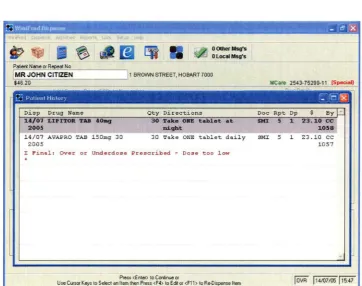
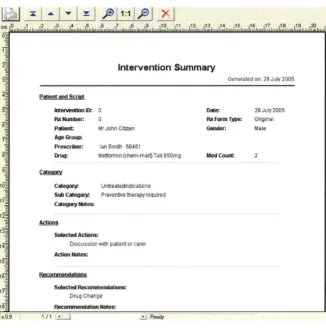
Once an intervention had been recorded, an entry concerning the intervention appeared in the patient history file (see Figure 4-10). The full details of the intervention could be accessed by double-clicking on this entry. In addition, a summary of the intervention could be
generated (see Figure 4-11).
O Olher Msa's
I
O Local Msg's~IM_R_J_O_H_N_C__lT_IZ_E_N _ _ _ _ _ ~l1 BROWN STREET, HOBART 7000 $46.20
Disp Drug Name 14(07 LIPITOR TAB 40mg
2005
14/07 AVAPRO TAB 150rng 30 2005
Qty Directions
30 Take 011!: tablet at night
30 Take ONE tablet daily
I Finel: Over or Underdo~e Pre~cribed - Do~e too low
Press <Enter> to Continue or
[image:18.563.116.479.223.509.2]Use Cursor Keys to Select an Item then Press <F4> to Edt or <F11 > lo Ae·D~pense Item
FIGURE 4-10: INTERVENTION NOTE IN PATIENT HISTORY
MCare 2543-75299-11 (Specioll
Doc Rpt Op By l.:.
SHI 5 1 23.10 CC 1058
'O.S
Cltnical Interventions in Australian Community Pharmacies
Intervention Summary
Patient and Script
lnteivention ID: O
Rx Number:
Palient: Mr John Citizen
Age Group:
Prescriber: Ian Smith 56461
Drug: Me~ormin (chem-mart) Tab B50mg
CateglllJ(. Untreateclndications
Sub Colegory. Preven~ve therapy required Calegoty Notes:
Actions
Selected Actions:
Discussion with patient or carer
Action Notes:
Recommendatjons
Selected Reconvnendations: Drug Change
Recommendation Notes:
1/1 ...!..!_] ..!J Ready
Generated on: 28 July 2005
Dale: 28 July 2005 Rx Form Type: Original
Gender: Male
[image:19.564.136.462.85.412.2]Med Count:
FIGURE 4-11: PRINTABLE INDIVIDUAL INTERVENTION SUMMARY
LOCAL INTERVENTION RECORD: REPORTS
A number of reports could be produced for the recording pharmacist (see Figure 4-12). These include a detailed report, a summary report and a statistical report of interventions. The detailed report is shown
Cltnical Interventions in Australian Community Pharmacies
Patient Name or Repeat No
I
:i_cript Drug U.sage
eatient
~octor
t'tursing Home
>I
Intervention Reports •
8.Qed Script Reports
(No Aged Scripts)
l[iew Last Report
~ast Report to ASCII
o other Msg's o Local Msg's
Detailed Report of Interventions Summary Report of Interventions Statistical Report of Interventions
FIGURE 4-12: REPORTS FOR INTERVENTIONS AVAILABLE AT EACH PHARMACY
Detailed Report of Interventions
Generated on: 08 JUiy 2005
• 0.9
Filter Conditions
Date: From 01/01/2005 To: 08/07/2005
lnteiwntion ID: 16 Date: 05105/2005 04:12:42 PM Rx Number: O Rx Form Type: Original
Drug:
Prescriber: Category.
Sub Category.
Selected Actions: Blank
Over or Underdose Prescribed Dose too high
Investigation: Patient History Discussion with patient or carer Discussion with patient or carer
Recommendations: Refer to Prescriber Drug Brand Change
Other Changes to Therapy Outcome: Accepted
Time taken: 2
MedCount: O
Significance: Moderate -Likely Doctors Consultafion Avoided or Required
Other Condition Notes:
test
1 /6 GlS ..£) Ready
FIGURE 4-13: PHARMACY-BASED DETAILED REPORT OF INTERVENTIONS
PHARMACIST AND PHARMACY DEMOGRAPHICS ASSESSMENTS
Prior to commencing the pilot study, it was clear that certain aspects of
a pharmacist and/or the pharmacy would influence the frequency and
nature of the interventions performed. The small sample size of the
Cltnical Interventions in Australian Community Pharmacies
However, the surveys used identified the type of information required
in order to adequately examine issues such as workload, "business
style", clinical skills and so on.
The details of the surveys and information collected from each
pharmacist and pharmacy are shown in Sections 4.3.1 and 4.4
respectively.
CLINICAL SIGNIFICANCE AND VALUE ASSESSMENTS
The pilot study assessment of the value of the interventions was a trial
of a system that could be used remotely. This system was further
refined, and the technical refinement made it possible to create a
web-based intervention assessment process. This enabled the use of expert
assessors from throughout Australia, without the expense and
inconvenience of a face-to-face meeting. Details of the modified
system can be found in Section 4.5
4.2
PROMISE STUDY DESIGNThe main aims of this project were to:
• determine the frequency with which Australian community
pharmacists resolve or prevent DRPs,
• evaluate the nature and severity of the problems and the drugs
involved in the problems, and
• estimate the potential value of these clinical interventions in
health and economic terms.
In order to be able to address the aims above, the PROMISe
intervention study used an observational controlled design, where
details of interventions that occurred were collected, and an
assessment of the potential severity of the outcomes of the
intervention was made by experts.
Within the study design, it was important to collect information on
various aspects of pharmacists and pharmacies that may relate to
intervention frequency and type. In addition, testing of whether the
Clinical Interventions in Australian Community Pharmacies
prompting interventions, observing and encouraging the pharmacist or
simply remunerating the pharmacist for the activity was an important
aspect of the study.
The initial intended design included a crossover of remuneration over
two, two week periods, with randomised allocation of the intervention
prompt and the presence of observer pharmacists between these arms
(see Figure 4-14).
Pharmacies Enrolled
Phase 1 (2 weeks)
Observation , . . . _ ..t Present
Intervention
Obs.erv•tlon Prompt Pharm•clst No Intervention
Prompt
Intervention
No observ•tion Prompt Pharmacist
No Intervention Prompt
Intervention
Observ•tlon Prompt Pharmacist
No Intervention Prompt
Intervention No observation Prompt
Ph.,maclst
No Intervention Prompt (") .., 0 "' "' 0 < t'I) ..,
Phase 2 (2 weeks)
Unpaid ln PhH•2
Paid In Phase2
FIGURE 4-14: INTENDED PROMISE INTERVENTION STUDY DESIGN
1n-terventlon Prompt No Intervention
Prompt
Intervention Prompt No Intervention
Prompt
However, as there were some initial installation difficulties with the
communications software, some pharmacies were delayed in
commencing their data collection. The intervention prompt that was
installed also caused a small overlap problem. When the intervention
prompt was de-commissioned, this occurred with the routine monthly
software update. The update was available to pharmacies from the 24th
of the month, and could be installed by individual pharmacies at any
Clinical Interventions in Australian Community Pharmacies
"turned off" their intervention prompts up to a week earlier than
others. In addition, the number of interventions documented was lower
than expected and extension of the study and the observation process
was required in order to collect information concerning a sufficient
number of interventions.
The final schema, randomisation outcome and duration of observation
and intervention prompt for the participating pharmacies are shown in
Figure 4-15.
52
Phormocies fnrollod
Phase 1 (2 weeks)
Observation
9
5 Intervention
Prom t 6 No Intervention
Prom t
9 Intervention
Prom t 9 No I ntervendon
Prom t
(3weeks)
Phase 2 (2 weeks)
9
Phase 3 (4 weeks)
5 2 - · Poldin
-J
FIGURE 4-15: RANDOMISATION SCHEMA FOR PROMISE INTERVENTION STUDY
Despite the difficulties and overlaps, there was still sufficient
information obtained to indicate the effects of observation,
remuneration and the intervention prompt. The effects of these could
be assessed independently and together using univariate and
multivariate analyses. The combined effect of all three techniques
(adjusted for non-recording of interventions) was used to determine an
Clinical Interventions tn Australian Community Pharmacies
Figure 4-16 represents the steps involved in conducting the project in
the Melbourne pharmacies.
ti n Sy tem
5.Rand
7. D t olle tion nd Ele tr ni Re ording of lnte ention (in luded egul ite vi it vith feedb k of suits)
FIGURE 4-16: OVERALL PROCESS OF ENROLMENT AND TRAINING OF PHARMACIES IN PROMISE INTERVENTION STUDY
4.2.1
STEP 1: RECRUITMENT AND ENROLMENT OFPHARMACIES AND PHARMACISTS
Pharmacies registered as users of the WiniFRED dispensing soltware in
metropolitan Melbourne were contacted and provided with information
on the PROMISe project. Expressions of interest were sought from the
260 registered users, with the opportunity to reply via email or fax.
Information concerning the project was also generally distributed
through AusPharmList and the Australian Pharmacist.
A flyer was developed to increase awareness of the project and
distributed in the Australian Pharmacist, the Victorian Guild Newsletter,
Clinical Interventions in Australian Community Pharmacies
Once the pharmacies had expressed interest in the project, preliminary
information was obtained, relating to:
• computer hardware,
• so~ware configuration and
• the number of staff likely to be involved.
This information provided detail for the logistical planning of the
project and ensured the sample provided a good representation of
community pharmacies. Appendix 8 contains information distributed
to the potential pharmacies. Only pharmacies who had installed the
Windows operating systems Windows 2000 or Windows XP were
accepted for enrolment.
Once each pharmacy had received information on the project, had
agreed to participate and met the so~ware requirements, they were
enrolled into the project. This involved signing an agreement with the University to participate in the project. The agreement covered aspects
C/1nical Interventions in Australian Community Pharmacies
What Is an Intervention? It is common for pharmacisl5 to carry out clinical interventions each day. For example
Mr Brandl presents presc~~on for Monodur 60mg one tablet twice a day
He has been previouslf taking 6()ng daily He CorT¥Jlains that his angina has been worse recenlly. The pharmacist cantacls the GP IJJ discuss nitrete IJJler-anca. The pharmacist recommends daily dosing •Mth Monodur 12()ng.
The PROMISe project wll explore the po-tential savings, in parocular health and econorric outcomes ot community phar-macisl5' clincal intervennons. Recording Interventions
Those community phanmac1sts who cur-rently record 1ntervenoons tend to do so in many different terms. including into a book or the notes section within their dispensing soltware. By establishing a standardised and centralised recording system 11 will be possible in the luture to compile repMs on community pharma-cists' clinical acti>ity. 'Mth this as sup-pornve eV1dence the acnV1ty ol commu-nity pharmacists can be more clearly defined to the Government and other stakeholders.
Back!JOUld to PROMSe A system for the electronc recordng, collabon and management ol medcation incidents in community pharmacy has been deveklped within the Unit for Medcaoon Outcomes Re-search and Educ anon at the School ot Phar-macy, Universny ot Tasmana. The system was pibttested in phanmacies in Tasmania to evaluate its funcoonality and to provide some prelirrinary infonmation. In this next phase we am to collect intervention data from phanmaaes 1n Melbourne and analyse these interventions tor cirncal and ecomonc benefit.
When the project 1s completed, Austraia will be the only country in the world with a mecha-nism for collecnng naoon-wide infonmanon re-lated to problems 1denofied 1n community pharmacies
Community phanmaasl5 otten idenofy issues relanng to medcation safety. The PROMISe project will proV1de a method for standardsed recOfdng ot these situanons and may lead to remuneration tor the documentation process.
For more infonmation Contact: PeterTenrn
Project Manager (03) 62261005 [email protected]
Funding for the prOJ•ct W'IS made available thrw~theAUlittalianDepUUhentofHealth
andA8'ing as part. of the Thud Commuruty Phannacy Aguemeri, which is managed by
The Pharmacy Owld of AuNaha
For more information vis~
www.promlse.Id.au
U
TAS
School of 'hannacy
U
MORE
~
>
~°""'*-'~-~School of Pharmacy University of Tasmania Private Bag 83 Hobart Tas 7001
ContactPetcrTenni (OJ) 6226 1005 [email protected] au
The PROMISe project, a message
from The Phannacy GuUd of Australia. One of the key roles cu"enlly being investigated
for pharmacists is the recording of
clinical interventions.
Pharmacists carry oul clinical interventions every d8j but lhe polential savings in terms of heaRh and economic DU/comes are nol clearly kn<JMl.
The Pharmacy Guild of Australia has corrmssioned this project to quantify and demonstrale the bene!is of communily pharmacies carrying oul these interventions and documenting this acl1viy Using the resuRs from this project # may be possible lo negoliale with the Government for remuneration to corrmunity pharma:ists to do clinical interventions and document them. ·we cannot stress enough how impol1ant this project is with the cuffent threats lo supply based remuneration. We hope you take this oppol1unily lo be involved in a project of high signiflcance to the profession and use this experience for your own benefit:
John Bronger Bill Scott National President Victorian President
The Pharmacy Guild of Australia
FIGURE 4-17: PROMISE PROMOTIONAL BROCHURE
Pharmacy Recording of
Medication Incidents and
Services
The PROMISe project
UMORE~)
.l!I. l ' l \ \ l l ' l \ t ~ ~ ( 11 JI ~ I \ I ' \
PCAINU SYSTEMS
The 2005 lrlal
Participating pharmacies will be
provided with ongoing technical and software support. Regula' visls to each pharmacy will ensure any potential problems are resolved quickly and easily
Full training wll be pro.,;ded to phanmaasts pal1iapating in the project. Generous pay. ment for the Orne taken for this trarnng 1s included.
The trial will run for three weeks in Apnl 2005.
At least ha~ ot the traring can be conn-pleted onhne at www.promseJd.au and each parnapant will have a chance win $2500
Training for the PROMISe Intervention Study involved education in
Clinical Interventions in Australian Community Pharmacies
PROMISe user interface. The training for the DOCUMENT classification
system was undertaken online, and demographic information
concerning the participant's background, opinions of pharmacy and
clinical skills was also collected during this process (see Section
4.2.2.1).
4.2.2
STEP2:
ON-LINE TRAINING FOR DOCUMENTCLASSIFICATION
Training in the DOCUMENT system was completed online. The training
was designed to familiarise the pharmacists with the selection of
appropriate categories during the process of documenting
interventions. The training module was available on the PROMISe
website (www.promise.id.au). This website was also used for ongoing
feedback and information for PROMISe trial pharmacists (see Figure
Clinical Interventions in Australian Community Pharmacies
PROMIS
e
Pharmacy Recording of Medication Incidents and:Ser.vices electronic documentation system
Home
About
What's new
Class1ficat1on
Training
Trial pamc1pants
Contact
Classification of interventions using DOCUMENT
The PROMISe Project Phase One involved the development of an
appropriate dassification system, DOCUMENT.Thi• system currently links in 1Nith community dispensing software, thereby enabling the accurate and
complete recording of pharmacist's interventions. These indude detection
of drug related problems and other dinical services. For further
information on the DOCUMENT dassification system developed for the PROMISe project, ~to view POF version (185 KB).
Email this page to friend
Click the button below to view a Flash presentation
View
Don't Have Flash? Download Flasr. Player.
Internet-based case scenarios of typical pharmacist interventions have been used to validate the DOCUHENT dassifitation scheme. To date over 400 pharmacists have enrolled to learn more about
the dassification system. Completion of all of the case scenario's is encouraged as this displays the
complete functionality of the system. The scenarios and DOCUMENT classification system has been refined for PROHISe phase 2. Returning users simply login to complete the new set of scenarios.
DOCUHENT dassification scheme allows interventions to be classified by:
• Type of medicaticn-related issue;
• Actions taken by the pharmacist to resolve the issue
• Recommendations (what the pharmacist did) for each intervention and
• dinical significancej
In the following cases you •Nill be asked to classify the intervention. This will include assigning the
appropriate Type and Subtype . (referenoe to the help notes is useful for new users of the system) Also documentation of the Action.s and Recommendations made by tile pharmacist are to be recorded. You will also be asked to assign a Significance categorisation for each intervention. These
classifications will be explained further as you start using the inyteractive OOCUHENT classification
tool.
Please note the following cases have been set up to familiarise the user with the DOCUMENT
d?1ssification system. The actions and recommendations made by the pharmacist may not reflect what
you would personally carry out in practice. Record only those actions undertaken by the pharmacist.
Ongoing feedback has been incorporated into these online scenarios.
Continue
FIGURE 4-18: DOCUMENT ON-LINE TRAINING WEBSITE
The online training included three types of activities
• Completion of two clinical problem solving skill tests.
• Completion of a demographics questionnaire.
• Allocation of DOCUMENT categories to 20 case-based scenarios
in which the problem and the steps taken to resolve the problem
were described.
The process of registration is depicted in Figure 4-19. Once registered,
the participant could complete the training. This registration also
allowed the participant to complete the training in different stages if
Clinical Interventions in Australian Community Pharmacies
PROMIS
e
,;~
Pharmacy Recording of Medication Incidents and.
Semices
electronic documentation system-- .. .ir;, .;:".
Training
Home The training requires you to complete the following.
l. Two diniatl problem solving tools (15 minutes each) What's new 2. A questionnaire about you and your bac ground (5 minutes)
Class1flcat1on 3. Vdinic-alidatal ion oscenf a arios ( the DOCUMl hour). ENT dassification scheme using 20 Training
Tnal part1opants
You can commence the training at any time, but it must be completed
by Friday 13th May, 2005. You do not have to t<>mplete all of the trainino at one time, each time you retum to the website you will be able to start from where you left off in a previous ses.sion. Contact
To proceed, Register (new users) or Login (retummg users) by chdong
Registration
To register, choose a username and password:
semame
I
pc:te · 05Password !._•_•_ .. _•_• ____ _. Regis er
login
login
Usemame ,.I p ... ct._e ... n_n_io ... s.__ ___ __,
Password .. I•_•_•_•_•_• _____ _. Login
Email this page to fiend
k.cturn,n9 us.er=;
Email tTis oage to a fnEnd
·-
If yo·
u share thiscomputer with others, please
ch•ck the corre-ct
us.ername and
pa•sword is in the boxes on the
left before you
dick Login. • You need to
FIGURE 4-19: REGISTRATION AND LOGIN PROCESS FOR ONLINE TRAINING
4.2.2.1
PHARMACISTS' CLINICAL SKILLS TRAININGTesting of clinical skills involved two interactive scenarios which
allowed the identification and assessment of a number of clinical
Clinical Interventions in Australian Community Pharmacies
Each step involved multiple choice questions or lines of investigation,
which then provided additional information depending on the path
chosen (see Figure 4-20). Individual participants in the clinical problem
solving skills case studies received an overall score, which was based
on:
• the number of problems that they identified,
• the appropriateness of the recommendations they made, and
• the number of investigative steps that they used to detect the
problems.
It was possible as a result of the design of the system to track the
number of pages that the pharmacist visited in order to identify the
underlying drug-related problems.
Thus, the total score was collated from an investigation score, a
problem identification score, and an appropriateness of
recommendation score. It was felt that pharmacists with different
levels of clinical skills would have different ratios of scores within these
three components.
A complete summary of the choices and details of the clinical skills
assessment scenario is shown in Appendix 9.
CPSA -1
You ~r• logged In ~s pct8nn103
A 54 year old man presents you with a new prescription for Avandia (Rosiglitazone)
4mg twK;e daily. He has taken the rosightazone at a dose of one daily for the last
month, and tells you that he has just been to the doctor, who said to increase to
twice daily. He also has a new prescription for frusemid<l 2°"'11 daily which he needs dispensed.
Wlolch ONE of the following would you do first?
F"ind out from the patient his previous treatment for diabetes, more information regarding other IT19dicai conditions and symptoms, and recent BSLs.
Dispense the prescnpbOn as written with appropnate counseflfng
regarding monitoring of BSLs on diabetes.
Contact the prescriber, primarity to tmd out the reason for the addition of the frusemtde.
contact the prescriber, pnmarity to find out c...,.ent ijver function tests.
Cltnical Interventions in Australian Community Pharmacies
4.2.2.2
PHARMACIST DEMOGRAPHIC INFORMATIONThe online pharmacist demographic questionnaire is shown in full in
Appendix 10, and addressed three main areas:
• Section 1: the pharmacist's background in terms of training and
experience (Figure 4-21)
• Section 2: the pharmacist's current practice profile (Figure 4-22)
• Section 3: the pharmacist's opinions regarding the profession of
Cltnical Interventions in Australian Community Pharmacies
You - logged 1n as pdanni05
ction 1- G tion nd b ck round
The folio ing 1nformatio is important to enable us o determine ho your background inflenoes the
ay e intervention soenaroos are classi 1ed.
Informed consent
Sy e<>mple no the forms 1n the folio. ing pages you COl'lsent to the collection and use of the data
collected on this website on the understanding 1t ill be de-iden "fied, processed and analysed in groups
and held acoording to University of Tasmania requirements. This project has been approved by the Human Research E hies Committee (Tasmania) Ne or .
• Please complete the details on the following pages as bes you can.
• Leave blan any questions you are unable to complete.
General infonnation
Gender
I
1ale3
Aoef<20
3
Year of graduation
C=:J
•·9-1990OR
r ot ye oraduated 1.4 Where did you complete your pre-reomrat1on tl"ammg?
I
Community PharmacyIf other please specify
1.5 Are you accredited to conduct mcd1cat1on l"ev1ews? r Yes r 0
3
1.6 Since you graduated, have you gamed any fonnal chmcal quahf1cat1ons? r Yes r No
If Yes please specify
1.7 Indicate the approximate number of full-t•me years that you have worked m the following prachce ,.,,,Hing" (sevel"al may etpply).
Humbel" of years
< 2 2 - s >S Nil
Communrty Pharmacy
r
r
r
r.Hospital Pharmacy r
r
r
r.Medicabon rev1e s on nurs1 g homes
r
r
r
r.Univen•tY or other tertiary eduait1on 1nstiution r r
r
r.Other
r
r
r
r.FIGURE 4-21: PHARMACIST DEMOGRAPHICS (SECTION 1: BACKGROUND, TRAINING
Clinical Interventions in Australian Community Pharmacies
Validation> Your details You are logged in as pdenniO·S
Section 2- About your main area of work (Community Pharmacists)
The following questions related to the practice setting where you spend the majority of your time practicing as a pharmacist.
2.2 What is your current role in community pharmacy?
r
Ownerr
Employeer
Locumr
other2.3 How long have you worked in your current position?
C : Jvears
2.4 When you work in this area, what proportion of the time do you do so?
(' Full-time
(' Part-time r Other
2.5 When you are at work, how many other pharmacists also are present the same time?
(' None, I am the sole pharmacist
r
One ot er pharmacistr
2-4 other pnarmacists r s or more other pharmacists2.6 How many hours do you work in community pharmacy during an average week?
r
<10 hoursr
10 to 20 hours r 20 to 40 hoursr
over 40 hoursClinical Interventions in Australian Community Pharmacies
You _ logg..:I ., u pdlannlOS
ection 3 - P rson I views of ph rm
cv
6.1 I am comfortdble with the technology changes tdkmg place in pharmacy
(' ('
gree
('
I
lydl
6.2 I .. ee the tradrtmnill .. ource.s of ph.umacy remunerahon a,. the only source of funds.
for the future
<' r
trongly gr
6.3 for me pharmacy as JUSt ii JOb
('
I
('
~ ro gr U ure
Str n ly di gr Un re
6.4 I believe that phdrmacasts. currently h<1ve too much to do and there 1s no capdcrty for
change
r
r
Stronq1y gr
('
I
r
r
[image:34.568.113.506.80.458.2]~tron ly ~i gr Un ure
FIGURE 4-23: PHARMACIST DEMOGRAPHIC QUESTIONNAIRE (SECTION 3: OPINIONS OF PHARMACY PROFESSION)
The opinion-based statements requested in section 3 of the questionnaire targeted aspects of the pharmacist's professional integrity, job satisfaction and readiness for change.
Scores for each of these three characteristics were determined from
the responses to questions in these areas. Thus, each pharmacist
completing the survey could be assigned an indicative score for professional integrity, job satisfaction and readiness for change, in addition to providing the demographic information.
4.2.2.3
PHARMACIST DOCUMENT TRAININGClinical Interventions in Australian Community Pharmaetes
DOCUMENT system. Some particularly difficult to categorise scenarios
were included with explanations for why particular selections should be
made. This allowed the participant to have greater exposure to the
different selection options (and their explanations).
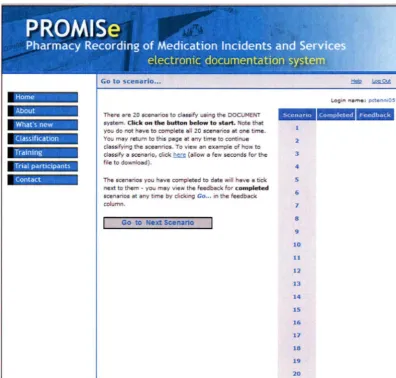
Once the user selected training for the DOCUMENT classification
system, a welcome screen for their first assessment appeared. There
was an option on this screen to view an online demonstration of how to
categorise an intervention using the DOCUMENT system (see Figure
4-24 ).
Home
About
What's new
Training
Tnal part1c1pants
Contact
Go to scenario ...
There are 20 scenarios to classify using th.. DOCUMENT
system. Click on the button below to start. Note that
you do not nave to complete all 20 scenarios at one time. You may retum to this page at any time to continue dassrfying the sceanrios~ To view an example cf how to classify a scenario, dick~ (allow a few seconds for the
file to download).
The scenarios you have completed to date will have a tick next to them -you may view the feedback for completed
scenarios at any time by dicking Go ... in the feedbac column.
Go to Next Scenano
2
3
4
5
6
7
8
9
10
11
12
13
14
15
16
17
18
19
[image:35.566.108.504.290.667.2]20
FIGURE 4-24: ONLINE DOCUMENT TRAINING WELCOME SCREEN
Login n
..•
ame: pctenniOSClinical Interventions in Australian Community Pharmacies
II Ttw • DOCUWEHT
·
-Go to sce11 •
~-.:.-There are 21 syJtem. Ok
you do not I'
You .,,_y ret
dafflfying tf c:feMlfv • K
fife to downl
.
...
-·
-Example of how to classify
The scen~rio
A 54 year okt woman was corrmenced on zolptdam to heEp her 5'eep about Z weeks ago. She comes ., to YOU" phannaq after using the meclic:ation fOf" 2 weeks to ask 1f her tablets coutd be making her forgetful and vague. You tel her that you wil have to check, and go and k>ok it up in the Australian
Medcnes Handbook. A.5 it's a new(ish) drug.. its not mentioned ., the book
you firs:t look in, so you consUt the eMims and find that zofptdem has been
associated with arnn1i&ia. According to the entry in eMims, the amnessa IS
more likely If the patient wakes Wlthin 4 hour'S of when the drug is taken. You go back to talk to the patient about whet:her her forgetfulness occurs:
during the day or night. She tels you that the forgetfuAness t5 mostty
during the mornings and describes several situations where she has
forgotten ,,_. - shopping, mosplaced CM keys and lost an umbrea..
You susp«t that the zolpid<!m may be hav.ng some sort of 'hanQov'
effect after she takes it the rjght before and you ask het" what tine she
rakes the zolpidem. 5"" teUs you sh<! takes ot last t!Wlg at night, just before she goes to bed at around llpm. You go back to the eMims to lind
the onset of action of the wlptdem which os o.s to 3 hours. You deode to recOf1'11TKHlC:t that she tnes takng the z.olptdem earlier n the evenng, at aroc..nd gpm and see 1f the "Hangover"' IS kiss of a problem. You also teJJ twr
that if this doesn't imp<ove the situation, sh<o shoUd go bad< to her docto< and Wlform hm of what IS happening.
Assessment and Classification
Type of Intervention
15
16
17
••
19
••
• Jn ths case, the type of problem is an adverse reacbon
due to the drug, so it would be one of the T (Toxicity or Adverse reaction) categories.
[image:36.567.108.498.81.386.2]·
-
,(FIGURE 4-25: EXAMPLE OF CLASSIFICATION IN DOCUMENT ONLINE TRAINING
Once the user selected a particular scenario, they were presented with
a scenario summary and instructions for completing the first step of
the categorisation process (see Figure 4-26). The scenario summary
remained active whilst assigning categories, actions and
recommendations.
For PROMISe trial participants, an audio visual presentation was also
made available to facilitate the training process; this was accessible
Clinical Interventions in Australian Community Pharmacies
'f" ;JH
PROMIS
e
.\;·
Pharmacy Recording of Medication Incidents and ~er.~ices electronic documentation system
Home
About What's new
Class1f1cat1on
Training
Tnal part1c1pants Contact
.
_
.... ~· 1. Classify the drug-related problem..
Scenc:1rio 1
A 76 year old woman presents with a new prescription for mirblzapine. She is currently receiving sertraline lOOmg daity. She was undear about the doctor's instructions ,.-egarding the sertntline, and
WllS going to continue taking both antidepressents. You contltd: the prescriber to confirm their
intentions, and advise the patient of the outcome. You discuss: with the dod:or that thi.s patient may
be suitat:Me for an HMR.
• To begin, read the scenario above and identify the drug related problem (ORP).
• The DOCUMENT classification of DR.Ps are li.st~ below. First select a broad category by dicking
on one c.f the links. This wilt expand the subcategories. Then select ONE subcategory which best
describes: the ORP you have identified.
• V/hen you have made your selection go to the bottom of the page and dick Next.
• Ncte: To see all the sub-categories, dick on each link to expand the enb,.e table.. • Click~ he,.e to view an example scenario and now to classify it.
0 Drug seJection
... Help Select One ...
Jll. Duplication Orug 1ntentcbon
w,.ong drug
Wrong do$t!tQB form other dl"Ug selection problem*
*specify fn notes sectiort at the end of th;s scenario O over or underdose orescribed
C Compliance
U Untreated indications M Monitoring required E Education or information N Non-clinical
('
("
r r
("
FIGURE 4-26: ASSIGNING TYPE OF DRP IN DOCUMENT ONLINE TRAINING
The previously mentioned scope notes and detailed definitions of each
subcategory were available by selecting the help section. Once
selection of the category and subcategory was completed actions could
be selected.
Pharmacists were asked to document the actions that were undertaken
by the pharmacist in the scenario presented (see Figure 4-27).
However, as the results of the training were examined, it became clear
that many pharmacists recorded the actions that they considered
appropriate i.e. 'what they would have done', rather than those
[image:37.565.106.496.81.448.2]Clinical Interventions in Australian Community Pharmacies
Home
What's new
Classification
Trammg
Tnal participants
Contact
2. Select actions to investigate the problem
Login nllme: pctenn10S
Scendrio 1
A 76 year old woman presents with a new prescription for mirtaz.apine. She is currently receiving
sertraline lOOmg daity. She was unclear about the doctor~s instructions regarding the sertraline, and
was going to continue taking both antidepressants. You contact the prescriber to confirm their intentions, and advise the patient of the outcome. You discuss with the doctor that this patient may
be suitable for an HMR.
What did the pharmacist do to sort out the problem?
• Check the boxes below · more than one may be checked if multiple actions done.
• Click Next at the bottom of this page when you have made your selections.
Select one or more .J a;. Investigation: written material r
l'!z. Investigation: software r
~ lnvesbgotlon: patient history r
Investigation: other
- specify Jn notes section tJt e.nd of r
scenario
~ Contacted prescriber r ~ Discussion with patient or carer ~ Al Corrected without discussion r
FIGURE 4-27: ASSIGNING ACTION TO INVESTIGATE DRP IN DOCUMENT ONLINE
TRAINING
Selecting appropriate recommendation(s) for the scenario was the next
step in the classification process. As with action selection, where
multiple recommendations were made by the pharmacist in the
[image:38.565.112.467.82.442.2]C/1nical Interventions tn Australian Community Pharmacies
3. Select recommendations to resolve the problem
ogi name: pctenniOS
Scenario 1
A 76 year old woman presents wit a ne• pr-escnptlo for mi azapine. She is currently receiving sertraline 100mg daily. She was unclear about the doctor's instructions regarding the sertraline, and was going to continue ta · g bcth antidepressants. You contact the prescriber to confirm their intentions, and advise the patient of the outcome. You discuss with the doctor that this patient may
be suitable for a HMR.
What did the pharmacist recommend as a solution to the problem?
• Chee the boxes below - more than one may be checked if multiple recommendations are
necessary.
• dick Next at the bottom of this page when you have made your-selection.
Select one or more•
A Change in Therapy
R.._ Dose change
r
R2 Drug change
r
R3 Drug formulatio change
r
R.._ rug brand change
r
RS Dose frequency/schedule change
r
R6 Prescription net dispensed
r
...J.. other changes to therapy
r
A referral required
R8 Refer to prescriber
r
R9 efer to ospital
r
__Q efer for medication review
r
g_ Other referral required
r
Provision of information
.!Ll Education/Counselling session
r
~ Written summary of medicationsr
Rl4 Commence dose administration aid
r
B...2 Other written information
r
MonitorB...§ Monitoring: non-laboratory
r
R.7 Monitoring: Laboratory test
r
[image:39.569.118.412.231.599.2]RO No recommendation necessary
r
FIGURE 4-28: ASSIGNING RECOMMENDATIONS TO RESOLVE DRP IN DOCUMENT ONLINE TRAINING
The significance of the situation was then assessed as nil, low, mild,
moderate or high, with the relevant definitions available (see Figure