TASK-BASED LEARNING AND CURRICULUM
INNOVATION IN A THAI EFL CONTEXT
by
lVIeechai Iemjinda, B.Ed. (Hons), MA
Submitted in fulfilment of the requirements
for the degree of Doctor of Philosophy
University of Tasmania
DECLARATION
I declare that this dissertation does not co�tain material which has been accepted for the award of any other degree or diploma of any university; nor does it contain material previously published or written by any other person, except where due reference is made in the text of the dissertation.
�----
---··---··-····---·-
--
-
--
-
1
UTAS
1
j
i
1
J
I
l'j
1
l
1 j;
l� I \/�
PERMISSION TO COPY
This thesis may be made available for loan or for limited copying in accordance with the Copyright Act 1968.
·--�-··
---Signed ...
M�
...·'-�
t:Y
�-�
Meechai Iemjinda
I : i 1'.
.)-,
j
" · � \ � •1-' I
ABSTRACT
'Professional development is one of the most promising and powerful routes to growth on the job, to combating boredom and alienation, to school improvement and to satisfaction' (Full an, 1982: 274 ).
The aim of this study was to develop, implement and evaluate a professional
development programme for teachers of English as a Foreign Language in Thailand to assist them to make a major change in their pedagogy, a change mandated by the National Education Act of 1999. More specifically, what was required of them was to change from being a teacher who delivers instruction in the classroom to a teacher who acts as a facilitator in a learner-centred classroom.
The professional development programme (PDP) drew for its design on programmes recommended for their success in other contexts, but was unique for its innovatory combination of specific forms of content ('task-based learning') and process (a
'coaching approach'), and for its adaptation to the needs ofEFL primary school teachers in Thailand. Task-based learning (TBL) was recommended in the literature for its success in helping teachers to focus on student learning, and providing explicit practices to implement the principles of communicative language teaching (CL T) as required by the new cuniculum. A coaching approach was claimed to assist teachers by clearly explaining theoretical concepts and their practical implementation at the classroom level, simplifying the steps for implementation in the classroom context and supporting teachers through the process of change.
The study was conducted in a non-metropolitan region in Thailand, and involved nine primary EFL teachers and their classes in three cities. Data were gathered by quantitative (questionnaire, classroom observation checklist) and qualitative (interview) methods before and after the PDP to record changes in the teachers' perceptions and classroom practices over eight months. The data showed that all the teachers were rated higher by their supervisors on the six major criteria chosen to characterise CL T, and the teachers and their students provided corroborating evidence of a major shift in pedagogy towards the model preferred by the Thai Ministry of Education.
The study showed that a professional development programme of this kind, closely adapted to a specific context, involving preparatory workshop training followed by a
semester of guided, strongly supported classroom implementation practice, can make a significant change in Thai primary EFL teachers' understanding and use of CLT as an innovatory pedagogy. It indicates that this model of professional development is capable of providing a means by which the desired change to a learner-centred, communicative English language cuniculum might be achieved system-wide in Thailand, one that has up to this point proved very difficult to implement.
This study represents a contribution to several fields, including curriculum change, teaching English as a Foreign Language, and professional development. It makes a
TABLE OF CONTENTS
Declaration
Permission to copy
Abstract
Table of contents
List of tables
Acknowledgements
CHAPTER 1 INTRODUCTION
Pages 11 iii IV v X Xll
Introduction 1
1.1 1.2 1.3 1.4 1.5 1.6 1.7 1.8 CHAPTER2
The demand for the reform of education in Thailand Planned changes to teaching and learning
English language curriculum reform The significance of the study
The purpose of the study
Research questions The scope of the study The structure of the thesis
LITERATURE REVIEW
In trod ucti on
Section 1: Managing curriculum innovation
2.1. 1 Curriculum change
2.1.2 A coaching approach as an agent of change 2.1.3 Teachers as adult learners
Section 2: A Learner-Centred Approach toEFL Teaching 2.2. 1 The learner-centred curriculum
2.2.2 A learner-centred approach and CLT 2.2.3 Task-based learning and CLT
5.1 5.1 5.3 5.4 5.5 5.6
The general objective of CLT Leaming and teaching activities The learner's role
The teacher's role Instructional materials The role of assessment
Summary
CHAPTER 6 FINDINGS RELATED TO THE RESEARCH
SUB-QUESTION 2
Introduction
6.1
6.2
6.3
Supervisors' and teachers' perceptions of the new curriculum
6.1. 1 The need for change
6.1.2 Understanding of the issues relevant to the new curriculum
6.1. 3 Beliefs about teaching methodology
Participants' perceptions of the process of curriculum implementation
6.2.1 Understanding the process of implementation
6.2.2 Participation and decision making in the implementation process
6.2.3 Implementation support
Students' perceptions of the new curriculum and methodology
Summary
CHAPTER 7 DISCUSS! ON
106 112 118 123 128 132 137 140 142 142 146 151 154 154 158 164 173 179
Introduction 183
7.1 Changes towards adopting a CLT approach 7.1.1 Changes in pedagogical concepts
7 . 1.2 Changes in teaching and learning activities 7. 1.3 Changes in the learner's role
7.1.4 Changes in the teacher's role
7 . 1.5 Changes in the role of instructional materials 7 .1.6 Changes in assessment
7.2 Changes in perception of the new curriculum and
implementation as the impact of the PDP
7.2. 1 Changes in understanding of the new curriculum 7.2.2 Perceptions of the process of curriculum
implementation
203 203
207
CHAPTER 8 CONCLUSIONS, IMPLICATIONS AND
RECOM1\1ENDATIONS
Introduction 216
8. 1 Overview of the findings 2 16
8 . 1.1 Task-based learning and communicative language teaching 2 17 8. 1.2 Coaching as an agent in the change process 2 18
8.2 Implications of the study 22 1
8.2.1 Theoretical implications 221
8.2.2 Practical implications 223
8.2.3. Policy implications 225
8.3 Limitations of the study 227
8.3. 1. Limitations in relation to the PDP 227
8.3.2 Sample limitations 228
8.3.3 Limitations in the research method 229
8.4 Recommendations for further research 230
8.4. 1 Would it work with other groups? 2 3 1
8.4.2 Further research on peer coaching/networking to develop
teachers as professionals in the long term 231
8.4.3 Teachers adapting to change 232
8.4.4 Fields other than EFL 232
REFERENCES
APPENDICES
Appendix A:
Appendix B:
Appendix C: Appendix D:
Appendix E: Appendix F:
Appendix G : Appendix H:
Appendix I: Appendix J:
Teacher & Supervisor Questionnaire Student Questionnaire
Classroom Observation Checklist Supervisor Interview Schedule Teacher Interview Schedule
Teacher & Supervisor Interview Schedule Student Interview Schedule
Sample response - Teacher & Supervisor Questionnaire Sample response - Student Questionnaire
Sample response- Classroom Observation Checklist
Appendix M: Sample responses - Teacher & Supervisor Interview 284
Appendix N: Sample responses- Student Interview Schedule 263
Appendix 0: Intensive Pre-PDP Workshop Schedule 266
Appendix P: Framework for Task-based Learning (TBL) 297
Appendix Q: Sample of six TBL task types 300
Appendix R: Sample task-based Je.sson outline 307
Appendix S: Sample of communicative games 321
. --.... ... �
--
-k
�
-
-
--.. _ --.
-�-1 ·-·--..•
k!
lj
.J.I'
.
I
l
!
.� I.. .._ ... _ I
··..._.
·' I ·-...
·;
f
i
.• f
I
�;
t
!
I
I
/ I /;.
/
List of Tables
Table Pages
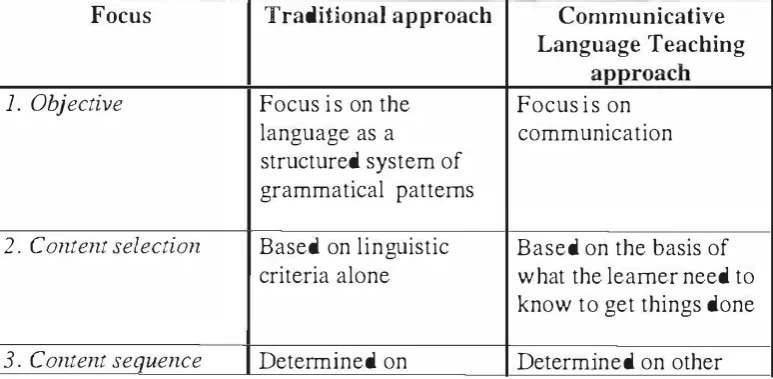
Table 2.1 A comparison between traditional teaching approach
and CLT 40-41
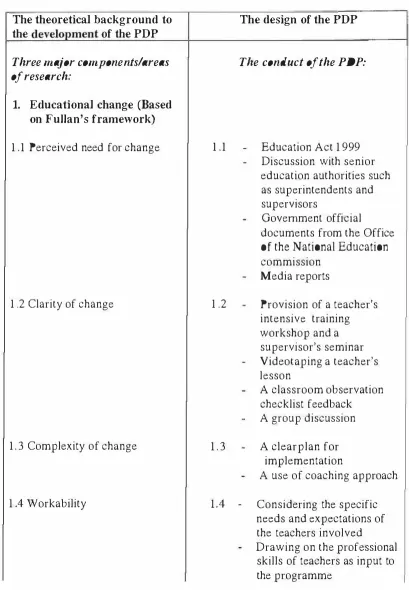
Table 3.1 The link between the theoretical background to the
Development and the design of the PDP 79-81
Table 4.1 A chronology of the development of the research tasks
associated with the study 88
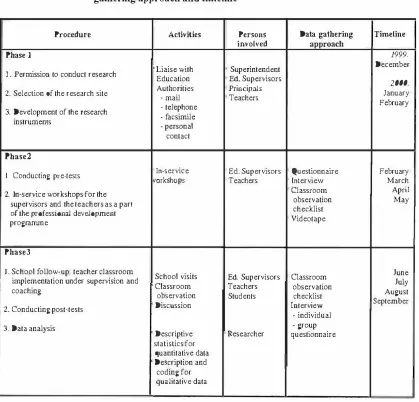
Table 4.2 Overview of the research design: persons involved,
activities, data gathering approach and timeline 103
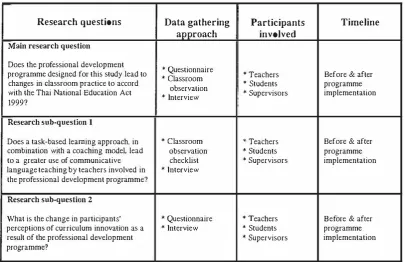
Table 4.3 Overview of research questions detailing the data gathering approaches employed, people involved and
timeline 104
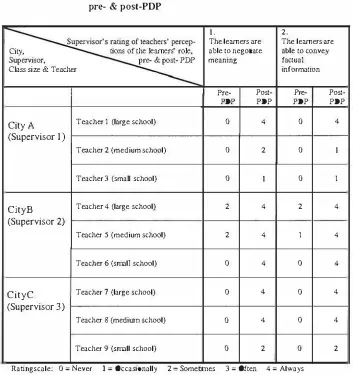
Table 5.1 Supervisors' rating of the frequency with which teachers' classroom practice indicates awareness of the purpose
of the CLT approach, pre-& post-PDP 107
Table 5.2 Supervisors' rating of the frequency with which teachers
use communicative learning activities, pre-& post-PDP 115
Table 5.3 Supervisors' perceptions of the learners' role before
and after the PDP implementation 119
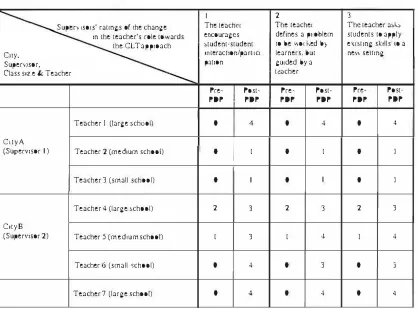
Table 5.4. Supervisors' perceptions of teachers' understandings of the
teacher's role in the CLT approach, pre- and post- PDP 124
Table 5.5 Supervisors' perceptions of teachers' understandings of the role of instructional materials in the CLT approach
pre- and post- PDP 129
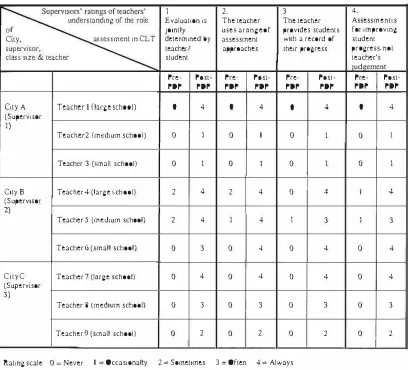
Table 5.6 Supervisors' perceptions of teachers' understandings of the role
of assessment in the CLT approach, pre- and post- PDP 133
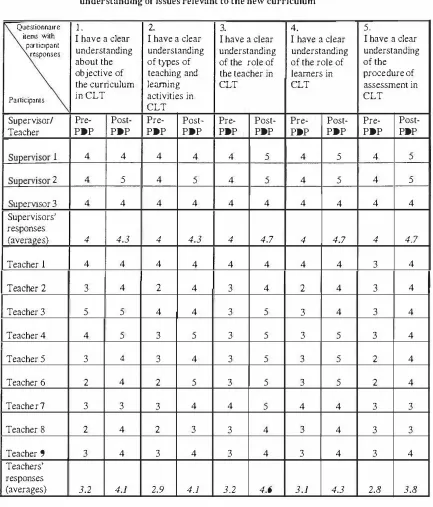
Table 6.1 Supervisors' and teachers' pre- and post-PDP perceptions
of the need for change 143
Table 6.2 Supervisors' and teachers' pre- and post-PDP perceptions of
Table 6.4 Supervisors' and teachers' pre- and post-PDP perceptions
of their understanding of the implementation process 154
Table 6.5 Supervisors' and teachers' pre- and post-PDP perceptions of
their participation in implementation of the new curriculum 160
Table 6.6 Supervisors' and teachers' pre- and post-PDP perceptions
of implementation support 166
Table 6 .7 Supervisors' and teachers' pre- and post-PDP perceptions
of the key supporters of curriculum implementation 1 7 1
Table 6.8 Students' responses on their perceptions of the new
ACKNOWLEDGEMENTS
This dissertation could not have been completed without the generous help of a
number of people. I wish to express my grateful appreciation to these people, and
I would especially like to thank:
The University of Tasmania, Australia, and Silpakorn University, Thailand, who
provided this opportunity for me to study i n Tasmania through the Tasmania International Scholarship Programme.
My supervisors, Dr Marion Myhi1l and Professor John Williamson, for their
comments, feedback and suggestions for my doctoral dissertation.
Faculty of Education, University of Tasmania, for providing me with world-class
research facilities that enabled me to fulfil my study.
My colleagues in the Department of Curriculum and Instruction, Silpakom
University, who took my classes while I was studying in Australia, particularly
Associate Professor Supatra Choomkate and Mr Anun Pun-in.
Ginni Woof, Carol Shams-Abadi, Phileem Calder-Potts and staff at the International Student.Office, University of Tasmania, for their generous assistance.
Kerry van den Berg, English Language tutor for International Students, for her
assistance with editing my dissertation
The Ministry of Education, Thailand who gave pennission to conduct my research in schools
Superintendents, supervisors, principals, teachers and students of the Thai schools
who were involved in the project and gave freely of their time and co-operation in
Greg Caimduff, whose help and support have proven invaluable during my
dissertation writing process.
Mike McCausland, for his unstinting support of my writing process, his expert help,
his suggestions for enquiry, and his unfailing moral support in many areas over the past five years.
My parents, my brother and sisters who have always believed in me and share my
success.
04 .. -- ·--·- •
� - .
-.. -· --. -.,� .. ·· ..
-UTAS
.� - ·-·- ...
., .·
CHAPTER 1
INTRODUCTION
1.1 Til.& demand for the reform of education in Thailand
The need for educational reform in Thailand was sharpened by the country's
severe economic downturn in 1 997. Thailand's 'relatively weak human
resource base' was identified as one of the major underlying factors in the
economic crisis (Office of the National Education Commission, 200 1 a: 1 -3),
and this in tum led the government to re-examine urgently the quality of the
country' s educational system.
Education in Thailand has developed from traditional forms conducted in
Buddhist temples, the palace and within the family. The impact of King
Chulalongkorn's modernisation of the country from 1 868 and the introduction
of Western concepts of schooling by missionaries in the later Nineteenth
Century led eventually to a state education system, one which was also based
upon resisting colonial imperialism. The monarchy (and after 1 932, the
constitutional government) sought to achieve a balance between traditional
"':'ays of learning and foreign approaches. This intermixing and adapting of different traditions and cultural forms gave Thai education a continuing role in
addressing social change and the modernisation of the country. This history
of reform in education linked to national development was taken to a further
stage with the establishment of the National Scheme of Education in 1 960,
which promulgated the First National Education Development Plan. The
seventh of these plans, issued in 1 992, emphasised that 'the education system should facilitate the country's development process towards self-reliance,
sustainability and enhance global competitiveness' (Office of the National Education Commission, 1 999). It was the failure to obtain these outcomes, in
economic crisis of 1 997, but also due to a perceived failure of Thai social
institutions 'to adapt themselves to cope with the formidable changes' facing
them (Office of National Education Commission, 1 999: 7), that created the
environment for a still faster rate of reform.
In respon8£"to this most recent of demands for reform, the Thai government,
acting through the Office of the National Education Commission (ONEC)
under the Prime Minister's Office, formulated radical new policies to bring
about necessary changes within the education system at all levels. ONEC
carried out initial research into the provision of quality education in developed
countries such as the United Kingdom, the United States, Japan, Canada and
Australia, with a view to their application in the Thai education system.
Foremost in ONEC' s interest was these systems' capacity to develop students'
analytic and independent thinking. On the basis of this enquiry ONEC
prepared recommendations for consideration by the Thailand's Constitution
Drafting Council, with the result that the 1997 Thai Constitution contained
extensive recommendations concerning major educational changes. These
included the provision of a twelve-year basic quality education free of charge
throughout the country, the promotion of local wisdom and national arts and
culture, and the development of the teaching profession through extended pre
service education, in-service programmes, certification and registration.
ONEC's recommendations also led to the National Education Act which
passed through parliament in August 1 999. The Act represented 'an
unprecedented and long over-due break' (Office of National Education
Commission, 2001a: 2) from traditional Thai educational policy in that it
focused on reform of learning for a more creative and constructivist approach
to knowledge acquisition. As well, it urged administrative reform towards
greater decentralisation, financial reforms in schools, which would allow
educational institutions to manage their own budgets, reform of educational
resources emphasising the use of information technology to support learning,
1.2 Planned changes to teaching and learning
The reform of learning envisaged b
y ONEC required rethinking adherence to
the long-standing tradition of formal instruction in teacher-directed
classroolll'( In a report by ONEC' s Sub-Committee on Learning Reform,
Learning refonn: A Learner-centred approach, the specialist committee under
the chairmanship of Professor Dr Prawase Wasi argued that there was a
number of key 'indicators of the urgent need of teaching-learning reform in
the school system': learners of all ages learn only subject matter and written
texts, lack training in analytical thinking, self-expression and the acquisition
of knowledge for themselves, do not 'learn to learn' but are recipients of
transferred knowledge through routine and repetitious methods of instruction
in teacher-directed classrooms, and are unhappy and bored (2001: 3-4). This
resulted, it was argued, in schools not creating an environment conducive to
learning linked with community life (2001: 4).
Responding to this concern about the teaching-learning process long
established in Thai schools, the National Education Act of 1999 devoted a full
chapter to learning reform, providing guidelines for a participatory approach
to creating a new teaching-learning vision. The proposed learning reform was
essentially a shift from focusing on content to focusing on human beings as
learners and their needs: a learner-centred approach has become mandatory in
all Thai schools. More specifically, the proposed reforms stipulate learning
processes that provide content and activities in response to learners' interests
and aptitudes. The proposed curriculum bears in mind individual differences
and expects teachers to train students in thinking processes, in independent
learning, and how to apply knowledge for obviating and solving problems. In
so doing, it requires teachers to organise activities for learners, which draw
from authentic experiences to drill in practical work for complete mastery.
of teaching-learning media and various sources of knowledge (National
Education Act, 1 999: Section 24: 1 0-1 1).
1.3 English language curriculum reform
Foreign languages have long held an important place in the Thai education
system' s efforts to support the modernisation movement. Initially French and
English were the more significant of the European languages fostered,
reflecting the colonial spheres of influence of those two powers on countries
bordering Thailand to the east and west/south. With the rise of English as a
global language, it became the core of the school foreign language
programme, and from 1961 it became a prestigious elective subject from
Grade 5 for those intending to proceed to university. In 1 99 6 it became
compulsory for all students from Grade 1 primary through to Grade 1 2 to
study English, and a pass in the subject is essential for entry to tertiary
education.
Though the teaching of English as a Foreign Language (EFL) has been long
established i n Thailand, it has not had a particularly successful history in the
school sector, its presence being more a result of government insistence than
popular appeal. Since the 1960s the Ministry of Education' s Department of
National Standard Assessment has regularly reviewed the performance of
schools, and has reported consistently over the years on the low standards of
achievement in English. In a report on curriculum assessment in 1 99 5 it
noted specifically the difficulties teachers were facing in interpreting the very
broad and generalised curriculum requirements in English, their over-reliance
on a limited number of textbooks, their lack of confidence in the mastery of
subject content and cultural background, and the ineffectiveness of their use
of resources (which were neither up-to-date nor particularly appropriate), and
placed English and mathematics as the subjects with the lowest student
In the current situation, in which English has become mandated for all Thai
students from lower primary schooling, the need for curriculum and teaching
learning reform that applied across all 'subjects took on particular urgency in
English. Recognising that the long--accepted 'vocabulary and grammar'
based syllabus had not proved successful, despite its compatibility with
traditiona¥Thai educational principles, the Ministry of Education turned close
attention to both the content of the subject and the methodology employed in
teaching it. Of greatest concern was the failure of learners to develop their
English language skills for communication, and it was this that became the
focus for the proposed changes. There were associated issues to that of
developing communicative competence, however, and the new syllabus
issued in 1 998 was based upon six 'learning principles' (in fact, learning
goals), revolutionary in their intended impact on EFL teaching throughout
Thailand. They were:
• to be able to use English properly for communicative purposes;
• to develop English language skills for further study and careers;
• to be able to apply English language skills in the class to real
situations;
• to understand English-speaking cultures and their backgrounds,
• to be able to use resources in English language for self-study, • to have a positive attitude toward English and realise the benefits
of learning English. (Department of National Curriculum, Ministry of Education, 2000: 2-3)
The theme that dominates this set of principles is a desire to create life-long
learners that can enjoy the study of English and see its relevance to their lives.
The emphasis here upon independent learning, career orientation,
international awareness and real-life experience anticipate and correspond
closely to the beliefs underpinning the ONEC sub-committee report on
learning reform that came out in 200 1 . The spirit of change manifested in the
new English curriculum reflects the current thinking in the Ministry of
It was also recognised within the Ministry that to achieve the six principles
for the new EFL syllabus it would be vital for teachers to change their
teaching behaviours extensively. Guidance for this was set out as five
'implications for teaching' :
• Communication is paramount. Speaking and listening skills are
__ emphasised at the beginning, then reading and writing skills
follow;
• Learners are the centre of the learning process. Teachers take the
role of learning supporters;
• Learning activities should encourage learners to enjoy their
learning so that the learners will have a positive attitude to English as a subject;
• Communicative tasks are focused. Task-based learning is
suggested for developing English for communication; and
• Learners are encouraged to become confident and independent in
learning development. (Department of National Curriculum, Ministry of Education, 2000: 17)
The generality with which these 'implications' were expressed left a great
deal for teachers still to do to enact the new 'principles'. The good intentions
for reform held by the Ministry, even when they might be shared by educators
at every level, still needed to be translated into radically different classroom
practice. Experience of curriculum innovation internationally would indicate
that it is in this process of interpretation and application that change can either
succeed, be deferred or founder (Department of National Curriculum, 2000).
The attempts to evolve more effective teaching-learning processes i n EFL in
Thailand, to judge by the Thai Department of Education Assessment reports,
had not been particularly successful up to 1999. A crucial issue in the success
of the reform proposed in the 1 999 National Education Act was certain to be
whether the desire for system-wide innovation could be fulfilled at classroom
level in this most pressing of national circumstances, and whether it could be
fulfilled specifically in subjects such as English where change had previously
1.4 The significance of the study
This present study arose from the researcher's perception of the daunting
challenge faced by classroom teachers who wished to meet the requirements
of the National Education Act, and particularly the predicament of primary
EFL teasJJers who were now expected to provide effective instruction to all
their pupils. Traditional methodologies were not proving very popular or
effective with cognitively maturer adolescent learners; the problems posed by
attempting to teach by traditional methods in the primary grades were greater
still, with relevance, cultural awareness and independent learning even more
difficult to establish with students at an early stage of cognitive and social
maturity. That adoption of the new curriculum would be beneficial and was
urgently needed were not questioned, the critical issue was implementation:
how could the transition to new methodologies be brought about most
effectively?
Research on curriculum innovation (Marsh, 1988; Wilson & Corcoran, 1988;
Louis & Miles, 1990; Pullan, 1992; Bottomley, Dalton, Corbe1 & Brindley,
1994; Williamson & Cowley, 1995) has suggested that there are three major
factors leading to successful implementation. One is that the teachers
involved must perceive the need for change i n curriculum and pedagogy and
feel the need for professional development. Another i s teachers'
understanding of the innovation. The third is that teachers must be able to
achieve the pedagogical changes expected of them; with the adoption of the
new national curriculum policy, Thai teachers need to be able to adapt the
preferred curriculum and pedagogy to their own situations. For these reasons,
the researcher considered the devising of an appropriate professional
development programme for Thai primary EFL teachers would be a key
mechanism for the successful implementation of the National Education Act
as it applied to this specific context. The timing was crucial too; pressure was
it came into effect in 1999, so the search for effective programmes to support
teachers in the challenge for change needed to have begun by then also.
In the field of EFL, attempts to intro.duce communicative language teaching
(CLT) in many non-English speaking countries in Asia in the last twenty
years haW'C proved to be particularly difficult, and with a low rate of success
(Sano, Takahashi & Yoneyama, 1984; Burnaby & Sun, 1989; Ellis, 1994;
Shamin, 1996; Li, 1998). These challenges have arisen from a variety of
sources: teachers' deficiency in spoken English and lack of training in CLT
methods, students' lack of motivation and limited English proficiency,
systemic problems such as inadequate resources, contextual difficulties such
as large classes and examination procedures focusing on vocabulary and
grammar, and a lack of family/community understanding and support for the
new pedagogy. Many of these challenges are outside the control of the
classroom teacher, and some may take many years to overcome. Some,
however, to do with teacher preparation and teacher/student attitudes, can be
addressed in professional development, as can teachers ' responses to the
systemic and contextual difficulties they find in their classrooms.
The Ministry of Education' s Report on Student Achievement (Department of
National Standard Assessment, 1 995b) has shown that the general level of
student ability to use English for communicative purposes was very low
before the mandating of CLT in the revised curriculum ( 1 996). There was
need for a new approach to address the difficulty of teachers not having a
clear and practical method of transferring from traditional to CLT methods,
and having the confidence to continue employing the new methods once they
were left alone in their classrooms. A teacher development programme to suit
the present context needed, in the opinion of the researcher, at least two
central components: one relating to the content of the change (understanding
of new teaching methodologies, knowledge of the new curriculum, new
methods of assessment, for instance) and one in relation to the
methodologies, selecting and adapting from the syllabus the specific material
suitable for their classroom, applying assessment procedures to enhance
learning and make valid judgments about stages in mastery).
This study is significant because it suggests a new approach to teachers'
profes-Sional development. This approach combines two major areas:
curriculum change and task-based learning in EFL The programme is
designed to assist Thai EFL teachers to bring about pedagogical change. It
introduces task-based learning as an innovation to tackle difficulties
encountered by Thai teachers when attempting to implement CLT. This is
combined with a coaching approach as a means for assisting the change
process. The process has been well researched and evidence of its
effectiveness elsewhere has been part of the research. The programme is
concerned with both content and process, the fact that it is projected into a
local Thai context, it could be expected to have a higher chance of success
than previous programmes, especially for long-term, permanent change.
The combination of TBL with a coaching approach held out to the researcher
the hope of finding a possible means to tackle a problem in the devising of
TEFL professional development, one that had been shown in the experience
of many education systems in Asia and elsewhere as being most intractable
(Hallinger, 2000). One of the significant factors involved in the failure of
efforts to implement major curriculum change would appear to be the lack of
continuing support for teachers at a practical school level, leaving them
feeling insecure and lacking the confidence to implement the innovation
individually in their schools. It was essential to the framing of this present
study that educational change and its implementation be recognised as a
complex process and that teachers require continuing support during it.
The present study is intended as a contribution to several intersecting fields:
curriculum change, teaching English as a Foreign Language, and professional
area of language education in Thailand in that it links education policy with
classroom practice; there are few studies of this kind in the literature. It is
also hoped that it might have potential for application to the field of teacher
professional development in other non-English speaking countries with an
educational tradition similar to Thailand's.
1.5 The purpose of the study
The broad purpose of the present study was to investigate a model for
bringing about a major change in teacher pedagogical behaviours in EFL
primary school teachers in Thailand. Within that general intention was the
aim to develop, implement and evaluate the effectiveness of a professional
development programme conducted with a limited group of representative
local educational administrators ( 'supervisors'), Grade 6 EFL teachers and
their students, with a view to establishing through this shorter-term pilot
programme an effective working model that could, with adaptation and
refinement under changing circumstances, be used by others. More
particularly, the study examined the impact of this professional development
programme (hereafter called 'the PDP') upon teachers who used traditional
forms of direct teacher-centred instruction but who wanted to make the shift
towards becoming facilitators in learner-centred classrooms. It considered
also their perceptions and those of their supervisors and their students about
the change in pedagogy that resulted from the teachers ' involvement in the
PDP.
For a change, which is major enough to constitute a paradigm shift in
pedagogical theory and practice to succeed requires more of its instigators
than a mental map of the new territory. It needs an effective process of
implementation, with assistance for teachers as they find their way into
unfamiliar and at times hazardous terrain. A coaching approach has been
claimed to be valuable in supporting teachers through the challenge of
Coaching can be effective for developing implementation skills in teachers by
providing clear guidance on what to do and how to do it. It has also been
shown to have the flexibility to assist individual teachers in dealing with the
specific difficulties they encounter, to assist them to gain the management
skills to cope with the complexities of change, and to provide this support
directty when it is most needed (Galton & Williamson, 1 992). For these
reasons the researcher saw a coaching approach as an important element in
enabling the content of a professional development programme to be
delivered and absorbed, and then to be adapted for use in the teachers' own
classroom practice.
The content of the PDP was to be based on a TBL approach to teaching EFL,
employing a coaching model in its mode of delivery. Such a specifically
designed PDP had not, insofar as the researcher or those members of the
Ministry of Education he contacted, been used before to introduce
pedagogical innovation in Thailand. It was postulated that this approach
would help teachers to manage their classrooms so as to maximise the
opportunities for learners to put their limited language to authentic use and to
provide a more effective learning environment. It was also postulated that
educators and students would have positive attitudes to the PDP and its
classroom outcomes. In the evaluative phases of the study, data were to be
gathered on the PDP's perceived effectiveness and the attitudes of the
educators and students involved in the programme towards it.
In summary, the aims of this study were:
• to develop, implement and evaluate a teacher professional
development programme designed to create major changes in primary
English as a Foreign Language classroom practice by assisting
• to investigate whether a task-based learning approach, in combination
with a coaching model, leads to greater use of authentic
communicative language teaching methods;
• to investigate the perceptions of teachers, students and education
supervisors concerning the effectiveness of the PDP.
1.6 Research questions
Main research question
Does the professional development programme designed for this study
lead to changes in classroom practice to accord with the Thai National
Education Act of 1999?
In order to answer the main research question, the question is broken into two
sub-research questions, which are:
Research sub-question 1
Does a task-based learning approach, in combination with a coaching
model, lead to a greater use of communicative language teaching by
teachers involved in the professional development programme?
Research sub-question 2
What is the change in participants' perceptions of curriculum
innovation as a result of the professional development programme?
1.7 The scope o f the study
The professional development programme conducted in this study, and upon
was designed to investigate a means by which significant changes in both
understanding and use of CLT in primary EFL classes might be effected. The
PDP and its evaluation attempted to balance the constraints placed upon what
a project conducted by a single researcher could achieve in a limited period of
time with the broad aim of investigating its potential application to n ation
wide o5rriculum innovation. The strategies chosen to represent the larger
context in the parameters of the specific pilot programme are outlined below:
The panicipants
The participants in this study were invited volunteers drawn from districts in
urban and rural areas in non-metropolitan Thailand (i.e., not in Bangkok or its
immediate neighbourhood). They were invited by superintendents in a Thai
Education Department based in the region where the PDP was conducted.
The key participants were three education supervisors and nine Grade 6
primary school teachers who indicated their enthusiasm to develop their
professional careers and to participate in an innovatory EFL programme. The
students in these teachers' classes were also involved in the sense that their
response to the new pedagogy was sought as part of the data gathered on its
effectiveness. The small size of the sample enabled the researcher to work
intensively with the supervisors and the teachers in delivering new content,
monitor individual change through school visits, provide professional support
in after-lesson discussions and group meetings, and administer questionnaires,
view videotapes of entire lessons and interview all participants separately. As
explained in Chapter 3, the choice of cities and schools in which the study was
conducted was designed to be as representative of the larger Thai context as
The timeline
The period immediately following the 1 999 Education Act was a crucial one
for curriculum change in Thailand. The demand for reform was urgent, but
the implementation of a pilot programme needed to allow for an adequate
periodin which pedagogical change could take place and be evaluated. This
study began soon after the Act came into force, allowing for the process by
which permission was obtained to undertake the research and the choice of
participants to be made. The timing also was linked to the start of a school
year, and began in the vacation period before its commencement to enable
professional development seminars to be conducted with the participants. The
study was comprised of three phases conducted over nine months: Phase 1
(preparation, initial training of participants, and supported classroom
introduction of the new pedagogy), Phase 2 (collection of data on teaching
methodology and attitudes), Phase 3 (monitoring the major stages in
pedagogical change).
The research methodology
The study used both quantitative methods (questionnaire, classroom
observation checklists) and a qualitative method (interview) for data
gathering. The combination of methods was designed to give reliable
measures of changes in teacher behaviour, to validate this data through
triangulation and to give a richer or more detailed account of the participants '
understandings and attitudes during the process of change. The researcher
acted both as the manager of the PDP (controlling input through seminars,
viewing and helping to assess videotapes of teachers in their classrooms,
discussing pedagogical issues with supervisors and teachers after lessons) and
as researcher (devising data-gathering instruments, recording interviews,
organising and analysing data, evaluating the programme from the data
gathered). Bias that could be introduced through this duplication of role has
for rating teacher behaviour to their supervisors, keeping permanent records
(videotaping lessons and tape recording interviews), using independent
translators to check accuracy of Thai/English translation of data, and the use
of multiple of research methods and instruments for gathering data.
1.8 -rhe structure o f the thesis
Chapter 2 presents a review of literature relevant to four intersecting fields
closely related to the study: teacher professional development associated with
curriculum innovation, coaching approaches used to assist curriculum
implementation, learner-centred curricula in EFL teaching and a task-based
learning approach to communicative language teaching. Chapter 3 describes
the theoretical concepts underpinning the development and the design of the
PDP. Chapter 4 describes the research methodology used in this study. In
Chapter 5, the findings in relation to the research sub-question 1 , whether a
task-based learning approach can assist teachers to make greater use of
communicative language teaching, are presented. This research sub-question
is broken down in order to answer the main research question as well as the
research sub-question 2 in the next chapter. Chapter 6 presents the findings in
relation to the research sub-question 2, which is concerned with the
participants' perceptions of implementation of the new curriculum. Chapter 7
presents a discussion of the findings in the study in relation to previous
research. In Chapter 8 the conclusions are presented and implications are
CHAPTER2
LITERATURE REVIEW
,_, Introduction
One of the most significant changes in education world-wide in recent times
has been the shift in attention from what teachers do to what students do,
and especially how they learn. However, how students learn is very much
dependent on how teachers teach, and current studies continue to focus on
the teacher as the vital link in delivering curricula - and in implementing
educational change. This remains true even when the reform i s towards a
learner-centred curriculum of the kind on which this study concentrates.
Teacher professional development programmes are recognised as an
extremely effectiv� way of instituting thorough-going changes in teaching
and learning. In the last two decades especially there has been a
considerable body of research published related to teacher professional
development and the implementation of change in teachers' practices in the
classroom. These studies have extended from those on the smallest scale,
intensive case studies of individual teachers making changes in their
classrooms, to broad national and international surveys of teachers and their
experiences of professional development. In addition, there is now a large
literature describing 'best practices' in professional development based on
the successful implementation of innovative programmes.
This chapter presents research and theories relevant to how teachers manage
curriculum innovation in their classrooms, with particular attention to
research on learner-centred curricula in EFL teaching. The review of the
literature focuses on the two main areas of research studies: educational
teaching. The first section of this chapter presents a review of literature
related to curriculum innovation, concentrating on a coaching approach.
The second section reviews a task-based learning approach as an explicit
EFL teaching method for encouraging greater use of communicative
language teaching. The main issues will be addressed in the following
sections:
Section 1 : Managing curriculum innovation
2. 1 . 1 Curriculum change
2.1 .2 A coaching approach as an agent of change
2.1.3 Teachers as adult learners
Section 2: A learner-centred approach to EFL teaching
Section 1
2.2. 1 The learner-centred curriculum
2.2.2 A learner-centred approach and CLT
2.2.3 Task-based learning and CLT
Managing curriculum innovation
2.1.1 Curriculum change
Accepting the wisdom of an international trend towards learner-centred
curricula, Thailand's recent National Education Act has mandated a shift
from the country's traditional approach to one which encourages active and
cooperative learning, a greater recognition of individual student differences,
and relating learning to 'real life', a group of features amongst others that
have become associated with 'progressive education' (Owens, 2001 ) .
While Thai education has long espoused such beliefs as the importance of
young people being active and of their cooperating with their teachers and
each other, that schooling nurtures individual students, and that education
should prepare students for life, especially in moral and practical senses, the
paradigm shift in Thai teachers' thinking. What may have been an
evolutionary process in American or British education over an extended
period of curriculum reform, and even natural to most of the teachers
involved, is much more of a challenge to Thai teachers ' established
understanding of their role and that of students when the period allowed for
expected change is reduced to months. And closely associated with that
challenge in reconceptualizing teaching and learning is the equally
demanding one of changing their teaching practice from being a knowledge
transmitter to one of student learning facilitator.
Two of the researchers whose work informs much of this study consider the
parameters of change in the following ways. Nunan (1988), from a
language teaching background, lists the key features involved in a shift in
teaching methodology as : (i) the pedagogical concept of the teaching
approach; (ii) the types of learning activities; (iii) the role of teacher and
learner; (iv) the role of materials; and (v) the role of assessment. Pullan
(1992), whose field is curriculum innovation, considers that educational
-change involves three related components: (i) the possible use of new or
revised materials (e.g., direct instructional resources such as curriculum
materials or technologies); (ii) the possible use of new approaches (e.g. new
teaching strategies or activities); and (iii) the possible alteration of beliefs
(e.g. pedagogical assumptions and theories underlying particular new
policies or programmes). These sets of parameters inform both the
discussion here of the literature relating to EFL teaching reform, and the
way data were gathered and organised in the study.
Considering the impetus for educational change, Pullan proposes two main
forms: voluntary- when teachers themselves choose to participate in or
even initiate change, when they find dissatisfaction in their current situation
and see the need to improve their professional practice; and imposed change
- which comes from a source external to the classroom, normally from
He argues that successful curriculum implementation is more likely when
the change is voluntary (Pullan, 1 992: 69). In such countries as the USA,
the UK and Australia the revolution that has taken place in EPL teaching
has been generated both from below and above; this joining of forces has
impelled these countries down the path to profound change with relative
agreerrrent system-wide. In Thailand, although educators at all levels
acknowledge that reform is necessary, it is the National Education Act of
1999 which is driving innovation almost alone. Pullan' s analysis of change,
therefore generally would imply that it faces the more difficult task.
A range of implementation strategies and pathways from the perspective of
innovation as a staged process, is reported in studies by Berman and
McLaughlin (1977) and White (1988). These studies all appear to agree on
there being three broad phases of the implementation process: initiation,
implementation, and continuation. The initiation phase consists of that part
of the process which leads up to and includes a decision to adopt or to
proceed with change. The implementation phase involves the first
experiences of attempting to put an idea or programme into place at a
practical level, while the continuation phase refers to whether the change
gets built in as an ongoing part of the system.
Pullan' s perspective on innovation recognises the significance of these
phases also. In his analysis, however, implementation of a new curriculum
involves two major interrelated components. The first i s the content of the
changes; such content involves the development of new meanings in
relation to new underlying concepts, new programmes, and new sets of
activities. The second involves the process of implementing and
maintaining the changes (1992: 128). As described by Pullan, the
successful implementation of curriculum change involves four interacting
factors or characteristics: perceived need, clarity, complexity and
• Perceived need
The degree to which people perceive the need for an innovation can
influence the extent to which the implementation is successful. The
neta for the change, as described by Pullan, comes from either external
or internal factors, or both. External factors are the social, political and
economic situations which require change in education policy. This
clearly applies to the current situation in Thailand. Internal factors
relate to the need to change being perceived by the people involved
because they are not satisfied with their present situation and are
looking to find a better means of providing students with better quality
learning (Pullan, 1991; cited in Bottomley, Dalton, Corbel & Btindley.
1994: 33). This applies to those who are actively seeking ways to
introduce new language teaching methods in Thailand - a group of
innovators, mostly with international links - but by no means all in the
field nor throughout the country.
• Clarity
According to Pullan, successful curriculum implementation requires the
participants to have a clear understanding of the issues involved in the
innovation in order to assist in determining its relevance of the
innovation. Such clarity applies to reconceptualising the specifics of
teaching methods, including the purpose of the new pedagogical
approach, types of learning activity, the role of teacher and learner, and
the role of materials and assessment. Where these introduce unfamiliar
procedures of the kind the new curriculum in EPL requires, such as
organising group learning activities or assessing individual learning
progress, the teacher's individual beliefs underpinning her or his
pedagogical practice are bound to be challenged as well, and make
• Complexity
As change is not a predictable process, it requires the people involved to
understand that it is complicated, and to be prepared to modify their
thinking and practice to suit specific, and changing, circumstances
(Fullan, 1992). It is important that a flexible implementation plan is
dntwn up for the people involved, though this should not lose the virtue
of clarity in doing so, if this is possible. Teacher participation in
curriculum delivery at all stages is one way of maintaining clarity
through a complex process. Studies related to the implementation of
change indicate that participation in decision-making at all levels of an
organisation helps develop a clearer understanding of the aims of the
implementation and this in tum develops a sense of commitment to the
innovation (Berman & McLaughlin, 1 977; White, 1988). It can be
inferred from this that the Thai curriculum reform under discussion here
would benefit from close participation in decision-making by educators
at all levels in the system, but especially by teachers, considering their
pivotal role.
• Workability
Workability is described by Fullan as an attribute of changes 'that fit in
well with the teacher's situation that are focused and include how-to-do
it possibilities '(l991: 72). In this sense, workability relates to planning,
the mobilisation of people and resources, and the actual practices used
when individuals are accommodating to change. Success in these areas
determines whether the change becomes an ongoing, integral part of the
system, or whether it disappears (Fullan, 1 99 1). From this it could be
argued that those implementing change need to consider carefully a
range of practical issues that relate to the specific context in which it is
placed. As the context of Thai primary EFL teaching is so radically
different from those in the USA, the UK and other countries where
workability (specifically here, adaptation to the cultural context) would
be a key aspect of a successful approach to innovation in Thai schools .
The question of flexibility raised under Pullan's treatment of complexity
above, but which relates also to workability, deserves further comment here.
Williafflson and Cowley have argued for a model of implementation that
involves matching national curriculum guidelines with localized
interpretation and implementation at a pace determined by the schools and
their teachers:
Teachers were able to become involved in the innovation as and when they wished, and to adopt changes at their own pace. To encourage teachers to become involved and to be open to new ideas, professional development was provided as and when necessary, and teachers worked collegially on developing new programmes and resources and learning new teaching and learning strategies, with a generally supportive environment being engendered in the school. Thus, for implementation of national curricula to be successful, it is suggested that a flexibility model is preferable to an over
prescriptive model (Williamson and Cowley, 1 998: 91).
One further issue raised in Williamson and Cowley's paper but as yet
undiscussed here is the importance of a supportive environment for
innovation. Pullan (1992) points out that when teachers are making a
transition to new pedagogical beliefs, their individual and personal 'network
of meaning' has to be given time to take up the new ideas and experiences.
While this is happening, teachers often need support and reassurance to
reduce feelings of insecurity. Because they find it difficult to carry out the
change alone, isolated as they usually are with their students in the
classroom, the support of a group of colleagues or an expert advisor helps
them to feel more confident ( Pullan, 1992: 72). Bottomley, Dalton, Corbel
and Brindley ( 1994) note that ongoing support from administrators and
-skilled teachers promoting change is important to teachers' continuing
commitment to the innovation. This is especially applicable to new teachers.
provision of training sessions to help teachers cope with the innovation, the
resources necessary to bring it about, time allocation for attending meetings
and workshops, and rewards to maintain motivation (Bottomley, Dalton,
Corbel & Brindley, 1994: 84). An advocate or consultant provides vital
assistance in successful implementation. It is accepted that individuals find
it diffi'eult to carry out the implementation of the innovation alone, so good
consultants can help the change proceed smoothly and effectively b y
providing concrete, practical advice either in the classroom or in
professional development workshops. Fullan ( 1992) emphasises that strong
advocacy at the administrative level is essential for change, while
Bottomley, Dalton, Corbel & Brindley (1994: 27) demonstrate that teacher
advocacy builds peer networks that impact positively on the capacity for
change.
Summing up, the position established by Fullan and others on successful
curriculum innovation suggests that the innovation must be perceived to be
needed by those who are to implement it, and they should be clear about the
change and how it will be accomplished. This process is recognised to be
complex, so practical - and flexible - plans need to be drawn up for it
which allow for input from those who will carry it out. This spirit of
consultation, attention to detail, practicality, flexibility and commitment
needs to be sustained through the implementation phase if the change is to
become on-going, and teachers are more likely to feel confident in
accomplishing the transition in a supportive school environment.
2.1 .2 A coaching approach as an agent of change
Coaching has been recognized as an effective way of facilitating the change
process. Coaching aims to assist in the acquisition of new concepts by
reducing a complex task to simple steps; a training programme devised on
coaching principles would help trainees to gain success at each step, leading
approach to curriculum change, teachers would be assisted to develop
effective ways of implementing innovation by simplifying an extremely
complex task into manageable components. Joyce and Showers (1980)
developed a model of professional development coaching for teachers
which consists of five explicit stages, steps by which practitioners might
achiev'<:f"changes in methodology. They linked these to the levels of impact
each stage had on the teacher undertaking such a programme in the
following way:
• Presentation of theory: level of impact - awareness.
Presentation of theory, according to Joyce and Showers ( 1980), can
raise awareness and increase conceptual control of an area to some
extent. However, it is for relatively few teachers that it results in skill
acquisition or the transfer of skills into the classroom situation. On the
other hand, when the presentation of the theory is used in combination
with other training components, it appears to boost conceptual control,
skill development, and transfer.
• Modelling or demonstration : level of impact - awareness, some
knowledge. Modelling appears to have an effect on awareness and some
on knowledge acquisition. Demonstration also increases the mastery of
theory. Many teachers can imitate demonstrated skills fairly readily and
a number will transfer them to classroom practice. However, for most
teachers, modelling alone is unlikely to result in the acquisition and
transfer of skills unless it is accompanied by other components.
• Practice under simulated conditions: level of impact - skill.
When awareness and knowledge have been achieved, practice is a very
efficient way of acquiring skills and strategies whether related to the
changing of teaching style or the mastery of a new approach.
• Structured and open-ended feedback: level of impact - skill and
transfer.
Feedback can result in considerable awareness of one' s teaching
fine-tuning of styles, it has reasonable power for acquisition of skills and
their transfer to the classroom situation. However, feedback alone does
not appear to provide pennanent changes, but regular and consistent
feedback is necessary to maintain those changes.
• Coaching for application: level of impact - application of the new skill.
Wnen the other training components are used in combination, the levels
of impact are considerable for most teachers up through the skill levels.
For many others, however, direct coaching on how to apply the new
skills and models appears to be necessary. Coaching can be provided by
other teachers, supervisors, professors, curriculum consultants or others.
Coaching for application involves helping teachers analyse the content
to be taught and the approach to be taken, and making very specific
plans to help the students adapt to the new teaching approach (Joyce &
Showers, 1980: 379-385).
As the coaching model became established in teacher professional
development, other attributes were found in its approach, and other
elements in its use were stressed. Caccia, for instance, emphasised the
important role of trust in the coaching process:
Coaching exists in name only unless the coach and the person being coached share trust and a sense of purpose. The last important aspect of successful coaching is a flexibility which teachers might need some helps in specific participation such as predetermined issues or in non -specific participation such as an outsider to determine areas for improvement ( 1996: 18).
Twenty years after the model' s original formulation, Joyce and Showers
had identified three further major functions that they believed it served:
• Provision of companionship
This function of coaching provides interchange with another over the
change process. The coaching relationship results in the possibility of
mutual reflection, the checking of perceptions, the sharing of
problems. Companionship provides reassurance that the problems are
normal. The companionship not only makes the training process
technically easier, it enhances the quality of the experience. It is a lot
more pleasurable to share a new thing than to do it in isolation.
• Extending executive control
Th'is function of coaching provides teachers with the capacity to make
adjustments in their own way. They may choose how to use the new
pedagogy appropriately during the transfer period, to select the right
occasions to use a particular teaching strategy, to examine curriculum
materials and plans and to practise the application of the new teaching
method they will be using later.
• Feedback and adaptation.
Success with a new methodology requires teachers to practise with
feedback on their early attempts so that they can improve their teaching
skills. It is important for teachers' confidence that feedback is positive
from students, colleagues and change agents during this trial period.
The coaching approach in general, it is important to remember, is to
assist change, not to evaluate teachers' performance (2000: 440-442).
This model, with refinement and application to particular settings, has
proved to be a powerful method of assisting teachers to change their
classroom practices in a range of subject areas. Ballard (200 1), for
example, reported on her experiences during three years as coach assisting
mathematics teachers in Michigan public schools. She found that using a
coaching approach successfully helped the mathematics teachers to adopt
curriculum reforms expected of them. The study also showed that the
coaching approach increased the teachers' understanding of mathematics
and of how students learned. In addition, coaching assisted these teachers
to implement classroom management strategies that led to a more positive
environment of learning and inquiry in the classroom (Ballard, 200 1 :
160-175). Slater and Simmons (200 1) conducted a study with 17 volunteer
the teachers' use of the new teaching strategies, and to overcome the
teachers' feelings of isolation. The study showed that the programme did in
fact help these teachers to enhance their teaching skills. The programme
evaluation results indicated high agreement among teachers that they had
learned new professional ideas, gained knowledge and ideas about practice,
and br0ught about positive attitude and behaviour changes in students.
2.1.3 Teachers as adult learners
In developing a PDP it is critical to remember that the PDP is dealing with
teachers as learners. This in fact means that that the PDP must consider the
differences between adults as learners and children as learners. There are
significant differences between adult and children learning processes. For
example, most frequently, in their learning children rely on others to decide
what is important to be learned. In the case of adults, they decide for
themselves what is important to be learned. This concept is critical in any
educational innovation - in these circumstances, the principle of adult
learning indicated ·above indicates that teachers will decide what it is they
will take up in their on-going learning. Translated into the arena of
educational reform, this means that initiatives for reform must take account
of teachers as adult learners.
It further follows that any professional development programmes
contributing to educational change, must take account of the principles of
adult learning if they are to be effective. If these principles are not taken
into account, then the professional development programme will not make a
positive contribution to the implementation of the desired or proposed
change.
Many researchers (Knowles, 1 978; Smith, 1 982; Brookfield, 1986; Bums,
1995; Tight, 1996) have described the key principles of adult learning.
Among these, Brundage and Mackeracher (1980) emphasise that voluntary
--participation as an element of adult learning assists in ensuring that the
learners do not feel threatened and that there is a positive learning
atmosphere developed. In the case of teachers this atmosphere or climate of
learning would apply to the school and to the staff of the school in their
approach to their professional development. The same researchers
demonm'rate that the provision of regular feedback enhances adult learners
in developing their continued learning.
In the teaching profession, feedback can be obtained in a variety of ways.
Teachers are encouraged to be reflective in their practice. Reflective
practice in itself is a form of feedback. Teachers working in collegial teams,
teachers conducting peer observation, teachers in study groups and other
forms of professional interaction all provide feedback to each other on
aspects of their learning together. Another principle of adult learning,
which is relevant to the success of any professional development
programme, is that adults expect that what they are learning is immediately
useful to their situation (Brookfield, 1986).
Many studies such as Knowles (1978); Smith (1982); Brookfield (1986);
Burns (1995); and Tight (1996) agree on essential principles of educating
adult learners when implementing any professional development
programme for adult learners. These involve:
1. An adult's readiness to learn depends on the amount of previous
practice and learning. The more knowledge a person has the better
able they are to assimilate new information with it.
2. The variety of past experiences a group of adult posses underscores
the diversity of starting points for any educational activity.
3. To maximise learning, information must be presented in an
organised fashion, proceeding from simple to complex, or organised
around a concept. The starting point for organising of knowledge