This is a repository copy of
Impact of visual acuity on developing literacy at age 4-5 years :
a cohort-nested cross-sectional study
.
White Rose Research Online URL for this paper:
http://eprints.whiterose.ac.uk/95358/
Version: Published Version
Article:
Bruce, Alison, Fairley, Lesley, Chambers, Bette orcid.org/0000-0003-4260-6572 et al. (2
more authors) (2016) Impact of visual acuity on developing literacy at age 4-5 years : a
cohort-nested cross-sectional study. BMJ Open. e010434. ISSN 2044-6055
https://doi.org/10.1136/bmjopen-2015-010434
[email protected] https://eprints.whiterose.ac.uk/ Reuse
Items deposited in White Rose Research Online are protected by copyright, with all rights reserved unless indicated otherwise. They may be downloaded and/or printed for private study, or other acts as permitted by national copyright laws. The publisher or other rights holders may allow further reproduction and re-use of the full text version. This is indicated by the licence information on the White Rose Research Online record for the item.
Takedown
If you consider content in White Rose Research Online to be in breach of UK law, please notify us by
Impact of visual acuity on developing
literacy at age 4
–
5 years: a cohort-nested
cross-sectional study
Alison Bruce,1,2Lesley Fairley,1,3Bette Chambers,4John Wright,1 Trevor A Sheldon5
To cite:Bruce A, Fairley L, Chambers B,et al. Impact of visual acuity on developing literacy at age 4–5 years: a cohort-nested cross-sectional study.BMJ Open2016;6: e010434. doi:10.1136/ bmjopen-2015-010434
▸ Prepublication history and
additional material is available. To view please visit the journal (http://dx.doi.org/ 10.1136/bmjopen-2015-010434).
Received 2 November 2015 Revised 21 December 2015 Accepted 22 December 2015
1
Bradford Institute for Health Research, Bradford, UK 2
Health Sciences, University of York, York, UK 3
Division of Epidemiology & Biostatistics, University of Leeds, Leeds, UK 4
Institute for Effective Education, University of York, York, UK
5
Hull York Medical School, University of York, York, UK
Correspondence to Dr Alison Bruce; [email protected]
ABSTRACT
Objectives:To estimate the prevalence of poor vision in children aged 4–5 years and determine the impact of visual acuity on literacy.
Design:Cross-sectional study linking clinical, epidemiological and education data.
Setting:Schools located in the city of Bradford, UK. Participants:Prevalence was determined for 11 186 children participating in the Bradford school vision screening programme. Data linkage was undertaken for 5836 Born in Bradford (BiB) birth cohort study children participating both in the Bradford vision screening programme and the BiB Starting Schools Programme. 2025 children had complete data and were included in the multivariable analyses. Main outcome measures:Visual acuity was measured using a logMAR Crowded Test (higher scores=poorer visual acuity). Literacy measured by Woodcock Reading Mastery Tests-Revised (WRMT-R) subtest: letter identification (standardised).
Results:The mean (SD) presenting visual acuity was 0.14 (0.09) logMAR (range 0.0–1.0). 9% of children had a presenting visual acuity worse than 0.2logMAR (failed vision screening), 4% worse than 0.3logMAR ( poor visual acuity) and 2% worse than 0.4logMAR (visually impaired). Unadjusted analysis showed that the literacy score was associated with presenting visual acuity, reducing by 2.4 points for every 1 line
(0.10logMAR) reduction in vision (95% CI−3.0 to
−1.9). The association of presenting visual acuity with
the literacy score remained significant after adjustment for demographic and socioeconomic factors reducing by 1.7 points (95% CI−2.2 to−1.1) for every 1 line
reduction in vision.
Conclusions:Prevalence of decreased visual acuity was high compared with other population-based studies. Decreased visual acuity at school entry is associated with reduced literacy. This may have important implications for the children’s future educational, health and social outcomes.
INTRODUCTION
The UK National Screening Committee (UK NSC) recommends that vision screening
should be provided to all children at age 4–5 years1; these recommendations form part of the Healthy Child Programme.2 However, the evidence supporting this recommenda-tion is weak. In particular, there are limited data on the prevalence of vision levels in chil-dren at age 4–5 years when they first enter
school, and the effect of reduced vision on educational attainment in children has not yet been established.1 3 Early literacy is a key indicator of future reading performance and educational attainment4 5 which in turn affects long-term health and social out-comes.6 7 It is intuitive that poor vision will impact on a child’s reading ability and lead to educational underachievement, yet there is little evidence to confirm this. At a time of
change and uncertainty in the commission-ing of vision screencommission-ing services, it is import-ant to understand both the level of vision in the population and the impact this is likely to have on future health and social out-comes.8 9 Better evidence is therefore required to inform child screening policy both in the UK and internationally.
The aim of this study is to determine the prevalence of poor vision in a multiethnic population and explore the impact of reduced vision on developing literacy skills in young children as they start primary school at age 4–5 years.
Strengths and limitations of this study
▪ Data linkage provides a comprehensive data set
which allowed adjustment for confounding factors.
▪ This is one of the first studies to investigate the
impact of reduced vision on educational attainment.
▪ The study is based in a large multiethnic
population.
▪ The study is limited by its cross-sectional nature. ▪ Not all participants have complete data sets for
One of the challenges to the investigation of a causal relationship between vision and literacy is the potential confounding effect of socioeconomic factors. It is well known that socioeconomic deprivation is associated with poor levels of literacy; therefore, any study seeking to explore the degree to which poor vision affects literacy over and above effects of socioeconomic and other demographic factors requires comprehensive data collection.
The city of Bradford in the UK offers the opportunity to conduct such a study because it is the setting for the Born in Bradford (BiB) birth cohort study10 which col-lected detailed epidemiological data during pregnancy, at birth and literacy measures in a subgroup of the chil-dren in their first year of school. Bradford also has a
comprehensive vision screening programme which pro-vides a detailed profile of children’s vision. These data
provide the unique opportunity to explore the associ-ation between visual acuity (VA) and early developing lit-eracy with adjustment for the effects of potential confounding variables.
METHODS
Vision screening and literacy measures were prospect-ively collected from children in their first year of
primary school within the same school term over two consecutive years (2012–2013 and 2013–2014). Vision screening data from all participants was used to deter-mine the prevalence of poor vision. Baseline epidemio-logical data collected from mothers and children of the BiB cohort, literacy measures and data captured from the vision screening programme were linked in order to investigate the impact of vision on literacy. Details of each element are provided below.
Born in Bradford
BiB is a longitudinal multiethnic birth cohort study aiming to examine the impact of environmental, psycho-logical and genetic factors on maternal and child health and well-being.10 Bradford is a city with high levels of socioeconomic deprivation and ethnic diversity. Approximately half of the births in the city are to mothers of South Asian origin. Women were recruited while waiting for a glucose tolerance test, routinely offered to all pregnant women registered at the Bradford Royal Infirmary at 26–28 weeks gestation. For
those consenting, a baseline questionnaire was com-pleted. The full BiB cohort recruited 12 453 women during 13 776 pregnancies between 2007 and 2010 and the cohort is broadly representative of the city’s mater-nal population.10 Ethics approval for the data collection was granted by Bradford Research Ethics Committee (Ref 07/H1302/112).
Literacy
As part of a separate BiB ‘Starting Schools Programme’
exploring literacy, movement and well-being, children’s
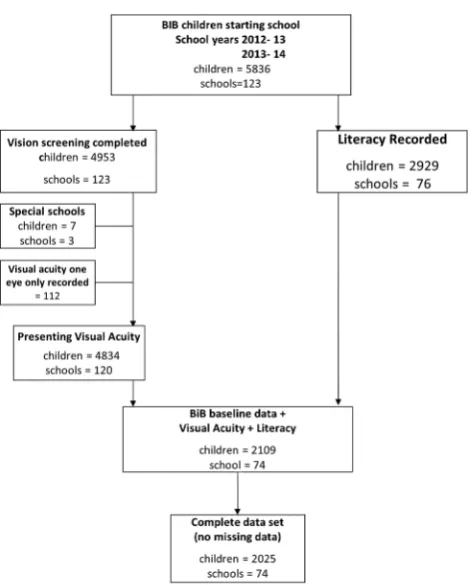
literacy levels on school entry were measured in school by experienced research assistants. All 123 Bradford primary schools were invited to participate, 76 separate schools agreed to take part and 2929 BiB children received a literacy assessment between September 2012 and July 2014.
Early literacy skills that predict future reading per-formance include letter identification.4Letter identifi
ca-tion measures the child’s ability to identify single letters, an essential skill mastered prior to reading and one of the best predictors of reading achievement.11 Letter identification was measured using the Woodcock
Reading Mastery Tests-Revised (WRMT-R) subtest: letter identification, a validated reading skill test.12
In addition, a measure of acquired or receptive vocabulary was recorded using the British Picture Vocabulary Scale (BPVS).13 It has been shown to be an important indicator of cognitive ability, providing a rep-resentation of the measure of IQ in young children. This measure is included to adjust for potential con-founding due to levels of general cognitive ability.
Both measures are standardised taking into account the child’s age and time of testing during the academic year, a mean score of 100 would be expected for a given population.12 13
Vision
A vision screening programme for school children aged 4–5 years has been established in Bradford. The screen-ing programme is conducted in school by orthoptists. Owing to the nature of the programme being conducted after school entry, coverage is high at 97%.14 In total, 11 186 children from 123 primary schools across the city participated in the vision screening programme. In total, 5836 BiB children were eligible for the study (started school between September 2012 and July 2014) and 4953 (85%) BiB children had completed the vision screening programme prior to the data linkage
(figure 1). The vision screening assessment includes
standard protocols for measurement of distance VA15 16 right and left eyes, with spectacles if worn. The VA test was administered by orthoptists, performed at a distance of 3 m and VA was measured to threshold (ie, best achievable VA with no defined endpoint). Additional
tests carried out by the orthoptists were cover test, ocular motility and non-cycloplegic auto refraction (Welch-Allyn Inc Skaneateles, New York, USA). VA was measured with an age appropriate logMAR Crowded Test (Keeler, Windsor)15 which has four letters per line each letter having a score of 0.025; the total score for each line represents 0.1 log unit. A matching card is used and knowledge of letters is not necessary to perform the test. In total, 4834 BiB children completed the vision screening and had VA recorded for both right and left eyes (figure 1). In total, 118/4834 (2%) of
chil-dren were unable to match letters, they were tested using Kay Pictures Crowded LogMAR (Kay pictures, Tring UK).17 18 Refractive error is commonly associated
with reduced VA in young children19; hence, non-cycloplegic autorefractor readings for the right and left eyes were recorded and a mean spherical equivalent (sphere plus half-negative cylinder) calculated for each eye of individual children.19 20In total, 4578 out of 4834 children had a mean spherical equivalent calculated. Data from the vision screening programme used for the analyses include presenting VA (best VA right or left eye, with glasses if worn) and the mean spherical equivalent from that same eye.
Presenting VA will be referred to as VA for the rest of the paper and in all tables. VA was categorised to examine prevalence of levels of vision. Four categories were established: better than 0.20 logMAR (a pass on visual screening), 0.225–0.30, 0.325–0.40, (referred to as
‘poor vision’ in many published studies)19 21 and worse than 0.4 (a category used to define visual impairment by
the WHO).22 VA was treated as a continuous variable in the statistical modelling allowing for letter-by-letter scoring.
Statistical analysis
Multilevel regression analysis (children nested within schools) was undertaken in BiB children where com-plete data sets from both the mother and child were available, 84 of 2109 children were excluded due to incomplete data (figure 1). This was mainly due to
incomplete data on the BPVS which was not recorded in
60 (3%) children. To analyse the effect of VA on literacy, unadjusted analysis was undertaken on BiB children with complete data (n=2025). Subsequent adjustment for demographic and socioeconomic (maternal and child characteristics) including BPVS score to account for cognitive ability was then undertaken. The character-istics included in the statistical analysis were those found to be associated with both educational and visual out-comes in the current literature. Demographic factors were: ethnicity (determined by the mothers’ ethnicity), sex at birth, birth weight, gestational age, language of baseline questionnaire completed by mother, mothers’
place of birth. Socioeconomic factors were: mother in receipt of benefits, level of mothers’ education, mother
smoked during pregnancy.23–28 The characteristics are
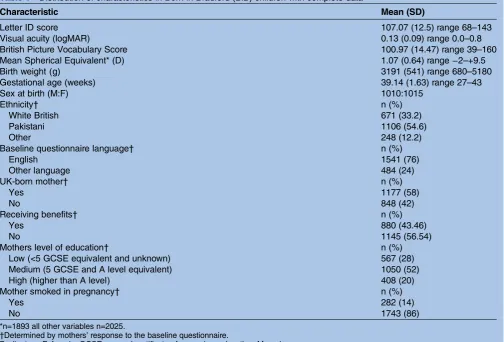
detailed intable 1.
The regression analyses were undertaken in three steps: first, demographic factors (listed above) were
included in the model; a second model was then run adjusting for the socioeconomic factors (listed above); and finally a fully adjusted model was run adjusting for
all demographic and socioeconomic factors and the BPVS score for general cognitive ability. In all these models, 2025 children from 74 schools were included.
Further regression analysis was undertaken to examine the impact of mean spherical equivalent on a subsample with complete data available (n=1893). A sensitivity ana-lysis was also undertaken excluding children unable to carry out letter matching (n=1979). Multilevel analysis was undertaken in order to account for variability between schools; the variance in attainment attributed to differences between schools was calculated to provide a variance partition coefficient for each model. All
ana-lyses were carried out using Stata V.13 (StataCorp, College Station, Texas, USA).
RESULTS
The overall mean (SD) VA for all children (n=11 186) who received vision screening was 0.14 (0.09) logMAR (range 0.0–1.0). In total, 8.7% (977/11 186) of children had a VA worse than 0.2logMAR, 4% (475/11 186) worse than 0.3logMAR and 1.8% (206/11 186) of chil-dren demonstrated a VA of worse than 0.4logMAR. There was no clinically significant difference between
the BiB and non-BiB children (see online supplemen-tary table S1).
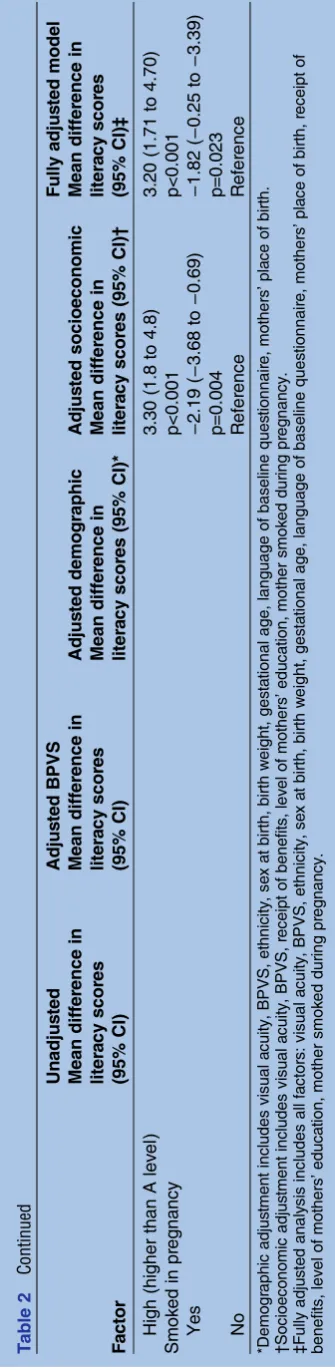
The univariate and adjusted model analyses for the BiB children are shown in table 2. Unadjusted analysis of the BiB children (n=2025) showed that the literacy score was associated with the level of VA. The literacy score reduced by 2.42 points for every one line (0.10logMAR) reduction in VA (95% CI −2.98 to −1.87), p<0.001. When adjusted to account for cognitive
ability (BPVS), demographic factors or socioeconomic factors, the impact of VA remained significant and
con-tinued to remain statistically significant in the
[image:4.595.48.285.42.335.2]multivari-able model after all factors are accounted for with the
literacy score reducing by 1.65 (95% CI−2.17 to−1.13),
p<0.001 for every one line (0.10logMAR) reduction in VA. The association between VA and literacy remained after a sensitivity analysis was undertaken to investigate the effect of poor literacy by excluding children unable to carry out the letter matching (see online supplemen-tary table S2). Adjustment for mean spherical equivalent made no material difference and by itself was not asso-ciated with literacy ( p=0.164), it therefore was not included in the model. The variance in attainment attributed to the difference between schools was 9% in the unadjusted model and 12% in the fully adjusted model across 74 schools.
DISCUSSION
This study is the first to reliably demonstrate that poor
VA in young children is associated with reduced early developing literacy. The average receptive vocabulary and slightly above average literacy scores (table 1) of the children indicate that general low achievement does not influence our findings. The mean VA (table 1) of these
4–5-year-old children is similar to previously published normative data29; however, our findings indicate a high
proportion of children (9%) had reduced VA with 2% classified as visually impaired.22 This is likely to impact
significantly on their early developing literacy. The
Bradford cohort of children demonstrates a higher prevalence of poor presenting VA (defined as worse
than 0.3logMAR) compared with that reported else-where19 21 23 30(table 3).
For the majority of children in Bradford, vision screen-ing at school entry is their first assessment of visual
status with few having had any previous treatment; this is likely to account for the increased prevalence observed. In this study, 2% of children were wearing glasses at vision screening, similar to that found in an urban popu-lation of children aged 30–71 months in the USA (1.7%),21 but substantially lower than the 4.4% of chil-dren aged 6 years in Australia.19 Another UK cohort study23 reported 0.6% prevalence of poor presenting VA at the age of 7 years; however, 3% of the children in their sample had undergone previous treatment. The prevalence reported in the US study was 1.2% in white children and 1.8% in black children.21 In our study, 2.7% of white British, 5.2% of Pakistani children and 2.8% of other ethnicities had VA worse than 0.3 logMAR. In both studies, the differences in VA between the ethnic groups were not statistically significant.
[image:5.595.49.554.61.403.2]It has been shown that children from socioeconomic-ally deprived households have an increased prevalence of vision problems,31 32 which may in part be due to
Table 1 Distribution of characteristics in Born in Bradford (BiB) children with complete data
Characteristic Mean (SD)
Letter ID score 107.07 (12.5) range 68–143
Visual acuity (logMAR) 0.13 (0.09) range 0.0–0.8
British Picture Vocabulary Score 100.97 (14.47) range 39–160 Mean Spherical Equivalent* (D) 1.07 (0.64) range−2–+9.5
Birth weight (g) 3191 (541) range 680–5180
Gestational age (weeks) 39.14 (1.63) range 27–43
Sex at birth (M:F) 1010:1015
Ethnicity† n (%)
White British 671 (33.2)
Pakistani 1106 (54.6)
Other 248 (12.2)
Baseline questionnaire language† n (%)
English 1541 (76)
Other language 484 (24)
UK-born mother† n (%)
Yes 1177 (58)
No 848 (42)
Receiving benefits† n (%)
Yes 880 (43.46)
No 1145 (56.54)
Mothers level of education† n (%)
Low (<5 GCSE equivalent and unknown) 567 (28) Medium (5 GCSE and A level equivalent) 1050 (52)
High (higher than A level) 408 (20)
Mother smoked in pregnancy† n (%)
Yes 282 (14)
No 1743 (86)
*n=1893 all other variables n=2025.
†Determined by mothers’response to the baseline questionnaire.
Table 2 Associations between Literacy (letter identification score) and visual acuity, British Picture Vocabulary Scale (BPVS), socioeconomic and demographic (child and maternal) factors, n=2025 children, n=74 schools
Factor
Unadjusted Mean difference in literacy scores (95% CI)
Adjusted BPVS Mean difference in literacy scores (95% CI)
Adjusted demographic Mean difference in literacy scores (95% CI)*
Adjusted socioeconomic Mean difference in
literacy scores (95% CI)†
Fully adjusted model Mean difference in literacy scores
(95% CI)‡
Change in literacy score per one line (0.1log unit) of visual acuity
−2.42 (−2.98 to−1.87) p<0.001
−1.79 (−2.32 to−1.26) p<0.001
−1.72 (−2.24 to−1.19) p<0.001
−1.72 (−2.25 to−1.19) p<0.001
−1.65 (−2.17 to−1.13) p<0.001
Change in literacy score per one unit change in BPVS
0.27 (0.23 to 0.30) p<0.001
0.26 (0.22 to 0.30) p<0.001
0.25 (0.22 to 0.29) p<0.001
0.25 (0.21 to 0 0.28) p<0.001
Ethnicity
White British Reference Reference
Pakistani 0.83 (−0.82 to 2.47)
p=0.325
−0.14 (−1.86 to 1.58) p=0.872
Other 3.79 (1.86 to 5.73)
p<0.001
2.85 (0.88 to 4.82) p=0.005
Sex at birth
Male Reference Reference
Female 3.01 (2.03 to 3.99)
p<0.001
3.06 (2.09 to 4.04) p<0.001
Birth weight (g) 0.001 (0.0001 to 0.002)
p=0.028
0.001 (0.0001 to 0.002) p=0.036
Gestational age (weeks) 0.006 (−0.35 to 0.37) p=0.975
−0.01 (−0.37 to 0.34) p=0.937
Questionnaire language
English 1.78 (0.21 to 3.35)
p=0.026
1.61 (3.18 to 0.04) p=0.045
Other language Reference Reference
UK born
Yes −1.19 (−2.66 to 0.28)
p=0.113
−0.97(−0.49 to 2.43) p=0.192
No Reference Reference
Receiving benefits
Yes −1.05 (−2.06 to−0.03)
p=0.043
−1.03 (−2.04 to−0.03) p=0.045
No Reference Reference
Level of education
Low (<5 GCSE equivalent and unknown)
Reference Reference
Medium (5 GCSE and A level equivalent)
1.14 (−0.024 to 2.3) p=0.055
1.13 (−0.04 to 2.3) p=0.059
Continued
al
.
BMJ
Open
2016;
6
:e010434
.
doi:10.113
6/bmjopen-20
15-010434
5
Open
Acces
s
group.bmj.com
on February 18, 2016 - Published by
http://bmjopen.bmj.com/
inequality in accessing health services.33 The Bradford vision screening programme covers 97% of children14 and therefore does not exclude children from the lower socioeconomic areas. The high levels of deprivation in the city may help explain the higher prevalence level of poor VA. Educational attainment is multifactorial and influenced by social disadvantage and demographic
factors, differences manifest early and are demonstrable through gaps in literacy achievement.27 28Factors known to be associated with educational outcome such as socio-economic status,28 34gender35and mothers’education36 were also shown in this study to impact on literacy
(table 2). There was no difference between the literacy
scores of the white British and the Pakistani children; however, there was a positive association between literacy and VA for children in the ‘other’ ethnic category. A third of children in this category had mothers with high educational attainment and this may help explain the association. The association between the level of VA and literacy remains significant after adjustment for
socio-economic and demographic factors (table 2).
Low degrees of refractive error, in particular, hyperopia are normally reported in young children.37 A few studies have found that low degrees of uncorrected hyperopia in young children have an impact on literacy.38 39 Non-cycloplegic autorefraction was used in this study to provide an indication of refractive status. Commonly non-cycloplegic refraction underestimates the level of hyper-opia present in young children,40 autorefraction using the Welch-Allyn has however been shown to have a small hyperopic bias41which could have increased the reported mean spherical equivalent of the Bradford population
(table 1). All children who failed their vision screening
assessment were referred for a cycloplegic examination to confirm refractive error; an ongoing longitudinal study of
these children will examine the results. In this study, our analysis demonstrates an association between literacy and VA but not refractive error.
A small number of population-based studies have examined the impact of VA on educational outcome. A US study evaluating the effect of visual function on aca-demic performance (children aged 6–9 years) found no association. However, the key indicator of academic per-formance (Metropolitan Readiness Test) was not avail-able for a large proportion of the children and a proxy measure of attainment was used, neither did the study take into account the effects of potential confounding factors.42 Retrospective analysis of the 1958 British birth cohort reporting outcomes at age 11 years found no association between unilateral amblyopia and educa-tional, health and social outcomes; however, participants with bilateral visual loss were excluded from the study.43 A large cohort study in Singapore reported no effect of presenting VA on academic school performance,44 but the Singapore cohort of children at age 9–10 years only included a small number of children with poor vision which reduced the power of the study to detect any sig-nificant association.
[image:7.595.74.242.54.741.2]Our paper reports the largest population-based study which explores the impact of VA on literacy and has a number of strengths. The cohort is set in a multiethnic population, and the use of data linkage has allowed us to undertake rigorous analysis taking into account the effect of potential confounding factors. However, there are limitations, 2929 out of 5836 (50%) of BiB children had received a literacy test at the time of data linkage; this reduced the number of children (n=2025) who had complete data sets and may compromise the representa-tiveness of the sample. However, comparison of the BiB children (n=2025) with complete data demonstrated a similar percentage of children within each quintile of the Index of Multiple Deprivation and is comparable to the complete BiB cohort of children (n=13 773).10 The prevalence of poor vision in this cohort of children (n=2025) is also similar to all Bradford children (n=11 186; see online supplementary table S1). As a proxy indicator for English as a second language, we used the language in which the baseline questionnaire was completed by the mother during pregnancy. Although all children are taught in school in English, this may not be the primary language of choice at home; this information was not available.
The study has the inherent limitations of a cross-sectional design, which reduces our ability to confidently
infer causality. However, it is unlikely that poor literacy resulted in poor performance in the vision test; the majority of children (98%) performed the recom-mended age appropriate vision test and the association between vision and literacy remained after excluding children unable to accomplish the letter matching. In addition, if indeed poor literacy causes poor vision we would expect that those children with specific reading
difficulties (dyslexia) would demonstrate reduced VA. In
a recent study four out offive children with reading dif-ficulties demonstrated normal visual function.45
By linking the clinical data set from the population-based vision screening programme with epidemiological data from a large birth cohort study, along with the base-line literacy assessments, this is the first multiethnic
population-based study to have the statistical power to take into account the multiple factors that are known to impact on educational outcomes. Our results demon-strate a significant association between VA and early
liter-acy. In a population with a high prevalence of reduced vision, this has important implications for children’s future educational outcomes. The reduction in the
literacy score by around 2% for every line of vision reduc-tion is important in a populareduc-tion where there are poor levels of vision on school entry. This study strengthens the argument for a national vision screening programme. The impact of such a programme will depend on the degree to which detection of reduced vision at age 4–
5 years results in effective intervention to improve vision and the impact this has on health, educational and social outcomes. Further research is required to determine the extent to which children with poor vision access treat-ment and the impact of such treattreat-ment not only on levels of vision but also on their educational attainment.
Acknowledgements The authors thank all the families and schools who took
part in this study, the orthoptists from Bradford Teaching Hospitals Foundation Trust who conducted the vision screening programme, the researchers from the Starting Schools programme who collected the literacy measures and the Data Support Team from Bradford Institute for Health Research who created and maintain the data linkage system.
Contributors AB initiated the project, designed data collection, monitored data
collection for the whole study, wrote the statistical analysis plan, cleaned and analysed the data, and drafted and revised the paper. She is the guarantor. LF wrote the statistical analysis plan, cleaned the data and revised the draft paper. BC and JW initiated the project and revised the draft paper. TAS initiated the project, wrote the statistical analysis plan and revised the draft paper.
Funding AB is funded by a National Institute for Health Research
Post-Doctoral Fellowship Award (PDF-2013-06-050). The Born in Bradford study presents independent research commissioned by the National Institute for Health Research Collaboration for Applied Health Research and Care (NIHR CLAHRC) and the Programme Grants for Applied Research funding scheme (RP-PG-0407-10044).
Disclaimer The views expressed are those of the author(s) and not
necessarily those of the NHS, the NIHR or the Department of Health.
Competing interests None declared.
Ethics approval National Research Ethics Committee Yorkshire & the
Humber-South Yorkshire (Ref 13/YH/0379).
Provenance and peer review Not commissioned; externally peer reviewed.
Data sharing statement No additional data are available.
Open Access This is an Open Access article distributed in accordance with
the terms of the Creative Commons Attribution (CC BY 4.0) license, which permits others to distribute, remix, adapt and build upon this work, for commercial use, provided the original work is properly cited. See: http:// creativecommons.org/licenses/by/4.0/
REFERENCES
[image:8.595.46.552.64.141.2]1. National Screening Committee. The UK NSC policy on vision defects screening in children 2013. http://www.screening.nhs.uk/ vision-child (accessed 24 Nov 2015).
Table 3 Comparison of studies reporting prevalence of poor visual acuity (worse than 0.30logMAR)
Author Community Age (years) Number of participants Prevalence (%)
Robaeiet al19 Australia 6–7 1738 0.9
Friedmanet al21 USA 2.5–5.5 1714 1.5
Williamset al23 O’Donoghueet al30
Bristol, UK
Northern Ireland, UK
7 6–7
7825 392
0.6 1.5
2. Department of Health, Department for Children Schools and Families. Healthy Child Programme: pregnancy and the first years of life. London, UK: Department of Health, 2009.
3. Carlton J, Karnon J, Czoski-Murray C,et al. The clinical effectiveness and cost-effectiveness of screening programmes for amblyopia and strabismus in children up to the age of 4–5 years: a systematic review and economic evaluation.Health Technol Assess
2008;12:iii, xi–194.
4. Marchman VA, Fernald A. Speed of word recognition and vocabulary knowledge in infancy predict cognitive and language outcomes in later childhood.Dev Sci2008;11:F9–16.
5. Feinstein L. Mobility in pupils’cognitive attainment during school life.
Oxf Rev Econ Policy2004;20:213–29.
6. Marmot M.Fair society, healthy lives. The Marmot review executive summary. London: The Marmot Review, 2010.
7. Dearden L, Sibieta L, Sylva K. The socio-economic gradient in early child outcomes: evidence from the Millennium Cohort Study. Longitudinal Life Course Stud2011;2:19–40.
8. NHS Commissioning Board ( July 2012) Commissioning fact sheet for clinical commissioning groups. http://www.england.nhs.uk (accessed 24 Nov 2015).
9. Which? (2011) One in five PCTs do not offer school sight tests. http://www.which.co.uk/news/2011/08/one-in-five-pcts-do-not-offer-school-sight-tests-264291/ (accessed 24 Nov 2015).
10. Wright J, Small N, Raynor P,et al. Cohort profile: the Born in Bradford multi-ethnic family cohort study.Int J Epidemiol2013;42:978–91. 11. Foulin JN. Why is letter-name knowledge such a good predictor of
learning to read?Read Writ2005;18:129–55.
12. Woodcock RW.Woodcock Reading Mastery Tests (Revised) Circle Pines. MN: American Guidance Service, 1987.
13. Dunn LM, Dunn LM, Whetton C,et al.British Picture Vocabulary Scale. 2nd edn. Windsor, Berks: NFER-Nelson, 1997.
14. Bruce A, Outhwaite L. Uptake, referral and attendance: results from an inner city school based vision screening programme.Br Ir Orthopt J2013;10:41–5.
15. McGraw PV, Winn B, Gray LS,et al. Improving the reliability of visual acuity measures in young children.Ophthalmic Physiol Opt
2000;20:173–84.
16. Simmers AJ, Gray LS, Spowart K. Screening for amblyopia: a comparison of paediatric letter tests.Br J Ophthalmol1997;81:465–9. 17. Kay H. New method of assessing visual acuity with pictures.
Br J Ophthalmol1983;67:131–3.
18. Shah N, Laidlaw DAH, Rashid S,et al. Validation of printed and computerised crowded Kay picture logMAR tests against gold standard ETDRS acuity test chart measurements in adult and amblyopic paediatric subjects.Eye (Lond)2012;26:593–600. 19. Robaei D, Rose K, Ojaimi E,et al. Visual acuity and the causes of
visual loss in a population-based sample of 6-year-old Australian children.Ophthalmology2005;112:1275–82.
20. Dirani M, Chan YH, Gazzard G,et al. Prevalence of refractive error in Singaporean Chinese children: the strabismus, amblyopia, and refractive error in young Singaporean Children (STARS) study.
Invest Ophthalmol Vis Sci2010;51:1348–55.
21. Friedman DS, Repka MX, Katz J,et al. Prevalence of decreased visual acuity among preschool-aged children in an American Urban Population: the Baltimore pediatric eye disease study, methods, and results.Ophthalmology2008;115:1786–95, 1795.e1–4.
22. Resnikoff S, Pascolini D, Mariotti SP,et al. Global magnitude of visual impairment caused by uncorrected refractive errors in 2004.
Bull World Health Organ2008;86:63–70.
23. Williams C, Northstone K, Howard M,et al. Prevalence and risk factors for common vision problems in children: data from the ALSPAC study.Br J Ophthalmol2008;92:959–64.
24. Pathai S, Cumberland PM, Rahi JS. Prevalence of and early-life influences on childhood strabismus: findings from the Millennium Cohort Study.Arch Pediatr Adolesc Med2010;164:250–7.
25. Cumberland PM, Pathai S, Rahi JS,et al. Prevalence of eye disease in early childhood and associated factors: findings from the millennium cohort study.Ophthalmology2010;117: 2184–90.e1–3.
26. Neuman S. Lessons from my mother: reflections on The National Early Literacy Report.Educ Res2010;39:301–4.
27. Burroughs-Lange SG, Douetil J. Literacy progress of young children from poor urban settings: a Reading Recovery comparison study.Lit Teach Learn2007;12:19–46.
28. Schoon I, Parsons S, Sacker A,et al. Socioeconomic adversity, educational resilience and subsequent levels of adult adaptation.
J Adolesc Res2004;19:383–404.
29. Sonksen PM, Wade AM, Proffitt R,et al. The Sonksen logMAR test of visual acuity: II. Age norms from 2 years 9 months to 8 years.
J AAPOS2008;12:18–22.
30. O’Donoghue L, McClelland JF, Logan NS,et al. Refractive error and visual impairment in school children in Northern Ireland.
Br J Ophthalmol2010;94:1155–9.
31. Ganz ML, Xuan Z, Hunter DG. Prevalence and correlates of children’s diagnosed eye and vision conditions.Ophthalmology
2006;113:2298–306.
32. Maples WC. Visual factors that significantly impact academic performance.Optometry2003;74:35–49.
33. Majeed M, Williams C, Northstone K,et al. Are there inequities in the utilisation of childhood eye-care services in relation to socio-economic status? Evidence from the ALSPAC cohort.
Br J Ophthalmol2008;92:965–9.
34. Hoff E. Interpreting the early language trajectories of children from low-SES and language minority homes: implications for closing achievement gaps.Dev Psychol2013;49:4–14.
35. Browne N.Gender equity in the early years. Maidenhead, Berkshire: Open University Press, 2004.
36. Sticht TG, McDonald BA.Teach the mother and reach the child: literacy across generations. Literacy Lessons. Geneva: International Bureau of Education, 1990.
37. Mayer DL, Hansen RM, Moore BD,et al. Cycloplegic refractions in healthy children aged 1 through 48 months.Arch Ophthalmol
2001;119:1625–8.
38. Williams WR, Latif AH, Hannington L,et al. Hyperopia and educational attainment in a primary school cohort.Arch Dis Child
2005;90:150–3.
39. Shankar S, Evans MA, Bobier WR. Hyperopia and emergent literacy of young children: pilot study.Optom Vis Sci
2007;84:1031–8.
40. Fotedar R, Rochtchina E, Morgan I,et al. Necessity of cycloplegia for assessing refractive error in 12-year-old children: a population-based study.Am J Ophthalmol2007;144:307–9.
41. Adams RJ, Dalton SM, Murphy AM,et al. Testing young infants with the Welch Allyn suresight non-cycloplegic autorefractor.Ophthalmic Physiol Opt2002;22:546–51.
42. Helveston EM, Weber JC, Miller K,et al. Visual function and academic performance.Am J Ophthalmol1985;99: 346–55.
43. Rahi JS, Cumberland PM, Peckham CS. Does amblyopia affect educational, health, and social outcomes? Findings from 1958 British birth cohort.BMJ2006;332:820–5.
44. Dirani M, Zhang X, Goh LK,et al. The role of vision in academic school performance.Ophthalmic Epidemiol2010;17:18–24. 45. Creavin AL, Lingam R, Steer C,et al. Ophthalmic abnormalities and
cross-sectional study
years: a cohort-nested
5
−
at age 4
Impact of visual acuity on developing literacy
Sheldon
Alison Bruce, Lesley Fairley, Bette Chambers, John Wright and Trevor A
doi: 10.1136/bmjopen-2015-010434
2016 6:
BMJ Open
http://bmjopen.bmj.com/content/6/2/e010434 Updated information and services can be found at:
These include:
Material
Supplementary
434.DC1.html
http://bmjopen.bmj.com/content/suppl/2016/02/16/bmjopen-2015-010 Supplementary material can be found at:
References
#BIBL http://bmjopen.bmj.com/content/6/2/e010434
This article cites 36 articles, 12 of which you can access for free at:
Open Access
http://creativecommons.org/licenses/by/4.0/
use, provided the original work is properly cited. See:
others to distribute, remix, adapt and build upon this work, for commercial the Creative Commons Attribution (CC BY 4.0) license, which permits This is an Open Access article distributed in accordance with the terms of
service
Email alerting
box at the top right corner of the online article.
Receive free email alerts when new articles cite this article. Sign up in the
Collections
Topic
Articles on similar topics can be found in the following collections(1392) Public health
(386) Paediatrics
(71) Ophthalmology
Notes
http://group.bmj.com/group/rights-licensing/permissions To request permissions go to:
http://journals.bmj.com/cgi/reprintform To order reprints go to: