University of Southern Queensland Faculty of Health, Engineering and Sciences
Development of a computer simulation for scouring
around bridge piers
A dissertation submitted by
Gary A. Nankervis
in fulfilment of the requirements of
ENG4111 and ENG4112 Research Project
towards the degree of
Bachelor of Engineering (Honours) (Civil)
i
Abstract
Bridges are important and valuable items of infrastructure in modern society. They are designed to be functional and cost effective, but they must also be safe. A great many bridges cross bodies of flowing water and have supporting piers founded within the water; therefore the foundations are subject to erosion by scouring and this could lead to potential bridge failures.
The aim of this research project is to develop a computer simulation of bridge pier scouring, to accurately predict the extent of potential scouring. Accurate predictions of scouring could lead to more efficient bridge designs while still maintaining the required level of safety. The project also proposes a new pier design with potential for improved scouring performance.
There has previously been much research conducted on various aspects of bridge pier scouring. This includes explaining the scouring mechanism, physical experiments on pier geometries and developing prediction formulas. Most of this work has been done using scale models in a hydraulic flume tank and therefore has some limitations in transference to real scale situations.
In recent years computer simulations have been developed for bridge pier scouring. They have an advantage of being able to model a situation at real scale, and can easily be altered as required. Early simulations were mainly single-phase (one fluid; water) models which require empirical sediment transport equations to predict sand movement. Multiphase (more than one fluid) simulation models are a more recent development; they model sediment transport as a granular flow.
ii
could be used to validate the model. A new streamlined slotted pier geometry was proposed for performance testing with the model after validation.
At present, development of the model does not achieve the anticipated objective of simulating local scouring around a bridge pier. The simulation of sand, as a riverbed sediment, is not realistic. Therefore the model has not been validated and is not reliable. The sand appears to behave much more like a liquid rather than a semi-solid granular flow.
The new pier design when tested in a two-dimensional (horizontal plane) model shows potential for reduced scouring. This is because of lower water velocity along its outer edges, compared to the cylindrical control pier. However it has not been possible to test the new pier in a three-dimensional scouring model.
Future successful development with this simulation model is dependent on further research and experimentation to achieve realistic sand movement. Additional models would be required specifically to better understand modelling of sand flow and the most appropriate parameter choices to achieve it.
iii
University of Southern Queensland
Faculty of Health, Engineering and Sciences
ENG4111/ENG4112 Research Project
Limitations of Use
The Council of the University of Southern Queensland, its Faculty of Health, Engineering & Sciences, and the staff of the University of Southern Queensland, do not accept any responsibility for the truth, accuracy or completeness of material contained within or associated with this dissertation.
Persons using all or any part of this material do so at their own risk, and not at the risk of the Council of the University of Southern Queensland, its Faculty of Health, Engineering & Sciences or the staff of the University of Southern Queensland.
iv
University of Southern Queensland
Faculty of Health, Engineering and Sciences
ENG4111/ENG4112 Research Project
Certification of Dissertation
I certify that the ideas, designs and experimental work, results, analyses and conclusions set out in this dissertation are entirely my own effort, except where otherwise indicated and acknowledged.
I further certify that the work is original and has not been previously submitted for assessment in any other course or institution, except where specifically stated.
Gary Nankervis
v
Acknowledgements
I would like to thank my project supervisor, Dr Andrew Wandel. His knowledge of the software package and advice on implementing it have been invaluable.
vi
Table of Contents
Abstract i
Acknowledgements v
List of figures ix
List of Tables xii
Nomenclature xiii
Glossary of terms xiv
Chapter 1
Introduction 1
1.1 Background 1
1.2 Project aims 2
1.3 Specific objectives 3
1.4 Consequential effects 4
Chapter 2
Background and Literature review 5
2.1 Bridges 5
2.1.1 Bridge and pier design 5
2.1.2 Failure causes 6
2.2 The scouring process 7
2.2.1 Characteristic flow 7
2.2.2 Sediment transport 8
2.2.3 Local scouring mechanism 11
2.3 Previous bridge scour research 13
2.3.1 Melville experiment 14
2.3.2 Scour mitigation trials 15
2.3.3 USQ projects 17
2.4 Empirical scour prediction formulas 18
2.4.1 HEC-18 equation 18
2.4.2 Sheppard equation 19
2.4.3 Melville equation 20
2.5 Numerical modelling 21
vii
2.5.2 Zhu and Liu 22
2.5.3 Xiong et al. 23
2.5.4 Knipe 24
2.6 Conclusions of review 24
Chapter 3
Methodology 26
3.1 Computer hardware and software 26
3.1.1 Hardware 27
3.1.2 Software familiarisation and support 27
3.1.3 Workbench 28
3.1.4 Geometry 28
3.1.5 Mesh 30
3.1.6 Fluent 32
3.1.7 Results 33
3.2 New pier design 34
3.3 Experimental process 35
3.4 Input data 37
3.4.1 Physical parameters 37
3.4.2 Normal flow conditions 38
3.5 2-D steady-state model 41
3.5.1 Empty domain space 41
3.5.2 Cylindrical pier 43
3.5.3 New pier design 43
3.6 2-D transient model 43
3.7 3-D transient model 44
3.8 Sand flow model 47
Chapter 4
Results 48
4.1 2-D model in a horizontal plane 48
4.2 2-D model in a vertical plane 50
4.3 3-D model 52
4.3.1 Early results 52
4.3.2 Improved results 53
viii
4.5 New pier design 57
4.6 Empirical estimates 59
Chapter 5
Potential future development 60
5.1 Further research 60
5.1.1 Current model 60
5.1.2 Model application 61
5.1.3 New pier design 61
Chapter 6
Conclusions 62
List of References 63
Appendix A
Project specification 66
Appendix B
Melville experiment results 68
B.1 Intermediate scour hole 69
B.2 Equilibrium scour hole 69
Appendix C
Empirical estimate formulae calculations 71
C.1 HEC18 formula 72
C.2 Sheppard formula 74
C.3 Melville formula 78
Appendix D
Model diagrams 84
D.1 Domain diagram 85
ix
List of figures
Figure 1.1 Local scour around a bridge pier (FDOT 2005). 2
Figure 2.1 The Shields diagram plots entrainment function against the shear Reynolds
number to indicate threshold of motion (Henderson 1966). 10
Figure 2.2 Flow disturbance around a cylindrical pier (Arneson et al. 2012). 11
Figure 2.3 Contour plot of the resulting equilibrium scour hole after 2.5 hrs flow time
(Melville 1975, p. 94). 15
Figure 2.4 An example of a typical flume tank setup for a physical model experiment
(Christensen 2009). 17
Figure 2.5 Definition diagram for the HEC-18 equation (Arneson et al. 2012). 19
Figure 3.1 Close-up view of the model domain in the vicinity of the cylindrical pier. 29
Figure 3.2 A section view of the sand and water bodies showing fine meshing in the
vicinity of pier, walls and sand surface. 32
Figure 3.3 The new slotted pier design, aligned with stream flow direction. 35
Figure 3.4 Chart prepared for estimation of critical shear velocity at threshold
conditions; demonstrated for the 0.385 mm nominated grain size. 40
Figure 3.5 Water velocity profile in a horizontal plane across the width of the flume,
when free of any flow obstructions (water flow is from left to right). 42
Figure 3.6 A model to examine sand behaviour as it drains freely under gravity alone.47
Figure 4.1 Water velocity profile due to flow obstruction from the cylindrical control
pier (water flow is from left to right). 48
Figure 4.2 Water velocity profile due to flow obstruction from the new pier design
(water flow is from left to right). 49
Figure 4.3 Early scouring results beneath a horizontal pipe after 0.3 seconds flow time
in a 2-D vertical model (water flow is from left to right). 51
Figure 4.4 Sand bed scouring appears to level off after a longer flowtime of 3.2 seconds
(water flow is from left to right). 51
Figure 4.5 An isosurface at 0.991 sand volume fraction appears to show most of the
sand has been scoured away. 52
Figure 4.6 An isosurface at 0.90 sand volume fraction appears to show most of the sand
is still present. 53
Figure 4.7 An isosurface at 0.62 sand volume fraction after 3.52 seconds flow time. It
shows a suggestion of localised scouring to the sides and behind the pier,
x
Figure 4.8 An isosurface at 0.62 sand volume fraction after 12.0 seconds flow time.
Generalised scouring is very prominent just back from the inlet, and
localised scouring adjacent to the pier has been wiped out. 55
Figure 4.9 An isosurface at 0.615 sand volume fraction after 20.0 seconds flow time.
Results are similar to those after 16.0 seconds but generalised scouring has
removed some sand volume from the entire surface area. 55
Figure 4.10 Visual proof that both a sand crater surface and a sand mounded surface can
be seen in the results if they actually exist. 56
Figure 4.11 Initial simulation results for the new pier design appear to show unrealistic
gouging and a suggestion of local scouring near the pier. These results are
unverified and unreliable. 58
Figure B.1 Contour plot of the resulting intermediate scour hole after a half hour of flow
time (Melville 1975, p. 93). 69
Figure B.2 Sectional elevation diagrams of the resulting equilibrium scour hole after 2.5
hrs flow time (Melville 1975, p. 94). 69
Figure B.3 Contour plot of the resulting equilibrium scour hole after 2.5 hrs flow time
(Melville 1975, p. 94). 70
Figure C.1 Chart prepared for estimation of critical shear velocity at threshold
conditions; demonstrated for the 0.385 mm nominated grain size. 80
Figure D.1 A full length view of the model domain, showing all the component stages.
85
Figure D.2 Velocity profile around the cylindrical pier, and stabilising as it flows
downstream to the outlet. 86
Figure D.3 Velocity profile around the new slotted pier, and stabilising as it flows
downstream to the outlet. 86
Figure D.4 An isosurface at 0.950 sand volume fraction. 87
Figure D.5 An isosurface at 0.90 sand volume fraction. 87
Figure D.6 An isosurface at 0.850 sand volume fraction. 88
Figure D.7 An isosurface at 0.991 sand volume fraction. 88
Figure D.8 An isosurface at 0.62 sand volume fraction after 3.52 seconds flow time. It
shows a suggestion of localised scouring to the sides and behind the pier,
with very little generalised scouring. 89
Figure D.9 An isosurface at 0.62 sand volume fraction after 4.82 seconds flow time.
Small areas of generalised scouring are beginning to appear just back from
xi
Figure D.10An isosurface at 0.62 sand volume fraction after 8.0 seconds flow time.
Generalised scouring is becoming more prominent just back from the inlet.
90
Figure D.11An isosurface at 0.62 sand volume fraction after 12.0 seconds flow time.
Generalised scouring is very prominent just back from the inlet, and
localised scouring adjacent to the pier has been wiped out. 90
Figure D.12An isosurface at 0.62 sand volume fraction after 16.0 seconds flow time.
Generalised scouring is very prominent just back from the inlet, and
localised scouring has re-emerged adjacent to the pier. 91
Figure D.13An isosurface at 0.615 sand volume fraction after 20.0 seconds flow time.
Results are similar to those after 16.0 seconds but generalised scouring has
xii
List of Tables
xiii
Nomenclature
Note: depending on original document sources, a symbol may sometimes be used to represent different parameters, or alternatively different symbols may
sometimes be used to represent the same parameter.
2-D Two dimensional. 3-D Three dimensional.
d50 Sediment particle diameter at 50 percentile of a given range. d84 Sediment particle diameter at 84 percentile of a given range. CFD Computational Fluid Dynamics.
D Diameter, in general usage.
D Pier width (equivalent diameter), used in the Melville equation. D50 As for d50, but specifically used in the Sheppard equation. g Gravitational acceleration, taken as 9.81 m s-2 .
k Unit multiplier, equal to 1000.
u Velocity
U Velocity
UDF User defined function.
V Velocity
Vf Volume fraction.
xiv
Glossary of terms
Bed load;
Sediment grains roll, or are dragged, across the stream bed surface but are not lifted into suspension.
Clear-water transport;
There is no sediment transport already coming from upstream. Live-bed transport;
There is already incoming sediment transport which originated further upstream.
Multiphase flow;
Two or more fluids flowing within the same volumetric space. Packing limit;
The maximum volume of a granular phase material which can be packed into a volume space, expressed as a proportion. (Takes account of void space). Suspended load;
Sediment grains are lifted into suspension and carried by the fluid flow. Volume fraction;
1
Chapter 1
Introduction
The research project is focused on scouring around bridge piers. It aims to improve the safety and cost efficiency of future bridges by developing an accurate computer simulation model for predicting the extent of scouring around bridge piers.
The dissertation provides a background to the scouring problem, sets out the project aims, examines previous research on the problem, explains project development methodology and presents project results.
1.1
Background
As part of a nation’s road and rail infrastructure, bridges provide a means of easy and efficient access to cross barriers like waterways, gorges and other un-trafficable areas. Bridges have considerable economic and social value in allowing personal travel and transport of goods. The failure of a bridge therefore imposes a significant cost on society, not just in monetary terms but perhaps also in loss of life.
The American Federal Highway Administration (FHWA) has found scouring to be a significant contributing factor in many bridge failures (Arneson et al. 2012), therefore, during bridge design there is need for accurate prediction of potential scouring effects. Historically scour estimation was based on designer’s experience, but later evolved to experimentally-based prediction equations. Computer simulation modelling could provide a better means to study and more accurately predict the extent of scouring.
2
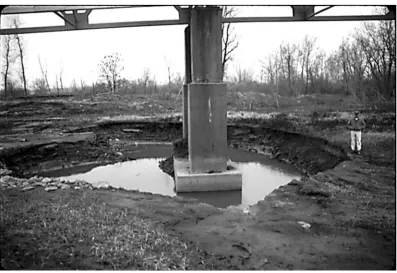
[image:17.595.100.497.197.470.2]Scouring is a dynamic process which can occur in several different forms (Arneson et al. 2012), either alone or in combination. General scour can occur anywhere along the length of a riverbed, contraction scour occurs adjacent to a flow restriction, and local scour occurs surrounding particular flow obstructions. Only local scour around bridge piers is considered in this research project. Figure 1.1 shows a very prominent example of local scour.
Figure 1.1 Local scour around a bridge pier (FDOT 2005).
1.2
Project aims
This research project aims to:
• Develop a three-dimensional, computational fluid dynamics (CFD) model for simulating water flow and river bed scouring around bridge piers. • Enable more accurate prediction of scouring around new and novel bridge
pier designs, at the design stage.
• Critically examine an alternative bridge pier design using the model.
3
1.3
Specific objectives
1. Conduct a literature search and review to discover existing knowledge and background information relating to bridge failure, the scouring process, and CFD modelling techniques. This will help identify a starting point based on extending the existing knowledge, and to identify gaps in the existing knowledge.
2. Propose a new and novel pier geometry based on existing knowledge of the scouring process, and as an extension of previously trialled pier geometries. The shape of the new design is expected to produce lower flow velocities around the pier, and therefore should also cause reduced scouring.
3. Develop a 2-D single-phase steady-state model to analyse water flow velocities. This is a relatively simple form of model which will not consume excessive computational runtime, but is quite adequate to examine flow velocities. Velocities around a traditional cylindrical pier are to be examined to establish a benchmark for comparison with those of a new and novel pier geometry. Reduced flow velocity around the new pier would prove it has potential to reduce scouring.
4. Further develop the model into a two-phase transient model. This more complex form of model is required to examine the inter-related flow of two different materials (phases) over a long time period. Granular river bed material is considered as a secondary phase fluid which moves (flows) as a consequence of the primary phase fluid (water) flow. The more complex model will have a much longer computational runtime.
4
6. Use the two-phase model to test scouring around the new pier design. This is the practical application of the model to test performance of a new pier design.
7. Compare modelling results with traditional scour estimates based on empirical formulae. This comparison checks for similarity or difference between results. Results will be examined and discussed in order to conclude whether the modelled results can be considered more accurate or not.
As time and resources permit:
1. Trial and evaluate different geometric variations. Once the model has been created it can easily be rerun with other variations of pier geometry to see if performance can be further improved.
2. Trial and evaluate different flow approach angles. The new pier design proposed in this research may not perform as well with increasingly oblique flow approach angles. Therefore different approach angles should be tested to see if performance is reduced or not.
1.4
Consequential effects
Positive effects of the project are an increase of knowledge on the subject of developing computer simulations to predict bridge pier scouring. If further development work can produce an accurate model, then application of the model could lead to more cost-efficient bridge designs which still provide satisfactory structural integrity.
5
Chapter 2
Background and Literature review
This chapter reviews the available literature, from textbooks or previous research, related to the aims of this project. It identifies existing knowledge/information which may be useful to this project, and also identifies areas where there may not be sufficient existing knowledge.
2.1
Bridges
2.1.1 Bridge and pier design
Many bridges use multiple simply supported spans to achieve the required total span length (Fu 2013). This design requires supporting piers, at the end of each span, founded on piles or spread footings. The piers may consist of a single, or multiple, columns. Multiple columns are usually interconnected at the top by a pier cap, with the bottoms either independent or interconnected by a footing. Column cross-sections are usually circular, square, or rectangular; they may also have rounded or angled ends to assist streamlining of water flow. Some long length piers may take the form of a continuous wall, rather than multiple columns.
When crossing waterways, piers must be founded within the riverbed, and are vulnerable to scouring.
6
2.1.2 Failure causes
A study of 114 reported bridge failures in the United States of America (Harik et al. 1990), between 1951 and 1988, categorised the causes of failure. Loss of use in at least one traffic lane was considered as a failure, and the worst case scenario was total collapse. The study authors suggest failures with potential for loss of life should be considered unacceptable, and designers should endeavour to prevent them. Accordingly the study was a first step towards developing a database of bridge failure details in order to improve future bridge design and construction.
The Harik et al. (1990) study was based on reports published in the public media; therefore it may not have included all bridge failures during the period. The accuracy and level of detail reported by these sources was limited. The study found natural phenomena to be the second most significant cause of bridge failures, after collisions from ships/vehicles. Natural phenomena included such things as floods, scouring and wind. Results could not be quantified any more accurately because detailed investigation records did not exist.
7
2.2
The scouring process
2.2.1 Characteristic flow
The characteristic nature of a fluid flow may be laminar, transitional or turbulent. The Reynolds Number (Re) is a dimensionless number used to determine the characteristic nature of a flow, and to compare the nature of one flow with that of others. Results are indicative only, with lower values suggesting laminar flow and higher values suggesting turbulent flow. By comparison with commonly accepted reference values, the calculated result is used to indicate if a particular flow situation is likely to be laminar, transitional, or turbulent. Reynolds Number is calculated from the formula
= = , (2.1)
where ρ is fluid density, V is flow velocity, D is diameter (characteristic length dimension), µ is dynamic viscosity, and ν is kinematic viscosity (Chadwick et al. 2004).
The Reynolds number is usually used in relation to flow through pipes but by substituting different characteristic lengths the formula can be used for flow through channels, flow around bodies (e.g. Piers) or flow around particles (e.g. Sediment or gravel) (Nalluri & Featherstone 2001). In the different situations, the characteristic length values are likely to be in different ranges of magnitude therefore the accepted reference values to distinguish between laminar and turbulent flow also differ.
8
For practical purposes, water flow in open channels and around submerged bodies is nearly always turbulent (Chadwick et al. 2004).
2.2.2 Sediment transport
Natural riverbeds generally consist of sediment particles which vary in size, shape and composition. Some of these particles may be dislodged, by the force of flowing water, and migrate downstream (Nalluri & Featherstone 2001). Such particle movement is known as sediment transport. Sediment transport can occur as “bed load”, or “suspended load” (Chadwick et al. 2004). The two transport modes can occur simultaneously.
Bed load occurs when individual particles either slide or roll along the bed surface (Chadwick et al. 2004). For this to happen, water forces acting on each particle must overcome the critical shear stress which exists between particles and the river bed. Smaller and lighter particles have a lower value of critical shear stress so they require less force to move and will be first to migrate.
Suspended load occurs when turbulent water flow happens to act in a direction which imparts an uplift force component on particles (Chadwick et al. 2004). If the uplift force overcomes the gravitational force, particles are lifted up off the riverbed and become suspended in the water flow. Smaller and lighter particles are also more prone to this transport mode than larger particles.
9
by upstream sediment inflow. This is not a solution to the scouring problem because it is only loose fill, and not firmly packed as the original stream bed would have been.
For a given riverbed, under normal flow conditions, all of the smallest particles, which may have once been present, will have been completely transported away. Of the particles remaining, the smallest size is related to flow velocity and is determined from the critical shear stress. The condition whereby there are no particles smaller than a certain size is known as “bed armouring” (Chadwick et al. 2004).
In stream flow where the bed is significantly wider than flow depth, bed shear stress (τb) can be taken as equal to mean shear stress (τ0), and hydraulic radius (R) can be taken as equal to flow depth (y0). At the threshold of particle motion, particle critical shear stress (τcr) is equal to average bed shear stress:
= = , (2.2)
where,
ρ is fluid density, g is gravity, and S0 is bed slope.
Critical friction velocity (u*c) is a theoretical reference value derived from the bed shear stress:
∗ = = . (2.3)
The entrainment function (Fs) (Chadwick et al. 2004) is used with the Shields
diagram to determine whether particle motion will occur or not.
10 where,
ρs is sediment particle density, D is particle diameter.
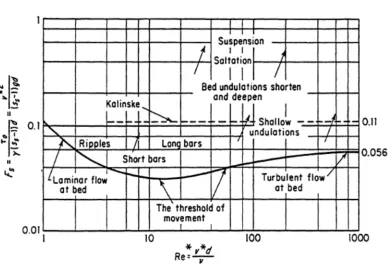
The Shields diagram, shown in Figure 2.1, plots the entrainment function against a form of Reynolds number, known as the shear Reynolds number (Re*). The shear Reynolds number uses friction velocity (u*) as the fluid velocity term.
[image:25.595.107.497.276.545.2]∗ !∗" (2.5)
Figure 2.1 The Shields diagram plots entrainment function against the shear
Reynolds number to indicate threshold of motion (Henderson 1966).
11
For an experimental study of local scouring, comparison of particle critical shear stress with mean bed shear stress is important to ensure sediment transport is not likely to occur under normal flow conditions; that would constitute general scouring rather than local scouring.
2.2.3 Local scouring mechanism
[image:26.595.98.496.347.614.2]Local scour occurs around an obstruction in the path of fluid flow. The obstruction forces the flow to divert its path in order to get past the obstruction. A cylindrical pier is commonly used as a benchmark in flow experiments and analysis (Zevenberger 2005) because it is a simple, yet realistic, geometric shape. Figure 2.2 shows typical disturbances to the flow around a cylindrical pier.
Figure 2.2 Flow disturbance around a cylindrical pier (Arneson et al. 2012).
12
diagram of Figure 2.2, approaches the pier from upstream. Free flow and maximum velocity occurs near the water surface, while least velocity occurs near the stream bed due to surface friction causing an energy loss in the boundary layer. As the vertical velocity profile reaches, and is obstructed by, the front (nose) of the pier a high pressure region develops. A pressure gradient forms with higher pressure near the water surface and reducing to lower pressure near the stream bed.
Oncoming flow attempts to divert to areas of lower pressure. Near the surface, a small upwelling occurs, but beneath the surface, flow is diverted down the face of the pier toward the stream bed (Laursen and Toch cited in Melville 1975). When obstructed again by the stream bed, this flow is diverted upstream along the stream bed and towards the oncoming normal flow. This is the start of a vortex in front of and at the base of the pier.
High pressure at the front of the pier simultaneously seeks to divert flow to lower pressure areas around the sides of the pier. The vortex formed in front of the pier is swept around the sides of the pier in a spiralling manner (Laursen and Toch cited in Melville 1975). The result is called a horseshoe vortex due to its characteristic shape.
All of the previously obstructed flow ultimately has to divert around the pier. This causes an increased flow rate through a now constricted cross-sectional area, therefore flow velocity increases around the pier in accord with the conservation of mass theory.
13
At the bed surface, increased turbulence due to the horseshoe vortex and increased flow velocity around the sides of the pier cause local scouring. In this region, larger sediment particles can be transported away downstream, compared with normal flow velocity over the general bed surface. Scouring starts as a small depression on each side of the pier, then grows into larger holes which migrate upstream until both sides meet at the nose of the pier (Melville 1975). Once started, scouring continues until an equilibrium state is achieved (Melville 1975) whereby the scour hole is large enough to allow flow to divert around the base of the pier without increased velocity adjacent to the modified bed surface.
2.3
Previous bridge scour research
From the 1950’s, and up to the present day, considerable research has been conducted with regard to scouring at bridge sites. Researchers are usually from university engineering departments, or government road authorities; sometimes working collaboratively.
Several researchers and organisations are quite prominent in the literature over several decades. They are:
• E.V. Richardson and S.R. Davis, Colorado State University (CSU), • D. M. Sheppard, University of Florida,
• B.W. Melville, Auckland University,
• American Federal Highway Administration (FHWA), and • Florida Department of Transport (FDOT).
The researchers named above have each developed their own equations for prediction of maximum scouring depth, and these are three of the most commonly used prediction equations (Zevenberger 2005).
14
conditions, flat bed and side walls of virtual channel, and scaled pier models. In reality bedding materials are inconsistent and flow is unsteady, rising to a peak then falling again. This leads to clear water transport followed by live bed transport, then back to clear water transport.
Previous research has examined characteristics of water flow and turbulence, the mechanism of riverbed scouring, bridge pier geometry, and performance of scouring countermeasures. Countermeasures are either flow altering devices or riverbed armouring devices.
Early experiments were based on cylindrical piers only. Later experiments often introduced some sort of geometric variation, as a scour reduction countermeasure, and compared performance with that of a cylindrical reference pier.
2.3.1 Melville experiment
Melville (1975) conducted cylindrical pier scour experiments in a flume tank at the University of Auckland. The main aim, at that time, was to better understand the scouring mechanism, rather than predict the scour depth. The research built on an earlier understanding of the scouring process by Laursen and Toch (1956). Melville commented that the flume could not perform live bed transport experiments because it did not have sand feed and collection (cycling) capability, however maximum scouring was expected to be at threshold conditions. Results were presented as a contour map and tabular data of the scour holes. A revised understanding of the scouring process was also discussed.
The experiment and results were well documented, and often cited by other subsequent researchers. The results are often used as a benchmark to verify the results of more recent experiments, particularly those from numerical modelling.
15
The CFD model will, as far as practicable, be run using all the same parameters as the Melville experiment.
The Melville (1975) experiment parameters are:
• Flume = 45.6 cm wide x 44 cm deep x 19 m long. 12.7 cm false floor depth. Glass panel sides.
• Bedslope (S0) = 0.0001 m/m. • Flow depth (y0) = 15 cm.
• Pier = 5.08 cm diameter (1/9 width ratio).
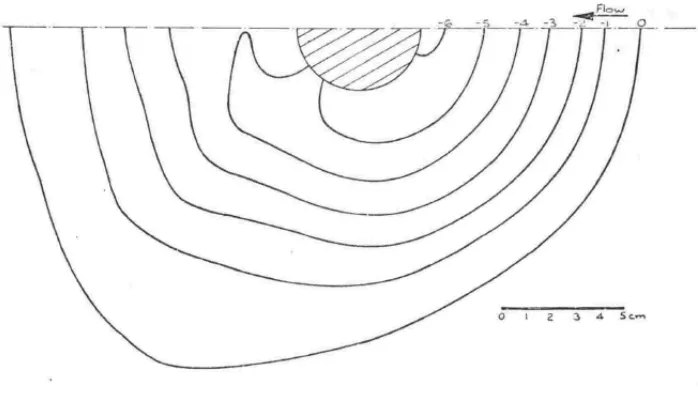
• Sand d50 = 0.385 mm, ρs = 2650 kg/m3, 32° angle of repose. • Inlet mean velocity (V0) = 0.25 m/s. Discharge (Q) = 17.12 L/s. • Bed shear velocity (u*) = 0.0121 m/s.
[image:30.595.141.490.374.580.2]• Critical particle shear velocity (u*cr) = 0.014 m/s.
Figure 2.3 Contour plot of the resulting equilibrium scour hole after 2.5 hrs flow
time (Melville 1975, p. 94).
2.3.2 Scour mitigation trials
16
The theory of the slot is to minimise or prevent down flow at the front of the pier by allowing the velocity profile pressure build-up to pass through the pier. Slots proportional to pier diameter (d) of d/2 width near the surface, and d/4 width near the bed were trialled in a flume tank.
Results are given as a percentage reduction of equilibrium scour depth as compared to a cylindrical control pier. It is suggested a slot near the surface effectively reduces water depth, and reduces scour by up to 30%. A slot near the bed reduces scour by up to 20%, but when combined with a collar can reduce it by 100% in clear-water conditions.
It is noted that bed shear velocity was kept at 0.9 times critical entrainment velocity, and that tests typically took 72 hrs to reach equilibrium. There is also a suggestion slots could be blocked by debris, thereby reducing performance.
Kumar et al. (1999) trialled slots of d/4 width in cylindrical piers under clear-water conditions. The aim was to study length of slots and flow approach angle. Slot lengths were full depth of water, and full depth plus anticipated equilibrium scour-hole depth (i.e. below normal bed surface). Three grades of sand were used; all fairly fine (0.78 mm < d50 < 1.54 mm). Critical shear velocity ratio was kept below one (u*/u*c between 0.75 and 0.98). Results indicate a slot extending down below the bed surface is more effective, however increased flow approach angles quickly negate the benefit of any slot.
17
2.3.3 USQ projects
In recent years a number of related USQ engineering research student projects have been undertaken to study the effect of bridge piers on flow velocity, vortices, and scouring. These have generally been restricted to flume tank experiments.
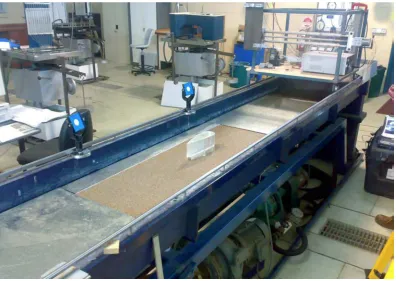
Figure 2.4 shows a typical flume tank setup. Collectively these experiments demonstrate a development of alternative geometrically shaped piers.
One of the most advanced shapes tested was an aerofoil styled cross section (Drysdale 2008). The wake vortices and velocity profile were studied but the horseshoe vortex and sediment transport were not. Dimensions of the pier models were scaled down from those of a real bridge using the Froude scaling method.
[image:32.595.102.498.427.708.2]Christensen (2009) further refined the aerofoil cross section, by adding a vertical slot through its long central axis. The horseshoe vortex, velocity profile and sediment transport were studied. The slot was reported to reduce scouring when compared with a benchmark cylindrical pier.
Figure 2.4 An example of a typical flume tank setup for a physical model
18
2.4
Empirical scour prediction formulas
Many researchers have developed pier scour prediction formulas from the results of experimental laboratory tests using scaled models in a flume tank (FDOT 2005). Most predict the maximum (equilibrium) scour depth. Formulas tend to correlate well with experimental results, but may not necessarily correlate well with larger scale real structures. There is limited field data available for validation with real large scale structures. The Sheppard equation has, however, been tested in some very large flume tanks, which are perhaps at the lower end of real scale structures.
Melville and Chiew (1999) also developed a formula for predicting the time required to achieve the equilibrium condition. The equilibrium condition is when the maximum scour hole depth is achieved and remains constant because the rate of incoming sediment transport equals the rate of outgoing sediment transport.
Zevenbergen (2005) compares results from three often cited scour prediction formulas. The three formulas nominated are:
• HEC-18 equation, • Sheppard equation, and • Melville equation.
Results tend to vary between the three equations. The Melville equation generally predicts the greatest scour (Zevenbergen 2005), while the Sheppard equation generally predicts the least scour.
2.4.1 HEC-18 equation
19 #$
#% = 2.0 *+*,*-.
/ #%0
.12
3+.4- , (2.6)
where:
ys = Scour depth, (m),
y1 = Flow depth directly upstream of the pier, (m), K1 = Correction factor for pier nose shape,
K2 = Correction factor for angle of attack of flow, K3 = Correction factor for bed condition,
a = Pier width, (m),
[image:34.595.103.494.337.558.2]Fr1 = Froude number directly upstream of the pier = V1 / (gy1)0.5, V1 = Mean velocity of flow directly upstream of the pier, (m/s), and g = Acceleration of gravity (9.81 m/s2).
Figure 2.5 Definition diagram for the HEC-18 equation (Arneson et al. 2012).
2.4.2 Sheppard equation
20
0.47 < V/Vc < 1.0, where Vc must be calculated as specified in the manual. Pages
3.4, 3.7 and 3.10 of the manual should be consulted when using the equation in order to determine the appropriate parameters and calculation methods.
The Sheppard equation for clear-water scour is:
5
6∗=2.5 tanh <.6∗0
.4
= >1 − 1.75 <ln CD E=D ,F G 6 ∗
62
0.4 .6∗ 62 0+.,+ 10.6 .6∗ 62 0 .+-K
(2.7) where:
ys = Maximum (equilibrium) scour depth,
y0 = Flow depth directly upstream of the pier, D* = Effective diameter of pier,
D50 = Median diameter of sediment particles,
V = Depth-averaged velocity of flow upstream of the pier, and
Vc = Critical depth-averaged velocity (for sediment motion on a flat bed).
2.4.3 Melville equation
The Melville equation (Melville & Sutherland 1988, eq. 7) is:
L$ *
M*#*L*N*5*O , (2.8) where:
ds = Maximum (equilibrium) scour depth,
D = Pier width (or diameter) normal to flow, KI = Flow intensity,
Ky = Flow depth directly upstream of the pier,
Kd = Sediment size (diameter),
Kσ = Sediment gradation factor,
Ks = Pier shape factor, and
21
The cited journal paper should be consulted for instructions, when using the equation, in order to determine the appropriate correction factor values.
When applied to the physical model and parameter values used in this project the Melville equation gives a maximum scour depth estimation of 0.106 m. Appendix C contains the method and calculations used to determine this result.
2.5
Numerical modelling
Numerical methods and CFD modelling have been developed and applied to the scouring problem within the last few years, but they have generally been limited to a single phase fluid flow.
2.5.1 Tao
Tao (2013) reviews recent developments in one and two phase CFD scouring models. Some explanation of relevant concepts and theories is given. These include: • Turbulence models including k-ε, k-ω, and Reynolds Stress Model (RSM). RSM is available in Fluent and considered to be most accurate (Tao 2013). • Discretisation by finite difference (FDM), finite volume (FVM), and finite elements (FEM). Fluent uses FVM; FEM is not recommended for fluid dynamics.
• For two phase situations, Eulerian models better suit fluid flow, and Lagrangian models better suit particle flow. Eulerian-Eulerian is satisfactory, and Eulerian-Lagrangian is satisfactory, but Lagrangian-Lagrangian is too complex and computationally expensive (Tao 2013). • Meshing; structured or non-structured.
22
Tao et al. (2015) trialled five different pier shapes in a 3-D single phase CFD model using COMSOL software. Some points of interest are:
• The domain was set up in two sections: a long coarsely-meshed first section to establish turbulent flow conditions at the inlet of a finely meshed second section containing the pier.
• Constant velocity at inlet one. • Zero pressure outlet at both outlets. • Non-slip walls at bottom and both sides. • Sliding wall at top water surface.
• Eight mesh boundary layers at the non-slip pier walls. • ~70,000 mesh elements in section two.
• Results were well displayed as velocity streamlines, and shear stress contour diagrams.
2.5.2 Zhu and Liu
Zhu and Liu (2012) modelled cylindrical piers and compared results with the Melville (1975) experiment. The software used was not named, but from the diagrams shown in their paper it does not look like ANSYS Fluent. They used a single phase Reynolds-Averaged Navier-Stokes (RANS) CFD model of flow, with standard k-ε turbulence model, and mathematical sediment transport models. The scour hole was developed by incremental updates of boundary adaptive mesh, based on the sediment transport equations.
They comment that an inlet velocity profile was not available from the test scenario so the model was run without the pier until reaching a stable profile. That profile was then used as the simulation input profile.
23
A number of simplifications were used to reduce computational load:
• Considerably shorter model space length; seven pier diameters before and ten diameters after the pier.
• Domain discretised with hexahedral blocks of non-uniform size; finer mesh in areas of greatest interest around the pier.
• Symmetric wall functions to avoid unnecessary fine meshing.
Results were similar to experimental results, but had a slight difference to the location and shape of the scour hole. They suggest this is because the model does not accurately allow for collapse of the scour hole due to gravity and the angle of repose of the bedding material. This suggests a two phase model should be better.
2.5.3 Xiong et al.
Xiong et al. (2016) modelled cylindrical piers and also compared results with the Melville (1975) experiment. By using an Eulerian two phase model they expected to produce a more reliable scour simulation. Software used was ANSYS Fluent but it appears to have been modified in some way by the “redevelopment function”. The paper mostly explains the methodology and theory behind their method. It does not provide much explanation from a practical modelling point of view, such as the parameter settings used.
Some comments of interest (Xiong et al. 2016) include:
• Each phase has a separate and independent volume fraction and velocity field.
• Solution is based on mass, momentum, and energy conservation equations. • The model space is 20 pier diameters long (6 ahead / 14 behind).
• Mesh is based on a scour influence region; a square of side five diameters. • Inflow for each phase was a pre-set pattern.
24
2016). Full scour development was expected to take about 2.5 hours, so equilibrium scour depth was not achieved. Results at the 30 minute run time were compared with the Melville experiment and considered to be fairly similar, although not identical. Results for a single phase model at 30 minutes run time were also compared; there are no details/description at all for the single phase model. It was concluded results for the two phase model were more accurate than the single phase model. This was taken as proof and justification of a two phase model being “more reliable”.
2.5.4 Knipe
Knipe (2014) used ANSYS Fluent, for a different purpose, in a USQ research project. Floodwater backflow behind a bridge was modelled using a water phase with an air phase above. Discrete analysis components were used in ANSYS workbench rather than complete analysis systems. This was to provide greater flexibility in how ANSYS can be used.
Various parameters associated with meshing and solution setup are mentioned Knipe (2014). Some specific choices are given; however the options are generally trialled to try and achieve the most reasonable results. A body sizing function is used to specify mesh size for specific chosen bodies, differently from other bodies.
2.6
Conclusions of review
Sediment particle characteristics and water flow velocity are the most significant factors in sediment transport. Accelerated water flow, when water is forced to go around an obstruction, is the most significant cause of local scouring.
25
Previous research suggests slotted piers could be prone to debris blockage (Chiew 1992), and loss of performance at oblique approach angles (Kumar et al. 1999).
Most previous numerical modelling focuses on the modelling methods rather than the scouring results. However they usually include a comparison with existing experimental results in order to validate their model. Multiphase models are relatively new and there are very few which model scour around bridge piers.
26
Chapter 3
Methodology
Computer simulations are an efficient way to test bridge designs, when compared to using scale models in a flume tank. They offer a big advantage in that they can easily be altered to test the effect of changes to any of the input parameters. This project develops a computer simulation model to test bridge pier designs.
Computational Fluid Dynamics (CFD) was used to simulate multiphase flows around bridge piers. A commercial software package, ANSYS Fluent, was used.
An existing experimental pier scour trial, conducted with a physical scale model in a flume tank, was replicated as a two-phase CFD model using water and sand phases. This was done because experimental setup and results were available from the literature to validate correct operation of the simulation model. The validated model could then be used to test performance of a new and novel pier design.
The project was developed from a simple initial model and progressively expanded into the final model. Firstly, a 2-D steady-state model, in a horizontal plane, was used to examine the flow velocity around both a circular pier and the new pier design. Next a 2-D transient model, in a vertical plane, was used to examine a normal flow velocity profile and its interaction with a sand bed. Finally, a 3-D transient model was developed to examine flow disturbance and scouring around each of the piers.
3.1
Computer hardware and software
27
from the author’s own computer. The student version (publically available from the ANSYS website) was used instead. The student version is a fully featured version but it has a maximum limit of 512k meshing elements/nodes available (ANSYS 2015). The meshing module can exceed this limit but the limit is enforced by the Fluent simulation module. Accordingly, the models were purposely kept within the meshing limit.
3.1.1 Hardware
The computer used for this project was a workstation class laptop. It was equipped with an Intel i7-6820HQ quad core processor, operating at 2.7 GHz, and eight gigabytes of memory. It was capable of performing the calculations but it was required to run for a very long time while doing so. Calculations could be done in blocks by using a specified number of time steps however these blocks were still typically a number of hours at a time, or overnight. There was a need to estimate how long a certain number of iterations may need to run, and calculations could not be stopped once a new block had commenced.
3.1.2 Software familiarisation and support
At project commencement the author had practically no prior experience with the ANSYS software. Familiarity was initially obtained from online tutorial type materials, and then further developed from experimental use of the program and reference to the user manuals.
28
The ANSYS software package contains on-board help files which include user manuals for each of the specialised modules within the package. The user manuals tend to give brief explanations and assume a certain amount of knowledge is already known, but they are quite helpful. The help files also contain a theory manual which explains some more complex aspects in greater detail.
Independently searching the internet also found some useful information available from various university websites. These include Cornell University, “SimCafe CFD tutorials” (Cornell 2015), and University of Connecticut, “ANSYS tutorial 21, Using the Eulerian Multiphase Model for Granular Flow” (ANSYS 2009).
When attempting to resolve the remote licencing problem, technical assistance was obtained from the USQ IT department and from LEAP Australia (agents for ANSYS in Australia), however they were not able to resolve the problem.
3.1.3 Workbench
The ANSYS software opens in “Workbench” which is a platform from which to open other more specific analysis modules. The other modules used were “Geometry”, “Mesh”, “Fluent”, and “Results”. These modules are available as an analysis system called “Fluid Flow (Fluent)” which groups all four modules together, however this project used the modules as separate entities and manually linked them together. This provided the opportunity to delete/change individual modules if required without losing information in the other modules. This technique was often used, especially with the Fluent module, as the easiest way to recover from having made an error or to ensure settings from a previous trial setup were not retained (Fluent did not always update all data for a new trial).
3.1.4 Geometry
29
domain under analysis, and any physical features within the domain. The physical features include edges, surfaces, and bodies (fluid or solid). Externally created geometry can also be imported from other popular CAD programs.
The geometry required by this project was quite simple so it was drawn within the Geometry module itself, however using the Geometry module is different from using popular CAD software so a workable level of familiarity had to be developed.
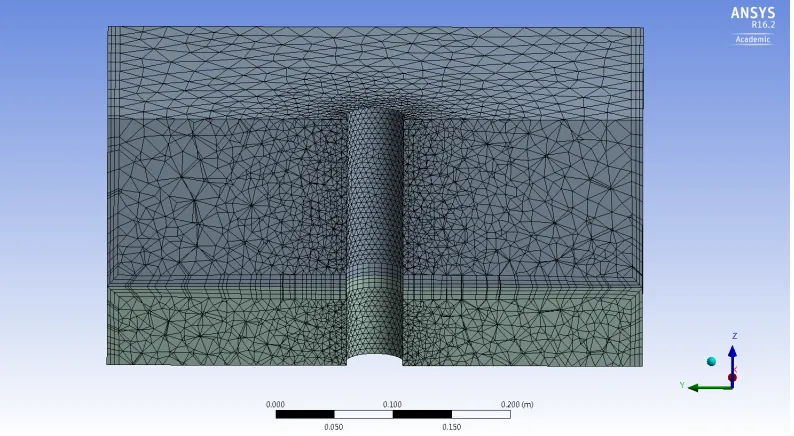
[image:44.595.101.498.449.654.2]The flume geometry was modelled as a full size replica of the physical experimental setup in order to try and reproduce realistic simulation results. The geometry was modelled in several stages with flow passing from one stage to the next through interior interfaces. The separate component parts were all grouped together as a single part, for meshing, so the mesh on each side of the interfaces was perfectly aligned for flow to pass seamlessly through them. The separate component parts allowed flexibility in how the components were utilised. At times some components were suppressed (hidden) in order to minimise mesh cell numbers in use, and computational load required. Figure 3.1 shows a close-up view of the domain in the vicinity of the cylindrical pier.
Figure 3.1 Close-up view of the model domain in the vicinity of the cylindrical
30
The model domain was generally set out the same as the original physical experiment. A Cartesian co-ordinate system (x, y, z) was used, with the origin located at the intersection of sand surface level and pier central vertical axis. Water flow was in the positive x direction. The water inlet was located upstream (at x = -15 m) to allow fully turbulent flow to develop before reaching the pier. The water outlet was located downstream (at x = 4 m) to allow any dislodged sand to settle, and to allow for any pressure backflow effects upstream of the outlet.
The height of the water body was limited to z = 0.15 m deep, the same as water depth in the physical experiment; no provision was made for an air body above the water surface. Lack of an air interface could lead to a slight error because it does not allow any water surface upwelling to occur in front of the pier. The sand body was limited in both length and depth to reduce the number of mesh cells required. Initially length was 0.25 m upstream and downstream of the pier but this was extended to 0.75 m in some later simulations. Depth was z = -0.070 m, which is slightly deeper than scouring experienced in the physical experiment. The sand body is considerably shorter than the water body; therefore the floor of the water body is a false floor, with a surface roughness equal to sand grain diameter, wherever there is no sand body below it.
3.1.5 Mesh
Mesh is a program for meshing the domain of complex fluid and solid geometries. It contains various methods of creating and refining 2-D or 3-D meshes. It can display, check quality and report statistics about the mesh. For convenience it can also attach user friendly names to particular parts of the geometry, such as walls or inlet/outlet etc. Naming specific parts of the geometry can be very helpful for identifying them within the Fluent and Results modules.
31
limit to its maximum computing capacity. For these reasons the domain was minimised wherever possible in order to reduce the number of mesh elements required.
Ideally there should be fine meshing around the pier and the streambed surrounding it. Radiating out from these areas the mesh can progressively grow in element size; this was achieved by using a body sizing function based on the pier itself.
The pier is a solid item and not part of the fluid domain therefore it did not necessarily have to be meshed; at times it was represented as a void space in the fluid domain, with only its outer wall being represented. Meshing the pier was also beneficial at times, such as when there was a desire to alternate that portion of the domain between being fluid or solid (pier absent or present). It was also beneficial when the pier was required for display in the graphical result outputs.
The walls and floor of the flume were represented as non-slip surfaces in order to create friction drag along a boundary layer. In order to accurately simulate the boundary layer effect, edge or surface inflation was used to create finer meshing adjacent to these surfaces. The ceiling (and sometimes the walls) was represented as a symmetry wall. This was to ensure there was a slip surface with no boundary effect. The result was as if the boundary did not exist but the domain continued indefinitely, and it meant fine meshing was not required along the boundary.
32
Figure 3.2 A section view of the sand and water bodies showing fine meshing in
the vicinity of pier, walls and sand surface.
3.1.6 Fluent
Fluent is the analysis module which performs the simulation calculations. There are many sub-models, parameters, variables and options available in this module however only those relevant to this project are mentioned.
Within Fluent, some basic input values have to be specified but many parameters can be chosen from an inbuilt selection of sub-models. Many parameters for which past researchers have developed a functional relationship are available as sub-models; the most generally appropriate of these are often set as the default choice. There may be a choice of several sub-models, and there is usually additional user choices available. User choices include nominating a constant value or a user defined function (UDF).
Fluent contains three broad categories of operations: setup, solution and results.
33
boundary conditions. All simulations in this project used the standard k-ε turbulence model because it was expected to be satisfactory for the simple geometry and because it creates less computational load than other potentially more accurate turbulence models. All multiphase simulations in this project used the Eulerian multiphase model with dispersed phases because the Fluent user manual indicates the Eulerian multiphase model is the only multiphase model which can handle dense granular phases (ANSYS 2015a).
Solution includes specifying time step size for transient simulations, setting initial values for calculations, setting convergence limits for calculation accuracy and running the calculations.
Results allows for visual inspection of particular simulation result parameters displayed graphically on nominated surfaces in the domain. These results are available from within Fluent while it is running the simulation (however the simulation has to be stopped at the time). This is handy for periodically checking if the simulation is progressing as expected.
3.1.7 Results
The Results module, also known as “CFD Post”, is used to process result data after the simulation run has finished; this is referred to as post-processing. It has similarities with the results section in the Fluent module but it seems to be more user friendly, have a better graphics quality and be more flexible in how it can present outputs.
34
display can also be difficult because the surface is not clearly defined and not located on a particular plane surface. An isosurface can be created to display an irregular surface at any locations where a specified value of a specified variable exists.
3.2
New pier design
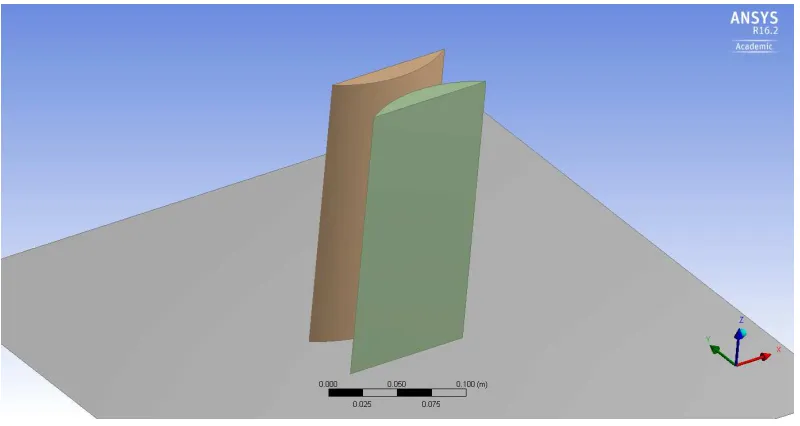
A new pier cross-sectional geometry (Figure 3.3) is proposed, as a further development of shapes already tested by previous researchers. The aim of the new shape is to prevent, or at least minimise, acceleration of water flow as it is forced to divert around an obstruction such as a bridge pier. This would be achieved by purposely forcing water flow to pass through the centre of the pier rather than diverting around the outside of it.
35
Figure 3.3 The new slotted pier design, aligned with stream flow direction.
The new pier used in the project has the same cross-sectional area as the cylindrical pier so that when used as a substitute it should provide the same compressive load bearing capacity. The overall width, normal to flow direction, is also the same as the cylindrical pier. This is in order to make a reasonable comparison of flow obstruction between the two pier designs. In order to have the same cross-sectional area, the new pier is longer in the flow direction however this is not expected to produce any adverse effects.
3.3
Experimental process
To develop a simulation model which replicates the original physical experiment an experimental approach was used. Parameter values and sub-model functions were selected in Fluent and trial simulation runs were conducted. Results were examined to see if they resembled the real situation.
36
results could be observed. However the correct settings may require a combination of changes. Where possible informed judgement was used when changing settings, but at times a radical change was made to test how it would affect the outcome. The Fluent user manual was often consulted however it does not usually give explicit recommendations applicable to any particular situation.
Most existing tutorials and research projects were of only limited use as guidance because they had different objectives to this project. They usually expected or even intended for the granular sand phase to be moving relatively quickly in situations such as slurry transport, mixing tanks or sedimentation. In contrast this project requires the granular sand phase to generally remain stationary in the presence of flowing water, except for within the localised turbulent region around a pier. In this project, where sand movement is expected to occur it is expected to happen very slowly.
Simplified versions of the models were used at times to try and narrow down reasons for not achieving desired results. Keeping the situation as simple as possible reduced run times and made changes in results more obvious. The experimental process was difficult because trial runs take a long time before any results or change in results can be seen. Ideally, duration of trial runs should be for at least a full residence time to allow calculations to stabilise and produce meaningful results. Residence time is the time required for a particle entering the inlet to pass along the full length of domain and appear at the outlet.
While there was a desire to keep the model simpler, smaller and quicker, there was also a realisation that going too far with simplification could adversely affect the accuracy of results. It was observed that if mesh cells were made too large accuracy was reduced. It was also observed that if time steps were made too large, in order to speed up calculations, the simulation would become unstable and produce blatantly unrealistic results. In the worst cases the simulation would suffer a fatal and irrecoverable error.
37
that wave propagation (water flow velocity in this case) can not travel further than one mesh element in a single time step (Chadwick et al. 2004). Care must be taken when considering this because water velocity varies throughout parts of a turbulent simulation and the mesh size is quite small in parts of the domain.
When using a fine mesh in order to produce more accurate results it was necessary to also use small time steps, and that in turn created long run times. Therefore it took a very long time to see if a setting change was beneficial or not.
In 3-D models, trying to achieve realistic sand behaviour in the presence of flowing water was the biggest problem. There was a need to prove the model would work properly before it could be used on the new pier design.
3.4
Input data
3.4.1 Physical parameters
The physical input parameter values used are the same as for the Melville (1975) experiment described in section 2.3.1 of this dissertation. They are:
• Flume = 45.6cm wide x 44 cm deep x 19m long. 12.7cm false floor depth. • Bed slope (S0) = 0.0001.
• Flow depth (y0) = 15cm.
• Inlet mean velocity (V0) = 0.25 m/s. • Discharge (Q) = 17.12L/s.
• Pier = 5.08cm diameter (1/9 width ratio).
38
3.4.2 Normal flow conditions
Mean bed shear stress is calculated as:
= (3.1)
= 1000 × 9.81 × 0.15 × 0.0001 = 0.147 kg m-1 s-2.
Friction velocity is calculated as:
∗ = = (3.2)
= √9.81 × 0.15 × 0.0001 = 0.0121 m s-1.
The entrainment function is calculated as:
T
LUT (3.3)
.+4V
,12 + ×W.X+× . -X2
= 0.0236 (unitless).
The shear Reynolds number is calculated as:
∗ = !∗L"UT (3.4)
= . +,+× .+. -×+ YZ-X2
39
Referring to the Shields diagram, the Fs and Re* values plot below the Shields function curve, therefore the sand will be stable under normal flow conditions.
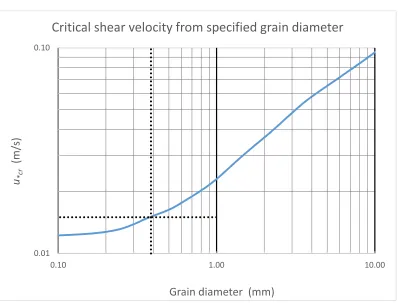
The Shields diagram is indirectly used to determine the critical friction velocity, at the threshold of motion, for a given grain size. The Shields diagram requires values of entrainment function and shear Reynolds number as inputs, however formulas for both of these values also require the unknown critical friction velocity as an input. Solution requires an initial estimate followed by an iterative refinement process. The correct critical friction velocity solution is confirmed when co-ordinate values of entrainment function and shear Reynolds number plot exactly on the Shields function line.
40
Figure 3.4 Chart prepared for estimation of critical shear velocity at threshold
conditions; demonstrated for the 0.385 mm nominated grain size.
Melville & Sutherland (1988, eq. 2) indicate the critical shear velocity can be converted to a critical mean stream flow velocity (Uc) using the formula:
[ = ∗ × 5.75 log .5.53 #T
LUT0 (3.5)
0.015 × 5.75 log .5.53 . .+2-X20
= 0.288 m s-1.
Estimates of both critical shear velocity and critical mean stream velocity are both higher than actual values present in the normal flow of this model situation. This also confirms the given grain size will be stable under normal flow conditions.
0.01 0.10
0.10 1.00 10.00
u*
c
r
(m
/s
)
Grain diameter (mm)
41
3.5
2-D steady-state model
A 2-D steady-state single-phase model, in a horizontal plane, was created first because it was a fairly simple form of model to begin with. It was used to examine and compare velocity profiles and pressure distributions for the empty domain space, the model domain with cylindrical control pier, and the model domain with the new pier geometry. Neither the limit on cell mesh numbers, or computational runtime, were a problem in these 2-D models.
The first stage, of 14.75m length, was moderately meshed for development of turbulent inflow. The second stage, of 0.5m length, was finely meshed to study interactions around piers. The third stage, of 3.75m length, was moderately meshed to allow for turbulent outflow. All stages used edge inflation to provide finer meshing along the flume walls in order to accurately simulate boundary effects.
3.5.1 Empty domain space
The full flume length was modelled to allow realistic turbulent flow development, and to determine the velocity profile due to boundary effects. Smooth (zero roughness height) standard no slip walls were used. Convergence residual monitors were set at 1E-6. Initialisation was at water x-velocity of 0.25 m/s.
A contour plot of velocity profile (Figure 3.5) shows a friction boundary layer at the tank walls. Frictional drag slows the boundary layer down to zero velocity at the wall surface. Due to mass conservation, velocity in the centre of the flume is slightly accelerated beyond the nominal input velocity, so a velocity profile exists across the tank width. The plot suggests at least 10 m flume lengths are required for development of a stable velocity profile. A velocity profile was recorded at 14.75 m distance from the inlet so it could be used as an inlet velocity profile in subsequent shorter model domains. A maximum velocity of 0.283 m/s was observed.
42
Figure 3.5 Water velocity profile in a horizontal plane across the width of the
43
3.5.2 Cylindrical pier
The cylindrical pier was modelled in a reduced flume length. The longer length of stage one was suppressed leaving only stages two and three. Smooth (zero roughness height) standard no slip walls were used. Convergence residual monitors were set at 1E-6. The velocity profile recorded from the empty flume was used as an inlet velocity profile at the start of stage two. Initialisation used parameter values, from the inlet profile, present at the water inlet.
3.5.3 New pier design
The new slotted pier was modelled in a reduced flume length, similarly to the cylindrical pier. The velocity profile recorded from the empty flume was again used as the inlet velocity profile, and for initialisation.
3.6
2-D transient model
A 2-D transient model was created after initial attempts to run a 3-D transient model were found to be unsuccessful and were taking a very long time to run. The 2-D model is a vertical slice through the central longitudinal axis of a 3-D model. It is a multiphase model with water as the primary phase and sand as the secondary phase. As a 2-D model it used a lower number of mesh cells and could therefore run much faster and provide meaningful results much sooner.
The model was used to examine the effects of setting changes on sand movement. This was first