Systematic Clustering-based Microaggregation for Statistical Disclosure Control
Md Enamul Kabir, Hua Wang Department of Mathematics and Computing
University of Southern Queensland Toowoomba, QLD 4350, Australia Emails: {kabir, wang}@usq.edu.au
Abstract—Microdata protection in statistical databases has recently become a major societal concern. Microaggregation for Statistical Disclosure Control (SDC) is a family of methods to protect microdata from individual identification. Microag-gregation works by partitioning the microdata into groups of
at leastkrecords and then replacing the records in each group
with the centroid of the group. This paper presents a clustering-based microaggregation method to minimize the information loss. The proposed technique adopts to group similar records together in a systematic way and then anonymized with the centroid of each group individually. The structure of systematic clustering problem is defined and investigated and an algorithm of the proposed problem is developed. Experimental results show that our method attains a reasonable dominance with respect to both information loss and execution time than the most popular heuristic algorithm called Maximum Distance to Average Vector (MDAV).
Keywords-Privacy; Microaggregation; Microdata protection;
k-anonymity; Disclosure control;
I. INTRODUCTION
In recent years, the phenomenal advance technological developments in information technology enable govern-ment agencies and corporations to accumulate an enormous amount of personal data for analytical purposes. These agencies and organizations often need to release individual records (microdata) for research and other public benefit purposes. This propagation has to be in accordance with laws and regulations to avoid the propagation of confidential information. In other words, microdata should be published in such a way that preserve the privacy of the individuals. To protect personal data from individual identification, SDC is often applied before the data are released for analysis [2], [20]. The purpose of microdata SDC is to alter the original microdata in such a way that the statistical analysis from the original data and the modified data are similar and the disclosure risk of identification is low. As SDC requires to suppress or alter the original data, the quality of data and the analysis results can be damaged. Hence, SDC methods must find a balance between data utility and personal confidentiality.
Microaggregation is a family of SDC methods for pro-tecting microdata sets that have been extensively studied recently [3], [4], [6], [7], [10], [11]. The basic idea of
microaggregation is to partition a dataset into mutually exclusive groups of at leastk records prior to publication, and then publish the centroid over each group instead of indi-vidual records. The resulting anonymized dataset satisfiesk -anonymity [17], requiring each record in a dataset to be iden-tical to at least (k−1) other records in the same dataset. As releasing microdata about individuals poses a privacy threat due to the privacy-related attributes, called quasi-identifiers, both k-anonymity and microaggregation only consider the quasi-identifiers. Microaggregation is traditionally restricted to numeric attributes in order to calculate the centroid of records, but also been extended to handle categorical and ordinal attributes [4], [7], [18]. In this paper we proposed a microaggregated method that also only applicable for the numeric attributes.
The effectiveness of a microaggregation method is mea-sured by calculating its information loss. A lower infor-mation loss implies that the anonoymized dataset is less distorted from the original dataset, and thus provides better data quality for analysis. k- anonymity [16], [17] provides sufficient protection of personal confidentiality of microdata, while to ensure the quality of the anonymized dataset, an effective microaggregation method should incur information loss as minimum as possible. In order to be useful in practice, the dataset should keep as much informative as possible. Hence, it is necessary to consider deeply the tradeoff between privacy and information loss. To minimize the information loss due to microaggregation, all records are partitioned into several groups such that each group contains at least k similar records and then the records in each group are replaced by their corresponding mean such that the values at each variable are the same. In the context of data mining, clustering is a useful technique that partitions records into groups such that records within a group are similar to each other, while records in different groups are most distinct from one another. So microaggregation can be seen as a clustering problem with constraints on the size of the clusters.
clustering method of Ward et al. [19]. Domingo-Ferrer and Torra [5], [6] proposed a microaggregation method based on the fuzzyc-means algorithm [1], and Laszlo and Mukherjee [12] extended the standard minimum spanning tree parti-tioning algorithm for microaggregation [21]. All of these microaggregation methods build all clusters gradually but simultaneously. There are some other methods for microag-gregation that have been proposed in the literature that build one cluster at a time. Notable examples include Maximum Distance [14], Diameter-based Fixed-Size microaggregation and centroid-based Fixed-size microaggregation [12], Maxi-mum Distance to Average Vector (MDAV) [3], MHM [8] and the Two Fixed Reference Points method [22]. Most recently, Lin et al. [23] proposed a density-based microaggregation method that forms records by the descending order of their densities, then fine-tunes these clusters in reverse order.
All the works stated above proposed different microag-gregation algorithms to form the clusters, where within clusters the records are homogeneous but between clusters the records are heterogeneous such that information loss is low. However, no single microaggregation method outper-form other methods in terms of inoutper-formation loss. This work presents a new clustering method for microaggregation, where all clusters are made simultaneously in a systematic way. According to this method, sort all records by using a sorting function and partitions all records into[nk] clusters, where n is the total number of records and k is the k -anonymity parameter. Randomly select a recordrfrom first k records to form the first cluster and the first records of the subsequent clusters form in a systematic way. Then adjusts the records in each cluster in a systematic way such that each cluster contains at least k records. Performance of the proposed method is compared against the MDAV [3] as MDAV is the most widely used microaggregation method. The experimental results show that the proposed microaggregation method outperforms MDAV with respect to both information loss and computational efficiency.
The reminder of this paper is organized as follows. Section II introduces the basic concept of microaggregation. Section III reviews previous microaggregation methods. We present a brief description of our proposed microaggregation method in Section IV. Section V shows experimental results of the proposed method. Finally, concluding remarks are included in Section VI.
II. BACKGROUND
Microdata protection through microaggregation has been intensively studied in recent years. Many techniques and methods have been proposed to deal with this problem. In this section we describe some fundamental concepts of microaggregation.
When we microaggregate data we should keep in mind two goals, data utility and preserving privacy of individuals. For preserving the data utility we should introduce as little
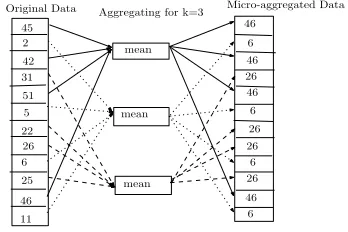
noise as possible into the data and for preserving privacy data should be sufficiently modified in such a way that it is difficult for an adversary to reidentify the corresponding individuals. Figure 1 shows an example of microaggregated data where the individuals in each cluster are replaced by the corresponding cluster mean. The figure shows that after ag-gregating the chosen elements, it is impossible to distinguish them, so that the probability of linking any respondent is inversely proportional to the number of aggregated elements.
5 2
11 6 25 22 31
26 45
42
51
46
6
6
6
6 26
26 26
26 46
46
46
46 mean
mean
mean
[image:2.612.349.523.194.310.2]Original Data Aggregating for k=3 Micro-aggregated Data
Figure 1. Example of Microaggregation using mean
Consider a microdata setT withpnumeric attributes and nrecords, where each record is represented as a vector in a p-dimensional space. For a given positive integer k ≤ n, a microaggregation method partitions T into g clusters where each cluster contains at leastk records (to satisfyk -anonymity), and then replaces the records in each cluster with the centroid of the cluster. Letni denote the number of records in theith cluster, andxij,1≤j≤ni, denote the jth record in theith cluster. Then,ni≥kfori= 1tog, and
∑g
i=1ni=n. The centroid of theith cluster, denoted byxi¯ is calculated as the average vector of all the records in the ith cluster. In order to determine whether two records are similar, a similarity function such as the Euclidean distance, Minkowski distance or Chebyshev distance can be used. A common measure is the Sum of Squared Errors (SSE). The SSE is the sum of squared distances from the centroid of each cluster to every record in the cluster, and is defined as:
SSE=
g
∑
i=1
ni
∑
j=1
(xij−x¯i)
′
(xij−x¯i) (1)
Definition 1 (Microaggregation problem) Given a dataset T of n elements and a positive integer k, find a partitioningG={G1, G2, ..., Gg}of T such that
1) Gi∩Gj = Φ, for alli̸=j= 1,2, ..., p, 2) ∪pi=1Gi=T,
3) SSE is minimized,
4) for allGi∈T,|Gi|≥k for anyGi∈G.
The microaggregation problem stated above can be solved in polynomial time for a univariate dataset [11] but has been shown to be NP hard for multivariate dataset [13]. It is a natural expectation thatSSEis low if the number of clusters is large. Thus the number of records in each cluster should be kept close to k. Domingo-Ferrer and Mateo-Sanz [3] showed that no cluster should contain more than (2k−1)
records since such clusters can always be partitioned to further reduce information loss.
III. PREVIOUSMICROAGGREGATIONMETHODS Previous microaggregation methods have been roughly divided into two categories, namely fixed-size and data-oriented microaggregation [3], [8]. For fixed-size microag-gregation, the partition is done by dividing a dataset into clusters having size k, except perhaps one cluster which has size between k and (2k−1), depending on the total number of records n and the anonymity parameter k. For the data-oriented microaggregation, the partition is done by allowing all clusters having sizes between k and(2k−1). Intuitively, fixed-size methods reduce the search space, and thus are more computationally efficient than data-oriented methods [23]. However, data-oriented methods can adapt to different values ofkand various data distributions and thus may achieve lower information loss than fixed-size methods. Domingo-Ferrer and Mateo-Sanz [3] proposed a mul-tivariate fixed-size microaggregation method, later called Maximum Distance (MD) method [14]. The MD method repeatedly locates the two records that are most distant to each other, and forms two clusters with their respective
(k−1)nearest records until fewer than2krecords remain. If there are at leastkrecords remain then form a new cluster with all remaining records. Finally when there are fewer than krecords not assigned to any cluster yet, this algorithm then individually assigns these records to their closest clusters. This method has a time complexity ofO(n3)and works well for most datasets. Laszlo and Mukherjee [12] modified the last step of the MD method such that each remaining record is added to its own nearest cluster and proposed Diameter-based Fixed-size microaggregation. This method is however not a fixed size method because it allows more than one cluster to have more thankrecords.
The MDAV method is the most widely used microaggre-gation method [14]. Similar to MD method, this algorithm choose two records and form two clusters with the chosen records and their respective(k−1) nearest records. MDAV
finds the recordrthat is furthest from the current centroid of the dataset, and the recordsthat is furthest fromr. Then form a cluster with r and its (k−1) nearest records and form another cluster with s an its (k−1) nearest records. For the remaining records, repeat this process until fewer than3krecords remain. If between2kand(3k−1)records remain, then find the record r that is furthest from the centroid of the remaining records and form a cluster with r and its (k−1) nearest records and another cluster with the remaining records. Finally when there are fewer than
2k records remain, this algorithm then form a new cluster with all the remaining records. Laszlo and Mukherjee [12] proposed another method, called Centroid-based Fixed-size microaggregation that also bases on centroid but builds only one cluster during each iteration. This method is not a fixed-size method as more than one cluster to have more thank records. Changet al.[22] proposed the Two Fixed Reference Points (TFRP) method to accelerate the clustering process of k-anonymization. During the first phase, TFRP selects two extreme points calculated from the dataset. Let Nmin andNmax be the minimum and maximum values over all attributes in the datasets, respectively. Then one reference pointG1hasNminas its value for all attributes, and another reference pointG2 hasNmax as its value for all attributes. A cluster of k records is then formed with the record r that is the furthest fromG1 and the (k−1) nearest records tor. Similarly another cluster of k records is formed with the recordsthat is the furthest fromG2 and (k−1) nearest records tos. These two steps are repeated until fewer thank records remain. Finally, these remaining records are assigned to their respective nearest clusters.This method is quite efficient as G1 and G2 are fixed throughout the iterations. After generating all clusters, TFRP applies a refinement step to determine whether a cluster should be retained or decomposed and added to other clusters. Domingo-Ferrer et al.[9] proposed a multivariate microaggregation method calledµ-Approx. This method first builds a forest and then decomposes the trees in the forest such that all trees have sizes betweenk and max(2k−1,3k−5). Finally, for any tree with size greater than (2k−1), find the node in the tree that is furthest from the centroid of the tree, form a cluster with this node and its (k−1) nearest records in the tree, and form another cluster with the remaining records in the tree.
IV. THEPROPOSEDAPPROACH
This section presents the proposed systematic clustering-based algorithm for microaggregation that minimizes the information loss and satisfy the k-anonymity requirement. The proposed approach builds and refines all clusters simul-taneously.
A. Sorting Function
Table I
SYSTEMATIC CLUSTERING-BASED MICROAGGREGATION ALGORITHM
Input: a datasetT ofnrecords and a positive integerk
Output: a partitioningG={G1, G2, ..., Gg}ofT
whereg=|G|andGi≥kfori= 1tog.
1. Sort all records inT in ascending order by using the SF in equation (2);
2. Letg:= int⌊nk⌋;
3. Get randomlykdistinct recordsr1, r2, ..., rkfrom first1tok;
4. Letxijis thejthrecord in theithcluster;
5. Fori= 1to g;
6. Letxi1:=T[r1+k(i−1)];
7. Nexti; 8. Forj:= 2tok; 9. Fori:= 1tog;
10. LetILi: = InfoLoss(T[rj+k(i−1)]);
11. LetN:= Find cluster number with lowestILi;
12. where cluster size≤k; 13. AddT[rj+k(i−1)]togn;
14. Nexti; 15. Nextj;
16. Lete:= (n−gk);
17. Find extra elementE1, E2, ..., Ee∈E;
18. Fork:= 1toe; 19. Form:= 1tog;
20. LetILm:=InfoLoss(Ek) in clusterm;
21. Nextm;
22. LetN:=Find cluster with lowestIL; 23. AddEktogn;
24. Nextk;
a sorting function to sort all the records in the dataset. Consider a microdata set T with p numeric attributes, namely Y1, Y2, ..., Yp and n records. Thus each record is represented as a vector in ap-dimensional space. To sort all the records with respect to the numeric attributes, we define thejth sorted record in the dataset T is as follows:
SFj=
p
∑
i=1
(yij−yi¯), j = 1,2..., n. (2)
where,yij is thejth record of theith attribute andyi¯ is the centroid of theith attribute. The SF stated above measures the distance between the records and their corresponding centroid. In this study, the SF are arranged in ascending order indicating records are arranged in order of magnitude. The lower the values of SF, the records are below their respective centroid and the higher the values of SF, the records are above their respective centroid. Thus the records in the datasetT sorted in ascending order based on the SF and the first and the last record are most distant among all other records in the datasetT.
B. Systematic microaggregation algorithm
Based on the information loss measure in equation (1) and the definition of microaggregation problem, we are now ready to discuss the systematic clustering-based microag-gregation algorithm. The general idea of the algorithm is as follows.
According to this method first sort all records in ascending order by using the sorting function in equation (2). Then identify the equivalence class and the number of clusters by,g = n
k, where n is the total number of records in the dataset T, k is anonymity parameter fork-anonymization. Round this as integer and randomly select a recordri from first k records as seed to form the first cluster. If there are g clusters to be formed then select the (ri + k)th,
(ri + 2k)th,..., {ri+ (g−1)k}th records in a systematic way to form 2nd, 3rd, ..., gth cluster respectively. Select another record rj(j ̸=i) from the first k records and add this record to the cluster which causes least information loss. Similar in a systematic way select(rj+k)th,(rj+ 2k)th,..., {rj + (g −1)k}th records and add these records to their respective clusters that cause least information loss. If any cluster size is exactly k, stop adding records to that cluster and continue the same process until all records of first k records finish. If n is not exactly divisible by k and still there are some records left, add these records to their closest clusters that incur least information loss. Systematic microaggregation algorithm endeavor to build all clusters simultaneously, whereas most of the microaggregation algo-rithms in the literature build one/two cluster(s) at a time. The algorithm selects first record randomly and the subsequent records from in a systematic way. As the records in the dataset T are arranged in ascending order and the first record of each cluster forms in everykth distance, the first record of each cluster contains non identical value, so this algorithm easily captures if there are any extreme values in the dataset. The systematic microaggregation algorithm is shown in Table I.
Definition 2 (Systematic clustering-based microaggre-gation decision problem)In a given datasetT ofnrecords, there is a clustering schemeG={G1, G2, ..., Gg}such that 1) | Gi |≥ k,1 < k ≤ n: the size of each cluster is
greater than or equal to a positive integerk, and 2) ∑gi=1IL(Gi)< c, c >0: the total information loss of
the clustering scheme is less than a positive integer c. where each cluster Gi(i = 1,2, ..., p) contains the records that are more similar to each other such that the cluster means are close to the values of the clusters and thus causes least information loss.
V. EXPERIMENTALRESULTS
The objective of our experiment is to investigate the recital of our approach in terms of data quality and the computa-tional efficiency. This section experimentally evaluates the effectiveness and efficiency of the systematic clustering-based microaggregation algorithm. For this purpose, we uti-lize a real dataset CENSUS1containing personal information of500thousands American adults. The dataset has9discrete attributes.
5 10 15 20 25 30 35 0 500 1000 1500 2000 2500 3000
k−value and Information loss(n=10,000, p=2 )
k T otal inf or mation Loss MDAV Systematic clustering
5 10 15 20 25 30 35 500 1000 1500 2000 2500 3000
k−value and Information loss(n=10,000, p=3 )
k
T
otal inf
or
mation Loss
5 10 15 20 25 30 35 1500 2000 2500 3000 3500 4000 4500
k−value and Information loss(n=10,000, p=4 )
k T otal inf or mation Loss MDAV Systematic clustering
5 10 15 20 25 30 35 2000 3000 4000 5000 6000 7000
k−value and Information loss(n=10,000, p=5 )
k T otal inf or mation Loss MDAV Systematic clustering
5 10 15 20 25 30 35 0
50000 100000 150000
k−value and Information loss(n=10,000, p=6 )
[image:5.612.62.286.72.394.2]k T otal inf or mation Loss MDAV Systematic clustering
Figure 2. Information Loss comparison for no. of attributes between 2 and 6
To accurately evaluate our approach, the performance of the proposed algorithm is compared in this section with MDAV [3] as until now MDAV is the most widely used mi-croaggregation method. For the experiment we have selected
10thousands records randomly from the whole dataset and run the experiment for k = 5,10, ...,35 and for different situations of number of attributes,p= 2,3, ...,6.
A. Data Quality and Efficiency
In this section, we report experimental results on the systematic clustering-based microaggregation algorithm for data quality and execution efficiency. In this paper, SSE defined in equation (1) is used to measure the information loss due to microaggregation.
Figure 2 reports the information loss of both the MDAV and the systematic clustering-based microaggregation algo-rithms for increasing the values ofk andp, wherepis the number of attributes in the dataset. With the increase of k, the information loss is increasing for both the algorithms. As the figure illustrates, the systematic clustering-based microaggregation algorithm results in the least cost of the information loss for both allkandpvalues. The superiority of our algorithm over the MDAV algorithm results from
5 10 15 20 25 30 35 5 10 15 20 25 30
k−value and Execution Time(n=10,000, p=2 )
k
Ex
ecution Time (sec.)
5 10 15 20 25 30 35 5 10 15 20 25 30
k−value and Execution Time(n=10,000, p=3 )
k
Ex
ecution Time (sec.)
MDAV Systematic clustering
5 10 15 20 25 30 35 5 10 15 20 25 30
k−value and Execution Time(n=10,000, p=4 )
k
Ex
ecution Time (sec.)
MDAV Systematic clustering
5 10 15 20 25 30 35 5 10 15 20 25 30 35
k−value and Execution Time(n=10,000, p=5 )
k
Ex
ecution Time (sec.)
MDAV Systematic clustering
5 10 15 20 25 30 35 5 10 15 20 25 30 35 40
k−value and Execution Time(n=10,000, p=6 )
k
Ex
ecution Time (sec.)
MDAV Systematic clustering
Figure 3. Running time comparison using census datset for no. of attributes between 2 and 6
2000 4000 6000 8000 10000 0 5 10 15 20 25 30
Cardinality and Execution Time(p=6, k=10 )
Cardinality
[image:5.612.323.547.73.394.2]Execution Time (sec.)
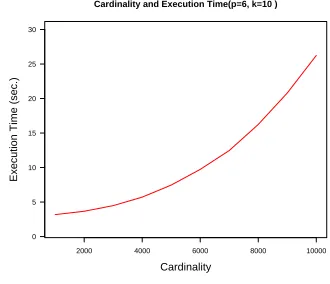
Figure 4. Cardinality and Runtime
the fact that our algorithm easily captures if there are any extreme values because of sorting function and the systematic way of selecting records in the clusters.
[image:5.612.348.513.448.590.2]algorithm with all different scenarios are much lesser than the MDAV algorithm for almost all values of k. However, as shows in Figure 3, for some moderate values of k, the running time of the proposed algorithm is little bit more (in some situations) than the MDAV. We believe that that is still acceptable in practice considering its better performance with respect to the information loss.
B. Scalability
Figure 4 shows the execution time behaviors of the systematic clustering-based microaggregation algorithm for various cardinalities with p = 6 and k = 10. For this experiment we used subsets of the Census dataset with different sizes. As shown, the running time increases almost linearly with the size of the dataset for our proposed al-gorithm. Again the proposed algorithm introduces the least information loss for any p and k. This shows that our approach preserves the quality of the data and is highly scalable.
ACKNOWLEDGEMENTS
The authors thankfully acknowledge vavuable contribution of Mr. Xiaoxun Sun for assistance with the experiments.
VI. CONCLUSION
Microaggregation is an effective method of protecting privacy in microdata. This work presents a new systematic clustering-based microaggregation method for numerical at-tributes. The new method consists of clustering individuals records in microdata in a number of disjoint clusters in a systematic way prior publication and then publish the mean over each cluster instead of individual records. A comparison is made on the proposed algorithm with the most widely used microaggregation method, called MDAV through experiment. In the microaggregation problem, the performance of a method is judged by both information loss and the running time. A method that incurs less information loss and has less execution time is the powerful method. The experimental results show that the proposed algorithm has a significantly reasonable dominance over the MDAV with respect to both information loss and execution time. Finally it has shown by experiment that the proposed algorithm is highly scalable.
REFERENCES
[1] J.C. Bezdek,Pattern recognition with fuzzy objective function
algorithms.Norwell, MA: Academic Publishers, 1981.
[2] J. Domingo-Ferrer and V. Torra, “Privacy in data mining,”Data
Mining and Knowledge Discovery,vol. 11, no. 2, pp. 117–119,
2005.
[3] J. Domingo-Ferrer and J. Mateo-Sanz, “Practical data-oriented microaggregation for statistical disclosure control,” IEEE
Transactions on Knowledge and Data Engineering, vol. 14,
no. 1, pp. 189-201, 2002.
[4] J. Domingo-Ferrer and V. Torra, “Extending microaggrega-tion procedures using defuzzificamicroaggrega-tion methods for categorical variables,” in Proc. 1st international IEEE symposium on
intelligent systems, Verna, Sept. 2002,pp. 44–49.
[5] J. Domingo-Ferrer and V. Torra, “Towards fuzzyc-means based microaggregation,” in Soft methods in probability, statistics
and data analysis,P. Grzegorzewski, O. Hryniewicz and M.A.
Gil, Eds. Heidelberg: Physica-Verlag, 2002, Advances in soft computing, vol. 16, pp. 289-294.
[6] J. Domingo-Ferrer and V. Torra, “Fuzzy microaggregation for microdata protection,” Journal of Advanced Computational
Intelligence and Intelligent Informatics,vol. 7, no. 2, pp.
153-159, 2003.
[7] J. Domingo-Ferrer and V. Torra, “Ordinal, continuous and heterogeneous kanonymity through microaggregation,” Data
Mining and Knowledge Discovery,vol. 11, no. 2, pp. 195-212,
2005.
[8] J. Domingo-Ferrer, A. Martinez-Balleste, J.M. Mateo-Sanz and F. Sebe, “Efficient multivariate data-oriented microaggrega-tion,”The VLDB Journal,vol. 15, no. 4, pp. 355-369, 2006.
[9] J. Domingo-Ferrer, F. Sebe and A. Solanas, “A polynomial-time approximation to optimal multivariate microaggregation,”
Computer and Mathematics with Applications,vol. 55, no. 4,
pp. 714-732, 2008.
[10] J.-M. Han, T.,-T. Cen, H.-Q. Yu and J. Yu, “A multivari-ate immune clonal selection microaggregation algorithm,” in Proc. IEEE international conference on granular computing,
Hangzhou, Feb. 2008,pp. 252-256.
[11] S. Hansen and S. Mukherjee, “A polynomial algorithm for optimal univariate microaggregation,” IEEE Transactions on
Knowledge and Data Engineering, vol. 15, no. 4, pp.
1043-1044, 2003.
[12] M. Laszlo and S. Mukherjee, “Minimum spanning tree parti-tioning algorithm for microaggregation,”IEEE Transactions on
Knowledge and Data Engineering,vol. 17, no. 7, pp. 902-911,
2005.
[13] A. Oganian and J. Domingo-Ferrer, “On the complexity of optimal microaggregation for statistical disclosure control,” Statistical Journal of the United Nations Economic
Commis-sion for Europe,vol.18, 345-354, 2001.
[14] A. Solanas, “Privacy protection with genetic algorithms,”
in Success in evolutionary computation, A. Yang, Y. Shan
and L.T. Bui, Eds. Heidelberg: Springer, 2008, Studies in Computional Intelligence, vol. 92, pp. 215-237.
[15] A. Solanas, A. Martinez-Balleste and J. Domingo-Ferrer,
“V−M DAV: A multivariate microaggregation with variable
group size,” inProc. 17th COMPSTAT Symposium of the IASC, Rome, Aug. 2006.
[16] P. Samarati, “Protecting respondent’s privacy in microdata release,” IEEE Transactions on Knowledge and Data
[17] L. Sweeney, “k-Anonymity: A model for protecting pri-vacy,” International Journal on Uncertainty, Fuzziness and
Knowledge-based Systems,vol. 10, no. 5, pp. 557-570, 2002.
[18] V. Torra, “Microaggregation for categorical variables: A me-dian based approach,” inPSD 2004,J Domingo-Ferrer and V. Torra, Eds. Heidelberg: Springer, 2004, LNCS, vol. 3050, pp. 162-174.
[19] J.H.J. Ward, “Hierarchical grouping to optimize an objective function,”Journal of the American Statistical Association,vol. 58, no. 301, pp. 236-244, 1963.
[20] L. Willenborg and T.D. Waal, “Elements of statistical disclo-sure control,”Lecture notes in statistics,vol. 155, 2001.
[21] C.T. Zahn, “Graph-theoretical methods for detecting and describing gestalt clusters,”IEEE Transactions on Computers, vol.C-20, no. 1, pp. 68-86, 1971.
[22] C.-C. Chang, Y.-C. Li and W.-H. Huang, “TFRP: An efficient microaggregation algorithm for statistical disclosure control,”
Journal of Systems and Software, vol. 80, no. 11, pp. 1866–
1878, 2007.
[23] J.-L. Lin, T.-H. Wen, J.-C. Hsieh and P.-C. Chang, “Density-based microaggregation for statistical disclosure control,”
Ex-pert Systems with Applications,vol. 37, no. 4, pp. 3256–3263,