International Journal of Innovative Technology and Exploring Engineering (IJITEE) ISSN: 2278-3075, Volume-8 Issue-10, August 2019
Abstract: Precision agriculture can enable the vision of smart agriculture, improves the crop productivity and increases profitability of yields. Utilization of water is also an important criterion for a good agriculture and high production. The new dimension of smart farming in agriculture is Internet of Things. The IoT is a best solution for smart agriculture due to the use of interoperable, pervasive, scalable and open technologies and gained momentum in the field of agriculture. The advanced growth in IoT technologies even made the dream come true with the connectivity reached to rural areas. The use of highly accurate IoT sensors can measure the environmental context of farms and helps in improving the accuracy of precision agriculture. This paper reviews the various applications of IoT motivated by a purpose to identify various areas with latest trends, architecture frameworks. Selected papers were clustered based on various domain and subdomains corresponding to the usage of sensors, actuators, communication technologies, energy controls, storage solutions, data analysis for decision making and visualization to the farmer through web applications.
Keywords : Data Analysis, Decision Making, Internet of Things, IoT Technologies, Precision Agriculture, Smart Agriculture
I. INTRODUCTION
Internet of Things (IoT) has found its applications in several areas including agriculture. As the world’s population is going to be expected nearly 9.7 billion by 2050 there will be a great demand in food supply in quality, production and safety. This is completed depended on the coupled climatic, weather conditions and availability of natural resources. This can be achieved by the proper utilization of resources and regular monitoring of field and crop conditions. The entire population is looking for the applications on IoT in agriculture which can make the crop monitoring easier and its analysis for better decision making. IoT has replaced the WSN which has been used for few decades for environmental monitoring and make decisions on precision agriculture. IoT applications in agriculture has started integrating various existing technologies with the new one like cloud computing, WSN with radio frequency identification, middleware technologies and other end-user applications. The applications of IoT in the field of agriculture has empowered the farmers with best decision-making tools, automation technologies with seamless integration of devices, and user services for better quality and productivity. The present article has reviewed the existing literatures and conducted a survey based on four
Revised Manuscript Received on August 02, 2019.
M Nagaraju*, Department of Computer Science and Engineering, Lovely Professional University, Phagwara, Punjab, India.
Dr. Priyanka Chawla, Department of Computer Science and Engineering, Lovely Professional University, Phagwara, Punjab, India.
components which includes IoT products, communication systems, data storage and its processing. The study has provided an ecosystem with four primary stages like collection of data from various deployed sensors, transfer the same to the cloud IoT platform, analyze the data and images, and visualizing and managing the operations using a server via user application. The IoT devices used in the ecosystem are sensors and actuators with wireless connectivity, micro controllers, communication modules, input/output interfaces, and storage units. The sensors deployed in the field has observed the parametric values of the field and crop like soil moisture, air, soil and dev point temperature, leaf wetness, wind speed and direction, rainfall, humidity, atmospheric pressure, chlorophyll, and leaf wetness. The communication
technologies used have been categorized as
licensed/unlicensed, short-range and long-range. The structured and unstructured data collected from various sensors have been stored in the cloud-based IoT platform with a service of managing it through end-to-end architecture. The study believed that the deployment of IoT devices must consider the key technological challenges like communication range, frequency of data collection, device battery life, latency, mobility, gateway installation, security and resilience. The main goal of the study was to acquire field information without any human operation and transmit the same to the cloud server for further processing and visualization. Several integrated tools made possible to monitor and manage a continuation in communicating with the wireless sensor network deployed and gather the data through internet. The IoT based smart farming adds value to agriculturalists by supporting them to collect field conditions data using sensor devices. Few IoT setups can provide, process and simultaneously analyze real-time data through cloud services and provide new insights and suggest better solutions for decision-making.
The study has pointed various benefits in the IoT based applications in agriculture like community farming, fraud prevention and safety control, competitive advantage, wealth creation and distribution, increased operational efficiency, asset management and awareness.
The study also identified some open issues and key challenges like cost of sensors purchase, installation, and maintenance, technical issues like interference, technology selection, reliability, scalability, localization, and optimization of resources.
IoT Implementation and Management for Smart
Farming
II. REVIEW OF LITERATURE
This section reviews agricultural applications that are utilizing Internet of Things. The need of the study is to identify various applications in agriculture, latest technologies emerged, architectures developed and some open challenges. A systematic review has been conducted using academic articles published in most reputed journals venues from 2015 to 2018. Selected publications were divided into several domains and classified into IoT applications and presented as a wide scope of existing solutions in agriculture. The widespread of internet during the last few decades brought number of benefits to humans and business around the world. An important benefit provided by internet is to collect and process data that is observed during the occurrence of real-time situations. To the concept of internet, Internet of Things has added more benefits to extend the ability of humans to monitor and react according to the situations happening around the environment. In this context, the field of agriculture is the best area where the IoT systems can be deployed. The systems can regularly monitor and control the field or crop situations by collecting the data through IoT sensors. The data can further be used to input machine learning algorithms and predict the situations to make decisions as per the need [31]. IoT sensors used at different levels of agriculture can able to evaluate various field parametric values like temperature, humidity, soil moisture. These values can assess and handle the real-time situations dynamically.
Based on potential benefits in the implementation of IoT aims to identify the existing and latest innovations in the field of agriculture. A systematic and a step-by-step review process has been done to identify the selection of relevant journal articles and analyzed them to present the results.
A. Planning
A systematic review process is defined by framing some research questions to collect the relevant information. During the study, the research problems are framed as questions like 1. What are the latest Internet of Things technologies existing in the agriculture field?
2. How the use of Internet of Things can make farming smarter?
3. What are the various architectures developed to implement in smart farming?
4. What are challenges and limitations facing while adopting the IoT solutions in agriculture?
To gather relevant information, the study performed a web search through various digital libraries and meta search engines. The outcomes are manually analyzed to retrieve needed information as solutions for the questions framed. Table I best describes the area from where the information has been collected. Later few search keywords have been defined to seek relevant articles in the digital libraries and search engines. Table II describes the group of words with synonyms related to Internet of Things and agriculture.
[image:2.595.305.548.55.250.2]To ensure quality, only the articles published in the reputed journals were considered for the review. Articles published in English language and released between 2015 and 2018 with both years inclusive were selected.
Table-I: Information Sources
Source URL Type
Science Direct http://www.sciencedirect.com/ Digital
Library
ACM http://dl.acm.org/dl.cfm Digital
Library
IEEE Xplore http://ieeeexplore.ieee.org/Xplore/
home.jsp
Digital Library
Scopus http://www.scopus.com/ Search
Engine
Google Scholar https://scholar.google.com/ Search
Engine
Table-II: Search Keywords
Keywords Synonyms
IoT Systems Internet of Things Technologies
IoT for Agriculture IoT for Smart Farming
IoT Architectures Architectural Frameworks for Internet of Things
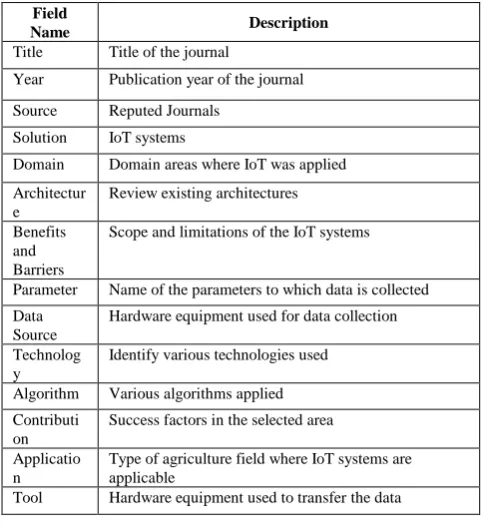
[image:2.595.306.548.311.577.2]Table III describes the various fields used to extract the information from the study.
Table-III. Search Fields used for Information Extraction Field
Name Description
Title Title of the journal
Year Publication year of the journal
Source Reputed Journals
Solution IoT systems
Domain Domain areas where IoT was applied
Architectur e
Review existing architectures
Benefits and Barriers
Scope and limitations of the IoT systems
Parameter Name of the parameters to which data is collected
Data Source
Hardware equipment used for data collection
Technolog y
Identify various technologies used
Algorithm Various algorithms applied
Contributi on
Success factors in the selected area
Applicatio n
Type of agriculture field where IoT systems are applicable
Tool Hardware equipment used to transfer the data
B. Conduction
International Journal of Innovative Technology and Exploring Engineering (IJITEE) ISSN: 2278-3075, Volume-8 Issue-10, August 2019
Fig. 1. Selection process of papers for systematic review
Fig. 2. Publication year-wise distribution of papers C. IoT Solutions
This section presents the outcomes of the system review process by answering the questions based on extracting the information from the selected references. By considering several factors like monitoring, energy-control, and prediction, IoT-oriented technological solutions have been identified for various application domains of agriculture.
Fig. 3. Various Factors considered for review The monitoring factor deals with the gathering of environmental parametric data with remote sensing and WSN. The primary aim of the activity was to acquire the crop and farm information without human involvement and transmit the same to a server for further processing, analyzing, and visualizing. It became possible to regularly monitor the form activities by having a regular communication with hardware equipment deployed in the field and access the stored data from the remote location. Monitoring the cultivation field and processing by implementing various models or algorithms can allow to control field activities and providing user friendly suggestions automatically [1]. Hence, IoT is an added assert to farmers by supporting them to monitor, access and predict the situations having in the field without visiting the location physically. Using some sensor
devices, IoT can monitor, gather, process and also analyze the data using cloud computing services to provide solutions and support for making better decisions.
IoT-based solutions to monitor greenhouse are becoming more common where the data is collected from various devices and uploads the same into a cloud environment. Later the data is analyzed deeply with more efficient and reliable way. As crop factories are becoming common in smart cities made to think of artificial growth systems [17-18]. Internet of Things have been incorporated into the environmental field to generate real-time and dense maps of water, air pollution, noise level, temperature and other radiations.
Monitoring the environmental conditions while doing some activity in the agriculture field is also an important factor. The latest environmental monitoring systems are offering some additional benefits in decision making and device management. Monitoring and Controlling includes remote monitoring, controlling open field, environment agriculture, and pest management [8]. The study has noted that collecting the phenotypic data of the plant can improve the crop [9]. Well evaluated equations like crop and climate models produces assessments to take better decisions by providing an early warning [8]. The study has developed a multi-sensor system enabled with two sensors to gather solar radiation and humidity sensor to gather the environmental data and integrated with another five sensor modules that can measure the canopy trait of a crop from the field. A multi-sensor system was proposed which obtains high throughput phenotyping in breeding plants [9]. The sensor system is integrated with five sensor modules like thermal infrared radiometers, ultrasonic distance sensors, RGB web cameras, portable spectrometers and NDVI sensors. The sensors from the field plot measure the crop canopy traits. A solar radiation sensor and relative humidity/air temperature sensor are integrated through GPS and collects the environmental data. A risk monitoring system was proposed using WSN that allows to deploy the hostile environments where there is no need of human interaction [10]. The system has a self-capability feature that can handle node failure and poor communication link. A real-time data architecture with a web service has been presented that comprise an adaptive controller to update the sensing node parameters based on the predefined policies and a WSN [32]. An IoT based environmental quality monitoring system was proposed [37]. It builds an artificial river and monitors the water, soil, temperature, and wind at a high spatial resolution. An automated crop disease advisory system framework was designed that integrates the interoperable IoT web repository with an advisory agriculture service center [26]. Monitoring through most demanding sensors like image sensors can capture images of a crop either image processing techniques or plain monitoring system[15]. The system produces the images of the crop, diagnosis the plant and sends the same information to the farmer to take corresponding decision for the disease.
Unlike monitoring, a new top-level of communication is needed to operate the hardware
equipment in the field. Many of
[image:3.595.57.281.263.405.2]concentrated on the standardization of IoT technologies. The system adopted from [24] is also accompanied with three more modules like remote sensor module, remote data unit modules and a watering module. A sensor module is a unit integrated with various sensors to collect the water level, humidity, temperature, light intensity and soil moisture data. This unit also comprises of a controller to monitor and control various parametric values receiving from the sensors. The traditional wireless sensor networks (WSN) and conventional wireless sensor-actor network (WSAN) deployed various smart devices for sensing and transferring the field/crop data to a sink and controlling actuators are the advanced aspects of interoperability of hardware devices and other objects [12]. In this case, commands will be sent to the actuators through a wireless sensor network from the cloud server to modify the state of the actuator’s activity. Actuators in IoT systems are used mainly to control the resources like consuming water, fertilizer, and pesticide through valves, humidifiers, motor pumps, and alert alarms. Sensors and Actuators deployed in agriculture are integrated using Wireless Sensors Networks are gaining attention in various domains like irrigation control and mobile sensing. The study has also mentioned the importance of Internet of Things (IoT) and Web of Things (WoT) as the frameworks through which the farm data is captured and managed using sensor networks. The similar technologies are graceful in handling diverse and dynamic real-time stream of data. The technologies can handle unstructured data, filters, correlates and match with the standard data values based on which the decision making is taken [19]. A systematic and scheduled irrigation can be provided to the fields based on the report received from the weather forecasting centers. IoT based solutions have been categorized into three-layer monitoring architecture with perceivable layer to manage WSN, network layer to collect the sensor data from remote location using various protocols, gateways, application layer with a server and a storage database [13]. The study has identified various variables like air, soil, water, plant and others monitoring. Few studies proposed solutions for remote crop monitoring and captures different variable like humidity, temperature, soil moisture, luminosity, CO2, pH levels and crop visuals. A systematic irrigation process was proposed with a soil moisture sensor deployed in the field. The current value of the soil moisture sensor is collected and compared with a threshold value already recorded in the system. When the gathered value moves beyond the threshold value, then the irrigation of water to the crop is automatically done. Once the supplied water receives to the required water levels then it stops. A remote farmland irrigation system for crop or field monitoring based on ZigBee was proposed. The developed system has an integrated solar-powered irrigation system to monitor humidity, soil and air temperature. To implement smart irrigation, proposed an IoT sensors embedded smart irrigation system [2]. The system is integrated with various sensors to monitor soil moisture, air temperature, soil temperature, relative humidity and UV light radiation of a crop field. Depending on the requirement, one sensor node or a network of wireless sensor nodes is deployed with four sensors to collect the primary data. The data includes the values related to soil moisture and temperature, radiation of UV light and
[image:4.595.310.544.123.306.2]relative humidity. The overall architecture of the system proposed is composed of hardware equipment in the cultivation field and an irrigation server [35]. The hardware devices used are irrigation controller, weather reporting station and a valve controller.
Fig. 4. Papers selected based on agriculture domains The weather station collects the weather data from the field and forwards the same to the irrigation server. The server uses the data to calculate the real-time values for decision making. When irrigation to a field is required then the server sends the related information to the irrigation controller. The same is sent to the valve controller to open the irrigation and supply the water. The water flow is monitored by the flow meter and controls the valve after enough water is pumped. [7] proposed an architecture with several sensor types are used to collect the soil moisture and temperature. In this system, the sensors are deployed in the field to observe and collect the data. The data is collected from the sensor nodes and the same are sent to the server through other probable nodes and common gateways. At the server side the data is analyzed and the same is presented to the farmer in their application interface. An automated precise irrigation scheduling system was proposed for greenhouses organized through a web application [14]. This system can interact with the sensor deployed in a greenhouse with remote sensing technology gathers the data about climate, irrigation values or controllers and forwards the data to the cloud for further processing. In wireless networks, the most challenging factor is the energy supply to the hardware equipment deployed. The [28] states that there is a strong need of developing multi-source energy harvesters to create battery-less solutions. This is because recharging the batteries to supply energy to the equipment is impractical and usually unable. A framework presented is an automated advisory service to monitor the crop disease runs with a solar cell from where the hardware equipment gets energy replacing the power converters and storage element [26]. A self-power soil water content sensor device used to monitor the soil moisture has been developed is a low-power field surveillance system. IoT applications were categorized in agriculture as a scalar sensor network that are used in agricultural environments to
International Journal of Innovative Technology and Exploring Engineering (IJITEE) ISSN: 2278-3075, Volume-8 Issue-10, August 2019
Fig. 5. Papers selected based on communication networks The multimedia sensor network is utilized to capture the crop image and further process it to detect the disease of a plant from a remote location.
Fig. 6. Papers selected based on energy controls
It was proved that Low-power Wide Area Networks (LPWAN) like Sigfox, narrowband IoT and LoRa are working efficiently and becoming more popular in the implementation of IoT applications due to low power consumption, covering wide range of field and low-cost when compared with other technologies [5]. A survey conducted [29] observed that LoRa can be a best selection of communication technology for various applications in agriculture. In one of the smart agriculture applications to monitor the low range water level for troughs using LoRa transceivers with WSN, allowing the cattleman to know the availability of water levels for livestock even from far away distance. A different application developed an IoT framework to implement an open-source equipment and long-range hardware for communication. The system was used LoRa transceivers for communication. The utilization of LoRa has proved that it is the right choice to select for rural villages and convenient without infrastructure barriers. For large area of farming, ZigBee Wi-Fi technology is used to communicate among multiple sensor nodes. The collected data from the sensors are stored in a local database after passing through a gateway node. A web service was developed using PHP as an API and hosted in Apache web server to communicate and forward the data from the sensor node to the server. Another
web service was developed using Python collects the data values from weather forecasting by interacting using the above API. At the server side the same data is stored in MySQL database for further predictions [2]. A new approach was proposed with a WSN technology with four major sections and of discretionary segments. The main segments are power unit with batteries and elective sources, a detecting unit with sensors and controllers, a handling unit for data storage, and a handset communication unit.
A newly developed network solution was proposed with the connectivity of rural areas and several agricultural/farming applications [21]. The solution is a low-cost and proved efficient in the quality of service. The proposed and developed system architecture by [20] is framed and distributed in three modules like crop, CPS tier and edge computing. At the crop, various sensors and actuators are installed and connected with CPS nodes. The data values of soil moisture, relative humidity, temperature, pH meter, CO2, water flow pressure, electrical conductivity is collected from the crop field. The CPS node units are interconnected together with an access networks like fiber optic, radio links or DSL. The second layer of the system includes a set of NFC controlled power modules to control the irrigation, nutrition, climate and auxiliary tasks like alarms and power consumptions. The third layer is used as an interface between the user and the core platform. The hardware setup developed by [7] is a custom board called KIANI with an embed of soil moisture, air humidity and temperature sensors. Raspberry Pi has been used as a gateway on the other side to send the data collected to the server. The collected data values have been presented in the GUI based application in a website and a mobile app. There is a vast use of GPS technologies were incorporated by [6] for seed plantation and harvesting using connected telemetry. Another smart farming technology used is an aerial vehicle to monitor and observed the plant health condition and analyzed the same for the need of nitrogen fertilizer in the crop. A four-layer architecture was proposed with physical layer, communication layer, service layer and application layer [13]. The main objective of physical layer is to have a perception and control on the data values collected from the sensors using the WSN. The sensor and other hardware in perception layer can be powered with solar panels or by batteries. The communication layer receives the same data from the physical layer through local and remote gateways. The control layer in contrast behaves as data sink to receive data from the perception layer and communication layer in the simplest way. The data further is stored in the cloud for analyze and alters the state of actuators in the field frequently to balance the parametric values. The communication layer forwards the information to the internet based on Ethernet or any valued mobile network. The service layer handles the information storage, analysis through cloud services, visualization and security. At last, the application layer allows the farmer to monitor, predict, and control the field operation from remote location. A novel QoS-Based cloud based automatic information system that can handle various considerations of field,
manages and allocates
[image:5.595.65.276.277.456.2]entire architecture has been classified into three layers like Software-As-Service(SaS), Platform-As-Service(PaS) and Infrastructure-As-Service(IaS). A user-interface has been developed in SAS through which the farmer can interact with the system, developed Aneka as an application developed in .NET technology, and IAS that can manage the resources automatically based on the requirements. Along with these layers, the designed architecture has two subsystems like user and the cloud.
Prediction is the other factor considered for the study to provide knowledge and various tools to farmers for decision making. The study introduced is a pilot project called Internet of Agriculture Things (AIoT) to integrate the state-of-art technologies and provide better monitoring of food suppliers [34]. The study believes that harsh environmental conditions such as humidity, temperature, high solar radiation, rainfall can affect the leaves of a plant [27]. The noise produced from a greenhouse, building structures can greatly affect the communication links between the nodes. The information regarding environmental conditions, estimation of production, crop health and its growth were collected. A multi-sensor system developed [9] has tested on soybean and wheat trail field. At the end of the crop season, the field data values were collected and tried to correlate with the data values of in-season crop traits. The results obtained was analyzed and showed a strong correlation among the sensor-oriented traits and data collected in the field. A system that predicts the environmental conditions by monitoring the weather forecasting and irrigation system using IoT. The study has introduced and IoT system for fixed network fishery real-time production and estimation system with ultrasonic sensors and professional learning [27]. A predictive algorithm was proposed to know the soil moisture for the upcoming days [2]. This data can be achieved by implementing the regression model and k-means clustering on sensor data values and weather forecasting data values. Based on the outcome values, the system also suggests the irrigation decisions on the different soil moisture levels. This process can help to save water and energy during the irrigation. A new design was proposed and developed to solve the problems of uneven distribution of water resources to the crop [35]. The introduced technology is a smart water irrigation control system designed using Internet of Things. In general, the irrigation decisions are mainly depending on the water content in the soil and physiological changes of a crop. To achieve and efficient controlling irrigation decision the present study developed a communication and IoT sensor technology that can solve real-time issues of agriculture field. An Agri-IoT system was proposed based on innovative analytical solutions by enabling large-scale of processing and analysis of real-time data coming from the sensors, surveillance cameras and images from drones, weather forecasting online services etc. Cloud data server is the area where the real-time crop and configuration parametric values are maintained. A variation in the configuration value triggers control actions to be performed. For the better communication among the applications and the analysis is carried out by the JSON data [20]. A program named LabVIEW were developed [9] to manage and synchronize the data
[image:6.595.316.535.85.246.2]measurements obtained from the sensor modules are stored in the local machine.
Fig. 7. Papers selected based on agriculture subdomains By gathering the NDVI and red-edge spectral indices and RGB pictures the processing is performed to extract the canopy green pixel fraction. A system proposed by [3] is a data analytical platform with multiple layers of device and communication planes as lower-level, data analysis as intermediate layer, application and end-user planes as higher layer. At each layer, data acquisition, modeling, analysis and visualization can perform specific operations. Agri-IoT, an integration of IoT based framework processing real-time stream and performs analysis on semantic internet technologies, facilitating correct decision-making support for farmers and situation handling. The proposed architecture [34] consists of five different layers including data access layer to gather the sensor, RFID, video recordings, farming, manufacturing time, logistics period, storage and sales period data. Data transmission layer transmits the data collected from the data access layer to server using wireless network technologies. The application service layer after receiving the raw data from the above layer performs data processing and analysis. The application module layer provides multiple layers of modules where users can select any one based on their requirements. The user application layer implements the application modules for the user. A system in [24] utilizes web of things with an IoT system to handles the sensors, data collection and communication among the sensors, controllers and other devices. A pervasive framework is used to collect and transmit the data from the remote field for the cultivating application for decision making. An alert alarm, SMS are received by the farmer from the framework. For integration and controlling of various precision agriculture activities, [20] has introduced a flexible three-tier software as an open source platform. In the field, Cyber-physical systems can interact with hardware devices to gather the field parametric values and performs real-time control actions. The developed system [7] has been deployed in a field of four equal regions with sensor nodes to collect the data. Through the Raspberry Pi gateway, the data is stored in the server collected for every hour and then transferred the same to the user interface. With the comprehensive data available, the farmer can take decision regarding planting,
International Journal of Innovative Technology and Exploring Engineering (IJITEE) ISSN: 2278-3075, Volume-8 Issue-10, August 2019
considered a CHARMS monitoring structure implemented by the government of China in agriculture monitoring and remote data sensing [33]. The structure depicts the various monitoring areas like crop acreage, soil moisture, crop growth, crop yield, and agro-disaster. Collect these data from remote sensing and other methods performs data processing. The results are later provided to the user interface for further management. Data from various levels are collected and properly stored in the database sub-systems. Later the same data is compared with the standard values and protocols for further decision making.
[image:7.595.58.279.481.645.2]The study has approached a next generation modelling of agriculture and assessed the relevant existing technologies, potential benefits and expected benefits to the agriculture community [25]. The concept of knowledge chain and application chain adopted by the study has provided a complimentary value fixing the models in the broader area of decision making. A knowledge chain is a step-by-step process of converting the data to information, knowledge and later use the same for decision-making. An application chain which always engages in the implementation of agriculture models with a software for data accessing, processing, analyzing, visualizing and a set of hardware for data storage and computing capacity. A representation in the study has described the data and information flow from various layers’ like model, synthesis and interface towards end-users. The study mentioned that agricultural data modelling has been handled with a variety of agriculture domains and a field map of soil properties, rate of pasture growth, gas emissions in greenhouse, and few others [19]. More sophisticated models may be developed using different machine learning techniques. Sensing technologies like Internet of Things has proven to be primary for precision agriculture by providing ground level sensor deployments for various farm activities.
Fig. 8. Papers selected based on application subdomain Finally, the study believed that utilization of latest technologies can provide better automation system to control field operations from a remote area are the biggest assets of a successful precision agriculture.
D. Discussion
This section has mentioned various limitations and open challenges that were identified after analyzing the literatures. The following are the three insights that has contributed to the adoption of IoT based systems in the agriculture field.
Compatibility: There is no stronger standardization among the various field devices including end-user interfaces and cloud providers.
Hardware and software design: No modular designing of hardware and software which can enable more compatibility and reuse for an end-user exists.
Deployment cost: Installation of various high-quality sensors and actuators in the field is cost effective. Deploying sensors nodes, maintaining the hardware devices, providing an internet connectivity, continues data accessing, and maintaining it in the cloud environments are the additional overheads in terms of cost.
The implementation of IoT solutions should ensure a quality and nutritious crop production. The smart farming technologies must promise an increased production of food even in different constraints like environment and climatic change with certain level of natural resources situation. In greenhouse agricultural it become very difficult to identify various stages of crop growth for large plants due to the limited space chambers. Plants growing in the artificial environments may vary with the development and growth of a plant growing in the normal environments. Developing and processing various methods and algorithms for crop images are the series issues. There is no adaption of good practice of engineering when new features are explored. Lack of dynamicity, adoption to heterogeneity, providing robust real-time analytical systems, and integration of computer systems are the other critical issues of agricultural IoT. It can only be possible when the software is well designed and documented, and hardware is designed as platform independence. Access to internet may be one of the factors that resists the implementation of agriculture in smart farming.
The most challenging factor that arise when IoT systems are implemented in the open agriculture field is a direct exposure to the worst environmental situations like high temperature and humidity, strong winds and rainfall, high solar radiations. The end-user systems must be active and function properly for a long period of time with a regular power supply and handling device damaging situations. Precision agriculture has brought new challenges in image processing, robotics, and data sensing. Another critical process of implementing IoT systems is to monitor itself so that the various hardware equipment cannot be controlled by an intruder. An intruder detection system applied in agriculture that generates alarms in the field and a plain text message was sent to the farmer’s mobile device when an intruder enters the cultivation field. Protecting highly sensitive data and data confidentiality can be a big challenge while using IoT applications. A large volume of data received from the sensors will raise a new challenge of analyzing such a huge one.
The open issues discussed in this section may be some of the reasons for the slow adaption of IoT based solutions in agriculture. More research must be done and identify the best solutions in providing a secure
A drastic reduction of investment is necessary serving the needs of small and medium level farmers to implement the IoT enabled systems.
III. CONCLUSION
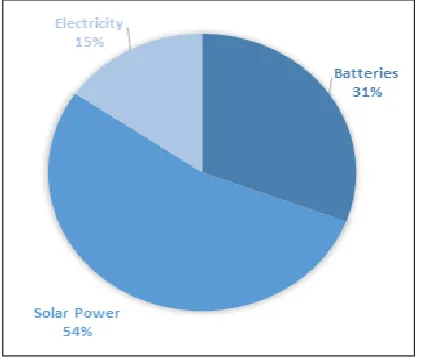
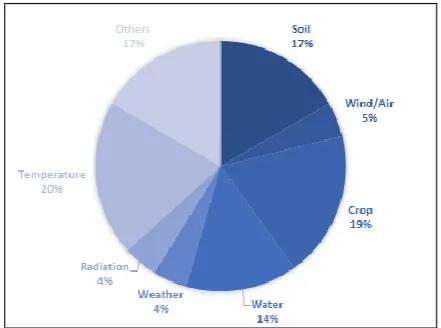
The present paper has provided an updated summary of IoT implementation in precision algorithm. Selected papers have been identified from various domains and subdomains of agriculture. The study has observed that the digitization of agriculture has improved a lot but not the smart technology applications. It was also observed that there are some barriers in adopting the heterogeneity in various technologies, lack of integration of devices, poor communication systems in rural areas, and difficult in manipulating the data collected from the machinery and equipment. Most of the studies still focuses on technologies (25%) and applications (21%). There are some primary solutions in monitoring (20%), energy controls (19%) and predictions (15%) using IoT. Green housing environments (20%) are improving a lot when compared with farming in agricultural environments (29%). In agricultural applications it was observed that soil and temperature parameters are considered as the most critical factors. It was also observed that environmental control, controlling irrigation system, and pesticide management, energy sources, data analysis and visualization through web applications are widely used in the development of precision agriculture.
REFERENCES
1. Aiello, G., Giovino, I., Vallone, M., Catania, P., & Argento, A, “A decision support system based on multisensor data fusion for sustainable greenhouse management”. Journal of Cleaner Production (in press), 2017.
2. Amarendra Goapa, Deepak Sharma, A.K. Shukla, C. Rama Krishna.,
“An IoT based smart irrigation management system using Machine
learning and open source technologies”. Journal of Computers and
Electronics in Agriculture, 2018, pp: 41–49.
3. Andreas Kamilaris, Feng Gao, Francesc X. Prenafeta-Boldu and
Muhammad Intizar Ali., “Agri-IoT: A Semantic Framework for
Internet of Things-enabled Smart Farming Applications”. IEEE 3rd
World Forum on Internet of Things (WF-IoT), 2016, pp: 442-445.
4. Barcelo-Ordinas, J. M., Chanet, J. P., Hou, K.-M., & Garcia-Vidal, J.,
“A survey of wireless sensor technologies applied to precision agriculture”. Precision Agriculture, 13, 2016, pp: 801-808.
5. Barrachina-Muñoz, S., Bellalta, B., Adame, T., Bel, A., “Multi-hop
communication in the uplink for LPWANs”. Computing. Networks.
123, 2017, pp: 153–168.
6. Dieisson Pivoto, Paulo Dabdab Waquil, Edson Talamini, Caroline
Pauletto Spanhol Finocchio, Vitor Francisco Dalla Corte, Giana de Vargas Mores., “Scientific Development of Smart Farming
Technologies and their Application in Brazil”. Information
Processing in Agriculture Journal, 2018, pp: 21–32.
7. Farzad Kiani, Amir Seyyedabbasi., “Wireless Sensor Network and
Internet of Things in Precision Agriculture”. International Journal of
Advanced Computer Science and Applications (IJACSA), Vol. 9, No. 6, 2018, pp: 99-102.
8. Ferentinos, K. P., Katsoulas, N., Tzounis, A., Kittas, C., & Bartzanas
T., “A climate control methodology based on wireless sensor networks in greenhouses”. Acta Horticulturae, 1107, 2015, pp: 75-82.
9. Geng Bai, Yufeng Ge, Waseem Hussain, P. Stephen Baenziger, George
Graef., “A Multi-Sensor System for High Throughput Field Phenotyping in Soybean and Wheat Breeding”. Journal of Computers and Electronics in Agriculture, 2016, pp: 182–190.
10. Giorgetti, A., Lucchi, M., Tavelli, E., Barla, M., Gigli, G., Casagli, N.,
Chiani, M., Dardari, D., “A robust wireless sensor network for landslide risk analysis: system design, deployment, and field testing”. IEEE Sens. Journal. 16, 2016, pp: 6374–6386.
11. Jayaraman, P., Palmer, D., Zaslavsky, A., & Salehi, A., “Addressing
information processing needs of digital agriculture with Open IoT
platform”. And open-source Retrieved from http://link.
springer.com/chapter/ 10.1007/978-3-319-16546-2_11, 2015.
12. Jazayeri, M. A., Liang, S. H. L., & Huang, C. Y., “Implementation and
evaluation of four interoperable open standards for the internet of things”. Sensors (Switzerland), 15(9), 2015, pp: 24343-24373.
13. Jesús Martín Talavera, Luis Eduardo Tobón, Jairo Alejandro Gómez,
María Alejandra Culman, Juan Manuel Aranda, Diana Teresa Parra, Luis Alfredo Quiroz, Adolfo Hoyos, Luis Ernesto Garreta., “Review of IoT Applications in Agro-Industrial and Environmental Fields”. Computers and Electronics in Agriculture Journal, 142, 2017, pp: 283–297.
14. Katsoulas, N., Bartzanas, T., & Kittas, C., “Online professional
irrigation scheduling system for greenhouse crops”. Acta
Horticulturae, 1154, 2017, pp: 221-228.
15. Katsoulas, N., Elvanidi, A., Ferentinos, K. P., Kacira, M., Bartzanas,
T., & Kittas., C. “Crop reflectance monitoring as a tool for water stress detection in greenhouses: A review”. Bio Systems Engineering, 151, 2016, pp: 374-398.
16. Keerthi, V., & Kodandaramaiah, G. N., “Cloud IoT based greenhouse
monitoring system”. International Journal of Engineering Research
and Applications, 5(10), 2015, pp: 35-41.
17. Kozai, T., & Fujiwara, K., “Moving toward self-learning closed plant
production systems. In LED lighting for urban agriculture”, 2016, pp:
445-448. Singapore: Springer Singapore. Retrieved from
https://doi.org/ 10.1007/978-981-10-1848-0_32.
18. Lee, M., & Yoe, H., 2015. “Analysis of environmental stress factors
using an artificial growth system and plant fitness optimization”. Bio Med Research International, 2015, pp: 1-6. Retrieved from https:// doi.org/10.1155/2015/ 292543.
19. Michael J. O’Grady, Gregory M.P. O’Hare., “Modelling the smart
farm”. Information Processing in Agriculture(IPA)-The Journal of the China Agricultural University, Vol.4, 2017, pp: 179–187.
20. Miguel A. Zamora-Izquierdo, Jose Santa a, Juan A. Martı´nez, Vicente
Martı´nez, Antonio F. Skarmeta., “Smart farming IoT platform based
on edge and cloud computing”. Bio Systems Engineering Journal,
2018, pp: 4-12.
21. Nurzaman Ahmed, Debashis De, and Md. Iftekhar Hussain., “Internet
of Things (IoT) for Smart Precision Agriculture and Farming in Rural Areas”. IEEE Internet of Things Journal, 2018, pp: 1-9.
22. Olakunle Elijah, Tharek Abdul Rahman, Igbafe Orikumhi, Chee Yen
Leow MHD Nour Hindia., “An Overview of Internet of Things (IoT)
and Data Analytics in Agriculture: Benefits and Challenges”. IEEE
Internet of Things Journal, 2018, pp: 1-12.
23. Pang, Z., Chen, Q., Han, W., Zheng, L., “Value-centric design of the
internet-of-things solution for food supply Chain: value creation, sensor portfolio and information fusion”. Inform. Syst. Front. 17, pp:
289–319. Retrieved from http://dx.doi.org/10.1007/
s10796-012-9374-9, 2015.
24. Pavithra G., “Intelligent Monitoring Device for Agricultural
Greenhouse Using IOT”. Journal of Agricultural Science and Food
Research, Vol.9, Issue 2, 2018, pp: 1-4.
25. Sander J.C. Janssen, Cheryl H. Porter, Andrew D. Moore, Ioannis N.
Athanasiadis, Ian Foster, James W. Jones, John M. Antle., “Towards a New Generation of Agricultural System Data, Models and Knowledge Products: Information and Communication Technology”. Agricultural Systems Journal 155, 2017, pp: 200–212.
26. Sarangi, S., Umadikar, J., Kar, S., “Automation of agriculture support
systems using Wisekar: case study of a crop-disease advisory service”. Comput. Electron. Agric. 122, 2016, pp: 200–210. Retrieved from http://dx.doi.org/ 10.1016/j.compag. 2016.01.009.
27. Saville, R., Hatanaka, K., Wada, M., “ICT application of real-time
monitoring and estimation system for set-net fishery”. In: OCEANS,
2015, pp: 1–5.
28. Shaikh, F.K., Zeadally, S., “Energy harvesting in wireless sensor
networks: a comprehensive review”. Renew. Sustain. Energy Rev. 55,
2016, pp: 1041–1054. Retrieved from
http://dx.doi.org/10.1016/j.rser.2015.11 .010.
29. Sinha, R.S., Wei, Y., Hwang, S.-H., “A Survey on LPWA technology:
LoRa and NBIoT”. ICT Express 3, 2017, pp: 14–21. Retrieved from http://dx.doi.org/10.1016/ j.icte.2017.03.004.
30. Sukhpal Singh Gill, Inderveer Chana, Rajkumar Buyya, “IoT Based
International Journal of Innovative Technology and Exploring Engineering (IJITEE) ISSN: 2278-3075, Volume-8 Issue-10, August 2019
hor-2 Photo
31. Wang, J., Yue, H., “Food safety pre-warning system based on data
mining for a sustainable food supply Chain”. Food Control 73, 2017,
pp: 223–229. Retrieved from http://dx.doi.org/10.1016
/j.foodcont.2016.09.048.
32. Wong, B.P., Kerkez, B., “Real-time environmental sensor data: an
application to water quality using web services”. Environ. Modell. Software 84, 2016, pp: 505–517. Retrieved from http://dx.doi.org/10.1016/j.envsoft. 2016.07.020.
33. Yanbo Huang, CHEN Zhong-xin, YU Tao, HUANG Xiang-zhi, GU
Xing-fa., “Agricultural Remote Sensing Big Data: Management and
Applications”. Journal of Integrative Agriculture 17(9), 2018, pp:
1915–1931.
34. Yi Liu, Weili Han, Yin Zhang, Lulu Li, Junyu Wang, Lirong Zheng.,
“An Internet-of-Things Solution for Food Safety and Quality Control:
A Pilot Project in China”. Journal of Industrial Information
Integration, 2016, pp: 2-7.
35. Zhang S. Wang M. Shi W. Zheng W., “Construction of intelligent
water saving irrigation control system based on water balance”. IFAC (International Federation of Automatic Control), 2018, pp: 466-469.
36. Zhang, J., Kong, F., Zhai, Z., Han, S., Wu, J., & Zhu, M., “Design and
development of IOT monitoring equipment for open livestock environment”. International Journal of Simulation: Systems, Science and Technology, 17(26), 2016. Retrieved from https://doi.org/ 10.5013/IJSSST.a.17.26.23.
37. Zheng, R., Zhang, T., Liu, Z., Wang, H., “An EIoT system designed for
ecological and environmental management of the Xianghe segment of china’s grand canal”. Int. J. Sustain. Dev. World Ecol. 23, 2016, pp: 372–380. Retrieved from http://dx.doi.org/10.1080/ 13504509.2 015.1124470.
AUTHORS PROFILE
M Nagaraju received his M.Tech in Computer Science and Engineering from JNTU, Hyderabad in 2012, the MSc in Computer Science from Osmania University, Hyderabad in 2004. He is currently a research scholar in Lovely Professional University, Phagwara. His research interests include Web Mining, Internet of Things, and Deep Learning.
Dr. Priyanka Chawla is doctorate from the Thapar University, Patiala, India. She is presently working as Professor in Lovely Professional University, India. Her active research areas include cloud computing, big data analytics, evolutionary algorithms and software engineering. She has been involving in research for more than 14 years. She has published
more than 30 research papers in reputed