© 2015, IRJET.NET- All Rights Reserved
Page 538
Design & Development of a Suitable Implement Matching with Low HP
Tractor
Subrata Kr Mandal
1, Dr. Atanu Maity
2, Ashok Prasad
3, Palash Kr Maji
4, Sankar Karmakar
51
Subrata Kr Mandal, Scientist, CSIR-Central Mechanical Engineering Research Institute, Durgapur, India
2
Dr. Atanu Maity, Scientist, CSIR-Central Mechanical Engineering Research Institute, Durgapur, India
3
Ashok Prasad, Scientist, CSIR-Central Mechanical Engineering Research Institute, Durgapur, India
4
Palash Kr Maji, Scientist, CSIR-Central Mechanical Engineering Research Institute, Durgapur, India
5
Sankar Karmakar, Scientist, CSIR-Central Mechanical Engineering Research Institute, Durgapur, India
---***---Abstract -
Proper matching of implements withtractor and the performance evaluation of the combination is very much important to minimize the expenditure in farming operations. To obtain a suitable implement according to tractor horsepower, implement size plays an important role. An improper matching of tractor-implement combination results in under loading of engine and hence poor efficiency and higher operating costs. Implements that are too large for the horsepower available will cause overload, excessive tire slippage, increase in fuel consumption and unsatisfactory performance in general. Implements that are too small will result in inefficient operations, low production and increased cost. The objective should be to match as effectively as possible the tractor with the implement as some of the small size implements will not utilize all of the tractor horsepower available. With small size tractor, it is necessary to select an implement size that is convenient to use or adequate for the job to be done. This paper aims to describe the design process and development of a suitable size implements to be matched with a low hp Tractor for optimum field performance at minimum operating cost.
Key Words:
Implements, field capacity, field efficiency,
draft, and drawbar
1. INTRODUCTION
A careful approach to matching implements and tractors can increase efficiency and cut costs for farmers. Implement matching involves an attempt to balance the characteristics of a load application unit such as a cultivator and a power unit, which is usually a tractor. The matching process is something, farmers often do sub-consciously but this method can be improved. Any improvements that can be made will substantially affect farm performance. Correct matching of machinery should
result in increased efficiency of operations, less operation costs and optimum use of capital on fixed costs (Powell, (2000). A tractor properly matched to an implement provides a “system” that performs at maximum efficiency. Thus correct matching of machinery should results in increased efficiency of operations, less operating costs, and optimum use of capital on fixed costs. When determining an appropriate balance (match) between tractor and an implement, consideration must be given to various factors like area to be covered (ha), working speed (kmph), working hours, estimated field efficiency (percentage), width of machine (working width, m), power requirements for implement to be used (kW) [1].
1.1 Effective Field Capacity
The effective field capacity is the actual output achieved by a machine. It is a function of the proportion of the machine width utilized, the travel speed and the amount of time lost in the field during the operation. Time is lost to implement blockages, working areas such as headlands more than once, adjustments, checking and minor repairs and excludes daily servicing requirements such as lubrication but would include the time taken to change points [2].
A practical way of determining field efficiency is to determine the theoretical time required to cover an area and compare this with the actual time taken.
100
%
,
time
Operating
time
l
Theoretica
efficiency
Field
© 2015, IRJET.NET- All Rights Reserved
Page 539
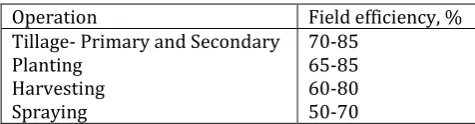
Table 1: Typical Field efficiency for a range of operationsOperation Field efficiency, %
Tillage- Primary and Secondary Planting the tractor must be able to provide at the drawbar. The engine power will be quite a bit higher than this. The draft for a particular type of implement varies a lot depending on soil type, soil condition, depth and speed. Table 2 gives a guide to the draft that could be expected for different implements on a range of soils conditions, soil type, soil moisture, depth of working, ground speed etc. The draft is given in terms of kilograms force per meter width of implement (kgf/m).
Table 2: Approximate draft of tillage implements [3]
Imple
When buying a tractor, concentration is required on its quoted PTO power, not its engine power. To calculate the required tractor PTO power from a known drawbar power, power losses associated with wheel slip and rolling resistance have to be taken care off. Reasonable field efficiency for a tillage operation is also necessary to look at the efficiency of the tractor in converting engine power to drawbar power. However, when considering losses from the axle to the drawbar, energy is lost in order to create traction. These losses depend on the tractor type and weight, soil conditions, as well as the load being pulled. Drawbar power is the product of pull and speed; where an infinite number of pull / speed combinations could be used to give the same power. Wheel tractors are designed to operate at higher speeds (greater than 8.0 km/h) and lower drawbar loads [4].
Table 3: Power conversion factors: Drawbar to PTO
Type of surface 2WD FWA 4WD
Firm surface 0.72 0.77 0.78
Table 3 describes some typical tractor efficiencies, which are very much useful for selecting implement and required tractor size [3]
Table 4: Typical Tractor efficiencies
© 2015, IRJET.NET- All Rights Reserved
Page 540
2. DESIGN OF SUITABLE IMPLEMENT MATCHING
WITH A LOW HP TRACTOR
Considering all the above-discussed matter the following calculation have been carried out for the selection of matching implements for a low HP tractor when engine power is known:
Engine parameters chosen: Make - Greaves,
Rated Speed = 3000 rpm, Rated Power = 10.2 hp
Max. Torque = 26 N-m @ 1800-2400 rpm Available Power = 80% of rated power
= 0.8x10.2 = 8.16 hp
Axle power = transmission efficiency x available power hp = 0.9x8.16 hp
= 7.34 hp
Tractive efficiency = drawbar power/axle power Or, drawbar power = (axle power)x(tractive efficiency) So, drawbar power = 7.34 x 0.6
= 4.4 hp
= 3.24 KW
Assuming operating speed 5.5 km/hr.
Optimum pull = drawbar power/operating speed = 3240/(5.5 x 1000/3600)
= 2120.7 N
So, Draft=Optimum pull = 2120.7 N~2120 N (Rounded off)
2
.
( )
( )
.
Draft
F i A B v
C v
W d N
(ASAE, 1999)
Where, F = dimensionless soil texture adjustment parameter = 0.85
i = 1 for fine, 2 for medium, 3 for coarse A, B, C = machine specific parameters v = operating speed km/hr. W = machine width, m d = tillage depth, cm
From the ASAE standards, following are the values: (for a cultivator)
F = 0.85, i = 2, A = 46 B = 2.8 C = 0 d = 15 cm v = 5.5 km/hr. By putting all the values,
Draft = 0.85x2x[46+2.8(5.5)+0x5.52] x Wx15 = 1565.7 x W
To get the total no. of tynes, Draft = optimum pull or, 2120 = 1565.7 x W or, W = 2120/1567.7 = 1.35 m
Assuming spacing between tynes = 12” = 304.8 mm n, = no. of tynes = 1.35 m/304.8 mm = 5 (approx.)
So for the case of low HP tractor of chosen engine parameters, a cultivator with 5 tynes will be suitable to get optimum performance in field operations.
3.0 MODEL CREATION FOR CULTIVATOR
Based on the design calculation and following the ASAE standard, the 3D model of a 5-tine cultivator, which was attached with the small hp tractor later on has been developed as shown in Fig. 1. This cultivator was developed through CAD, using CAD software. Initially the conceptual design was made which using Auto CAD software. After the conceptual design, the detail design and manufacturing design was made. Using high capacity 3D software, 3D CAD model generated for getting the proper visualization of the product to be made through fabrication. This model was then checked for functional analysis to examine whether the product will be capable of carrying the load while the tractor is in field condition. The goal was to minimize the mass of the part while maintaining the same stiffness and strength as an existing cultivator. The 2D CAD model of the designed cultivator has shown in Fig.2 while Fig.3shows the physical prototype of the developed cultivator attached with a Low HP Tractor. Fig 4 describes the laboratory trials particularly weight balancing of the developed cultivator and Fig.5 shows the field trials of the cultivator along with a low hp tractor.
© 2015, IRJET.NET- All Rights Reserved
Page 541
Fig.2: 2D view of the Designed 5-tine CultivatorFig.3: Physical prototype of the developed cultivator attached with a Low HP Tractor
Fig.4: Laboratory trial (weight balancing) of the cultivator
Fig.5: Field trial of the cultivator with a Low HP Tractor
Fig.6: Depth of cut measurement during field trial of the cultivator
4.0 PERFORMANCE ANALYSIS
The 5-tine cultivator was designed and developed at CMERI and its performance was analyzed in the laboratory and as well as in the field. In the laboratory the cultivator was attached with a low hp tractor which was also developed in CMERI for checking the weight distribution, balancing and proper fitting so as the same should perform well in the field.
© 2015, IRJET.NET- All Rights Reserved
Page 542
Table: 5 Data of field performance of the 5-tine cultivatorattached with a low hp tractor
Parameters Tractor operating speed km/hr
1.6 2.6 3.9 Depth of cut (cm) 150 135 130 Width of cut (mm) 980 980 980 Fuel consumption (l/hr.) 1.2 1.15 1.10
6.0 CONCLUSION
A suitable implement say cultivator was designed and developed at CSIR-Central Mechanical Engineering Research Institute. This implement was designed and developed following the ASAE standard for matching it with a typical low hp tractor. The developed cultivator was evaluated for its performance analysis in the laboratory and as well as in the field. By following the steps outlined in this paper, to carefully select and match the tractor and tillage equipment for particular needs, investment and operating costs of tillage can be minimized. If a step-by-step approach is used when matching power units and implements, it is possible to eliminate the majority of guesswork that is normally employed when a machinery purchase decision has to be made. This approach is simplistic but does allow changes to any of the inputs. Care must be taken not to overestimate either the time available to complete the task or field efficiency.
ACKNOWLEDGEMENT
This work is supported by the Director, CSIR-Central Mechanical Engineering Research Institute, Durgapur and Council of Scientific & Industrial Research, New Delhi.
REFERENCES
[1] Hoggart C. White, Matching Tractor Horsepower and Farm Implement Size. Guidelines for better Family farming, 2001.
[2] W. F. Baillie and G H Vasey, Graphical representation of tractor performance, Journal of the Institution of
Engineers, 41(6): 83-92, 1969
[3] P. A. Smith and, A L Palmer, The Australian tillage and traffic-ability Data Bank. NSW Agriculture, 1987.
[4] G. Neville and Roger Lund, Matching Tractor and Implements the economic way. NSW Agriculture Research Centre, 2000.
[5] Graham Powell, Selection and Matching of Tractors and Implements. DPI’s Agency for Food and Fibre Sciences, 2000.
[6] ASAE standard, Agricultural Machinery Management Data ASAE D497.4, 1999.
BIOGRAPHIES
Mr. Subrata Kr Mandal is a Scientist in CSIR-Central Mechanical Engineering Research Institute, Durgapur, India. His Research interests include Farm Machinery Design, Tractor design, CAD, Mechanical System Design.
Dr Atanu Maity is a Scientist in CSIR-Central Mechanical Engineering Research Institute, Durgapur, India. His Research interests include Robotics, Tractor design, Mechanical System Design.
Mr Ashok Prasad is a Scientist in CSIR-Central Mechanical Engineering Research Institute, Durgapur, India. His Research interests include Manufacturing, Tractor design, Bio medical implants.
Mr. Palash Kr. Maji, is a Scientist in CSIR-Central Mechanical Engineering Research Institute, Durgapur, India, His Research interests include Tractor design, 3D CAD, Rapid Prototyping, Bio medical implants.