Optim. Control Appl. Meth.2010;00:1–20
Published online in Wiley InterScience (www.interscience.wiley.com). DOI: 10.1002/oca
Robust Stabilization of Hybrid Uncertain Stochastic Systems by
Discrete-time Feedback Control
Yuyuan Li
1, Jianqiu Lu
2, Chunhai Kou
3∗†, Xuerong Mao
2, Jiafeng Pan
21College of Information Sciences and Technology, Donghua Univerisity, Shanghai 201620, China 2Department of Mathematics and Statistics, University of Strathclyde, Glasgow G1 1XH, UK
3Department of Applied Mathematics, Donghua Univerisity, Shanghai 201620, China
SUMMARY
This paper aims to stabilize hybrid stochastic differential equations (SDEs) with norm bounded uncertainties
byfeedback controls based on the discrete-time observations of both state and mode. The control structure
appears only in the drift part (the deterministic part) of an SDE and the controlled system will be robustly
exponentially stable in mean-square. Our stabilization criteria are in terms of linear matrix inequalities
(LMIs) whence the feedback controls can be designed more easily in practice. An example is given to
illustrate the effectiveness of our results. Copyright c2010 John Wiley & Sons, Ltd.
Received . . .
KEY WORDS: Stochastic systems; Markovian jumping systems; uncertain systems; robust stabilization;
discrete-time feedback control
1. INTRODUCTION
Stochastic systems have received a lot of attention as stochastic modeling has played a more and
more important role in many branches of science and engineering in recent years (see e.g. [1–4]).
In practice, some stochastic systems, such as electric power systems, manufacturing systems and
financial systems, may experience abrupt changes in their structures and parameters because of
environment changes, random failures of components, etc. Hybrid stochastic differential equations
(SDEs) (also known as SDEs with Markovian switching) have been used to model such systems
(see e.g. [5–8]). An area of particular interest in the study of hybrid SDEs is the automatic control,
with subsequent emphasis being placed on the stability analysis. There is an intensive literature in
the area (see e.g. [9–18]). Particularly, Mao [10,11] are two of the most cited papers while Mao and
Yuan [13] is the first book in this area.
It is well known that parameter uncertainties exist inherently in many dynamic systems and are
frequently a cause of instability and performance degradation. Therefore, a great deal of attention
has been devoted to the study of linear or nonlinear uncertain systems. In particular, the problem of
robust stability and stabilization for uncertain systems has become an important issue and attracted
an increasing interest (see e.g. [19–23] and references therein). Moon et al. [24] investigated the
robust stabilization of uncertain state-delayed systems. A delay-dependent stabilization condition
using a memoryless controller was formulated in terms of matrix inequalities. Based on a reduction
method, a delayed feedback controller was designed in [25] to stabilize uncertain systems with
time-varying delay. As for the stochastic cases, Lu et al. [26] considered the robust state-feedback
stabilization of uncertain stochastic delay systems by applying the linear matrix inequality method.
Wang et al. in [27] designed a state feedback controller to stabilize bilinear uncertain time-delay
stochastic systems with Markovian jumping parameters in mean square sense. A robust
delayed-state-feedback controller that exponentially stabilized uncertain stochastic systems was proposed
in [28]. It is worth noting that the state feedback controllers in these papers require continuous
observations of the system state for all time, which is expensive and impractical. Recently, for
the sake of saving costs and being more realistic, Mao [29] studied the stabilization problem of
hybrid stochastic systems by feedback control based on discrete-time state observations, which
develops the corresponding studies for deterministic systems (see e.g. [30–32]). Then Mao et al.
generalized the theory to a class of nonlinear hybrid stochastic systems, and You et al. [34] weakened
the global Lipschitz assumption on coefficients and further investigated the asymptotic stabilization
of nonlinear hybrid stochastic systems.
It is obserbed that the discrete-time feedback controls in [29,33,34] are based on the
discrete-time observations of the state but they still depend on the continuous-discrete-time observations of the mode.
This is perfectly fine if the mode of the system is fully observable at no cost. However, the mode
is not obvious in many real-world situations and it costs to identify the current mode of the system
in practice. For example, Geromel J and Gabriel G [35] pointed out the necessity to design the
feedback control based on discrete-time observations of both state and mode from the numerical
point of view when studying the state feedback sampled-data control design problem of Markov
jump systems. Therefore, it is necessary and reasonable that we identify the mode at the discrete
times when we make observations for the state. These motivate us to go a step further to design
a feedback controlleru(x(δ(t)), r(δ(t))), whereδ(t) = [t/τ]τfort≥0andτ >0, which is based
on the discrete-time observations of both state and mode, to stabilize hybrid uncertain stochastic
systems. It should be pointed out that our work is not a simple generalization of the existing results
(see e.g. [29,33,34]). Mathematically speaking, the analysis in this paper becomes much more
complicated due to the difficulties arisen from the discrete-time Markov chainr([t/τ]τ). This is
because that r(t)is a jumping process (namely r(t−)and r(t+) may be at different states) and
hencer([t/τ]τ)dose NOT tend tor(t)asτtends to 0, althoughx([t/τ]τ)tends tox(t). Therefore,
the effect caused by x([t/τ]τ) can be controlled in terms of x(t) and x(t)−x([t/τ]τ) but it is
inappropriate to expect the effect caused byr([t/τ]τ)is similar to that caused byr(t)no matter how
small τ is. These difficulties will be presented in detail later when we perform the proofs of our
main results.
The organization of the rest of this article is as follows. After giving some notations at the end of
this section, the main problem is stated in Section 2 and related definition and some useful lemmas
are also given for later use. The main results are presented in Section 3. Section 4 covers a numerical
Notation:Forx∈Rn,|x|denotes its Euclidean norm. IfAis a vector or matrix, its transpose is
denoted byAT. For a matrixA, we let|A|=ptrace(ATA)be its trace norm andkAk= max{|Ax|:
|x|= 1} be the operator norm. If A is a symmetric matrix (A=AT), denote by λmin(A) and
λmax(A)its smallest and largest eigenvalue, respectively. For two symmetric matrices Aand B,
A >(<,≥,≤)B means that A−B is positive definite (negative definite, positive semidefinite,
negative semidefinite). The integer part of a real number x will be denoted by [x]. Moreover,
(Ω,F,{Ft}t≥0,P) is a complete probability space with a filtration{Ft}t≥0 satisfying the usual
conditions (i.e. it is increasing and right continuous with F0 containing all P-null sets). Let
w(t) = (w1(t),· · · , wm(t))T be an m-dimensional Brownian motion defined on the probability
space. Denote by L2F
t(R
n)
the family of all Ft-measurable Rn-valued random variables ξ such
thatE|ξ|2<∞. Letr(t),t≥0, be a right-continuous Markov chain on the probability space taking
values in a finite state spaceS={1,2,· · ·, N}with generatorΓ = (γij)N×N given by
P{r(t+ ∆) =j|r(t) =i}=
γij∆ +o(∆) ifi6=j,
1 +γii∆ +o(∆) ifi=j,
where∆>0 and γij ≥0 is the transition rate from i toj if i6=j, whileγii=−Pj6=iγij. We
assume that the Markov chain r(·)is independent of the Brownian motionw(·). It is known that
almost all sample paths ofr(t)are step functions with a finite number of simple jumps in any finite
subinterval of R+:= [0,∞). We stress that almost all sample paths of r(t)are right continuous.
Let C(Rn×
R+;R+) denote the family of continuous functions from Rn×R+ to R+, and
C2,1(
Rn×R+×S;R+)denote the family of continuous functionsV(x, t, i)fromRn×R+×S
toR+such that for eachi∈S,V(x, t, i)is continuously twice differentiable inxand once int.
2. PRELIMINARIES AND PROBLEM STATEMENT
Given an unstable hybrid uncertain stochastic system
dx(t) = [A(r(t)) + ∆A(t, r(t))]x(t)dt+
m
X
k=1
ont≥0, with initial data
x(0) =x0∈L2F0(R
n), r(0) =r
0∈S, (2)
where for any i∈S, k= 1,2,· · ·, m, A(i) =Ai and Bk(i) =Bik are known constant matrices,
while uncertainties∆A(t, i),∆Bk(t, i)are assumed to be norm bounded, i.e.
∆A(t, i) =LAFA(t)Ni, ∆Bk(t, i) =LBFB(t)Eik, (3)
with known constant matrices LA, Ni, LB, Eik and unknown matrix functions FA(t) and FB(t)
having Lebesgue-measurable elements and satisfying
FAT(t)FA(t)≤I, FBT(t)FB(t)≤I, ∀t≥0. (4)
Now we aim to design a feedback controlu(x(δ(t)), r(δ(t)))based on the discrete-time observations
of both state and mode in the drift part so that the controlled system
dx(t) =[(A(r(t)) + ∆A(t, r(t)))x(t) +C(r(t))u(x(δ(t)), r(δ(t)))]dt
+
m
X
k=1
[Bk(r(t)) + ∆Bk(t, r(t))]x(t)dwk(t) (5)
will be mean-square exponentially stable, whereC(i) =Ciis a given matrix whileuis a mapping
fromRn×StoRn,τ >0and
δ(t) = [t/τ]τ fort≥0, (6)
in which[t/τ]is the integer part oft/τ. We choose the structure control of the formu(x, i) =K(i)x
and then the controlled system (5) becomes
dx(t) =[(A(r(t)) + ∆A(t, r(t)))x(t) +C(r(t))K(r(δ(t)))x(δ(t))]dt
+
m
X
k=1
[Bk(r(t)) + ∆Bk(t, r(t))]x(t)dwk(t). (7)
The equation (7) is in fact a special hybrid uncertain stochastic system with a bounded variable
delay and the coefficients satisfy the Lipschitz condition and the linear growth condition. According
to the existence-uniqueness theorem on SDDEs with Markovian switching (see e.g. [13]), equation
To close this section, we cite the following definition (see [13]) and two lemmas on matrix
inequalities (see [36]) that will be in this paper.
Definition 1
The controlled system (7) with initial conditions (2) is said to be robustly exponentially stable in
mean square, if there is a positive constantλ >0such that for any uncertainties satisfying (3) and
(4), the solutionx(t)satisfies
lim sup
t→∞ 1
t log(E|x(t)|
2)≤ −λ.
Lemma 1
For any vectorsu∈Rq, v∈
Rland a matrixM ∈Rq×l, the inequality
2uTM v≤ruTM GMTu+1
rv TG−1v
holds for any symmetric positive definite matrixG∈Rl×land numberr >0.
Lemma 2
Let A, B, D, F, W be matrices with suitable dimensions. IfW >0, FTF ≤I, then for any number
ε >0such thatW−1−εDDT >0, it holds that
(A+DF B)TW(A+DF B)≤AT(W−1−εDDT)−1A+ε−1BTB.
3. MAIN RESULTS
Let us first present two lemmas in order to prove our main result.
Lemma 3
For anyt≥0, v >0andi∈S,
P(r(s)6=i f or some s∈[t, t+v]|r(t) =i)≤1−e−¯γv,
Proof
Givenr(t) =i, define the stopping time
ρi=inf{s≥t:r(s)6=i},
where and throughout this paper we set inf∅=∞(in which∅denotes the empty set as usual). It is
well known (see [37]) thatρi−thas the exponential distribution with parameter−γii. Hence
P(r(s)6=i f or some s∈[t, t+v]|r(t) =i)
=P(ρi−t≤v|r(t) =i) =
Z v
0 1
−γii eγiisds
=1−eγiiv ≤1−e−¯γv
as desired.
Lemma 4
Letx(t)be the solution of the uncertain hybrid SDE (7). Set
MA= 2 max i∈S(kAik
2+kL
Ak2· kNik2), MCK = max i∈S kCiKik
2,
MB= 2 max i∈S
m
X
k=1
(kBikk2+kLBk2· kEikk2),
and define
K(τ) = (6τ2MA+ 6τ MB+ 3τ2MCK)e6τ 2M
A+6τ MB (8)
forτ >0. Ifτis small enough for2K(τ)<1, then
E|x(t)−x(δ(t))|2≤ 1−2K2K(τ()τ)E|x(t)|2 (9)
holds for allt≥0.
Proof
Fix any integerl≥0. Fort∈[lτ,(l+ 1)τ), we haveδ(t) =lτ. Then it follows from (7) that
x(t)−x(δ(t)) =x(t)−x(lτ)
=
Z t
lτ
[(A(r(s)) + ∆A(s, r(s)))x(s) +C(r(s))K(r(lτ))x(lτ)]ds
+
m
X
k=1 Z t
lτ
By the fundamental inequality|a+b+c|2≤3|a|2+ 3|b|2+ 3|c|2,H¨older0sinequality and Doob’s
martingale inequality , we can then derive
E|x(t)−x(δ(t))|2≤3E|
Z t
lτ
[A(r(s)) + ∆A(s, r(s))]x(s)ds|2
+3E|
Z t
lτ
C(r(s))K(r(lτ))x(lτ)ds|2
+3E| m
X
k=1 Z t
lτ
[Bk(r(s)) + ∆Bk(s, r(s))]x(s)dwk(s)|2
≤3τ
Z t
lτ
E(kA(r(s)) + ∆A(s, r(s))k2|x(s)|2)ds
+3τ
Z t
lτ
E(kC(r(s))K(r(lτ))k2|x(lτ)|2)ds
+3
m
X
k=1 Z t
lτ
E(kBk(r(s)) + ∆Bk(s, r(s))k2|x(s)|2)ds. (10)
Note thatkFA(t)k ≤1for anyt≥0from (4). Consequently, for anyi∈S,
kAi+ ∆A(t, i)k2≤2(kAik2+kLAFA(t)Nik2)≤MA. (11)
Similarly, for anyi∈S,kBik+ ∆Bk(t, i)k2≤2(kBk ik
2+kL
Bk2kEikk
2), and then
m
X
k=1
kBik+ ∆Bk(t, i)k2≤MB. (12)
Substituting (11) and (12) together into (10), we have
E|x(t)−x(δ(t))|2≤3(τ MA+MB)
Z t
lτ
E|x(s)|2ds+ 3τ2MCKE|x(lτ)|2
≤6(τ MA+MB)
Z t
lτ
E|x(s)−x(lτ)|2ds
+(6τ2MA+ 6τ MB+ 3τ2MCK)E|x(lτ)|2.
The well-known Gronwall inequality shows
E|x(t)−x(δ(t))|2≤K(τ)E|x(lτ)|2≤2K(τ)(E|x(t)−x(lτ)|2+E|x(t)|2),
which implies (9) holds fort∈[lτ,(l+ 1)τ). Then assertion (9) must hold for allt≥0asl≥0is
Theorem 1
Assume that there exist positive definite matricesQiand positive numbersρi, εi(i∈S) such that
¯
Qi:=Qi(Ai+CiKi) + (Ai+CiKi)TQi+ρiQiLALTAQi+ρ−1i N T i Ni+
N
X
j=1
γijQj
+
m
X
k=1
(Bik)T(Q−1i −εiLBLTB)−1B k i +ε
−1
i m
X
k=1
(Eik)TEik (13)
are all negative-definite matrices, and for anyi∈S,
Q−1i −εiLBLTB>0. (14)
LetK(τ)be the same as defined in Lemma4and set
λM = max
i∈S λmax(Qi), λm= mini∈S λmin(Qi), λ= maxi∈S λmax( ¯Qi),
MQCK = max
i∈S kQiCiKik
2, M
C= max i∈S kCik
2, H
K = max
i,j∈SkKj−Kik
2
(and of courseλ <0). Ifτis sufficiently small for
λτ :=λ+ 2
s
2MQCKK(τ)
1−2K(τ) + 2λM
s
2MCHK(1−e−γτ)
1−2K(τ) <0, (15)
then the solution of (7) satisfies
lim sup
t→∞ 1
tlog(E|x(t)|
2)
≤ λτ λM
.
In other words, the hybrid uncertain SDE (7) is exponentially stable in mean square.
Proof
LetV(x(t), r(t)) =xT(t)Q(r(t))x(t), whereQ(i) =Q
i asr(t) =i. Applying the generalized Itˆo
formula toV, we get
dV(x(t), r(t)) =LV(x(t), r(t))dt+dM1(t),
whereM1(t)is a martingale withM1(0) = 0and
LV(x(t), i) =2xT(t)Qi[(Ai+ ∆A(t, i))x(t) +CiK(r(δ(t)))x(δ(t))] + N
X
j=1
γijxT(t)Qjx(t)
+
m
X
k=1
xT(t)(Bik+ ∆Bk(t, i))TQi(Bik+ ∆B
k(t, i))x(t).
According to (3), (4) and Lemma1, the first term can be treated as
2xT(t)Qi(Ai+ ∆A(t, i))x(t) + 2xT(t)QiCiK(r(δ(t)))x(δ(t))
≤2xT(t)QiAix(t) +ρixT(t)(QiLALTAQi)x(t) +ρ−1i x T
(t)(NiTNi)x(t)
+2xT(t)QiCiK(r(δ(t)))x(δ(t))
≤xT(t)(Qi(Ai+CiKi) + (Ai+CiKi)TQi)x(t)
+ρixT(t)(QiLALTAQi)x(t) +ρ−1i x
T(t)(NT
i Ni)x(t)
−2xT(t)QiCiKi(x(t)−x(δ(t)))−2xT(t)QiCi(K(r(t))−K(r(δ(t))))x(δ(t)). (17)
For the last term, we can, using (3) (4) and Lemma2, show that
m
X
k=1
xT(t)(Bki +LBFB(t)Eik) TQ
i(Bki +LBFB(t)Eik)x(t)
≤ m
X
k=1
xT(t)[(Bki) T
(Q−1i −εiLBLTB)−1B k
i +ε−1i (E k i)
T
Eik]x(t). (18)
Substituting (17) and (18) into (16), we have that for anyi∈S,
LV(x(t), i)≤xT(t) ¯Qix(t)−2xT(t)QiCiKi(x(t)−x(δ(t)))
−2xT(t)QiCi(K(r(t))−K(r(δ(t))))x(δ(t))
≤λ|x(t)|2+ 2p
MQCK|x(t)||x(t)−x(δ(t))|
−2xT(t)QiCi(K(r(t))−K(r(δ(t))))x(δ(t)). (19)
Applying the generalized Itˆo formula now toeθtV(x(t), r(t)), withθ=−λτ
λM >0, we then obtain
that, for anyt≥0,
eθtxT(t)Q(r(t))x(t) =xT(0)Q(r(0))x(0)
+
Z t
0
whereM2(t)is a continuous martingale withM2(0) = 0. Taking the expectation on both sides, and
then using (19) and Fubini’s theorem, we have
eθtE(xT(t)Q(r(t))x(t))≤λME|x(0)|2+
Z t
0
eθs(θλM +λ)E|x(s)|2ds
+
Z t
0
eθs2pMQCKE(|x(s)||x(s)−x(δ(s))|)ds
−
Z t
0
eθsE[2xT(s)QiCi(K(r(s))−K(r(δ(s))))x(δ(s))]ds. (20)
Settinga=q2MCHD(1−e−γτ)
1−2K(τ) , b=
q
2MQCKK(τ)
1−2K(τ) and applying Lemma3and Lemma4, we further
derive that
−2E[xT(s)QiCi(K(r(s))−K(r(δ(s))))x(δ(s))]
≤aλME|x(s)|2+ λM
a E(kCik
2kK(r(s))−K(r(δ(s)))k2|x(δ(s))|2)
≤aλME|x(s)|2+λMaMCE
E(kK(r(s))−K(r(δ(s)))k2|x(δ(s))|2|Fδ(s))
=aλME|x(s)|2+λMaMCE
|x(δ(s))|2
E(kK(r(s))−K(r(δ(s)))k2|Fδ(s))
=aλME|x(s)|2+ λMMC
a E
|x(δ(s))|2 X r(δ(s))=i
I{r(δ(s))=i}E(kK(r(s))−K(r(δ(s)))k2)
≤aλME|x(s)|2+ λMMC
a E(|x(δ(s))|
2 X
r(δ(s))=i
I{r(δ(s))=i}max
i,j∈SkKj−Kik
2)
≤aλME|x(s)|2+λMaMCHK(1−e−γτ)E|x(δ(s))|2
≤aλME|x(s)|2+ λMMC
a HK(1−e
−γτ)(2
E|x(s)|2+ 2E|x(s)−x(δ(s))|2)
≤aλME|x(s)|2+ λMMC
a ·
2
1−2K(τ)HK(1−e
−γτ
)E|x(s)|2
=2aλME|x(s)|2
and
2pMQCKE(|x(s)||x(s)−x(δ(s))|)≤bE|x(s)|2+MQCKb E|x(s)−x(δ(s))|2≤2bE|x(s)|2.
Substituting these into (20) yields
λmeθtE|x(t)|2≤λME|x(0)|2+
Z t
0
eθs(θλM+λτ)E|x(s)|2ds=λME|x(0)|2,
which leads to
lim sup
t→∞ 1
t log(E|x(t)|
2)≤ −θ= λτ
as required.
Let us now begin to consider the design of a feedback controller based on the discrete-time
observations of both state and mode that robustly stabilizes hybrid uncertain stochastic system (1)
in mean-square sense. According to Theorem 1, we need to design K(·), namely Ki for i∈S,
and further find Qi and positive numbers ρi, εi in order for (13) and (14) to hold for any i∈S.
Fortunately, we can transfer conditions (13) and (14) into LMIs, which it is easy to check in practice
by using MATLAB Toolbox. The following theorem describes the details.
Theorem 2
Assume that there are solutionsPi=PiT >0,ρi>0, εi>0andYi(i∈S) to the following LMIs
Πi=
Π11i PiNiT Π31Ti ΠT41i ΠT51i
NiPi −ρiI 0 0 0
Π31i 0 Π33i 0 0
Π41i 0 0 Π44i 0
Π51i 0 0 0 Π55i
<0, (21)
where
Π11i =AiPi+PiATi +CiYi+YiTC T
i +γiiPi+ρiLALTA,
Π33i =diag(−P1,· · · ,−Pi−1,−Pi+1,· · · ,−PN),
Π31i = ( √
γi1Pi,· · · , √
γi,i−1Pi, √
γi,i+1Pi,· · · , √
γiNPi)T,
Π44i =diag(εiLBLTB−Pi, εiLBLTB−Pi,· · · , εiLBLTB−Pi),
Π41i = (Pi(Bi1) T, P
i(Bi2)
T,· · · , P i(Bim)
T)T,
Π55i =diag(−εiI,−εiI,· · ·,−εiI),
Π51i = (Pi(E1i) T
, Pi(Ei2) T
,· · ·, Pi(Eim) T
)T.
Then by settingQi=Pi−1andKi=YiPi−1, the controlled system (7) will be robustly exponentially
Proof
We first observe that by the well-known Schur complements (see e.g. [13]), the LMIs (21) are
equivalent to the following matrix inequalities
AiPi+PiATi +CiYi+YiTC T
i +γiiPi+ρiLALTA
+ρ−1i PiNiTNiPi+
X
j6=i
(√γijPi)Pj−1( √
γijPi)
+
m
X
k=1
Pi(Bik) T(P
i−εiLBLTB)
−1Bk
iPi+ε−1i m
X
k=1
Pi(Eik) TEk
iPi<0 (22)
and
εiLBLTB−Pi<0. (23)
Recalling thatKi=YiPi−1andPi=PiT, we can rewrite (22) as
AiPi+PiATi +CiKiPi+PiKiTC T
i +γiiPi+ρiLALTA
+ρ−1i PiNiTNiPi+
X
j6=i
(√γijPi)Pj−1( √
γijPi)
+
m
X
k=1
Pi(Bki) T
(Pi−εiLBLTB)−1B k
iPi+ε−1i m
X
k=1
Pi(Eik) T
EikPi<0. (24)
Multiplying Pi−1 from left and then from right, and noting Qi=Pi−1, we see that the matrix
inequalities (24) are equivalent to the following matrix inequalities
QiAi+ATi Qi+QiCiKi+KiTC T
i Qi+γiiQi+ρiQiLALTAQi+ρ−1i N T i Ni+
X
j6=i γijQj
+
m
X
k=1
(Bik)T(Qi−1−εiLBLTB)
−1Bk
i +ε
−1
i m
X
k=1
(Eik)TEik <0, (25)
which means the matrices in (13) are all negative-definite. Moreover, from (23) we have
Q−1i −εiLBLTB>0.
Then the required assertion follows directly from Theorem1.
From the above theorem we can see that, to get the robust controller, we should first find solutions
for (21) and then obtain smallτaccording to condition (15) after calculating all related quantities.
Remark. As we can see, the controller in this paper is based on the discrete-time observations of both
topic and hence our work is a useful improvement. Our controller is mode-dependent and this may
be unrealistic in some real-world situations where the system mode is inaccessible. So the problem
of mode-independent control for hybrid systems has attracted a lot of attention and some excellent
results have appeared (see e.g. [38,39]). However, there are also some practical systems which are
mode available or part available. In this case, the mode-independent results may be conservative due
to the full negligence of mode information. In fact, some papers designed both mode-independent
controllers and mode-dependent controllers, corresponding to the cases of mode inaccessible and
mode accessible or part accessible, respectively (see e.g. [40]).
Note that on one hand, the most existing mode-independent results totally neglect system mode
no matter whether it is available or not, and hence the controlleru(t) =Kx(t)will be conservative
the case where the system mode is available or part available; on the other hand, the mode-dependent
controlleru(t) =Kr(t)x(t)is not applicable to the case where the system mode is inaccessible. We
hence feel that we may design a new controller, likeu(t) = (Kr(t)+ρ(t)∆Kr(t))x(t)(∆Kr(t)=
K−Kr(t) andρ(t) = 1 or0), in order to combine both mode-dependent and mode-independent
methods together to establish better results. This will be our further research topic.
4. NUMERICAL EXAMPLE
Linear hybrid stochastic differential equations have been extensively employed to model many
real-world systems (see e.g. [5,7,8]). Due to the practical constraints and different limitations for
different practical problems, most real-world models are very special, with constant coefficients,
diagonal matrix coefficients or some other specific matrix coefficients. To illustrate the theory
developed in this paper better, we will use more general system matrices instead of diagonal matrices
etc.
Let us consider a two-dimensional linear hybrid uncertain SDE
on t≥0. Here w(t) is a scalar Brownian motion and r(t)is a Markov chain on the state space
S={1,2}with the generator
Γ =
−3 3
2 −2
,
∆A(t, r(t))and∆B(t, r(t))are defined as in (3) and (4) and all the other matrices are given by
A1=
−2.1 0.1
0.1 1.1
, A2=
−1.9 −0.1
−0.1 0.9
, LA=
0.1
0.1
,
B1=
0.2 1
0 0.2
, B2=
0.1 0
0 0.3
, LB =
0.2
0.2
,
N1=
0.2 0.1
, N2=
0.13 0.21
,
E1=
0.4 0.3
, E2=
0.24 0.31
.
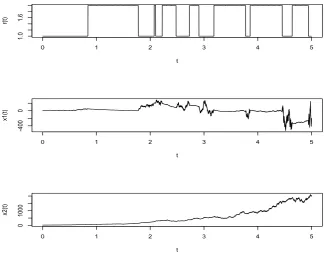
The numerical simulation (Figure 5.1) shows that this hybrid uncertain SDE is not almost surely
exponentially stable (and then certainly not mean-square exponentially stable as the latter implies
the former).
Now we aim to design a feedback control based on discrete-time observations of both state and
mode to stabilize the system. Assume that the controlled linear hybrid uncertain SDE has the form
dx(t) =[(A(r(t)) + ∆A(t, r(t)))x(t) +C(r(t))K(r(δ(t)))x(δ(t))]dt
+[B(r(t)) + ∆B(t, r(t))]x(t)dw(t), (27)
where
C1=
0.1
0.7
, C2=
0.2
0.5
.
Our aim is to findK1andK2inR1×2and then make sureτis sufficiently small for this controlled
SDE to be exponentially stable in mean square. To apply Theorem2, we first find that LMIs (21)
have the feasible solutions
P1=
8.8284 0.0897
0.0897 8.5196
, P2=
9.0255 0.1382
0.1382 9.4558
0 1 2 3 4 5
1.0
1.6
t
r(t
)
0 1 2 3 4 5
-4
00
0
t
x1
(t)
0 1 2 3 4 5
0
1000
t
x2
[image:16.595.127.453.90.345.2](t)
Fig. 5.1. Computer simulation of the paths ofr(t), x1(t)andx2(t)for the hybrid uncertain SDE (26) using
the Euler–Maruyama method with step size10−6and initial valuesr(0) = 1, x1(0) = 10andx2(0) = 20.
Y1=
3.9907 −30.7673
, Y2=
23.5315 −40.1093
,
ρ1= 21.8561, ρ2= 21.6545, ε1= 18.0638, ε2= 18.8368.
A further calculation shows that
K1=
0.4888 −3.6165
, K2=
2.6728 −4.2808
,
and
λM = 0.1177, λm= 0.1053, λ=−0.2384,
MQCK= 0.0911, MC= 0.5, HK= 5.2112,
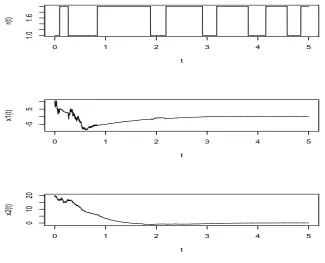
It is easy to show that (15) holds wheneverτ <0.0031. So by Theorem2, if we setKi(i= 1,2)
as above and make sureτ <0.0031, then the controlled system (27) is mean-square exponentially
stable. The numerical simulation (Figure 5.2) supports this result clearly.
0 1 2 3 4 5
1.0
1.6
t
r(t
)
0 1 2 3 4 5
-5
5
t
x1
(t)
0 1 2 3 4 5
0
10
20
t
x2
[image:17.595.125.451.166.429.2](t)
Fig. 5.2. Computer simulation of the paths ofr(t), x1(t)andx2(t)for the controlled hybrid uncertain SDE
(27) withτ = 0.002using the Euler–Maruyama method with step size10−6and initial values
r(0) = 1, x1(0) = 10andx2(0) = 20.
5. CONCLUSION
In this paper, we have showed that unstable hybrid uncertain stochastic systems can be stabilized by
linear state feedback controls based on the discrete-time observations of both state and mode. Such
discrete-time controls are more realistic and cost less compared with continuous-time feedback
controls. A method in terms of LMIs for designing the robust controller has also been developed.
ACKNOWLEDGEMENTS
The authors would like to thanks the reviewers and editor for their very professional comments and
suggestions which have significantly improved this paper. This paper was completed when the first author
was visiting the Department of Mathematics and Statistics, University of Strathclyde, whose hospitality
is greatly appreciated. The authors would like to thank the financial support from Donghua University
(15D310414) and the Leverhulme Trust (RF-2015-385), and the first author would especially like to thank
the Chinese Scholarship Council for awarding her the scholarship to visit the University of Strathclyde for
one year.
REFERENCES
1. Kushner H.Stochastic Stability and Control. Academic Press: New York, 1976.
2. Khasminskii RZ.Stochastic Stability of Differential Equations. Sijthoff and Noordhoff: Leiden, 1981.
3. Mao X. Stochastic Differential Equations and Applications (Second Edition). Horwood Publishing Limited: Chichester, 2007.
4. Mohammed SEA.Stochastic Functional Differential Equations. Longman Scientific and Technical: Harlow, 1986. 5. Ghosh MK, Arapostathis A, Marcus SI. Optimal control of switching diffusions with application to flexible
manufacturing systems.SIAM J. Control Optim.1993;31(5):1183–1204.
6. Ghosh MK, Arapostathis A, Marcus SI. Ergodic control of switching diffusions.SIAM J. Control Optim.1997; 35(6):1952–1988.
7. Yin G, Liu RH, Zhang Q. Recursive algorithms for stock liquidation: A stochastic optimization approach.SIAM J. Optim.2002;13(1):240–263.
8. Mariton M.Jump Linear Systems in Automatic Control. Marcel Dekker: New York, 1990.
9. Basak GK, Bisi A, Ghosh MK. Stability of a random diffusion with linear drift.J. Math. Anal. Appl.1996;202:604– 622.
10. Mao X. Stability of stochastic differential equations with Markovian switching.Sto. Proc. Their Appl.1999;79:45– 67.
11. Mao X. Exponential stability of stochastic delay interval systems with Markovian switching.IEEE Trans. Auto. Control2002;47(10):1604–1612.
12. Yue D, Han Q. Delay-dependent exponential stability of stochastic systems with time-varying delay, nonlinearity, and Markovian switching.IEEE Trans. Automat. Control2005;50:217–222.
14. Mao X, Yin G, Yuan C. Stabilization and destabilization of hybrid systems of stochastic differential equations.
Automatica2007;43:264–273.
15. Mao X, Lam J, Huang L. Stabilisation of hybrid stochastic differential equations by delay feedback control.Systems & Control Letters2008;57:927–935.
16. Wu L, Su X, Shi P. Sliding mode control with boundedL2gain performance of Markovian jump singular time-delay
systems.Automatica2012;48(8):1929–1933.
17. Zhang LX, Ning ZP, Shi P. Input-output approach to control for fuzzy Markov jump systems with time-varying delays and uncertain packet dropout rate.IEEE Transactions on Cybernetics2015;45(11):2449–2460.
18. Zhang LX, Zhu YZ, Shi P, Zhao YX. Resilient asynchronousH∞filtering for Markov jump neural networks with
Unideal measurements and multiplicative noises.IEEE Transactions on Cybernetics2015;45(12):2840–2852. 19. Chen W, Guan Z, Lu X. Delay-dependent exponential stability of uncertain stochastic systems with multiple delays:
an LMI approach.Systems Control Lett.2005;54:547–555.
20. Niu YG, Ho DWC, Lam J. Robust integral sliding mode control for uncertain stochastic systems with time-varying delay.Automatica2005;41:873–880.
21. Shi P, Mahmoud MS, Yi J, Ismail A. Worst case control of uncertain jumping systems with multi-state and input delay information.Information Sciences2006;176:186–200.
22. Wei G, Wang Z, Shu H, Fang J. RobustH∞control of stochastic time-delay jumping systems with nonlinear
disturbances.Optim. Control Appl. Meth.2006;27:255–271.
23. Xu S, Lam J, Wang JL, Yang GH. Stabilization andH∞control for uncertain stochastic time-delay systems via
non-fragile controllers.Asian Journal of Control2006;8:197–200.
24. Moon YS, Park P, Kwon WH, Lee YS. Delay-dependent robust stabilization of uncertain state-delayed systems.
International Journal of Control2001;74(14):1447-1455.
25. Yue D, Han QL. Delayed feedback control of uncertain systems with time-varying input delay.Automatica2005; 41(2):233-240.
26. Lu CY, Tsai JSH, Jong GJ, Su TJ. An LMI-based approach for robust stabilization of uncertain stochastic systems with time- varying delays.IEEE Trans. Automat. Control2003;48(2):286-289.
27. Wang Z, Qiao H, Burnham KJ. On stabilization of bilinear uncertain time-delay stochastic systems with Markovian jumping parameters.IEEE Trans. Automat. Control2002;47(4):640–646.
28. Huang L, Mao X. Robust delayed-state-feedback stabilization of uncertain stochastic systems.Automatica2009; 45:1332–1339.
29. Mao X. Stabilization of continuous-time hybrid stochastic differential equations by discrete-time feedback control.
Automatica2013;49(12):3677–3681.
30. Allwright JC, Astolfi A, Wong HP. A note on asymptotic stabilization of linear systems by periodic, piecewise constant, output feedback.Automatica2005;41(2):339–344.
31. Hagiwara T, Araki M. Design of stable state feedback controller based on the multirate sampling of the plant output.
32. Hagiwara T, Araki M. On preservation of strong stabilizability under sampling.IEEE Trans. Automat. Control1988; 33(11):1080–1082.
33. Mao X, Liu W, Hu L, Luo Q, Lu J. Stabilization of hybrid SDEs by feedback control based on discrete-time state observations.Systems & Control Letters2014;73:88-95.
34. You S, Liu W, Lu J, Mao X, Qiu Q. Stabilization of hybrid systems by feedback control based on discrete-time state observations.SIAM J. Control Optim.2015;53(2):905–925.
35. Geromel JC, Gabriel GW. OptimalH2state feedback sampled-data control design of Markov jump linear systems. Automatica2015;54:182-188.
36. Wang Y, Xie L, De Souza CE. Robust control of a class of uncertain nonlinear systems.Systems & Control Letters
1992;19:139–149.
37. Anderson WJ.Continuous-Time Markov Chains. Springer: New York, 1991.
38. Pan GL, Bar-Shalom Y. Stabilization of jump linear Gaussian systems without mode observations.Int. J. Control
1996;64(4):631–661.
39. Wu HN, Cai KY. Mode-independent robust stabilization for uncertain Markovian jump nonlinear systems via fuzzy control.IEEE Transactions on Systems, Man and Cybernetics-Part B: Cybernetics2006;36(3):509–519.