De
MOBILE CLOUD
COMPUTING
Debashis De
MOBILE CLOUD COMPUTING
Architectures, Algorithms and Applications
A C H A P M A N & H A L L B O O K 6000 Broken Sound Parkway, NW
Suite 300, Boca Raton, FL 33487 711 Third Avenue
New York, NY 10017 2 Park Square, Milton Park Abingdon, Oxon OX14 4RN, UK an informa business
K23405
w w w . c r c p r e s s . c o m “… the first complete reference book on mobile cloud computing. … an excellent book that serves not only as a resource for teaching purposes with a clear and detailed view of the various aspects of mobile cloud computing, but also as a complete research reference.”
—From the Foreword by Professor Rajkumar Buyya, Director of Cloud Computing and Distributed Systems (CLOUDS) Laboratory, The University of Melbourne; Editor-in-Chief of Software: Practice and Experience; and CEO of Manjrasoft Pty Ltd
“This book provides an introduction to the emerging computing paradigm of mobile cloud computing. It also enables mobile cloud application engineers and cloud service providers to leverage the appropriate features that can mitigate communication and computation latencies in order to increase the quality of service for mobile cloud users.”
—From the Foreword by Professor Abdullah Gani, Dean of the Faculty of Computer Science and Information Technology, University of Malaya
Essential for high-speed fifth-generation mobile networks, mobile cloud computing (MCC) integrates the power of cloud data centers with the portability of mobile computing devices.
Mobile Cloud Computing: Architectures, Algorithms and Applications covers the latest technological and architectural advances in MCC. It also shows how MCC is used in health monitoring, gaming, learning, and commerce.
FEATURES
• Provides the first book on the field of MCC
• Introduces sensor MCC, vehicular MCC, and femtocell-based MCC
• Addresses security and privacy concerns, the business aspects of MCC models, and resource allocation and management schemes
• Explores open research problems and future research directions to improve the strength of MCC and enrich mobile user experience
• Offers code for various algorithms on the book’s CRC Press web page
MOBILE CLOUD
COMPUTING
Architectures, Algorithms and Applications
ISBN: 978-1-4822-4283-6
9 78 1 482 242836
MOBILE CLOUD
COMPUTING
MOBILE CLOUD
COMPUTING
Debashis De
West Bengal University of Technology
Kolkata, India
Architectures, Algorithms and Applications
Boca Raton London New York CRC Press is an imprint of the
Boca Raton, FL 33487-2742
© 2016 by Taylor & Francis Group, LLC
CRC Press is an imprint of Taylor & Francis Group, an Informa business No claim to original U.S. Government works
Version Date: 20150825
International Standard Book Number-13: 978-1-4822-4284-3 (eBook - PDF)
This book contains information obtained from authentic and highly regarded sources. Reasonable efforts have been made to publish reliable data and information, but the author and publisher cannot assume responsibility for the valid-ity of all materials or the consequences of their use. The authors and publishers have attempted to trace the copyright holders of all material reproduced in this publication and apologize to copyright holders if permission to publish in this form has not been obtained. If any copyright material has not been acknowledged please write and let us know so we may rectify in any future reprint.
Except as permitted under U.S. Copyright Law, no part of this book may be reprinted, reproduced, transmitted, or uti-lized in any form by any electronic, mechanical, or other means, now known or hereafter invented, including photocopy-ing, microfilmphotocopy-ing, and recordphotocopy-ing, or in any information storage or retrieval system, without written permission from the publishers.
For permission to photocopy or use material electronically from this work, please access www.copyright.com (http:// www.copyright.com/) or contact the Copyright Clearance Center, Inc. (CCC), 222 Rosewood Drive, Danvers, MA 01923, 978-750-8400. CCC is a not-for-profit organization that provides licenses and registration for a variety of users. For organizations that have been granted a photocopy license by the CCC, a separate system of payment has been arranged.
Trademark Notice: Product or corporate names may be trademarks or registered trademarks, and are used only for
identification and explanation without intent to infringe.
vii
Forewords ... xix
Preface ... xxi
Acknowledgments ...xxiii
Author ... xxv
1. Mobile Computing ...1
1.1 Introduction to Mobile Computing ...1
1.2 Architecture of Mobile Network ...3
1.2.1 Architecture of Cellular Network ...3
1.2.2 Architecture of Mobile Ad Hoc Network...4
1.2.3 Architecture of Mobile Wireless Sensor Network ...5
1.3 Generations of Mobile Communication ...6
1.3.1 1G Mobile Communication ...6
1.3.2 2G Mobile Communication ...7
1.3.3 2.5G Mobile Communication ...9
1.3.4 3G Mobile Communication ...9
1.3.5 4G Mobile Communication ... 11
1.3.6 5G Mobile Communication ... 13
1.3.7 Comparison of the Generations of Mobile Communication ... 14
1.4 Mobile Operating Systems ... 14
1.4.1 Windows CE Operating System ... 16
1.4.2 Mac OS X ... 16
1.4.3 Symbian OS ... 16
1.4.4 Android OS ... 17
1.4.5 Blackberry 10 ... 17
1.5 Applications of Mobile Communication ... 17
1.5.1 Smartphones ... 18
1.5.2 Digital Music Players ... 18
1.5.3 Bluetooth and Wi-Fi ... 19
1.5.4 GPS ... 19
1.5.5 Smart Systems ... 19
1.5.5.1 Smartcards... 19
1.5.5.2 Smart Labels ...20
1.5.5.3 Smart Tokens ...20
1.5.5.4 Sensors ...20
1.5.5.5 Actuators ... 21
1.6 Challenges of Mobile Communication ... 21
1.6.1 Wireless Communication ...22
1.6.1.1 Disconnection ...22
1.6.1.2 Low Bandwidth ...22
1.6.1.4 Variable Network Conditions ...22
1.6.1.5 Security Issues ...22
1.6.2 Mobility ...23
1.6.2.1 Changing Network Address ...23
1.6.2.2 Locality Migration...23
1.6.2.3 Location Management ...23
1.6.2.4 Mobile Network Traffic Forecasting ... 24
1.6.2.5 Mobile Call Admission Control and Handover Management... 24
1.6.3 Resource Limitation ... 24
1.6.3.1 Data Storage ... 24
1.6.3.2 Power Consumption ... 24
1.6.4 Mobile Channel Model ...25
1.6.5 Disaster Management ...25
1.6.6 Mobile Data Mining ...25
1.6.7 Quality of Service ...25
1.7 Conclusion ...26
Questions ...26
References ...26
2. Cloud Computing ...29
2.1 Introduction ...30
2.2 Evolution of Cloud Computing ...30
2.3 Cloud Computing: What Is It Actually? ... 31
2.3.1 Virtualization as a Component of Cloud Computing ... 32
2.3.1.1 Characteristics of Virtualized Environments ...33
2.3.1.2 Taxonomy of Virtualization Techniques ...33
2.3.1.3 Virtualization and Cloud Computing ...35
2.4 Characteristics of Cloud Computing ...36
2.5 Related Technologies ... 37
2.6 Cloud Computing Architecture ... 37
2.6.1 Cloud Computing Service Models ... 37
2.6.1.1 Software as a Service ...38
2.6.1.2 Platform as a Service ...38
2.6.1.3 Infrastructure as a Service ... 39
2.7 Cloud Computing Deployment Models ... 39
2.7.1 Public Cloud ... 39
2.7.2 Private Cloud ...40
2.7.3 Hybrid Cloud ...40
2.7.4 Public Cloud versus Private Cloud ... 41
2.8 Issues of Cloud Computing ... 41
2.8.1 Scheduling ... 41
2.9 Security and Trust ...42
2.9.1 Types of Trust ...43
2.9.1.1 Direct Trust ...43
2.9.1.2 Indirect Trust ...43
2.9.1.3 Hybrid Trust ...43
2.10 Energy Efficiency ...43
2.10.2 Reduction in Energy for Cooling Server ...44
2.10.3 Increase in Energy Consumption for Increase in Network Traffic ...44
2.11 Interactivity, Real-Time Streaming ...44
2.12 Data Management ...45
2.12.1 Data Storage and Access on Cloud ...45
2.12.2 Data Portability and Interoperability ...45
2.13 Quality of Service ...45
2.14 Resource Utilization ...46
2.15 Applications of Cloud Computing ...46
2.15.1 Mobile Cloud Computing ...47
2.15.2 Healthcare ...47
2.15.3 Cloud Gaming ...47
2.15.4 Storage ...48
2.16 Conclusion ...48
Questions ...48
References ...49
3. Mobile Cloud Computing ... 51
3.1 Introduction ... 51
3.2 Motivation to Mobile Cloud Computing ... 52
3.3 Architecture of Mobile Cloud Computing ...53
3.3.1 Service-Oriented Architecture ...53
3.3.2 Agent–Client Architecture ...56
3.3.3 Collaborative Architecture ... 57
3.4 Platform and Technologies ...58
3.4.1 Platform of MCC ...58
3.4.2 Enabling Technologies of MCC ...58
3.5 Mobile Augmentation Approaches ...58
3.5.1 Hardware Approaches ...58
3.5.2 Software Approaches ...58
3.6 Issues of Mobile Cloud Computing ...59
3.6.1 Operational Issues ...60
3.6.1.1 Offloading Methods ...60
3.6.1.2 Cost–Benefit analysis ... 61
3.6.1.3 Mobility Management ...63
3.6.1.4 Connection Protocol...64
3.6.2 End-User Issues ...64
3.6.2.1 Incentive Scheme ...64
3.6.2.2 Presentation and Usability ...64
3.6.3 Service-Level and Application-Level Issues ...64
3.6.3.1 Fault Tolerance ...64
3.6.3.2 Supporting Performance at Service Level ...65
3.6.3.3 Cloud APIs ...65
3.6.4 Security and Privacy ...65
3.6.4.1 General Cloud Security ...65
3.6.4.2 Security for Mobile User ...66
3.6.5 Context Awareness ...66
3.6.5.1 Context-Aware Service Provisioning...66
3.6.5.2 Risk Assessment Using Context Awareness ...68
3.6.5.3 Resource and Common Goal Identification Using Context Awareness ...68
3.6.5.4 Energy Awareness ...68
3.6.6 Mobile Data Management ... 69
3.6.6.1 Personal Data Storage on Mobile Cloud ... 69
3.6.6.2 Data Access ... 69
3.6.6.3 Data Portability and Interoperability ... 69
3.6.6.4 Embedded Mobile Databases ... 70
3.7 Advantages of Mobile Cloud Computing ... 70
3.8 Applications of Mobile Cloud computing ...71
3.8.1 Mobile Commerce ...71
3.8.2 Mobile Learning ...71
3.8.3 Mobile Gaming ...72
3.8.4 Mobile Health Monitoring ...72
3.9 Research Challenges in Mobile Cloud Computing ...72
3.9.1 Connectivity between Mobile Device and Cloud ...72
3.9.2 Cloudlet Deployment in MCC ...73
3.9.3 Centralization in Collaborative Model of MCC ...73
3.9.4 Security in MCC ...73
3.9.5 Incentives in MCC ...73
3.9.6 Energy Efficiency in MCC ...73
3.9.7 Business Model of MCC ... 74
3.9.8 Data Traffic Management ... 74
3.10 Conclusion ... 74
Questions ... 74
References ...75
4. Offloading in Mobile Cloud Computing ...79
4.1 Introduction ...80
4.2 Offloading Decision ... 81
4.2.1 Improving Performance ... 81
4.2.2 Saving Energy ...83
4.3 Types of Offloading ...84
4.3.1 Depending on Material Being Offloaded ...84
4.3.2 Depending on Approaches to Time Reduction ...84
4.3.2.1 Fine-Grained Offloading or Partial Offloading ...84
4.3.2.2 Coarse-Grained Offloading or Full Offloading ...86
4.4 Topologies of Offloading ...86
4.5 Offloading in Cloud Computing and in Mobile Cloud Computing: Similarities and Differences ...87
4.6 Adaptive Computation Offloading from Mobile Devices ...87
4.6.1 Mobile Augmentation Cloud Services ...88
4.6.2 Adaptive Computation Offloading ...89
4.7 Cloud Path Selection for Offloading ... 91
4.7.1 Cloud Path Selection Methods ...92
4.8 Mobile Data Offloading Using Opportunistic Communication ...93
4.8.1 System Model ...93
4.8.2 Target-Set Selection...94
4.8.3 Greedy, Heuristic, and Random Algorithms ...95
4.9 Three-Tier Architecture of Mobile Cloud Computing ...95
4.10 Requirements of Data Offloading ...96
4.11 Performance Analysis of Offloading Techniques...97
4.11.1 Analysis of Energy Consumption in Offloading for Different Data Amounts ...97
4.11.2 Analysis of Energy Consumption in Offloading for Different Connectivity ...98
4.12 Multi-Cloud Offloading in Mobile Cloud Computing Environment ...98
4.12.1 Performance Analysis of Multi-Cloud Offloading Schemes ...99
4.13 Conclusion ... 100
Questions ... 100
References ... 100
5. Green Mobile Cloud Computing ... 103
5.1 Introduction ... 103
5.2 Green Mobile Computing ... 104
5.2.1 Green Data Center ... 105
5.2.2 Green Macrocell Base Station ... 105
5.2.3 Green Femtocell Base Station ... 105
5.2.4 Green Mobile Device ... 111
5.2.5 Green Mobile Application and Services ... 111
5.3 Green Mobile Network ... 112
5.3.1 Congestion Control for Energy-Efficient Mobile Network ... 112
5.3.2 Energy Efficiency of Femtocell, Microcell, and Picocell Network over Macrocell-Based Mobile Network ... 113
5.4 Green Cloud Computing... 117
5.4.1 Green Cloud Servers... 118
5.4.2 Green Cloud Data Center ... 119
5.4.3 Green Cloud Hardware ... 120
5.4.4 Green Cloud Software ... 120
5.4.5 Green Wired or Wireless Network ... 120
5.5 Green Mobile Cloud Computing ... 121
5.5.1 Energy Saving in Mobile Cloud Infrastructures ... 121
5.5.2 Issues and Requirements for Green MCC ... 123
5.6 Green Mobile Devices Using Mobile Cloud Computing ... 123
5.6.1 Computation Offloading ... 123
5.6.2 Resource Management ... 127
5.7 Green Femtocell Using Mobile Cloud Computing... 128
5.8 Green Seamless Service Provisioning with Mobile Cloud Computing ... 129
5.8.1 Architecture of a Mobile Ad Hoc Cloud ... 129
5.8.2 Functioning of Mobile Ad Hoc Cloud ... 132
5.8.2.1 Module 1: Service Discovery ... 133
5.8.2.2 Module 2: Seamless Services ... 133
5.8.2.3 Module 3: Offloading Decisions ... 134
5.9 Green Location Sensing within Mobile Cloud Computing Environment ... 135
5.10 Conclusion ... 137
Questions ... 137
References ... 138
6. Resource Allocation in Mobile Cloud Computing ... 141
6.1 Introduction ... 142
6.2 Significance of Resource Allocation in Mobile Cloud Computing ... 142
6.3 Resource-Allocation Strategies in Mobile Cloud Computing ... 142
6.3.1 Semi-Markov Decision Process (SMDP)-Based Resource Allocation in MCC ... 143
6.3.1.1 System Model of Cloud ... 144
6.3.1.2 System States of Cloud... 144
6.3.1.3 Actions of Cloud ... 144
6.3.1.4 Dropping Probability ... 144
6.3.1.5 Comparison of SMDP with Greedy Approach ... 145
6.3.2 Task Scheduling Using Activity-Based Costing Algorithm ... 146
6.3.2.1 Activity-Based Costing Algorithm ... 146
6.3.2.2 Performance of ABC Algorithm ... 148
6.3.3 Resource Allocation Using Middleware... 148
6.3.3.1 Architecture of Middleware ... 150
6.3.3.2 Resource-Allocation Strategies ... 151
6.3.4 Energy-Aware Resource Allocation ... 152
6.3.4.1 Green Cloud Architecture ... 152
6.3.4.2 Energy-Aware Data Center Resource Allocation ... 154
6.3.5 Resource Allocation in MCC Using Entropy-Based FIFO Method ... 155
6.3.6 Auction Mechanism for Resource Allocation in MCC ... 157
6.4 Research Challenges in Resource Allocation in Mobile Cloud Computing ... 158
6.4.1 Energy-Aware Memory Management ... 158
6.4.2 Maintaining Strict Service-Level Agreements (SLAs) ... 158
6.4.3 Merging of Different Resource-Allocation Strategies ... 158
6.5 Conclusion ... 159
Questions ... 159
References ... 159
7. Sensor Mobile Cloud Computing ... 161
7.1 Introduction ... 161
7.2 Wireless Sensor Network ... 162
7.2.1 Different Deployment Technologies of WSN ... 162
7.2.2 Architecture of WSN ... 163
7.3 Sensor Cloud ... 163
7.3.1 Architecture of Sensor Cloud ... 164
7.3.2 Benefits of Sensor Cloud ... 165
7.3.3 Extension of Sensor Cloud with Mobile ... 165
7.4 Sensor Mobile Cloud Computing ... 167
7.4.1 Architecture of Sensor Mobile Cloud Computing ... 167
7.4.2 Service Life Cycle Model of Sensor Mobile Cloud Computing ... 169
7.4.3 System Architecture for a Rescue Service Model ... 170
7.5 Internet of Things ... 173
7.6 Urban Sensing ... 173
7.6.1 Opportunistic Sensing ... 174
7.6.2 Participatory Sensing ... 175
7.7 Application ... 175
7.7.1 A Complete Architecture of Health Service Model ... 176
7.8 Challenges of Sensor Mobile Cloud Computing ... 178
7.9 Conclusion ... 179
Questions ... 179
References ... 180
8. Mobile Social Cloud Computing ... 183
8.1 Introduction ... 184
8.2 Mobile Social Cloud Architecture ... 185
8.3 Resource Sharing in Mobile Social Cloud ... 187
8.3.1 Motivation for Contribution of Resources ... 188
8.3.2 Social Capital ... 188
8.3.3 Virtualized Resources ... 188
8.3.4 Banking ... 188
8.3.5 Registration ... 188
8.3.6 Social Market ... 189
8.4 Warehousing and Analyzing Social Data Using Cloud ... 191
8.4.1 Architecture of Analysis and Warehousing of Social Network Data ... 191
8.4.2 Case Study on Tweet Data Analysis... 193
8.4.2.1 Tweet Mapping ... 193
8.4.2.2 Mood Probabilities ... 194
8.5 Social Compute Cloud: Sharing and Allocating Resources ... 195
8.5.1 Architecture of Social Compute Cloud ... 196
8.6 3D Visualization of Social Network Data ... 197
8.6.1 Visualization of Social Network Data ... 197
8.6.2 OLAP Data Analysis and Cube Generation ... 197
8.6.3 MVC-Based Model for Visualization ... 198
8.7 Security in Mobile Social Cloud ... 199
8.7.1 Security in Social Network ...200
8.7.1.1 Purpose of Attackers ...200
8.7.1.2 Method of Attacks ... 201
8.7.2 Resource Allocation for Security Services ... 201
8.8 Trust in Mobile Social Cloud ... 202
8.8.1 Trust Inference in Social Networks ...203
8.8.2 Trust Contextualizing in Social Clouds...204
8.8.3 Social Cloud Exchange Structure ...204
8.8.3.1 Prior Expectation ...204
8.8.3.2 Social Interchange ...205
8.8.3.3 Completion ...205
8.9 Applications of Mobile Social Cloud ...206
8.9.1 Cloud-Assisted Adaptive Video Streaming ...206
8.9.2 Personal Emergency Preparedness Plan ... 207
8.9.3 Massively Multiplayer Online Games ...208
8.9.3.1 Challenges in CAMEO Architecture ...208
8.9.4 Geosmart: Social Media Education ... 210
8.9.4.1 Entities of Geosmart ... 210
8.9.4.2 Architecture of Geosmart ... 211
8.10 Conclusion ... 212
Questions ... 212
References ... 212
9. Privacy and Security in Mobile Cloud Computing ... 215
9.1 Introduction ... 216
9.2 Security Needed in Different Levels for Securing Mobile Cloud Computing ... 216
9.2.1 Level 1: Security Issues in Mobile Devices ... 217
9.2.1.1 Approaches to Mitigate Security Issues Related to Mobile Devices... 218
9.2.2 Level 2: Security Issues in Communication Channels ... 218
9.2.2.1 Approaches to Mitigate Security Issues Related to Communication Channel ... 218
9.2.3 Level 3: Security Issues in Cloud Computing ... 219
9.2.3.1 Approaches to Mitigate Security Issues in Cloud Infrastructure ... 219
9.3 Security Issues in Mobile Cloud Environment ...220
9.3.1 Application Security ...220
9.3.1.1 Existing Schemes for Application Security ...220
9.3.2 Authentication Issues ...223
9.3.2.1 Existing Authentication Schemes ...223
9.3.3 Data Security ...225
9.3.3.1 Existing Schemes for Data Security...225
9.3.4 Digital Rights Management ...234
9.3.4.1 Existing DRM Scheme ...234
9.3.5 Intrusion Detection ...235
9.3.5.1 Drawbacks of Intrusion Detection ...235
9.3.5.2 Existing Schemes for Intrusion Detection ...235
9.4 Conclusion ... 239
Questions ... 239
References ... 240
10. Trust in Mobile Cloud Computing ... 243
10.1 Introduction ...244
10.2 Trust Properties ... 245
10.3 Components of Trust ... 245
10.3.1 Security ... 245
10.3.2 Privacy ... 245
10.3.3 Auditability ... 246
10.3.4 Accountability ... 246
10.4 Types of Trust ... 246
10.4.1 Direct Trust ... 246
10.4.2 Indirect Trust ... 247
10.5 Trust Issues ... 248
10.5.1 Weak Chain of Trust ... 248
10.5.2 Lack of Control and Visibility ... 248
10.6 Ways of Trust Establishment ... 248
10.6.1 Service-Level Agreement ... 248
10.6.2 Audit ... 248
10.6.3 Measuring and Rating ... 249
10.6.4 Self-Assessment Questionnaire ... 249
10.6.5 Trust and Reputation Model ... 249
10.6.5.1 QoS+ Parameters for Trust and Reputation Models ... 249
10.6.5.2 Promising Trust and Reputation Models ...250
10.7 Trust Evaluation ...250
10.7.1 Black Box Approach...250
10.7.2 Inside-Out Approach ...250
10.7.3 Outside-In Approach ...250
10.8 Detailed Study of Various Aspects of Trust in MCC ... 251
10.8.1 User Behavior Trust ... 251
10.8.1.1 Evaluation Principles of User Behavior Trust ... 251
10.8.1.2 Decomposition of User Behavior Trust ... 251
10.8.1.3 Acquirement of Behavior Trust Evidence ...253
10.8.1.4 User Behavior Trust Evaluation Methods ...253
10.8.2 Trustworthy Mobile Sensing Framework ...254
10.8.3 Mobile Agent-Based Trustworthy Infrastructure for MCC ...254
10.8.4 Building Trustworthy Social Network Based on Call Behavior ...256
10.8.5 Trust-Based Mobile Commerce ... 259
10.8.5.1 Automated Trust Negotiation ... 259
10.8.5.2 Proxy Certificate ...260
10.8.5.3 CBTN Protocol for Trust-Based Mobile Commerce ...260
10.9 Conclusion ...260
Questions ...260
References ... 261
11. Vehicular Mobile Cloud Computing ...263
11.1 Introduction ...264
11.2 Vehicular Ad Hoc Network ...265
11.2.1 Working Principles of Vehicular Ad Hoc Networks ...266
11.3 Architecture and Working Model of Vehicular Mobile Cloud Computing ... 266
11.3.1 VMCC Architecture ... 267
11.3.2 Performance Analysis of VMCC ... 270
11.4 Privacy and Security in Vehicular Mobile Cloud Computing ... 270
11.4.1 Security and Privacy Attacks in VMCC ... 271
11.4.1.1 Possible Forms of Attacks ... 271
11.4.1.2 Threats in VMCC... 271
11.4.1.3 Authentication of Mobility Nodes ... 272
11.4.2 Solution to Secure VMCC ... 272
11.5 Limitations of Vehicular Mobile Cloud Computing ... 272
11.5.1 Mobility in VMCC ... 272
11.5.2 Volatility in VMCC ... 273
11.5.4 Liability ... 273
11.5.5 Scalability ... 273
11.6 Challenges in Vehicular Mobile Cloud Computing ... 273
11.7 Applications ... 274
11.7.1 Safety Applications ... 274
11.7.2 User Applications... 274
11.8 Conclusion ... 274
Questions ... 275
References ... 276
12. Business Aspects of Mobile Cloud Computing ...277
12.1 Introduction ... 278
12.2 Cloud Business Models ... 279
12.2.1 Cloud Computing Architecture ...280
12.2.2 Current Offerings of Cloud Computing ...280
12.2.3 Pricing Strategies of Cloud ...280
12.2.4 Method of Dynamically Pricing Resources ... 281
12.2.4.1 Dynamic Pricing Scheme ... 282
12.2.4.2 User Welfare in Cloud Computing ...284
12.2.5 Cooperation among Cloud Service Providers ...285
12.2.5.1 Brokering Mechanism in Mobile Cloud Business Model...285
12.2.5.2 Broker as a Service ... 287
12.2.5.3 Resource Estimation and Pricing Model ...288
12.2.5.4 Pricing and Billing ... 289
12.2.5.5 System Model and Assumption ... 292
12.2.5.6 Resource and Revenue Sharing among Cloud Providers ... 293
12.3 Business Model of Mobile Computing Environment ... 294
12.4 Cooperation among Service Providers ... 295
12.4.1 Model of Mobile Cloud Computing ... 295
12.4.2 Model of Resource Pool ... 296
12.5 Weblet-Based Mobile Cloud Computing Model ... 296
12.6 Mobile Cloud Service Insurance Brokerage ... 297
12.7 Business Aspects of Social Mobile Cloud Computing ... 298
12.7.1 Impact on Global Business ... 298
12.7.2 Individual Roles of Components of SMAC ... 298
12.8 Conclusion ...299
References ...300
13. Application of Mobile Cloud Computing ...303
13.1 Introduction ...303
13.2 Cloud Mobile Media Application ...304
13.2.1 Architecture ...305
13.3 Biometric Application ...306
13.3.1 Face Recognition ...307
13.3.2 Fingerprint Recognition ...307
13.4 Vehicle Monitoring ...308
13.4.1 Mobile Vehicular Cloud ...308
13.4.1.1 Route Tracking ...308
13.5 Pervasive Forensic Analysis ...309
13.5.1 Pervasive and Collaborative Analysis ...309
13.5.2 Forensic Cloud ...309
13.5.2.1 Framework Design ... 310
13.6 Mobile Learning ... 311
13.6.1 Mobile Learning Procedure ... 311
13.6.1.1 Cloud Model ... 311
13.6.1.2 Client Model ... 311
13.7 Remote Display ... 312
13.8 Context-Aware Navigation System ... 313
13.9 Cloud Computing Support for Enhanced Health Applications ... 314
13.9.1 Femtocell-Based Health Monitoring Using MCC ... 315
13.10 Sensing as a Service ... 316
13.11 Secure Web Referral Services for Mobile Cloud Computing ... 317
13.12 Mobile Multimedia Storage ... 317
13.13 Application of Mobile Cloud Computing in Defense Sector ... 318
13.14 Application in Social Cloud ... 319
13.15 Conclusion ... 320
Questions ... 320
References ... 321
14. Future Research Scope of Mobile Cloud Computing ... 323
14.1 Introduction ... 324
14.2 Efficient Bandwidth Allocation ... 324
14.2.1 Use of 5G Network ... 324
14.2.2 Mobile Cloud Computing Architecture with 5G Network ... 324
14.2.3 Mobile Cloud Computing Architecture with Femtocell Base Station ... 324
14.2.4 Efficient Spectrum Utilization Using Cognitive Radio ... 326
14.2.4.1 Mobile Cloud Computing with Cognitive Radio Technology ... 326
14.3 Use of Cloudlet in Mobile Cloud Computing ... 326
14.4 Cross-Cloud Communication ... 327
14.4.1 Mobile Sky Computing ... 327
14.5 Standard Interface in Mobile Cloud Computing ... 327
14.6 Cloud Resource Access Mechanism ... 328
14.7 Elastic Application Model ... 328
14.8 Security and Privacy in Mobile Cloud Computing ... 331
14.8.1 Secured Mobile Cloud Computing ... 331
14.9 Enterprise Mobile Cloud ... 331
14.9.1 Identity Security ... 331
14.9.2 Disaster Recovery ... 332
14.9.3 Pricing in Mobile Cloud Computing ... 332
14.9.4 Service Execution and Delivery ...334
14.10 Reducing Energy Consumption of Offloading ...335
14.10.1 Femtocell-Based Offloading Strategy for Mobile Cloud Computing ...335
14.10.2 Cloud Path Selection for Offloading Data Storage and Application Execution ...335
14.10.3 Offloading Strategy for Mobile Devices ...336
14.11 Improving Quality of Service with Cloudlets ...336
14.11.1 Load Balancing among Cloudlets ... 337
14.11.2 Load Sharing among Cloudlets ... 337
14.11.3 Provisioning of Seamless Mobile Cloud Services ... 337
14.12 Reduction in Cloud Data Center Energy Consumption ... 337
14.13 Resource Management ...338
14.14 Application Migration Schemes for Data Center Servers ...338
14.15 Conclusion ...338
Questions ... 339
xix
Mobile cloud computing has gained popularity because of its potential to minimize power consumption and enhance user experience by outsourcing resource/computation-intensive applications/operations from mobile devices to clouds. Mobile Cloud Computing:
Architectures, Algorithms, and Applications is the first complete reference book on mobile cloud computing.
Mobile devices suffer from poor battery life and limited resource and storage capac-ity. To overcome these constraints, mobile cloud computing has introduced offloading, where data storage and computations are performed inside the remote cloud instead of the mobile device. With this emergence, mobile cloud computing has become a vital issue that requires an energy-efficient mobile network and green cloud environment. Resource allocation and security are also important issues discussed in detail in this book. Mobile cloud computing–based health monitoring, gaming, learning, and commerce are feasible due to high-speed 4G/5G mobile networks. The issues of mobile cloud computing are dis-cussed in the 14 chapters with future open research problems.
Overall, this is an excellent book that serves not only as a resource for teaching purposes with a clear and detailed view of the various aspects of mobile cloud computing, but also as a complete research reference.
I wish success for the book.
Prof. Rajkumar Buyya Fellow of IEEE Director, Cloud Computing and Distributed Systems (CLOUDS) Laboratory Department of Computing and Information Systems, The University of Melbourne, Parkville,
Victoria, Australia Editor-in-Chief, Software: Practice and Experience CEO, Manjrasoft Pty Ltd, Melbourne, Victoria, Australia
the key concern, reduces the growth of MCC. Even though the processing and data-storage capabilities of a mobile device have grown exponentially, they are still limited in terms of resources compared to high-end computers. CPU and memory, such as RAM, are the main limiting factors.
This book comprehensively debates on the emergence of mobile cloud computing from cloud computing models. Various technological and architectural advancements in mobile and cloud computing have been reported. It has meticulously explored the design and architecture of computational offloading solutions in cloud and mobile cloud computing domains to enrich mobile user experience. Furthermore, to optimize mobile power consumption, existing solutions and policies toward green mobile computing, green cloud computing, green mobile networking, and green mobile cloud computing are briefly discussed. The book also presents numerous cloud and mobile resource allo-cation and management schemes to efficiently manage existing resources (hardware and software). Recently, integrated networks (e.g., WSN, VANET, MANET) have sig-nificantly helped mobile users to enjoy a suite of services. The book discusses existing architecture, opportunities, and challenges, while integrating mobile cloud comput-ing with existcomput-ing network technologies such as sensor and vehicular networks. It also briefly expounds on various security and privacy concerns, such as application security, authentication security, data security, and intrusion detection, in the mobile cloud com-puting domain. The business aspects of mobile cloud comcom-puting models in terms of resource pricing models, cooperation models, and revenue sharing among cloud pro-viders are also presented in the book. To highlight the standings of mobile cloud comput-ing, various well-known, real-world applications supported by mobile cloud computing models are discussed. For example, the demands and issues while deploying resource-intensive applications, including face recognition, route tracking, traffic management, and mobile learning, are discussed. This book concludes with various future research directions in the mobile cloud computing domain to improve the strength of mobile cloud computing and to enrich mobile user experience.
This book provides an introduction to the emerging computing paradigm of mobile cloud computing for the readers. It also enables mobile cloud application engineers and cloud service providers to leverage the appropriate features that can mitigate communi-cation and computation latencies in order to increase the quality of service for mobile cloud users. Furthermore, discussion presented on various technological and architectural advancements in mobile cloud computing enables the reader to comprehend the mecha-nisms in mobile cloud computing. In particular, the highlighted open research challenges provide research directions to domain researchers for further investigations and improve-ments in mobile cloud computing.
xxi
Mobile cloud computing is essential for high-speed fifth-generation mobile networks. The book consists of 14 chapters on the recent developments in mobile cloud computing. Chapter 1 deals with mobile computing, which is computation within a mobile device. The chapter discusses the evolution, architecture, and different generations of mobile net-works along with the operating systems used in mobile devices. Various applications of mobile computing are also discussed with several challenges in this area.
In Chapter 2, the evolution, architecture, and applications of cloud computing are dis-cussed in detail. Various aspects of cloud computing, such as security, data management, and energy-efficiency, are discussed, and different deployment schemes of the cloud are described.
Chapter 3 discusses mobile cloud computing in terms of the integration of mobile com-puting and cloud comcom-puting. The revolution of mobile cloud comcom-puting is described with its architecture, advantages, and applications. Various issues—and solutions—of mobile cloud computing are studied.
Mobile devices suffer from poor battery life and limited resource and storage capacity. To deal with these constraints, offloading is performed. In Chapter 4, offloading strategies are illustrated. Offloading refers to a mechanism in which data storage and computations are done inside the remote cloud instead of the mobile device. Consequently, the battery life of the device is increased and the difficulties of storage and resource limitations are over-come. In this chapter, we discuss offloading and its applications toward energy efficiency. Green mobile cloud computing is an emerging research area. Green mobile network refers to energy-efficient mobile networks that consume low power. Small cell networks can be considered green mobile networks. By offloading computation inside the cloud, power consumption by a mobile device can be reduced. But this can cause more power, and thus cost, consumption inside the cloud. Therefore, there should be a trade-off between energy-efficient mobile networks and green cloud environment. In Chapter 5, the existing approaches for green mobile networks and green cloud computing are described. Based on the comparative study, a discussion is presented on how green mobile cloud computing can be achieved by merging green cellular networks with cloud environment.
Chapter 6 discusses the various resource allocation schemes of mobile cloud comput-ing, including energy-aware resource management. Different task scheduling methods are also discussed. Challenges faced in the field of resource allocation are explored.
Sensor mobile cloud computing, an integration of wireless sensor networks with mobile cloud computing, is another emerging research area. In Chapter 7, the architecture and applications of sensor mobile cloud computing are studied. A life-cycle model of this architecture is developed, and different challenges of sensor mobile cloud computing are also discussed.
Chapter 9 presents the security and privacy issues in mobile cloud computing. Trust management, referring to the goodness, honesty, reliability, and faithfulness of an object, is also important in mobile cloud computing. We tend to trust a system that works accord-ing to our expectations. In mobile cloud computaccord-ing, trust is a vital parameter because in this case long-distance personal data storage and data processing happen remotely.
In Chapter 10, different types of trust in mobile cloud computing are described. It is also discussed how the trust of the entire system can be increased by eliminating malicious users.
Research on mobile cloud computing studies several mobile agents such as vehicles, robots, and the like. All these mobile agents collaborate and interact to feel the environ-ment, process the data, propagate the outputs, and mostly share resources. The vision of vehicular mobile cloud computing (VMCC) is a nontrivial argumentation regarding dif-ferent dimensions with conventional mobile cloud computing. Chapter 11 provides a dis-cussion of VMCC, in which underutilized resources of vehicles, such as storage, Internet connectivity, computing power, and the like, are shared among the drivers and are rented over the Internet for other customers/users.
Mobile cloud computing business management depends on the quality of service of the cloud service providers to the mobile users. A smile on the customer’s face and retaining premium customers are the primary goals of service providers for business development. In Chapter 12, various economic and efficient business models are discussed, which have competitive advantages over each other on various quality-based parameters.
Mobile cloud computing has several applications including mobile learning, vehicles monitoring, digital forensic analysis, biometric application, and so forth. Through the help of mobile cloud computing, data can be stored and processed outside the mobile device and inside the cloud. This overcomes several challenges, for example, low bandwidth, limited speed, limited storage of traditional mobile learning, mobile health monitoring, and mobile gaming. Various applications of mobile cloud computing are presented in Chapter 13.
Mobile cloud computing has overcome several of the disadvantages of mobile comput-ing mentioned earlier. Yet, various issues where research is needed remain. In Chapter 14, a variety of challenging applications of mobile cloud computing are discussed, including energy efficiency, latency minimization, efficient resource management, billing, and secu-rity. The chapter also recommends solutions to such challenges.
xxiii
I acknowledge my past and present MTech students of the West Bengal University of Technology for their continuous support and enthusiasm. I am thankful to my PhD stu-dent Anwesha Mukherjee (gold medalist, MTech, IT), who is pursuing her research work as a DST-INSPIRE fellow under my supervision, and all the members of the mobile cloud computing laboratory of the West Bengal University of Technology. I am grateful to my brother Subhashis De for providing an excellent photograph for the cover page of this book. I thank my wife Swati De for supporting me all the way to completion of this proj-ect. The forewords written by Prof. Rajkumar Buyya, the cloud computing expert, and Prof. Abdullah Gani have added another dimension to this book. I am grateful for the invaluable feedback from all of the experts, reviewers, and the editorial team. I also thank Aastha Sharma, Hayley Ruggieri, Sarah Gelson, and Alex Edwards of CRC Press for their patience, enthusiasm, and support during my writing of this first edition of the book and at the same time for keeping me on schedule.
Finally, I am grateful to the Department of Science and Technology (DST) for sanctioning a research project entitled “Dynamic Optimization of Green Mobile Networks: Algorithm, Architecture and Applications” under the Fast Track Young Scientist scheme reference no. SERB/F/5044/2012-2013, under which this work was completed.
xxv
1
1
Mobile Computing
Mobile
Computing
ABSTRACT Mobile computing is computation within a mobile device. This chapter traces the evolution, architecture, and different generations of the mobile network. Different operating systems used in mobile devices are discussed. Various applications of mobile computing are described, along with several challenges in this area.
KEY WORDS: mobile computing, Mobile network, 2G, 3G, 4G, 5G, mobility.
1.1 Introduction to Mobile Computing
Mobile computing is the process of distributed computation on diversified mobile devices and hybrid networks interconnected by mobile communication protocols. Mobile computing focuses on the key technical issues related to the following:
1. Mobile architectures: Mobile networks and hosts, agents and proxies, wired and wireless systems integration, new development and standardization, mobility and location management, load balancing, mobile agent, and proxy architectures. 2. Mobile support services: Mobility and roaming, multimedia operation, operating
system support, power/energy management, green mobile computing. Focusing on seamless incorporation of wired and wireless access networks to provide both increased mobility and bandwidth for broadband services.
3. Algorithm for mobile network design: Innovative dynamic optimization algorithm for mobile networks, bio-inspired algorithms for mobile networks.
4. Protocol design and analysis: Mobile environments, protocol design, efficient band-width utilization, intermittent connectivity, mobile IP protocol design for seamless access on mobile Internet, all-time hangout with social networks.
5. Mobile environments: Data and knowledge management, performance modeling and characterization, security, scalability and reliability, design, management and operation, systems, and technologies.
6. Mobile communication systems: Data encoding and compression, spread-spectrum technologies, multiuser access and multichannel processing, and channel coding. 7. Applications: Location-dependent and sensitive, nomadic computing, wearable
computers and body area networks, multimedia applications and multimedia sig-nal processing, pervasive computing, and wireless sensor networks.
8. Emerging mobile technologies: Opportunistic computing, urban sensing, Internet of things.
9. Pervasive and mobile computing: Pervasive/ubiquitous computing bringing in ground-breaking paradigms for computing models. Remarkable developments in mobile communications and networking, embedded designs, wearable body area networking, sensors, radio frequency identification (RFID) tags, smart spaces, middleware, and software agents have led to the evolution of pervasive comput-ing platforms. The target of pervasive computcomput-ing is to create ambient intelligence, where network devices embedded in the environment provide connectivity and services all the time, thus improving the human quality of experience. In this environment, the world around us, appliances, human body, cars, homes, offices, and cities are interconnected as a pervasive network of intelligent devices that cooperatively and autonomously collect, process, and transport information, in order to adapt to the associated context and activity. Various characteristic of pervasive computing are the following:
a. Pervasive computing architectures and protocols b. Autonomic computing and communications
c. Ambient intelligence, invisible and adaptive computing d. Mobile peer-to-peer computing
g. Bluetooth, body area networks, personal area networks h. Embedded systems and wearable computers
i. Wireless sensors networks and RFID technologies j. Multiple interconnected hybrid networking technologies k. Positioning and tracking technologies
l. Auto-configuration and authentication
m. Context-aware computing and location-based services and applications n. Service creation, discovery, management, and delivery mechanisms o. Middleware and agent technologies
p. Application layer protocols and services
q. Programming paradigms for pervasive and ubiquitous computing applications r. User interfaces and interaction models
s. Runtime support for intelligent, adaptive agents
t. Innovative applications requirements, performance, and benchmarking u. Security, privacy, fault tolerance, and resiliency issues
1.2 Architecture of Mobile Network
Mobile networks can be classified into three different categories:
1. Cellular networks 2. Mobile ad hoc networks
3. Mobile wireless sensor network
In the following sections, we discuss the architecture of these three types of mobile networks.
1.2.1 Architecture of Cellular Network
The architecture of early mobile systems was intended to realize a huge coverage area using a single transmitter operating with high-power consumption and mounted on an elevated tower [1,2]. Though this architecture provided good coverage, it did not facili-tate frequency reuse. To support frequency reuse and provide good coverage, a cellular architecture was sought for mobile networks [1]. In this architecture, the high-power-consuming transmitters used previously were replaced with many low-power-high-power-consuming transmitters [2]. The cellular architecture is such that each geographic coverage area is split into hexagonal cells, with each cell being served by a base station [2]. The cellular architec-ture is pictorially depicted in Figure 1.1.
frequency channels to prevent interference [1]. Let us consider cell D is using a frequency
fx; then none of the cells A, B, C, E, F, and G can use frequency fx. If cell A uses frequency
fy, then cells C, B, and D cannot use this frequency, as they are adjacent to A, but F, G, or E
can use this frequency. This concept is termed frequency reuse.
Let us assume cell D is using frequency fx, cell A is using frequency fy, and cell B is using
frequency fz; then cell E can reuse frequency fy, cell C can use fz, cell F can use frequency
fy, and cell G can use frequency fz. In this case, if frequency reuse is employed, only three
frequencies are needed. Thus, the frequency reuse factor is 1/3 [1,2]. The frequency reuse distance is computed as [1]
d r= ×
(
3´n)
(1.1)where
r is the distance between cell center and cell boundary
n is the number of adjacent cells surrounding the concerned cell [1,2]
In case the cells are divided into x sectors, then frequency reuse factor is x/n [1]. The con-cept of frequency reuse prevents interference among adjacent cells efficiently.
1.2.2 Architecture of Mobile Ad Hoc Network
Mobile ad hoc network (MANET) [1] is an infrastructureless network consisting of mobile devices communicating via wireless means. In such a network, the position of the switches, routers, or hubs are not fixed. In MANET, the organization is dependent on the position of nodes, connectivity among them, and their ability to locate service and send or receive messages to and from neighboring or peer nodes. In Figure 1.2, the architecture of MANET is depicted.
Figure 1.2 shows a MANET consisting of five nodes, out of which two are mobile nodes designated as Mobile node 1 and Mobile node 2, one is a handheld PC node, one is a
Cell B Cell A
Cell C Cell D Cell E
Public switching telephone network
(PSTN)
Interconnection between base stations Cell G
Cell F
Base station
FIGURE 1.1
sensor node, and one is the base station. Each of these nodes behaves like a router and routes messages among the connected devices. The architecture is not static and may change with the movement of the nodes. Thus, it can be said that the MANET is a self-organizing network [1].
1.2.3 Architecture of Mobile Wireless Sensor Network
Mobile wireless sensor network (MWSN) is a MANET composed of sensor nodes having computational as well as communicational abilities [1]. MWSNs are flexible compared to static sensor networks as they can efficiently deal with topological changes. The architec-ture of the MWSN is depicted in Figure 1.3.
The architecture of a MWSN consists of sensor nodes acting as routers to route informa-tion between the nodes. The nodes communicate in an ad hoc manner with other MANETs as well as cellular networks. The benefit of using mobile sensors is the expansion in the
Base station
Handheld PC node
Sensor node Mobile node 1
Mobile node 2
Router Router
Router
Router
Router
FIGURE 1.2
Architecture of MANET.
Cellular network
Sensor node 2
Base station Sensor node 1
Sensor node 3
Mobile ad hoc network Internet
Router
Router
Router
FIGURE 1.3
number of applications, which would not be possible with static WSNs. Sensors can be employed for health monitoring such as heart rate, blood pressure, and so on [1]. Sensors can be used to track animal movements to get information related to their migration behav-ior, food habits, and many other purposes.
1.3 Generations of Mobile Communication
Budding technologies such as fourth generation (4G) and fifth generation (5G) attract a huge portion of engineering and commerce. However, second-generation (2G) and third-generation (3G) networks remain highly important and support nearly 80% of the mobile phone industry [1]. With the passage of time and improvements in technologies, mobile communication and computing have evolved from first generation (1G) to fifth genera-tion (5G). The first generagenera-tion of mobile communicagenera-tion was capable of providing only voice services. In addition to this capability, the second generation of mobile commu-nication was capable of providing data services as well. The third generation provided multimedia services in addition to the services provided by the second generation. The fourth generation of mobile communications supported 3D audio and video in addition to the features supported by the third generation. The fifth generation of mobile com-munications will support complete multimedia using cloud-based offloading. In this section, we present an analysis of the evolving generations of mobile communications and computing.
1.3.1 1G Mobile Communication
Developed during 1970–1980, the first generation of mobile communications comprised the analog radio systems [1–5]. These systems function with the employment of frequency division multiple accesses (FDMA), which indicates that every channel makes use of a fre-quency band for voice calls [2–4]. The 1G mobile system has a small traffic capacity [3], and has a speed of 2.4 kbps [6]. The examples of the 1G mobile system include advance mobile phone service (AMPS), a total access communication system (TACS), Nordic mobile tele-phony (NMT), Japanese TACS (JTACS), and the C-system [4]. The features of these systems are presented in Table 1.1 [3].
TABLE 1.1
Features of 1G Mobile Communication Systems
System Range of Frequency (MHz) Channel Spacing (kHz) Number of Channels
AMPS 824–949 30 832
NMT-450 453–457.5 25 180
NMT-900 890–915 12.5 1999
TACS 935–960 25 1000
JTACS 915–925 25 400
The major disadvantages of these systems include the following [4]:
• Low data rate
• Vulnerability to security attacks • Unavailable roaming facilities
This generation continued to dominate the field of mobile communications until it was replaced by 2G digital cell phones.
1.3.2 2G Mobile Communication
Second generation mobile devices were introduced in 1990 [1]. 2G mobile communications makes use of digital modulation and provides voice and limited data services. Global system for mobile communications (GSM) forms the basis of 2G mobile communication. GSM provides roaming and short message service (SMS) facility [4]. GSM was developed to provide a mobile telephone standard, but it was readily honored and accepted uni-versally [3]. GSM standards operate in the frequency ranges of three bands: 900, 1800, and 1900 MHz [2]. The 900 and 1800 MHz bands make use of the same base band sig-nals but operate using different carrier frequencies. The separation of radio frequency between the uplink and downlink carrier for 900 MHz is 45 MHz while that of 1800 MHz is 90 MHz [5]. The 1900 MHz band is used primarily in North America. The frequency separation between the uplink and downlink frequencies is 80 MHz. The GSM features are as follows [3]:
• Adjacent carrier frequencies are separated by 200 kHz. • GSM uses Gaussian minimum shift keying modulation. • The transmission rate is 270 kbps.
The GSM architecture consists of the following components [1–3]:
• Mobile station (MS)
• Base station subsystem (BSS) • Base transceiver station (BTS) • Base station controller (BSC) • Network switching subsystem (NSS)
• Mobile services switching center (MSC)
• Gateway mobile services switching center (GMSC) • Home location register (HLR)
• Visitor location register (VLR) • Operating subsystem
• Operation and maintenance center (OMC) • Authentication center (AuC)
The architecture is pictorially depicted in Figure 1.4. The interface Um connects the mobile
station with the BTS. The BTS is connected with the BSC via the Abis interface. The BSC in
turn connects with the MSC via the A interface.
The functioning of all the components of the GSM architecture is presented in Table 1.2. GSM provides three types of services, which are represented in Figure 1.5.
GSM services are classified as follows:
1. Teleservices: This includes voice calls, Fax, SMS, emergency calls, MMS (multime-dia message service), and so on.
2. Supplementary services: This includes call forwarding, caller line identification, closed user group formation, call barring or waiting, call charge advice, and so on. 3. Bearer services: This includes data transmission and reception over network
inter-faces, and so on.
BSC HLR
EIR AuC
GMSC MSC
VLR
OMC
PSTN/ISDN BSC
BTS
Um Abis Am
BTS
FIGURE 1.4
GSM architecture.
TABLE 1.2
Functioning of Components of GSM Architecture
• Mobile station: This represents the mobile device and consists of the subscriber identity module (SIM). The international mobile equipment identity (IMEI) uniquely identifies the mobile device. The SIM holds a secret key that helps in authentication and security measures.
• Base station subsystem: This unit is composed of BTS and BSC. BTS represents the transceivers and antennas used in the cells. BSC administers radio resources for the BTSs [1]. It handles channel setup, frequency hopping, and handover procedures when the users are moving [2].
• Network switching subsystem: This unit consists of MSC, GMSC, HLR, and VLR [1–3]. The functioning of each of these parts are as follows [4]:
• MSC manages processing of signals, setting up and termination of calls, monitoring calls made to and from a mobile device, call charging, call forwarding, and so on.
• HLR maintains databases of MSs in a GSM network. It is responsible for storing subscriber data such as a mobile subscriber ISDN (integrated services digital network) number, and details of subscription permissions such as call forwarding, roaming, user’s location area, and user’s current VLR status. • VLR is a database that stores both permanent and temporary subscriber data, which are required for
communication between MSs in the coverage area of MSC associated with the HLR.
• GMSC handles connections to fixed networks such as PSTN (public switched telephone network) or ISDN. • Operating subsystem: This unit consists of OMC, AuC, and EIR [1–4]. The functioning of these parts are as follows:
• OMC is accountable for controlling the functioning of the component units of GSM architecture. • AuC is used by the HLR to authenticate the users.
Figure 1.6 shows a GSM spectrum. The GSM spectrum shows the resolution bandwidth (RBW) and the video bandwidth (VBW) with the sweep and span. RBW is a band-pass filter in an IF (intermediate frequency) path. It is the minimum bandwidth over which two signals can be separated. The video bandwidth is used to filter noise. The center frequency is set to 935.1991 MHz as observed from the figure.
1.3.3 2.5G Mobile Communication
The 2.5G mobile communications technologies were developed in 1995 and supported a data rate of 64 kbps [3–5]. This generation of mobile communication was primarily domi-nated by the general packet radio services (GPRS). GPRS is an upgraded version of the GSM system in terms of the speed of data transmission. GPRS operates using the packet switching mode for both data transmission and Internet access. The GPRS architecture is shown in Figure 1.7.
The architectural entities are described in Table 1.3 [3–5].
GPRS supports a data rate of ~115 kbps [4]. It allows users to make voice calls and data transmission at the same time. The development of GPRS is an important step toward the development of 3G technologies.
1.3.4 3G Mobile Communication
3G mobile communication systems support data rates of over 153.6 kbps [1–3]. They provide better quality of experience for the users and support multimedia data transfers such as transfer of audio, video, text, and pictures. In 1997, WCDMA was selected as the 3G radio interface [4–7]. CDMA2000 was brought to the market in 2000 [5]. In Table 1.4, an analysis of the characteristics of WCDMA and CDMA2000 is presented.
GSM services
Teleservices Supplementary services Bearer services Data transmission and reception over network interfaces Call forwarding
Caller line identification Closed user group formation
Multiparty grouping Call barring or waiting
Call charge advice Telephonic-voice at
full data rate, i.e., 13.4 kbps Fax SMS
[image:36.504.60.442.76.293.2]Emergency number for emergency calls MMS
FIGURE 1.5
FIGURE 1.6
GSM spectrum.
BSC
BSC
MSC
BTS
GGSN SGSN
SGSN VLR
AuC EIR
Um Abis Am
HLR BTS
FIGURE 1.7
[image:37.504.69.434.408.608.2]The ability to transfer both voice data such as a phone call and nonvoice data such as uploading and downloading information, e-mail exchange, and instant messaging is provided by 3G.
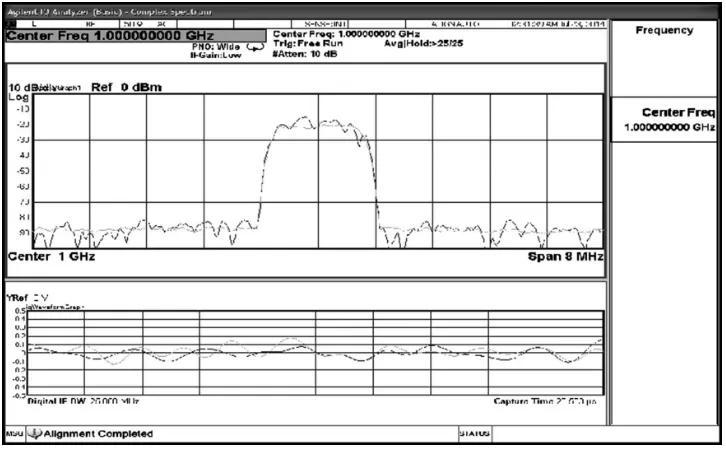
Figure 1.8 presents the WCDMA spectrum with RBW and VBW with sweep and span. The center frequency is set to 999.989 MHz, as seen from the figure. In case of the WCDMA spectrum, the RBW and VBW are both 20 kHz, as seen from Figure 1.8.
1.3.5 4G Mobile Communication
4G mobile communication was deployed during 2010–2012 [3–8]. It supports high-speed multimedia data transfer, high-definition television (HDTV) content, and high-speed Internet access [8]. It provides seamless Internet access anytime, anywhere. 4G provides a
TABLE 1.3
Functioning of Components of GPRS Architecture • The radio subsystem (RSS) consists of MS, BTSs, and BSCs.
• An MS with GPRS features holds a cipher key sequence number (CKSN), which is used for user authentication and security purposes.
• The network subsystems are composed of serving GPRS support node (SGSN) and MSC. The SGSN interfaces with the BSCs as well with other SGSNs.
• The GPRS context-containing information related to MS status, data compression, and routing details is stored in the MSs as well the SGSN.
• EIR helps preserve security issues and maintenance activities.
[image:38.504.56.452.263.462.2]• The gateway subsystem consists of gateway GPRS support node (GGSN) and serving GPRS Support Node (SGSN) and provides Internet connectivity.
TABLE 1.4
Characteristics of WCDMA and CDMA2000
Features WCDMA CDMA2000
Frequency
spectrum 1.920–1.980 GHz for reverse and 2.110–2.170 GHz for forward Can operate at 400, 800, 900, 1700, 1800, 1900 MHz
Bandwidth 5 MHz 3.75 MHz
Chipping rate 3.84 Mchips/s 3.6864–3.84 Mchips/s Data transfer
rates Greater than or nearly equal to 2 Mbps for short distances and 384 kbps for long distances Greater than or nearly equal to 2.05 Mbps for short distances and 614 kbps for long distances
Forward link From BTS to MS From BTS to MS Reverse link From MS to BTS From MS to BTS Modulation
type Quadrature pulse shift keying (QPSK) modulation for both forward and reverse link QPSK modulation for forward link and binary pulse shift keying modulation (BPSK) for reverse link
Multi-rate
transmission Use single code while transmitting small amounts of data and multiple codes while transmitting large amount of data
Use variable spread factors between 4 and 256 for data transfer rates of 307–5 kbps
trustworthy network, better quality service, and enhanced mobility and high security [8]. The technologies dominating 4G are the following [8]:
• Worldwide interoperability for microwave access (WiMAX) advanced • Long-term evolution (LTE) advanced
The features of WiMAX advanced are presented in Table 1.5. The features of LTE advanced are presented in Table 1.6.
4G is a fully IP-based integrated system and the Internet work is accomplished with the union of wired and wireless networks including computers, consumer electronics, com-munication technology, and the capability to provide 100 Mbps and 1 Gbps, respectively, in outdoor and indoor environments with better quality of service (QoS) and improved security, facilitating any kind of services anytime, anywhere, at affordable cost and single billing [8].
FIGURE 1.8
[image:39.504.71.434.82.308.2]WCDMA spectrum.
TABLE 1.5
Features of WiMAX Advanced
Features Definition
Frequency spectrum Can be 450–470 MHz, 698–960 MHz, 1.710–2.025 GHz, 2.110–2.200 GHz, 2.300–2.400 GHz, 2.500–2.690 GHz or 3.400–3.600 GHz
Multiplexing Frame duplex division (FDD) and time duplex division (TDD) Modulation Quadrature pulse shift keying (QPSK)
Channel bandwidth 5–20 MHz Type of encoder Channel encoder
Uplink power control Both closed-loop AND open-loop power control are used
Figure 1.9 presents the LTE spectrum with RBW and VBW with the sweep and span. The center frequency is set to 2.001091 GHz, as observed from the figure. In the case of LTE spectrum, the RBW and VBW are both 180 kHz.
1.3.6 5G Mobile Communication
To fulfill the user demand for high-speed mobile communication, fifth generation (5G) mobile communication was introduced as a promising research area. It is evident that it should be valid for all sorts of radio access technologies while taking into consideration a smooth tran-sition to 5G, so that 5G can generate better profits for current global operators; in addition, interoperability will become more feasible. There should be a general platform unique for all the technologies to build 5G practical for all sorts of radio access technologies (RAT). The fifth generation of mobile communication is a wireless race that will be sustained by large area
TABLE 1.6
Features of LTE Advanced
Features Definition
Frequency spectrum 100 MHz
Uplink data rate 500 Mbps
Downlink data rate 1 Gbps
Spectral efficiency Uplink 15 bps/Hz Downlink 20 bps/Hz
Uplink power control Fractional path loss compensation Latency 10 ms user plane and 50 ms control plane
[image:40.504.64.442.193.472.2]Applications Streaming multimedia, video, HDTV, internet access
FIGURE 1.9
synchronized code division multiple access (LAS-CDMA), orthogonal frequency- division multiplexing (OFDM), multicarrier code division multiple access (MC-CDMA), ultrawide band (UWB), local multipoint distribution system (network-LMDS), and Internet Protocol
ver-sion 6 (IPv6) [9,10]. IPv6 is the elementary protocol for running on both 4G and 5G [10]. The 5G mobile communication system is an all-IP based system. In 5G, the IP-based mobile appli-cations and services such as mobile portals, mobile commerce, mobile health care, mobile government, and others, are obtainable by means of cloud computing resources (CCRs) [9]. Cloud computing is a technology for on-demand network access to configurable comput-ing resources such as networks, servers, storage, applications, and services. Cloud computcomput-ing facilitates users to get their data stored and applications run in a distant cloud server. The importance of 5G can be understood once the 4G technology and its limitations become clear and practiced. Thus, the typical 5G concept should be introduced somewhere around 2020.
1.3.7 Comparison of the Generations of Mobile Communication
A comparative analysis of the generation of mobile communication is presented in Table 1.7 [1–10].
1.4 Mobile Operating Systems
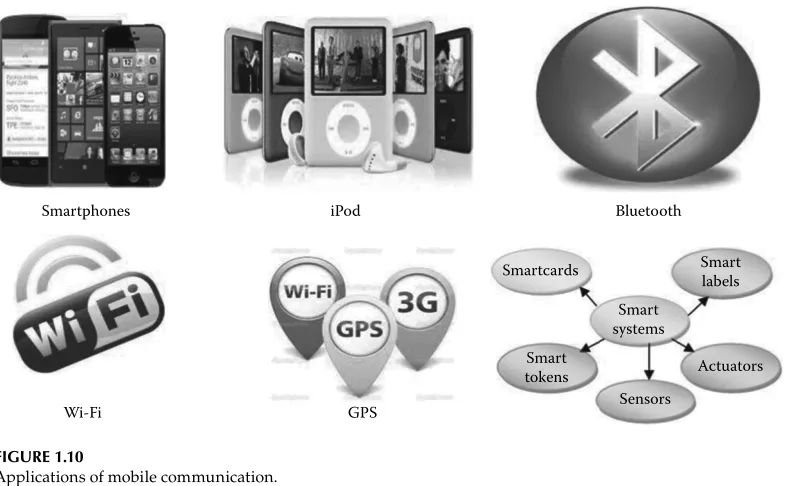
The mobile operating system, or the mobile OS, offers the platform to operate a smart-phone, tablet, or other mobile devices [11]. The present-day mobile OS sustains features of a personal computer together with those of touch screen, Bluetooth, Wi-Fi, GPS, camera for still and moving images, video and audio recorders, video and audio player, and many other attributes. The development of mobile OS over generations has led to the enhance-ment of features of the mobile devices and evolution of smartphones from ordinary phones. A brief history of the generations of mobile OS is presented here [11].
• The period 1979–1992 saw mobile phones using embedded systems for controlling their functioning.
• In 1993, the first smartphone was launched with touch screen, e-mail, and per-sonal digital assistant (PDA) facilities.
• The year 1996 saw the introduction of the Palm Pilot 1000 PDA operating with the Palm OS. This year was also marked by the introduction of the Windows CE portable PC devices.
• In 1999, the Nokia S40 OS was introduced to the market. • In 2000, Symbian OS was introduced.
• In 2001, Kyocera 6035 was launched as the first smartphone with Palm OS. • In 2002, the first Blackberry smartphone was introduced.
• In 2005, Maemo OS was released by Nokia for the first Internet tablet N770. • In 2007, Apple iPhone with iOS was introduced.
• In 2008, Android 1.0 was introduced by HTC.
• In 2009, the webOS366 was introduced by Palm, and the Bada OS was introduced by Samsung.
TA B LE 1. 7 M ob ile C om m u n ic at io n H is to ry a nd S ta tu s Ge n era ti on 1G 2G 2. 5G 3G 4G 5G Starting time 1985 1992 1995 2002 2010–2012 W
ill be in the market by 2020
Driven technique
Analogue signal Pr
ocessing
Digital signal pr
ocessing
Packet switching
Intelligent signal pr
ocessing Intelligent softwar e auto configuration Packet switching Repr esentative standar d AMPS, T ACS, NMT GSM, TDMA
GPRS, I-Mode, HSCSD, EDGE
IMT
-2000 (UMTS,
WCDMA, CDMA2000)
OFDM, UWB
OFDM, MC-CDMA, LAS-CDMA, IPv6
Radio fr
equency (Hz)
400 M–800 M
800 M–900 M
1800 M–1900 M
2G
3G–5G
Gr
eater than 4.9G
Bandwidth (bps)
2.4 kbps–30 kbps
9.6 kbps–14.4 kbps
171 kbps–384 kbps
2 Mbps–5 Mbps
10 Mbps–20 Mbps
Higher than 1 Gbps
Multiaddr ess technique FDMA TDMA, CDMA TDMA, CDMA CDMA
FDMA, TDMA, CDMA LAS-CDMA, MC-CDMA,
Cellular coverage Lar ge ar ea Medium ar ea Medium ar ea Small ar ea Mini ar ea Cor e networks Telecom networks Telecom networks Telecom networks
Telecom networks, some IP
networks All-IP networks All-IP networks Service type V oice V oice, SMS Data service V oice, data Multimedia
Dynamic access to information Wearable devices with artificial intelligence capabilities
• The year 2012 was marked by the introduction of the Firefox OS by Mozilla. • In 2013, the Ubuntu Touch version of Linux was introduced, and Blackberry
intro-duced Blackberry 10 as its new OS for smartphones.
The mobile OS executes resource allocation and management and provides a platform to run the software that operates the mobile devices [11].
1.4.1 Windows CE Operating System
Windows CE OS was introduced by Microsoft [1]. It is officially known as Windows Embedded Compact. It is a real-time operating system suitable for handheld devices and embedded systems. Windows CE is suitable for devices with reduced storage and is run under a megabyte of memory. Many platforms have been developed on the Windows CE platform, which include Microsoft’s AutoPC, Pocket PC 2000, Pocket PC 2001, Windows Mobile 2003, Windows Mobile 5.0, Windows Mobile 6, Smartphone 2002, Smartphone 2003, Windows Phone, and many other embedded and handheld devices. Some of the features of the Windows CE operating system are as follows [1]:
• It is a 32-bit operating system.
• It is well suited with a diversity of processor architectures. • It is compiled for a precise set of hardware.
• The source code is contained in the kernel including the hardware abstraction layer. • Memory space is partitioned.
• It supports large storage media.
• It includes a file system that supports larger file sizes.
• Files and data are saved in the flash file system when the battery is exhausted. • It supports connectivity to cellular networks.
1.4.2 Mac OS X
Mac OS X is used in Apple iPhones [1]. There are four layers in this OS. The first layer facilitates the basic services, the second layer is responsible for the core services, the third layer supports media features, and the fourth layer is designated as the touch layer. The OS size is 500 MB but may vary depending on the OS version [1]. They support highly efficient and speedy user interfaces.
1.4.3 Symbian OS
Symbian OS is used in a large range in smartphones [11]. It is very similar to the desktop operating systems [1]. It is an open source operating system designed for smartphones. It supports preemptive multitasking, multithreading, and memory management. It puts huge stress on memory conservation. Symbian OS supports event-based processing, and when applications are not related to events, the processor is switched off. This technique helps in reducing power consumption and enhancing battery lifetime. Some of the fea-tures of the Symbian OS are as follows [11]: