Collaboration, Grid, Web 2.0,
Cloud Technologies
Geoffrey Fox, Alex Ho
Anabas
SBIR Introduction I
• Grids and Cyberinfrastructure have emerged as key technologies to support distributed activities that span scientific data gathering networks with commercial
RFID or (GPS enabled) cell phone nets. This SBIR
extends the Grid implementation of SaaS (Software as a Service) to SensaaS (Sensor as a service) with a
SBIR Introduction II
• The final delivered software both demonstrates the concept and provides a framework with which to extend both the supported sensors and core
technology
• The SBIR team was led by Anabas which provided collaboration Grid and the expertise that developed
SensaaS. Indiana University provided core technology and the Earthquake science application. Ball
Aerospace integrated NetOps into the SensaaS framework and provided DoD relevant sensor application.
Objectives
• Integrate Global Grid Technology with multi-layered sensor technology to provide a Collaboration Sensor Grid for Network-Centric Operations
research to examine and derive warfighter requirements on the GIG.
• Build Net Centric Core Enterprise Services compatible with GGF/OGF and Industry.
• Add key additional services including advance collaboration services and those for sensors and GIS.
• Support Systems of Systems by federating Grids of Grids supporting a heterogeneous software production model allowing greater sustainability and choice of vendors.
• Build tool to allow easy construction of Grids of Grids.
• Demonstrate the capabilities through sensor-centric applications with situational awareness.
Technology Evolution
• During course of SBIR, there was substantial technology evolution in especially mainstream commercial Grid applications
• These evolved from (Globus) Grids to clouds allowing enterprise data centers of 100x current scale
• This would impact Grid components supporting
background data processing and simulation as these need not be distributed
• However Sensors and their real time interpretation are naturally distributed and need traditional Grid systems • Experience has simplified protocols and deprecated
Commercial Technology Backdrop
• Build everything as Services
• Grids are any collection of Services and manage distributed services or distributed collections of Services i.e. Grids to give Grids of Grids
• Clouds aresimplified scalable Grids
• XaaS or X as a Service is dominant trend
– X = S: Software (applications) as a Service
– X = I: Infrastructure (data centers) as a Service – X = P: Platform (distributed O/S) as a Service
• SBIR added X = C: Collections (Grids) as a Service
– and X = Sens(or Y): Sensors as a Service
• Services interact with messages; using
publish-subscribe messaging enables collaborative systems • Multicore needs run times and programming models
from cores to clouds
Databas e
SS
S
S SS
S
S SS SS SS
Port al
Sensor or Data Interchange Service
Another Grid
Raw Data Data Information Knowledge Wisdom Decisions
S S S S Another Service S S Another
Grid S S
Another Grid SS SS SS SS SS SS SS SS Inter-S ervice Messages Storage Cloud Compute Cloud S
S SS SS S
S Filter Cloud Filter Cloud Filter Cloud Discovery Cloud Discovery Cloud Filter Service fs fs fs fs fs fs Filter Service fs fs fs fs fs fs Filter Service fs fs fs fs
fs fs FilterCloud Filter Cloud Filter Cloud Filter Service fs fs fs fs fs fs
Information and Cyberinfrastructure
Component Grids Integrated
• Sensor display and control
– A sensor is a time-dependent stream of information with a geo-spatial location.
– A static electronic entity is a broken sensor with a broken GPS! i.e. a sensor architecture applies to everything
• Filters for GPS and video analysis
(Compute or Simulation Grids)
• Earthquake forecasting
• Collaboration Services
Multiple Sensors Scaling for NASA application
v The results show that 1000 publishers (9000 GPS
sensors) can be supported with no performance loss. This is an operating system limit that can be improved
14 Topic 1A Topic 1B Topic 2 Topic n
Time Of The Day
0:00 1:30 3:00 4:30 6:00 7:30 9:0010:3012:0013:3015:0016:3018:0019:3021:0022:30
Time (ms ) 0 1 2 3 4 5 6
Multiple Sensors Test
15
Average Video Delays
Scaling for video streams with one broker
Latency ms
# Receivers One session Multiple
sessions
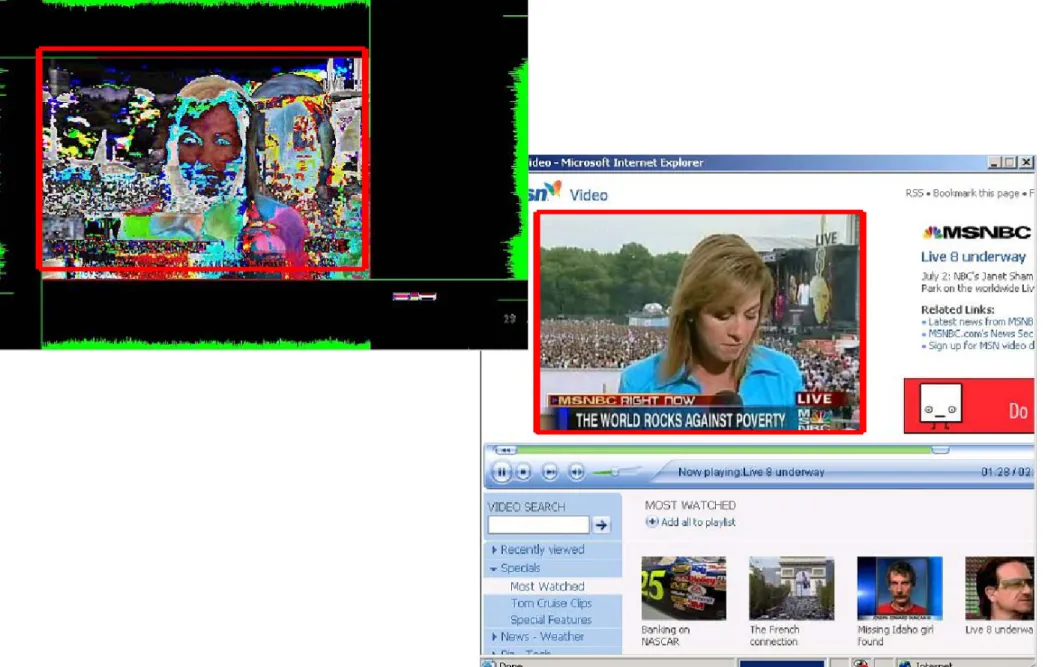
Illustration of Hybrid Shared Display on the sharing of a browser window with a fast changing region.
Screen capturing
Region finding
Video encoding SD screen data encoding
Network transmission (RTP) Network transmission (TCP)
Video Decoding (H.261) SD screen data decoding
Rendering Rendering
Screen display
HSD Flow
Presenter Participants
Through NaradaBrokering
VSD CSD
What are Clouds?
n Clouds are “Virtual Clusters” (maybe “Virtual Grids”)
of usually “Virtual Machines”
• They may cross administrative domains or may “just be a single cluster”; the user cannot and does not want to know
• VMware, Xen .. virtualize a single machine and service (grid) architectures virtualize across machines
n Clouds support access to (lease of) computer instances
• Instances accept data and job descriptions (code) and return results that are data and status flags
n Clouds can be built from Grids but will hide this from
user
n Clouds designed to build 100 times larger data centers
n Clouds support green computing by supporting remote
Web 2.0 and Clouds
n Grids are less popular than before but can re-use technologies
n Clouds are designed heterogeneous (for functionality)
scalable distributed systems whereas Grids integrate a priori heterogeneous (for politics) systems
n Clouds should be easier to use,
cheaper, faster and scale to larger sizes than Grids
n Grids assume you can’t design
system but rather must accept
results of N independent
supercomputer funding calls
n SaaS: Software as a Service
n IaaS: Infrastructure as a Service
or HaaS: Hardware as a Service
n PaaS: Platform as a Service
delivers SaaS on IaaS
Emerging Cloud Architecture
PAAS Build VO
Build Portal Open SocialGadgets Ringside
Build Cloud
Application Ruby on RailsDjango(GAI)
Move Service (from PC to Cloud)
Security
Model “UNIX”VOMS Shib OpenID Deploy VM Workflow becomes Mashups MapReduce Taverna BPEL DSS Windows Workflow DRYAD, F# Sho Matlab Mathematica Scripted Math Libraries R SCALAPACK High level Parallel “HPF” Classic Compute File Database
on a cloud
EC2, S3, SimpleDB CloudDB, Red Dog
Bigtable GFS (Hadoop)
? Lustre GPFS ? MPI CCR ? Windows Cluster
22
Analysis of DoD Net Centric
Services in terms of Web
23
The Grid and Web Service Institutional Hierarchy
OGSA GS-*
and some WS-* GGF/W3C/…. XGSP (Collab) WS-* from OASIS/W3C/ Industry Apache Axis .NET etc.
Must set standards to get interoperability
2: System Services and Features (WS-* from OASIS/W3C/Industry)
Handlers like WS-RM, Security, UDDI Registry 3: Generally Useful Services and Features
(OGSA and other GGF, W3C) Such as “Collaborate”, “Access
a Database” or “Submit a Job”
4: Application or Community of Interest (CoI)
Specific Services such as “Map Services”, “Run BLAST” or “Simulate a Missile”
1: Container and Run Time (Hosting) Environment (Apache Axis, .NET etc.)
XBML
XTCE VOTABLE CML
24
The Ten areas covered by the 60 core WS-* Specifications
WS-* Specification Area Examples
1: Core Service Model XML, WSDL, SOAP
2: Service Internet WS-Addressing, WS-MessageDelivery; Reliable Messaging WSRM; Efficient Messaging MOTM
3: Notification WS-Notification, WS-Eventing (Publish-Subscribe)
4: Workflow and Transactions BPEL, WS-Choreography, WS-Coordination
5: Security WS-Security, WS-Trust, WS-Federation, SAML, WS-SecureConversation
6: Service Discovery UDDI, WS-Discovery
7: System Metadata and State WSRF, WS-MetadataExchange, WS-Context
8: Management WSDM, WS-Management, WS-Transfer
9: Policy and Agreements WS-Policy, WS-Agreement
WS-* Areas and Web 2.0
WS-* Specification Area Web 2.0 Approach
1: Core Service Model XML becomes optional but still useful SOAP becomes JSON RSS ATOM
WSDL becomes REST with API as GET PUT etc. Axis becomes XmlHttpRequest
2: Service Internet No special QoS. Use JMS or equivalent?
3: Notification Hard with HTTP without polling– JMS perhaps?
4: Workflow and Transactions
(no Transactions in Web 2.0) Mashups, Google MapReduceScripting with PHP JavaScript ….
5: Security SSL, HTTP Authentication/Authorization, OpenID is Web 2.0 Single Sign on
6: Service Discovery http://www.programmableweb.com
7: System Metadata and State Processed by application – no system state –
Microformats are a universal metadata approach
8: Management==Interaction WS-Transfer style Protocols GET PUT etc.
9: Policy and Agreements Service dependent. Processed by application
26
Activities in Global Grid Forum Working Groups
GGF Area GS-* and OGSA Standards Activities
1: Architecture High Level Resource/Service Naming (level 2 of slide 6), Integrated Grid Architecture
2: Applications Software Interfaces to Grid, Grid Remote Procedure Call, Checkpointing and Recovery, Interoperability to Job Submittal services, Information Retrieval,
3: Compute Job Submission, Basic Execution Services, Service Level Agreements for Resource use and reservation, Distributed Scheduling
4: Data Database and File Grid access, Grid FTP, Storage Management, Data replication, Binary data specification and interface, High-level publish/subscribe, Transaction management
5: Infrastructure Network measurements, Role of IPv6 and high performance networking, Data transport
6: Management Resource/Service configuration, deployment and lifetime, Usage records and access, Grid economy model
27
Net-Centric Core Enterprise Services
Core Enterprise Services Service Functionality
NCES1: Enterprise Services
Management (ESM) including life-cycle management NCES2: Information
Assurance (IA)/Security Supports confidentiality, integrity and availability.Implies reliability and autonomic features
NCES3: Messaging Synchronous or asynchronous cases
NCES4: Discovery Searching data and services
NCES5: Mediation Includes translation, aggregation, integration, correlation, fusion, brokering publication, and other transformations for services and data. Possibly agents
NCES6: Collaboration Provision and control of sharing with emphasis on synchronous real-time services
NCES7: User Assistance Includes automated and manual methods of optimizing the user GiG experience (user agent)
NCES8: Storage Retention, organization and disposition of all forms of data
28
The Core
F
eatures/
S
ervice Areas I
Service or Feature WS-* GS-* NCES
(DoD) Comments
A: Broad Principles FS1: Use SOA: Service
Oriented Arch. WS1 Core Service Architecture, Build Grids on WebServices. Industry best practice
FS2: Grid of Grids Distinctive Strategy for legacy subsystems and
modular architecture
B: Core Services
FS3: Service Internet,
Messaging WS2 NCES3 Streams/Sensors.
FS4: Notification WS3 NCES
3 JMS, MQSeries.
FS5 Workflow WS4 NCES
5 Grid Programming
FS6 : Security WS5 GS7 NCES
2 Grid-Shib, Permis Liberty Alliance ...
FS7: Discovery WS6 NCES
4 UDDI
FS8: System Metadata
& State WS7 Globus MDSSemantic Grid, WS-Context
FS9: Management WS8 GS6 NCES
1 CIM
29
The Core
F
eature/
S
ervice Areas II
Service or Feature WS-* GS-* NCES Comments
B: Core Services (Continued) FS11: Portals and User
assistance WS10 NCES7 Portlets JSR168, NCES Capability Interfaces
FS12: Computing GS3 Clouds!
FS13: Data and Storage GS4 NCES8 NCOW Data Strategy
Clouds!
FS14: Information GS4 JBI for DoD, WFS for OGC
FS15: Applications and User
Services GS2 NCES9 Standalone ServicesProxies for jobs
FS16: Resources and
Infrastructure GS5 Ad-hoc networks
FS17: Collaboration and
Virtual Organizations GS7 NCES6 XGSP, Shared Web Service ports
FS18: Scheduling and matching of Services and Resources
Tomcat +
Portlets and Container
Grid and Web Services
(TeraGrid, GiG, etc) Grid and Web Services(TeraGrid, GiG, etc) Grid and Web Services
(TeraGrid, GiG, etc)
HTML/HTTP
SOAP/HTTP
Common portal architecture. Aggregation is in the
portlet container. Users have limited
selections of components.
Web 2.0 Impact
Various GTLAB
applications deployed as portlets:
GTLAB Applications as Google Gadgets: MOAB dashboard, remote directory
Other Gadgets
Providers Tomcat + GTLABGadgets
Grid and Web Services (TeraGrid, GiG, etc)
Other Gadgets Providers
Social Network Services (Orkut,
LinkedIn,etc) RSS Feed, Cloud, etc
Services Gadget containers aggregate content from
multiple providers. Content is aggregated
on the client by the user. Nearly any web
application can be a simple gadget (as
Iframes)
MSI-CIEC Web 2.0 Research Matching Portal
n Portal supporting tagging and linkage of Cyberinfrastructure Resources
n NSF (and other agencies via grants.gov) Solicitations and Awards
n MSI-CIEC Portal Homepage n Feeds such as SciVee and NSF n Researchers on NSF Awards n User and Friends
n TeraGrid Allocations n Search Results
n Search for linked people, grants etc. n Could also be used to support
matching of students and faculty for REUs etc.
MSI-CIEC Portal Homepage
Parallel Programming 2.0
n Web 2.0 Mashups (by definition the largest market) will
drive composition tools for Grid, web and parallel
programming
n Parallel Programming 2.0 can build on same Mashup tools
like Yahoo Pipes and Microsoft Popfly for workflow.
n Alternatively can use “cloud” tools like MapReduce
n We are using workflow technology DSS developed by
Microsoft for Robotics
n Classic parallel programming for core image and sensor
programming
n MapReduce/”DSS” integrates data processing/decision
support together
n We are integrating and comparing Cloud(MapReduce),
• Applicable to most loosely coupled data parallel applications
• The data is split into m parts and the map
function is performed on each part of the data concurrently
• Each map function produces rnumber of results
• A hash function maps these r results to one ore more reduce functions
• The reduce function collects all the results that maps to it and processes them
• A combine function may be necessary to
combine all the outputs of the reduce functions together
• It is “just” workflow with messaging runtime
map(String key, String value): // key: document name // value: document contents
reduce(String key, Iterator values): // key: a word
// values: a list of counts reduce(key, list<value>)
“MapReduce is a programming model and an associated implementation for processing and generating large data sets. Users specify a map function that processes a key/value pair to
generate a set of intermediate key/value pairs, and a reduce function that merges all intermediate values associated with the same intermediate key.”
MapReduce: Simplified Data Processing on Large Clusters Jeffrey Dean and Sanjay Ghemawat
map(key, value)
• The framework supports the splitting of data
• Outputs of the map functions are passed to the reduce functions
• The framework sorts the inputs to a particular
reduce function based on the intermediate keys before passing them to the reduce function
• An additional step may be necessary to combine all the results of the
• Data is distributed in the data/computing nodes
• Name Node maintains the namespace of the entire file system
• Name Node and Data Nodes are part of the Hadoop Distributed File System (HDFS)
• Job Client
– Compute the data split
– Get a JobID from the Job Tracker
– Upload the job specific files (map, reduce, and other configurations) to a directory in HDFS
– Submit the jobID to the Job Tracker
• Job Tracker
– Use the data split to identify the nodes for map tasks
– Instruct TaskTrackers to execute map tasks
– Monitor the progress
– Sort the output of the map tasks
– Instruct the TaskTracker to execute reduce tasks A 1 2 TT B 2 TT C 3 4 TT D 4 TT
Name Node Job Tracker
Job Client Data/Compute Nodes 3 1 TT Data Block Data Node Task Tracker
Point to Point Communication DN
DN
DN DN
• A map-reduce run time that supports iterative map reduce by keeping intermediate results
in-memory and using long running threads
• A combine phase is introduced to merge the results of the
reducers
• Intermediate results are transferred directly to the reducers(eliminating the overhead of writing
intermediate results to the local files)
• A content dissemination network is used for all the communications
• API supports both traditional map reduce data analyses and iterative map-reduce data
•
Implemented using Java
•
Messaging system
NaradaBrokering
is used for
the content dissemination
•
NaradaBrokering has APIs for both Java and
C++
•
CGL Map Reduce supports map and reduce
functions written in different languages;
currently Java and C++
•
Can also implement algorihm using MPI and
• In memory Map Reduce based Kmeans Algorithm is used to cluster 2D data points
• Compared the performance against both MPI (C++) and the Java multi-threaded version of the same algorithm
• The experiments are performed on a cluster of multi-core computers
• Overhead of the map-reduce runtime for the different data sizes
Number of Data Points
MPI MPI
MR
Java
MR MR
HADOOP
MPI
CGL MapReduce
Factor of 103
Factor of 30
Parallel Overhead
CCR Threads per Process
1 1 1 2 1 1 1 2 2 4 1 1 1 2 2 2 4 4 8 1 1 2 2 4 4 8 1 2 4 8
Nodes
1 2 1 1 4 2 1 2 1 1 4 2 1 4 2 1 2 1 1 4 2 4 2 4 2 2 4 4 4 4
MPI Processes per Node
1 1 2 1 1 2 4 1 2 1 2 4 8 1 2 4 1 2 1 4 8 2 4 1 2 1 8 4 2 1
32-way
16-way 8-way
4-way
2-way
Deterministic Annealing Clustering
Scaled Speedup Tests on 4 8-core Systems 10 Clusters; 160,000 points per cluster per thread