Int. J. Electrochem. Sci., 8 (2013) 6656 - 6663
International Journal of
ELECTROCHEMICAL
SCIENCE
www.electrochemsci.org
Improved Electrocatalytic Activity of Size-Controlled
Single-Crystalline Tungsten Oxide Nanoplates under Visible-Light
Illumination
Je-Suk Moon, Young-Woo Lee, Sang-Beom Han, Choon-Koo Zhoh* and Kyung-Won Park*
Department of Chemical Engineering, Soongsil University, Seoul 156-743, Republic of Korea
*
E-mail: [email protected]; [email protected]
Received: 6 March 2013 / Accepted: 27 March 2013 / Published: 1 May 2013
We report size-controlled single crystalline WO3H2O nanoplates for improved electrocatalytic
reaction under visible-light. The size-controlled single crystalline WO3H2O nanoplates were
synthesized by means of hydrothermal reaction process as a function of reaction time and characterized by scanning electron microscopy, transmission electron microscopy, and X-ray powder diffraction method. The nanoplates showed a remarkably enhanced performance for methanol oxidation under AM 1.5 solar illumination as compared to that without the solar illumination. The improved photocatalytic activity of WO3H2O nanoplates might be related to an enhanced methanol
oxidation by photo-generated holes in the WO3H2O under the solar illumination.
Keywords: nanostructures; oxides; chemical synthesis; visible-light; electrochemical properties
1. INTRODUCTION
Tungsten oxide materials have been utilized in a variety of fields, such as electrochromic devices [1-4], fuel cells [5-8], lithium ion batteries [9,10], photo-catalysis [11-15], gas sensors [16,17], heterogeneous catalysts [18,19], and solar energy devices [20,21]. In particular, WO3 is an n-type
metal oxide semiconductor with an indirect band gap of 2.6-2.7 eV, i.e. responsive to the blue end of the visible spectrum [22]. Furthermore, under the visible light excitation of the WO3 electrode, an
electron-hole pair is produced as follows:
The photo-generated holes can react with methoxy species of methanol and oxidize as the following equations:
CH3O- + h+ CH3O (2)
CH3O CH2O- + H+ (3)
CH2O- CH2O + e- (4)
Finally, when the visible light is absorbed by WO3, methanol is oxidized by the holes and the
electrons are collected generating oxidation current as follows:
WO3(h) + CH3OH + H2O WO3 + CO2 + 6H+ + 6e- (5)
The tungsten oxide nanoparticles [23-25], nanowires [26,27], and nanoplates [28,29] have been prepared by a variety of synthetic methods [30-32]. Hydrous WO3∙H2O crystals form layers built up by
corner sharing [WO6] octahedral with water molecules between these planes. Intercalated water
molecules lead to WO3∙H2O layers with a basal spacing d=5.36 in orthorhombic crystal system,
exhibiting enhanced intercalation properties towards cationic species, comparing with anhydrous WO3
[33]. Especially, two-dimensional tungsten oxide nanostructures as electrochemical materials have been intensively because of active sites for photo-electrochemistry and building blocks for complex nanostructures. It has been reported that tungsten oxide nanoplates have been synthesized using a topochemical conversion reaction or anodizing process [34]. Also, it was reported that size quantization effects in the ultrathin nanostructure might alter the WO3 band gap, representing
enhanced performance for photocatalytic reduction of CO2 in the presence of water in hydrocarbon
fuels that do not exist in its bulk form [35].
Herein, we prepared single crystalline WO3H2O nanoplates by hydrothermal reaction process
as a function of reaction time and described an improved electrocatalytic reaction for methanol oxidation of the nanoplates under AM 1.5 solar illumination. The structural and catalytic properties were characterized by means of scanning electron microscopy (SEM), transmission electron microscopy (TEM), X-ray diffraction (XRD), and voltammetry.
2. EXPERIMENTAL
To prepare WO3H2O nanoplates, sodium metatungstate hydrate (2 g, Aldrich) as a precursor
was introduced into 140 mL of 5 M hydrochloric acid solution (Samchun, 35%) with continuous stirring at 25 oC for 1 h, and then kept at 140 oC for different reaction times (20, 40, 60, 90 and 120 min). The resulting precipitates in the solutions were cooled down to 25 oC and washed with ethanol and distilled water. The yellow powders were obtained after dying in 50 oC oven.
The morphologies of the as-synthesized WO3H2O nanoplates were characterized by
Tecnai G2 F30 system microscope, using an accelerating voltage of 300 kV. TEM samples were prepared by placing drops of powder suspension dispersed in ethanol on a carbon-coated copper grid. The phase and structure of the product were identified by X-ray powder diffraction (D2 PHASE SYSTEM, BRUKER), using Cu K source ( = 0.15406 nm) radiation at 30 kV and 10 mA in a 2θ range from 20° to 80°.
To evaluate the electrochemical performance of the electrodes, the electrochemical curves were examined using a conventional three-electrode electrochemical system consisting of a deposited electrode, a Pt gauze, and Ag/AgCl as the working, counter, and reference electrode, respectively, at 25 oC. The tungsten oxide powder was mixed together in a bowl for a few minutes with 5 wt% Nafion solution (Aldrich), de-ionized water, and 2-propanol solution (C3H8O, Sigma). The paste was
deposited on Indium-doped tin oxide coated transparent glasses using doctor blade technique. The film as a wording electrode was heated at 60 oC for 2 h in air atmosphere. The solution of 0.5 M H2SO4 or
2.0 M CH3OH + 0.5 M H2SO4 was stirred constantly and purged with argon gas. The current-voltage
curves were measured using a 500 W xenon lamp (XIL model 05A50KS source units) that was simulated AM 1.5 solar irradiance with the intensity of 100 mWcm-2, which was adjusted using a NREL fabricated Si reference solar cell. The working electrodes were positioned in a three-neck flask and fitted with a fused silica window faced the light source.
3. RESULTS AND DISCUSSION
Fig. 1 shows FE-SEM and FE-TEM images of WO3H2Oparticles synthesized during different
reaction times from 20 to 120 min (Nano-20, Nano-40, Nano-60, Nano-90, and Nano-120). As indicated in Fig. 1(a)-(c), as the reaction times of 20 to 60 min increase, the WO3H2O nanoparticles
exhibit side-direction growth forming nanoplates. In contrast, the Nano-90 and Nano-120 display thick nanoplates (Fig. 1(d),(e)). Form FE-TEM images (Fig. 1(f)-(j)), it is also observed that as-synthesized WO3H2O particles show well-edged plates with increasing reaction time by corner sharing [WO6]
octahedral with water molecules between these planes. Furthermore, high-resolution TEM (HR-TEM) images and FFT patterns indicate single-crystalline WO3H2O plate (Fig. 1(k)-(o)).
The XRD patterns of samples synthesized as a function of reaction time are shown in Fig. 2. All the diffraction patterns exhibit WO3H2O phase (JCPDS No. 84-0336) with an orthorhombic
crystal structure. With increasing reaction time, the peak broadening is decreased and the relative intensity of the peak is increased, representing the formation of well-grown WO3H2O nanoplates as
indicated in the inset of Fig. 2. From the Scherrer equation, the average particle sizes of the Nano-20, Nano-40, Nano-60, Nano-90, and Nano-120 are ~23.3, 24.2, 30.7, 37.9, and 38.1 nm, respectively.
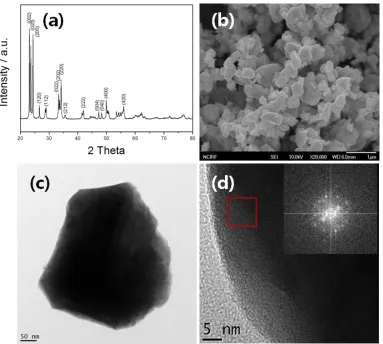
To compare electrocatalytic reaction under visible-light illumination, commercial tungsten trioxide (Comm-WO3) was prepared as shown in Fig. 3. The unit cell parameter for the Comm-WO3 is
determined to be a=7.297 Å, b=7.539 Å and c=7.688 Å in agreement with that of the bulk monoclinic WO3 material with space group of P21/n (JCPDS No. 43-1035) (Fig. 3(a)). In the SEM and TEM
nm to a few μm in particle size. Furthermore, the Comm-WO3 particle seems to be polycrystalline as
confirmed by HR-TEM image and FFT pattern (Fig. 3(d)).
Figure 1. SEM, TEM and HR-TEM images of WO3H2O nanoplates synthesized during different
[image:4.596.120.484.131.699.2][image:5.596.142.450.73.324.2]
Figure 2. XRD patterns of (a) Nano-20, (b) Nano-40, (c) Nano-60, (d) Nano-90, and (e) Nano-120. The inset is the fine scan between 23.5o and 26.0o.
[image:5.596.114.497.393.737.2]
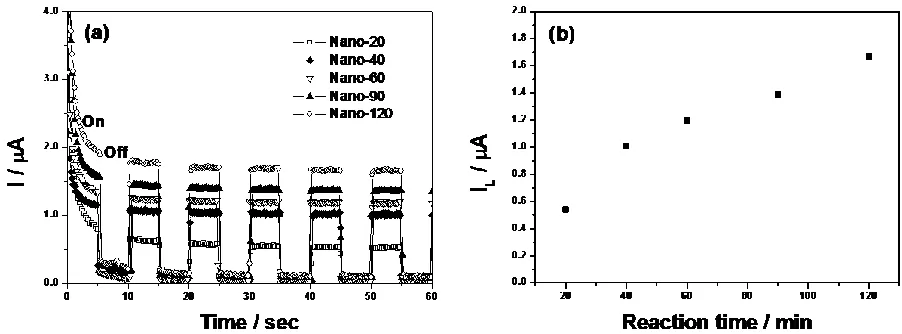
Figure 4. (a) Plots of current versus time of WO3H2O nanoplates at 0.6 V by switching AM 1.5 solar
illumination On/Off in 2.0 M CH3OH + 0.5 M H2SO4. (b) Comparison of limited oxidation
currents of WO3H2O nanoplates under AM 1.5 solar illumination.
As shown in Fig. 4(a), plots of current versus time of WO3H2O nanoplates at 0.6 V for
methanol oxidation in 2.0 M CH3OH + 0.5 M H2SO4 were detected by switching AM 1.5 solar
illumination On/Off with a duration time of 5 sec. When the solar illumination source is turned on and off every 5 sec, the WO3H2O nanoplates show a pulse current response every 5 sec. When the solar
radiation is turned on, oxidation currents of the electrodes in 2.0 M CH3OH + 0.5 M H2SO4 are
surprisingly increased.
Figure 5. (a) Plots of current versus time of the Nano-120 at 0.6 V by switching AM 1.5 solar illumination On/Off in 2.0 M CH3OH + 0.5 M H2SO4 and 0.5 M H2SO4. (c) Comparison of
current versus time of the Nano-120 and comm-WO3 at 0.6 V by switching AM 1.5 solar
illumination On/Off in 2.0 M CH3OH + 0.5 M H2SO4.
[image:6.596.73.522.455.618.2]
activity for methanol oxidation under solar radiation. On the other hand, under no radiation, i.e. dark condition, the currents of the WO3H2O nanoplates are reduced to almost the same level in all samples,
representing no serious oxidation current without the solar radiation.
To further speculate the electrocatalytic reaction of the WO3H2O nanoplate with or without
methanol, plots of current versus time of the Nano-120 at 0.6 V in 2.0 M CH3OH + 0.5 M H2SO4 and
0.5 M H2SO4 were obtained as shown in Fig. 5(a). When the solar illumination source is turned on and
off, the Nano-120 shows pulse current responses in 2.0 M CH3OH + 0.5 M H2SO4 and 0.5 M H2SO4.
Under no illumination, the Nano-120 represents little current in 2.0 M CH3OH + 0.5 M H2SO4 and 0.5
M H2SO4. However, when the AM 1.5 solar illumination is turned on, the current of the electrode in
2.0 M CH3OH + 0.5 M H2SO4 increases more than twice as compared to that of the electrode in 0.5 M
H2SO4. This means that in the case of the WO3H2O nanoplate under the AM 1.5 solar illumination, the
photocatalytic activity for methanol oxidation by photo-generated holes is more prevalent than photocurrent effect by photo-generated electron-hole pairs. Fig. 5(b) shows a comparison of current modulation of the Nano-120 with Comm-WO3 at 0.6 V in 2.0 M CH3OH + 0.5 M H2SO4. Under AM
1.5 solar radiation, the current of the Nano-120 is much higher than that of the Comm-WO3,
representing an excellent photocatalytic activity of the Nano-120. The size quantization effects in this thin-layered nanostructure of the Nano-120 might modify the energy band gap exhibiting enhanced performance for methanol oxidation by electrocatalysis under AM 1.5 solar radiation [32].
4. CONCLUSIONS
We have prepared size-controlled single crystalline WO3H2O nanoplates for improved
electrocatalytic reaction for methanol oxidation. The as-synthesized single crystalline WO3H2O
nanoplates showed a remarkably enhanced performance for methanol oxidation under AM 1.5 solar illumination. The well-grown Nano-120 exhibited the highest oxidation current under the AM 1.5 solar illumination, i.e. improved electrochemical performance for methanol oxidation under the solar radiation. The improved performance of the WO3H2O nanoplates might be due to the enhanced
methanol oxidation by photo-generated holes under AM 1.5 solar illumination.
ACKNOWLEDGMENTS
This work was supported by the National Research Foundation of Korea Grant funded by the Korean Government (NRF-2010-0022892).
References
1. S.-H. Baeck, K.-S. Choi, T.F. Jarmillo, G.D. Stucky, E.W. McFarland, Adv. Mater., 15 (2003) 126 9
2. S.-H. Lee, R. Deshpande, P.A. Parilla, K.M. Jones, B. To, A.H. Mahan, A.C. Dillon, Adv. Mater., 18 (2006) 763-766.
365
4. G. A. Niklasson, C. G. Granqvist, J. Mater. Chem., 17 (2007) 127
5. S. Jayaraman, T.F. Jaramillo, S.-H. Baeck, E.W. McFarland, J. Phys. Chem. B, 109 (2005) 2295 6. B. Wickman, M. Wesselmark, C. Lagergren, G. Lindbergh, Electrochim. Acta, 56 (2011) 9496 7. E. Antolini, E.R. Gonzalez, Appl. Catal. B, 96 (2010) 245
8. Y. Liu, S. Shrestha, W.E. Mustain, ACS Catal., 2 (2012) 456 9. W.-J. Li, Z.-W. Fu, Appl. Surf. Sci., 256 (2010) 2447
10. S.H. Yoom, C.S Jo, S.Y. Noh, C.W. Lee, J.H. Song, J.W. Lee, Phys. Chem. Chem. Phys., 13 (2011 ) 11060
11. K.-W. Park, K.-S. Ahn, J.-H. Choi, Y.-C. Nah, Y.-E. Sung, J. Phys. Chem. B, 107 (2003) 4352 12. R. Liu, Y. Lin, L.Y. Chou, S.W. Sheehan, W. He, F. Zhang, H.J.M. Hou, D. Wang, Angew. Chem.
Int. Ed., 50 (2011) 499.
13. Q. Chen, J. Li, B. Zhou, M. Long, H. Chen, Y. Liu, W. Cai, W. Shangguan, Electrochem. Commu n., 20 (2012) 153
14. P.-T. Hsiao, L.-C. Chen, T.-L. Li, H. Teng, J. Mater. Chem., 21 (2011) 19402
15. M.R. Waller, T.K. Townsend, J. Zhao, E.M. Sabio, R.L. Chamousis, N.D. Browning, F.E. Osterlo h, Chem, Mater., 24 (2012) 698
16. O. Berger, T. Hoffmann, W.-J. Fischer, J. Mater. Sci. Mater. Electron, 15 (2004) 483
17. J. Polleux, A. Gurlo, N. Barsan, U. Weimar, M. Antonietti, M. Niederberger, Angew. Chem. Int. E d., 45 (2006), 261-265.
18. M.A. Gondal, A. Hameed, Z.H. Yamani, J. Mol. Catal. A, 222 (2004) 259
19. H. Liu, S.J Huang, L. Zhang, S. Liu, W. Xin, L. Xu, Catal. Commun., 10 (2009) 544
20. A.Z. Sadek, H. Zheng, M. Breedon, V. Bansal, S.K. Bhargava, K. Latham, J. Zhu, L. Yu, Z. Hu, P
.
G. Spizzirri, W. Wlodarski, K. Kalantar-zadeh, Langmuir, 25 (2009) 9545 21. H. Zheng, Y. Tachibana, K. Kalantar-zadeh, Langmuir, 26 (2010) 1914822. Q. Mi, A. Zhanaidarova, B.S. Brunschwig, H.B. Gray N.S. Lewis, Energy Environ. Sci., 5(2012) 5 694
23. M, Niederberger , Acc. Chem. Res., 40 (2007) 793
24. J. Polleux, N. Pinna, M. Antonietti, M. Niederberger, J. Am. Chem. Soc., 127 (2005) 15595 25. N.L. Houx, G. Pourroy, F. Camerel, M. Comet, D. Spitzer, J. Phys. Chem. C, 114(2010) 155 26. A. Phuruangrat, D.J. Ham, S.J. Hong, S, Thongtem, J.S. Lee, J. Mater. Chem., 20 (2010) 1683 27. J. Zhang, J.-P. Tu, X.-H. Xia, X.-L. Wang, C.-D. Gu, J. Mater. Chem., 21 (2011) 5492.
28. K. Kalantar-zadeh, A. Vijayaraghavan, M.-H. Han, H. Zheng, M. Breedon, M.S. Strano, Chem. M ater., 22 (2010) 5660
29. D. Chen, L. Gao, A. Yasumori, K. Kuroda, Y. Sugahara, Small, 10 (2008) 1813
30. X.-X. Zou, G.-D. LI, P.-P. Wang, J. Su, J. Zhao, L.-J. Zhou, Y.-N. Wang, J.-S. Chen, Dalton Tran s., 41 (2012) 9773
31. X. Su, F. Xiao, Y. LI, J. Jian, Q. Sun, J. Wang, Mater. Lett., 64 (2010) 1232 32. X. He, C. Hu, Q. Yi, X. Wang, H. Hua, X. Li, Cata. Lett., 142 (2012) 637 33. J. Livage, G. Guzman, Solid State Ionics 84 (1996) 205
34. J. Ma, J. Zhang, S. Wang, T. Wang, J. Lian, X. Duan, W. Zheng, J. Phys. Chem. C 115 (2011) 181 57
35. X. Chen, Y. Zhou, Qi. Liu, Z. Li, J. Liu, Z. Zou, ACS Appl. Mater. Interfaces 4 (2012) 3372