S T U D Y P R O T O C O L
Open Access
Study protocol: A cluster randomised controlled
trial of implementation intentions to reduce
smoking initiation in adolescents
Mark Conner
1*, Sarah Grogan
2, Rebecca Lawton
1, Christopher Armitage
3, Robert West
4, Kamran Siddiqi
5,
Brenda Gannon
4, Carole Torgerson
6, Keira Flett
2and Ruth Simms-Ellis
1Abstract
Background:The current literature suggests that forming implementation intentions (simple‘if-then’plans) about how to refuse the offer of a cigarette may be an effective intervention to reduce smoking initiation in adolescents. This study is a pragmatic trial to test the effectiveness and cost-effectiveness of such an intervention in reducing smoking initiation in a sample of UK adolescents.
Methods/Design:A cluster randomised controlled trial with at least 36 schools randomised to receive an
implementation intention intervention targeting reducing smoking initiation (intervention group) or increasing homework (control group). Interventions will be conducted at the classroom level and be repeated every six months for four years (eight interventions). Objectively assessed (carbon monoxide monitor) and self-reported smoking plus smoking related cognitions (e.g., smoking intentions, attitudes, norms and self-efficacy) will be assessed at baseline and 12, 24, 36 and 48 months post baseline. Objectively assessed smoking at 48 months post baseline will be the primary outcome variable. Health economic analyses will assess life years gained.
Discussion:The results of the trial will provide information on the impact of a repeated implementation intention
for refusing offers of cigarettes on rates of smoking initiation in adolescents.
Trial registration:ISRCTN27596806
Background
Both in the UK and internationally, tobacco smoking continues to be an important cause of morbidity and mortality. For example, smoking related illnesses are estimated to kill over 100,000 people in the UK each year [1,2], usually later in life. Yet smoking is a behav-iour that is, in general, taken up between the ages of 10 and 20 years. A variety of different research studies have supported the idea that the vast majority of smokers take up this habit as adolescents [3-5] with 40% of adult smo-kers having started before they reached 16 years of age [1]. The General Household Survey [6] reported that 38% of adult regular smokers took up the habit before the age of 15 years. This appears to be the case despite the fact that health promotion messages have ensured
that awareness of the health consequences of smoking is now widespread, even among the young. In the UK, while the rates of regular smoking at 11 years of age are only 0.5%, this rapidly rises to 15% by 15 years of age, and then more gradually to around 20% among young adults [7]. The recent UK Department of Health [2] plan is to reduce the rates of regular smoking in 15 year olds to 12% or less by the end of 2015. Two important ways to tackle smoking-related harm are interventions to help individuals (usually adults) quit smoking and interven-tions to help individuals (usually adolescents) not to ini-tiate smoking. The present paper reports the protocol for an intervention designed to reduce smoking initi-ation in adolescents as potentially the most effective way to reduce smoking-related harm.
A worthwhile intervention to reduce smoking initiation in the groups most likely to take up this habit (i.e., adoles-cents) would need to have at least three important charac-teristics: strong effects on reducing initiation; wide reach; * Correspondence:[email protected]
1Institute of Psychological Sciences, University of Leeds, Leeds LS2 9JT, UK
Full list of author information is available at the end of the article
and low cost. Promising initial data have been collected [8] (i.e., an explanatory trial) on the efficacy of one inter-vention technique that may have all of these characteris-tics. The study outlined here would aim to collect further data on the outcome effectiveness and cost-effectiveness of this technique in the form of a cluster randomised con-trolled trial (i.e., a pragmatic trial). Given the nature of the existing data in this area, this has been cast as a pragmatic trial [9] that could inform the potential roll out of this intervention for widespread use. The intervention in ques-tion is the formaques-tion ofrepeated implementation intentions about how to refuse offers of cigarettes. Implementation intentions are simple ‘if-then’ plans [10] about how to re-spond to environmental cues in order to help achieve a goal such as not taking up smoking, e.g., If offered a cigarette I will say ‘no thanks, I don’t smoke’. Such plans can be formed before the opportunity to act presents itself and have been found to be an effective means to change a range of behaviours [11]. Our research has shown that the repeated formation of implementation intentions about how to refuse offers of cigarettes can have a strong effect on reducing smoking initiation rates among adolescents [8,12]. In addition, this is a simple intervention that could be deployed across most schools (i.e., has wide reach) in order to help tackle smoking initiation in ado-lescent groups. Finally, this intervention is relatively low cost, requiring around 30 minutes per session to implement (including anti-smoking messages and com-pleting an implementation intention questionnaire). Such an intervention could offer ‘value for money’and be rolled out to significant proportions of the adoles-cent population in the UK.
Adolescence is the period during which the vast major-ity of smokers take up this habit in the UK [1,3]. As such it represents a key period during which to intervene. A considerable number of interventions have been tested in this age group. The vast majority of such interventions have been school-based but have met with only mixed evi-dence of effectiveness (for reviews see [13,14]). In part this may be attributable to lack of thorough evaluation. Never-theless, even among high quality randomised controlled trials of school-based interventions the evidence is mixed. For example, information-based interventions have gener-ally been ineffective, while social influence interventions have tended to show rather mixed effectiveness [13]. The most highly regarded and longest trial of this type of inter-vention was the Hutchinson Smoking Preinter-vention Project which reported no evidence for effectiveness over a period of 8 years [15]. The ASSIST project is another well con-ducted trial carried out in the UK to evaluate a peer-led intervention to reduce smoking initiation [16]. This RCT did report support for a peer-led intervention over both a one- and a two-year period. More mixed evidence has been reported for interventions that target social competence or
test multi-modal interventions [13], although there are far fewer such studies in this area. A further problem has been that many of these interventions have been quite intensive and costly to implement. For example, the Hutchinson Smoking Prevention Project [15] included a total of 65 lessons provided over a period of 8 years. Similarly, the ASSIST intervention involved two-day training events for the peer supporters. Such interventions may be costly and difficult to scale up into population level interventions that could be conducted in all schools across the UK at reasonable cost and with relative ease. In contrast, an intervention involving forming a repeated implementation intention about how to refuse offers of cigarettes would appear to be efficacious in reducing smoking initiation rates [8,12] and is also simple, easy to administer, cheap, and would appear to have the potential to be readily scal-able up into a population-level intervention delivered in the vast majority of UK classrooms.
Gollwitzer [10] has defined an implementation intention as a plan of how, where and when to commit a behaviour (see [11] for a review). This type of plan establishes an
‘if-then’link between a situation and a planned behaviour (e.g., between the offer of a first cigarette and a refusal strategy). Implementation intentions have proved to be effective yet simple means of changing a range of different health behaviours [17]. Gollwitzer and Sheeran’s [11] meta-analysis showed that across 94 independent studies in both laboratory and field settings, implementation intentions had an average effect size of d+ = 0.65, al-though only 6 out of the 94 studies reviewed by Gollwitzer and Sheeran [11] investigated health-risk behaviours and none examined smoking. More recently, research has begun to emerge to suggest that implementation inten-tions may be effective in promoting smoking cessation. For example, in two field experiments, Armitage [18,19] found that implementation intentions caused significantly more smokers to quit (up to 19% quit) compared with smokers randomly allocated to active control conditions (2% quit), suggesting that the technique has utility in this domain.
how to refuse offers of cigarettes (intervention) or complete their homework (control) on 7 occasions be-tween the ages of 11–12 and 13–14 years (both groups also read simple anti-smoking messages on each occasion). Research assistants delivered the intervention in classroom time to whole classrooms of children in approximately 30 minute sessions. After controlling for various known pre-dictors of smoking initiation (e.g., gender, attitudes to smoking, friends and family smoking) and the multi-level nature of the data, rates of self-reported and objectively assessed smoking at age 15–16 years were significantly lower in the intervention compared to the control condi-tion (d+ = 0.24 and 1.04 for self-reported smoking and ob-jectively assessed smoking respectively). For self-reported smoking, the unadjusted reduction in smoking initiation was approximately 7% between the intervention and con-trol conditions, while the unadjusted difference for object-ively assessed smoking was approximately 10%.
Research questions
The following research questions will be addressed in this trial:
Can repeated implementation intentions related to refusing offers of cigarettes reduce smoking initiation rates in 11–16 year olds relative to a control group of adolescents?
What is the cost effectiveness of such an intervention?
Methods/Design
Design
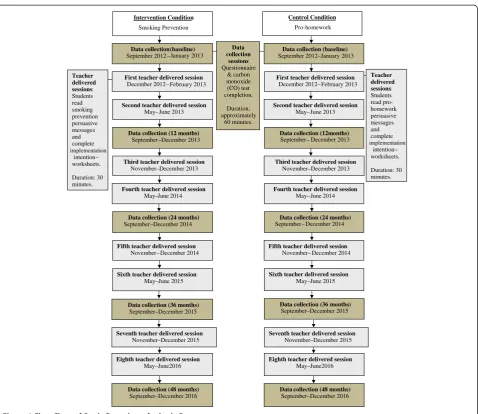
This study will use a pragmatic cluster randomised con-trolled trial design (see Figure 1). The unit of randomisa-tion will be schools. Individual adolescents will be the unit of analysis although we will take account of cluster-ing by schools.
Sampling and recruitment of schools and adolescents All secondary schools (except independent schools) in the Leeds and Staffordshire areas will be invited to take part. There will be a total of at least 36 schools recruited into the RCT (see Figure 2). We will approach secondary schools in the West Yorkshire and Staffordshire Local Education Authorities (the participating regions) and the surrounding areas to request participation in the pro-posed research. Through previous work and that of our collaborators we have good experience of recruiting and working with schools in both regions. Based on our pre-vious work [8,12] we anticipate at least 50% of schools will agree to participate. Within each school all available classes in year 7 (11–12 year olds) will participate (esti-mated to be at least 4 classes of 30 adolescents per school).
We will ask head teachers to sign a written consent form agreeing that their schools take part in the trial and agreeing not to introduce any new anti-smoking interventions during the time period of the trial without informing the trial staff. We will seek to record carefully any anti-smoking initiatives conducted in each school during the trial period. Through the schools we will seek to obtain parental consent (an opt-out procedure) for participation in the RCT (intervention plus data collec-tion) through letters from the participating schools.
Study population Proposed sample size
In selecting a sample size we have based our estimates on six factors: 1) the size of effect observed in our previ-ous research; 2) the fact that school will be the unit of randomisation and adolescents will be clustered within schools; 3) a likely dropout rate based on our previous research; 4) an estimate of the intra-class correlation co-efficient (ICC); 5) choice of significance level at 5% and sought power of at least 90%; and 6) a correction for imbalances in recruitment or drop-out rates across schools. Based on these values we have estimated the power of our study to detect differences between inter-vention and control arms of the RCT using our pro-posed sample sizes. In relation to effect size, our explanatory trial [8] indicated that the intervention reduced objectively assessed smoking rates from around 14% to around 4% (in unadjusted data) in 15–16 year olds. In the analysis controlling for other predictors of smoking and the multilevel nature of the data (children clustered within classes, classes clustered within schools) this equated to a large effect size with an odds ratio of 0.15 (95%CI: 0.03–0.80). We have conservatively pow-ered the present study using a value at the upper end of this range, i.e., to detect a difference of 5% between the intervention (9% rate of smoking initiation) and control (14% rate of smoking initiation) arms at the end of the study (i.e., equivalent to an odds ratio of 0.61). In rela-tion to dropout rates we have estimated that 85% of those who begin the study will be available to follow-up at 48 months [8]. For ICC we have estimated a value of 0.01 based on previous research [8]. In relation to sig-nificance level we have used an alpha of 0.05 using a two-sided test in order to be open to testing the possibil-ity that the intervention actually increased smoking initi-ation rates. In reliniti-ation to a correction factor to allow for imbalances in recruitment or dropout we estimate this will not reduce our statistical power by more than 1%.
4 classes per school). Based on an 85% recruitment rate (due to refusal to participate and non-attendance on test-ing days) the overall number of adolescents available for analysis will be: 0.85 * 18 * 120 = 1836 per group. The effective number of adolescents per group will be reduced further due to a design effect (i.e., adolescents clustered by school): Design effect = 1 + (m–1)*ICC, where m is the number of participants per cluster. This yields a design effect of 2.01 and reduces the effective sample size per group to 913 (1836/2.01). This effective sample size yields a statistical power of 90.65% to detect a 5% difference in smoking initiation between the intervention (9% initiation) and control (14% initiation) arms using a two-sided test with an alpha of 0.05. Adding our correction factor for potential imbalances in recruitment would still provide a power of almost 90%. Therefore our proposed sample size is 4320 adolescents from 36 schools (18 intervention; 18 Data
collection sessions
Questionnaire & carbon monoxide (CO) test completion.
Duration: approximately
60 minutes.
Teacher delivered sessions: Students read pro- homework persuasive messages and complete
worksheets.
Duration: 30 minutes.
Teacher delivered sessions: Students read smoking prevention persuasive messages and complete implementation
intention –
implementation intention –
worksheets.
Duration: 30 minutes.
Fourth teacher delivered session
May June 2014
Data collection (24 months)
September December 2014
Fifth teacher delivered session
November December 2014
Sixth teacher delivered session
May June 2015
Data collection (36 months)
September–December 2015
Eighth teacher delivered session
May–June2016
Seventh teacher delivered session
November–December 2015
Data collection (48 months)
September–December 2016
Intervention Condition
Smoking Prevention
Data collection (baseline)
September 2012
First teacher delivered session
December 2012
January 2013
Second teacher delivered session
May June 2013
Data collection (12 months)
September December 2013
Third teacher delivered session
November–December 2013
Control Condition
Pro-homework
Data collection (baseline)
September 2012–January 2013
First teacher delivered session
December 2012
Second teacher delivered session
Data collection (12 months)
Third teacher delivered session
Fourth teacher delivered session
Data collection (24 months)
Fifth teacher delivered session
Sixth teacher delivered session
Data collection (36 months)
Eighth teacher delivered session Seventh teacher delivered session
Data collection (48 months)
–
–
– May June 2013–
– September December 2013–
– May June 2014–
–
– –
February 2013 – February 2013
November–December 2013
September December – 2014
November December 2014–
September–December 2015
November–December 2015
May–June2016
[image:4.595.60.539.85.499.2]September–December 2016 May June 2015–
Figure 1Flow Chart of Study Procedures for both Groups.
Eligible Schools
Randomization
N > 36 schools
Intervention Group Smoking prevention condition
N > 18 schools
Control Group Pro-homework condition
N > 18 schools
Excluded
[image:4.595.57.292.574.720.2]control), with approximately 120 adolescents being approached per school.
Discontinuation criteria
Analyses will follow intention-to-treat (ITT) principles as far as possible. Therefore we will include in the ana-lyses all schools and children initially randomised who provide data at baseline, including them for the purpose of analysis in the group originally allocated to them. To maximise the power of such analyses all reasonable and ethical steps will be taken to ensure the completeness of follow-up measures. Where data are missing we will use multiple imputation based on baseline data to replace missing data [20]. Children missing at baseline but present at one or more subsequent data collection time points will be treated as‘other participants’and excluded from the intention-to-treat analyses.
Schools withdrawal
If a school wishes to withdraw from the study we will attempt to collect data on the reasons for withdrawal. We will explore with the school the possibility of using all data collected up until that point and the possibility of still collecting data from pupils at the school at the final time point in order to maximise the chance of having more complete data on our key outcome measures (an ITT principle). Provided data is available from baseline, multiple imputation will be used to replace missing data. Where no baseline data are available all data will be excluded from analyses as there will be insufficient data to appropriately perform any multiple imputation of missing values.
Child withdrawal
Parents will have the opportunity to have their child not included in the study before commencement. Parents will also have the opportunity to withdraw their child from the study at any time point by informing the school. Further data will not be collected from children withdrawn from the study (missing data will be replaced based on multiple imputation from available data). As data will be collected anonymously, it will not be pos-sible to withdraw data already collected. Children with-drawn from the study may not be left out of any whole class activities that form part of the intervention as to do so might involve taking the child out of the class whilst these activities were occurring.
Interim analysis and stopping rules
Overall smoking rates in the two conditions will be com-puted and presented to the Independent Trial Steering Committee (TSC; and associated data monitoring com-mittee) each year. Evidence of considerably higher rates of smoking initiation in the intervention condition com-pared to the control condition could be considered by
the Committee as reason to stop the trial. All adverse events would also be reported to the TSC.
Randomisation
The unit of randomisation will be schools and our sample size calculations and analyses takes account of this cluster-ing of the data. We believe randomiscluster-ing by school before the intervention begins is most appropriate in order to re-duce the likelihood of contamination between the interven-tion and control condiinterven-tions (randomising by individual or classroom risks such contamination). The Trial Statistician (RW) will use a random number generator to randomly allocate schools to the control or intervention arms of the trial. Schools have requested feedback on which condition they are randomised to before giving final agreement to participate and agreeing to send out letters to parents. The trial will therefore deviate from best practice in recruiting children to the trial after rather than before randomisation. We will monitor any consequential effects on participation rates. As we hope to recruit all classes in a school year movement between classes within a school should not be a problem. However, adolescents moving school during the RCT are likely to have missing data. Of those initially par-ticipating in the study at age 11–12 years we anticipate a cumulative loss to follow-up at age 15–16 years of 15% (based on our previous research, [8]). We will make efforts to minimize drop out (e.g., attempting to ensure each school is visited on more than one day to collect smoking measures) and any potential biases attributable to drop out will be explored statistically.
Compliance with good practice
All statistical analyses of primary and secondary outcomes will be carried out under the guidance of the trial statistician (RW).
HTA guidelines for missing data in RCTs will be followed [20].
CONSORT guidelines [21,22] for presentation of results from cluster randomised trials will be followed.
Presentation of results will conform to good practice for presentation of complex interventions [23]. The flow of clusters and individuals through the
trial, from assignment to analysis, will be presented using a flowchart, in accordance with CONSORT guidelines [21,22].
Intra-class correlation coefficients from the
multilevel analyses will be presented following good practice for cluster randomised trials.
Ethical considerations
(Reference number 12–0155). The University of Leeds will act as trial sponsor. Written informed consent will be obtained from all participating schools. The informed con-sent of participants’parents will be sought by letter using an opt-out approach, i.e. parents will have the opportunity to“opt out”of the study if they do not wish their child to take part. Children will receive information sheets about the study and will have the opportunity to not complete the measures.
Data collection methods
The primary outcome measure is smoking initiation based on objective measures at 48 months. A secondary measure will be self-reported smoking. These measures will also be assessed at baseline and at 12, 24, and 36 months post-baseline in order to explore the time periods over which the intervention might be best targeted. These data collec-tion sessions will be completed in classroom time by the researchers and take approximately 30 minutes. Self-reported smoking and measures of cognitions (e.g. atti-tudes to smoking, intentions to resist smoking, self-efficacy over resisting, family smoking and friends smoking) will be collected via questionnaire completed individually but in a classroom setting. An objective measure of smoking will be completed individually outside a classroom setting. A number of measures of objective smoking are feasible. The two most common measures are breath carbon monoxide measures and saliva cotinine measures. Although saliva cotinine may be more effective in detecting occasional smoking (due to the greater half-life of 16–18 hours versus 4–6 hours in breath carbon monoxide) it also has a num-ber of disadvantages. These include lower acceptability to adolescents, greater cost, and loss of ability to feed back the results to participants immediately. For this reason our objective measure of smoking will be obtained from breath
carbon monoxide monitors (Micro+ SmokerlyzerW CO
Monitor, Bedfont Scientific Limited, Kent, England). This instrument gives a measure of carbon monoxide in the breath in parts per million (ppm) accurate to within 2% based upon exhaling one breath into the device and has been adapted for use in adolescent samples. Although a number of factors influence carbon monoxide in the breath, recent smoking should significantly elevate levels. Carbon monoxide in the breath can be used as a reliable and valid measure of exposure to cigarette smoking [24], comparable in accuracy to blood carboxyhaemoglobin levels [25]. The Bedfont devices have been demonstrated to give reliable and valid assessments of smoking status [26] and have been employed by various researchers with adolescent samples [8,27]. Our secondary outcome meas-ure, self-reported smoking, will be assessed by standard measures (as used in national surveys and our previous research; [8,28]).
Intervention
The intervention will take place in classroom time and will be led by a teacher using materials provided by the researchers. The materials will include written simple anti-smoking messages (as in our previous research, these will be varied between sessions to reduce boredom) and paper versions of the implementation intentions sheets to be completed. The time required will be no longer than 60 minutes to include an introduction by the teacher, brief classroom discussion, reading of the anti-smoking mes-sages and completion of the paper and pencil implementa-tion intenimplementa-tion task. We will negotiate with schools about the least disruptive and most appropriate teaching session in which to implement these sessions (e.g., morning regis-tration). Teachers will be provided with a one-to-two hour training session to introduce them to implementation intentions and anti-smoking messages, and to provide them with advice and written information on how to run the intervention sessions. This training will be conducted by the research team and teachers will be paid for their time. We will negotiate with schools on whether the same or different teachers will run the sessions throughout the trial and it may be necessary to train some additional teachers each year.
Intervention fidelity
We will assess adherence to the intervention in two ways. First, approximately 10% of intervention sessions will be assessed for adherence to protocol (a mixture of self-report by teachers and observation by researchers). Sec-ond, all written implementation intentions sheets will be collected by teachers and passed to research staff and they will be analysed for completeness. In our previous re-search [8] 73% of adolescents completed implementation intentions sheets on at least 6 occasions (out of a total of 8 occasions). In addition, the number of occasions imple-mentation intentions sheets were completed was unre-lated to reduced smoking initiation. In the present trial the impact of number of complete and partially complete implementation intentions sheets on rates of objective and self-reported smoking will be examined statistically. Both sets of data will inform the basis of an intervention fidelity analysis.
Analyses
Analyses of primary and secondary outcome measures The study uses a two group experimental design with schools of adolescents (all aged 11–12 years at outset) randomly allocated to one of two conditions: a repeated implementation intention condition targeting smoking or a control condition. The primary outcome will be object-ively assessed smoking and the secondary outcome meas-ure will be self-reported smoking. A two-level logistic regression will be used to model smoking outcomes at 48 months. Given that drop outs are expected, multiple
imputation, based on regression methods, will be under-taken to‘complete’the data and ensure efficient analysis. This will be done for all participants for whom baseline data is available (to provide meaningful imputations) and will take into consideration the two-level hierarchical nature of the data. With this approach the results will be unbiased given the general assumption of missing at ran-dom (MAR) rather than the more restrictive assumption of missing completely at random (MCAR). Results from the multiple imputations will be combined using Rubin’s rules.
Subgroup analyses will be used to examine any differ-ences between high and low deprived schools, between regions (West Yorkshire versus Staffordshire), and be-tween boys and girls. We will use mediation analyses to explore the extent to which any intervention effects are mediated by changes in the measured cognitions as tested in our previous work (e.g., attitudes to smoking, intentions to resist smoking, self-efficacy to not smoke, etc.; [31-34]).
Economic analyses
Discussion
Reducing smoking initiation is potentially the most effect-ive way to reduce smoking-related harm. The present paper reports the protocol for an intervention designed to reduce smoking initiation in adolescents. The intervention involves the repeated formation of implementation inten-tions (i.e. if-then plans) about how to refuse offers of cigarettes Promising initial data have been collected on the efficacy of this intervention [8]. The current cluster randomised controlled trial will collect further data on the effectiveness of the intervention. This is a simple interven-tion that could be deployed across most schools (i.e., has wide reach) in order to help tackle smoking initiation in adolescents. In addition, this intervention is relatively low cost, requiring around 30-60 minutes per session to im-plement, and can be implemented by teachers. Should the intervention prove effective in changing smoking out-comes and prove ‘value for money’ it might usefully be rolled out to significant proportions of the adolescent population in the UK.
Competing interests
The authors declare that they have no competing interests.
Authors’contributions
MC conceived the study. MC, SG, RL, CA, RW, KS, BG and CT were applicants for the funding and involved in designing the study. MC led the drafting of the protocol with input from all authors. All authors read and approved the final protocol.
Acknowledgements
The present research is funded by a grant from the Medical Research Council/National Preventive Research Initiative (reference MR/J000264/1) to Mark Conner, Sarah Grogan, Rebecca Lawton, Christopher Armitage, Robert West, Kamran Siddiqi, Brenda Gannon, and Carole Torgerson. Keira Flett and Ruth Simms-Ellis are employed on the grant.
Author details
1Institute of Psychological Sciences, University of Leeds, Leeds LS2 9JT, UK.
2
Department of Psychology, Sports and Exercise, Staffordshire University, Stoke-on-Trent ST4 2DF, UK.3Department of Psychology, University of Manchester, Manchester M13 9PL, UK.4Institute of Health Sciences, University of Leeds, Leeds LS2 9JT, UK.5Department of Health Sciences, University of York, York YO10 5DD, UK.6School of Education, Durham University, Durham DH1 1TA, UK.
Received: 14 December 2012 Accepted: 11 January 2013 Published: 19 January 2013
References
1. Cancer Research UK:Smoking statistics.; 2012. [On-line] Available: http://info. cancerresearchuk.org/cancerstats/types/lung/smoking/ (accessed 12.11.12). 2. Department of Health:Healthy lives, healthy people–A tobacco control plan
for England. London: HMSO; 2011.
3. ASH:Facts at a glance.; 2011. [On-line]. Available: http://www.ash.org.uk/ files/documents/ASH_93.pdf (accessed 28.4.11).
4. Paavola M, Vartiainen P, Puska P:Predicting adult smoking: The influence of smoking during adolescent and smoking among friends and family. Health Educ Res1996,11:309–315.
5. Royal College of Physicians:Smoking and the young. Suffolk: Lavenham Press; 1992.
6. General Household Survey:2007 report. London: ONS; 2009.
7. Fuller E, Sanchez M:Smoking, drinking and drug use among young people in England in 2009. London: NHS Information Centre for Health and Social Care; 2010.
8. Conner M, Higgins A:Long-term effects of implementation intentions on prevention of smoking uptake among adolescents: A cluster randomized controlled trial.Health Psychol2010,29:529–538.
9. Roland M, Torgerson DT:Understanding controlled trials: What are pragmatic trials?Br Med J1998,316:285.
10. Gollwitzer P:Goal achievement: The role of intentions.Eur Rev Soc Psychol
1993,4:141–185.
11. Gollwitzer PM, Sheeran P:Implementation intentions and goal achievement: A meta-analysis of effects and processes.Adv Exp Soc Psychol2006,38:69–119.
12. Higgins A, Conner M:Understanding adolescent smoking: The role of the Theory of Planned Behaviour and implementation intentions.Psychol Health Med2003,8:177–190.
13. Thomas RE, Perera R:School-based programmes for preventing smoking. Cochrane Database Syst Rev2006,3(Art. No. CD001293). doi:10.1002/ 14651858.CD001293.pub2.
14. Wiehe SE, Garrison MM, Christakis DA, Ebel BE, Rivara FP:A systematic review of school-based smoking prevention trials with long-term follow-up.J Adolesc Health2005,36:162–169.
15. Peterson AV, Kealey KA, Mann SL, Marek PM, Sarason IG:Hutchinson smoking prevention project: Long-term randomizes trial in school-based tobacco use prevention–results on smoking.J Natl Cancer Inst2000, 92:1979–1991.
16. Campbell R, Starkey F, Holliday J, Audrey S, Bloor M, Parry-Langdon N, Hughes R, Moore I:An informal school-based peer-led intervention for smoking prevention in adolescence (ASSIST): A cluster randomized trial. Lancet2008,371:1595–1602.
17. Sheeran P, Milne S, Webb TL, Gollwitzer PM:Implementation intentions and health behaviours. InPredicting health behaviour. 2nd edition. Edited by Conner M, Norman P. Maidenhead: OU Press; 2005:276–323.
18. Armitage CJ:Efficacy of a brief worksite intervention to reduce smoking: The roles of behavioral and implementation intentions.J Occup Health Psychol2007,12:376–390.
19. Armitage CJ:A volitional help sheet to encourage smoking cessation: A randomized exploratory trial.Health Psychol2008,27:557–566. 20. Carpenter JR, Kenwood MG:Missing data in clinical trials - a practical guide.
Birmingham: National Institute for Health Research; 2008. Publication RM03/ JH17/MK.
21. Campbell M, Elbourne D, Altman D:CONSORT statement: Extension to cluster randomised trials.Br Med J2004,328:702–708.
22. Campbell M, Piaggio G, Elbourne DR, Altman DG:CONSORT 2010 statement: Extension to cluster randomised trials.Br Med J2012,345:e5661. 23. Perera R, Heneghan C, Yudkin P:Graphical methods for depicting
randomised trials of complex interventions.Br Med J2007,334:127–129. 24. Stookey GK, Katz BL, Olson CA, Drook SL, Cohen SJ:Evaluation of
biochemical validation measures in determination of smoking status. J Dent Res1987,66:1597–1601.
25. Jarvis MJ, Tunstall-Pedoe H, Feyerabend C, Vesey C, Saloojee Y:Comparison of tests used to distinguish smokers from non-smokers.Am J Public Health1987,77:1435–1438.
26. Irving JM, Clark EC, Crombie IK, Smith WCS:Evaluation of a portable measure of expired-air carbon monoxide.Prev Med1988,17:109–115. 27. Zack M, Belsito L, Scher R, Eissenberg T, Corrigall WA:Effects of abstinence
and smoking on information processing in adolescent smokers. Psychopharmacology2001,153:249–257.
28. Jarvis L:Smoking among secondary school children in 1996. England. London: HMSO; 1997.
29. Campbell M, Fitzpatrick R, Haines A, Kinmonth AL, Sandercock P, Spiegelhalter D, Tyrer P:Framework for design and evaluation of complex interventions to improve health.Br Med J2000,321:694–696.
30. Craig P, Dieppe P, Macintyre S, Michie S, Nazareth I, Petticrew M: Developing and evaluating complex interventions: The new Medical Research Council guidance.Br Med J2008,337:979–983.
31. Conner M, Grogan S, Fry G, Gough B, Higgins AR:Direct, mediated and moderated impacts of personality variables on smoking initiation in adolescents.Psychol Health2009,24:1085–1104.
32. Conner M, Sandberg T, McMillan B, Higgins A:Role of anticipated regret in adolescent smoking initiation.Br J Health Psychol2006,11:85–101. 33. Grogan S, Conner M, Fry G, Gough B, Higgins A:Gender differences in
34. Lawton R, Conner M, Parker D:Beyond cognition: Predicting health risk behaviors from instrumental and affective beliefs.Health Psychol2007, 26:259–267.
35. Raikou M, McGuire A:A review of the cost-effectiveness of interventions (specifically point of sales measures and mass media) to prevent the uptake of smoking in young people under 18 years old, NICE.; 2007.
doi:10.1186/1471-2458-13-54
Cite this article as:Conneret al.:Study protocol: A cluster randomised controlled trial of implementation intentions to reduce smoking
initiation in adolescents.BMC Public Health201313:54.
Submit your next manuscript to BioMed Central and take full advantage of:
• Convenient online submission
• Thorough peer review
• No space constraints or color figure charges
• Immediate publication on acceptance
• Inclusion in PubMed, CAS, Scopus and Google Scholar
• Research which is freely available for redistribution