meet-implication fragment of IPC
Nick Bezhanishvili1, Dion Coumans2, Sam van Gool2,3, and Dick de Jongh1 1
ILLC, Faculty of Science, University of Amsterdam Science Park 107, 1098 XG Amsterdam, The Netherlands 2
IMAPP, Faculty of Science, Radboud University Nijmegen P. O. Box 9010, 6500 GL Nijmegen, The Netherlands
3 LIAFA, Universit´e Paris-Diderot, Case 7014 75205 Paris Cedex 13, France
Abstract. In this paper we investigate the fragment of intuitionistic logic which only uses conjunction (meet) and implication, using finite duality for distributive lattices and universal models. We give a descrip-tion of the finitely generated universal models of this fragment and give a complete characterization of the up-sets of Kripke models of intuitionistic logic which can be defined by meet-implication-formulas. We use these results to derive a new version of subframe formulas for intuitionistic logic and to show that the uniform interpolants of meet-implication-formulas are not necessarily uniform interpolants in the full intuitionistic logic.
Keywords: Duality, universal models, intuitionistic logic, Heyting al-gebras, free alal-gebras, implicative semilattices, definability, interpolation
1
Introduction
Heyting algebras are the algebraic models of intuitionistic propositional logic, IPC. In this paper we will be concerned with the syntactic fragment of IPC consisting of the formulas which only use the connectives of conjunction (∧) and implication (→), but no disjunction (∨) or falsum (⊥). The algebraic structures corresponding to this fragment are called implicative semilattices4. A result due to Diego [1] says that the variety of implicative semilattices is locally finite, i.e., finitely generated algebras are finite, or equivalently, the finitely generated free algebras are finite. In logic terms, this theorem can be expressed as saying that there are only finitely many equivalence classes of (∧,→)-formulas in IPC. One of the key results in this paper is a dual characterization of a (∧,→ )-subalgebra of a given Heyting algebra generated by a fixed set of elements (The-orem 21). This the(The-orem leads to a proof of Diego’s the(The-orem and a characteriza-tion of then-universal models of the (∧,→)-fragment of IPC (Theorem 22) as submodels of the universal model, in the same spirit as the proof by de Jongh
4
et al. in [2]. The first characterization of this model was obtained by K¨ohler [3] using his duality for finite implicative meet-semilattices. Our slightly different approach in this paper also enables us to obtain new results about the (∧,→ )-fragment of IPC. In particular, in Theorem 24, we give a full characterization of the up-sets of a Kripke model which can be defined by (∧,→)-formulas. Since our characterization in particular applies to then-universal model of IPC, this may be considered as a first step towards solving the complicated problem of characterizing the up-sets of then-universal models which are definable by intu-itionistic formulas (also see our more detailed remarks in Section 5). Building on this result, we use the de Jongh formulas for IPC to construct formulas that play an analogous role in the (∧,→)-fragment. Finally, we use the characterization of (∧,→)-definable subsets of then-universal models of IPC to show that a uniform interpolant of a (∧,→)-formula in intuitionistic logic may not be equivalent to a (∧,→)-formula.
A word on methodology. The two essential ingredients to our proofs are, on the one hand, Birkhoff duality for finite distributive lattices and, on the other hand, the theory of n-universal models for IPC ([4], [5]). Our methods in this paper are directly inspired by the theory of duality for (∧,→)-homomorphisms as developed in [3], [6], [7], [8], and also by the observations about the relation between then-universal models and duality for Heyting algebras in [9]. However, we made an effort to write this paper in such a way to be as self-contained as possible, and in particular we do not require the reader to be familiar with any of these results. In particular, we give a brief introduction to duality for finite distributive lattices and its connection to Kripke semantics for IPC in Section 2, and we do not need to go into the intricacies of duality for implicative meet-semilattices, instead opting to give direct proofs of the duality-theoretic facts that we need.
The paper is organized as follows: in Section 2 we present the necessary prelimi-naries about IPC and Heyting algebras in the context of duality for distributive lattices; in Section 3 we study the meet-implication fragment of IPC and prove our main theorems mentioned above; in Section 4 we apply these results to define (∧,→)-de Jongh formulas and analyze semantically the uniform interpolation in the (∧,→)-fragment of IPC. In Section 5 we summarize our results and give suggestions on where to go from here.
2
Algebra, semantics and duality
and in Subsection 2.4 we recall how the universal and canonical models for IPC are related to free finitely generated Heyting algebras via duality.
2.1 Adjunction, Heyting algebras, implicative meet-semilattices
Since the notion of adjunction is crucial to logic in general, and in particular to intuitionistic logic, we recall some basic facts about it right away. An adjunction can be understood as an invertible rule that ties two logical connectives or terms. The typical example in intuitionistic logic is the adjunction between∧and →, which can be expressed by saying that the following (invertible) rule is derivable in IPC.
p∧q`r
p`q→r
(1)
Recall that an adjunction between partially ordered sets A and B is a pair of functionsf :AB:gsuch that, for alla∈Aandb∈B,f(a)≤bif, and only if,a≤g(b); notation:f ag. In this case, we say thatf islower adjointtogand
gisupper adjointtof. Note that the derivability of rule (1) in IPC says exactly that, for anyψ, the functionϕ7→ϕ∧ψon the Lindenbaum algebra for IPC (cf. Example 3(b) below) is lower adjoint to the functionχ7→ψ→χ. The following general facts about adjunctions are well-known and will be used repeatedly in this paper.
Proposition 1. Let AandB be partially ordered sets and letf :AB:g be an adjunction. The following properties hold:
1. Iff is surjective, then f g= idB, and thereforeg is injective and the image ofg is{a∈A| gf(a)≤a};
2. The functionf preserves any joins (suprema) which exist inAand the func-tiong preserves any meets (infima) which exist in B;
3. For any b ∈B,g(b) is the maximum of {a∈A | f(a)≤b}. In particular, the fact thatg is upper adjoint to f uniquely determines g.
Moreover, ifC andD are complete lattices andf :C→D is a function which preserves arbitrary joins, then f has an upper adjoint.
Proof. Straightforward; cf., e.g., [10, 7.23–7.34]. ut
Recall that a tuple (A,∧,∨,→,0,1) is a Heyting algebra if (A,∧,∨,0,1) is a bounded lattice, and the operation→is upper adjoint to∧, i.e., for anya, b, c∈
A,
a∧b≤c ⇐⇒ a≤b→c. (2)
algebras that preserves each of the operations. An implicative meet-semilattice is a “Heyting algebra without disjunction”. More precisely, animplicative meet-semilattice is a tuple (A,∧,→) such that (A,∧) is a semilattice, and equation (2) holds. We will write (∧,→)-homomorphism to abbreviate “homomorphism of implicative meet-semilattices”. Note that any implicative meet-semilattice has a largest element, 1, which is preserved by any (∧,→)-homomorphism. Also note that finite implicative meet-semilattices are distributive lattices, but (∧,→ )-homomorphisms do not necessarily preserve joins. However, surjective (∧,→ )-homomorphisms do preserve join (cf. [3, Lemma 2.4 and the remark thereafter]):
Lemma 2. Iff :A→Bis a surjective(∧,→)-homomorphism between Heyting algebras, then f is join-preserving.
Proof. First of all, we have 0B = f(a) for some a ∈ A, and 0A ≤ a, so that
f(0A) = 0B. Now leta, a0∈A. Pickc∈Asuch thatf(c) =f(a)∨f(a0). Now
f(a∨a0)→(f(a)∨f(a0)) =f(a∨a0)→f(c) =f((a∨a0)→c) =f((a→c)∧(a0→c))
= (f(a)→f(c))∧(f(a0)→f(c)) = (f(a)∨f(a0))→f(c) = 1,
so f(a∨a0) ≤ f(a)∨f(a0). The other inequality holds because f is
order-preserving. ut
Example 3. (a) An important example of a Heyting algebra is the collection of upward closed sets (‘up-sets’) of a partially ordered set (X,≤), ordered by inclusion; we denote this Heyting algebra byU(X). The Heyting implication of two up-setsU andV is given by the formula
U →V = (↓(U ∩Vc))c, (3)
that is, a pointxis inU →V if, and only if, for ally≥x,y ∈U impliesy∈V. The reader who is familiar with models for IPC will recognize the similarity between this condition and the interpretation of a formula ϕ→ψ in a model; we will recall the precise connection between the two in 2.3 below.
(b) Another example of a Heyting algebra, of a more logical nature, is that of the Lindenbaum algebra for IPC; we briefly recall the definition. Fix a set of propositional variables P and consider the collection F(P) of all propositional formulas whose variables are inP. Define a pre-orderonF(P) by saying, for
ϕ, ψ∈F(P), thatϕψif, and only if, ψis provable fromϕin IPC. The Lin-denbaum algebra is defined as the quotient ofF(P) by the equivalence relation
≈ := ()∩()−1. The Lindenbaum algebra is the free Heyting algebra over the set P, i.e., any function from P to a Heyting algebra H lifts uniquely to a Heyting homomorphism from the Lindenbaum algebra overP to H. We will denote the free Heyting algebra overP byFHA(P). Note that the same construc-tion can be applied to the (∧,∨)- and (∧,→)-fragments of IPC to yield the free distributive lattice FDL(P) and the free implicative meet-semilattice F∧,→(P),
2.2 Duality
We briefly recall the facts about duality that we will need. LetDbe a distributive lattice. We recall the definition of the dual poset, D∗, of D. The points of D∗
are the prime filters ofD, i.e., up-setsF ⊆D which contain finite meets of their subsets and have the property that if a∨b ∈ F, then a ∈ F or b ∈ F. The partial order on D∗ is the inclusion of prime filters. The map η :D → U(D∗)
which sends d∈D to{F ∈D∗ |d∈ F} is (assuming the axiom of choice) an
embedding of distributive lattices, which is called thecanonical extensionofD. IfD is finite, thenη is an isomorphism, so that any finite distributive lattice is isomorphic to the lattice of up-sets of its dual poset. The assignmentsX 7→ U(X) and D 7→ D∗ between finite posets and finite distributive lattices extend to a
dual equivalence, or duality, of categories: homomorphisms from a distributive lattice D to a distributive lattice E are in a natural bijective correspondence with order-preserving maps from E∗ to D∗. A homomorphism h : D → E is
sent to the map h∗ :E∗ →D∗ which sendsF ∈ E∗ to h−1(F), and an
order-preserving map f : X → Y is sent to the homomorphismf∗ : U(Y)→ U(X) which sends an up-set U ofY to f−1(U).
IfX andY are posets, it is natural to ask which order-preserving mapsf :X →
Y are such that their dualf−1:U(Y)→ U(X) is a Heyting homomorphism. It turns out that these are thep-morphisms, i.e., the order-preserving maps which in addition satisfy the condition: for anyx∈X,y∈Y, iff(x)≤y, then there existsx0≥xsuch thatf(x0) =y.
To end this subsection, we recall how duality yields a straight-forward description of the free distributive latticeFDL(P). In any category of algebras, the free alge-bra over a setPis theP-fold coproduct of the one-generated free algebra. There-fore, since duality transforms coproducts into products, the dual spaceFDL(P)∗
is the P-fold power of the posetFDL({p})∗, the dual of the one-generated free
algebra. Note thatFDL({p}) is the three-element chain{0≤p≤1}, so its dual is the two-element poset 2 = {0,1}. Since products in posets are simply given by equipping the Cartesian product with the pointwise order, it follows that
FDL(P)∗ = 2P. Therefore, the free distributive lattice over P is the lattice of
up-sets of 2P; in a formula,F
DL(P) =U(2P).
2.3 Semantics via duality
Notation.Throughout the rest of this paper, we fix a finite set of propositional variables P = {p1, . . . , pn}. We denote the free algebras over P by FHA(n),
FDL(n), etc.
In this paper, a frame is a poset (M,≤). A model is a triple (M,≤, c), where (M,≤) is a poset and c, the coloring, is an order-preserving function from M
to 2n. The coloring c yields, via duality, a distributive lattice homomorphism
homomorphism, v, from the free n-generated Heyting algebra to the Heyting algebraU(M), as in diagram (4).
FDL(n) (2n)∗=
FHA(n)
U(M)
v
c∗
(4)
A pointxin a modelM is said tosatisfya formulaϕif, and only if,x∈v(ϕ); we employ the usual notation:M, x|=ϕ. Note that, as an alternative to the above algebraic description, one may equivalently define the satisfaction relation for models by induction on the complexity of formulas; see e.g. [5, Def. 2.1.8]. A model is said to satisfyϕif every point of the model satisfiesϕ. Ap-morphismf
from a modelM to a modelN is a p-morphism between the underlying frames ofM andN which in addition satisfies, for anyx∈M,cN(f(x)) =cM(x). From the above definitions, it is clear that p-morphisms preserve truth, i.e.,M, x|=ϕ
if, and only if, N, f(x) |= ϕ, for any formula ϕ. A generated submodel of M
is a submodel M0 such that the inclusion f : M0 ,→ M is a p-morphism, or equivalently, such thatM0 is an up-set. We sayM0 is ap-morphic imageof M
if there exists a surjective p-morphismf :M M0.
Recall that ageneral frameis a tuple (M,≤, A), where (M,≤) is a poset andAis a subalgebra of the Heyting algebra of up-sets ofM. The elements of the algebra
A are called the admissible sets of the general frame. An important subclass consists of those general frames (M,≤, A) for which (M,≤) is the dual poset of the Heyting algebraA; these are precisely thedescriptivegeneral frames.5 An admissible coloring is a coloring c : M → 2n with the additional property that, for each 1≤i≤n, the set{x∈M |c(x)i= 1}is admissible. By the latter description and duality, admissible coloringsc on a descriptive frame (M,≤, A) correspond to homomorphisms c∗ : FDL(n)→A. A diagram analogous to (4), replacing U(M) by A, is now used to define the semantics of a general model (M,≤, A, c).
2.4 Canonical and universal models
The dual poset of the free n-generated Heyting algebra,FHA(n), is called the canonical frameand is denoted byC(n). In logic terms, points in the canonical frame are so-called “theories with the disjunction property”. The canonical frame carries a natural coloringc, which is the dual of the inclusionFDL(n),→FHA(n). Concretely,c(x)i= 1 if, and only if, the variablepiis an element ofx. The model thus defined is called the canonical model, and is also denoted byC(n).6
5 For an equivalent characterization of descriptive general frames as the ‘compact refined’ general frames, cf. e.g. [5, Def. 2.3.2, Thm. 2.4.2].
6
Note that, by the embeddingη:FHA(n),→ U(C(n)), any elementϕofFHA(n) defines an up-set η(ϕ) ={x∈C(n) |ϕ ∈x} of C(n). Since η is in particular a Heyting homomorphism that extends c∗, it is equal to the semantics map
v for C(n) defined in (4). Concretely, this means that, for any x ∈ C(n) and
ϕ∈FHA(n), we haveC(n), x|=ϕif, and only if,ϕ∈x; this fact is often referred to as thetruth lemma.
LetF\HA(n) be the profinite completion ofFHA(n); recall from [11, Thm 4.7] that \
FHA(n) is the Heyting algebra of up-sets ofC(n)fin:={x∈C(n)| ↑xis finite}, the image-finite part ofC(n). The generated submodelC(n)finofC(n) is known as theuniversal model and denoted byU(n).
Lemma 4. The mapv:FHA(n)→ U(U(n))is injective.
Proof. Cf., e.g., [5, Thm 3.2.20]. ut
Importantly, the universal model can be described by an inductive top-down construction, as follows.
Theorem 5. The universal model U(n) is the unique image-finite model sats-fying all of the following conditions:
1. there are2n maximal points with mutually distinct colors in U(n);
2. for any x ∈ U(n) and c0 < c(x), there is a unique point x0 ∈ U(n) with
c(x0) =c0 and↑x0 ={x0} ∪ ↑x;
3. for any finite antichain S ⊆ U(n) and c0 ≤min{c(x) | x∈ S}, there is a unique pointx0∈U(n)with c(x0) =c0 and↑x0={x0} ∪S
x∈S↑x.
Proof. Cf. [5, Sec. 3.2]. ut
The following important fact states a ‘universal property’ for the universal model. Following the terminology of [5, Sec 3.1], we say that a frameM hasfinite depth
≤mif every chain inM has size at mostm.
Proposition 6. IfM is a model onn variables of finite depth≤m, then there exists a unique p-morphismf :M →U(n). Moreover, the image off has depth
≤m.
Proof. 7 We prove the statement by induction on m. First let M be a model of depth 0. In this case, there is clearly a unique p-morphism from M toU(n), namely the one which sends each point in M to the unique maximal point in
U(n) of the same colour. Now letM be a model of depthm+ 1, form≥0. Let
x∈M be arbitrary; we will definef(x)∈U(n). Note that, for everyy > x, the submodel My :=↑y generated by y has depth≤m. Thus, for each y > x, let
fy :My →U(n) be the unique p-morphism; the image offy has depth ≤mby the induction hypothesis. Therefore, the set S :=S
in U(n). IfS is empty, thenxis maximal, and we definef(x) to be the unique maximal point ofU(n) that has the same colour asx. Otherwise,S has finitely many minimal points, s0, . . . , sk, say. Pick points y0, . . . , yk in M such that
si ∈ im(fyi). Ifk = 0 andc(y0) =c(x), then we define f(x) := s0. Otherwise, by Theorem 5, there is a unique point s in U(n) whose immediate successors ares0, . . . , sk such thatc(s) =c(x); we definef(x) :=s. It is straightforward to check thatf defined in this manner is the unique p-morphism fromM toU(n),
and clearly the image off has depth≤m+ 1. ut
Remark 7. Two points xand x0 in a model M of finite depth are bisimilar if, and only if, the unique p-morphismf in Proposition 6 sends them to the same point ofU(n).
Theorem 8. For eachx∈U(n)there exist formula ϕw andψw such that 1. v(ϕw) =↑x,
2. v(ψw) =U(n)\ ↓x.
Formulas ϕw andψw are called de Jongh formulas.
Proof. Cf. [5, Thm. 3.3.2]. ut
Note that the de Jongh formulaψwhas the following property: a frameGrefutes
ψwiff there is a generated subframe ofGp-morphically mapped onto the frame generated byw. This way de Jongh formulas correspond to the so-called Jankov or splitting formulas, see [5, Sec. 3.3] for the details.
3
Separated points and the meet-implication fragment
In this section we use a duality for Heyting algebras and (∧,→)-homomorphisms for characterizing n-universal models of the (∧,→)-fragment of IPC (Theo-rem 22) and for characterizing (∧,→)-definable up-sets of n-universal models of IPC (Theorem 24). The main technical contribution is the characterization of the dual model of the (∧,→)-subalgebra of a Heyting algebra A generated by a finite set of generators (Theorem 21). Our proofs rely on a discrete duality and do not use topology. They can be extended to Priestley [13] and Esakia [14] dualities by adding topology, but we will not use this (explicitly) in this paper. In the study of the meet-implication fragment, the following notion of ‘separated point’ in a model will be crucial.8
Definition 9. Let M = (M,≤, c) be a model. A point x∈ M is separated if, and only if, there is a variablepsuch thatM, x6|=pand, for ally > x,M, y|=p. Remark 10. Note that a pointxis separated precisely when there exists a vari-ablepsuch thatxis maximal in the down-setv(p)c, the complement ofv(p).
8
The following alternative characterization of separated points relates them to the (∧,→)-fragment.
Lemma 11. Letxbe a point in a modelM. The following are equivalent:
1. The pointxis separated;
2. There exists a(∧,→)-formulaϕ such that xis maximal in the complement ofv(ϕ).
Proof. It is clear that (1) implies (2) by Remark 10. For (2) implies (1), we prove the contrapositive. Suppose that xis not separated. We prove the negation of (2), i.e., x is not maximal in (v(ϕ))c for any (∧,→)-formula ϕ, by induction on complexity of ϕ. For ϕ = p, this is clear by Remark 10. For ϕ = ψ∧χ, note that v(ϕ)c = v(ψ)c∪v(χ)c. From this equality, it follows that if xwere maximal inv(ϕ)c, it would already be maximal in eitherv(ψ)c or v(χ)c, which contradicts the induction hypothesis. Forϕ=ψ→χ, suppose thatxis maximal inv(ϕ)c. We will prove thatxis also maximal inv(χ)c, which again contradicts the induction hypothesis. By maximality ofx, ally > xsatisfyψ→χ. However,
xdoes not satisfy ψ →χ, so we must have that x∈v(ψ)∩v(χ)c. Since v(ψ) is an up-set, we conclude that, for all y > x,y ∈v(ψ), and thereforey ∈v(χ).
Hence,xis maximal inv(χ)c, as required. ut
For a model M, we denote by Ms the submodel consisting of the separated points ofM. That is, the order and coloring onMs are the restrictions of the corresponding structures on M. (Note that the model Ms is a submodel, but almost never ageneratedsubmodel, i.e. is up-set, ofM!)
Lemma 12. LetM be a model onn variables. The submodel(Ms,≤|
Ms, c|Ms) has finite depth ≤n.
Proof. LetC be a chain in Ms. For anyx, y∈Ms, ifx < y, thenc(x)< c(y), sincexis separated andy > xinM. Therefore,{c(x)|x∈C} is a chain in the poset (2n,≤), so that it must have size ≤n. Hence,C has size at mostn. ut
Definition 13 (The model M∧,→). Let M be a model andMs its submodel
of separated points. Let f :Ms→U(n) be the unique p-morphism which exists by Proposition 6 and Lemma 12. Define M∧,→ := f(Ms) to be the generated
submodel ofU(n)consisting of those points in the image off, as in the following diagram.
M ⊇Ms M
∧,→
U(n)
f (5)
Remark 14. Note thatM∧,→ is a generated submodel ofU(n) of depth≤nand
in particular, thatM∧,→ is a finite model. Moreover, note thatM∧,→⊆U(n)s:
separated inM, we may pick a propositional variablepsuch thatM, x|=pand
M, x0 6|= p for all x0 > x. Since f preserves the colouring, U(n), y |= p. Also, for any y0 > y = f(x), there exists x0 > x such that f(x0) = y0, because f
is a p-morphism. By assumption, M, x0 6|= p, and therefore, since f preserves the colouring,U(n), y0 6|=p. Thus, y is separated inU(n). (The same argument shows that any p-morphism preserves separated points.) ut
In Theorem 21 below, we will show that, for any descriptive model (M,≤, A, c), the modelM∧,→ is dual to the (∧,→)-subalgebra ofAthat is generated by the
admissible up-setsv(p1), . . . , v(pn). We need two lemmas.
Lemma 15. Let f : H → K be a function between Heyting algebras with an upper adjointg:K→H. Thenf preserves binary meets if, and only if, for all
a∈H,b∈K, the equality a→g(b) =g(f(a)→b)holds.
Proof. Leta∈H be arbitrary. Consider the following two diagrams.
H
H
K
K f
a∧ −
f
f(a)∧ −
H
H
K
K g
a→ −
g
f(a)→ − (6)
A way to express the assertion that f preserves binary meets is that, for all
a ∈ H, the left diagram in (6) commutes. By uniqueness of adjoints, the left diagram in (6) commutes if, and only if, the right diagram in (6) commutes. ut
Lemma 15 and its proof are very similar to, and were in fact directly inspired by, theFrobenius conditionin [15, Def. p. 157] and the remark following it; we leave further exploration of the precise connection to future research.
Definition 16. We say that a modelM is a model with bordersor thatM has borders9 if, for any variablep,v(p)c=↓max(v(p)c).
Proposition 17.
1. Every image-finite model has borders. 2. Every descriptive model has borders.
Proof. Item (1) is straightforward. For the proof of (2) see e.g., [5, Thm. 2.3.24]. The following lemma now provides the key connection between the construction ofMs and the (∧,→)-fragment.
9
Lemma 18. LetM be a model with borders. Consider the following diagram:
FHA(n)
F∧,→(n)
U(M) U(Ms)
v v
s
r
`
q i
(7)
whereiis the natural inclusion,v andvsare the valuation maps ofM andMs, respectively, qis the lattice homomorphism dual to the inclusionMs,→M, and
r is its upper adjoint. Then
r◦vs◦i=v◦i. (8)
Remark 19. Note that, by Proposition 1, the functionrsends an up-setV ofMs to the up-set{x∈M | ∀y ≥x, y∈Ms:y ∈V} ofM. Therefore, the equality (8) says precisely that, for allϕ∈(∧,→),x∈M, we have
M, x|=ϕ ⇐⇒ ∀y≥x, y∈Ms:Ms, y|=ϕ. (9) In this sense, Lemma 18 is an algebraic rendering of the crucial ingredient to [2, Proof of Thm. 1]. The proof we give here is different in spirit.
Proof (of Lemma 18).By Proposition 1,qr= id sinceq is surjective. We prove the equality (8) by induction on the complexity of ϕ∈F∧,→(n), and suppress
the function i in our notation. Ifϕ is a variablep, note that vs(p) =qv(p) by definition, so we need to provev(p) =rqv(p). The inequalityv(p)≤rqv(p) holds becauseris upper adjoint toq. For the other inequality, suppose thatx6∈v(p). As M is a model with borders we can pick y ∈ max(v(p)c) such that y ≥ x. Theny∈Ms, so thatx6∈rqv(p), as required. The stepϕ=ψ∧χis clear from the fact that both v and rvs preserve binary meets (r is meet-preserving since it is an upper adjoint). Finally, suppose that (8) holds for formulasψandχ; we prove (8) forψ→χ. Note in particular thatqv(ψ) =qrvs(ψ) =vs(ψ), where we use that qr= id. We now havervs(ψ→χ) =r(vs(ψ)→vs(χ)) = r(qv(ψ)→
vs(χ)) = v(ψ) → rvs(χ), where the last equality holds by Lemma 15, since
q preserves binary intersections. By the induction hypothesis, rvs(χ) = v(χ). Hence,rvs(ψ→χ) =v(ψ)→v(χ) =v(ψ→χ), as required. ut
Corollary 20. LetM be a model with borders and letMsandf :Ms→M∧,→
be as in Definition 13. Then for eachw∈Msand a (∧,→)-formulaϕ, we have
M, w|=ϕ ⇐⇒ M∧,→, f(w)|=ϕ. (10)
Proof. By (9) we have thatM, w|=ϕ ⇐⇒ ∀y≥w, y∈Ms:Ms, y|=ϕ. So, if
w∈Ms, thenMs, w|=ϕ, and asf is a p-morphism we also haveM
∧,→, f(w)|=
ϕ. Conversely, ifM∧,→, f(w)|=ϕ, then Ms, w |=ϕ. Therefore, Ms, y |=ϕfor
Theorem 21. LetM be a model with borders. Consider the following diagram:
FHA(n)
F∧,→(n)
U(M) U(Ms) U(M
∧,→)
U(U(n))
v v
s
r
`
q i
h f∗ vU(n)
t (11)
where the left part of the diagram is defined as in (7),vU(n) is the valuation on
U(n), and the trianglef∗=h◦tis the dual of the triangle in (5). The following properties hold:
1. The image of the composite rh is equal to the (∧,→)-subalgebra of U(M) that is generated byv(p1), . . . , v(pn);
2. The implicative meet-semilatticeU(M∧,→)is isomorphic to the (∧,→
)-sub-algebra ofU(M) that is generated byv(p1), . . . , v(pn).
Proof. It clearly suffices to prove (1), as (2) then follows immediately. Let B
denote the (∧,→)-subalgebra of U(M) that is generated by v(p1), . . . , v(pn). Note thatB= im(vi). We show that im(rh) is equal toB = im(vi). To this end, note first that, chasing the diagram (11), we have:
vi=rvsi=rf∗vU(n)i=rhtvU(n)i, (12) where we use Lemma 18 and the fact that vs = f∗vU(n), since f is a p-morphism of models. In particular,B contains im(r◦h) and im(r◦h) contains
v(p1), . . . , v(pn). It thus remains to show that im(r◦h) is a (∧,→)-subalgebra of
U(M), or equivalently, thatr◦hpreserves∧and→. Sinceris an upper adjoint andhis a Heyting homomorphism,r◦hpreserves∧. Moreover, using Lemma 15 and the fact thatqr= id, we have, for anyU, V ∈ U(M∧,→), that
rh(U)→rh(V) =r(qrh(U)→h(V)) =r(h(U)→h(V)) =rh(U →V),
where the last step uses thathis a Heyting homomorphism. ut
We now use this theorem to prove three facts about the (∧,→)-fragment of IPC. The first is Diego’s theorem.
Theorem 22. For any n, we haveF∧,→(n)∼= U(U(n)∧,→). In particular, the
variety of implicative meet-semilattices is locally finite.
Proof. Apply Theorem 21 to the general model (U(n),≤,U(U(n)), c). Since the valuationv:FHA(n)→ U(U(n)) is injective (Lemma 4), viis injective. By (12) in the proof of Theorem 21, vi = rhtvU(n)i. Since rh is also injective, it now follows easily thattvU(n)i:F∧,→(n)→ U(U(n)∧,→) is an isomorphism. The ‘in
Theorem 23. For anyϕ∈FHA(n), there exists s(ϕ)∈F∧,→(n)such that, for
any model M andx∈Ms, we have:
Ms, x|=ϕ ⇐⇒ Ms, x|=s(ϕ).
Proof. SinceF∧,→(n) is finite by Theorem 22, it is a Heyting algebra, in which
the supremum is given by
ϕYψ=^{χ∈F∧,→ |ϕ≤χandψ≤χ}.
Hence, there exists a unique Heyting homomorphism s : FHA(n) → F∧,→(n)
such thats(p) =pfor all propositional variablesp. Note thatsiis the identity on
F∧,→(n), sosis surjective. Also note thattvU(n)iis surjective: ifU ∈ U(M∧,→),
then rh(U) is in the image of vi, by Theorem 21, so pick ψ ∈ F∧,→(n) such
that rh(U) = vi(ψ). Now, by (12),rh(U) = rhtvU(n)i(ψ), so U = tvU(n)i(ψ), sincerhis injective. We conclude thattvU(n)isis a surjective (∧,→)-preserving map, and therefore it is a Heyting homomorphism by Lemma 2. Now,htvU(n)is is also a Heyting homomorphism and htvU(n)is(p) = htvU(n)(p) = vs(p). By uniqueness of the mapvs, we conclude thathtvU(n)is=vs, as required. ut We now give a characterization of the (∧,→)-definable subsets in any model.
Theorem 24. Let M be a model with borders. Let U ⊆M be an up-set. The following are equivalent:
1. There exists a(∧,→)-formulaϕsuch thatv(ϕ) =U;
2. For allx∈M, if, for all z∈Ms such that z≥x, there existsy ∈U∩Ms bisimilar toz inMs, then x∈U;
3. For allx∈M,
(a) if all separated points abovexare in U, then x∈U, and
(b) if x∈Ms and there existsx0 ∈U ∩Ms which is bisimilar toxin Ms, thenx∈U.
Proof. By Theorem 21(1), the up-sets which are definable by a (∧,→)-formula are precisely the up-sets in the image of rh. Let h[ denote the lower adjoint of h, which is given explicitly by sendingS ∈ U(Ms) to f(S)∈ U(M∧,→). By
Proposition 1(1), applied to the adjunction h[qarh, an up-set U is in im(rh) if, and only if,rhh[q(U)⊆U. Writing out the definitions ofr, h,h[ andq, we see that this condition is equivalent to:
∀x∈M, if ∀z∈Ms ifz≥xthenz∈f−1(f(U∩Ms)) thenx∈U.
This condition is in turn equivalent to (2), using Remark 7. If (2) holds, then (3a) is clear. For (3b), supposexis separated and there existsx0∈U∩Mswhich is bisimilar toxinMs. By bisimilarity, for anyz∈Ms withz≥x, there exists
y∈Mswith y≥x0 andy bisimilar toz inMs. Moreover, sinceU is an up-set containingx0, we havey ∈U. Using (2), we conclude that x∈U. Now assume
(3) and let x∈M be a point such that for all z∈Mswith z≥x, there exists
4
Subframe formulas and uniform interpolation
In this section we will apply the results obtained in the previous section to define (∧,→)-versions of de Jongh formulas. We will show in Theorem 28 that these formulas correspond to subframe formulas in just the same way as de Jongh formulas correspond to Jankov formulas. We will also use the characterization of (∧,→)-definable up-sets of U(n) to prove that uniform interpolants in the (∧,→)-fragment of IPC are not always given by the IPC-uniform interpolants (Example 31).
From Definition 13 and the remark following it, we know thatU(n)∧,→is a finite
up-set ofU(n). So every up-set of U(n)∧,→ is also a finite up-set of U(n), and
hence is definable by an intuitionistic formula (cf. Theorem 8). The next theorem shows that these up-sets are also definable by the (∧,→)-formulas that are the
s-images of these intuitionistic formulas.
Theorem 25. LetU ⊆U(n)∧,→⊆U(n)be defined inU(n)by an intuitionistic
formula ϕ. ThenU is defined inU(n)∧,→ by the (∧,→)-formulas(ϕ).
Proof. First note thatU(n)∧,→⊆U(n)s, by applying Remark 14 toM =U(n).
Now letU ⊆U(n)∧,→be defined by an intuitionistic formulaϕ. By Theorem 23,
U(n)s, x|=ϕif, and only if,U(n)s, x|=s(ϕ). Therefore,U is defined bys(ϕ) in
U(n)s. Finally, asf is a p-morphism of models, we obtain thatU is defined by
s(ϕ) inU(n)∧,→. ut
For eachw∈U(n) we let ϕw denote its de Jongh formula (see Theorem 8). We letIw denote the set of immediate succesors ofw andϕIw :=
W
{ϕv :v ∈Iw},
ξw := s(ϕw) → s(ϕIw). We have the following useful corollary of Theorems 8 and 25.
Corollary 26. Let w∈U(n)∧,→. Then
1. ↑w=v(s(ϕw)), 2. ↑Iw=v(s(ϕIw)), 3. U(n)∧,→\ ↑w=v(ξw).
Proof. Items (1) and (2) follow directly from Theorems 8 and 25. Item (3) follows
from (1) and (2). ut
We need one more auxiliary lemma before proving the main theorem of this section.
Lemma 27. For each finite rooted frameF, there exist n∈ω and a colouring
c : F → 2n such that M = (F, c) is isomorphic to a generated submodel of
Proof. Letn:=|F|and enumerate the points ofF asx1, . . . , xn. Define c(xi)j, the jth coordinate of the colour of the point x
i, to be 1 if xi ≥ xj, and 0 otherwise. All points in M = (F, c) have distinct colors, and are in particular separated, soM =Ms. Letf be the unique p-morphism fromM =MstoU(n) from Proposition 6, its image isM∧,→. Recall from Remark 14 thatM∧,→ is a
submodel ofU(n)s. Letg be the unique p-morphism fromU(n)sontoU(n)
∧,→.
Since the composite gf:M →U(n)∧,→ preserves colours, it is injective, and it
is therefore an isomorphism onto a generated submodel ofU(n)∧,→. ut
Theorem 28. LetF be a finite rooted frame and letM = (F, c)be the model on
F defined in the proof of Lemma 27. There exists a (∧,→)-formula β(F)such that for each descriptive model N we have
N 6|=β(F) ⇐⇒ M is a p-morphic image ofNs.
Proof. By Lemma 27, M is isomorphic to a generated submodel of U(n)∧,→.
Without loss of generality, we will assume in the rest of this proof thatM actually isa generated submodel ofU(n)∧,→. Since the modelM is rooted, there exists
w∈U(n)∧,→ such thatM =↑w. We defineβ(F) :=ξw=s(ϕw)→s(ϕIw) and prove thatβ(F) satisfies the required property.
First note that, as follows from Corollary 26,s(ϕw) defines the up-set ofU(n)∧,→
generated bywands(ϕIw) defines the up-set ofU(n)∧,→generated by the set of
proper successors of w. Therefore,wis the only point ofU(n)∧,→that satisfies
s(ϕw) and refutess(ϕIw).
Suppose that N 6|= β(F). Since N is descriptive, we can find a successor u
of v such that N, u |= s(ϕw), N, u 6|= s(ϕIw) and every proper successor of
u satisfies s(ϕIw) (see e.g., [5, Thm. 2.3.24]). By Lemma 11, this implies that
u∈Ns. Letf :Ns→U(n)∧,→ be the unique p-morphism as in Proposition 6.
Because u ∈ Ns, s(ϕw) is a (∧,→)-formula, and N, u |= s(ϕw), Corollary 20 entails that U(n)∧,→, f(u)|=s(ϕw). By the same argument we also have that
U(n)∧,→, f(u) 6|= s(ϕIw). Thus, we obtain that U(n)∧,→, f(u) |= s(ϕw) and
U(n)∧,→, f(u) 6|= s(ϕIw). We have shown in the previous paragraph that this implies f(u) = w. Therefore, as f is a p-morphism, we obtain that F is a p-morphic image ofNs.
For the other direction, let f : Ns → M be a surjective p-morphism. Since f is surjective, pick u∈Ns such thatf(u) =w. As wsatisfies s(ϕ
w) and refutes
s(ϕIw), and both are (∧,→)-formulas, the same argument as in the proof of Corollary 20 gives thatN, u|=s(ϕw) andN, u6|=s(ϕIw). Hence,N 6|=β(F). ut The formulaβ(F) defined in Theorem 28 is called thesubframe formula of F. Recall that, for any formulaϕinnvariables, we say a Heyting algebraAsatisfies the equation ϕ ≈1, notation A |= ϕ ≈1, if v(ϕ) = 1 under each assignment
v:{p1, . . . , pn} →A. If there is an assignment v under whichv(ϕ)6= 1, we say that Arefutes the equationϕ≈1.
Corollary 29. Let F be a finite rooted frame and Aits Heyting algebra of up-sets. Then for each Heyting algebra B we have
Proof. It follows from the proof of Theorem 28 that the model (F, c) refutes
β(F). This means that, in the Heyting algebra A = U(F), the formula β(F) does not evaluate to 1 under the assignmentv:pi7→c∗(pi). Suppose that there is a (∧,→)-embedding i : A ,→ B. Since β(F) is a (∧,→)-formula, under the assignment i◦v, the formula β(F) does not evaluate to 1 in B. Conversely, suppose that B 6|=β(F)≈1, under an assignmentv. LetG be the descriptive frame with B as its algebra of admissible up-sets. The assignment v yields an admissible colouring c0 on G with the property that N = (G, c0) 6|= β(F). By Theorem 28, this implies in particular that F is a p-morphic image of Ns. It now follows from Theorem 21 thatAis (∧,→)-embedded intoB. ut
Remark 30. Subframe formulas axiomatize a large class of logics having the fi-nite model property [6, Ch. 11]. The frames of these logics are closed under taking subframes. Alternatively varieties of Heyting algebras corresponding to these logics are closed under (∧,→)-subalgebras. There exist many different ways to define subframe formulas for intuionistic logic: model-theoretic [6, Ch. 11], al-gebraic [16], [8], and via the so-called NNIL formulas [17]. Theorem 28 gives a new way to define subframe formulas. The proof of this theorem shows that the same way de Jongh formulas for intuitionistic logic correspond to Jankov formulas [5], de Jongh formulas for the (∧,→)-fragment of intuitionistic logic correspond to subframe formulas. This provides a different perspective on the interaction of de Jongh-type formulas and frame-based formulas such as Jankov formulas, subframe formulas etc.
We finish this section by applying the results of this paper to show that the uniform IPC-interpolant, as defined by Pitts [18], of a meet-implication formula is not necessarily equivalent to a meet-implication formula.
Example 31. As can be readily checked, the uniform interpolant of the formula
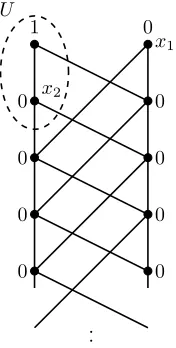
p→(q→p) in IPC with respect to the variablepis the formula¬¬p. We will use the characterization in Theorem 24 prove that¬¬pis not equivalent to a (∧,→ )-formula. Namely, if there were a (∧,→)-formulaϕequivalent to¬¬pis, then in particular the up-setU defined by the formula¬¬pin the 1-universal model of IPC (see figure 1 below) would be (∧,→)-definable. It thus suffices to show that
U is not (∧,→)-definable. To see this, note thatU(1)s= maxv(p)c ={x1, x2}, and these two points are bisimilar in U(1)s. Sincex2∈ U but x1 6∈U, U does not satisfy (3b) in Theorem 24, and is therefore not (∧,→)-definable.
We now also prove that the least (∧,→)-definable up-set ofU(1) containingU is
1 0
x1
0 x2 0
0 0
0 0
0 0
U
.
[image:17.612.264.352.118.292.2]..
Figure 1: The 1-universal model,U(1), also known as the Rieger-Nishimura ladder, withU(1)s={x
1, x2} andU =v(¬¬p).
5
Conclusions and future work
In this paper we studied the (∧,→)-fragment of intuitionistic logic via methods of duality theory. We gave an alternative proof of Diego’s theorem and characterized (∧,→)-definable up-sets of the n-universal model of intuitionistic logic, using duality as our main tool. Interestingly, we were able to directly use finite duality for distributive lattices and adjunction properties such as the Frobenius property (Lemma 15), without resorting to any of the existing dualities for implicative meet-semilattices. We expect that the techniques developed in Section 3 could be extended to the infinite setting in order to give a unified account of the different dualities that exist in the literature for implicative meet-semilattices, e.g., [3], [7] and [8]. We leave this as an interesting question for future work.
The characterization of (∧,→)-definable up-sets that we gave in Theorem 24 can be considered as a first step towards solving a complicated problem of charac-terizing all IPC-definable up-sets ofn-universal models. This problem is linked to the following interesting question. In [20] free Heyting algebras are described from free distributive lattices via step-by-step approximations of the operation
Acknowledgements
We are thankful to Mai Gehrke for many inspiring discussions on this paper.
References
1. Diego, A.: Sur les alg`ebres de Hilbert (transl. from the Spanish original by L. Iturrioz). Volume S´erie A 21 of Collection de Logique Math´ematique. Gauthier-Villars, Paris (1966)
2. Renardel de Lavalette, G.R., Hendriks, A., de Jongh, D.H.J.: Intuitionistic impli-cation without disjunction. J. Logic Comput.22(3) (2012) 375–404
3. K¨ohler, P.: Brouwerian semilattices. Trans. Amer. Math. Soc.268(1) (1981) 103– 126
4. de Jongh, D.: Investigations on the Intuitionistic Propositional Calculus. PhD thesis, University of Wisconsin (1968)
5. Bezhanishvili, N.: Lattices of intermediate and cylindric modal logics. Volume 2006-2 of ILLC Dissertation Series. ILLC, University of Amsterdam (2006) 6. Chagrov, A., Zakharyaschev, M.: Modal Logic. Volume 35 of Oxford Logic Guides.
Clarendon Press, Oxford (1997)
7. Bezhanishvili, G., Jansana, R.: Esakia Style Duality for Implicative Semilattices. Appl. Categ. Structures21(2013) 181–208
8. Bezhanishvili, G., Bezhanishvili, N.: An algebraic approach to canonical formulas: Intuitionistic case. Rev. Symb. Log.2(3) (2009) 517–549
9. Gehrke, M.: Canonical extensions, Esakia spaces, and universal models. In: to appear in: Leo Esakia on duality in modal and intuitionistic logics. Trends in Logic: Outstanding Contributions. Springer (2013) preprint available at http: //www.liafa.univ-paris-diderot.fr/~mgehrke/Ge12.pdf.
10. Davey, B.A., Priestley, H.A.: Introduction to Lattices and Order. 2nd edn. Cam-bridge University Press (May 2002)
11. Bezhanishvili, G., Gehrke, M., Mines, R., Morandi, P.J.: Profinite Completions and Canonical Extensions of Heyting Algebras. Order23(2006) 143–161 12. Yang, F.: Intuitionistic Subframe Formulas,N N IL-formulas, andn-universal
Mod-els. Volume 2008-12 of Master of Logic Thesis Series. ILLC, University of Amster-dam (2008)
13. Priestley, H.A.: Representation of distributive lattices by means of ordered Stone spaces. Bull. London Math. Soc.2(1970) 186–190
14. Esakia, L.L.: Topological Kripke models. Sov. Math. Dokl.15(1974) 147–151 15. Pitts, A.M.: Amalgamation and interpolation in the category of Heyting algebras.
J. Pure and Appl. Algebra (1983) 155–165
16. Bezhanishvili, G., Ghilardi, S.: An algebraic approach to subframe logics. Intu-itionistic case. Ann. Pure Appl. Logic147(1-2) (2007) 84–100
17. Visser, A., de Jongh, D., van Benthem, J., de Lavalette, G.R.: NNIL a study in intuitionistic logic. In Ponse, A., de Rijke, M., Venema, Y., eds.: Modal logics and Process Algebra: a bisimulation perspective. (1995) 289–326
18. Pitts, A.M.: On an Interpretation of Second Order Quantification in First Order Intuitionistic Propositional Logic. J. Symbolic Logic57(1) (1992) 33–52
20. Ghilardi, S.: Free Heyting algebras as bi-Heyting algebras. C. R. Math. Acad. Sci. Soc. R. CanadaXVI(6) (1992) 240–244
21. Bezhanishvili, N., Gehrke, M.: Finitely generated free Heyting algebras via Birkhoff duality and coalgebra. Log. Methods Comput. Sci.7(2) (2011) 1–24
22. Hendriks, A.: Computations in Propositional Logic. Volume 1996-01 of ILLC Dis-sertation Series. ILLC, University of Amsterdam (1996)