UNIVERSITI TEKNIKAL MALAYSIA MELAKA
ASSESSING A SYSTEM RELIABILITY: A CASE STUDY IN ARM
REAR AXLE ASSEMBLY
This report submitted in accordance with requirement of the Universiti Teknikal Malaysia Melaka (UTeM) for the Bachelor of Manufacturing Engineering
(Manufacturing Management) (Hons.)
by
NUR AWALIAH BINTI ABD RAHMAN B051110140
920706-10-6192
UNIVERSITI TEKNIKAL MALAYSIA
MELAKA
BORANG PENGESAHAN STATUS LAPORAN PROJEK SARJANA MUDA
TAJUK: Assessing a System Reliability: A Case Study in Arm Rear Axle Assembly
SESI PENGAJIAN: 2014/15 Semester 2
Saya NUR AWALIAH BINTI ABD RAHMAN
mengaku membenarkan Laporan PSM ini disimpan di Perpustakaan Universiti Teknikal Malaysia Melaka (UTeM) dengan syarat-syarat kegunaan seperti berikut:
1. Laporan PSM adalah hak milik Universiti Teknikal Malaysia Melaka dan penulis. 2. Perpustakaan Universiti Teknikal Malaysia Melaka dibenarkan membuat salinan
untuk tujuan pengajian sahaja dengan izin penulis.
3. Perpustakaan dibenarkan membuat salinan laporan PSM ini sebagai bahan pertukaran antara institusi pengajian tinggi.
4. **Sila tandakan ( )
SULIT
TERHAD
TIDAK TERHAD
(Mengandungi maklumat yang berdarjah keselamatan atau kepentingan Malaysia sebagaimana yang termaktub dalam AKTA RAHSIA RASMI 1972)
(Mengandungi maklumat TERHAD yang telah ditentukan oleh organisasi/badan di mana penyelidikan dijalankan)
Alamat Tetap:
NO.1 Jalan 6,
Taman Bukit Belimbing Indah,
45000 Kuala Selangor, Selangor.
Tarikh: ________________________
Disahkan oleh:
Cop Rasmi:
Tarikh: _______________________
DECLARATION
I hereby, declared this report entitled “Assessing A System Reliability: A Case Study in Arm Rear Axle Assembly” is the results of my own research as cited in references.
Signature : ……...
APPROVAL
This report is submitted to the Faculty of Manufacturing Engineering of UTeM as a partial fulfillment of the requirements for the degree of Bachelor of Manufacturing Engineering (Manufacturing Management) (Hons.). The member of the supervisory committee is as follow:
i
ABSTRACT
This study aims at assessing System Reliability in manufacturing industry. This takes place in the arm rear axle assembly of factory A. The problems arise when the workers need to do other works while waiting the robot to function again. The problem occurs when one of the robot frequently abruptly terminates during the process. Thus, the research was conducted to improve poor reliability of robots as well as the reliability of system.
ii
ABSTRAK
Kajian ini bertujuan untuk menilai Sistem Kebolehpercayaan dalam industri pembuatan. Ini berlaku di lengan pemasangan gandar belakang kilang A. Masalah timbul apabila pekerja perlu melakukan kerja-kerja lain sementara menunggu robot berfungsi semula. Masalah ini berlaku apabila salah satu robot yang sering tiba-tiba menamatkan semasa proses tersebut. Oleh itu, kajian ini dijalankan untuk meningkatkan kelemahan dari segi kebolehpercayaan robot dan kebolehpercayaan sistem.
iii
DEDICATION
I dedicated this research to my beloved family, lecturers and friends whose have
iv
ACKNOWLEDGEMENT
In the name of Allah, the most gracious, the most merciful, I would like to express my gratitude to the people who directly or indirectly involved during the preparation and after I successfully manage to complete this PSM project.
First and foremost, I would like to thank Prof Madya Dr. Rizal bin Saleh, (Dean of Faculty of Manufacturing Engineering) and special thank to my dedicated and committed PSM supervisor, Prof Madya Dr. Lukman Sukarma for his excellence guidance and encouragement. I also like to show my gratitude to the Mr. Nor Akramin B. Mohamad, Mr. Muhammad Syafiq B. Syed Mohamed, Dr. Effendi B. Mohamad, Dr. Isa B. Halim as PSM I and PSM II examiners, and all the PSM Committee for their fully support and commitment.
v
TABLE OF CONTENT
Abstrak i
Abstract ii
Dedication iii
Acknowledgement iv
Table of Content v
List of Table ix
List of Figures x
List Abbreviations, Symbols, and Nomenclature xii
1. INTRODUCTION 1
1.1 Background of the study 1
1.2 Problem Statement 3
1.3 Objectives 4
1.4 Scope of the study 5
1.5 Structure of Project 5
2. LITERATURE REVIEW 7
2.1 Manufacturing system 7
2.2 Machine configuration 8
2.2.1 Series configuration 9
vi
2.2.3 Combination of Series and Parallel 11
2.2.4 Complex System 12
2.3 Definition of reliability 12
2.4 Purposes of system reliability 15
2.5 Lifetime distribution 16
2.5.1 Exponential distribution 17
2.5.2 Weibull distribution 17
2.5.3 Normal distribution 18
2.6 Failure Analysis 19
2.6.1 Failure mode and effect analysis (FMEA) 20
2.6.2 Fault tree analysis (FTA) 20
3. METHODOLOGY 22
3.1 Flow chart of conducting the PSM I and PSM II 22
3.2 Phase 1 24
3.2.1 Define the problem statement 24
3.2.2 Establish Objective and scope 25
3.2.3 Literature review on related topic 25
3.2.4 Identify the system and method 25
3.3 Phase 2 26
3.3.1 Data Collection 26
3.3.2 Assess the distribution and evaluate the system 27
3.3.3 Analysis of result 27
vii
3.3.5 Conclusion and Recommendation 28
3.4 Methodology the objective of the study 28
3.4.1 Methodology for objective 1 28
3.4.1.1 Data Collection 29
3.4.1.2 Plot the distribution by Minitab software 30
3.4.1.3 Statistical data analysis 30
3.4.1.4 Make prediction on each robots’ lifetime 32
3.4.1.5 Measure and analyze the reliability system configuration 32
3.4.2 Methodology for objective 2 32
3.4.2.1 Classified the failure mode into individual failure modes 33
3.4.2.2 Identify the most critical individual failure mode 34
3.4.3 Methodology for objective 3 34
3.4.3.1 Further study regarding to avoid the failure 35
3.4.3.2 Make corrective action 35
4. RESULT AND DISCUSSION 36
4.1 Data of the time to failure 36
4.1.1 Historical data of welding robot 1 37
4.1.2 Historical data of welding robot 2 38
4.2 Choice of Distribution Model 39
4.2.1 Probability plot for time to failure 39
4.2.2 Distribution ID Plot 41
4.3 Parametric Distribution Analysis 42
4.4 Characteristic of distribution 47
viii
4.4.2 Survival Probabilities of Normal distribution 50
4.4.3 Statistical term 50
4.4.3.1 Reliability of each welding robot 51
4.4.3.2 Reliability of the system 52
4.5 The Parametric Distribution Analysis with multiple failure modes 53
4.5.1 Individual failure mode of welding robot 1 55
4.5.2 Probability plot of the individual failure modes 59
4.5.3 Table survival probabilities of individual failure mode 60
4.5.4 Interpretation of processing failure mode 62 5. CONCLUSION 65
REFERENCES
APPENDICES
A Gantt Chart for PSM 1 B Gantt Chart for PSM 2
ix
LISTS OF TABLES
4.1 The historical data of welding robot 1 37
4.2 The historical data of welding robot 2 38
4.3 The classification of failure modes 54
4.4 Verification of each causes of the failure 63
x
LIST OF FIGURES
1.1 Frequency number of repairs for six month (Month) 4
2.1 Configuration illustrating Product Layout 9
2.2 Active redundant system 10
2.3 The standby redundancy 11
2.4 k-out-of-m redundancy 11
2.5 Complex System 12
2.6 The life phase 14
3.1 Methodology flow chart 23
3.2 Methodology flow chart of objective 1 29
3.3 Example of Minitab Statistical Software Screen 30
3.4 The example of the distribution selection 31
3.5 Methodology flow chart of objective 2 33
3.6 Methodology flow chart of objective 3 34
4.1 The selection of distribution 39
4.2 Probability plot of graph from three distribution for welding robot 1 40 4.3 Probability plot of graph from three distribution for welding robot 2 40 4.4 The output of Goodness-of- Fit for welding robot 1 in the session window 41 4.5 The output of Goodness-of-Fit for welding robot 2 in the session window 41 4.6 Parameter distribution analysis 42 4.7 Probability plots for time to failure of welding robot 1 43 4.8 Table of percentiles of welding robot 1 44 4.9 Probability plot for time to failure of the welding robot 2 45
xi
4.11 Estimates Parameter of the welding robot 1 46
4.12 Estimates Parameter of the welding robot 2 47
4.13 Characteristic of distribution of the welding robot 1 48 4.14 Characteristic of distribution of the welding robot 2 48 4.15 Survival plot from characteristic of distribution of welding robot 1 49 4.16 Survival plot from characteristic of distribution of welding robot 2 49
4.17 The normal distribution 50
4.18 The mean value to obtain reliability welding robot 1 51 4.19 The mean value to obtain reliability welding robot 2 52 4.20 Table of survival probabilities of the welding robot 1 53 4.21 Table of survival probabilities of the welding robot 2 53
4.22 Failure mode column 55
4.23 The distribution analysis for equipment 56
4.24 The distribution analysis for man 57
4.25 The distribution analysis for processing 58
4.26 The probability plot of the individual failure modes 59 4.27 The table of survival probabilities for equipment 60
4.28 The table of survival probabilities for man 60
[image:15.595.112.517.79.530.2]xii
LIST OF ABBREVIATIONS
CMS - Continuous Manufacturing System CMS - Cellular Manufacturing System
WIP - Work-In-Progress
PDF - Probability Density Function CDF - Cumulative Distribution Function MTTR - Mean Time To Failure
MRL - Mean Residual Life
FMEA - Failure Modes and Effects Analysis FTA - Fault Tree Analysis
MTBF - Mean Time Between Failures PSM - Projek Sarjana Muda
ID - Individual Identification
ADJ - Anderson – Darling statistic value
ML - Maximum Likelihood
CI - Confidence Interval
IQR - Interquartile Range
Q1 - First Quartile
Q3 - Third Quartile
1
CHAPTER 1
INTRODUCTION
This chapter provides a review about the project entitled “Assessing a System Reliability: A Case Study in the Arm Rear Axle Assembly”. These include an overview of the concept and importance of a system reliability focusing in the system of arm rear axle assembly process. Background study, problem statements, objectives and scopes of this study are discussed in the following segments.
1.1 Background of the Study
2
Derivation the product probability law of series component was initiated during the analysis of the missile system by Robert Lusser. The theorem concerns about the overall systems functioning only if all the components are functioning and is valid under special assumptions. To make up the system, it reviews that the reliability of such system is equivalent to the product of the reliability of the individual components (Rausand and Hoyland, 2004a). From this situation, it explains that the production of the product in the system will stop and influence the quality of product as well due to the poor reliability of the machine. The reliability is measured by analyse the failure rate of machine and on how often does it fail during a certain amount of time.
The purpose of system reliability is to prevent failures that affect the operational capability of the system. According Jolly and Wadhwa (2004a), the consequences of the failure of a system were always considered in the term of ‘reliability’. Thus, the rate of failure or failure probability of machine in the system need to be measured during the data collection under specified time for customer requirements compliance. The system reliability is important to ensure that the failure probabilities are reduced and failure detection capability needs to be increased.
3
To assess a system reliability of this study, one entire process system in manufacturing plant of Factory A has been chosen. Factory A is a manufacturing industry that provides robotic and machinery to join and assembled metal automotive component.One process of the assembly system in factory A will be selected and the mapping of the welding robots in the system will be observed and measured. The assembly process of arm rear axle is chosen since the one of the welding robot in the system is frequently abruptly stop. This stoppage of the robot is due to unreliable robot being used in the entire process. Thus, the aim of this study is to assess the reliability of the system by applying statistical method. Based on the results of this assessment, this study will emerge with suggestions to improve the reliability of the system.
1.2 Problem statement
4
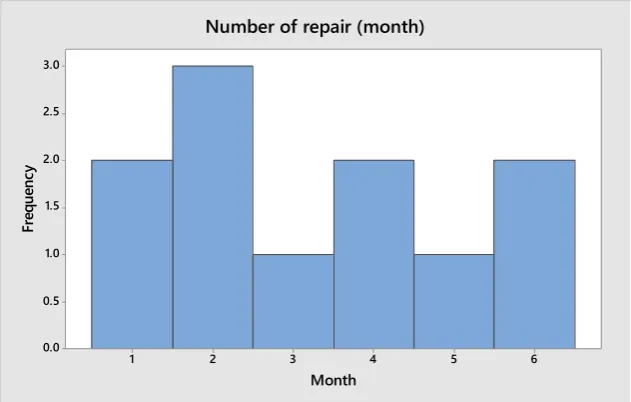
Figure 1.1: Frequency number of repairs for six month (Month)
This will effect the efficiency of the operation process and consequently reduce the overall performance of the system to assemble the arm rear axle. Thus, the series configuration of welding robots is identified through the flow of assembly process in the entire system. The two types of welding robots are conducted to assemble the metal automotive components which is the arm rear axle. Factory A has to maintain their robotic welding in highly reliable conditions in order to be able to struggle in a highly competitive global.
1.3 Objectives
a) To measure and assess the reliability of each machine as well as the reliability of the system under study.
b) To identify the causes of failures of the machine in a system that prevent a system from perform a required function.
c) To give suggestion for improvement of system reliability based on the identification of failure.
6 5 4 3 2 1 3.0 2.5 2.0 1.5 1.0 0.5 0.0 Month Fr eq ue nc y
[image:20.595.160.476.72.273.2]5
1.4 Scope of the study
This research is limited to one assembly system in the manufacturing plant of Factory A. Only the flow of the component assembly through the mapping of welding robots in that process system will be studied. The process of arm rear axle assembly is selected in this study which involve between two welding robots in series configuration. The life data analysis of each welding robot in the system is obtained. The lifetime distribution will be measured by using failure data in that process. The distribution will be studied using reliability prediction and modelling. Thus, the reliability of each robot needs to be improved to enhance the system’s safety, quality and operational availability.
1.5 Structure of Project
The organization for this thesis according to the format in Projek Sarjana Muda 1 and 2 stated as below:
Chapter 1: Introduction
This chapter includes the background of relevant topic, problem statement, objectives, scope and limitation.
Chapter 2: Literature review
6
Chapter 3: Methodology
This chapter states the flow chart that carried out for the whole process of the methodology. Next, the data collection that includes the primary resources and second resources that obtained from production department of factory A is shown to aid in the problem analysis. The analysis techniques and tools are also summarized in this chapter.
Chapter 4: Result and Discussion
This chapter covers the reliability system and each welding robot based on the chosen life data distribution. The statistical method and parameter estimation are applied to get the result. The system data are collected and analyzed to obtain the connection between quantified failure modes that affect the system reliability.
Chapter 5: Conclusion
7
CHAPTER 2
LITERATURE REVIEW
This chapter provides a review of the concepts machine configuration that related to the concept, definition, purposes of a system reliability assessment in manufacturing industry focusing in the production line. Besides, this chapter also defines and explains the failure and lifetime term of the component, machine and equipment in the system that tend to relate with the research study using statistical methods regarding to exponential, normal distribution and so on. The failure analysis also is explained in order to define the reliability prediction of the system as well.
2.1 Manufacturing system
Machineries is a very common word in manufacturing process, especially for higher rate of production output (Subramaniam et al., 2009). The machine capabilities are needed to produce products during production runs. Machinery investments are high and costly, therefore industries try to exploit their usage to maximize profit.
8
successfully or before it failed showed that the key factor in most of the performance systems is that reliability of machine (Sun et al., 2007a).
Li and Meerkov (2000) stated that the problem of production variability in manufacturing system is related to unreliable machine. Based on the Bernoulli statistics of machine reliability are assumed, unreliable production line also generate three problems which are the production variance, the constant demand satisfaction and the random demand satisfaction problems. These problems also are caused as the long lines smooth out of production and reduce its variability. Based on their study, the number of parts are produced by the system is a random variable due to machine breakdown during a fixed interval of time. This shows that its expected value and variances characterize the production volume and variability respectively. In general, the production variances only gives theoretical characterization of the production variability.
2.2 Machine configuration
The system-level reliability of a manufacturing system affected by the machine configuration selection as it gives a great impact on it. (Sun et al., 2007b). System-level reliability also is resulted from the unpredictable machine breakdown and improper maintenance decisions that affect the products quality and tools degradation.