This is a repository copy of Structure and algorithms for (cap, even hole)-free graphs.
White Rose Research Online URL for this paper:
http://eprints.whiterose.ac.uk/119116/
Version: Accepted Version
Article:
Cameron, K, Da Silva, MVG, Huang, S et al. (1 more author) (2018) Structure and
algorithms for (cap, even hole)-free graphs. Discrete Mathematics, 341 (2). pp. 463-473.
ISSN 0012-365X
https://doi.org/10.1016/j.disc.2017.09.013
© 2017 Elsevier B.V. This manuscript version is made available under the CC-BY-NC-ND
4.0 license http://creativecommons.org/licenses/by-nc-nd/4.0/
[email protected] https://eprints.whiterose.ac.uk/ Reuse
This article is distributed under the terms of the Creative Commons Attribution-NonCommercial-NoDerivs (CC BY-NC-ND) licence. This licence only allows you to download this work and share it with others as long as you credit the authors, but you can’t change the article in any way or use it commercially. More
information and the full terms of the licence here: https://creativecommons.org/licenses/
Takedown
If you consider content in White Rose Research Online to be in breach of UK law, please notify us by
Structure and algorithms for (cap, even hole)-free graphs
Kathie Cameron∗ Murilo V. G. da Silva† Shenwei Huang‡ Kristina Vuˇskovi´c§
July 15, 2017
Abstract
A graph is even-hole-free if it has no induced even cycles of length 4 or more. A cap is a cycle of length at least 5 with exactly one chord and that chord creates a triangle with the cycle. In this paper, we consider (cap, even hole)-free graphs, and more generally, (cap, 4-hole)-free odd-signable graphs. We give an explicit construction of these graphs. We prove that every such graphGhas a vertex of degree at most 3
2ω(G)−1, and hence
χ(G)≤ 3
2ω(G), where ω(G) denotes the size of a largest clique inG and χ(G) denotes
the chromatic number ofG. We give anO(nm) algorithm forq-coloring these graphs for fixedqand anO(nm) algorithm for maximum weight stable set, wherenis the number of vertices andmis the number of edges of the input graph. We also give a polynomial-time algorithm for minimum coloring.
Our algorithms are based on our results that triangle-free odd-signable graphs have treewidth at most 5 and thus have clique-width at most 48, and that (cap, 4-hole)-free odd-signable graphs G without clique cutsets have treewidth at most 6ω(G)−1 and clique-width at most 48.
Keywords: even-hole-free graph, structure theorem, decomposition, combinatorial optimiza-tion, coloring, maximum weight stable set, treewidth, clique-width
1
Introduction
In this paper all graphs are finite and simple. We say that a graphGcontainsa graphF, ifF
is isomorphic to an induced subgraph ofG. A graphGisF-freeif it does not containF, and for a family of graphsF,GisF-freeifGisF-free for everyF ∈ F. Aholeis a chordless cycle of length at least four. A hole iseven (respectively,odd) if it has an even (respectively, odd)
∗Department of Mathematics, Wilfrid Laurier University, Waterloo, ON, Canada, N2L 3C5. Research
supported by the Natural Sciences and Engineering Research Council of Canada (grant RGPIN-2016-06517).
†Department of Computer Science, Federal University of Technology-Paran´a, Curitiba, Brazil.
‡School of Computer Science and Engineering, University of New South Wales, Sydney, NSW 2052,
Aus-tralia.
§School of Computing, University of Leeds, Leeds LS2 9JT, UK; and Faculty of Computer Science (RAF),
number of vertices. Acapis a graph that consists of a holeH and a vertexxthat has exactly two neighbors in H, that are furthermore adjacent. The graphCn is a hole of lengthn, and
is also called an n-hole. In this paper we study the class of (cap, even hole)-free graphs, and more generally the class of (cap, 4-hole)-free odd-signable graphs, which we define later.
Let Gbe a graph. We usen to denote the number of vertices ofGand mthe number of edges ofG. A setS ⊆V(G) is a cliqueofGif all pairs of vertices ofS are adjacent. The size of a largest clique in a graphGis denoted byω(G), and is sometimes called theclique number
of G. We say that Gis acomplete graphifV(G) is a clique. We denote byKnthe complete
graph on n vertices. The graph K3 is also called a triangle. A set S ⊆V(G) is a stable set
of G if no two vertices of S are adjacent. The size of a largest stable set of G is denoted by α(G). A q-coloring of G is a function c:V(G) −→ {1, . . . , q}, such that c(u) 6=c(v) for every edge uv of G. The chromatic number of a graphG, denoted by χ(G), is the minimum number q for which there exists aq-coloring of G.
The class of (cap, odd hole)-free graphs has been studied extensively in literature. This is precisely the class of Meyniel graphs, where a graphGisMeynielif every odd length cycle of G, that is not a triangle, has at least two chords. These graphs were proven to be perfect by Meyniel [30] and Markosyan and Karapetyan [28]. Burlet and Fonlupt [5] obtained the first polynomial-time recognition algorithm for Meyniel graphs, by decomposing these graphs with amalgams (that they introduced in the same paper). Subsequently, Roussel and Rusu [33] obtained a faster algorithm for recognizing Meyniel graphs (of complexityO(m2)), that is not decomposition-based. Hertz [23] gave anO(nm) algorithm for coloring and obtaining a largest clique of a Meyniel graph. This algorithm is based on contractions of even pairs. It is an improvement on the O(n8) algorithm of Ho`ang [24]. Roussel and Rusu [34] gave an O(n2) algorithm that colors a Meyniel graph without using even pairs. This algorithm “simulates” even pair contractions and it is based on lexicographic breadth-first search and greedy sequential coloring.
Algorithms have also been given which find a minimum coloring of a Meyniel graph, but do not require that the input graph be known to be Meyniel. A Meyniel obstruction is an induced subgraph which is an odd cycle with at most one chord. Astrong stable setin a graph
G is a stable set which intersects every (inclusion-wise) maximal clique of G. Cameron and Edmonds [6] gave anO(n2) algorithm which for any graph, finds either a strong stable set or a Meyniel obstruction. This algorithm can be applied at mostntimes to find, in any graph, either a clique and coloring of the same size or a Meyniel obstruction. Cameron, L´evˆeque and Maffray [7] showed that a variant of the Roussel-Rusu coloring algorithm for Meyniel graphs [34] can be enhanced to find, for any input graph, either a clique and coloring of the same size or a Meyniel obstruction. The worst-case complexity of the algorithm is still O(n2).
non-polyhedral algorithm for the maximum weight stable set problem for Meyniel graphs. Furthermore, using the decomposition theorems from [11] and [12], they obtain a polynomial-time algorithm for solving the maximum weight stable set problem for (cap, even hole)-free graphs (and more generally cap-free odd-signable graphs). For a survey on even-hole-free graphs and odd-signable graphs, see [40].
Aboulker, Charbit, Trotignon and Vuˇskovi´c [1] gave an O(nm)-time algorithm whose input is a weighted graph G and whose output is a maximum weighted clique of G or a certificate proving that G is not 4-hole-free odd-signable. (The crux of this algorithm was actually developed by da Silva and Vuˇskovi´c in [20].)
In Section 3, we give an explicit construction of (cap, 4-hole)-free odd-signable graphs, based on [11] and [12]. From this, in Section 4, we derive that every such graph G has a vertex of degree at most 32ω(G)−1, and hence χ(G) ≤ 32ω(G). It follows that G can be colored with at most 32ω(G) colors using the greedy coloring algorithm.
In Section 5, we prove that triangle-free odd-signable graphs have treewidth at most 5 and thus have clique-width at most 48 [15]. We also prove that (cap, 4-hole)-free odd-signable graphsGwithout clique cutsets have clique-width at most 48 and treewidth at most 6ω(G)−1.
In Section 6, we give an O(nm) algorithm for q-coloring (cap, 4-hole)-free odd-signable graphs. We give a (first known) polynomial-time algorithm for finding a minimum coloring of these graphs (chromatic number). We also obtain anO(nm) algorithm for the maximum weight stable set problem for (cap, 4-hole)-free odd-signable graphs. We observe that the algorithm in [14] proceeds by first decomposing the graph by amalgams, a step that takes
O(n4m) time (O(n2m) to find an amalgam [16], which is called O(n2) times) and creates
O(n2) blocks. For each block, O(n) maximum weight stable set problems must be solved, each of which can be done inO(n+m) time. Thus the overall complexity of their algorithm isO(n4m). Finally, we observe that all our algorithms are robust in the sense that we do not need to assume that the input graph is (cap, 4-hole)-free odd-signable.
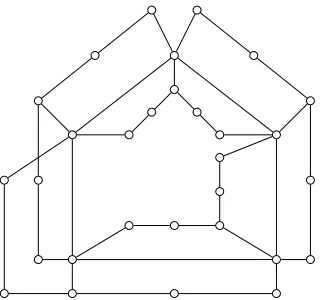
It is known that planar even-hole-free graphs have treewidth at most 49 [35]. We observe that (cap, even hole)-free graphs are not necessarily planar. It is not hard to check that the graph in Figure 1 is (triangle, even hole)-free and has aK5-minor.
The complexity of the stable set problem and of the coloring problem remain open for even-hole-free graphs.
2
Odd-signable graphs
Wesigna graph by assigning 0,1 weights to its edges. A graph isodd-signableif there exists a signing that makes the sum of the weights in every chordless cycle (including triangles) odd. Even-hole-free graphs are clearly odd-signable: assign weight 1 to each edge. To characterize odd-signable graphs in terms of excluded induced subgraphs, we now introduce two types of
3-path configurations(3P C’s) and even wheels.
Figure 1: A (triangle even hole)-free graph that has aK5-minor.
Let x1, x2, x3, y1, y2, y3 be six distinct vertices ofGsuch that{x1, x2, x3}and {y1, y2, y3}
induce triangles. A 3P C(x1x2x3, y1y2y3) is a graph induced by three chordless paths P1 =
x1, . . . , y1, P2 = x2, . . . , y2 and P3 = x3, . . . , y3, such that any two of them induce a hole.
We say that a graphG contains a 3P C(∆,∆) if it contains a 3P C(x1x2x3, y1y2y3) for some
x1, x2, x3, y1, y2, y3 ∈V(G). The 3P C(∆,∆)’s are also known as prisms.
Awheel, denoted by (H, x), is a graph induced by a holeHand a vertexx6∈V(H) having at least three neighbors inH, sayx1, . . . , xr. A subpath ofHconnectingxiandxj is asector
if it contains no intermediate vertex xl, 1 ≤l ≤r. A wheel (H, x) is even if it has an even
number of sectors.
It is easy to see that even wheels, thetas and prisms cannot be contained in even-hole-free graphs. In fact they cannot be contained in odd-signable graphs. The following characteriza-tion of odd-signable graphs states that the converse also holds, and it is an easy consequence of a theorem of Truemper [39].
Theorem 2.1 ([11])A graph is odd-signable if and only if it does not contain an even wheel, a theta or a prism.
3
Construction of (cap, 4-hole)-free odd-signable graphs
LetG be a graph andS ⊆V(G). The subgraph of Ginduced by S is denoted by G[S], and
G\S=G[V(G)\S]. We say thatS is a vertex cutsetof GifG\S is disconnected. Aclique cutset of G is a vertex cutset that is a clique of G. Note that an empty set is a clique, and hence every disconnected graph has a clique cutset. An graph with no clique cutset is called an atom.
LetG= (V, E) be a graph andK ⊆V a clique cutset such that G\K is a disjoint union of two subgraphsH1and H2 ofG. We letGibe the subgraph ofGinduced by V(Hi)∪Kfor i= 1,2. We say thatG is decomposed into G1 and G2 via K, and call this a decomposition
step. We then recursively decompose G1 and G2 via clique cutsets until no clique cutset
exists. This procedure can be represented by a rooted binary tree TG where G is the root
ofG). Tarjan [37] showed that for any graphG,TGcan be found inO(nm) time. Moreover,
in each decomposition step Tarjan’s algorithm produces an atom, and consequently TG has
at mostn−1 leaves (or equivalently atoms).
LetA andB be disjoint subsets of vertices of a graphG. We say thatA iscompletetoB
if every vertex ofAis adjacent to every vertex of B, and Aisanticomplete toB if no vertex of A is adjacent to a vertex of B. A vertex which is adjacent to all other vertices is called
universal.
A connected graph Ghas an amalgam(V1, V2, A1, A2, K) if the following hold:
• V(G) =V1∪V2∪K, where V1, V2 andK are disjoint sets, and |V1| ≥2, |V2| ≥2.
• K is a (possibly empty) clique of G.
• Fori= 1,2,∅ 6=Ai⊆Vi.
• A1 is complete to A2, and these are the only edges with one end in V1 and the other in
V2.
• K is complete toA1∪A2(note that vertices ofK may have other neighbors inV1∪V2).
A graph is chordal if it is hole-free. A graph is 2-connected if it has at least 3 vertices and remains connected whenever fewer than 2 vertices are removed. A basic cap-free graph G is either a chordal graph or a 2-connected triangle-free graph together with at most one additional vertex, that is adjacent to all other vertices ofG.
Theorem 3.1 ([11]) A connected cap-free graph that is not basic has an amalgam.
A module (or homogeneous set) in a graph G is a set M ⊆V(G), such that 2 ≤ |M| ≤ |V(G)| −1 and every vertex of V(G)\M is either adjacent to all of M or none ofM. Note that a module with 2 ≤ |M| ≤ |V(G)| −2 (i.e. a proper module) is a special case of an amalgam. Aclique module is a module that induces a clique.
Let G be a 4-hole-free graph and (V1, V2, A1, A2, K) an amalgam of G. Without loss of
generality we may assume thatA1 induces a clique, and hence eitherA1∪K is a clique cutset or A1 is a proper clique module. So, Theorem 3.1 particularized to 4-hole-free graphs, and
the well-known fact that every chordal graph that is not a clique has a clique cutset, gives the following decomposition.
Theorem 3.2 If G is (cap, 4-hole)-free graph, then eitherG has a clique cutset or a proper clique module, or G is a complete graph or a (triangle, 4-hole)-free graph together with at most one additional vertex that is adjacent to all other vertices of G.
We now give a complete structural description of (cap, 4-hole)-free graphs that do not have a clique cutset, by considering the proof of Theorem 3.1 from [11] particularized to 4-hole-free graphs.
An expanded hole consists of nonempty disjoint sets of vertices S1, . . . , Sk, k≥4, not all
singletons, such that for all 1 ≤i≤ k, the graphs G[Si] are connected and, for i6=j, Si is
complete to Sj if j = i+ 1 or j = i−1 (modulo k), and anticomplete otherwise. We also
a clique for every i= 1, . . . , k. The following statement can be extracted from the proofs of Lemma 5.1 and Theorem 7.1 in [11].
Lemma 3.3 Let G be a (cap, 4-hole)-free graph. Suppose that S =∪k
i=1Si is an inclusion-wise maximal expanded hole of G such that |S2| ≥2. Let U be the set of vertices of G that
are complete to S. Then G has an amalgam(V1, V2, A1, A2, K) where S2 =A2 and K ⊆U.
In particular, either K∪S2 is a clique cutset or S2 is a proper clique module.
Let M be a proper clique module of a graph G. The block of decomposition of G with respect to M is the graph G′ = G\(M \ {u}), where u is any vertex of M. For a graph
G and a vertex u of G, we denote NG(u) (or N(u) when clear from context) by the set of
neighbors ofu inG. Also N[u] =N(u)∪ {u}. The degreedG(u) of u is|NG(u)|.
Lemma 3.4 Let M be a proper clique module of a graph G, and let G′ be the block of decomposition with respect to this module. If G does not have a clique cutset, then G′ does not have a clique cutset.
Proof: SupposeK is a clique cutset ofG′. Let u be the vertex ofM that is inG′. If u6∈K
thenNG′(u)\K is in the same connected component ofG′\K asu, and henceK is a clique
cutset of G. Ifu∈K thenM∪K is a clique cutset of G. 2
Theorem 3.5 Let G be a (cap, 4-hole)-free graph that contains a hole. Let F be a maximal vertex subset of V(G) that induces a 2-connected triangle-free graph, U the set of vertices of V(G)\F that are complete to F, D the set of vertices of V(G)\F that have at least two neighbors in F but are not complete to F, andS =V(G)\(F∪U∪D). Then the following hold:
(i) U is a clique.
(ii) U is complete toD∪F.
(iii) If G does not have a clique cutset, then for every d∈D, there is a vertex u ∈F and D′ ⊆D that contains d such that D′∪ {u} is a clique module of G. In particular, for every d′∈D′, N[d′] =N[u].
(iv) If G does not have a clique cutset, then S=∅.
(v) If G does not have a clique cutset,F does not have a clique cutset.
Proof: SinceGis 4-hole-free andF contains nonadjacent vertices, clearlyU must be a clique, and hence (i) holds.
Claim: For every d∈D, G[F]contains a hole H such that G[V(H)∪ {d}] is an expanded hole of G.
G is cap-free and we are assuming that G[V(H)∪ {d}] is not an expanded hole, it follows thatdis complete toV(H). LetF′ be a maximal subset ofF such thatG[F′] containsH, is 2-connected anddis complete toF′. SinceF 6=F′ and bothG[F] andG[F′] are 2-connected, somez∈F\F′belongs to a holeH′ that contains an edge ofG[F′]. As before, it follows that
dis complete to V(H′), and hence F′∪V(H′) contradicts the choice of F′. This completes the proof of the Claim.
By the Claim, every vertex d of D has two nonadjacent neighbors in F, and since G is 4-hole-free, it follows that every vertex ofU is adjacent tod. Therefore, (ii) holds.
Now suppose thatGdoes not contain a clique cutset. By the Claim and Lemma 3.3, (iii) holds. Let D′∪ {u} be a proper clique module from (iii). Then the block of decomposition with respect to this module is the graphG\D′. So by performing a sequence of clique module decompositions, we get the graph G′ = G\D. By Lemma 3.4, G′ does not have a clique cutset. Suppose thatS 6=∅. Note that every vertex inS has at most one neighbor in F. Let
C be a connected component ofG[S]. By the maximality ofF, there is at most one vertex in F, say y, that has a neighbor in C. So U ∪ {y} is a clique cutset ofG′, a contradiction. If no component of G[S] is adjacent to a vertex of F, then U is a clique cutset of G′, a contradiction. Therefore, (iv) holds. Finally, suppose thatF has a clique cutsetK. Then by (i) and (iv),K∪U is a clique cutset of G′, a contradiction. Therefore, (v) holds. 2
We say that the graph G′ is obtained from a graph G by blowing up vertices of G into cliques if G′ consists of the disjoint union of cliques Ku, for every u ∈ V(G), and all edges
between cliquesKu and Kv if and only ifuv∈E(G). This is also referred to as substituting
clique Ku for vertex u (for all u). The graph G′ is obtained from a graph G by adding a universal cliqueif G′ consists ofG together with (a possibly empty) clique K, and all edges between vertices of K and vertices of G. Note that both of these operations preserve being (cap, 4-hole)-free, i.e.,G is (cap, 4-hole)-free if and only ifG′ is (cap, 4-hole)-free.
Theorem 3.6 Let G be a (cap, 4-hole)-free graph that contains a hole and has no clique cutset. Let F be any maximal induced subgraph ofG with at least 3 vertices that is triangle-free and has no clique cutset. Then G is obtained from F by first blowing up vertices of F into cliques, and then adding a universal clique. Furthermore, any graph obtained by this sequence of operations starting from a (triangle, 4-hole)-free graph with at least 3 vertices and no clique cutset is (cap, 4-hole)-free and has no clique cutset.
Proof: Let F′ be a maximal 2-connected triangle-free induced subgraph of G that contains
F. By Theorem 3.5 (v), F′ does not have a clique cutset, and hence F′ = F. So the first statement follows from Theorem 3.5. The second statement follows from an easy observation that blowing up vertices into cliques and adding a universal clique preserves being (cap, 4-hole)-free and having no clique cutset. 2
Triangle-free odd-signable graphs were studied in [12] where the following construction was obtained. A chordless xz-path P is an ear of a hole H contained in a graph G if
V(P)\ {x, z} ⊆ V(G)\V(H), vertices x, z ∈ V(H) have a common neighbor y in H, and (V(H)\ {y})∪V(P) induces a holeH′inG. The verticesxandzare theattachmentsofP in
from a graph G′ by an ear addition if the vertices ofG\G′ are the intermediate vertices of an ear of some hole H inG′, say an earP with attachmentsx and zinH, and the graphG
contains no edge connecting a vertex ofV(P)\ {x, z}to a vertex ofV(G′)\ {x, y, z}, where
y∈V(H) is adjacent to x andz. An ear addition is goodif
• y has an odd number of neighbors inP,
• G′ contains no wheel (H1, v), wherex, y, z ∈V(H1) and v is adjacent to y, and
• G′ contains no wheel (H2, y), wherex, z are neighbors of y inH2.
The complete bipartite graph K4,4 with a perfect matching removed is called the cube.
Note that the cube contains 4-holes.
Theorem 3.7 (Theorem 6.4 in [12]) Let G be a triangle-free graph with at least three vertices that is not the cube and has no clique cutset. Then, G is odd-signable if and only if it can be obtained, starting from a hole, by a sequence of good ear additions.
4
Bound on the chromatic number
It is well-known that the class of (triangle, 4-hole)-free graphs has unbounded chromatic number [25]. In [29] it is shown that (triangle, even hole)-free graphs have a vertex of degree at most 2. We now show that (triangle, 4-hole)-free odd-signable graphs that contain at least one edge have an edge whose ends each have degree at most 2. This will imply that every (cap, 4-hole)-free odd-signable graph (and in particular every (cap, even hole)-free graph)G
has a vertex of degree at most 32ω(G)−1, and hence that every graph in this class has a proper coloring that uses at most 32ω(G) colors.
Theorem 4.1 Every (cap, 4-hole)-free odd-signable graph G has a vertex of degree at most
3
2ω(G)−1.
Proof: Given a graph G, let us say that a vertex v of G is nice if its degree is at most
3
2ω(G)−1. We prove that if G is a (cap, 4-hole)-free odd-signable graph, then either G is
complete or it has at least two nonadjacent nice vertices. Assume that this does not hold and let Gbe a minimum counterexample.
Suppose that G has a clique cutsetK. Let C1, . . . , Ck be the connected components of G\K, and fori= 1, . . . , k, let Gi =G[Ci∪K]. Since Gis a minimum counterexample, for
every i, Gi is either a complete graph or it has at least two nonadjacent nice vertices. So
there is a vertexvi ∈Ci that is nice in Gi, and hence inG as well. But thenG has at least
two nonadjacent nice vertices, a contradiction. Therefore,G does not have a clique cutset. This also implies that G cannot be chordal, since every chordal graph is either complete or has a clique cutset. So, G contains a hole. Let F be a maximal induced subgraph of G
that is triangle-free and has no clique cutset. By Theorem 3.6, G is obtained from F by blowing up vertices of F into cliques and adding a universal clique U. Note that if a vertex
Claim: If u1, u, v, v1 is a path of F such thatu and v are each of degree 2 inF, then u or v
is nice in G.
Proof of the Claim: Since|Ku|+|Kv| ≤ω(G), we may assume that|Ku| ≤ 12ω(G). But then dG(v) =|Ku|+|Kv| −1 +|Kv1| ≤
3
2ω(G)−1. This completes the proof of the Claim.
By Theorem 3.7 we consider the last ear P in the construction ofF. Say thatP is an ear of hole H and its attachments inH arex and z. Let y be the common neighbor of x and z
inH. Since P is a good ear, y has an odd number of neighbors in P. Let y1, . . . , yk be the
neighbors ofy inP in the order when traversingP fromxtoz (soy1=x andyk=z). Since F is (triangle, 4-hole)-free, both they1y2-subpath of P and theyk−1yk-subpath ofP contain
an edge whose ends are each of degree 2. It then follows by the Claim that G has at least two nonadjacent nice vertices, a contradiction. 2
Corollary 4.2 If G is a (cap, 4-hole)-free odd-signable graph, then χ(G)≤ 32ω(G).
Proof: It follows immediately from Theorem 4.1. 2
Theorem 4.1 immediately gives a 32-approximation algorithm for coloring (cap, 4-hole)-free odd-signable graphs. The algorithm greedily colors a particular ordering of vertices
v1, v2, . . . , vn, where vi is a vertex of minimum degree in G[v1, . . . , vi]. It is clear that this
ordering of vertices can be found in O(n2) time. Therefore, Theorem 4.1 ensures that the greedy algorithm properly colors the graph using at most 32ω(G) colors in O(n2) time.
5
Treewidth and clique-width
AtriangulationT(G) of a graphGis obtained fromGby adding edges until no holes remain. Clearly,T(G) is a chordal graph on the same vertex set as G which contains all edges of G. The treewidth of a graph G is the minimum of ω(T(G))−1 over all triangulations T(G) of
G. Treewidth k is equivalent to having a tree decomposition of width k, which is generally used in algorithms. Bodlaender [3] gave an algorithm which for fixedk, recognizes graphs of treewidth at mostk, and constructs a width ktree decomposition; the algorithm is linear in
n=|V(G)|but exponential in k.
The clique-width of a graph G is the minimum number of labels required to constructG
using the following four operations: creating a new vertex with label i, joining each vertex with label i to each vertex with label j, changing the label of every vertex labelled i to
j, and taking the disjoint union of two labelled graphs. A sequence of these operations which constructs the graph using at most k labels is called a k-expression or clique-width k-expression.
Treewidth and clique-width have similar algorithmic implications. Problems that can be expressed in monadic second-order logic M SO2 can be solved in linear time for any class of
graphs with treewidth at most k [17]. Problems that can be expressed in the subset M SO1
of M SO2 which does not allow quantification over edge-sets can be solved in linear time for
using clique-width require a k-expression as part of the input. This latter requirement was removed by Oum and Seymour [32] and then more efficiently by Oum [31], who gave anO(n3) algorithm which, for any input graph and fixed integer k, finds a clique-width 8k-expression
or states that the clique-width is greater than k.
Corneil and Rotics [15] improved a result of Courcelle and Olariu [19] to show that the clique-width of a graphGis at most 3×2tw(G)−1. Further, they construct, in polynomial time,
a k-expression of the stated size. Espelage, Gurski, and Wanke [21] gave an algorithm that takes as input a tree decomposition with widthk, and gives a clique-width 2O(k)-expression
[21] in linear time.
A chord of a cycle is called shortif it creates a triangle with the cycle.
Theorem 5.1 Every triangle-free odd-signable graph has treewidth at most 5.
Proof: LetG∗ be a triangle-free odd-signable graph. Apply the clique cutset decomposition algorithm to decompose G∗ into atoms. We will show that each atom is contained in a chordal graph that has clique number at most 6. Gluing these chordal graphs together along the clique cutsets used to decompose G∗ gives a chordal graph containing G∗ with clique number at most 6, and this proves the theorem.
It is easy to check that the cube is contained in a chordal graph with clique number 4. So we may assume that an atomGhas at least 3 vertices and is not the cube. Then by Theorem 3.7, Gcan be obtained from a holeH by a sequence of good ear additions. LetP1, . . . , Pq be
the sequence of ears in the construction, withPq being the last ear added. For eachi, letHi
be the holePi is attached to, let xi and zi be the attachments of Pi inHi, and letyi be the
common neighbor ofxi and zi inHi.
We now obtain a triangulation T of G with clique number at most 6. We construct
T as follows. For each ear Pi, make xi, yi and zi complete to Pi \ {xi, zi}, and add the
edge xizi. Call the edges xizi type 1 edges. Choose any edge uv of H, and join u and v
to all the vertices of H \ {u, v}; call these type 2 edges. For each i, let Si = {xi, yi, zi}, Gi=G[V(H)∪V(P1)∪ · · · ∪V(Pi)] andTi =T[V(H)∪V(P1)∪ · · · ∪V(Pi)].
Claim 1: For 1≤j≤q, Sj is a clique cutset in T that separatesHj\Sj from Pj \Sj.
Proof of Claim 1: To prove the claim we prove by induction on i the following state-ment: for 1≤j≤i≤q, Sj is a cutset in Ti that separatesHj\Sj from Pj \Sj.
By construction, the statement clearly holds fori= 1. Leti >1, and inductively assume that for 1≤j≤i−1,Sj is a cutset inTi−1that separates Hj\Sj fromPj\Sj. Suppose that
for some j≤i,Sj is not a cutset inTi that separates Hj\Sj fromPj\Sj. Then clearly (by
construction), j ≤ i−1. By the induction hypothesis, Sj is a cutset in Ti−1 that separates
Hj\Sj from Pj\Sj. Let CHj (respectively, CPj) be the connected component of Ti−1\Sj
that contains Hj\Sj (respectively, Pj\Sj). Then, without loss of generality,xi∈CHj and
zi∈CPj. SinceHi is a hole ofGi−1 that containsxi andzi, andSj is a cutset inGi−1 which
separates xi and zi, and yj is adjacent to xj and zj, it follows that Hi∩Sj ={xj, zj}. So,
without loss of generality, yi =xj. But then since Hi∪ {yj}cannot induce a theta in Gi−1,
(Hi, yj) is a wheel in Gi−1, which contradicts the fact that Pi is a good ear. This completes
Claim 2: T is chordal andω(T)≤6.
Proof of Claim 2: By Claim 1, it suffices to show that T[H], and, for 1 ≤ i ≤ q,
T[V(Pi)∪ {yi}] are all chordal and have clique number at most 6. Let G0 = G[H], and
observe that,
(*) since G is triangle-free, for every 1 ≤i≤q, every interior vertex of Pi has at most one
neighbor inGi−1.
Let H = v1, . . . , vk, v1, and without loss of generality we assume that u = v1 and v =
v2. Suppose C is a hole contained in T[H]. Since, by construction, {u, v} is complete to
V(H)\ {u, v}, V(C)∩ {u, v} =∅. Let vi be the smallest-indexed vertex of C. Soi≥3. It
follows that the edges of C are either edges of H or are of type 1 and hence, by the above observation (*), are short chords of H. It follows by the choice of vi that vi+1 and vi+2 are
the neighbors ofvi inC. But thenvi+1vi+2 is a chord ofC, a contradiction. ThereforeT[H]
is chordal. Since the edges of T[V(H)\ {u, v}] are either edges of H or short chords of H,
ω(T[V(H)\ {u, v}])≤3, and hence ω(T[V(H)])≤5.
Now consider an earPi. Suppose thatT[V(Pi)∪{yi}] contains a holeC. By construction, Si is a clique ofT[V(Pi)∪ {yi}] that is complete toV(Pi)\ {xi, zi}, and henceV(C)∩Si =∅.
So V(C)⊆V(Pi)\ {xi, zi}. Recall that Pi is a chordless path in G, and that every edge of T[V(Pi)\ {xi, zi}] that is not an edge of Pi is of type 1. Letxjzj be such a type 1 edge, and
suppose that yj is not a vertex of Pi. Then j > i. By the above observation (*),yj cannot
be an interior vertex of Pk where k > i. So yj is a vertex of Gi−1, and since the only vertex
of Gi−1 that can be adjacent in Gi to two interior vertices ofPi is yi, it follows thatyj =yi.
LetH′ be the hole obtained by augmentingHi withPi. Then the wheel (H′, yj) is contained
inGj−1 and contradictsPj being a good ear. Thereforeyj ∈V(Pi), and so every type 1 edge
ofT[V(Pi)\ {xi, zi}] is a short chord ofPi. This contradicts the assumption thatC is a hole
of T[V(Pi)\ {xi, zi}]. Hence,T[V(Pi)∪ {yi}] is chordal. SinceT[V(Pi)\ {xi, zi}] consists of
edges of Pi and short chords ofPi, it follows that ω(T[V(Pi)\ {xi, zi}]) ≤3, and therefore ω([V(Pi)∪ {yi}])≤6. This completes the proof of Claim 2.
By Claim 2, it follows that there is a triangulation of G∗ with clique number at most 6, and hence the treewidth of G∗ is at most 5. 2
As mentioned above, Corneil and Rotics [15] proved that the clique-width of a graph G
is at most 3×2tw(G)−1, and so the following is a direct corollary of Theorem 5.1.
Corollary 5.2 Triangle-free odd-signable graphs have clique-width at most 48.
Theorem 5.3 If Gis (cap, 4-hole)-free odd-signable graph with no clique cutset, thenG has clique-width at most 48.
Proof: LetG be a (cap, 4-hole)-free odd-signable graph with no clique cutset. LetU be the set of universal vertices. We may assume that G\U contains a hole, since otherwiseG\U
is a clique and so its clique-width is 2. Let F be a maximal induced subgraph of G\U
of a graph G1 gives a graph with clique-width at most the maximum of the clique-widths
of G1 and G2 [19], [22]. A clique of size at least 2 has clique-width 2. Thus it follows that
G\U has clique-width at most 48. Adding a universal vertex to a graph with at least one edge does not change the clique-width. Thus Ghas clique-width at most 48. 2
Theorem 5.4 If G is a (cap, 4-hole)-free odd-signable graph with no clique cutset, then G has treewidth at most 6ω(G)−1.
Proof: Let G be a (cap, 4-hole)-free odd-signable graph with no clique cutset. We may assume that G contains a hole, since otherwise G is a clique and so the treewidth of G is
|V(G)| −1 = ω(G)−1. Let U be the set of universal vertices of G, and note that G\U
has no clique cutset. Let F be a maximal induced subgraph of G\U that is triangle-free and has no clique cutset. By Theorem 3.6, G\U is obtained from F by, for each vertexv, substituting a clique Kv. Since F is triangle-free odd-signable, it follows from Theorem 5.1
that the treewidth ofF is at most 5. In particular, there is a triangulationT ofF with clique number at most 6. We can obtain a triangulationT′ ofG\U by substituting the cliquesKv
for the verticesvof T. Each of these cliquesKv has size at most ω(G)− |U|, so the size of a
largest clique in T′ is at most 6(ω(G)− |U|). We obtain a triangulation T′′ of G by adding toT′ the cliqueU and joining every vertex of U to every vertex of T′. The largest clique in
T′′ has size at most 6(ω(G)− |U|) +|U|= 6ω(G)−5|U| ≤6ω(G). ThusG has treewidth at
most 6ω(G)−1. 2
6
Algorithms for coloring and maximum weight stable set
In this section, we give polynomial-time algorithms for maximum weight stable set,q-coloring (that is, coloring with a fixed numberq of colors), and chromatic number restricted to (cap, 4-hole)-free odd-signable graphs (and in particular, (cap, even hole)-free graphs). Our algo-rithms will take the following general approach.
1. Decompose the input graph G via clique cutsets into subgraphs that do not contain clique cutsets. These subgraphs are calledatoms.
2. Find the solution for each atom using Theorems 3.6, 5.1, 5.3, 5.4.
3. Combine solutions to atoms along the clique cutsets to obtain a solution for G.
6.1 Clique cutset decomposition
In a slightly more complicated fashion, Tarjan [37] showed that once the maximum weight stable set problem is solved for atoms, one can solve the problem forG. LetG= (V, E) be a graph with a weight functionw:V →R. For a given subsetS⊆V, we letw(S) =Pv∈Sw(v), and denote the maximum weight of a stable set ofGbyαw(G). Suppose thatGis decomposed
intoAand B via a clique cutsetS, whereA is an atom. We now explain Tarjan’s approach. To compute a stable set of weightαw(G), we do the following.
(i) Compute a maximum weight stable set I′ of A\S.
(ii) For each vertexv ∈S, compute a maximum weight stable setIv of A\N[v].
(iii) Re-define the weight of v∈S asw′(v) =w(v) +w(Iv)−w(I′).
(iv) Compute the maximum weight stable set I′′ of B with respect to the new weightw′. IfI′′∩S={v}, then let I =Iv∪I′′; otherwise let I =I′∪I′′.
It is easy to see thatαw(G) =w(I). This divide-and-conquer approach can be applied
top-down onTG to obtain a solution for Gby solving O(n2) subproblems on induced subgraphs
of atoms, as there are O(n) decomposition steps and each step amounts to solving O(n) subproblems as explained in (i)-(iv).
Therefore, it suffices to explain how to solve coloring and maximum weight stable set for atoms of (cap, 4-hole)-free odd-signable graphs. We do this below.
6.2 Skeleton
We say that two verticesuandvof a graphGaretrue twins ifNG[u] =NG[v]. In particular,
any pair of true twins are adjacent. It is clear that the binary relation on V(G) defined by being true twins is an equivalence relation and therefore V(G) can be partitioned into equivalence classes of true twins. Let U be the set of universal vertices of graph G; the
skeleton of G is the subgraph of G\U induced by a set of vertices consisting of one vertex from each equivalence class of true twins.
LetGbe a (cap, 4-hole)-free odd-signable graph without clique cutsets. By Theorem 3.6,
G is obtained from a (triangle, 4-hole)-free induced subgraph F that has no clique cutset by first blowing up vertices v ∈V(F) into cliques Kv, and then adding a (possibly empty)
universal clique U. The cliquesKv (v ∈V(F)) and U are equivalence classes of true twins,
and F is the skeleton ofG.
Our algorithm relies on finding equivalence classes efficiently. The following theorem is left as an exercise in [36]. We give a proof. We say that a vertex u distinguishes vertices v
and wifu is adjacent to exactly one of v and w.
Theorem 6.1 Given a graph G with n vertices and m edges, one can find all equivalence classes of true twins inO(n+m) time.
Proof: Suppose thatV(G) ={v1, v2, . . . , vn}. We think of each vertex being adjacent to itself,
and consequently any vertexv does not distinguish v and any neighbor of v. The idea is to start with the trivial partition P0 ={V(G)} and obtain a sequence of partitions P1, . . . ,Pn
ofV(G) such thatPiis a refinement ofPi−1 and is obtained as follows: for each setS∈ Pi−1,
we partition S into two subsets S′ =S∩N[vi] and S′′ =S\S′, andPi =∪S∈Pi−1{S
′, S′′}.
distinguished by one ofv1, . . . , vi. Therefore, the equivalence classes of true twins are exactly
the non-empty sets inPn.
It remains to show that this can be implemented in O(n+m) time. In the algorithm, we do not actually maintain the sets in a partition. Instead, we use an arrays[vi] to keep track
of which subset vi belongs to. Initially, we set s[vi] = 0 for all i and this takes O(n) time.
Then we do the following: for each 1 ≤i≤n, we set s[u] =s[u] + 2i−1 for each u ∈N[v
i].
Clearly, this takes Pv
iO(d(vi)) =O(m) time. In the end, we group vertices with the same
s-value by scanning the array once and this takes O(n) time. Therefore, the total running
time is O(n+m). 2
In the following algorithms, we assume that G is the input graph. We first use Tarjan’s algorithm to findTGinO(nm) time. For any atomAofG, we letnAandmAbe the number
of vertices and the number of edges of A, respectively. By Theorem 6.1 we can find the skeletonF ofA,Kv andU inO(nA+mA) time. Therefore, it takesO(n)O(n+m) =O(nm)
time to find skeletons for all atoms ofG. So, we fix an atom Aand assume that the skeleton
F of A,Kv (v∈V(F)) andU are given.
6.3 Solving chromatic number using clique-width
It follows from Theorem 5.1 and Theorem 5.3 that F has treewidth at most 5 and clique-width at most 48. We first find a tree decomposition of F with width at most 5 in linear time by Bodlaendar [3], and then feed this decomposition into the algorithm of Espelage, Gurski, and Wanke [21] which outputs in linear time ak-expression of F for some constant
k (k could be larger than 48). Then we construct from F, Kv (v ∈ V(F)) and U in linear
time a k-expression of G [19]. Finally, we find the chromatic number of A in polynomial time by Kobler and Rotics [27]. We solve chromatic number for every atom ofGin this way. The total running time is dominated by Kobler and Rotics’s algorithm [27] which runs in
O(23k+1k2n22k+1+1
) time.
6.4 Solving q-coloring using treewidth
We first find the clique number ω(G) of G in O(nm) time [1]. If ω(G) > q, then G is not
q-colorable, and we are done. Otherwise, ω(G)≤q and so every atomA also has ω(A)≤q. By Theorem 5.4, the treewidth of A is at most 6q−1. We then use Bodlaender’s algorithm [3] to find a tree decomposition with width 6q−1 in O(nA) time. Finally, q-coloring can be
solved inO(nA) time for A[38, 17]. Since there areO(n) atoms, the running time for finding
all colorings of atoms is O(n)O(n) = O(n2). Recall that combining colorings of atoms can also be done in O(n2) time, and so the total running time is dominated by finding TG and
skeletons, that is,O(nm).
We remark that there is a factor depending on q in the running time of this algorithm. Bodlaender’s algorithm [3] finds a tree decomposition of a graph of treewidth at most k
and of order n in O(kO(k3)
n) time. Here the treewidth is at most 6q −1, so the fac-tor is (6q−1)O((6q−1)3
). Given a width-k tree decomposition, the algorithm of Telle and
Proskurowski [38] finds aq-coloring inO(q2(k+1)n) time. So here the factor isq12q. Thus the total running time is O((6q−1)O((6q−1)3)
6.5 Solving maximum weight stable set using treewidth
For maximum weight stable set, we letv′ ∈Kv be the vertex with maximum weight among
vertices in Kv. Similarly, if U 6=∅ then let u′ ∈U be the vertex with largest weight among
vertices in U. Let F′ = {u′} ∪ {v′ : v ∈ V(F)} if U 6= ∅, and F′ = {v′ : v ∈ V(F)} if
U =∅. Note that F′ is obtained from F by adding at most one universal vertex. Moreover, the maximum weight of a stable set in A equals the maximum weight of a stable set in
F′. It follows from Theorem 5.1 that F has treewidth at most 5, and so F′ has treewidth at most 6. Let SA be the clique cutset used in the decomposition step that yields A, and n′A = |V(A\SA)|. Recall that, for each atom A, we need to solve O(n) subproblems on
induced subgraphs of A\SA. Each such subproblem can be solved in O(n′A) time by first
finding a tree decomposition with width at most 6 in O(n′A) time by Bodlaender [3], and then solving maximum weight stable set inO(n′A) time [4]. Note that for two different atoms
AandB, the subgraphs ofA for which the subproblems need to be solved are vertex-disjoint from the subgraphs of B for which the subproblems need to be solved. This implies that it takes O(n)PAnA=O(n2) time to solve all these subproblems, where the summation goes
over all atoms of G. So, the total running time is dominated by finding TG and skeletons,
that is,O(nm).
An important feature of our algorithms is that they are robust in the sense that we do not need to assume that the input graph is (cap, 4-hole)-free odd-signable. Our algorithms either report that the graph is not (cap, 4-hole)-free odd-signable or solve the problems (in which case the input graph may or may not be (cap, 4-hole)-free odd-signable): for any input graphG, we find the skeleton F of each atomA ofG and test ifF has treewidth at most 5. If for some atom, the answer is no, thenGis not (cap, 4-hole)-free odd signable by Theorem 5.1; otherwise we use the above algorithms to solve coloring or maximum weight stable set. Note that we can test if the treewidth is at most 5 in linear time [3], so this does not increase the complexity of the algorithms.
6.6 Recognition
Even-hole-free graphs were first shown to be recognizable in polynomial time in [13]. Cur-rently, the fastest known recognition algorithm for this class has complexity O(n11) [9]. In [12], an O(n4) algorithm is given for recognizing triangle-free odd-signable graphs (and in particular (triangle, even hole)-free graphs). In [11] an O(n6) algorithm is given for recog-nizing cap-free odd-signable graphs (and in particular (cap, even hole)-free graphs). We now show how to do this inO(n5)-time.
Lemma 6.2 There is an O(nm2) time algorithm to decide if a graph contains a cap.
Proof: We first guess an edge e = uv and a vertex w such that w is the vertex that is adjacent to u and v which are in a hole not containing w. Clearly, there are m choices for e and at most n choices for w. We then test if u and v are in the same component of
through u and v, and the vertex w that is not onH, then there must exist a uv-path inG′.
2
Lemma 6.3 Let G be a graph that contains a universal vertex u. Then Gis odd-signable if and only if G\ {u} is even-hole-free.
Proof: Suppose that G is odd-signable. Then G does not contain thetas, prisms or even wheels by Theorem 2.1. The fact that u is universal implies that G\ {u} is even-hole-free. Conversely, if G\ {u} is even-hole-free, then clearly G has no even wheels. Furthermore,
G\ {u} has no prisms and thetas, as it is even-hole-free. Note that thetas and prisms do not contain universal vertices, and so adding a universal vertex toG\ {u}does not create a theta or prism. This shows that Gis odd-signable by Theorem 2.1. 2
Theorem 6.4 There exists anO(n5) time algorithm to decide if a graph is (cap, 4-hole)-free odd-signable (resp. (cap, even hole)-free).
Proof: Let G be a graph. We first test if G contains a 4-hole using brute force, and this takes O(n4) time. If G contains a 4-hole, then we stop. Therefore, we now assume that G
is 4-hole-free. Secondly, we apply Lemma 6.2 to see ifG contains a cap inO(nm2) =O(n5) time. IfGcontains a cap, we stop. So, we may assume that Gis (cap, 4-hole)-free.
We then apply Tarjan’s algorithm to find the clique cutset decomposition tree TG in O(nm) time. It is easy to see that G is odd-signable if and only if each atom is. For each atom A, we find its skeleton F,Kv for v∈V(F) and U in O(n+m) time by Theorem 6.1.
If U =∅, then A is odd-signable if and only ifF is odd-signable, since adding twin vertices preserves being odd-signable; ifU 6=∅, i.e.,Acontains a universal vertex, then it follows from Lemma 6.3 that A is odd-signable if and only if F is even-hole-free. We finally apply the
O(n4) time recognition algorithm from [12] for triangle-free odd-signable graphs or (triangle, even hole)-free graphs toF depending on whetherU is empty or not. If the algorithm returns no for the skeletonF of some atom, thenGis not odd-signable; otherwise Gis odd-signable. The running time for testing all atoms isO(n)O(n4) =O(n5). Therefore, the total running time for recognizing (cap, 4-hole)-free odd-signable graphs is O(n5). Similarly, (cap, even hole)-free graphs can be recognized with the same time complexity. 2
7
Open Problems
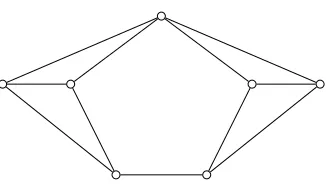
The bound given by Corollary 4.2 is attained by odd holes and the Haj´os graph (see Figure 2). Note that these graphs have clique number at most 3. For graphs with large clique number, we do not have an example showing that the bound is tight. Nevertheless, the optimal constant is at least 54. For any integer k≥ 1, let Gk be the graph obtained from a
5-hole by substituting a clique of size 2kfor each vertex of the 5-hole. Clearly,|V(Gk)|= 10k, α(Gk) = 2 and ω(Gk) = 4k. Hence, χ(Gk) ≥ |Vα((GGkk))| = 5k. Moreover, it is easy to see that Gk does admit a 5k-coloring. So, χ(Gk) = 5k = 54ω(Gk). A natural question is whether or
not one can reduce the constant from 32 to 54.
Figure 2: The Haj´os graph.
It was shown in [10] that this is true for the class of (C4, P5)-free graphs, which is a
subclass of the class of (cap, even hole)-free graphs.
Even-hole-free graphs are also known to be χ-bounded. In [2] it is shown that every even-hole-free graph has a vertex whose neighborhood is a union of two cliques. This implies that ifGis even-hole-free, then χ(G)≤2ω(G)−1. It remains open whether a better bound is possible.
The complexity of 3-coloring, q-coloring, and minimum coloring is unknown for even-hole-free graphs, 4-even-hole-free odd-signable graphs, and odd-signable graphs. Polynomial-time algorithms for minimum coloring have been given for (diamond, even hole)-free graphs [26] and (pan, even hole)-free graphs [8].
The clique covering problem is to find a minimum number of cliques which partition the vertices of a graph. This problem is the same as finding a minimum coloring of the complementary graph. The complexity of this problem is unknown for the following classes of graphs: (cap, even hole)-free graphs, (cap, 4-hole)-free odd-signable graphs, 4-hole-free odd-signable graphs, even-hole-free graphs, and odd-signable graphs.
Acknowledgement. We would like to thank Haiko M¨uller for fruitful discussions, and to thank Jerry Spinrad for pointing to us the idea of finding true twins in O(n+m) time.
References
[1] P. Aboulker, P. Charbit, N. Trotignon and K. Vuˇskovi´c, Vertex elimination orderings for hereditary graph classes Discrete Mathematics 338 (2015) no. 5, 825-834.
[2] L. Addario-Berry, M. Chudnovsky, F. Havet, B. Reed and P. Seymour, Bisimplicial vertices in even-hole-free graphs, Journal of Combinatorial Theory B 98 (2008) 1119-1164.
[3] H. L. Bodlaender, A linear-time algorithm for finding tree-decompositions of small treewidth, SIAM J. Comput. 25 (1996) no. 6, 1305-1317.
[4] H. L. Bodlaender and A. M. C. A. Koster, Combinatorial optimization on graphs of bounded treewidth, The Computer Journal 51 (2008) no. 3, 255-269.
[6] K. Cameron and J. Edmonds, An algorithm for finding a strong stable set or a Meyniel obstruction in any graph, Discrete Mathematics and Theoretical Computer Science Pro-ceedings (2005) 203-206.
[7] K. Cameron, B. L´evˆeque and F. Maffray,Coloring vertices of a graph or finding a Meyniel obstruction, Theoret. Comput. Sci. 428 (2012) 10-17.
[8] K. Cameron, S. Chaplick and C. T. Ho`ang, On the structure of pan, even hole-free graphs, arXiv:1508.03062 [cs.DM], 2015, to appear in Journal of Graph Theory.
[9] H.-C. Chang and H.-I. Lu,A faster algorithm for recognising even-hole-free graphs, Jour-nal of Combinatorial Theory B 113 (2015) 141-161.
[10] S.A. Choudum, T. Karthick, M. A. Shalu,Perfectly coloring and linearlyχ-boundP6-free
graphs, Journal of Graph Theory (2007) 293-306.
[11] M. Conforti, G. Cornu´ejols, A. Kapoor and K. Vuˇskovi´c,Even and odd holes in cap-free graphs, Journal of Graph Theory 30 (1999) 289-308.
[12] M. Conforti, G. Cornu´ejols, A. Kapoor and K. Vuˇskovi´c, Triangle-free graphs that are signable without even holes, Journal of Graph Theory 34 (2000) 204-220.
[13] M. Conforti, G. Cornu´ejols, A. Kapoor and K. Vuˇskovi´c,Even-hole-free graphs, Part II: Recognition algorithm, Journal of Graph Theory 40 (2002) 238-266.
[14] M. Conforti, B. Gerards and K. Pashkovich, Stable sets and graphs with no even hole, Math. Program., Ser. B 153 (2015) 13-39.
[15] D. G. Corneil and U. Rotics, On the relationship between clique-width and treewidth, SIAM J. Comput. 34 (2005) no. 4, 825-847.
[16] G. Cornu´ejols and W. H. Cunningham,Compositions for perfect graphs, Discrete Math-ematics 55 (1985) 245-254.
[17] B. Courcelle, The monadic second-order logic of graphs. i. Recognizable sets of finite graphs, Information and computation 85 (1990) no. 1, 12-75.
[18] B. Courcelle, J. Makowsky, and U. Rotics,Linear time solvable optimization problems on graphs of bounded clique-width, Theory of Computing Systems 33 (2000) no. 2, 125-150.
[19] B. Courcelle and S. Olariu, Upper bounds to the clique width of graphs, Discrete Appl. Math. 101 (2000) no. 1-3, 77-114.
[20] M. V. G. da Silva and K. Vuˇskovi´c,Triangulated neighborhoods in even-hole-free graphs, Discrete Mathematics 307 (2007) 1065-1073.
[21] W. Espelage, F. Gurski, and E. Wanke, Deciding clique-width for graphs of bounded tree-width, J. Graph Algorithms Appl. 7 (2003) no. 2, 141-180.
[23] A. Hertz,A fast algorithm for colouring Meyniel graphs, Journal of Combinatorial The-ory B 50 (1990) 231-240.
[24] C. T. Ho`ang,On a conjecture of Meyniel, J. Comb. Th. B 42 (1987) 302-312.
[25] J. B. Kelly and L. M. Kelly, Paths and circuits in critical graphs, Amer. J. Math. 76 (1954) 786-792.
[26] T. Kloks, H. M¨uller and K. Vuˇskovi´c, Even-hole-free graphs that do not contain dia-monds: a structure theorem and its consequences, J. Combin. Theory Ser. B 99 (2009) no. 5, 733800.
[27] D. Kobler and U. Rotics,Edge dominating set and colorings on graphs with fixed clique-width, Discrete Appl. Math. 126 (2003) no. 2-3, 197-221.
[28] S. E. Markosjan and I. A. Karapetjan,Perfect graphs, Akad. Nauk Armjan. SSR. Dokl. 63 (1976) 292-296.
[29] S. E. Markossian, G. S. Gasparian and B. A. Reed,β-perfect graphs, Journal of Combi-natorial Theory B 67 (1996) 1-11.
[30] H. Meyniel,On the perfect graph conjecture, Discrete Mathematics 16 (1976) 339-342.
[31] S. Oum,Approximating rank-width and clique-width quickly, ACM Trans. Algorithms 5 (2009) no. 1, Art. 10, 20 pp.
[32] S. Oum and P. D. Seymour, Approximating clique-width and branchwidth, Journal of Combinatorial Theory, Series B, 96 (2006) no. 4, 514-528.
[33] F. Roussel and I. Rusu, Holes and dominoes in Meyniel graphs, Internat. J. Found. Comput. Sci. 10 (1999) 127-146.
[34] F. Roussel and I. Rusu, An O(n2) algorithm to color Meyniel graphs, Discrete Mathe-matics (2001) 107-123.
[35] A. Silva, A. A. da Silva and C. Linhares Sales, A bound on tree width of planar even-hole-free graphs, Discrete Applied Mathematics 158 (12) 1229-1239.
[36] J. P. Spinrad,Efficient Graph Representations, American Mathematical Society, 2003.
[37] R. E. Tarjan,Decomposition by clique separators, Discrete Mathematics (1985) 221-232.
[38] J. A. Telle and A. Proskurowski,Algorithms for vertex partitioning problems on partial k-trees, SIAM J. Discrete Math. 10 (1997) no. 4, 529-550.
[39] K. Truemper, Alpha-balanced graphs and matrices and GF(3)-representability of ma-troids, Journal of Combinatorial Theory B 32 (1982) 112-139.