This is a repository copy of Microstructural Evolution and Phase Formation in Rapidly Solidified Ni-25.3 At. Pct Si Alloy.
White Rose Research Online URL for this paper: http://eprints.whiterose.ac.uk/88806/
Version: Accepted Version
Article:
Cao, L, Cochrane, RF and Mullis, AM (2015) Microstructural Evolution and Phase Formation in Rapidly Solidified Ni-25.3 At. Pct Si Alloy. Metallurgical and Materials Transactions A, 46 (10). 4705 - 4715. ISSN 1073-5623
https://doi.org/10.1007/s11661-015-3070-6
[email protected] https://eprints.whiterose.ac.uk/
Reuse
Unless indicated otherwise, fulltext items are protected by copyright with all rights reserved. The copyright exception in section 29 of the Copyright, Designs and Patents Act 1988 allows the making of a single copy solely for the purpose of non-commercial research or private study within the limits of fair dealing. The publisher or other rights-holder may allow further reproduction and re-use of this version - refer to the White Rose Research Online record for this item. Where records identify the publisher as the copyright holder, users can verify any specific terms of use on the publisher’s website.
Takedown
If you consider content in White Rose Research Online to be in breach of UK law, please notify us by
Microstructural evolution and phase formation in rapidly
solidified Ni-25.3 at.% Si alloy
Leigang Cao1,a, Robert F. Cochrane1,band Andrew M. Mullis1,c
1Institute for Materials Research, University of Leeds, Leeds LS2-9JT, UK.
aPermanent address: School of mechanical and material engineering, North China University
of Technology, Beijing 100144, China. E-mail address:[email protected]
bE-mail address:[email protected]
cCorresponding author: Tel. +44 113 343 2568. Postal Address: Institute for Materials
Research, School of Chemical and Process Engineering, University of Leeds, Leeds LS2-9JT, UK. Email address:[email protected]
Abstract
The drop-tube technique was used to solidify droplets of the Ni-25.3 at.% Si alloy at high cooling rates. XRD, SEM and TEM analysis revealed that the metastable phase, Ni25Si9, formed as the dominant phase in all ranges of the droplets, with -Ni31Si12 and 1-Ni3Si also being present. Three different microstructures were observed: the regular and anomalous eutectic structures and near single phase structure containing small inclusions of a second phase, termed here a heteroclite structure. Both eutectic structures comprise alternating lamellae of Ni25Si9 and 1-Ni3Si, which, we conjecture, is a consequence of an unobserved eutectic reaction between the Ni25Si9 and 1-Ni3Si phases. The matrix of the heteroclite structure is also identified as the metastable phase Ni25Si9, in which twined growth is
observed in the TEM. As the cooling rate is increased (particle size decreased) the proportion of droplets displaying the entire heteroclite structure tends to increase, with its fraction increasing from 13.91% (300-500 µm) to 40.10% (75-106 µm). The thermodynamic
properties of the Ni25Si9phase were also studied by in-situ heating during XRD analysis and by DTA. This showed the decomposition of Ni25Si9 to 1 and -Ni31Si12for temperatures in excess of 790 K (517 °C).
1. Introduction
Intermetallic compounds have been paid great attention for their potential application as high temperature structural materials, due to the possibility of combining the ductility of metals
and the strength and oxidation resistance of ceramics [1]. One such is the Ni3Si compound, noted for its high melting point, excellent oxidation resistance and high strength at elevated temperatures. However, like many other intermetallics, its limited room temperature ductility restricts its application owing to the difficulty in fabricating engineering components via conventional processing routes [2-6]. A number of trials have been carried out to improve its ductility and a significant body of fundamental research into phase formation and
microstructural evolution under different processing conditions has been amassed. One potential route to overcome this difficulty is to form intermetallic-metal matrix composites by incorporating a ductile phase into the brittle matrix, or by solidifying a ductile phase directly from the parent melt, to form a so-calledin-situcomposite [1, 7].
At the Ni-rich end of the Ni-Si phase diagram, which is shown in Fig.1, the main phases
present are -Ni and the intermetallics -Ni3Si, -Ni31Si12 and -Ni2Si. occurs in three forms, a low temperature polymorph, 1, which has the L12crystal structure and two high temperature forms, 2 and 3, both of which have the D022 crystal structure, with 2being an ordered form of 3. Çadırlı et al. [9] produced four arc-melted samples with Si composition being 10, 21.4, 25 and 35 at.%. Subsequent mechanical testing indicated that the
microhardness increased with increasing Si content. Layered composite structures consisting of -Ni and 1-Ni3Si have also been obtained using directional solidification techniques [10-13]. Milenkovic et al. [13] concluded that the micro-hardness decreased in the sequence Ni3Si, Ni-Ni3Si eutectic (as-solidified) and Ni-Ni3Si eutectic (directionally solidified), indicating the latter, layered composite, might possess higher ductility.
fundamental solidification mechanism. The highest undercooling of this material, at 550 K (550 °C), has been achieved using a glass fluxing and cyclic superheated method, wherein Liu et al. [19] and Lu et al. [20] observed a complex microstructural evolution from regular lamellar eutectic, via irregular lamellar eutectic, coarse directional dendritic to quasi-spherical eutectic colonies, and fine directional dendrite to superfine anomalous eutectic. Significant grain refinement was observed with increased undercooling [21], which they attributed to enhanced nucleation, although many other mechanisms have also been suggested to account for this phenomenon in deeply undercooled melts, including post-recalescence remelting [22] and the development of growth instabilities [23, 24]. Conversely, a study by
Goetzinger et al. [25] attained a regular eutectic microstructure for T<30 K (30 °C), which
was then progressively replaced by an anomalous eutectic microstructure as the undercooling
is increased, with the transition being complete at T>150 K (150 °C). Similar to the samples produced by arc-melting or directional solidification, only -Ni and 1-Ni3Si were present in these alloys. Conversely, when high cooling rates were applied, for instance in the studies by Leonhardt et al. [8] and Dutra et al. [26], the metastable phase Ni25Si9was observed.
The direct solidification of -Ni3Si from a melt of the same composition has been studied by Ahmad et al. [27], who performed undercooling experiments on a Ni-25.3 at% Si alloy using a melt-fluxing technique. On the basis of the phase diagram (Fig. 1), the equilibrium
solidification path from the Ni-25.3 at.% Si melt would be for the growth of -Ni31Si12, with the subsequent conversion to 3via a peritectic reaction below 1443 K (1170 °C). As the temperature is further decreased, 3 will undergo an ordering reaction to form 2, which itself will decompose via a eutectoid reaction to give 1 + . With the -liquidus at this composition estimated at 1496 K (1223 °C) direct access to 3should become possible for undercoolings
of≈53 K (53 °C) or above. However, despite obtaining the required undercooling Ahmad et
small amounts of 3and the metastable phase Ni25Si9were retained in the as-solidified structure, despite the low cooling rate, estimated at <10 K s-1.
Recently, studies on Ni-29.8 at.% Si eutectic alloy were carried out by Lu et al., who
obtained a small amount of amorphous phase at an undercooling in excess of 240 K (240 °C)
with a cooling rate of≈1 K s-1[29], indicating a very low cooling rate for amorphous phase
formation in a binary alloy. The formation of the amorphous phase here might be because the Ni-29.8 at.% Si melt, like the Ni-25.3 at.% Si studied by Ahmad et al., has an anomalously high viscosity [27]. In this paper we focus on Ni-25.3 at.% Si alloy which has been rapidly solidified by processing in a 6.5 m drop tube, wherein free-fall solidification and rapid in-flight cooling can be achieved. This technique is an effective method to form and retain non-equilibrium phases, e.g. supersaturated solid solution, metastable phase and metallic glass [14], due to the high undercoolings likely through melt sub-division and the high post-recalescence cooling rates achieved. This extends our previous work on this alloy by both
melt undercooling [27], wherein a eutectic structure between and was observed and drop tube processing, wherein a previously unobserved 1– Ni25Si9eutectic was detected [30, 31]. However, in these previous drop-tube studies microstructural characterisation was limited to
relatively large droplets (mean diameter = 400 m), wherein only one type of microstructure
was identified. In comparison we here extend the work to significantly smaller particles
(mean diameter for smallest size fraction = 90 m), which gives access to cooling rates that
are at least one order of magnitude higher. Consequently, two further microstructures have been identified, one of which is essentially single phase Ni25Si9. This has also permitted, for the first time, a study into the thermal decomposition of Ni25Si9, using DTA and XRD analysis within situheating. Moreover, a much larger number of droplets has now been
collected and analysed, permitting a statistical analysis of microstructure as a function of
cooling rate, wherein we are able to determine that the previously observed 1– Ni25Si9 eutectic is associated with low undercooling in the free-falling droplets while the new structures are associated with high undercooling.
2. Experimental
ensure that the composition of the material used for drop-tube processing had not deviated from its notional value.
The alloy was loaded into an alumina crucible with 3 laser drilled holes (300m diameter) in the base. The crucible was placed in a RF coil fixed at the top of the 6.5 m drop tube, which was filled to a pressure of 50 kPa with dried, oxygen free N2gas, having previously been flushed multiple times with N2and evacuated to a pressure of 4 × 10⁻³Pa. The alloy was heated by induction of heating of a graphite susceptor. Temperature determination was by means of an R-type thermocouple inside the melt crucible. When the desired superheat was achieved the melt was sprayed by pressurising the crucible with 4 × 10⁵Pa of N2gas. The spherical droplets with diameters in the range of 75-850 m were collected at the bottom of
the drop tube and classified into several size groups. The size of the sieves used here are 850
m, 500 m, 300 m, 212 m, 150 m, 106 m, 75 m. In total 3 separate batches of powder were produced in order to conduct the analysis reported below. For particle sizes of 150 m
and above the material from each batch of powder was analysed separately. No significant differences were found to exist between the separate batches and typical results are presented.
For particle sizes of 106 m and below, once the average composition of the particles had
been checked the powders from the 3 batches were combined for subsequent analysis due to the small mass of fine powder produced in each run.
The particles of each group size were hot mounted using Transoptic resin. The mounted samples were ground flat using a series of progressively finer SiC papers starting with 240, 400, 800 and lastly 1200 grit, with optical microscopy being used to check the quality of the surface finish at each stage. Once the samples were appropriately ground they were polished
using 6 m, 3 m, 1 m and 0.25 m diamond paste. The samples were washed using dilute
detergent and methanol and then dried using hot air between each polishing step.
The composition of the polished samples was characterized using EDX detection mounted on a LEO 1530 Gemini FEGSEM. Once EDX analysis was complete the polished samples were etched using here a mixture of Hydrofluoric Acid (5ml), Hydrogen Peroxide (5ml) and water (10ml) to reveal the microstructure for further SEM analysis. FIB was used to prepare the TEM specimens, which were analysed subsequently using an FEI Tecnai F20 FEG-TEM.
XRD analysis, including XRD within-situheating, was conducted to identify the phase
heating was performed in a sealed chamber at high vacuum (≈1.68 × 10⁻⁴Pa), in which the sample could be heated to a maximum 1473 K (1200 °C). The sample was heated from 298 K (25 °C) to around 723 K (450 °C), although it was not possible to calibrate the temperatures at which the observed phase transitions occurred. This data was therefore coupled with DTA measurements using a Perkin Elmer DTA 7, which was used to determine the onset
temperature of the metastable phase transformation.
3. Results
3.1. EDX, XRD and DTA analyses
At least 10 particles in each size range, with at least 3 from each of the three batches of powder, were checked by EDX in order to determine the average composition of the droplets. These measurements were within the range 24.97-25.46 at.% Si, indicating that in all size ranges the particles have average compositions close to the nominal composition.
Fig. 2 shows the XRD patterns of the Ni-25.3 at.% Si droplets as a function of particle size. It can be seen that all of the resulting diffraction patterns, even for the smallest particles
(highest cooling rate), show the same general trend, namely the presence of three main phases: Ni25Si9 (metastable phase), -Ni31Si12 and 1-Ni3Si.
Here, a couple of comments relating to the phases present may be pertinent. Ni74Si26is a known stacking variant of Ni25Si9[32]. Although the lattice constants 'a' and 'b' are same, the 'c' value of Ni74Si26(c=28.855 Å) is three times of that of Ni25Si9(c=9.618 Å). It is therefore difficult to identify Ni74Si26in co-existence with Ni25Si9. Moreover, the structure and
diffraction data of Ni74Si26are incomplete.Therefore, in the present work, the metastable phase
is referred to as Ni25Si9for the purposes of analysis and discussion, but has previously been interchangeably referred to as either Ni74Si26or Ni25Si9by other authors. Moreover, it is also
difficult to distinguish the -Ni and 1-Ni3Si phases, because both phases have the same cubic structure, with the lattice constant ‘a’ being 3.5244 Å and 3.5050 Å, respectively. A number
of previous studies on Ni-Si alloys [8, 33] have shown overlapping -Ni and 1-Ni3Si XRD peaks. Here, the 1-Ni3Si phases can only be confirmed according to the presence of the unique, but weak, characteristic peaks corresponding to the (100) and (110) planes at 3.5050
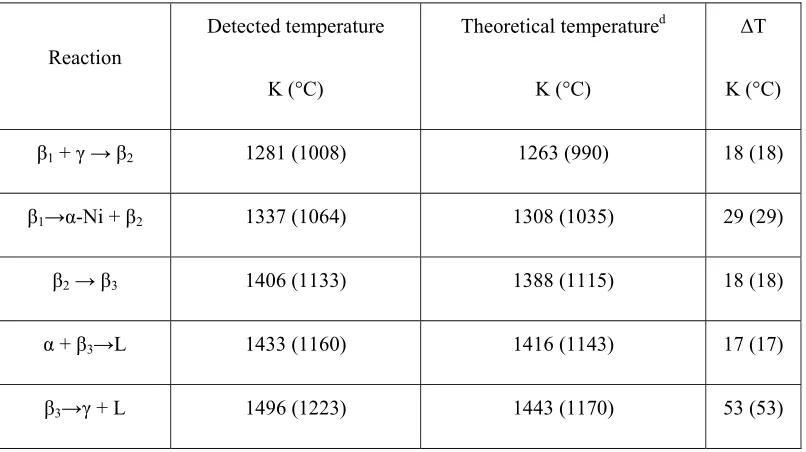
In order to obtain an accurate temperature determination for the phase transformation of Ni25Si9, DTA analysis was performed on the 300-500 droplets with heating rate of 20 K min-1, the results of which are shown in Fig. 3. The curve for the first cycle displays an exothermic reaction near 789 K (516 °C), which is ascribed to the transformation of the metastable Ni25Si9phase. On the basis of the equilibrium phase diagram, the endothermic peaks near 1281 K (1008 °C) and 1337 K (1064 °C) may be related to the 1 + 2 and the 1 -Ni + 2 transformation, respectively. The strong peak at 1406 K (1133 °C) is due to the 2 3 transformation. The peaks at 1496 K (1223 °C) and 1519 K (1246 °C) represent the peritectic reaction and final melting respectively. The temperature departures of these reactions from the equilibrium phase diagram are listed in Table 1. There was no exothermic peak near 789 K (516 °C) during the second heating cycle, implying that the metastable phase transformed completely. Fig. 4 shows the results of thein-situXRD heating experiment on the 300-500
m droplets, indicating a gradual phase transformation at elevated temperatures. Comparing
the XRD patterns of the sample before and after heat treatment at 298 K (25 °C), it indicates that the metastable Ni25Si9 phase converted fully to 1-Ni3Si and -Ni31Si12.
3.2.SEM and TEM analysis
Microstructural analysis reveals that the majority of droplets can be classified as containing one or more of three typical structures. As shown in Fig. 5 these comprise two eutectic structures – regular (I) and anomalous (II) and one two-phase but non-eutectic structure which we here term the heteroclite structure (III). Moreover, three single phase morphologies were also observed: M1- an extended single phase (Fig. 6); M2– a phase that grows
continuously throughout the whole droplet (Fig. 7a) and M3– a phase that is surrounded by the regular lamellar structure (Fig. 7b). In order to determine the origin of these three typical structures (I, II and III) and three single phase morphologies (M1, M2and M3), fine lamellar TEM specimens (12 × 8 m) have been prepared using the Focused Ion Beam (FIB)
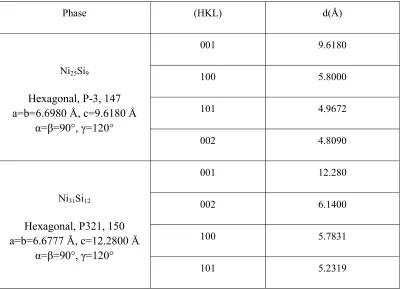
technique. Both the Ni25Si9and Ni31Si12phases have a complicated hexagonal crystal structure and consequently these have been identified in the TEM using the diffraction patterns corresponding to the distinguishable interplanar spacing, as shown in Table 2.
It is clear that the regular lamellar structure (I) comprises two phases. A clear lamellar nanostructure may be observed in the TEM bright field micrograph shown in Fig. 8. This
bands has not been achieved. However, from Fig. 8 it is clear that the thin bands are
continuous with, and therefore the same phase as, the single phase regions embedded within the lamellar structure. A selected area diffraction pattern confirms that this single phase
region, and therefore the thin lamellae, are the intermetallic phase 1-Ni3Si. A similar selected area diffraction pattern confirms that the wide lamellar phase is metastable phase Ni25Si9.
The anomalous eutectic structure (II) and the single phase (M1) were also analyzed by TEM, as shown in Fig. 9. The TEM selected area diffraction patterns confirm that the irregular eutectic structure (II) also comprises the metastable Ni25Si9 and stable 1-Ni3Si phases.
Therefore, the structures, I and II, are composed of the same phases.The single phase M1was identified as the -Ni31Si12phase.
The heteroclite structure (III) also comprises two phases, with a small volume of a fine phase with a curved morphology dispersed in a dominant matrix phase. The selected area
diffraction pattern confirms that the coarse matrix is the metastable Ni25Si9phase (Fig. 10). Twinned growth was also confirmed from the TEM analysis. The thickness of the fine phase is typically less than 20 nm and it is therefore difficult to confirm its identity. The phases M2 and M3 are identified as 1-Ni3Si and Ni25Si9respectively (Fig. 11a and b). Moreover, the phase next to 1-Ni3Si is also identified as Ni25Si9, which also supports the co-growth mechanism of Ni25Si9 and 1-Ni3Si under non-equilibrium conditions.
One particle in which the heteroclite structure (III) was the only morphology present was selected for heat treatment, wherein it was held for 30 minutes at 867 K (594°C) under a protective nitrogen atmosphere. The microstructure after heat-treatment (Fig. 12a) shows the fine phase I1dispersed in a matrix (I2). These two phases were identified as -Ni31Si12(I1) and
1-Ni3Si (I2) by TEM, as shown in Fig. 12b. This is consistent with the results ofin-situ heating during XRD analysis.
In order to study the microstructural evolution with decreasing particle size, the droplets are classified into two different categories (A and B). Type A droplets present the entire
numbers of particles being counted are 230 (300-500 m), 295 (212-300 m), 304 (150-212 m), 428 (106-150 m) and 394 (75-106 m). For particles of 150 m diameter and above,
particles from each of the three batches of powder were mounted separately and the count data combined as there were no significant differences between the batches. For particles
below 150 m diameter the powders were combined prior to counting. The counted results
are illustrated in Fig. 13, showing that the fraction of type A droplet increases as the particle
size decreases, from 13.91% (300-500 m) to 40.1% (75-106 m). There are no type A droplets in the 500-850 m particles.
Within type B droplets, the anomalous structure II can be observed in all ranges of the droplets. Conversely, the fraction of the regular lamellar structure shows a decreasing trend with decreasing particle size, this structure being easily observed in large particles (212-850
m) but almost disappearing in the 75-106 m size fraction.
4. Discussion
From the results of microstructural evaluation described above we may conclude that the dominant phase present in all size fractions, and therefore at all cooling rates studied, is the metastable phase Ni25Si9.
According to previous studies [8, 27, 28] on the Ni-rich end of the Ni-Si phase diagram, it has been established that the growth velocity of the Ni-Si melts drops with increasing Si
composition. The highest velocities, at 50-60 m s-1 ( T=250 K (250 °C)), were measured by
Cochrane et al. [28] on pure Ni and Ni-Si melts for Si < 4.09 at.%, while the maximum for Ni-21.4 at.% Si alloy measured by Leonhardt et al. was only 1.5 m s-1 ( T=220 K (220 °C)). The extremely low growth velocity of the Ni-25.3 at.% Si melt recorded by Ahmad et al. [27] was about 0.018 m s-1 ( T=160 K (160 °C)), which is consistent with their observation of an unusually high viscosity in the melt, which they speculated might be due to the existence of structure in the liquid resulting from Si acting as a network former. Such a covalent network within the liquid would give rise to low atomic mobility and hence low growth velocity. Under rapid solidification conditions a low atomic mobility might in turn favour the
diffusion and the subsequent favouring of features with very fine length scales, which is indeed observed here.
Although Ni25Si9was found to be the dominant phase formed in this study, the formation of Ni25Si9was not observed during undercooling experiments on Ni-21.4 at.% alloys [21, 25], with only a small fraction being observed in Ni-25.3 at.% Si alloy [27]. Conversely, when high cooling rates have been applied, it was obtained in the rapidly solidified eutectic Ni-21.4 at.% Si alloys produced by Leonhardt et al. [8] by quenching the undercooled sample onto a chilled substrate and by Dutra et al. [26] using the melt-spinning technique. This seems to indicate that high cooling rates are necessary for the formation of the metastable Ni25Si9 phase to be observed in the as-solidified sample. Thermal analysis by DTA has indicated that the decomposition temperature for Ni25Si9is 789 K (516ºC), which is consistent with the observations of Leonhardt et al. [8] and Dutra et al. [26] who both identified this transition as occurring around 773 K (500 ºC). Such a low decomposition temperature relative to a melting temperature of 1530 K (1230 ºC) points to poor thermal stability.
One scenario that we should therefore consider is that, even if the solidification condition favours the formation of the Ni25Si9 phase, it would convert into the 1-Ni3Si and -Ni31Si12 phases in the post-recalesence and subsequent cooling period. This would be consistent with the retention of Ni25Si9during drop-tube processing, wherein the estimated cooling rate for the coarsest size fraction, 500-850 m, is around 500 K s-1based on the model of
Kasperovich et al. [34], which will largely inhibit any post-recalescence transformations. However, XRD analysis within-situheating indicates that the metastable Ni25Si9phase decomposes to 1-Ni3Si and -Ni31Si12. Consequently, while it may be possible that Ni25Si9 formed, and subsequently underwent thermal decomposition in the undercooling experiments on Ni-21.4 at.% Si eutectic alloy [21, 25], it is not consistent with the results Ahmad et al., in
which the mixed structure of -Ni31Si12 and 1-Ni3Si was not observed in the resulting as-solidified samples. Instead, the -Ni31Si12phase was formed from the undercooled liquid as the primary solidification phase and retained in the final samples. Moreover, a small fraction of Ni25Si9was successfully retained, even at the very low cooling rates reported for their apparatus.
Microstructural analysis indicates that, except for the 500-850 m droplets (completely type
droplets of the same size will be subjected to the same cooling rate. However, it is not true that all droplets of the same size will solidify at the same undercooling, as this is controlled by nucleation which is a stochastic process. Solidification of the liquid might be catalysed by a potent nucleation site, such as an oxide, and in such cases, deep undercooling would not be expected. However, the catalytic effect of active nuclei can be restricted by dispersing the liquid into a large number of small droplets that solidify individually [35], as is the case in the drop tube. In this stochastic process, a range of undercoolings from low to quite high would be expected in each size range of droplets due to the variation in nuclei density and potency. For a given nucleation density, the probability of a given particle containing an active nucleus decreases with decreasing volume. Consequently, high undercooing is much more likely in a population of small droplets. With reference to Fig. 13, we see that the proportion of type A droplets (entire heteroclite structure) increases with decreasing particle size, from 13.91%
(300-500 m) to 40.1% (75-106 m). This suggests that type A droplets are the high
undercooling forms. By inference, type B droplets, displaying a mixed structure, must be subject to lower undercooling.
The structures displayed by the type B droplets appear to be largely eutectic (or possibly eutectoid) in nature, which is not easily reconciled with the metastable Ni-Si diagram
produced by Leonhardt et al. [8]. The bulk composition, measured by EDX analysis, is within
the range 24.97-25.46 at.%, which is on the hypereutectic side of the postulated -Ni25Si9 eutectic and between the theoretical composition of the 1-Ni3Si (22.6-24.5 at.%) and Ni25Si9 (26.47 at.%) phases. Consequently, if the formation of the high temperature 2/ 3phases were suppressed and formation of Ni25Si9were permitted, the expected structure would be single phase Ni25Si9 + -Ni25Si9 eutectic where, as per the results from Ahmad et al. [27], the -Ni maybe highly supersaturated for a deep non-equilibrium process. However, the observation here of a Ni25Si9/ 1-Ni3Si eutectic, displaying both regular lamellar and anomalous eutectic structures, would imply that the metastable liquidus line for Ni25Si9would be dropping much more steeply than is shown in Fig.1.
As mentioned above the alternative hypothesis is that the observed structure forms via a eutectoid reaction, which is attractive as the very fine structure observed appears more consistent with a solid-state, rather than liquid-solid, transformation. As can be seen from the
phase diagram, there are two high temperature forms of the -phase (disordered 3and ordered 2). High cooling rates in the drop tube would be expected to favour the formation of
observed 1-Ni25Si9lamellar structure. However, further analysis refutes this formation route. Firstly, XRD analysis failed to indicate the presence of any 3 and 2. Some residual 3/ 2 would be expected to remain at the highest cooling rates, particularly as Ahmad et al. [27]
observed extensive retained 3in fluxed samples in which a cooling rate < 10 K s-1was attained. Secondly, the microstructural analysis also failed to observe the potential mixed
structure of the 1-Ni3Si + -Ni31Si12, which might be expected via the eutectoid reaction, 2
1 + (according to the equilibrium phase diagram) if this assumption is correct. Moreover, a eutectoid reaction to give 1-Ni3Si + Ni25Si9would seem highly unlikely given the poor thermal stability of Ni25Si9and that the eutectoid temperature would be well above the measured thermal decomposition temperature for Ni25Si9. Consequently, we postulate that the observed lamellar structure formed as a result of a hitherto unobserved eutectic reaction
between 1and Ni25Si9, with the present experimental composition close to the eutectic composition.
Further evidence for the direct growth of the observed structures from the liquid comes from
the variations between structures I and II. These have the same phase constitution, 1-Ni3Si and Ni25Si9, but are morphologically distinct with (I) being a regular lamellar structure and (II) being a much more disordered eutectic structure. In fact it is clear that the structure II has the features of an anomalous eutectic, a structure that is widely observed [36, 37] in the
solidification of eutectic alloys from their undercooled parent melt, wherein the distinct lamellar morphology of a regular eutectic cannot be observed. Many studies [36, 37] have indicated that the fraction of anomalous eutectic structure increases with increasing undercooling. The structure II can be observed in all ranges of type B droplet, while the fraction of the regular structure (I) presents a decreasing trend with decreasing particle size
and has almost disappeared in all of the 75-106 m droplets. This is consistent with the
formation of an anomalous eutectic structure resulting from solidification from an
undercooled melt and hence indicates that growth occurred from the liquid via a eutectic, rather than the solid via a eutectoid, reaction.
undercooled below the metastable extension of the Ni25Si9solidus line, wherein the droplets solidify entirely to the heteroclite structure in which the primary solidification of Ni25Si9 occurs.
It can be summarized that at moderate cooling rates the Ni-25.3 at.% Si alloy solidifies to 1 -Ni3Si + Ni25Si9via a previously unobserved eutectic reaction while at high cooling rates and high undercooling it solidifies to almost single phase Ni25Si9. This behaviour is not only different from the prediction of the phase diagram, but also different from the studies by
Ahmad et al. [27], who observed a eutectic structure between -Ni31Si12 and supersaturated -Ni with complete suppression of -phase solidification from the melt. This has strong
parallels with work on Nb-xSi (x= 21.0-27.0 at.%) alloys by Bertero et al. [39], who
performed a series of experiments using levitation techniques, which in some cases were combined with splat quenching of the undercooled melt. Contrary to the prediction from the phase diagram that direct solidification to primary Nb3Si should be possible for
undercoolings in excess of 270 K (270 °C), they observed solidification was to a metastable
-Nb and -Nb5Si3eutectic in levitated samples. Conversely, the formation of Nb3Si was observed in splat quenched samples, which, as they described, was independent of the undercooling prior to splat quenching. They attributed this phenomenon to difficulty in nucleating the Nb3Si phase, which can grow at high cooling rate due to enhanced short-range diffusion and possibly heterogeneous nucleation sites on the splat. Therefore, it is not without precedent that high cooling rates should be the deterministic factor in the formation of the single phase structures in materials in which the short-range diffusion is preferential. This is
also consistent with the nanostructure morphology in 1-Ni25Si9eutectic structures with narrow lamellae spacings.
There is one further common characteristic in the solidification of Nb-25 at.% Si and Ni-25.3 at.% Si alloys at high undercooling and high cooling rate, namely the suppression of the peritectic reaction. In the initial stage of the peritectic reaction the primary phase is expected to be coated by a thin layer of the peritectic phase with the subsequent reaction being a diffusion-controlled process [40], with diffusion occurring through the growing solid layer of the peritectic phase. Alternatively, St. John et al. [41] pointed out that some degree of
the secondary phase took place at many other sites in the Pb-Bi liquid. The observation of Nb3Si formation at high cooling rate by Bertero et al. might be a consequence of the second mechanism. In the undercooling study of Ahmad et al., a small amount of 3phase was observed in fluxed samples, however the primary solidification was always the eutectic
growth of -Ni31Si12 and supersaturated -Ni. In the present work, we have found no evidence for formation of either the 3or 2phases, despite the high cooling rates which would be expected to favour their retention in the as-solidified droplets. This might be
because the peritectic reaction is completely suppressed and the nucleation of 3 and 2from the liquid is difficult.
Rapid solidification at high cooling rates is an effective route to the formation metallic glass, especially for deep eutectic melts [14] as this reduces the normalised glass transition
temperature. Recently, Lu et al. [29] obtained small amounts of an amorphous phase in bulk eutectic Ni70.2Si29.8alloy under slow cooling conditions (about 1 K s-1). Meanwhile, in the Nb-Si system, Benderdky et al. formed an amorphous phase in the narrow region adjacent to the chill surface in melt-spinning experiments on Nb-25 at.% Si alloy [43], indicating that at high cooling rates melts other than those of eutectic composition can be frozen into the amorphous state. However, in this study no evidence for an amorphous phase was observed, even in the smallest particle range. This may be because of the presence of the crystalline phases Ni25Si9 and 1-Ni3Si with compositions very close to that of the parent melt. Conversely, the condition is different for the Nb-Si alloys, in which the formation of the
stable phases, -Nb (<3.44 at.% Si) and -Nb5Si3(37.5-38.6 at.% Si) requires long-range diffusion.
5. Conclusions
The following conclusions can be derived from the present investigation.
1. Three phases are obtained in the drop tube solidified Ni-25.3 at.% Si droplets, 1-Ni3Si, -Ni31Si12and Ni25Si9, with Ni25Si9being the dominant phase in all ranges of the droplets.
2. There is strong evidence for the existence of a previously unobserved 1– Ni25Si9eutectic, with the eutectic composition being close to the composition of the starting alloy, namely Ni-25.3 at.% Si.
the droplets with entire heteroclite structure increases with decreasing particle size, from
13.91 % in the 300-500 m size range to 40.1% in the 75-106 m size range.
4. The metastable phase Ni25Si9 decomposes to the stable phases, 1 and -Ni31Si12, with the onset transformation temperature being around 789 K (516°C) at the heating rate of 20 K min-1.
Acknowledgements
The authors acknowledge financial supports of the China Scholarship Council (CSC) – University of Leeds scholarship program.
References
[1] C.M. Ward-Close, R. Minor and P. Doorbar:Intermetallics, 1996, vol. 4, pp.217-229.
[2] C. Cui, J. Zhang, K. Wu, Y. Ma, L. Liu and H. Fu:Phys. B Condens. Matter, 2012,
Vol. 407, pp. 3566-3569.
[3] R.L. Fleischer:J. Mater. Sci., 1987, vol. 22, pp. 2281-2288.
[4] E.M. Schulson, L.J. Briggs and I. Baker:Acta Metall. Mater., 1990, vol. 38, pp.
207-213.
[5] N.S. Stoloff, C.T. Liu and S.C. Deevi:Intermetallics, 2000, vol. 8, pp. 1313-1320.
[6] T. Takasugi, H. Suenaga and O. Izumi:J Mater Sci., 1991, vol. 26, pp. 1179-1186.
[7] J.M. Yang:JOM, August 1997, vol. 49, pp. 40-43.
[8] M. Leonhardt, W. Löser and H.G. Lindenkreuz:Mater. Sci. Eng. A, 1999, vol. 271, pp.
31-37.
[9] E. Çadırlı, D.M. Herlach and T. Volkmann: J. Non-Cryst. Solids, 2010, vol. 356, pp.
461-466.
[10] H. Bei, G.M. Pharr and E.P. George:J. Mater. Sci., 2004, vol. 39, pp. 3975-3984.
[11] R. Caram and S. Milenkovic:J. Cryst. Growth, 1999, vol. 198-199, pp. 844-849.
[12] A.T. Dutra, P.L. Ferrandini and R. Caram:J. Alloy Compd., 2007, vol. 432, pp.
[13] S. Milenkovic and R. Caram:J. Cryst. Growth, 2002, vol. 237-239, pp. 95-100.
[14] D.M. Herlach:Mater. Sci. Eng. R Rep., 1994, vol. 12, pp. 177-272.
[15] E.M. Schulson and D.R. Barker:Scr. Metall., 1983, vol. 17, pp. 519-522.
[16] Y. Kaneno, M. Wada, H. Inoue and T. Takasugi:Mater. Trans., vol. 42, pp. 418-421.
[17] R.W. Cahn, P.A. Siemers, J.E. Geiger and P. Bardhan:Acta Metall., 1987, vol. 35, pp.
2737-2751.
[18] R.W. Cahn, P.A. Siemers and E.L. Hall:Acta Metall., 1987, vol. 35, pp. 2753-2764.
[19] F. Liu, Y. Chen, G. Yang, Y. Lu, Z. Chen and Y. Zhou:J. Mater. Res., 2007, vol. 22,
pp. 2953-2963.
[20] Y. Lu, N. Liu, T. Shi, D. Luo, W. Xu and T. Li:J. Alloy Compd., 2010, vol. 490, pp.
L1-L4.
[21] Y. Lu, F. Liu, G. Yang, H. Wang and Y. Zhou:Mater. Lett., 2007, vol. 61, pp.
987-990.
[22] M. Schwarz A. Karma, K. Eckler and D.M. Herlach:Phys. Rev. Lett., 1994, vol. 73,
pp. 1380-1383.
[23] A.M. Mullis and R.F. Cochrane:J. Appl. Phys., 1997, vol. 82, pp. 3783-3790.
[24] A.M. Mullis and R.F. Cochrane:Acta Mater., 2001, vol. 49, pp. 2205-2214.
[25] R. Goetzinger, M. Barth and D.M. Herlach:Acta Mater., 1998, vol. 46, pp. 1647-1655.
[26] A.T. Dutra, S. Milenkovic, C.S. Kiminami, A.M. Santino, M.C. Gonçalves and R.
Caram:J. Alloy Compd., 2004, vol. 381, pp. 72-76.
[27] R. Ahmad, R.F. Cochrane and A.M. Mullis:Intermetallics, 2012, vol. 22, pp. 55-61.
[28] R.F. Cochrane, A.L. Greer, K. Eckler and D.M. Herlach:Mater. Sci. Eng. A., 1991,
vol. 133, pp. 698-701.
[29] Y. Lu, G. Yang, X Li and Y. Zhou:J. Mater. Sci. Technol., 2009, vol. 25, pp. 370-372.
[31] Mullis, A.M., L.G. Cao, and R.F. Cochrane:Mater. Sci. Forum, 2014, vol. 790-791,
pp. 22-27.
[32] M. Ellner, S. Heinrich, M.K. Bhargava and K. Schubert:J. Less Common Met., 1979,
vol. 66, pp. 163-173.
[33] E. Karaköse and M. Keskin:J. Alloy Compd., 2012, vol. 528, pp. 63-69.
[34] G. Kasperovich, T. Volkmann, L. Ratke and D.M. Herlach:Metall. Mater. Trans. A,
2008, vol. 39, pp. 1183-1191.
[35] D.M. Herlach, R.F. Cochrane, I. Egry, H.J. Fecht and A.L. Greer:Int. Mater. Rev.,
1993, vol. 38, pp. 273-347.
[36] B. Wei, G. Yang and Y. Zhou:Acta Metall. Mater., 1991, vol. 39, pp. 1249-1258.
[37] C.R. Clopet, R.F. Cochrane and A.M. Mullis:Acta Mater., 2013, vol. 61, pp.
6894-6902.
[38] J.F. Li, W.Q. Jie, S. Zhao and Y.H. Zhou:Metall. Mater. Trans. A, 2007, vol. 38, pp.
1806-1816.
[39] G.A. Bertero, W.H. Hofmerster, M.B. Robinson and R.J. Bayuzick:Metall. Trans. A,
1991, vol. 22, pp. 2723-2732.
[40] H. Fredriksson and T. Nylen:Met. Sci., 1982, vol. 16, pp. 283-294.
[41] D.H. StJohn:Acta Metall. Mater., 1990, vol. 38, pp. 631-636.
[42] N.J.W. Barker and A. Hellawell:Met. Sci., 1974, vol. 8, pp. 353-356.
[43] L. Bendersky, F.S. Biancaniello, W.J. Boettinger and J.H. Perepezko:Mater. Sci.
Table 1. The detected and the theoretical temperatures for the reaction observed in the DTA analysis
Reaction
Detected temperature
K (°C)
Theoretical temperatured
K (°C)
T
K (°C)
1 + β 1β81 (1008) 1β6γ (990) 18 (18)
1 -Ni + β 1γγ7 (1064) 1γ08 (10γ5) β9 (β9)
β γ 1406 (11γγ) 1γ88 (1115) 18 (18)
+ γ L 14γγ (1160) 1416 (114γ) 17 (17)
γ + L 1496 (1ββγ) 144γ (1170) 5γ (5γ)
Table β. Some standard XRD diffraction data of the Niγ1Si1β and Niβ5Si9 phases
Phase (HKL) d(Å)
Niβ5Si9
Hexagonal, P-γ, 147 a=b=6.6980 Å, c=9.6180 Å
= =90°, =1β0°
001 9.6180
100 5.8000
101 4.967β
00β 4.8090
Niγ1Si1β
Hexagonal, Pγβ1, 150 a=b=6.6777 Å, c=1β.β800 Å
= =90°, =1β0°
001 1β.β80
00β 6.1400
100 5.78γ1