rsif.royalsocietypublishing.org
Research
Cite this article:
Mann RP, Garnett R. 2015
The entropic basis of collective behaviour.
J. R. Soc. Interface
12
: 20150037.
http://dx.doi.org/10.1098/rsif.2015.0037
Received: 14 January 2015
Accepted: 10 March 2015
Subject Areas:
biomathematics, computational biology
Keywords:
collective behaviour, maximum entropy, causal
entropic principle, Galton – Watson process,
Weber’s law, entropic forces
Author for correspondence:
Richard P. Mann
e-mail: [email protected]
The entropic basis of collective behaviour
Richard P. Mann
1,2and Roman Garnett
31Professorship of Computational Social Science, ETH Zurich, Zurich, Switzerland 2Department of Mathematics, Uppsala University, Uppsala, Sweden
3Department of Computer Science and Engineering, Washington University in St Louis, St Louis, MO, USA
We identify a unique viewpoint on the collective behaviour of intelligent agents. We first develop a highly general abstract model for the possible future lives these agents may encounter as a result of their decisions. In the context of these possibilities, we show that thecausal entropic principle, whereby agents follow behavioural rules that maximize their entropy over all paths through the future, predicts many of the observed features of social interactions among both human and animal groups. Our results indicate that agents are often able to maximize their future path entropy by remaining cohesive as a group and that this cohesion leads to collectively intelligent outcomes that depend strongly on the distribution of the number of possible future paths. We derive social interaction rules that are consistent with maximum entropy group behaviour for both discrete and continuous decision spaces. Our analy-sis further predicts that social interactions are likely to be fundamentally based on Weber’s law of response to proportional stimuli, supporting many studies that find a neurological basis for this stimulus–response mechanism and pro-viding a novel basis for the common assumption of linearly additive ‘social forces’ in simulation studies of collective behaviour.
1. Introduction
Collective decision-making and the emergence of collective intelligence are key areas of study in animal behaviour and social science. Since Francis Galton observed the power of the central limit theorem to provide an accurate estimate for the weight of a bull by averaging individual opinions (as told by James Surowiecki [1]), the ability of groups to make decisions that improve on the accuracy of the individuals comprising them has continued to surprise researchers. Human [2], animal [3] and even algorithmic [4] groups have been shown to improve on individual performance in estimation problems (Galton’s bull example), navigation [5], identifying superior options [6] and pre-diction tasks [7]. In an age of unprecedented global connectivity of individuals through Web and mobile Internet technologies, the opportunity to understand the origins of social behaviour is greater than ever before.
Much is already known about how the transfer of information by individ-uals can lead to intelligent outcomes on the group level. Models of social contagion [8–10], quorum decision-making [11–13], Bayesian social decision rules [14,15] and information cascades [16,17] all provide a detailed theory for how each agent in a group can acquire and use information from other indi-viduals’ actions, and under what conditions this leads to improved or disrupted decision-making.
However, when we face the challenge of understanding the collective behaviour of the millions of connected individuals now on our planet, the prospect of beginning that process at the level of a single individual decision maker is daunting. Statistical mechanics, and particularly the principle of maximum entropy [18], provides an expedient methodology for studying the behaviour of large systems with many interacting elements. Harte and co-workers [19,20] show how maximum entropy methods imply specific non-trivial distributions of organisms in space and energy usage, which match observed natural distributions and those predicted by more structured
biological theory [21,22]. Maximum entropy distributions can also be used to analyse snapshots of moving groups, inferring effective interactions by assuming the snapshot of positions and directions is sampled from a Boltzmann distribution [23]. Such an approach assumes that the collective is in a form of quasi-equilibrium. Extending the maximum entropy concept, the principle of maximum entropy production (reviewed by Niven [24]) has enabled these methods to be applied to more-general flow systems outside of the classical notion of equilibrium, and causal entropy [25] has been pro-posed to extend this to the case where the individual elements of the system exhibit intelligence.
A physical, mechanical approach has already provided a fruitful route to understanding collective behaviour, in par-ticular collective motion, via the abstraction of social forces: pseudo-forces that can modify an agent’s energy depending on its alignment with or proximity to other individuals [26], or explicitly provide a physical force to alter the agents’ motion [27,28]. Such approaches have been able to demonstrate why human and animal groups undergo phase transitions between quasi-equilibria analogous to those seen in statistical–mechanical systems and have been developed to a particularly high degree of sophistication in the study of human crowds [29], where they are used to understand disasters such as at Hillsborough (1989) and the Love Parade (2010) [30]. However, social forces are a con-venient abstraction of psychological choices, and therefore are typically adjusted to fit observations, rather than being based on the fundamental logic of interactions.
In this paper, we demonstrate a new way to understand collective behaviour, from a purely entropic viewpoint, with-out anya priori specification of social information transfer, social forces or individual interaction rules. We do this by building on the causal entropic (CE) framework of Wissner-Gross & Freer [25]. By specifying our uncertainty about the long-term futures of a group of agents, we will show that the decisions this group makes now can be predicted. We will further show that social rules of interaction and social forces, as assumed in many studies of collective behaviour in the form of conditional expectations for agents to make specific choices based on their decisions of others, emerge not from the adaptiveness of the agents’ choices, nor from any consideration of their immediate needs or desires, but simply from a tacit assumption that their long-term actions are maximally uncertain.
2. The causal entropic principle
The CE principle is an assertion about our knowledge of a sys-tem’s future path through state space. This is fundamentally an argument from a principle of maximumignorance—we deem ourselves to be as uncertain as possible about the path an agent will take through all the future options available. As we shall show, this counterintuitively provides us with infor-mation about which choices the agent is likely to make now. In previous work, Wissner-Gross & Freer [25] derived a ‘CE force’ that drives systems towards locally available new micro-states that permit a greater number of available paths through future state space. In the cases presented by Wissner-Gross & Freer [25], this force acts upon particles moving in a continu-ous, bounded Euclidean space. As the ergodic principle for equilibria states that any microstate of the particles in the gas
is equally probable, so in a causal entropic system, all available future paths are assigned an equal probability. Therefore, the probability of any new reachable microstate being selected is proportional to the number of future state-space paths that it makes available. This CE force was shown to cause a diverse range of systems to behave in apparently intelligent ways, mimicking for example animal use of tools or complex cooperation. Inspired by these examples, we consider whether the same principle can predict the interactions between individuals in groups that are the foundation of collective cognition and intelligence.
2.1. Application to collective decisions: a toy example
Consider observing a group of agents who must decide between two options, A and B. Typically for social animals (including humans) that live as groups, social interactions between individuals will have an influence on which option each agent chooses. This interaction is typically expressed via the conditional probability for a focal agent to choose option A, based on the number of other individuals who have chosen either A or B, which we denote nA and nB:P(AjnA,nB). From this conditional probability, the likelihood
P(nA) that a certain number of the agents will ultima-tely choose option A can be derived by considering the probability of all possible sequences of choices that lead to that outcome.
We address this problem in reverse. We first derive the group-level distribution P(nA), and ultimately use this to infer an equivalent individual interaction rule P(AjnA,nB) that satisfies this. We assume that at the macro-scale group level, the distribution of future paths through state-space will conform to the CE principle, and subsequently ask which interactions between individuals would need to evolve to pro-duce this maximum entropy distribution. Thus, we retain the principle that theindividualacts as the decision maker. Further-more, we do not assign entropy-maximizing agency or will to the individual agent or to the group; we ask instead what interactions the maximum entropy distribution implies and assess whether these correspond to interactions previously observed in nature and in experiments.
In this example, we construct a hypothetical world where the information about the future is the following: behind one door lies four more options; behind the other, there is only one. This is illustrated in figure 1. Assuming that the door with four options is equally likely to be either A or B, what distribution of the agents between the two options will maxi-mize their expected entropy, over the possible future paths to the final level of the branching tree?
For any given branching tree, entropy is maximized by making any assignment of the agents to each future path that reaches the final level equally probable. Because the graph of choices is a tree, each final option is associated with a single unique path through the future space; therefore, it is equivalent to assign agents randomly to the final nodes on the tree. We aim to find a consistent distribution of agents that maximizes the path entropy over all possible worlds—a general way for the agents to organize themselves such that their entropy will be as high as possible, on average, in all the worlds they might encounter. Therefore, we take each possible tree, weighted by its probability of existing and assign a uniform multinomial distribution of the agents to its final nodes. We then feed this distribution back to the
rsif.r
oy
alsocietypublishing.org
J.
R.
Soc.
Interfa
ce
12
:
20150037
first choices (in this case, A and B) that the agents must make. Denoting byNthe total number of agents, and bynAandnB the number choosing each door, this model implies that the probability distribution for the number choosing door A is a weighted sum of two binomial distributions, one with
p¼4/5, the other withp¼1/5. Each has a weight of 1/2, as each has a 50% chance of existing:
P(nA)¼1
2
N nA
4 5
nA1 5
NnA
þ1
2
N nA
1 5
nA4 5
NnA
¼1
2
N nA
4nAþ4NnA
5N : (2:1)
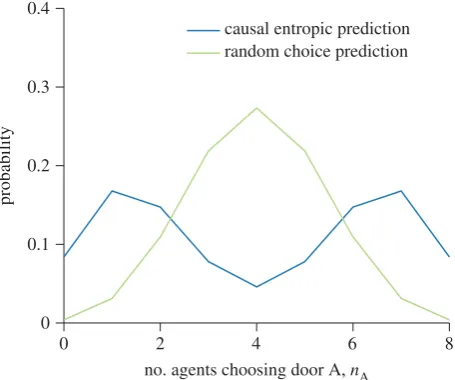
For the case of eight agents picking between these two options, the expected distribution is shown in figure 2, along-side the distribution we would expect if each agent chose a door independently at random. The exact form of the distri-bution varies with the total number of agents, as well as with the number of future options. The figure clearly shows that the CE principle, picking randomly from future options rather than the immediately available ones, induces a greater degree of cohesion on the agents—they are much more likely to choose the same option. This cohesive ‘force’ increases as the difference between the number of options behind each door increases.
3. Collective causal entropic model
We now expand the toy example above to consider more gen-eral collective decisions, where the information about the number of future options is less precise. LettingP(pA) and
P(pB) describe the probability of finding pAandpB future paths behind doors A and B, respectively (assuming for now that these are independent), equation (2.1) generalizes
to an infinite sum of probability-weighted binomial distributions.
P(nAjN)¼
N nA
X1
pA¼0
X1
pB¼0
P(pA)P(pB) p
nA ApN
nA B (pAþpB)N
¼ N
nA
ð1
R¼0
P(R)RnA(1R)NnAdR, (3:1)
whereR¼(pA)/(pAþpB). The key factor in equation (3.1) that controls the number of agents nA choosing door A is the ratioR, the proportion of future options that lie behind door A. The problem of estimating the agents’ behaviour is thus largely a problem of estimatingP(R), the probability of this ratio.
3.1. A distribution for the number of possible futures
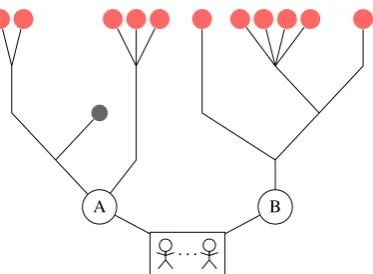
In general, the number of future paths that either A or B may lead to may take any distribution. However, for the purposes of deriving the consequences of a model of collective decision-making, we must determine a specific form forP(pA) andP(pB), and most importantly forP(R). We propose the following method: a continuing branching tree of possible choices, in which each branch leads to an unknown number of future choices (illustrated in figure 3). The number of new choices generated on each branch is determined by some fixed distribution, independent of time. This is a Galton– Watson (GW) process [31]. We stress that the agents themselves need not hold any beliefs about these future choices. Instead, we argue that agents will develop interaction rules that serve to maximize entropy over these possible trees of future choices.
We are interested in the number of nodes on this branch-ing tree after some time windowh—the height of the tree. The Kesten –Stigum theorem [32] states that for any GW process, the distribution on the number of nodes converges to an exponential distribution, conditional on the tree not .. .
B A
world 1: p= 1/ 2
world 2: p= 1/ 2
.. .
[image:3.595.74.265.40.260.2]B A
Figure 1.
Schematic of a toy example illustrating the CE collective model. A
group of agents at the root of the tree must choose between two options: ‘A’
and ‘B’. Two possible worlds exist: one where option A leads to four more
choices and B to one, or one where A leads to one more choice and B to
four. The decision rule for the group that maximizes their future path entropy
averaged over the two possible worlds is a mixture of two binomial
distri-butions, shown in figure 2.
0
no. agents choosing door A, nA
2 4 6 8
0 0.1 0.2 0.3 0.4
probability
[image:3.595.320.548.43.233.2]random choice prediction causal entropic prediction
Figure 2.
An example of predicted decisions by a group of eight agents in a
‘toy’ world: choosing one (unknown) option leads to four possible future
paths, and the other to one. A future path is assigned at random to each
agent, averaging over possible configurations of the future world, where
the four options may be behind choice A or B. The predicted distribution
of
n
A, the number of agents choosing door A, is a weighted sum of binomial
distributions, with far greater cohesion than expected if each agent would
independently choose a door at random.
rsif.r
oy
alsocietypublishing.org
J.
R.
Soc.
Interfa
ce
12
:
20150037
becoming extinct. Thus, including the possibility of extinc-tion, for largeh, the number of options is distributed as
P(p)≃ad(0)þ(1a) 1
zhexp p zh
, (3:2)
wherezis the mean number of descendants of each node in each generation,ais the extinction probability and dis the Dirac delta function. The extinction probability is determined by the fixed point of the generating function for the number of new choices generated on each branching. We will treata
as an adjustable parameter of our model. The behaviour of agents on this tree is determined, via equation (3.1), by the ratio distribution P(R)¼P((pA)/(pAþpB)). Since our assumption is that each new branch of the tree forms an inde-pendent GW process, this takes a simple form
P(R)¼ 1
1þa((1a)þa(d(0)þd(1))): (3:3)
This follows from noting that the ratio X/(XþY) of two identically distributed exponential random variablesX and
Yis a uniformly distributed random variable on (0, 1), and considering the special cases where eitherpAorpBis zero. Instances where both pA and pB are zero are undefined and do not contribute to the calculation. The Dirac delta func-tions are the result of the possible extinction of one branch or the other. The final distribution over the choices ofNagents can be obtained via equation (3.1) and mirrors the distri-bution ofR, with an equal probability of 1 to N– 1 agents choosing door A, and higher probabilities for either 0 orN
agents to do so if a.0. An equivalent model exists for a tree embedded in continuous time: the Yule process [33,34]. Thus the distribution derived for P(R) does not depend on whether the branching process for possible future trees is dis-crete or continuous in time.
3.2. More than two choices
The same principles used to derive the distribution of the agents over two choices can be applied to an arbitrarily higher number of options. To do so, we need the following fact: the proportional ratios of i.i.d. exponential random vari-ablesX1,X2,. . .,XKare beta distributed. Using this fact and
accounting for the probability that one or more of the trees behind each option goes extinct, we may generalize equation (3.3). We have the following probability distribution forR, the proportion of future paths behind one choice, in the case where there areKoptions:
P(R)¼ 1
1aN "
a(1aN1)d(0)þaN1(1a)d(1)
þ(1a)X
N1
i¼1
N1
i
aN1i(1a)ib(R, 1,i)
#
, (3:4)
whereb(R;a,b) represents the beta probability distribution on
Rwith parametersaandb. Asa becomes large, the factors multiplying the beta probability distributions tend to zero faster than the delta function terms, and consensus is still enforced. Each door shares an equal probability of being the consensus choice, reflected in the greater chance that
R¼0 than R¼1. This result mirrors the experimentally observed tendency of, for example, fish to remain as a group when presented with three options [35], though it should be noted that this framework does not provide a clear way to model groups with conflicting preferences—a limitation addressed in the discussion. For all but the highest values ofa, the probability of a consensus decreases with the number of optionsK, implying the common-sense notion that the probability of all agents choosing the same option is reduced as the number of equivalent choices becomes very high.
4. Consequences
4.1. Consensus decision-making
The CE model predicts a tendency for groups of agents to reach a consensus. In the case where the extinction prob-ability is greater than zero, there is a strong entropic ‘bonus’ for agents to remain as a single group, specified by the Dirac delta functions in equations (3.3) and (3.4). How-ever, even in the case where the probability of all but one future tree becoming extinct is effectively zero, such as whenais zero or very small, or when the number of choices is very high, there is still a strong bias towards consensus decisions. For example, in the case that a¼0, in figure 4 we plot the probability that a group of agents of size 2, 3 or 4 will choose the same option fromKindependent choices, compared to the probability of this occurring if each agent makes a choice uniformly at random.
4.2. Social interaction rules
The entropic prediction of collective consensus is fundamen-tally a group-level analysis. Most studies in collective decision-making have started from a model of how individ-uals react to the decisions of others. What individual interaction rules would be necessary to produce the group-level behaviour that our analysis predicts? We can answer this question by considering a single individual choosing . . .
[image:4.595.73.260.38.175.2]B A
Figure 3.
Schematic illustrating the general branching process of future
choices. Each choice leads to an unknown number of future options to
choose between, creating an expanding tree of possible future paths.
The number of new options is generated from a stationary probability
dis-tribution, such that each new branch forms an independent and identically
distributed tree. The total number of options at the top of the tree,
p
, is
distributed according to a GW process. If the probability of generating no
new choices is non-zero, dead-ends can form (black circle) and there is a
probability
a
that the tree will become extinct. The CE collective model
assumes that agents will be uniformly distributed on the final options
(red circles), weighted by the probability of the tree being generated by
a GW process.
rsif.r
oy
alsocietypublishing.org
J.
R.
Soc.
Interfa
ce
12
:
20150037
from two options when the other members of the group have already decided. From equation (3.1), assuming thatnAandnB agents have already assigned themselves to options A and B:
P(AjnA,nB)¼
Ð1
R¼0P(R)RnA
þ1(1R)nBdR
Ð1
R¼0P(R)RnA(1R)
nBdR : (4:1)
If the extinction probability is zero (a¼0), implying that
P(R)¼1, this can be simplified in form to reveal a Weber’s law interaction [36]:
P(AjnA,nB)¼
Ð1
R¼0RnAþ1(1R)nBdR
Ð1
R¼0RnA(1R)nBdR
¼b(nAþ2,nBþ1) b(nAþ1,nBþ1)
¼ nAþ1
nAþnBþ2,
(4:2)
where b is the beta function. This is Weber’s law with one ‘pseudo-observation’ for both A and B, and also corresponds to the expected value of a Bernoulli probability after observing
nAsuccesses andnBfailures, assuming a uniform prior. In the case wherea.0, there exists a special case when eithernAornBis equal to zero. For example, if nA.0 and
nB¼0 then
P(AjnA.0,nB¼0)¼(1
a)b(nAþ2, 1)þa (1a)b(nAþ1, 1)þa
: (4:3)
In this special case, a!1 enforces the same consensus as derived at the group level, since the first agent to commit to option A or B makes the probability of that option for sub-sequent agents approximately equal to one, thus causing an irreversible information cascade.
4.3. Collective intelligence
The entropic enforcement of consensus decisions implies some degree of collective intelligence. To see this, consider the model used by Wardet al.[37] to explain the collective
decisions of groups of varying size. In this ‘many-eyes’ model, if any one agent in a group spots a threat, all agents will avoid it. This implies that the proportion of agents avoid-ing a threat should grow in proportion to the probability that at least one will spot the threat, i.e. 120.5(12d)N, wheredis
the detection probability.
Our model implies a similar result. As the agents them-selves are notactively trying to maximize entropy (instead, social decision rules have evolved that tend to maximize entropy in general), any agent seeing a threat should avoid it. However, once this occurs, the general tendency of the other agents to maintain a consensus means that the group will generally stick together, with a probability determined by the extinction probability of the branching process, closely mimicking the many-eyes model. We can calculate the expected number of agents avoiding a threat as a function of the extinction probability, by conditioning equation (3.1) on a given number, i, detecting the threat and avoiding it, and weighting by the probability of that number of detec-tions, givend.
P(nAavoid threat)¼
XnA
i¼0
N i d
i(1d)Ni
Ni
nAi
Ð1
R¼0P(R)RnA
i(1R)NnAidR
Ð1
R¼0P(R)RidR
#
:
(4:4)
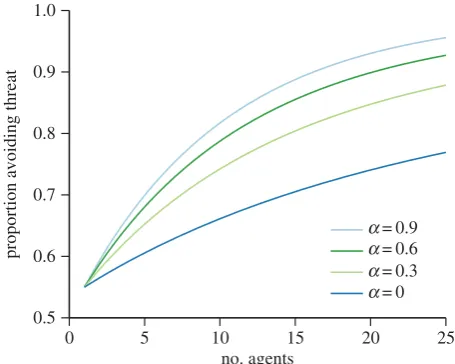
In figure 5, we plot the implied collective intelligence for differ-ent values of the extinction probability, in the case where any given agent has ad¼0.1 chance of detecting a hidden threat, as in the example of Wardet al.[37]. The prediction for high values ofa is essentially identical to the prediction of Ward
et al. [37]. When a is high, consensus is entirely enforced since equation (3.3) tends to the sum of two delta functions. This implies that one agent that spots and avoids the predator is sufficient to cause all group members to avoid it, matching the assumption made by Wardet al.[37].
0 2 4
no. options, K
6 8 10
24
23
22
21
20 PCE
/
P random
N= 4
N= 3
[image:5.595.51.276.41.229.2]N= 2
Figure 4.
The ratio of the probability that a group of
N
agents make the
same choice from
K
options within the CE model, relative to random
chance. Note the log scale on the
y
-axis. The ratio is always above one
for
K
.
1 and increases with both
K
and
N
, indicating the CE model’s
bias towards consensus collective decision-making.
0 5 10 15 20 25
a= 0.9
a= 0.6
a= 0.3
a= 0 0.5
0.6 0.7 0.8 0.9 1.0
no. agents
[image:5.595.317.545.42.224.2]proportion avoiding threat
Figure 5.
The increasing proportion of agents avoiding a threat with a low
detection probability (
d
¼
0.1) as a function of group size, for different
values of the extinction probability on the future paths tree. The greater
the possibility of one or other of the future path trees becoming extinct,
the greater the cohesive force between the agents, and thus the stronger
the information transfer between the detecting agents and the others,
resulting in improved collective intelligence.
rsif.r
oy
alsocietypublishing.org
J.
R.
Soc.
Interfa
ce
12
:
20150037
4.4. Collective motion: derivation of a social force
Set in a discrete space, the model we describe here does not give immediate quantitative predictions about the types of collective motion [38] we would expect in a continuous space. However, we can sketch what such a generalized model would look like. The choice of which direction to move in is a decision like any other, but with many possible options. According to the arguments above, agents in approximately the same spatial location—those who will experience the same branching process of future options— should tend to move in the same direction.For a given type of agent and environment, there is likely to be a typical spatial range over which future option trees are strongly correlated. We can associate this with the zones of interaction found in many models of collective motion, such as the classic Vicsek model [26] and Couzin zonal model [27]. In the case of a relatively confined environment, individ-uals outside of the immediate perceptual range may still experience the same future trees, and this can be expressed in individual interaction terms via a memory of encounters [39], leading to something akin to a mean-field model.
We can discuss the form of interaction rules with refer-ence to a quantitative special case. Assume that in a continuous space, there are Nþ1 agents, of which N are already committed to a particular position. Where should the (Nþ1)th agent position itself? Let Ri¼pi/Pjpj be the
ratio of number of future options atxito the number available
at all other pointsfxjg. At each pointxiin the space-direction
continuum occupied by an agent in f1,. . .,Ng, there is a probability distribution over this ratioP(Rijxi), whereRiare
assumed to be i.i.d. unless two points share the same future tree. Let us further assume a particular form for the distri-bution P(RNþ1jxNþ1): with probability gk, this position
shares a future tree with positionxk. We take this probability
to be defined by a squared exponential decay function
gk¼exp (L1(x
Nþ1xk)2): (4:5)
The probability distribution of possible position choicesnNþ1is determined by a mixture of the possibility thatP(RNþ1jxNþ1) is independent of all other points, and each of the possibilities that xNþ1 shares a future tree with the position of another agent. Again ignoring second-order effects, we have
P(xNþ1)≃ 1
X
k
gk
! Y
i
kRlþX
N
k¼1
gkkR2lY
i=k
kRl
¼mNþ1þX
N
k¼1
gkmN1s2, (4:6)
wherem¼kRlands2¼kR2lm2. We find the optimal position by maximizingP(xNþ1), obtaining
d dxNþ1
XN
k¼1
exp (L1(xNþ1xk)2)¼0, (4:7)
which we identify as the least-squares solution: xNþ1¼ 1=NPNk¼1xk. Therefore, the unique optimal position for agent
Nþ1 is the mean position of all the other agents, implying a social force towards this point proportional to dP(xNþ1)/ dxNþ1. It should be clear that the same argument would apply in relation to the direction choices of other individuals as well, creating an equivalent social force to rotate the agent’s direction towards the average of the group. If the probability of sharing
future trees were correlated between space and direction, then a distance-dependent alignment force would emerge.
5. Discussion
We have demonstrated that the CE principle gives a purely statistical prediction for many of the emergent properties of collective behaviour, without any detailed understanding on the mechanisms of interactions between individuals. Com-pared to previous work applying maximum entropy methods in behavioural ecology (e.g. [20,23]), our approach differs by focusing on dynamical processes rather than static snapshots or equilibrium distributions. As such we measured entropy over paths through state space, following Wissner-Gross & Freer [25], rather than entropy over current positions and velocities. Adopting the taxonomy of modelling approaches described by Sumpteret al. [40], this is a purely global approach to modelling groups and is complementary to a detailed understanding of individual behaviour, rather than a replacement. On the individual level, selection favours those who make decisions which aid their survival and repro-duction. This is entirely consistent with the idea that the group operates with some degree of consensus, as following the decisions of other group members is often individually rational [14–16]. Our claim is that the resulting collective be-haviour can be understood in part from a group-level entropic view without a detailed understanding of how or why individuals interact by considering the probability distribution of all possible futures for the group.
Our model takes a unique approach to understanding the origins of collective behaviour and makes testable predictions about the fundamental form of social interactions. It predicts that interactions between individuals take the form of Weber’s law. This social decision rule has empirical support in the response to various stimuli of several species, e.g. insects [41,42], fish [15] and humans [10,43], as well as a solid grounding in experimental psychology [44] and the psy-chophysical [45] and neurological [46] basis of estimating differences. In continuous spaces, we have shown that reasonable assumptions about the spatial and directional cor-relations between individuals’ futures lead to social forces resembling those of self-propelled particle models, which have also found experimental support [47–49], and which underlie static maximum entropy approaches to collective self-organization [23]. As our model can be shown to be equivalent to Weber’s law interactions and social forces, data supporting these form of interaction would equally support our construction in an empirical test.
However, there are other studies that find that individual decisions are better described by more nonlinear interactions [11,12]. As pointed out by Bialeket al.[23], the fact that a maxi-mum entropy method makes minimal assumptions does not necessarily make it correct. Instead, this should be seen as a basis model for social behaviour, implying that Weber’s law can be considered the most basic form for social interactions. However, observations of apparent nonlinear interactions do not necessarily imply a fundamentally different mechanism. Pernaet al.[42] have shown that an accumulation of Weber’s law interactions, combined with some degree of noise or inac-curacy (which we would expect in any real system) can lead to apparently nonlinear interactions. We therefore suggest that where nonlinear interactions are observed, these may be the
rsif.r
oy
alsocietypublishing.org
J.
R.
Soc.
Interfa
ce
12
:
20150037
result of an accumulation of smaller scale linear interactions, which self-propelled particle models have shown can lead to strongly nonlinear consensus decision-making in moving groups [50,51]. In many experimental set-ups involving animal groups, the choices ultimately made by the individuals are not single events, but the final result of a period of motion where many smaller choices are made, supporting the idea that the final choice can be seen as an accumulation of smaller interactions.
A limitation of our model is the lack of a description of groups with conflicting information or preferences. Variation in information or personality in groups has been shown to be a potentially important driver of collective outcomes [50,52,53]. This could potentially be addressed by assigning different beliefs to each agent about the probability distri-bution on future trees. However, we have deliberately framed our model in terms of a consistent rule that produces a maximum entropy result over all possible futures, rather than assigning entropy-maximizing agency to the individuals themselves. There is no clear reason for individual agents, animal or human, to desire greater entropy over future paths; rather, we consider it as a minimal assumption regard-ing our certainty in which futures may be possible, and which decisions the agents will take. Nonetheless, the view-point could be relaxed to allow the emergence of a more sophisticated model including conflicting groups in the future. The entropic consequences of conflict are therefore an area of importance for future research in this area.
The model described here gives a simple caricature of the types of decisions that face groups of intelligent agents. This abstraction is useful for understanding the logic of how CE maximization implies group behaviours, social interactions and collective intelligence. We have shown how the model might be generalized to a continuous space in consideration of collective motion. Such an expansion of the model could potentially describe the structure of moving animal groups [23,54,55] and patterns of group-level direction changes [56]. More widely, the CE principle may provide a general framework for understanding the dynamics of complex intel-ligent systems, extending from animal groups, through organizations such as corporations and governments, to global human social systems built on the enormous connec-tivity of the Internet. We cannot be sure what series of choices every animal, pedestrian, bureaucrat or social-net-work user will face, or what decisions they will make, over an extended period of time. But precisely this ignorance can help us to predict what they will do next.
Acknowledgements. We thank Seth Frey and one anonymous referee, whose reviews substantially improved this manuscript.
Funding statement. R.P.M. was supported by ERC Starting grant ‘IDCAB’ reference no. 220/104702003 to David J. T. Sumpter and ERC Advanced Investigator Grant ‘Momentum’ reference no. 324247 to Dirk Helbing. R.G. was supported by the German Science Foundation (DFG) under the reference no. GA 1615/1-1.
References
1. Surowiecki J. 2005The wisdom of crowds. New York, NY: Random House LLC.
2. Woolley AW, Chabris CF, Pentland A, Hashmi N, Malone TW. 2010 Evidence for a collective intelligence factor in the performance of human groups.Science330, 686 – 688. (doi:10.1126/ science.1193147)
3. Sumpter D. 2010Collective animal behavior. Princeton, NJ: Princeton University Press. 4. Rokach L. 2010 Ensemble-based classifiers.Artif. Intell.
Rev.33, 1–9. (doi:10.1007/s10462-009-9124-7) 5. Simons AM. 2004 Many wrongs: the advantage of
group navigation.Trends Ecol. Evol.19, 453 – 455. (doi:10.1016/j.tree.2004.07.001)
6. Seeley TD. 2010Honeybee democracy. Princeton, NJ: Princeton University Press.
7. Wolfers J, Zitzewitz E. 2006Prediction markets in theory and practice, Working Paper 12083. Cambridge, MA: National Bureau of Economic Research. 8. Salganik M, Dodds P, Watts D. 2006 Experimental
study of inequality and unpredictability in an artificial cultural market.Science311, 854 – 856. (doi:10.1126/science.1121066)
9. Hedstrom P, Liu K-Y, Nordvik MK. 2008 Interaction domains and suicide: a population-based panel study of suicides in Stockholm, 1991 – 1999.Soc. Forces87, 713 – 740. (doi:10.1353/sof.0.0130) 10. Mann RP, Faria J, Sumpter DJT, Krause J. 2013 The
dynamics of audience applause.J. R. Soc. Interface
10, 20130466. (doi:10.1098/rsif.2013.0466)
11. Sumpter D, Krause J, James R, Couzin I, Ward A. 2008 Consensus decision making by fish.Curr. Biol.
18, 1773 – 1777. (doi:10.1016/j.cub.2008.09.064) 12. Ward AJW, Sumpter DJT, Couzin ID, Hart PJB, Krause
J. 2008 Quorum decision-making facilitates information transfer in fish shoals.Proc. Natl Acad. Sci. USA105, 6948 – 6953. (doi:10.1073/pnas. 0710344105)
13. Ward A, Krause J, Sumpter D. 2012 Quorum decision-making in foraging fish shoals.PLoS ONE7, e32411. (doi:10.1371/journal.pone.0032411) 14. Pe´rez-Escudero A, De Polavieja G. 2011 Collective
animal behavior from bayesian estimation and probability matching.PLoS Comput. Biol.7, e1002282. (doi:10.1371/journal.pcbi.1002282) 15. Arganda S, Pe´rez-Escudero A, De Polavieja G. 2012
A common rule for decision making in animal collectives across species.Proc. Natl Acad. Sci. USA109, 20 508 – 20 513. (doi:10.1073/pnas. 1210664109)
16. Easley D, Kleinberg J. 2010Networks, crowds, and markets: reasoning about a highly connected world. Cambridge, UK: Cambridge University Press.
17. Mann RP, Herbert-Read JE, Ma Q, Jordan LA, Sumpter DJ, Ward AJW. 2013 A model comparison reveals dynamic social information drives the movements of humbug damselfish (Dascyllus aruanus).J. R. Soc. Interface11, 20130794. (doi:10. 1098/rsif.2013.0794)
18. Jaynes ET. 1957 Information theory and statistical mechanics.Phys. Rev.106, 620 – 630. (doi:10.1103/ PhysRev.106.620)
19. Harte J, Zillio T, Conlisk E, Smith A. 2008 Maximum entropy and the state-variable approach to macroecology.Ecology89, 2700 – 2711. (doi:10. 1890/07-1369.1)
20. Harte J. 2011Maximum entropy and ecology: a theory of abundance, distribution, and energetics. Oxford, UK: Oxford University Press.
21. Niwa H-S. 2003 Power-law versus exponential distributions of animal group sizes.J. Theor. Biol.
224, 451 – 457. (doi:10.1016/S0022-5193(03) 00192-9)
22. Ma Q, Johansson A, Sumpter DJ. 2011 A first principles derivation of animal group size distributions.J. Theor. Biol.283, 35 – 43. (doi:10. 1016/j.jtbi.2011.04.031)
23. Bialek W, Cavagna A, Giardina I, Mora T, Silvestri E, Viale M, Walczak AM. 2012 Statistical mechanics for natural flocks of birds.Proc. Natl Acad. Sci. USA109, 4786 – 4791. (doi:10.1073/pnas. 1118633109)
24. Niven RK. 2009 Steady state of a dissipative flow-controlled system and the maximum entropy production principle.Phys. Rev. E80, 021113. (doi:10.1103/PhysRevE.80.021113)
25. Wissner-Gross A, Freer C. 2013 Causal entropic forces.Phys. Rev. Lett.110, 168702. (doi:10.1103/ PhysRevLett.110.168702)
rsif.r
oy
alsocietypublishing.org
J.
R.
Soc.
Interfa
ce
12
:
20150037
26. Vicsek T, Cziro´k A, Ben-Jacob E, Cohen I, Shochet O. 1995 Novel type of phase transition in a system of self-driven particles.Phys. Rev. Lett.75, 1226 – 1229. (doi:10.1103/PhysRevLett.75.1226) 27. Couzin ID, Krause J, James R, Ruxton GD, Franks NR.
2002 Collective memory and spatial sorting in animal groups.J. Theor. Biol.218, 1 – 11. (doi:10. 1006/jtbi.2002.3065)
28. Helbing D, Molnar P. 1995 Social force model for pedestrian dynamics.Phys. Rev. E51, 4282 – 4286. (doi:10.1103/PhysRevE.51.4282)
29. Helbing D, Johansson A. 2009 Pedestrian, crowd and evacuation dynamics. InEncyclopedia of Complexity and Systems Science(ed. R Meyers). Heidelberg, Germany: Springer.
30. Helbing D, Mukerji P. 2012 Crowd disasters as systemic failures: analysis of the Love Parade disaster.EPJ Data Sci.1, 7. (doi:10.1140/ epjds7)
31. Watson HW, Galton F. 1875 On the probability of the extinction of families.J. Anthropol. Inst. Great Britain Ireland4, 138. (doi:10.2307/2841222) 32. Kesten H, Stigum BP. 1966 A limit theorem for
multidimensional Galton – Watson processes.Ann. Math. Stat.37, 1211 – 1223. (doi:10.1214/aoms/ 1177699266)
33. Yule GU. 1925 A mathematical theory of evolution, based on the conclusions of Dr. J. C. Willis, F.R.S.
Phil. Trans. R. Soc. Lond. B213, 21 – 87. (doi:10. 1098/rstb.1925.0002)
34. Simon HA. 1955 On a class of skew distribution functions.Biometrika42, 425 – 440. (doi:10.1093/ biomet/42.3-4.425)
35. Miller N, Garnier S, Hartnett AT, Couzin ID. 2013 Both information and social cohesion determine collective decisions in animal groups.Proc. Natl Acad. Sci. USA110, 5263 – 5268. (doi:10.1073/pnas. 1217513110)
36. Weber EH. 1834De Pulsu, resorptione, auditu et tactu: Annotationes anatomicae et physiologicae. . .. Leipzig, Germany: CF Koehler.
37. Ward A, Herbert-Read J, Sumpter D, Krause J. 2011 Fast and accurate decisions through collective vigilance in fish shoals.Proc. Natl Acad. Sci. USA
108, 2312 – 2315. (doi:10.1073/pnas.1007102108) 38. Vicsek T, Zafeiris A. 2012 Collective motion.Phys. Rep.
517, 71–140. (doi:10.1016/j.physrep.2012.03.004) 39. Mann RP, Perna A, Garnett R, Herbert-Read JE,
Sumpter DJT, Ward AJW. 2013 Multi-scale inference of interaction rules in animal groups using Bayesian model selection.PLoS Comput. Biol.9, e1002961. (doi:10.1371/journal.pcbi.1002961)
40. Sumpter DJT, Mann RP, Perna A. 2012 The modelling cycle for collective animal behaviour.Interface Focus2, 764–773. (doi:10.1098/rsfs.2012.0031)
41. Smith BH, Getz WM. 1994 Nonpheromonal olfactory processing in insects.Annu. Rev. Entomol.39, 351 – 375. (doi:10.1146/annurev.en.39.010194.002031) 42. Perna A, Granovskiy B, Garnier S, Nicolis SC, Labe´dan
M, Theraulaz G, Fourcassie´ V, Sumpter DJ. 2012 Individual rules for trail pattern formation in Argentine ants (Linepithema humile).PLoS Comput. Biol.8, e1002592. (doi:10.1371/journal.pcbi.1002592) 43. Deco G, Scarano L, Soto-Faraco S. 2007 Weber’s law in decision making: integrating behavioral data in humans with a neurophysiological model.
J. Neurosci.27, 11 192 – 11 200. (doi:10.1523/ JNEUROSCI.1072-07.2007)
44. Stevens SS. 1957 On the psychophysical law.
Psychol. Rev.64, 153 – 181. (doi:10.1037/h0046162) 45. Johnson KO, Hsiao SS, Yoshioka T. 2002 Book
review: neural coding and the basic law of psychophysics.Neurosci.8, 111 – 121. (doi:10.1177/ 107385840200800207)
46. Dehaene S. 2003 The neural basis of the Weber – Fechner law: a logarithmic mental number line.
Trends Cogn. Sci.7, 145 – 147. (doi:10.1016/S1364-6613(03)00055-X)
47. Katz Y, Tunstrom K, Ioannou C, Huepe C, Couzin I. 2011 Inferring the structure and dynamics of interactions in schooling fish.Proc. Natl Acad. Sci. USA108, 18 720– 18 725. (doi:10.1073/pnas.1107583108)
48. Herbert-Read J, Perna A, Mann R, Schaerf T, Sumpter D, Ward A. 2011 Inferring the rules of interaction of shoaling fish.Proc. Natl Acad. Sci. USA108, 18 726 – 18 731. (doi:10.1073/pnas. 1109355108)
49. Gautrais J, Ginelli F, Fournier R, Blanco S, Soria M, Chate´ H, Theraulaz G. 2012 Deciphering interactions in moving animal groups.PLoS Comput. Biol.8, e1002678. (doi:10.1371/journal.pcbi.1002678) 50. Couzin ID, Krause J, Franks NR, Levin SA. 2005
Effective leadership and decision-making in animal groups on the move.Nature433, 513 – 516. (doi:10.1038/nature03236)
51. Leonard NE, Shen T, Nabet B, Scardovi L, Couzin ID, Levin SA. 2012 Decision versus compromise for animal groups in motion.Proc. Natl Acad. Sci. USA
109, 227 – 232. (doi:10.1073/pnas.1118318108) 52. Couzin I, Ioannou C, Demirel G, Gross T, Torney C,
Hartnett A, Conradt L, Levin S, Leonard N. 2011 Uninformed individuals promote democratic consensus in animal groups.Science334, 1578 – 1580. (doi:10.1126/science.1210280)
53. Aplin LM, Farine DR, Mann RP, Sheldon BC. 2014 Individual-level personality influences social foraging and collective behaviour in wild birds.Proc. R. Soc. B
281, 20141016. (doi:10.1098/rspb.2014.1016) 54. Ballerini Met al. 2008 Interaction ruling animal
collective behavior depends on topological rather than metric distance: evidence from a field study.
Proc. Natl Acad. Sci. USA105, 1232 – 1237. (doi:10. 1073/pnas.0711437105)
55. Ballerini M, Cabibbo N, Candelier R, Cavagna A, Cisbani E, Giardina I, Orlandi A, Parisi G, Procaccini A . 2008 Empirical investigation of starling flocks: a benchmark study in collective animal behaviour.
Anim. Behav.76, 201 – 215. (doi:10.1016/j.anbehav. 2008.02.004)
56. Buhl J, Sumpter D, Couzin I, Hale J, Despland E, Miller E, Simpson S. 2006 From disorder to order in marching locusts.Science312, 1402 – 1406. (doi:10. 1126/science.1125142)