Rochester Institute of Technology
RIT Scholar Works
Theses
Thesis/Dissertation Collections
6-1-1972
Statistical Separation of Objects in Shadows from
Objects in Daylight in an Aerial Scene
David Valvo
Follow this and additional works at:
http://scholarworks.rit.edu/theses
This Thesis is brought to you for free and open access by the Thesis/Dissertation Collections at RIT Scholar Works. It has been accepted for inclusion
in Theses by an authorized administrator of RIT Scholar Works. For more information, please contact
.
Recommended Citation
Rochester
Institute
ofTechnology
Rochester,
New York
CERTIFICATE
OF APPROVAL
A
Paper
Presented
In
Lieu
Of
A Master's
Thesis
This
is
to
certify
that
the
requirementfor
aMaster's
Thesis
for
David
J.
Valvo
with a majorin
Photographic Science
has
been
wavedby
the
Thesis
Committee
withthe
submission of a paperin
lieu
ofthe
thesis
for
the
Master
ofScience
degree
atthe
convocation ofJune
10,
1972.
Thesis
Committee:
Thesis
adviserGraduate
adviserSTATISTICAL
SEPARATION
OF
OBJECTS
IN
SHADOWS
FROM OBJECTS
IN
DAYLIGHT
IN
AN AERIAL
SCENE
by
David
J.
Valvo
A
paper presentedin
lieu
of athesis
to
demonstrate
the
ability
to
performthe
research and analysis of athesis
whichusually
is
submittedin
partialfulfillment
ofthe
requirements
for
the
degree
ofMaster
ofScience
in
Photographic
Science
in
the
College
ofGraphic
Arts
andPhotography
ofthe
Rochester
Institute
ofTechnology.
June
1972
ACKNOWLEDGEMENTS
I
wishto
express sincere appreciationto
Professors
Gerhard
W.
Schumann
andJohn
F.
Carson
ofthe
Rochester
Institute
ofTechnology
for
their
assistance and guidancein preparing
this
document.
Appreciation
is
also extendedto
my understanding
wife,
Angela,
whosediligence
andtyping
expertice wereinvaluable
at all phases ofthis
study.
11
TABLE
OF
CONTENTS
List
ofTables
iv
List
ofFigures
vAbstract
1
Introduction
1
Discussion
6
Experimental
Design
6
Data
Analysis
8
Results
14
Conclusion
20
References
21
LIST
OF
TABLES
Table
1.
Five
Step
Gray
Scale
Table
2.
Statistical
Comparison
Of
Total,
Folded And
Shadow
Distributions
Table
3.
Statistical
Comparison
Of
Folded
And
Shadow
Distri
butions
Adjusted For
Differences
In
Illumination
LIST
OF
FIGURES
Figure
1.
Peculiar
"Hump"Seen
On
Many Log
E
Distributions
Figure
2.
Depicts
Camera
Line
Of
Sight
Coincident
With
Earth-Sun
Line
Figure
3.
The
Same
Building
And
Road
Are
Shown
With
Two
Types
Of
Illumination
Figure
4.
Experimental
Geometry
Figure
5.
Raster
Scan
Depicting
Collection
Of
Density
Data
Points
Figure
6.
Linear
Regression
Fit
Of
Target
Reflectances
To
Corresponding
Exposure
Recorded
On
Film
Figure
7.
Upper
Portion
Of
Distribution
Folded About
Mode
Figure
8.
Folded
Distribution
Subtracted
From Total
Distribu
tion
To
Give
"Shadow"Distribution.
. .ExaggeratedSTATISTICAL
SEPARATION
OF OBJECTS
IN
SHADOWS
FROM
OBJECTS
IN
DAYLIGHT
IN AN
AERIAL
SCENE
by
David
J.
Valvo
An
Abstract
A
paper presentedin
lieu
of athesis
to
demonstrate
the
ability
to
performthe
research and analysis of athesis
whichusually
is
submittedin
partialfulfillment
ofthe
requirements
for
the
degree
ofMaster
ofScience
in
Photographic
Science
in
the
College
ofGraphic
Arts
andPhotography
ofthe
Rochester
Institute
ofTechnology.
June
1972
ABSTRACT
Objects
photographedin
an aerial scene are orderedinto
frequency
histograms
in
terms
oflog
exposure onthe
film.
A
statistical analysis showsthat
eachdistribution
actually
contains
two
separatedistributions;
one of objectsin
daylight,
the
other of objectsin
shadows.The
difference
is
due
to
a variation
in
apparentluminance
ofthe
objects.For
example,
as an asphalt road passes
in
and out of ashadow,
its
absolute
reflectancedoesn't
changebut
its
apparentluminance
does.
It
is
also shownthat
the
ratio ofthe
derived
shadowdistribution
to
the
daylight
distribution
is
exactly
the
sameINTRODUCTION
For
aerialphotography
the
earth's atmospheresufficiently
lowers
the
contrast of objectsto
warrantthe
use ofhigh
contrast
films.
The
use ofhigh
contrastfilms,
onthe
otherhand,
reducesthe
exposurelatitude
thus
mandating
the
best
exposure
the
first
time.
To
evaluate aerialphotography
for
quality
ofexposure,
one convenient methodis
to
collectdensities
from
photographs of urban areas with amicrodensi-tometer
and orderthem
into
afrequency
distribution.
The
density
distribution
may be
easily
transformed
into
alog
exposure
distribution
through
conversionsusing
the
processcurve.
The
exposure analysisthen
evaluatesthe
statisticsof
the
distribution,
i.e.,
the
two
sigmalimits,
modes,
andmeans.
Mees1
reported
the
work ofJones
andCondit
and statedthat
log
luminance
distributions
are symmetrical aboutthe
averagefor
outdoor scenes.The
authorhas
also observedthe
symmetry
of
many
log
exposure(E)
distributions
which are relatedto
log
luminance
distributions
by
a constant.The
symmetry
may
imply
that
these
distributions
arelog
normal.In
any
event,
it
has
been
notedthat
many
log
E
distributions
are characterized
by
a peculiar "hump" onthe
left
side(Figure
1).
The
Figure
1.
PECULIAR
"HUMP"SEEN ON
MANY
LOG E
DISTRIBUTIONS
Mean
o
pJ <D
U u o U o
o o
P5
c* <o u
tu
[image:11.548.113.494.169.598.2]Sorem
et. al.2*3in
1965
notedthe
"hump"in many
oftheir
log
luminance
distributions
and suggestedthat
it
may
be
due
to
the
existance of shadowsin
the
scene.If
indeed
the
existance of
the
"hump"is
due
to
the
presence ofshadows,
then
it
is
entirely
possiblethat
an aerialdistribution
contains
two
sets ofdata...
one of objectsin
daylight,
the
other of similar objects
but
in
shadows,
both
mixedtogether
and not
easily
distinguishable
in
the
collectedmicrodensi-tometer
data.
To
test
this
hypothesis,
there
arefive
(5)
methods:1.
Photograph
an urban area whenthe
sun angleis
exactly
90
degrees.
This
would eliminate all shadows sincethe
sun wouldbe
directly
overheadand
the
distribution
shouldbe
symmetrical.
Unfortunately,
a90
degree
solar altitude will not occur atlatitudes
greaterthan
23
degrees
which makes
it
impossible
to
obtain aerialphotography
and stillstay
withinthe
conti nentalUnited
States.
2.
Alternate
to
1.
is
to
obtain an aerial photographjust
after sunsetto
give an urban area as all"shadows".
Unfortunately,
this
would present a spectralenergy
distribution
unlikethat
during
the
day.
Nevertheless,
an attemptto
obtain aerialphotography
atdusk
was madebut
proved unfruitfuldue
to
underexposure andimage
motion.3.
An
aerial scenewith
and without shadows couldbe
selectively
scanned so asto
collect sunlitdata
pointsseparately
from
shadowdata
points.
A
gray
scalein
the
shadows would allow propershadow reflectance conversion.
Unfortunately,
this
would require considerable micro-D operatortime
andthe
selection areasmay be
biased
to
4.
There
is
one specific case which atfirst
thought
might
lend
itself
to
the
collection ofdata
withthe
absence of shadows.This
case exists(other
than
for
case1
above)
whenthe
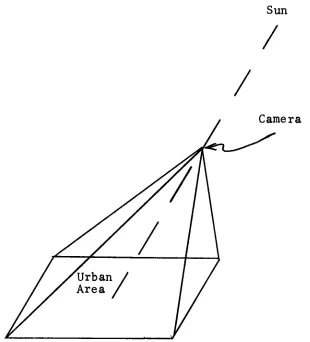
camerapointing
vector
is
perfectly
aligned withthe
sun'spointing
vector(Figure
2)
.This
situationdepends
strongly
onthe
time
ofday
andis
very
difficult
to
obtain.The
absence of shadowswould exist
only
in
a plane abovethe
direct
line
of sight ofthe
camera.The
camera notbeing
atinfinity
would see shadowsto
the
left,
right andbottom
ofthe
field
of viewmaking
this
technique
unacceptable.5.
As
an asphalt road passesfrom
sunlightinto
a
building's
shadow,
the
illuminance
changesfrom
daylight
to
skylight.The
aerial photograph,
in
recording
whatis
seen,
doesn't
discriminate
adifference
in
illumination
from
a
difference
in
reflectance.It
wouldbe
possible
then,
to
statistically
analyzelog
exposuredistributions
in
terms
oflog
%
reflectance(R)
distributions.
The
analysis wouldtest
eachdistribution
for
normality
conjecturing
that
the
observedlog
%
R
distribution
actually
contains
two
separatedistributions
of:a.
Sunlit
objectsb.
Similar
objectsbut
in
shadowsMethod
5
was selectedfor
the
analysis and willbe
discussed
in
detail.
The
luminous
emittance(M)
of an objectis
proportionalto
the
reflectionfactor
ofthat
object(R)
times
the
illuminance
(I
)
incident
uponit.
Any
changein
illuminance
will resultin
adirect
changein
luminous
emittance ofthat
object.Therefore,
any
givenobject will
have
a constant reflectanceproviding
there
is
no change
in
the
direction
orthe
spectralquality
ofthe
illuminant.
This
paperdoes
not attemptto
considerany
of
the
spectral variations ofdaylight,
skylight,
objects,
and/or
their
relationshipsto
each other.Thus,
allthe
objects are considered as
being
gray
andLambertian
diffusors
as a good
first
order approximation.Figure
2.
DEPICTS
CAMERA
LINE
OF
SIGHT
COINCIDENT
WITH
EARTH
-SUNLINE
Sun
/
/
[image:14.548.109.419.383.725.2]DISCUSSION
Experimental
Design
The
acquisitionplanning
is
quiteimportant
to
successfully
perform
the
experiment.Advance
consideration mustbe
givento
sunangle,
camerapointing
angles andthe
direction
ofthe
shadows.The
mostfrequently
used aerial photographicpointing
angleis
straightdown
(vertical)
.This
angle mustbe
included
in
the
experiment as well asphotography
at angles otherthan
vertical.
If
the
obliquity
angles(angles
otherthan
vertical)
are chosen such
that
they
look
atbuilding
sidesboth
in
andout of
shadows,
the
frequency
ofthe
same objectboth
in
andout of shadows will
be
increased.
To
illustrate,
the
building
in
Figure
3
has
one side surfaceilluminated
by
daylight,
andthe
other sideby
skylight.The
roadby
the
building
is
in
daylight
as well asin
shadows.The
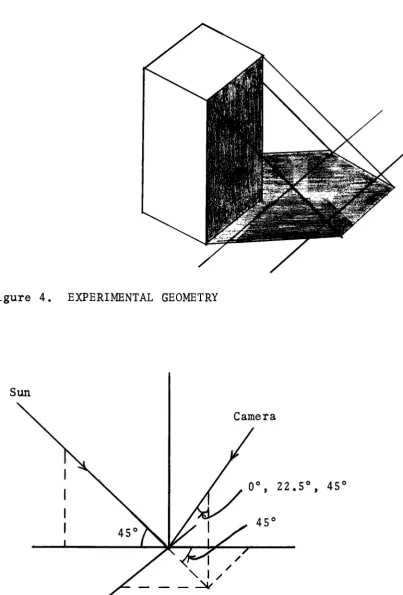
camerapointing
angles were selectedto
be
0,
22.5
and45
degrees
from
vertical.For
geometricalreasons,
the
sunangle at
the
time
ofphotography
was selectedto
be
45
degrees.
The
projection ofthe
camera'sline
of sight onthe
earthformed
a45
degree
angle withthe
projection ofthe
sun'svector on
the
earth(Figure
4)
.Two
replicates at each cameraFigure
3.
THE
SAME
BUILDING AND
ROAD ARE
SHOWN
WITH
TWO
TYPES
OF
ILLUMINATION
Figure
4.
EXPERIMENTAL
GEOMETRY
Sun
Camera
[image:16.548.61.465.119.715.2] [image:16.548.74.412.485.719.2]To
accomplishthe
calibration and correlatethe
absolutereflectance of ground objects
to
the
exposures received onthe
film,
afive
step
gray
scale withknown
reflectances
was
laid
out on aflat
ground surface.Data Analysis
Only
those
processed negativesthat
containedgray
scaleswere selected
for
analysis.The
same urban area was scannedin
eachframe
selectedusing
aGAF
Model
650
microdensitometer.The
scanning
processis
similarto
aTV
raster suchthat
data
are collected
automatically
in
lines
but
in
discrete
incre
ments as shown
in
Figure
5.
Figure
5.
RASTER SCAN
DEPICTING
COLLECTION
OF
DENSITY
DATA
POINTS
TOOOO^
Each
circle represents atwo
foot
ground area andis
onedata
point.
The
output wasautomatically
punched out oncomputer cards
in
terms
directly
proportionalto
the
voltageoutput of
the
microdensitometer.The
process controlstrip
with
known
densities
was also scanned withthe
microdensitometer
to
correlatethe
voltage outputto
density
andultimately
to
log
E.
Exacting
control was maintainedby
keeping
an undeveloped process controlstrip
frozen
in
dry
ice
and removed atthe
end ofthe
actual photography.Any
latent
image
failure
that
occurredto
the
flight
roll wouldthen
also occurto
the
control strip.A
computer programthen
generated afrequency
histogram
in
terms
oflog
E
from
the
cardinput
data.
Exposure
is
linearly
relatedto
reflectanceby:
E
= axR +a2
where
E
= exposure received onthe
film
R
= object reflectancea2
= a constantto
be
determined
by
linear
regressionanalysis and
is
the
intercept
ofthe
exposureaxis where
the
reflectanceis
theoretically
zero.
a2
is
the
exposuredue
to
atmospherichaze
luminance
whichis
non-imageforming
10
a.l
= a constant alsoto
be
determined
by
linear
regression and
is
the
actinictransmission
factor
ofthe
atmosphere.If
the
transmit
tance
was1.00,
the
slope wouldbe
45
degrees
and
a^
wouldbe
zero.This
condition willoccur
only
in
the
absence of an atmosphere.Five
large
gray
panels were placedin
the
scene whosereflectances were measured
by
a spectrophotometer.The
spectral reflectance
data
wasintegrated
overthe
same wavelength
region asthe
photography
and shownin
Table
1.
The
five
step
gray
scale when photographed at altitude willprovide a method of
converting
the
log
exposures receivedon
the
film
to
log
%
R
onthe
ground.Table
1.
FIVE
STEP
GRAY
SCALE.
. .MEASUREDREFLECTANCES
AND
CORRESPONDING
FILM EXPOSURES
%
R
Log
E
E_
4.5
7.51
.03247.5
7.60
.039813.4
7.74
.055026.0
7.88
.075911
Figure
6.
LINEAR
REGRESSION
FIT
OF
TARGET
REFLECTANCES
TO
CORRESPONDING
EXPOSURE
RECORDED
ON
FILM
U
o
X
VI
.12C
-.100
-.060
-.040
"
.020
-Regression
Intercept
Regression
Slope
.027100
.001817
10
20
30
I
Reflectance
T"
[image:20.548.44.530.131.713.2]12
The
equations'*used
in
the
regression are:5ZER
-SEER
*,-..,
a, =
; = .001817
1 5ZR2
- (ZR)2
a _
SESR2
-
ZERZR
n,,in.
&2
"5ZR*
-(ZIP
=
-027100
The
regressionline
and actualdata
pointfit
are shownin
Figure
6.
The
log
E
distribution
may
nowbe
convertedto
alog
%
R
distribution.
To
test
the
theory
proposedin
the
introduction
that
there
arein
actuality
two
distributions,
the
statistical analysisbegins
by
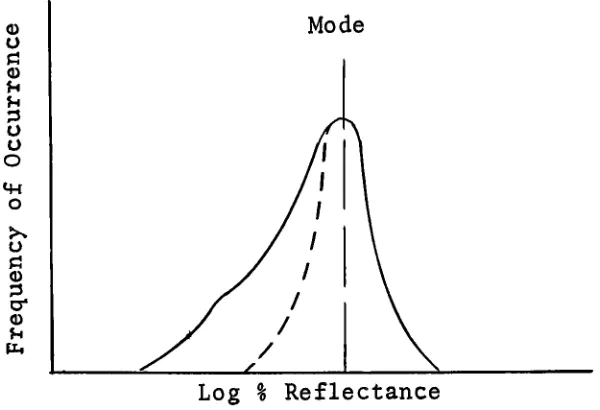
folding
the
upperdistri
bution
data
aboutthe
mode suchthat
a symmetricaldistribution
is
formed
as shownin
Figure
7.
The
folded
distribution
is
subtractedthen
from
the
total
distribution
to
producea remainder or "shadow"
distribution
shownin
Figure
8.
A
special computer program was writtento
do
the
manipulationsas well as perform
the
statistics.Chi-square
tests
to
checkfor normalcy
were performed onthe
total,
folded
and "shadow"13
Figure
7.
UPPER PORTION
OF
DISTRIBUTION
FOLDED
ABOUT
MODE
Log
%
Reflectance
Fieure
8.
FOLDED
DISTRIBUTIONSUBTRACTED
FROM
TOTAL
-DISTRIBUTION
TO
GIVE
"SHADOW"
DISTRIBUTION,
EXAGGERATED
Mode
[image:22.548.142.442.150.355.2]14
RESULTS
The
results are summarizedin
Table
2
for
eachdistribution
A
through
F
making
atotal
of18
distributions
evaluated.The
hypothesis
that
the
distributions
are normalis:
H
:(0
- E)2 -.0
nullhypothesis
Ht:
(0
- E)2 >0
alpha risk =.10
where:
0
is
the
observedfrequency
E
is
the
expectedfrequency
To
interpret
the
statistics pfTable
2,
the
last
column shows:1.
None
ofthe
distributions
from
the
verticalphotography
are normal.2.
Some
ofthe
distributions
are accepted as normalfor
the
sidelooking
photography
(22.5 and45).
The
statistical acceptance meansthere
is
noreason
to
believe
that
the
distributions
arenot normal.
3.
It
appearsthat
there
is
alarger
incidence
normalcy
atthe
larger pointing
angles (45 as opposedto
22.
5)
.The
hypothesis
then
implies
that
there
areindeed
two
distri
butions;
one of objectsin
sunlight andthe
other of similarobjects
but
in
shadows.There
was one assumption madethat
may have
alteredthe
resultsIn
every
casethe
distributions
werefolded
aboutthe
mode.
16
Table
2.
STATISTICAL
COMPARISON OF
TOTAL,
FOLDED AND SHADOW
DISTRIBUTIONS
Angle
of
View
Di
stributionCalculated
x2
Degrees
ofFreedom
Table
X2 ~51.8
34.4
37.9
Based
onNull
Figure
9.
ILLUMINANCE
OF
DAYLIGHT
AND SKYLIGHT ON
VERTICAL
AND
HORIZONTAL
PLANES
(JONES AND
CONDIT)
17
-
8000
-DAYLIGHT
/
-6000
/Vertical
/Horizontal
-4000
-200QT
Vertical
Horizontal
i i i i
SKYLIGHT
10
20
30
40
Solar Altitude
(degrees)
[image:25.548.18.527.62.743.2]15
mean often
lies,
far
enoughfrom
the
modeto
makethe
folded
distribution bi-modal
andthe
"shadow"distribution
negative.
It
is
believed
that
the
mode was a good choice.Table
2
showsthat
none ofthe
verticaldistributions
arenormal.
A
reasonmay
be
that
in
the
verticalphotography,
the
roofing
material
of abuilding
in
sunlightmay be
different
than
onein
shadows.
Whereas,
in
the
sidelooking
photography,
the
samebuilding
couldbe
in
a shadow as well asin
sunlight(as
shownin
Figure
3)
.The
sidelooking
photography
wouldhave
ahigher
incidence
of similar objects whichmay be
significant.
To
further
substantiatethe
abovepossibility,
an adjustmentof
the
"shadow"distribution
may
be
madefor
the
difference
in
daylight
to
skylightillumination.
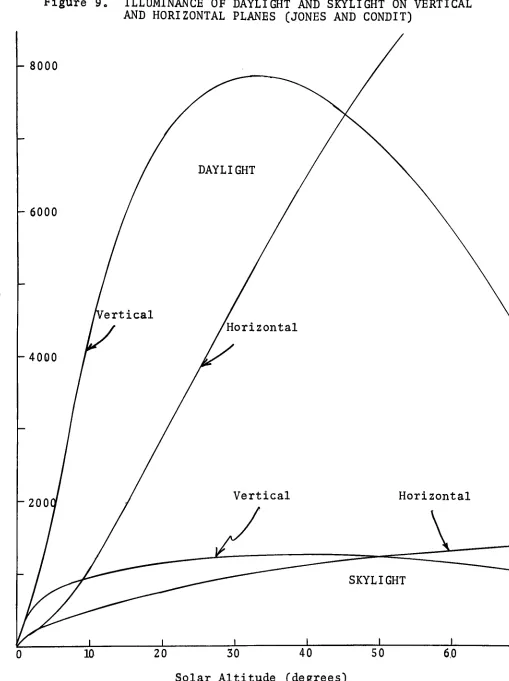
Jones
and Condit5report
the
data
shownin
Figure
9
and show alog
ratio of1.2:1
at45
degrees
sun angle.Inasmuch
asthe
distributions
are normal at
the
larger
pointing
angles,
only
the
meansneed
be
compared.The
questionis
then:.... Is
the
shadowobject mean reflectance similar
to
daylight
object meanreflectance when
its
illumination
is
adjustedto
be
the
same as
daylight?
As
ahypothesis...
H0
H
shadow=
y
daylight
H:
y
18
The
test
statisticis:
(*i
-%2)
-CUx
-U2)
a rxp
(xT
-x2)
where:
Pi
-U2
=0
a
_
=
sD
-yTll
(xx
-x2)
p
v +ir:
As
is
shownin
Table
3,
for
01 =.05 and
t
=1.96,
the
studentt
values are quite
high.
Therefore,
it
is
not possibleto
rejectthe
null andthe
hypothesis
that
the
means arethe
sameis
true
to
within95%
probability.Therefore,
there
is
no evidence of significant
difference
in
the
two
averages compared andthe
objects19
Table
3.
STATISTICAL
COMPARISON OF
FOLDED
AND
SHADOW
DISTRIBUTIONS ADJUSTED FOR
DIFFERENCES
IN
ILLUMINATION
Distribution
Mean
sAdjusted
ns
a(~7
-^Log
%
R
Means
P
(Xl
'
*z)
Log
%
R
D
Folded
1.39
0.14
1.39
201
,.165 .0192
20.8
D
Shadow
.990.19
1.20
117
E
Folded
1.44
0.08
1.44
56
.085 .0129
11.6
E
Shadow
1.29
0.09
1.56
190
F
Folded
1.53
0.09
1.53
57
.10 .0147
12.9
20
CONCLUSION
Log
%
reflectancedistributions
obtained atobliquity
anglesgreater
than
22.5
degrees
containtwo
log
normaldistributions
One
that
contains objectsin
daylight
andthe
otherthat
contains similar objects
in
the
shadows.The
difference
is
apparently due
to
adifference
in
illuminance
andthe
statistics show
that
the
ratio ofthe
two
distributions
are21
REFERENCES
1.
Mees,
C.
E.,
The
Theory
ofthe
Photographic
Process,
Macmillan Co.
,New
York,
1954.
''
2.
Sorem,
A.
L.,
Fritz,
N.,
Speckt,
R.
,"Luminance
Distributions
in
Aerial
Scenes",
S.P.S.E.
Convention,
May 17-21,
1965.
3.
Sorem,
A.
L.,
"Luminance
Characteristics
ofAerial
Scenes",
Part
I.,
S.P.S.E.
Convention,
April
29,
1963,
4.
Rickmers,
A.
D.
andTodd,
H.
N.
,Statistics:
An
Introduction,
p.251,
McGraw-Hill
Book
Company,
Inc.
New
York,
1967.
5.
Jones,
L.
A.
andCondit,
H.
R.
,"Sunlight
and