Identification of Basic Phrases for Kazakh Language using
Maximum Entropy Model
Gulila Altenbek*
,+Xiaolong Wang* Gulizhada Haisha
+*School of Computer Science and Technology, Harbin Instituteof Technology,150001,China.
+
College of Information Science and Engineering, Xinjiang University,830046, China.
+
The Base of Kazakh and Kirghiz Language of National Language Resource Monitoring and
Research Centre Minority Languages, Xinjiang, 830046, China.
[email protected], [email protected], [email protected]
Abstract
This paper proposes the definition, classification and structure of the Kazakh basic phrases, and sets up a framework for classifying them according to their syntactic functions. Meanwhile, the structure of the Kazakh basic phrases were analyzed; and the determination of the Kazakh basic phrases collocation and extraction of the Kazakh basic phrases based on rules were followed. The Maximum Entropy (ME) model uses for the identification of the phrases from texts and achieved a result of automatic identifica-tion of Kazakh phrases with an accuracy of 78.22% based on rules System and addiidentifica-tional artificial mod-ification. Design feature of this ME model join rely on templates of Kazakh Word, part of speech, affix-es. Experimental results show that the accuracy rate reached 87.89%.
1
Introduction
Automatic phrase identification is an important task in natural language processing. A phrase is a group of words that work together. Phrase recognition is a grammatical unit agent between words and sentences in natural language processing. Phrase identification Parser has been developed for different languages, for example, the Church's Base NP Recognition for English (Church, 1988). The rule-based Model and Maximum Entropy Model (ME) are the most commonly used technology for phrase repre-sentation and parsing.
Kazakh Language belongs to the Turkish Language group in the Altaic language family. It is an agglu-tinative language with word structures formed by adding derivational or inflectional affixes to root words. Phrase identification is also an indispensable part for Kazakh information processing. In the past a few year, we have put forward methods for Kazakh morphological analysis, which includes stem extraction, part of speech(POS) tagging, spelling check, etc. Recently, we are working on syntax parsing, analysis of phrase structure, automatic identification of phrase and in-depth analysis of sen-tence structure.
Kazakh phrases are syntactic units consisting of two or more than two words. The phrases can be clas-sified into two categories, which are free phrase and fixed phrase. We are exploring methods which are more suitable for shallow syntactic parsing of Kazakh according to the nature of Kazakh language. The research includes a systematic study on information regularity and disambiguation of the Kazakh phrase, and automatic recognition of basic phrases of Kazakh language. We have developed a rule-based method for the automatic recognition of Kazakh basic phrases, and automatic identification of verb phrase, noun phrase and adjective phrase based on maximum entropy in Kazakh language at the same time. Moreover, the ambiguity of structures is also resolved based on rules.
In this paper, our work focuses on identifying noun phrases, adjective phrase and verb phrases, which are the most difficult aspects of Kazakh phrase recognition analysis. This is achieved by using rules are ME method.
2
Related work
There are a variety of techniques used for phrase recognition, which include rule-based technique, sta-tistical technique, and a combination of them. Church's (1988) approach used manual or semi-automatic annotation phrase corpus as a training corpus. Another popular method is to use a Chunk parsing for statistics model to determine the boundary (Koeling, 2000). Chunk parsing was first intro-duced by Abney (1991), which is one of the most widely used syntactic parsing methods. The main idea of chunk parsing lies in seeking the appropriate breakthrough point, and decomposing the full parsing problems into a syntax topology statistical structure and syntactic relations. Zhao and Huang (1998) are pioneers in Chinese phrase studies; Tsinghua University had also completed its TCT (Tsinghua Chinese Treebank) for Chinese (Zhou, 2004). The method has been also applied into studies of other languages, such as Kazakh Base NP recognition (Altenbek et al, 2009), and Uyghur Base VP Recognition by CRF (Mamatmin et al, 2012).
Maximum Entropy was first introduced to NLP area by Berger et al (1996) and Della Pietra et al. (1997). Maximum Entropy is an extremely flexible technique for linguistic modelling. It can use a vir-tually unrestricted and rich feature set in the framework of a probability model. It is a conditional, dis-criminative model and allows mutually dependent variables (Ratnaparkhi, 1999).
3
Kazakh Phase Parsing
3.1 Kazakh Morphology
Morphological analysis is an important task in natural language processing research. It was developed for different languages, included English (Porter, 1980), Finnish (Karttunen, 1983), Turkish (Oflaz-er, 1994; Gülşen, 2004), and Arabic (Beesley, 1996).
Comparing with other languages, the Kazakh morphological system uses a large number of suffixes and a small number of prefixes. Every word has a root, or a stem (Milat, 2003;Zhang 2004). The basic Kazakh phrase is an adjacent and non-nested phrase which does not contain recursive structure.
3.2 The Categories of Kazakh Phrase
Parsing is one of the most basic and fundamental components in natural language processing. Chunk parsing intends to obtain a fragment without thinking deeply.
A Kazakh phrase is composed of two or more than two words which connected with meaning and grammatical structure. There is only a core word in a Kazakh phrase. In the case of Kazakh, Kazakh phrases can be divided into fixed phrases and temporary phrases by the meanings of the phrases.
Abney propose the first complete description of lexical chunks system. In this study the basic phrase chunks base was found according to Abney’s system. The five most common phrase in Kazakh are
NO. Category Explanation Example (Kazakh) Example (English) 1 NP noun phrase The golden autumn 2 VP verb phrase Achieve dreams 3 ADJP adjective phrase Very clean
4 NUMP Numeral phrases Eight & nine thousand 5 ADVP Adverb phrase The front of
noun phrase, verb phrase, adjective phrase, Numeral phrases, Adverb phrase as shown in table 1. Kazakh language is rich in the external morphology which shows prominent in phrase structure.
3.3 The Basic Kazakh phrase mark specification
Basic Kazakh phrase marks both its own attribute, for example part of speech, stems and affixes, and types of phrase. We used IOB Tagging to mark the start and end of chunks.
Basic Kazakh phrase start of chunks Inner tag of chunks Out tag of chunks noun phrase B-NP I-NP
O verb phrase B-VP I-VP
adjective phrase B-ADJP I-ADJP Adverb phrases B-ADVP I-ADVP Numeral phrase B-NUMP I-NUMP
Table 2. The Basic Kazakh phrase IOB Tagging.
4
Statistics and Analysis of Kazakh Phrase Structure
Referring to modern Kazakh grammar (Milat, 2003; Dingjing Zhong. 2004), the basic rules of phrase structure of Kazakh language was summarized. The phrase structures are extracted from the corpus, and a set of rules are created based on it as well.
In the representation of basic phrase structures, the following part of speech tagging symbols are used in XML documents of Kazakh corpus: v (verb), n. (noun), adj. (adjective), num. (number), adv. (ad-verb), pron. (pronoun), ono. (onomatopoeia), int.(interjections), conj. (conjunction), part. (partical). The Kazakh phrases Structure divided by the function of phrases in our system are shown below.
Kazakh verb phrase structure:
1) n+v; 2) v+v; 3) adv+v; 4) adj+v; 5) v+adv; 6) v+v+v; 7) pron+v; 8) n+part+v; 9) n+conj+v; 10) ono+v; 11) int+v; 12) v+part+v; 13)v+part; 14) v+conj+v; 15)pron+part+v.
Kazakh noun phrase structure:
1) n+n; 2) n+conj+n; 3) pron+conj+pron; 4) pron+n; 5) adj+conj+adj; 6) adj+n; 7) adj+adv+n; 8) num+n; 9) v+n; 10) [ ]+n.
Kazakh adjective phrase structure:
1) adj+n; 2) adj+v; 3) adj+n+v; 4) pron+adj; 5) adv+adj+n; 6) adj+adj+n; 7) num+adv+n;
Collocations, like v+adv, n+part+v, pron+adv, v+part+v, v+part, also exist in other phrase except verb phrase. These conditions easily cause ambiguity.
5
Rule-based phrase tagging
Kazakh language has two characteristics that have to be taken into account: agglutinative morphology and rather free word order with explicit case marking.
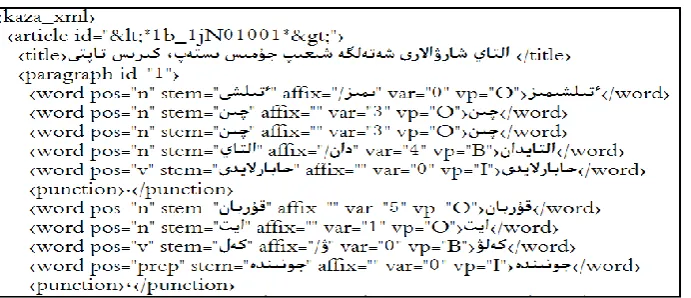
The corpus we used in this process has been already segmented. The way we extracted stem and affix was briefly mentioned in the paper. In this paper we used the segmented results of early work, as it is not the core part of the algorithm.
Input: word segmentation (extraction stem and affix) and POS tagged corpus (test.xml); Output: First: Phrase tagged file; Second: Phrase file;
Based on the basic rules of phrase, we have done extraction of phrases from POS tagged Kazakh cor-pus. The extraction process is as follows:
(a) First roughly segmented XML corpus. The common segmentation marks include semicolon, com-ma, full stop, exclamation mark, question mark.
(c) Look for the matched rule in the rule set. If found, save the basic phrase. Otherwise go back step 1. According to combination rules of basic Kazakh phrase, basic phrase was extracted from corpus and modified by manual work. The correct combination of basic Kazakh phrase was marked.
6
Analysis of Kazakh phrase structure ambiguity
Ambiguity computer analysis of language structure has been one of the difficulties problems. This ar-ticle from the delimitation ambiguity and structural relationship is to study two aspects of phrase struc-ture ambiguity.
One of the difficulties in Kazakh phrase research is the phrase disambiguation problem. Ambiguous reasons is word POS ambiguity, phrase boundaries is not easy to determine, POS with the same se-quence, E.g. there are five ambiguous forms:
(1) VD form (v + adv )
Eg.1a: is verb phrase. (Admission to reduce) Eg.1b: is adverb phrase. ( Admission to more than) (2) ND for (n+adv, pron+adv)
Eg.2a: is verb phrase.( Change a new clothes) Eg.2b
:
is adverb phrase.( Good record) (3) NPV form( n+part+v, pron+part+v)Eg.3a: is verb phrase.( Learn about unity) Eg.3b: is noun phrase.( only Ashan) (4) VPV form (v+part+v)
Eg.4a: is verb phrase.( came then left)
Eg.4b: is adverb phrase. (Relevant research to understand) (5) VP form (v+part)
Eg.5a: is verb phrase.( Speaking before) Eg.5b: is verb phrase.( Organize the relevant)
For these ambiguities, we can'tsimply use the rules to match ways to eliminate, but rather to use max-imum entropy model to solve the problem.
7
Kazakh Phrase Identification based Maximum Entropy Model
Maximum Entropy Model is an effective machine learning model which is proposed to solve the POS tagging problem, it using ME model is the ability to incorporate various features into the conditional probability. The Kazakh phrase recognition task is presented as follow.
The entropy model P: H(p)
x,y p(x,y)log(x,y) (1) Note: X represents the environmental context words to be marked and y is the output.Maximum Entropy Model: Such a model can be shown to have the following form: )
( max arg
*
p H p
C p
(2) Goal: select a distribution p from a set of allowed distributions that maximizes H(y|X).
7.1 Feature defined
Kazakh language is an agglutinative language with word structures formed by adding derivational, inflectional affixes or suffixes to root words. The features include words, part of speech (POS), inflec-tional affixes of the training corpus. It seems that the features are naïve. However, these three kinds of features are the most important components of Kazakh language, and they reflect the characteristic of Kazakh language.
(2) part of speech(POS), including the part-of-speech types of the current word, previous word and next word.
(3) Affix ingredients, including the current word and the word about the additional ingredient info-mation.
(4) Phrase tag that contains the current word and the words to the right and the left two words Phrase marker.
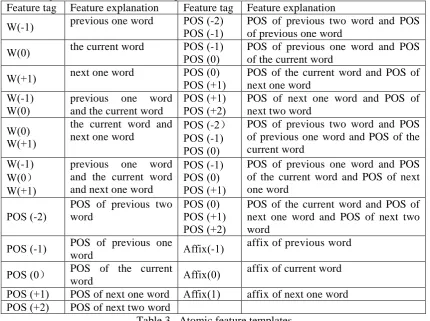
This rule-based approach was applied to generate the maximum entropy model training corpus. Based on Kazakh linguistics, the atomic feature space is as shown in table 3.
Feature tag Feature explanation Feature tag Feature explanation
W(-1) previous one word POS (-2) POS (-1) POS of previous two word and POS
affix of previous word
POS (0) POS of the current
word Affix(0)
affix of current word
POS (+1) POS of next one word Affix(1) affix of next one word POS (+2) POS of next two word
Table 3. Atomic feature templates.
7.2 Feature selection
Basic phrases with statistical model recognition need to select a high correlation, and the Kazakh lan-guage features to train with good effect. Establish model based on rule of the lanlan-guage, this work se-lected feature through templates. After several rounds of experimental debugging, then used artificial selection, twenty one templates were selected for Kazakh verb phrase, only considered important fea-tures. According to each one’s feature, templates were defined as follow.
No. template No. template No. template 1 LPos,Cpos,RPos 8 CVP,RVP,RRVP 15 CWord,RWord 2 LLPos,Lpos,CPos 9 LVPCPosRVP 16 LPos,LVP 3 CPos,Rpos,RRPos 10 LPos, LAffix, LVP 17 RWord,RPos 4 CPos,CAffix,RPos 11 Cpos, CAffix, CVP 18 RPos,RVP 5 LPosLAffixCPos 12 CWord,RWord,RAffix 19 CPos,RPos 6 LVP,CVP,RVP 13 CWord,CPos 20 LPos,CPos 7 LLVP,LVP,CVP 14 LWord,LPos 21 LWord,LVP Table 4. Combined feature of Kz Base VP.
Each information function valued in the context of current word, combine the various function values into the premise of features, got the characteristics of the movement through the word tag, then it can extract features.
Template A: [RRPos, RRVP, RWord, RAffix, RPos, RVP, CPos, CVP, CWord, CAffix, LLPos, LLVP, LWord, LAffix, LPos, LVP]Observation of effects of all the words in the feature space on the result of the experiment.
Template B: [CPos, CVP, CWord, CAffix, LLPos, LLVP, LWord, LAffix, LPos, LVP]Observation of effects of left side two words of the candidate word on the result of the experiment.
Template C:[ RRPos,RRVP,RWord,RAffix,RPos,RVP,CPos,CVP,CWord,CAffix] Ob-servation of effects of right side two words of the candidate word on the result of the experiment. Template D:[ RWord,RAffix,RPos,RVP,CPos,CVP,CWord,CAffix, LWord,LAffix, LPos,LVP] Observation of effects of each side one word of the candidate word on the result of the experiment.
Template E:[ RWord,RAffix,RPos,RVP,CPos,CVP,CWord,CAffix, LLPos,LLVP, LWord,LAffix,LPos,LVP] Observation of effects of left side two words and right side one word of the candidate word on the result of the experiment.
Template F:[ RRPos,RRVP,RWord,RAffix,RPos,RVP,CPos,CVP,CWord,CAffix, LWord,LAffix,LPos,LVP] Observation of effects of left side one word and right side two words of the candidate word on the result of the experiment.
We selected some corpus from Xinjiang Daily tested on six features above, we got different influences of different characters. It shows that the C and F template give us the most highest result, namely the two words on the right have the biggest influence to the result. It proves Kazakh verb phrases are commonly at the end of the sentence.
7.3 General threshold selection
There are two general feature selection methods: incremental feature selection and feature selection of based on frequency threshold. The frequency is greater than a threshold value equal to a characteristic. Through repeating them many times, the frequency threshold value was characterized k = 5, character-ized in that the use of the frequency characteristic is greater than 5.
8 Kazakh Phrase Recognition System
Kazakh phrase recognition system, which based on Maximum Entropy Model, consists of four ules, namely, pre-processing module, training module, Feature selection module, identification mod-ule. System training process as shown flow as figure 1.
Feature module base
Training corpus
Learning document Preprocessing selectionFeature
Parameter estimation
algorithm
Figure 1. Training data flow diagram.
System testing process as shown flow as figure 2.
learning documents
Test
corpus Preprocessing extractionFeature decoding
Identify output
Figure 2. Testing data flow diagram.
Figure 3. The Kazakh language basic verb phrase recognition.
By following a comprehensive analysis of Kazakh words, the following is the Kazakh shallow parsing process:
(1)Sentence:
Golden autumn is coming, Hambar came to the place whish has very strong winds together with sheep.
(2) POS:
(3)Phrase POS:
9 Experiment Results and Analysis
9.1 Data set
In this paper, according to the data set, we used the data of January 2008 of the Xinjiang Daily (Ka-zakh version) corpus. The corpus consists of the raw texts and the POS tagged XML format texts, ex-periments were done for phrase extraction.
9.2 Experiment results
The experiments of the accuracy rates are evaluated using as follow standard evaluation measures:
Precision: 100% b
a P
(3) Recall 100%
d c
R (4)
F-measure
P R
P R F
2 (5)
Note: a is number of correctly identified phrases. b is number of identifiedphrases. c is number of all phrases, d is number of should correct identify.
Method Precision (%) Recall (%) F-measure (%) Rule 78.22 70.01 85.25
ME 87.89 83.13 87.46 Table 5. Phrase recognition test.
10
Conclusion
This paper provided solution for identifying Kazakh basic phrases. We have tried rule-based and the maximum entropy methods. The Kazakh words, part of speech, affixes context information are used to design template of features for maximum entropy model. Based on statistical methods, higher accura-cy could be obtained in the test, but it was requires more training data.
The recognition of basic Kazakh phrase could simplify sentence structure, reduce the difficulty of syn-tactic analyzer. This work put maximum entropy model into recognition of basic Kazakh phrase. However, there are still space for improvement on scale and accuracy rate comparing to English and Chinese. In the future, our work will focus on completing of corpus and other models.
Acknowledgments
This work is funded by the Natural Science Foundation of P.R. China (NSFC)(No.61363062, No. 61063025 and No.61272383), Science and Technology Research and Development Funds of Shen-zhen City (No. JC201005260118A).
Reference
Church K. A stochastic parts program and noun phrase parser for unrestricted text. 1988. In Proceedings of the Second Conference on Applied Natural Language Processing. Texas, USA. 19(8):136-143.
Rob Koeling . Chunking with Maximum Entropy Models. 2000. Proceedings of CoNLL-2000 and LLL-2000. 109(15):139-141.
Steven Abney. Parsing by chunks. 1991. Dordrecht: Kluwer Academic Publishers. 257-278.
Zhao Jun and Huang Changning. 1999. Chinese basic noun phrase structure analysis model, Computer science . 22(2):141-146.
Qiang Zhou. 2004. Annotation scheme for Chinese Treebank, Journal of Chinese Information Processing. Vol 18(4):1-8.
Gulila Altenbek, Ruina-Sun. 2010. Kazakh Noun Phrase Extraction based on N-gram and Rules, International Conference on Asian Language Processing (IALP2010). Harbin, China. 305-308.
Gulila A. and Dawel, A. and Muheyat, N. 2009. A Study of Word Tagging Corpus for the Modern Kazakh Lan-guage, Journal of Xinjiang University. 26(4):394-401.
Zulpiya Mamatmin et al, 2012.Uyghur Base Verb phrases Recognition . A master's degree thesis, Beijing uni-versity of posts and telecommunications.
Adam Berger, Stephen Della Pietra, and Vincent Della Pietra. 1996. A Maximum Entropy Approach to Natural Language ,Processing Computational Linguistics, 22(1):39-71.
Adwait Ratnaparkhi. 1999. Learning to parse natural language with maximum entropy models. Machine Learn-ing, 341(3):151-176
Porter, M.F. 1980. An algorithm for suffix stripping, Program, 14(3):130−137.
Karttunen, Lauri. 1983. KIMMO: A general morphological processor. Texas Linguistic Forum, 22:163–186. Kemal Oflazer. 1994. Two-level description of Turkish morphology. Literary and Linguistic Computing,
9(2):137-148.
Gülşen, E. and Eşref, A. 2004. An affix stripping morphological analyzer for Turkish, Proceedings of the Inter-national Conference on Artificial Intelligence and Application, Austria, 299-304.
Beesley, K.R. 1996. Arabic finite-state morphological analysis and generation. In COLING-96, Copenhagen, 89-94.
Milat, A. 2003. Modern Kazakh language, Xinjiang People's press, China.