City, University of London Institutional Repository
Citation:
Howe, M. L. & Garner, S. R. (2017). Can false memories prime alternative
solutions to ambiguous problems?. Memory, doi: 10.1080/09658211.2017.1332226
This is the published version of the paper.
This version of the publication may differ from the final published
version.
Permanent repository link:
http://openaccess.city.ac.uk/17736/
Link to published version:
http://dx.doi.org/10.1080/09658211.2017.1332226
Copyright and reuse: City Research Online aims to make research
outputs of City, University of London available to a wider audience.
Copyright and Moral Rights remain with the author(s) and/or copyright
holders. URLs from City Research Online may be freely distributed and
linked to.
City Research Online:
http://openaccess.city.ac.uk/
[email protected]
Full Terms & Conditions of access and use can be found at
http://www.tandfonline.com/action/journalInformation?journalCode=pmem20
Download by: [Mark L. Howe] Date: 29 May 2017, At: 05:38
Memory
ISSN: 0965-8211 (Print) 1464-0686 (Online) Journal homepage: http://www.tandfonline.com/loi/pmem20
Can false memories prime alternative solutions to
ambiguous problems?
Mark L. Howe & Sarah R. Garner
To cite this article: Mark L. Howe & Sarah R. Garner (2017): Can false memories prime alternative solutions to ambiguous problems?, Memory, DOI: 10.1080/09658211.2017.1332226
To link to this article: http://dx.doi.org/10.1080/09658211.2017.1332226
© 2017 The Author(s). Published by Informa UK Limited, trading as Taylor & Francis Group
Published online: 29 May 2017.
Submit your article to this journal
View related articles
Can false memories prime alternative solutions to ambiguous problems?
Mark L. Howeaand Sarah R. Garnerb
a
Department of Psychology and Centre for Memory and Law, City, University of London, London, UK;bCentre for Memory and Law, City, University of London, London, UK
ABSTRACT
Research has demonstrated that false memories are capable of priming and facilitating insight-based problem-solving tasks by increasing solution rates and decreasing solution times. The present research extended this finding by investigating whether false memories could be used to biasambiguousinsight-based problem-solving tasks in a similar manner. Compound remote associate task (CRAT) problems with two possible correct answers, a dominant and a non-dominant solution, were created and normed (Experiment 1). In Experiment 2, participants were asked to solve these CRAT problems after they were given Deese/Roediger-McDermott lists whose critical lures were also the non-dominant solution to half of the corresponding CRATs. As predicted, when false memories served as primes, solution rates were higher and solution times were faster for non-dominant than dominant CRAT solutions. This biasing effect was only found when participants falsely recalled the critical lure, and was not found when participants did not falsely recall the critical lure, or when they were not primed. Results are discussed with regard to spreading activation models of solution competition in problem-solving tasks and current theories of false memory priming effects.
ARTICLE HISTORY Received 27 January 2017 Accepted 11 May 2017
KEYWORDS
False memory; problem-solving; priming; spreading activation; biasing; response competition
That we are not entirely in conscious control of our behav-iour, actions, and decisions is something that has been of interest to both those in the public domain (Gladwell, 2005) as well as many psychologists. Evidence for the idea that our judgements, behaviours, and reasoning are not always driven by active thinking, but rather by non-conscious, implicit processes, comes from a widely investi-gated phenomenon known as priming. In classic research, priming refers to changes in a person’s reaction to an item as a result of previous encounters either with that item or a related item (e.g., Schacter, Gallo, & Kensinger, 2007). In semantic priming, participants might be presented with words, objects, or images that are meaningfully associated to information presented on a later task. For example, par-ticipants are either presented words subliminally via masked presentation, or they are required to consciously process the stimuli, perhaps via a sentence-scrambling task. Participants are then given a second task without being alerted to their relatedness and the influence of the prior exposure on this task is measured. One classic task used to investigate semantic priming for example, is the lexical decision task, consisting of a prime word fol-lowed by a target that is either a word or a string of letters. Participants are asked to decide if the target is a word or not, and standard findings have shown that par-ticipants are faster to respond if the target is shown after
a semantically related prime (e.g.,cat-dog) rather than an unrelated prime (e.g.,lamp-dog).
How might it be that prior exposure to a stimulus can influence our decisions on a later task without our aware-ness? A number of theories of semantic priming exist in the literature (e.g., compound cue theory, Ratcliff & McKoon,1981; Becker’s verification model, Becker,1976), however, perhaps the most popular of these theories revolves around the notion of spreading activation. Initially incorporated into a model of memory by Collins and Loftus (1975), spreading activation is now widely considered to account for a number of implicit memory and priming effects found within numerous domains in psychology. According to spreading activation accounts, memory is conceptualised as a network of nodes (concepts) that are all interconnected by links that vary in strength. Encounter-ing an item activates its internal memory representation and this activation spreads to other related concepts in a network of associations (e.g., Nelson, Kitto, Galea, McEvoy, & Bruza, 2013; Nelson, McEvoy, & Pointer,2003). This increased activation facilitates subsequent retrieval of that concept as well as related concepts, resulting in priming effects. Thus, it is easy to see how spreading acti-vation models can account for semantic priming effects.
Another domain in which spreading activation might be important is in insight-based problem-solving.
Insight-© 2017 The Author(s). Published by Informa UK Limited, trading as Taylor & Francis Group
This is an Open Access article distributed under the terms of the Creative Commons Attribution License (http://creativecommons.org/licenses/by/4.0/), which permits unrestricted use, distribution, and reproduction in any medium, provided the original work is properly cited.
CONTACT Mark L. Howe [email protected] Department of Psychology and Centre for Memory and Law, City, University of London, London EC1V 0HB, UK
MEMORY, 2017
based problem-solving tasks are said to involve solutions that are found via a sudden flash of insight, rather than by trial and error. Sio and Rudowicz (2007; also see Smith,1995; Smith & Blankenship,1991) have suggested that this process is enhanced via the occurrence of spread-ing activation, a process that sensitises participants to various related concepts that aid problem-solving. One insight task that has been used to study this is the com-pound remote associate task (CRAT; Mednick, 1962). These tasks involve the presentation of three words (e.g.,
apple,family, andhouse) each of which is associated with a fourth word, in this casetree, that results in three new words or phrases (apple tree,family tree, andtree house). In order to gain insight and solve this problem, theorists have suggested that a process of spreading activation is used, one that starts with the presentation of the initial three words, and continues until the correct concept has been activated (Bowden, Jung-Beeman, Fleck, & Kounios, 2005).
Many models of spreading activation assume that acti-vation of concepts will decay over time or with intervening mental activity. However, research is beginning to emerge that shows that priming can withstand the effects of a delay. A common theme in this research is that the more complex and demanding the task, the greater priming seems to be over a delay compared to less complex seman-tic tasks (e.g., see Becker, Moscovitch, Behrmann, & Joor-dens, 1997; Woltz & Was, 2007). The ability to prime performance on complex semantic tasks over a delay has been shown in a number of new experiments examining the role of false memories in priming. Where priming effects have traditionally been studied using memories for items that were actually presented (i.e., true memories of things that happened), new research has demonstrated that false memories can also serve as effective primes. False memories occur when people remember details or events that have never occurred. Interest in such memory illusions has increased in part because they can be easily created under controlled laboratory conditions using the Deese/ Roediger-McDermott (DRM) paradigm (Deese,1959; Roedi-ger & McDermott,1995). This procedure involves present-ing participants with lists of words (e.g., truck, bus,train, andvehicle) all of which are associates of an unpresented critical lure (i.e.,car).Despite not being presented, partici-pants will often falsely remember the critical lure as being presented on the list. Although theories vary, a number of explanations of the creation of false memories favour the notion of spreading activation. For example, activation-monitoring theory (Roediger & McDermott, 1995; Roediger, Balota, & Watson,2001) and associative-activation theory (AAT; Howe, Wimmer, Gagnon, & Plump-ton,2009) propose that processing words on the list leads to spreading activation to related concepts. These acti-vated, associated concepts can often be unpresented items that are later falsely remembered.
It is apparent that the mechanisms underlying the cre-ation of false memories and those related to general
semantic priming effects are very similar. Therefore, it is not that surprising to find that false memories have been used to prime simple implicit memory tests in a similar manner to true, presented memories (e.g., McDermott, 1997). False memory priming effects have also been observed in lexical decision tasks (e.g., Sherman & Jordan, 2011) where it has been found that priming occurs not just from presented items (true memories) but also from critical lures (false memories). This is important because there is evidence that false memories can persist for longer periods of time than true memories, something that might be important when understanding long-term semantic priming. For example, McDermott (1996; Exper-iment 1) found that although true recall declined, false recall rates remained constant over a two-day delay. Thapar and McDermott (2001; Experiment 1) extended this false memory persistence effect to a delay of one week and Toglia, Neuschatz, and Goodwin (1999; Exper-iment 2) extended it to three weeks. Others have success-fully shown false memory persistence effects using recognition rather than recall [e.g., Howe, Candel, Otgaar, Malone, & Wimmer,2010(Experiment 3); Payne, Elie, Black-well, & Neuschatz, 1996 (Experiment 1); Seamon et al., 2002; Thapar & McDermott, 2001 (Experiment 2)]. The false memory persistence effect is not restricted to adults, but is also evident in research with children [e.g., Brainerd, Reyna, & Brandse,1995; Howe et al. (2010; Exper-iments 4 and 5)]. Interestingly, the persistence of false memories may be linked to the fact that they are self-gen-erated (i.e., arise spontaneously due to spreading acti-vation) rather than other-generated (i.e., presented by the experimenter). Because self-generated information is generally retained better in memory than other-generated information (Mulligan & Lozito, 2004; Sui & Humpreys, 2015), such information should serve as a better prime especially following a delay. The important point is that because self-generated false memories remain robust over time, their effectiveness as primes seems inevitable.
the falsely remembered words remained high enough to spread through memory during the later problem-solving task. This finding has since been replicated with children (Howe, Garner, Charlesworth, & Knott, 2011) and has recently been extended to recognition tests where, cru-cially, the locus of these effects have been pin-pointed to activation of the critical lure during the study phase, not the test phase, of the paradigm (Howe, Wilkinson, Garner, & Ball,2016). That is, priming was equally robust when par-ticipants only studied DRM lists or when they studied DRM lists and then received a memory test before solving CRATs. Similar results have been reported for recall, where priming effects were equally robust regardless of whether recall tests were administered (Howe et al.,2010). Key to the priming effect found in all of these studies is that they only occur when the critical lure is also falsely remembered on a memory test. Again, it is not the test itself that is important to priming effects (Howe et al., 2010, 2016), but it does help us gauge the strength of the false memory, something that is critical to whether it will prime subsequent problem solutions. This theoretical constraint is particularly important because it suggests that the ability of false memories to prime insight-based problem-solving is limited to circumstances where false memories achieve activation levels that are sufficient enough to produce recall or recognition. From a spreading activation account of memory then, false memories that have been activated during DRM list presentation are still above threshold activation level and remain active in memory when participants are trying to solve CRAT pro-blems. Solving CRAT problems becomes easier because spreading activation from the CRAT terms to the problem solution is faster, given that the critical lure is already active in memory. False memories that were activated but not falsely remembered are thought to have either dropped below the activation threshold required for priming after being rejected during test, or to have not been activated sufficiently above the threshold required for priming during study.
Interest in priming effects is not just limited to increases in solution rates and decreases in solution times but extends to the ability of primes to bias solution choices. Many“real-world”problems either have multiple interpret-ations (with only one leading to the correct solution) or multiple solutions where the problem-solver must choose between solutions to find the most effective (adaptive) one. In terms of the former multi-interpretation problems, some investigators have conducted implicit memory experiments where they have attempted to bias which answer is selected by using homonyms. Homonyms are words that are pronounced the same but have very differ-ent contextual meanings (e.g., the wordscore). In a study by Eich (1984), participants were presented with critical pairs of words, the second of which was a homophone and the first of which was a word intended to bias the less common context of the homophone (e.g., the critical pair“movie-REEL”). Eich found that the prior priming of
the uncommon interpretation of the homophone signifi-cantly biased the spelling participants chose in the sub-sequent recall task, with participants more likely to choose the spelling of the word that was consistent with the primed context. As with theories underlying insight-based problem-solving and false memory priming effects, research suggests that the potential meanings of homo-nyms are accessed via an automatic process. For example, Eckstein, Kubat, and Perrig (2011) have suggested that all of the meanings of a homonym are accessed in par-allel before one of the meanings is selected in a competi-tive race. Their research has shown that this process is automatic, whereby the subliminal presentation of a homonym with a prime facilitated the solution of a lexical decision task. Interestingly, the supraliminal presen-tation of the homonym actually slowed the decision process.
Importantly, new research has also demonstrated that false memories can bias the selected meaning of homo-nyms in an analogical reasoning task. In a series of exper-iments, we developed analogical reasoning problems that contained homonyms (Howe, Garner, Threadgold, & Ball,2015). One meaning of the homonym would lead to an incorrect solution whereas the other meaning would lead to correct analogical reasoning. Our findings demon-strated that when primed with false memories, participants were better able to supress the unhelpful meaning of the homonym and made it easier for them to select the meaning that would lead to the correct solution on the task.
In terms of the latter multi-solution problems, Kokinov, Vankov, and Bliznashki (2009) have proposed that when processing problems with at least two solutions, partici-pants will usually arrive at the dominant interpretation, with any other responses being inhibited by the dominant one. In line with this proposal, research by Gibson (2004) has demonstrated that the priming of a non-dominant but correct answer to an ambiguous word problem can overcome this inhibition and facilitate problem-solving in participants. In a series of three experiments Gibson attempted to bias the answer chosen in a number of lateral thinking problems. Findings showed that processing information relevant to the non-dominant solution signifi-cantly biased the production of that solution. However, priming a solution that is already dominant had no effect upon solution generation.
As mentioned, previous research has demonstrated that false memories can implicitly prime solutions to insight-based problem-solving tasks. However, these false memory priming effects are limited to instances in which there is only one correct, and therefore dominant, solution to a problem, with priming simply raising the activation level of the only correct response to a problem. The ques-tion addressed here concerns what happens in instances of solution competition, where a problem has two possible solutions fighting for dominance within the semantic network, and where one of these solutions is ordinarily
more dominant than the other? Would priming a non-dominant solution with a potent false memory enable biasing away from the dominant solution, as has been found with true memory priming?
To answer this question, we can turn to theories of spreading activation (AAT in particular) which suggest that words do not always have simple associations. Indeed, they can have multiple sets of associations with one another, with pathways containing different theme nodes depending on the context of the association. When words are activated, not only are associated words along a pathway activated, but so too are the relevant themes, ones that in turn activate other relevant themes and associated words. The more themes that are associ-ated with a word, the weaker the level of activation will be from spreading activation, with words with only a few themes having a stronger level of activation. Problem tasks with multiple solutions therefore, will have a number of themes and concepts in memory competing with one another to be chosen as the correct answer. The activation of these competing concepts should be weaker than problems with only one possible meaning and solution. Similarly, in a problem with two possible answers, where one is more dominant than the other, the dominant answer will be more closely related within the semantic network, allowing spreading activation to elicit this answer more quickly and more often under ordin-ary circumstances.
Is it possible then, to use robust and time persistent false memories to increase the activation level of this more distant, non-dominant solution to a problem? Unlike classic semantic priming research, which empha-sises the impact a prime may have upon the speed of problem solution, research concerning the biasing of problem-solving has focused mainly on the rate and change of solution production, often neglecting to con-sider the influence a prime can have solution time (e.g., Birch & Rabinowitz,1951; Gibson,2004). Given previous robust findings that demonstrate the ability of false memory primes to also improve the speed of problem-solving in instances of single solution pro-blems, one might expect that in instances of solution competition, false memories are capable of not only biasing the solution production towards the non-domi-nant solution, but also decrease the time taken to produce this solution. The present research set about testing this using a number of newly created CRAT pro-blems, ones with multiple solutions. As with previous research, each CRAT consisted of three words, all of which could be solved by a single linking word. However, in this study each CRAT had two possible sol-utions; a dominant and a non-dominant solution the latter of which was also the critical lure from a DRM list. For example, the CRAT police/super/sports could be solved by the wordman (dominant) to form police-man, superpolice-man, sportsman, or by the critical lure from the car DRM list (non-dominant) to form police car,
super car and sports car. Given the key findings in the previous series of false memory priming experiments is that participants must falsely recall the critical lure in order for it to facilitate problem-solving, a similar outcome is predicted in the present study. It is pre-dicted therefore, that false memories will successfully bias solution production towards the non-dominant sol-ution, and improve solution times on ambiguous CRATs, only when the critical lure is falsely recalled.
Experiment 1
In our first experiment, we document the creation and norming of a set of ambiguous CRATs. These CRATs were specifically created to have more than one solution. Sol-ution dominance was determined by asking participants to solve each of the CRATs and see which of the solutions was produced more frequently.
Method
Participants
Thirty-two undergraduate and postgraduate students aged between 18 and 25 were participated in this norming study. All participants provided written informed consent prior to the study and were fully debriefed about the purpose of the study.
Design and materials
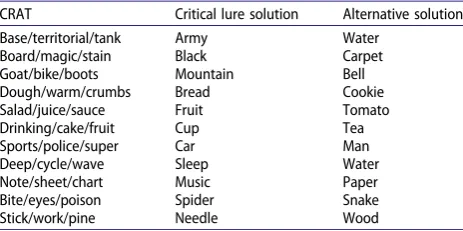
[image:6.609.311.543.627.742.2]A within-subject design was used, with each participant completing all 11 CRATs. The order of the CRATs was ran-domised to reduce any order effects. Critical lures were taken from the DRM lists provided by Roediger, Watson, McDermott, and Gallo (2001). Eleven CRAT’s were then created corresponding to eleven critical lures in these DRM lists. As with the CRATs used in previous research, each CRAT consisted of three words, all of which could be solved by a single linking word. However, in this study each CRAT had two or more possible solutions, one of which was the critical lure from a DRM list. For example, the CRAT police/super/sports could be solved by the wordMan, to form police man, superman, sports man, or by the critical lure from the CarDRM list, to form police
Table 1.Ambiguous CRATs with two solutions.
CRAT Critical lure solution Alternative solution
Base/territorial/tank Army Water
Board/magic/stain Black Carpet
Goat/bike/boots Mountain Bell
Dough/warm/crumbs Bread Cookie
Salad/juice/sauce Fruit Tomato
Drinking/cake/fruit Cup Tea
Sports/police/super Car Man
Deep/cycle/wave Sleep Water
Note/sheet/chart Music Paper
Bite/eyes/poison Spider Snake
car, super car and sports car. The complete set of 11 CRATs is shown inTable 1(see Roediger, Watson, et al.,2001for the corresponding DRM lists).
Procedure
Participants were told that they would see three words on the screen and would be asked to generate a fourth word that could be combined with all three words to make a compound word or phrase. Participants were not informed that there was more than one possible answer to the problem. Participants were first given an example, followed by three practise CRATs before they began. Each CRAT was presented on a screen, after a fixation cross, in a random-ised order and participants were asked to provide a sol-ution verbally. If participants failed to correctly solve a CRAT, they were given feedback as to the correct answer after each problem. The solution process was timed, with participants having a maximum of one minute to complete each problem before moving to the next.
Results and discussion
The solution rates (solution rate) and times (solution time) for each newly created ambiguous CRAT problem were cal-culated. The data were further conditionalised into the rate at which the critical lure was chosen as an answer (CL sol-ution rate) and times for both the critical lure solsol-ution (CL solution time) and the alternative solution to the CRATs (alt solution time). The data for each CRAT is shown inTable 2 in order of critical lure solution rates with CRAT’s most likely to be solved using the critical lure solution presented first. As can be seen fromTable 2, the study succeeded in creating 8 ambiguous CRATs each having at least 2 poss-ible solutions (because the other 3 had 100% solution rates for only one of the two answers, these cannot be con-sidered ambiguous). These CRATs vary in overall problem difficulty (solution rate), with the difficulty varying from the most difficult cup problem with a solution rate of 20% to the easiestarmyandfruitproblems with solution rates of 90%. Importantly, the problems also differ in their critical lure solution rate, varying from those problems whose dominant answer is the critical lure solution (domi-nant problems; army, black, fruit, mountain, and bread),
problems without a dominant solution (equal problems;
cupandcar), and those problems whose dominant solution is the non-critical lure, alternative word (non-dominant problems; water, paper, snake, and wood) (compare column CL solution choice rate with alt solution choice rate).
Experiment 2
Having successfully created a number of ambiguous CRAT’s, Experiment 2 set about testing the hypothesis that false memories could be used to bias the solution choice in a manner similar to that demonstrated in the true memory priming literature. Like the work by Gibson (2004), the present study attempted to prime two different categories of ambiguous CRATs; those where the critical lure was slightly dominant or where both solutions were equally dominant (control problems) versus those whose dominant solution was the alternative, non-critical lure sol-ution (non-dominant solsol-ution). The problems selected that were defined as non-dominant CRATs had an average criti-cal lure solution rate of 20% and problems that were defined as control CRATs had average critical lure solution rate of 53%.
As with the previous research on biasing insight pro-blems with true memories, a number of different predic-tions were generated. First, it was predicted that, like Gibson’s study, priming would bias problem-solving when the non-dominant answer is primed. This prediction was made under the assumptions of spreading activation models of memory, such as AAT, whereby the natural dominant response is thought to be closer in the semantic network than the non-dominant response, allowing spreading activation to naturally activate this answer more often and more quickly. Thus, it was expected that priming more distant non-dominant solutions would allow for spreading activation to facilitate an increase in the amount (and decrease the time with which) these answers are chosen.
[image:7.609.68.546.619.734.2]Second, given that one of the key findings in the pre-vious series of false memory priming experiments is that participants must falsely recall the critical lure in order for it to facilitate problem-solving, a similar finding is predicted in the present study. In other words, it is predicted that
Table 2.Normative data for ambiguous CRATs.
CL solution Alt solution Solution rate Solution time CL solution choice rate Alt solution choice rate CL solution time Alt solution time
Army Water 0.9 9.69 1 0 9.69 na
Black Carpet 0.63 19.18 1 0 19.18 na
Mountain Bell 0.63 14.93 1 0 14.93 na
Bread Cookie 0.95 14.32 0.82 0.18 13.8 16.61
Fruit Tomato 0.9 13.44 0.67 0.33 13.99 12.33
Cup Tea 0.2 18.89 0.5 0.5 30.25 7.53
Car Man 0.8 12.4 0.42 0.58 9.03 15.18
Sleep Water 0.48 13.59 0.32 0.68 13.5 13.62
Music Paper 0.63 18.37 0.24 0.76 18.52 18.33
Spider Snake 0.65 11.32 0.23 0.77 8.61 12.14
Needle Wood 0.65 18.37 0.04 0.96 31.32 17.85
Note: All solution times are presented in seconds. CL, critical lure.
false memories will only successfully bias solution choice on ambiguous CRATs when the critical lure is falsely recalled.
Method
Participants
Thirty-two undergraduate and postgraduate students aged between 21 and 40 who did not participate in Experiment 1 were recruited for Experiment 2. All participants provided written informed consent prior to the study and were fully debriefed about the purpose of the study upon completion.
Design, materials, and procedure
A mixed design was used where each participant was primed on half (three out of six) of the CRATs using the matching DRM lists and then attempted to solve all six CRATs. Half of the participants were primed on the three control problems (see below) and the remaining partici-pants were primed on the three non-dominant problems. Participants were randomly assigned different DRM-CRAT pairings and both the order of the DRM lists and the order of CRAT presentations were carefully counterba-lanced to reduce any order effects.
Six ambiguous CRATs were selected from the normative data produced in Experiment 1. Three problems were control problems (fruit, cup, and car; mean backward associative strength of the CRAT terms to the critical lure sol-utions = .04 and to the alternative solsol-utions = .12) and three were specifically selected such that their dominant solution was the non-critical lure, alternative word (non-dominant problems;water,paper, andwood; mean backward associat-ive strength of the CRAT terms to the critical lure solutions = .07 and to the alternative solutions = .18). Participants were given three out of the six DRM lists in a randomised order. None of the items from the DRM lists were present in the CRAT problems. Each of the three DRM lists was admi-nistered to participants verbally with a tempo of approxi-mately 1.5 seconds per word and a-2.5 second break between the lists, followed by a distractor task (counting backwards in threes for 30 seconds) before they were then asked to recall as many words as they could remember from the list. Once this had been completed for each word list, participants were then asked to complete all six CRATs. Participants were first given an example, followed by two practice CRATs before they began. Each CRAT was presented on a screen, in a randomised order and participants were asked to provide a solution verbally. If participants failed to correctly solve a CRAT, they were given feedback as to the correct answer after each problem. The solution process was timed, with participants having a maximum of one minute to complete the problem.
Results and discussion
CRAT solution rates using either the critical lure or the alternative solution were calculated as was the mean
CRAT solution rates (proportion correctly solved out of total) and the mean CRAT solution times (seconds) for each participant who solved a CRAT using the critical lure solution. The data were first conditionalised into the rate at which the critical lure was chosen as an answer when primed (primed CL solution rate) and times for the critical lure solution (primed CL solution time).
To compare whether priming the critical lure had a biasing effect on the answer selected to solve CRATs, an independentt-test was conducted comparing the rate at which the critical lure was chosen as a solution (instead of the alternative solution) from the normative data, com-pared with these same rates when the critical lure was primed. The t-test revealed that the mean critical lure primed solution rate (M= .64, SD = .13) was significantly higher than the mean critical lure normative solution rate (M= .37, SD = .22), t(10) =−2.583, p< .05, d =1.5. Thus, priming was effective.
Turning to the main focus of this study, we were primarily interested in the biasing of selection choice as primed by the false memory or critical lure. Rather than an analysis for general CRAT solution rates and times therefore, analyses were conducted for CRATs solved using the critical lure sol-ution, excluding the solution rates and times when partici-pants solved using the alternative solution. This permits a direct investigation of false memory biasing effects.
False memory rates were at 16% due in large measure to the fact that backward associative strength on most of the DRM lists was moderate (M= .28). This is one of the pro-blems encountered when trying to find lists that are suit-able for ambiguous CRATs. Critically, there were no instances of participants falsely recalling the critical lure and then solving the CRAT using the alternative solution (i.e., when participants recalled the CL, they either solved it using the CL, or did not solve it at all). (Note that in general, rates of alternative solutions in the other con-ditions matched the normative rates found in Experiment 1.) Therefore, for primed CRATs, 16% of the responses occupied the primed and did recall the CL category and 84% of the responses occupied the primed but did not recall the CL category. Clearly, this meant that there was sufficient power to detect differences between responses in this latter category and those in the not primed category, but power to detect differences was considerably lower in the former category. To anticipate the findings, because performance on the CRATs was generally superior in the primed and did recall the CL than in the other two con-ditions, issues of power were not of concern in this experiment.
Turning to the specific analyses, for CRATs solved using the critical lure solution, a single factor (solution type: not primed vs. primed but did not recall the CL vs. primed and did recall the CL) repeated measures analysis of var-iance (ANOVA) was conducted for both solution rates and solution times. For solution rates, the ANOVA revealed a significant main effect of solution type,F(2, 24) = 7.75,p
< .01,h2
post hoc Tukey’s LSD test, solution rates using the critical lure solution were significantly higher on CRATs where par-ticipants were primed and had a false memory (M= .92, SD = .28) than when they were primed but did not have a false memory (M= .46, SD = .48; p< .01) than when they were not primed (M= .30, SD = .38). Solution rates did not differ significantly for items where participants were primed but did not have a false memory and those that were not primed (p= .41).
For solution times, the ANOVA revealed no significant main effect of solution type,F(2, 62) = 1.63,p= .21. Thus, solution times using the critical lure solution did not differ when participants were primed and had a false memory (M= 41.24, SD = 22.81), were not primed (M= 35.22, SD = 26.00), were primed but did not have a false memory (M= 31.31, SD = 23.16).
These initial findings suggest that, as predicted, partici-pants solved a higher proportion of CRATs using the primed critical lure solution rather than the alternative sol-ution. This effect was only found when participants falsely recalled the critical lure. Analysis of the solution time data suggests that although false memories successfully biased the CRAT problems towards the critical lure, they did not increase the speed with which participants solved problems.
Non-dominant solution problems
As well as being interested in whether false memories can successfully bias the solution choice on insight problems with more than one solution, the present research was specifically concerned with whether there were any differ-ences when biasing non-dominant solution problems. To examine this question, we analysed the data for only those CRATs whose non-dominant solution was primed. As with the overall data, an initial independentt-test was conducted to determine whether priming the critical lure had a biasing effect on the answer selected to solve
CRATs for non-dominant problems. The t-test for non-dominant problems was conducted by comparing the rate at which the critical lure was chosen as a solution from the normative data compared with these same rates when the critical lure was primed. Thet-test revealed that the mean critical lure primed solution rate (M= .54, SD = .08) was significantly higher than the mean critical lure normative solution rate for non-dominant problems (M
= .20, SD = .14), t(4) =−3.658, p< .05, d= 2.98. To deter-mine the role of false memories in this biasing effect, a single factor (solution type: not primed vs. primed but did not recall the CL vs. primed and did recall the CL) ANOVA was conducted for both solution rates and solution times for those CRATs solved using the critical lure. The sol-ution rates for those CRAT problems whose non-dominant solution was primed revealed a significant main effect of solution type,F(2, 24) = 5.75,p< .01,h2
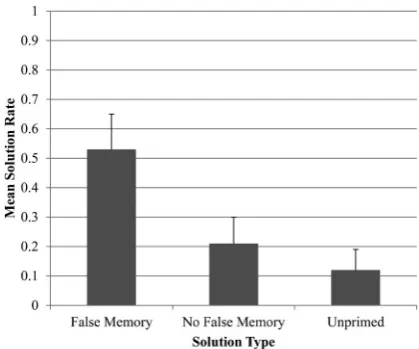
p= .15. As shown in
Figure 2, and confirmed using a post hoc Tukey’s LSD test, solution rates using the critical lure solution were signifi-cantly higher on CRATs where participants were primed and had a false memory (M= .53, SD = .51), than those who were primed but did not have a false memory (M
= .21, SD = .42; p< .05), and those who were not primed (M= .12, SD = .33,p< .01). Solution rates did not differ sig-nificantly between participants who did not have a false memory or who were not primed (p= .48).
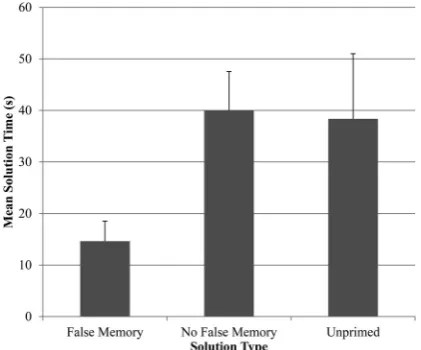
The solution times ANOVA also revealed a significant main effect of solution type, F(2, 18) = 3.91, p< .05, h2
p
= .33. As shown in Figure 3, and confirmed using a post hoc Tukey’s LSD test, solution times using the critical lure solution were significantly faster on CRATs where partici-pants were primed and had a false memory (M= 14.64, SD = 11.04) than when participants were primed but did not have a false memory (M= 39.98, SD = 18.49; p< .05) than when they were not primed (M= 38.36, SD = 28.28,
[image:9.609.76.286.61.240.2]p< .05). Solution times did not differ significantly between participants who did not have a false memory
Figure 1.Mean overall solution rates for CRATs solved using the critical lure solution.
Note: Error bars represent the standard error.
Figure 2.Mean solution rates for non-dominant CRATs solved using the critical lure solution.
Note: Error bars represent the standard error.
[image:9.609.320.530.533.707.2]or who were not primed (p= .89). This analysis suggests that false memories can bias answer selection on ambigu-ous insight problems, but only when the non-dominant solution is primed and when participants falsely recall the critical lure. This priming not only biases the answer chosen towards the primed critical lure, but also increases the speed with which participants then solve the CRAT.
General discussion
The findings from the present research are unique in demonstrating that as well as being able to prime insight-based problem-solving tasks, false memories can also bias the solution choice on these same problem types. Like previous findings on false memory priming, the strength of the false memory (as reflected in partici-pants’being able to falsely recall the critical lure) was key to producing the biasing effect. That is, in order for the criti-cal lure to significantly bias the answer chosen to solve the CRAT towards the critical lure solution and away from the alternative solution, the critical lure from the DRM list must be of sufficient strength in memory to be falsely remembered during an earlier recall task. This finding has been replicated in all of the experiments that have looked at false memory priming on problem-solving tasks. Of interest is that there were no instances of partici-pants falsely recalling the critical lure and then solving pro-blems using the alternative solution. When participants were primed and recalled the critical lure, they either solved the CRAT using the critical lure, or did not solve it at all, suggesting that there was no resistance to using criti-cal lure solutions.
The strength of false memories as reflected in test per-formance should not be confused with the locus of these observed priming effects. That is, we know from previous research, that it is not the test itself that serves to prime performance on subsequent problem-solving, but rather
the self-generation of the false memory during encoding. Specifically, robust priming effects are observed even when a memory test is absent between study and problem-solving, and this has been found in both recall (Howe et al., 2010) and recognition (Howe et al., 2016) paradigms. In fact, priming effects are not increased by the presence of memory tests. Specifically, Howe et al. (2016) showed that when problem solutions were pre-sented only at test, there was no improvement in solution times or rates. Moreover, when DRM lists were presented only at study, solution times and rates were more robust than in conditions in which DRM lists were studied and tested prior to problem-solving. Thus, the priming effects that are routinely observed in experiments like the ones presented here cannot be accounted for by the fact that memory tests were administered prior to problem-solving. Another prediction about the false memory biasing effect, one that was anticipated from previous literature on true memory biasing, was that the effect was significant for the priming of non-dominant problem solutions. That is, on CRATs with two solutions where there exists one par-ticularly dominant solution, priming of the other non-dominant solution not only successfully biased participants towards solving the CRAT with that solution, but also decreased the time needed to solve such problems.
The results of this study support other recent research that has examined the ability of false memories to prime alternate meanings of homonyms to solve analogical reasoning problems. Previous research (Howe et al.,2015) has found that false memories are not only capable of priming the solution to analogical reasoning problems, but that they allow one to more easily suppress an interfer-ing and incorrect homonym meaninterfer-ing, enablinterfer-ing partici-pants to access a more difficult, but correct solution to the problem. The present study suggests that false mem-ories can function in a similar manner in instances of sol-ution competition. That is, the activation of false memories can increase one’s chances of selecting an ordin-ary but uncommon solution over a more dominant sol-ution to a problem that has more than one possible answer.
The findings of the present study can be accounted for using AAT (Howe et al.,2009) whereby the natural domi-nant response is thought to be stronger and closer in the semantic network than the non-dominant response, allow-ing spreadallow-ing activation to ordinarily activate this answer more often and more quickly. Priming further away, non-dominant solutions then, allows for spreading activation to facilitate an increase in the frequency with which these uncommon and less dominant answers are chosen and to also increase the speed of this selection process.
[image:10.609.77.288.64.239.2]Indeed, spreading activation models of memory provide a good theoretical framework for which to understand per-formance on standard implicit priming tasks, priming within problem-solving tasks, and the false memory priming effect. The question arises as to whether such models can also account for the literature on priming
Figure 3.Mean solution times for non-dominant CRATs solved using the critical lure solution.
solution bias. AAT in particular can offer a good account, due to the recent addition of theme nodes to the model (e.g., Howe & Derbish,2010) and the acknowledgement that activation of concepts in the network not only occur automatically and in parallel, but that these concepts may be quite distant in semantic space (also see Nelson et al., 2003, 2013). AAT acknowledges that words may have numerous associations with one another and that pathways may also contain different theme nodes along them, ones that are also activated during spreading acti-vation. For example, as suggested by Howe and Wilkinson (2011), when presented with the wordsdogandcat, com-peting theme nodes such asanimalorpetmay also be acti-vated. The context in which a word is presented will influence which theme nodes are activated, which in turn will influence which associated words are activated via spreading activation. Insight-based problems with multiple solutions will therefore have a number of themes and con-cepts in memory competing with one another to be chosen. The ability of false memories to boost the acti-vation level of a concept for a considerable period of time, therefore, allows for increased activation of the usually distant, non-dominant solution to the problem, increasing its likelihood of being selected as a solution.
Although the results of the present research are both interesting and informative for theories surrounding semantic priming and false memory, they also have novel implications regarding evolutionary and adaptive theories of human memory. One school of thought is that because memory is reconstructive it gives rise to both true and false memories (e.g., Howe,2011; Newman & Lindsay, 2009; Schacter, Guerin, & St. Jacques, 2011). That false memories are just a by-product of a very well adapted system is one possible explanation of the false memory priming effects. As Howe et al. (2010) argued, false memories themselves may serve an adaptive func-tion, by generating information that can prime and facili-tate later problem-solving. Indeed, false memories may serve a higher order adaptive function by self-activating key information that may be useful for decision-making and problem-solving (e.g., see Leach,1994; Leach & Griffith, 2007).
If previous research using false memories to prime insight problem-solving tasks is correct in its suggestion that the self-generation of false memories from associative information can serve to prime later problem-solving in an adaptive manner, then the findings from the present research adds to this adaptive theory. The findings of the present research are novel in that they extend the pre-viously found positive benefits of false memories to those situations where more than one possible choice could be made. Moreover, we have demonstrated that when complex problems with multiple solutions are avail-able, false memories can bias which solution is selected. This is in line with research suggesting that when faced with a choice, or complex decision, implicit processing is more advantageous than conscious processing (e.g., the
deliberation-without-attention hypothesis; Dijksterhuis, Bos, Nordgren, & van Baaren,2006). Importantly, our find-ings demonstrated that when naturally weaker responses were primed, false memories are especially beneficial at overcoming a dominant response (a dominant response which could often be incorrect in the face of stress and sur-vival, e.g., Leach & Ansell,2008).
Klein, Cosmides, Tooby, and Chance (2002) have argued that by considering the possible functions our memory systems have evolved for we gain a greater understanding of memory in general, and may discover functions of memory that surprise us. Regarding this, the present research is the first to extend false memory priming effects by applying it to the biasing of multiple solution insight problems. This research yet again demonstrates the ability of false memories to behave in a similar manner to true memories and highlights the possible adaptive functions that associative memory networks may have for problem-solving.
Disclosure statement
No potential conflict of interest was reported by the authors.
Funding
This research was supported by grants from the Economic and Social Research Council of Great Britain (0452 and RES-062-23-3327).
References
Becker, C. A. (1976). Allocation of attention during visual word recog-nition.Journal of Experimental Psychology: Human Perception and Performance,2, 556–566.
Becker, S., Moscovitch, M., Behrmann, M., & Joordens, S. (1997). Long-term semantic priming: A computational account and empirical evi-dence.Journal of Experimental Psychology: Learning, Memory, and Cognition,23, 1059–1082.
Birch, H. G., & Rabinowitz, H. S. (1951). The negative effect of previous
experience on productive thinking. Journal of Experimental
Psychology,41, 121–125.
Bowden, E. M., Jung-Beeman, M. J., Fleck, J., & Kounios, J. (2005). New approaches to demystifying insight.Trends in Cognitive Sciences,9, 322–328.
Brainerd, C. J., Reyna, V. F., & Brandse, E. (1995). Are children’s false
memories more persistent than their true memories?.
Psychological Science,6, 359–364.
Collins, A. M., & Loftus, E. F. (1975). Spreading-activation theory of semantic memory.Psychological Review,82, 402–428.
Deese, J. (1959). Influence of interitem associative strength upon immediate free recall.Psychological Reports,5, 235–241.
Dijksterhuis, A., Bos, M. W., Nordgren, L. F., & van Baaren, R. B. (2006). On making the right choice: The deliberation-without-attention effect.Science,311, 1005–1007.
Eckstein, D., Kubat, M., & Perrig, W. J. (2011). Visible homonyms are ambiguous, subliminal homonyms are not: A close look at priming.Consciousness and Cognition,20, 1327–1343.
Eich, E. (1984). Memory for unattended events: Remembering with and without awareness.Memory & Cognition,12, 105–111.
Gibson, J. M. (2004). Priming problem solving with conceptual proces-sing of relevant objects.The Journal of General Psychology,131, 118– 135.
Gladwell, M. (2005).Blink: The power of thinking without thinking. New York, NY: Little, Brown.
Howe, M. L. (2011). The adaptive nature of memory and its illusions. Current Directions in Psychological Science,20, 312–315.
Howe, M. L., Candel, I., Otgaar, H., Malone, C., & Wimmer, M. C. (2010). Valence and the development of immediate and long-term false memory illusions.Memory,18, 58–75.
Howe, M. L., & Derbish, M. H. (2010). On the susceptibility of adaptive memory to false memory illusions.Cognition,115, 252–267. Howe, M. L., Garner, S. R., Charlesworth, M., & Knott, L. (2011). A
brighter side to memory illusions: False memories prime children’s and adults’insight-based problem solving.Journal of Experimental Child Psychology,108, 383–393.
Howe, M. L., Garner, S. R., Dewhurst, S. A., & Ball, L. J. (2010). Can false memories prime problem solutions?Cognition,117, 176–181. Howe, M. L., Garner, S. R., Threadgold, E., & Ball, L. J. (2015). Priming
analogical reasoning with false memories. Memory & Cognition, 43, 879–895.
Howe, M. L., & Wilkinson, S. (2011). Using story contexts to bias chil-dren’s true and false memories. Journal of Experimental Child Psychology,108, 77–95.
Howe, M. L., Wilkinson, S., Garner, S. R., & Ball, L. J. (2016). On the adap-tive function of children’s and adults’false memories.Memory,24, 1062–1077.
Howe, M. L., Wimmer, M. C., Gagnon, N., & Plumpton, S. (2009). An associative activation theory of children’s and adults’memory illu-sions.Journal of Memory and Language,60, 229–251.
Klein, S., Cosmides, L., Tooby, J., & Chance, S. (2002). Decisions and the evolution of memory: Multiple systems, multiple functions. Psychological Review,109, 306–329.
Kokinov, B., Vankov, I., & Bliznashki, S. (2009). How analogy could force re-representation of the target and inhibition of the alternative interpretation. In B. Kokinov, K. Holyoak, & D. Gentner (Eds.),New frontiers in analogy research(pp. 269–278). Sofia: NBU Press. Leach, J. (1994).Survival psychology. London: Macmillan Press. Leach, J., & Ansell, L. (2008). Impairment in attentional processing in a
field survival environment.Applied Cognitive Psychology,22, 643–652. Leach, J., & Griffith, R. (2007). Restrictions in working memory capacity during parachuting: A possible cause of no pull fatalities.Applied Cognitive Psychology,22, 147–157.
McDermott, K. B. (1996). The persistence of false memories in list recall.Journal of Memory and Language,35, 212–230.
McDermott, K. B. (1997). Priming on perceptual implicit memory tests can be achieved through presentation of associates.Psychonomic Bulletin & Review,4, 582–586.
Mednick, S. A. (1962). The associative basis of the creative process. Psychological Review,69, 220–232.
Mulligan, N. W., & Lozito, J. P. (2004). Self-generation and memory. Psychology of Learning and Motivation,45, 175–214.
Nelson, D. L., Kitto, K., Galea, D., McEvoy, C. L., & Bruza, P. D. (2013). How activation, entanglement, and searching a sematic network contribute to event memory.Memory & Cognition,41, 797–819. Nelson, D. L., McEvoy, C. L., & Pointer, L. (2003). Spreading activation or
spooky activation at a distance?Journal of Experimental Psychology: Learning, Memory, and Cognition,29, 42–52.
Newman, E. J., & Lindsay, D. S. (2009). False memories: What the hell are they for?Applied Cognitive Psychology,23, 1105–1121. Payne, D. G., Elie, C. J., Blackwell, J. M., & Neuschatz, J. S. (1996).
Memory illusions: Recalling, recognizing, and recollecting events that never occurred.Journal of Memory and Language,35, 261–285. Ratcliff, R., & McKoon, G. (1981). Does. Activation really spread?
Psychological Review,88, 454–462.
Roediger, H. L., III, Balota, D. A., & Watson, J. M. (2001). Spreading acti-vation and the arousal of false memories. In H. L. Roediger III, J. S. Nairne, I. Neath, & A. M. Surprenant (Eds.),The nature of remember-ing: Essays in honor of Robert G. Crowder(pp. 95–115). Washington, DC: American Psychological Association.
Roediger, H. L., III, & McDermott, K. B. (1995). Creating false memories: Remembering words not presented on lists.Journal of Experimental Psychology: Learning, Memory and Cognition,21, 803–814. Roediger, H. L., III, Watson, J. M., McDermott, K. B., & Gallo, D. A. (2001).
Factors that determine false recall: A multiple regression analysis. Psychonomic Bulletin & Review,8, 385–407.
Schacter, D. L., Gallo, D., & Kensinger, E. (2007). The cognitive neuro-sciences of implicit and false memories: Perspectives on processing specificity. In J. S. Nairne (Ed.) The foundations of remembering: Essays in honor of Henry L. Roediger III(pp. 353–378). New York, NY: Psychology Press.
Schacter, D. L., Guerin, S. A., & St. Jacques, P. L. (2011). Memory distor-tion: An adaptive perspective.Trends in Cognitive Sciences,15, 467– 474.
Seamon, J. G., Luo, C. R., Kopecky, J. J., Price, C. A., Rothschild, L., Fung, N. S., & Schwartz, M. A. (2002). Are false memories more difficult to forget than accurate memories? Memory & Cognition, 30, 1054– 1064.
Sherman, S. M., & Jordan, T. R. (2011). Word-frequency effects in
long-term semantic priming and false memory. British Journal of
Psychology,102, 559–568.
Sio, U. N., & Rudowicz, E. (2007). The role of an incubation period in creative problem solving.Creativity Research Journal,19, 307–318. Smith, S. M. (1995). Fixation, incubation, and insight in memory and
creative thinking. In S. M. Smith, T. B. Ward, & R. A. Finke (Eds.), The creative cognition approach (pp. 135–146). Cambridge, MA: MIT Press.
Smith, S. M., & Blankenship, S. E. (1991). Incubation and the persistence of fixation in problem solving.American Journal of Psychology,104, 61–87.
Sui, J., & Humpreys, G. W. (2015). The integrative self: How
self-refer-ence integrates perception and memory. Trends in Cognitive
Sciences,19, 719–728.
Thapar, A., & McDermott, K. B. (2001). False recall and recognition induced by presentation of associated words: Effects of retention interval and level of analysis.Memory & Cognition,29, 424–432. Toglia, M. P., Neuschatz, J. S., & Goodwin, K. A. (1999). Recall accuracy
and illusory memories: When more is less.Memory,7, 233–256. Wilkinson, S., & Howe, M. L. (2016). Persistence pays off: False
mem-ories are more effective primes than true memmem-ories one week later. Manuscript submitted for publication.
Woltz, D. J., & Was, C. A. (2007). Available but unattended conceptual information in working memory: Temporarily active semantic
content or persistent memory for prior operations? Journal of