Poly(a)morphic portrait of the electrical double layer in
ionic liquids
V. Ivaniˇstˇseva,∗, S. O’Connora, M.V. Fedorova,∗
aDepartment of Physics, Scottish Universities Physics Alliance (SUPA), Strathclyde University,
John Anderson Building, 107 Rottenrow East, Glasgow, UK G4 0NG.
Abstract
In this paper we present a unified view on charge-driven structural transitions
in the electrical double layer in ionic liquids and summarise molecular-scale
mechanisms of the ionic liquid structural response to the surface charge.
Keywords: Ionic liquids, Electrical double layer, Molecular simulations
1. Introduction
Charge/voltage driven structural transitions in the electrical double layer
(EDL) in ionic liquids (ILs) have recently attracted large interest in
exper-imental [1, 2, 3, 4, 5, 6], theoretical [7] and computational [8, 9, 10, 11, 12,
13, 14] communities due to the importance of this subject for a variety of IL
applications [15, 16].
Bazant et al. [7] suggested that general trends in structural transitions in
ILs upon surface charging are determined by the crossover between the
over-screening and the crowding regime in the EDL structure. In a recent
mod-∗Corresponding author
Email addresses: [email protected](V. Ivaniˇstˇsev),
elling work [11] it was shown that this crossover corresponds to a structural
transition from a multilayer (intermediate charges) to an overcrowded
struc-ture (high charges; superposition of two or more counter-ion layers) through
the formation of a monolayer structure at a certain charge density value.
Recently in Ref.[14] it has been suggested that these trends may be universal
and are expected to be found in many IL systems (see also [17]). However,
this hypothesis is based on theories and models that do not take into account
molecular-scale effects of ion geometry and heterogeneous partial charge
dis-tribution across the IL molecules, and overall it remains unclear whether the
conclusions from the Refs. [7, 11, 14] are not effects of an oversimplified view
on ILs.
Here we make the next step towards rationalising general mechanisms
of charge-driven interfacial structural transitions in ILs by investigating and
comparing structural behaviour of three different coarse-grained IL
mod-els [18, 19, 11] with the behaviour of a fully atomistic model of
1-butyl-3-methylimidazolium tetrafluoroborate ([BMIm][BF4]) [20].
2. Methods
2.1. Simulations
All simulations were performed using the classical Molecular Dynamics
(MD) method in the N V T ensemble at a temperature of 350 K with the
Gromacs 4.5.5 software [21]. The simulation setups (equilibration, length
of simulations, system parameters and computational methods) were overall
the same to the ones used in our previous works: Ref. [20] (fully atomistic
2.1.1. Coarse-grained simulations
The models represented IL ions as charged Lennard-Jones spheres [18, 11].
Three different models of IL were chosen, with the cation-to-anion diameter
(dLJ) ratios of 1 : 1 (large anion – LA), 1 : 0.8 (medium anion – MA) and
1 : 0.5 (small anion – SA) with constant dLJ(Cation) = 1.0 nm.
The simulated systems represent IL ions confined between two model
electrodes [18, 19, 11]. The electrodes consist of 2500 Lennard-Jones spheres
with a diameter (dLJ) of 0.22 nm that are arranged on a square lattice with
a size of 11 nm ×11 nm, in x and y directions. The distance between the
electrodes was chosen to be 54 nm, 36 nm and 24 nm for the LA, MA and SA
systems, respectively. The ion pair number was fixed in all simulations to be
equal 1050.
2.1.2. Fully atomistic simulations
The system consisted of two rigid graphene slabs with dimensions of 3.408
nm by 3.4433 nm separated by a distance of 10.4 nm. 374 [BMIm][BF4] ion
pairs were placed between these surfaces and equilibrated. The OPLS-AA
force field was used together with partial charges taken from [22] for the
IL. The charges were screened by a factor of 0.79 to account for the
high-frequency electronic polarisability [20].
2.2. Analysis
As in Refs. [11, 14], we define a unifiedκ-scale, where the surface charge
density (σ) is normalised by the maximum charge density that can be stored
in a densely packed counter-ion monolayer (θmax Ion ):
κIon =
Below we use theκ-scale for generalised analysis with a focus on the regions
0< κAnion<1 and 0< κCation <2, whereκCation corresponds to the negative
surface charge density values (σ <0) and κAnion corresponds to the positive
values (σ > 0).
Because the monolayer structure is characterised by smearing of
oscilla-tions in the electrostatic potential φ(z)-profiles[11, 14], the value of (θIonmax)
was extracted from the simulation results at the point of surface charge that
corresponds to a linear potential drop. The potential drop at κIon = 1 can
be roughly approximated as:
φML= d θ
max
Ion , (2)
where θmax Ion ≈e
qIon
r2 Ion
,d is the distance between the surface and the monolayer
charge planes, rIon is ionic radius,qIon is ionic charge, eis elementary charge,
and is permittivity of the monolayer structure. θmax
Cation was found to be the same for all three coarse grain-systems (+16µC/cm2) in accordance with the
fact that the cation model is the same in all systems. This value equals to
the density of one cation per 1 nm2 of the surface that corresponds to the
dense coverage of the surface by the cations. θmax
Anion values were found to be
−68, −26 and −16µC/cm2 for the systems with small, medium and large
anions, respectively. These values also correspond to the dense coverage of
the surface by the anions. For the atomistic model of [BMIm][BF4],θmaxAnionis
−100µC/cm2, θmax
Cation is +38µC/cm 2
.
The restructuring process at different charge densities can be illustrated
defined as the normalised excess of charge in this layer [14]:
λi =κIon×
cnQ(zi)
σ −1 , (3)
where zi corresponds to an extremum or to a step height on the ion charge
density −cnQ(z)/σ-profiles in the i-th interval between the two successive
interception points |cnQ(z)/σ| = 0. In the analysis below we consider only
the λ parameter of the first ion layer (λ1), therefore the index iis omitted.
TheκIon–scale represents a universal analogue of dimensionless “reaction
coordinate” for the EDL restructuring process in response to the surface
charge. Analysis of the dependence ofλonκIonallows to study the evolution
of the EDL structure in terms of the charge excess. Namely, an increase of
the charge excess in the first interfacial layer (λ1) manifests formation of a
multilayer EDL structure, while the decrease of the charge excess indicates
the vanishing of the multilayer EDL structure towards the formation of the
monolayer structure at κIon = 1.
3. Results
Figure 1 presents the dependency of the IL ion number densityρN from
the distance to the electrode z and κ in the form of ρN(z, κ) contour maps.
These maps illustrate charge-dependent layering of cation (light, red) and
anion (dark, blue) for the coarse-grained (left, MA) and the atomistic (right)
model IL systems.
Although the compared IL models are quite different from each other,
in both cases the contour maps reveal similar features of the IL structural
As can be seen, the vertical ridges of high ion number density divide
the interfacial region into distinct regions of ion accumulation. We refer to
the region of counter-ions accumulation closest to the electrode, as the first
layer. Counter-ions ρN(z, κ) in the first layer grows upon surface charging
while counter-ions become pressed against the surface due to the strong
elec-trostatic attraction. Differently, in the subsequent layer the ρN(z, κ) grows
until some saturation at κIon≈0.5 and then decreases until κIon = 1.0. The
dotted horizontal lines point to the areas of practical absence of layering
around κIon = 1.0 (Figure 1).
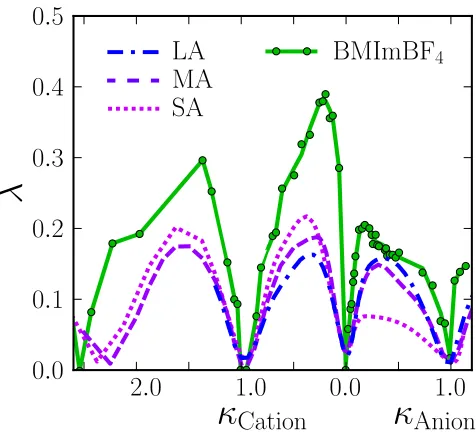
To facilitate comparison of different IL systems, in Figure 2, we plot λ versus κfor cationic and anionic layers. As can be seen, the evolution of the
EDL structure upon surface charging is qualitatively the same for all
coarse-grained and atomistic models. This implies that the main mechanisms of ion
accumulation at the surface are governed mostly by electrostatic interactions
and sterical effects. Yet, despite of the apparent general similarity seen in Figures 1 and 2, there is a lamination of the ρN(z,Cation) at large κCation
due to the presence of both parallel and perpendicular orientation of the
[BMIm]+ ring in the first cationic layer.
4. Conclusions
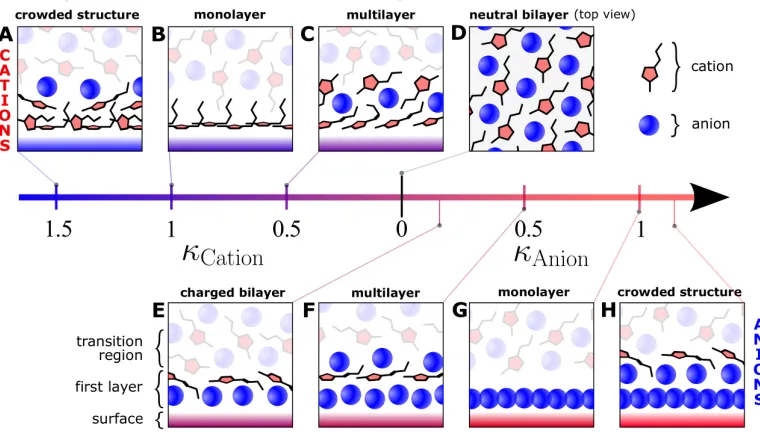
As a summary, Figure 3 illustrates general mechanisms of structural
tran-sitions in the EDL which are represented as an ensemble of charge-dependent
poly(a)morphic structures. These mechanisms can be described by the
high surface charges (A,H).
D,E: Ionic bilayers of cations and anions that are formed at small surface
charges κ≈ 0. Analysis of the MD simulations results reveals that at
small absolute σ values the first layer consists of two correlated
sub-systems – anionic and cationic – that form the ionic bilayer. Upon
surface charging, the cationic and anionic subsystems become
sepa-rated in space due to depletion of the co-ions and enrichment of the
counter-ions near the surface. The anionic and cationic subsystems
be-come completely separated byκ≈0.5 when the multilayer structure is
formed.
C,F:Multilayered structures formed at intermediateκ-values that are
com-posed from well-distinguishable layers of cations and anions that
al-ternate in the normal direction (see Figure 1). These multilayered
structures are characterised by maximal values of the charge excess
parameter (λ) (see Figure 2).
B,G:Cationic (B) and anionic (G) monolayer structures formed atκ-values
close to 1.0. In the cationic monolayer most of the [BMIm]+ rings lie
parallel to the surface and few of the [BMIm]+ rings orient
perpendic-ular to the surface. Noteworthy that the reorientation of a small part
of the [BMIm]+ rings happens for the same reason as the displacement
of the tails from the surface – in order to provide higher charge density
in the ionic layer closer to the surface. The tails are pulled away from
the surface at κ > 0.5 forming a flexible sublayer. This observation
intermediate layer [23] in a confined pyrrolidinium-based IL.
A,H: Crowded structures formed by cations (A) and anions (H) at high
values of κIon (κIon > 1.0) when the net counter charge cannot be
provided by a single dense layer of counter-ions [7]. We point to the molecular details of this phenomenon for ions with complex molecular
geometry like the [BMIm]+ cations considered in this study: in the
molecular simulations a higher counter-charge can be accumulated
ei-ther by the formation of a distinguishable second sublayer of [BMIm]+
cations (leading to crowding) or by reorientation of the [BMIm]+ rings
from parallel to perpendicular orientation relative to the surface (due
to electrostriction).
The visualised reorientation of the alkyl chains and the [BMIm]+ ring
(Figure 3B–D) is in agreement with recent spectroscopic studies [24].
More-over, the molecular representation of the bilayer-to-multilayer restructuring
(Figure 3C–F) supports atomic force microscopy (AFM) insights into the
EDL structure in ILs [5, 25, 2, 26]. First, using eq. 2 with = 1.6 we
esti-mate the potential of the monolayer formation of common [BPyr]+, [TFSI]−,
[FAP]− to be −3.1 V, +2.9 V and +2.7 V, respectively. Consequently, we
conclude that the electrode potential range used in experiments [5, 25, 2, 26]
corresponds to the κIon values between 0 and 0.5–0.7. In both MD
simula-tions and in AFM experiments [5, 26], upon κCation → 0.5, the number of
interfacial layers is increasing (Figure 1); at negative surface charge densities
the thickness of the first layer varies due to the reorientation of the cation
the first layer remains constant, although, the alkyl tails may penetrate the
anionic sublayer (Figure 3E).
The presented results also prove that the earlier ideas on over-screening to
overcrowding structural transitions [7] obtained on simple IL models [11, 14]
are still generally valid even when the molecular structure of IL ions is taken
into account.
5. Acknowledgement
We acknowledge the supercomputing support from ARCHIE-WeSt High
Performance Computer centre (www.archie-west.ac.uk, EPSRC grant no.
References
[1] Y. Liu, Y. Zhang, G. Wu, J. Hu, Coexistence of liquid and solid phases
of bmim-PF6 ionic liquid on mica surfaces at room temperature, J. Am.
Chem. Soc. 128 (23) (2006) 7456–7457.
[2] J. Sweeney, F. Hausen, R. Hayes, G. B. Webber, F. Endres, M. W.
Rutland, R. Bennewitz, R. Atkin, Control of nanoscale friction on gold
in an ionic liquid by a potential-dependent ionic lubricant layer, Phys.
Rev. Lett. 109 (15) (2012) 155502–5.
[3] H. Zhou, M. Rouha, G. Feng, S. S. Lee, H. Docherty, P. Fenter, P. T.
Cummings, P. F. Fulvio, S. Dai, J. McDonough, V. Presser, Y. Gogotsi,
Nanoscale perturbations of room temperature ionic liquid structure at
charged and uncharged interfaces, ACS Nano 6 (11) (2012) 9818–9827.
[4] F. Buchner, K. Forster-Tonigold, B. Uhl, D. Alwast, N. Wagner,
A. Groß, R. J. Behm, Towards the microscopic identification of anions
and cations at the ionic liquid | ag(111) interface: A combined
experi-mental and theoretical investigation, ACS Nano 7 (2013) 7773–7784.
[5] H. Li, R. J. Wood, F. Endres, R. Atkin, Influence of alkyl chain length
and anion species on ionic liquid structure at the graphite interface as a
function of applied potential, J. Phys.: Condens. Matter 26 (28) (2014)
284115.
[6] T. Carstens, R. Gustus, O. H¨offt, N. Borisenko, F. Endres, H. Li, R. J.
Wood, A. J. Page, R. Atkin, Combined STM, AFM, and DFT study
bis(trifluoromethylsulfonyl)imide interface, J. Phys. Chem. C 118 (20)
(2014) 10833–10843.
[7] M. Z. Bazant, B. D. Storey, A. A. Kornyshev, Double layer in ionic
liquids: Overscreening versus crowding, Phys. Rev. Lett. 106 (4) (2011)
046102–4.
[8] S. Tazi, M. Salanne, C. Simon, P. Turq, M. Pounds, P. A. Madden,
Potential-induced ordering transition of the adsorbed layer at the ionic
Liquid/Electrified metal interface, J. Phys. Chem. B 114 (25) (2010)
8453–8459.
[9] E. Paek, A. J. Pak, G. S. Hwang, A computational study of the
interfa-cial structure and capacitance of graphene in [BMIM][PF6] ionic liquid,
J. Electrochem. Soc. 160 (1) (2013) A1–A10.
[10] S. A. Kislenko, R. H. Amirov, I. S. Samoylov, Molecular dynamics
sim-ulation of the electrical double layer in ionic liquids, J. Phys.: Conf. Ser.
418 (1) (2013) 012021–8.
[11] K. Kirchner, T. Kirchner, V. Ivaniˇstˇsev, M. Fedorov, Electrical double
layer in ionic liquids: Structural transitions from multilayer to monolayer
structure at the interface, Electrochim. Acta 110 (2013) 762–771.
[12] C. Merlet, B. Rotenberg, P. A. Madden, M. Salanne, Computer
simula-tions of ionic liquids at electrochemical interfaces, Phys. Chem. Chem.
Phys. 15 (38) (2013) 15781–15792.
D. Chandler, B. Rotenberg, The electric double layer has a life of its
own, J. Phys. Chem. C.
[14] V. Ivaniˇstˇsev, M. V. Fedorov, Interfaces between charged surfaces and
ionic liquids: Insights from molecular simulations, Interface 23 (1) (2014)
65–69.
[15] F. Endres, O. H¨offt, N. Borisenko, L. H. Gasparotto, A. Prowald, R.
Al-Salman, T. Carstens, R. Atkin, A. Bund, S. Z. El Abedin, Do solvation
layers of ionic liquids influence electrochemical reactions?, Phys. Chem.
Chem. Phys. 12 (8) (2010) 1724–1732.
[16] M. V. Fedorov, A. A. Kornyshev, Ionic liquids at electrified interfaces,
Chem. Rev. 114 (5) (2014) 2978–3036.
[17] A. A. Kornyshev, R. Qiao, Three-dimensional double layers, J. Phys.
Chem. C.
[18] M. V. Fedorov, A. A. Kornyshev, Ionic liquid near a charged wall:
Struc-ture and capacitance of electrical double layer, J. Phys. Chem. B 112 (38)
(2008) 11868–11872.
[19] M. V. Fedorov, A. A. Kornyshev, Towards understanding the structure
and capacitance of electrical double layer in ionic liquids, Electrochim.
Acta 53 (23) (2008) 6835–6740.
[20] V. Ivaniˇstˇsev, M. V. Fedorov, R. M. Lynden-Bell, Screening of
Ion–Graphene electrode interactions by ionic liquids: The effects of
[21] B. Hess, C. Kutzner, D. van der Spoel, E. Lindahl, GROMACS 4:
Al-gorithms for highly efficient, load-balanced, and scalable molecular
sim-ulation, J. Chem. Theory Comput. 4 (3) (2008) 435–447.
[22] S. V. Sambasivarao, O. Acevedo, Development of OPLS-AA force field
parameters for 68 unique ionic liquids, J. Chem. Theory Comput. 5 (4)
(2009) 1038–1050.
[23] A. M. Smith, K. R. J. Lovelock, N. N. Gosvami, P. Licence, A. Dolan,
T. Welton, S. Perkin, Monolayer to bilayer structural transition in
con-fined pyrrolidinium-based ionic liquids, J. Phys. Chem. Lett. 4 (2013)
378–382.
[24] S. Baldelli, Interfacial structure of room-temperature ionic liquids at
the Solid–Liquid interface as probed by sum frequency generation
spec-troscopy, J. Phys. Chem. Lett. 4 (2) (2013) 244–252.
[25] H. Li, F. Endres, R. Atkin, Effect of alkyl chain length and anion species
on the interfacial nanostructure of ionic liquids at the au(111)–ionic
liquid interface as a function of potential, Phys. Chem. Chem. Phys.
15 (35) (2013) 14624–14633.
[26] R. Hayes, N. Borisenko, M. K. Tam, P. C. Howlett, F. Endres, R. Atkin,
Double layer structure of ionic liquids at the au(111) electrode interface:
An atomic force microscopy investigation, J. Phys. Chem. C 115 (14)
bilayer multilayer monolayer crowded str. multilayer monolayer
Figure 1: The figure presents the ion number densityρN(z, κ) contour maps that illustrate
charge-dependent layering of cation (light, red) and anion (dark, blue) for the MA (left)
and the [BMIm][BF4] (right) models. The contour interval equals toρbulk, the first contour
starts at 1.5ρbulk (MA) and 2.5ρbulk ( [BMIm][BF4]), and theρN(z, κ) peaks are cut at
7ρbulk to facilitate the visual analysis. For [BMIm][BF4] the positions of the IL anions
and cations are assigned to the centres of C1 and B atoms respectively; the picture of
[BMIm]+ indicates that the lamination of theρN(z,Cation) at largeκCation values is due to the presence of parallel and perpendicular (shown) orientation of the aromatic ring in
Figure 2: Variation of the normalised charge excess in the first interfacial layer (λ) withκ
for the four model ILs studied in this work. The figure illustrates the overall similarity of
the charge-induced EDL restructuring in thesedifferent model ILs. TheκIonvalues of 1.0 correspond to theθmax
Ion values of the charge density σ. λ minimum atκ≈2.3 indicates the formation of a crowded layer of cations which accommodates more counter-ions that is
expected from a superposition of two dense monolayers; that happens due to the squeezing
Figure 3: Schematic representation of cations (red pentagons with black tails) and anions (blue balls) packing and orientations close to the electrode (coloured rectangle) at different
κ-values. Links between the shown structures and the position on theκ-scale are indicated
with lines. In terms of cation and anion packing, the EDL structures formed upon surface
charging can be roughly classified as ionic bilayer (D,E), multilayer (C,F), monolayer (B,G)
![Figure 1: The figure presents the ion number density ρto the presence of parallel and perpendicular (shown) orientation of the aromatic ring in[BMIm]N(z, κ) contour maps that illustratecharge-dependent layering of cation (light, red) and anion (dark, blue)](https://thumb-us.123doks.com/thumbv2/123dok_us/1637992.117166/14.612.110.499.125.276/presents-presence-perpendicular-orientation-aromatic-illustratecharge-dependent-layering.webp)