City, University of London Institutional Repository
Citation
:
Moore, L. and Tapper, K. (2008). The impact of school fruit tuck shops and school food policies on children's fruit consumption: a cluster randomised trial of schools in deprived areas. Journal of Epidemiology and Community Health, 62(10), pp. 926-931. doi: 10.1136/jech.2007.070953This is the accepted version of the paper.
This version of the publication may differ from the final published
version.
Permanent repository link:
http://openaccess.city.ac.uk/5376/Link to published version
:
http://dx.doi.org/10.1136/jech.2007.070953Copyright and reuse:
City Research Online aims to make research
outputs of City, University of London available to a wider audience.
Copyright and Moral Rights remain with the author(s) and/or copyright
holders. URLs from City Research Online may be freely distributed and
linked to.
City Research Online: http://openaccess.city.ac.uk/ [email protected]
Can school fruit tuck shops increase children’s fruit consumption? A cluster randomised controlled trial.
Laurence Moore1* & Katy Tapper 2
1
Cardiff Institute of Society, Health and Ethics, 53 Park Place, Cardiff University, Cardiff, CF10 3AT, UK. Email [email protected]
2
Department of Psychology, Swansea University, Swansea, SA2 8PP, UK. Email [email protected]
Abstract
Background: The aim of the study was to examine the impact of school fruit tuck shops on
children’s consumption of fruit and other sweet and savoury snacks.
Methods: The study employed a cluster randomised design with school as the unit of
analysis. Forty-three primary schools in south Wales and south-west England were randomly
assigned to an intervention or control condition. Intervention schools were asked to operate
fruit tuck shops throughout the academic year. Consumption of fruit and other snacks were
assessed using a computerised single-day 24-hour recall procedure and a brief questionnaire.
Data were collected from children in years 5 and 6 (aged 9-11). For the recall measure, data
were obtained from 1902 children at baseline and 1924 children at follow-up. For the
questionnaire measure, data were obtained from 1976 children at follow-up. Tuck shop sales
were also recorded throughout the year.Data were analysed using school level regression
analysis and random effects logistic regression.
Results: Children in intervention schools more likely to report eating fruit as a snack at
school ‘often’ (odds ratio 1.49 (95% confidence interval 1.15, 1.95)). It is estimated that
70,000 fruits were sold in the 23 intervention schools over the year, equivalent to
approximately 0.06 fruits per student per day. The recall measure suggested a small increase
in children’s fruit intake at school (+0.06 portions (-0.10, 0.21)), but this was not statistically
significant. There were no significant differences in children’s intake of other snacks. For
fruit consumed at school there was a significant interaction (p<0.02) between intervention
group and school food policy with a greater effect found in schools with a policy that
restricted food items that students were allowed to bring to school to ‘fruit only’ (+0.37
portions (0.11, 0.64)) or ‘no food’ (+0.14 portions (-0.30, 0.58)) compared to that among
Conclusions: The results suggest that, when used in isolation, the tuck shops were not
effective in bringing about substantial changes to children’s diets. However, impact was
greater where tuckshops were introduced in schools with policies restricting the types of
Can school fruit tuck shops increase children’s fruit consumption?
A cluster randomised controlled trial.
Background
In recent years there has been increasing concern about the diets of British school children.
Research shows that many children consume large amounts of sugar, salt and saturated fats,
whilst very few achieve the recommended intake of fruit and vegetables [1]. These dietary
habits are associated with a wide variety of health problems, including cardiovascular disease,
stroke, cancer and diabetes [2, 3, 4, 5, 6]. UK death rates from coronary disease are now
among the highest in the world [7] and it is likely that the incidence of childhood type 2
diabetes will become increasingly common [8]. As part of an attempt to reverse these trends,
the UK government has introduced a number of measures aimed at improving children’s
diets, including the introduction of initiatives designed to increase consumption of fruit and
vegetables [9].
In some instances, good quality fruit and vegetables are simply not readily available.
For example, many school canteens provide only limited amounts of fruit and salad [10] and
cooked vegetables may be poorly prepared [11]. Those on low incomes also tend to have
limited access to affordable, healthy foods [12]. This can be the result of poor local food
facilities together with difficulties reaching supermarkets and other shops because of a lack of
transport. Thus many government initiatives are based on the assumption that low levels of
fruit and vegetable consumption are in part due to a lack of availability or affordability and
that if these issues are addressed, increases in consumption will follow. Such initiatives have
included the introduction of nutritional standards for food provided in schools [13] and the
provision of free fruit for 4-7 year olds [14].
The view that fruit and vegetable consumption is partially dictated by availability is
to have poorer diets [12, 14]. A number of studies have also shown that availability of fruit
and vegetables predicts, or is positively associated with, levels of consumption [15, 16, 17,
18, 19, 20, 21]. However, it is possible that such associations reflect other variables. For
example, a group’s preference for a particular food may independently influence both their
consumption and, via demand, levels of availability in their homes, schools and local shops.
Thus it is unclear from these studies whether increasing the availability of fruit and vegetables
would in fact lead to increases in consumption. To make such a claim, experimental data are
required.
Unfortunately, very little experimental research has examined the impact of fruit and
vegetable availability on consumption. The evaluation of intervention programmes aimed at
increasing consumption usually employ experimental study designs. However, these tend to
include availability as just one of a number of different intervention components and do not
assess its effects separately [22; 23; 24; 25; 26, 27]. Thus, where these interventions have
been successful, it has been unclear to what extent, if any, this was due to increased
availability.
A limited number of studies have directly examined the effects of increased fruit and
vegetable availability on consumption and the results of some of these have been promising.
In Denmark, primary schools piloted a fruit ‘subscription’ scheme whereby 6-10 year olds
whose parents subscribed to the scheme were provided with one portion of fruit or vegetables
each day. Research showed that five weeks after the introduction of the scheme, fruit
consumption had increased by 0.4 pieces per school day among children who subscribed and
by 0.3 pieces among non-subscribers [28]. In Norway, where schoolchildren have been
provided with free fruit and vegetables, research has also shown increases in consumption
[29, 30, 31]. Three years after the introduction of this scheme, estimated increases in
Likewise, research carried out in a North American office cafeteria showed that over a 3 week
period, increases in the availability of fruit and salad options, coupled with a reduction in the
prices of these items, resulted in significant sales increases for these foods [32].
However, other studies examining the long term effects of increased availability of
healthy foods have not been as positive. In English secondary schools, increasing the
availability of healthy foods at lunchtime did not have significant, sustained effects on
consumption of these foods when assessed over a 2 year period [33]. In primary schools,
provision of free fruit resulted in no increases in consumption after 20 months [34]. And in
American middle schools, provision of low-fat foods in school food outlets (combined with a
limited amount of promotion) had no effect on fat intake when it was measured two years
after the introduction of the changes [35]. Thus there are a very limited number of studies that
have assessed the long term effects of increasing the availability of healthy foods in schools
and the findings from these have been contradictory.
In addition, we know little about the mechanisms by which food availability impacts
upon consumption. In some instances, it may be that consumption levels are restricted by a
lack of availability and thus by increasing availability one simply removes this barrier.
However, it is also possible that availability influences consumption via other variables such
as group norms and preferences. For example, the peer group exerts a substantial amount of
influence on children’s behaviour [36]. In particular, there is evidence to show that if children
observe a peer eating a food, they are more likely to do so themselves [37, 38, 39]. There is
also evidence to show that the repeated tasting of particular foods (‘taste exposure’) leads to
increased preference for those foods [40, 41, 42, 43, 44, 45]. This is important since food
preferences predict consumption [16, 46]. Thus although increasing fruit and vegetable
minority of children, it is possible that such changes would eventually occur amongst other
children due to processes of peer influence and taste exposure.
The present study examines the impact of school fruit tuck shops on children’s diets.
Fruit tuck shops can be an effective way of making fruit readily available to children. They
require limited investment from government and are a relatively low-maintenance and
sustainable initiative for schools. For these reasons, they are becoming increasingly popular
as part of a drive towards healthy eating [47]. However, to date their efficacy in terms of
dietary change has not been examined. The present study employs a randomised controlled
trial design to examine their impact on children’s consumption of both fruit and other sweet
and savoury snacks. Consumption of these foods was assessed at school 9 months after the
introduction of the tuck shops in relation to two time periods; the school day and the entire
day. Although the tuck shops were introduced to the whole primary school (5-11 years), due
to the difficulties associated with obtaining accurate dietary information from young children
[48], consumption measures were taken with children aged 9-11 years only. Questionnaire
measures of children’s fruit consumption, peer group norms regarding fruit, and preference
for fruit were also taken at follow-up. In addition, intervention schools were asked to keep a
weekly record of fruit tuck shop sales.
Method
Participants and recruitment
Two-hundred and fifty-five primary and junior schools in eight local education authorities in
south-west England and south Wales were identified as having a free school meal entitlement
higher than the national average of 17%. These schools were contacted regarding tuck shop
provision. If there was an existing tuck shop, selling any type of food, the school was
study, bearing in mind that there was a 50% chance that they would be randomised to the
control condition. Forty-three schools agreed to participate and were each promised a £50
donation on completion of the study to compensate for disruption to school activities. Prior to
the study, letters were sent to parents informing them of the research and giving them the
opportunity to withdraw their child from the data collection. Figure 1 shows that flow of
schools and students through the study.
INSERT FIGURE 1 HERE
Sample size
Previous research indicated that primary school children in low income areas of south-west
England consumed an average of 0.75 portions of fruit per day [49]. Assuming an average of
50 children per school, and intra-cluster correlations within schools of 0.02, a power
calculation indicated that a sample size of 42 schools would provide 80% power to detect a
25% difference in fruit consumption between intervention and control schools.
Randomisation
After all 43 schools had been recruited, they were randomised to control and experimental
groups using a minimisation strategy relating to the following variables; school size (above or
below 40 children in year 6), country (England or Wales), existing policy on snacks at
morning break (no food, fruit only or no restrictions) and expressed preference for allocation
(preference for control, preference for intervention or no preference). Given the nature of the
intervention, teachers , children and researchers were not blind to group allocation.
Measures
The primary outcome measure was consumption of fruit and other sweet and savoury snacks,
Previous research indicated that this measure showed acceptable levels of validity, reliability
and sensitivity [49]. The questionnaire recorded the number of servings of i) fruit, ii) sweets,
chocolate, biscuits, and iii) crisps consumed during the previous 24-hour period. For each of
these three food types, two measures were computed; the number of servings consumed at
school and the number of servings consumed throughout the whole day. All intervention
schools were also asked to keep a weekly record of fruit tuck shop sales throughout the 9
month period.
Secondary outcomes were collected at follow-up only, using a brief pencil and paper
questionnaire. These assessed whether the tuck shops influenced children’s preference for
fruit and their peer group norms regarding fruit. This questionnaire was also used as a means
of identifying any small changes in fruit consumption that the computerised questionnaire
may not have been sensitive enough to detect. Prior to its use, the questionnaire was piloted in
a primary school that was not involved in the study and the final version of the questionnaire
consisted of a series of closed questions to which children responded with one of two or three
alternatives (see Results section).
Procedure
The computerised questionnaire was administered prior to the introduction of the tuck shops
in the intervention schools (summer term, 1999) and at follow-up, 12 months later. The brief
questionnaire was administered at follow-up only. On both occasions, one class of Year 5
children and one class of Year 6 children were randomly selected from each school to
complete the questionnaire(s). Thus the study employed a repeated cross-section design,
although many of the Year 5 children who provided data at baseline were re-surveyed at
follow-up. On data collection days, laptop computers were set up in each school and children
participated in groups of four to five. Two researchers were present to assist with any
Throughout the study, both intervention and control schools were asked to continue
with their existing curriculum and school meal arrangements. Intervention schools set up tuck
shops that were not subsidised in any way, although some support and advice was available to
schools from a project support officer. Schools were asked to offer a choice of fruit in the
tuck shop, to price each item at 15 pence and to refrain from stocking sweets, crisps and other
items as alternatives. Other than this, schools were relatively free to choose how they operated
the tuck shop and this resulted in a variety of different approaches (Moe et al., 2001).
Data analysis
Primary outcomes were analysed using school level regression analysis. For each of the 6
outcomes, the baseline measure for each school was used as a covariate, in addition to the
four minimisation variables. Models were estimated using weights calculated according to the
formula described by Donner and Klar [50]. Secondary outcomes only collected at follow-up
were analysed using random effects logistic regression [51]. Items with three alternative
responses were dichotomised and the four minimisation variables were included as covariates.
Results
Computerised questionnaire measure
A total of 1902 children completed the questionnaire at baseline. However, 12 children did
not provide complete data, and a further 258 were excluded as they reported eating over 8
servings of fruit [49]. This left a total of 1632 children; 918 in the 23 intervention schools and
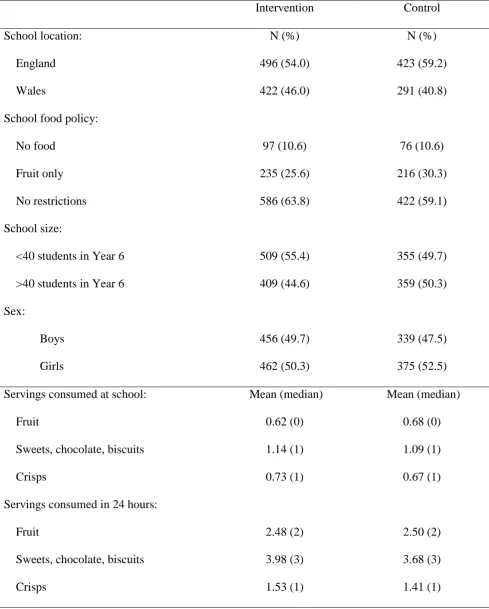
714 in the 20 control schools (see Figure 1). Baseline characteristics were evenly distributed
between the control and intervention groups (Table 1).
A total of 1924 children completed the questionnaire at follow-up, of which 1612 were
included in analysis; 921 intervention students and 691 control (see Figure 1). Reported levels
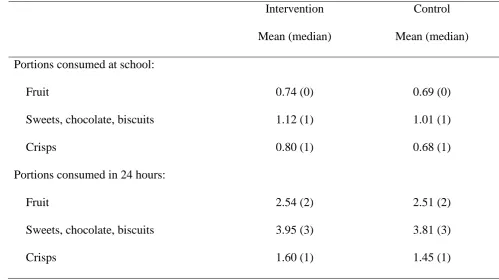
of fruit and snack intake at follow-up are displayed in Table 2. These showed that in the
intervention schools, children consumed an average of 0.74 servings of fruit at school and
2.54 servings throughout the whole 24 hour period. In the control schools, children consumed
an average of 0.69 servings of fruit at school, and 2.51 servings throughout the whole 24 hour
period. Consumption of other snacks was also similar across the intervention and control
schools. For example, at school, children in the intervention schools consumed an average of
1.12 servings of sweets, chocolate and biscuits and 0.80 servings of crisps, whilst in the
control schools they consumed an average of 1.01 servings of sweets, chocolate and biscuits
and 0.68 servings of crisps.
INSERT TABLE 2 HERE
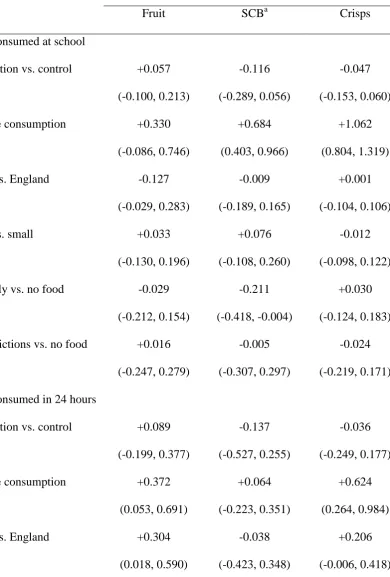
The results of the school-level regression models are shown in Table 3. For all six outcomes
the intervention effect estimates were near zero, and the 95% confidence intervals were
distributed fairly symmetrically over the null effect. Thus overall, the tuck shops had no effect
on children’s consumption of fruit or other snacks. It is also important to note that the
confidence intervals were not wide (generally 0.3 serving), indicating that the absence of a
statistically significant effect was not due to a lack of power.
INSERT TABLE 3 HERE
The data were then tested for interactions with school policy. Of the 6 analyses conducted
p<.02. In this model, estimates of the difference in fruit consumption between intervention
and control school students were 0.37 portions (95% CI: 0.11, 0.64) greater consumption
among schools with a fruit only policy; 0.14 0.30, 0.58) with a no food policy, and -0.13
(-0.33, 0.07), that is 0.13 fewer portions in those with no restrictions on food brought to school.
Fruit tuck shop sales
For many schools, the maintenance of the tuck shop sales records proved to be more onerous
than the operation of the tuck shops themselves. In these cases, frequent reminders were
required to obtain records, and the quality of the data received from schools was questionable.
It was decided that the continued cooperation of schools (and operation of tuck shops) should
not be jeopardised by strict enforcement of the quality and timeliness of the weekly sales
record data. Thus, a detailed analysis of the sales data was not undertaken. Over the 23
schools, there were 5,600 students on the school rolls, which over an academic year totals
approximately 1.1 million student school days. Fruit sales over the year in the 23 intervention
schools were estimated to have been in the region of 70,000 fruits. This is the equivalent of
0.06 fruits per student per day, which in turn equates to approximately 1 in 4 children eating 1
piece of fruit per week, or 1 in 17 eating fruit every day. In general, fruit sales were highest in
the first term of operation (Autumn term, 1999) and then declined, both as the Autumn term
progressed, and during the spring and summer terms. By the end of the summer term, four out
of the 23 tuck shops were permanently or temporarily closed.
Brief questionnaire measure
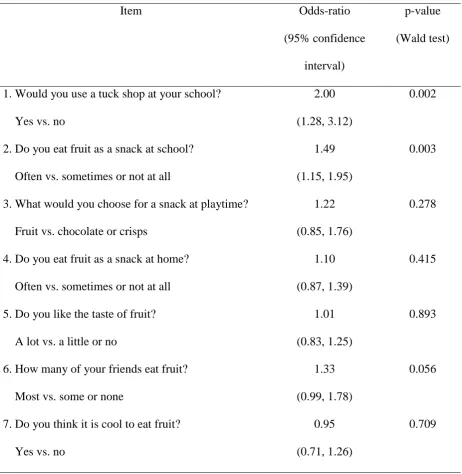
The brief questionnaire was completed by 1976 children. Table 4 shows the odds-ratios from
the random effects regression models for the association between intervention group and a
INSERT TABLE 4 HERE
Table 4 indicates that, with the exception of the final item, children in schools with fruit tuck
shops were more likely to give positive responses to the items on the questionnaire. In
relation to fruit consumption, children in intervention schools were significantly more likely
to state that they would use a tuck shop (p<.002) and were significantly more likely to state
that they often ate fruit as a snack at school (p<.005). They were also more likely to state that
most of their friends ate fruit, but this was not statistically significant at conventional levels
(i.e. p<.05). However, they were not more likely to choose fruit rather than chocolate or crisps
as a snack at playtime, nor were they more likely to eat fruit as a snack at home. In relation to
measures of preference for fruit and group norms relating to fruit, there was no evidence to
indicate that children in the intervention schools were more likely to enjoy the taste of fruit or
that they were more likely to think that it was cool to eat fruit. However, as described above,
there was some evidence to indicate that children in intervention schools were more likely to
state that most of their friends ate fruit.
The data were then tested for one interaction, which was that between the fruit tuck shop
intervention and school food policy. Of the 7 analyses conducted results showed a significant
effect for question 6 (‘How many of your friends eat fruit?’), chi2(2) = 9.99, p<.01.
Consistent with predictions, odds ratios for tuckshop versus no tuckshop schools were higher
for those with a no food policy (4.44, 95% CI: 1.96, 10.0)) or a fruit only policy (1.35, 95%
CI: 0.82, 2.23) compared to those with no food restrictions (1.05, 95% CI: 0.75, 1.47). For
question 2 (‘Do you eat fruit as a snack at school?’) although the interaction test was less
significant, chi2(2) = 3.87, p = 0.14, the same pattern was apparent with odds ratios for the
a fruit only policy (1.89, 95% CI: 1.19, 3.01)) compared to those with no food restrictions
(1.21, 95% CI: 0.88, 1.67).
Discussion
The present study examined the impact of a school fruit tuck shop scheme on the diets of
children aged 9-11 years. The cost of the scheme was kept to a minimum and care was taken
to ensure that the tuck shops were representative of the kind that could feasibly be operated in
any primary school. For these reasons, the research is directly relevant to large-scale attempts
to employ fruit tuck shops as a means of improving children’s diet. The use of a randomised
controlled trial design also ensured that the study provided an unbiased estimate of the
intervention effect [52].
Self-reported measures of consumption were taken approximately 9 months after the
introduction of the tuck shops using a 24-hour recall procedure. These showed that, overall,
the tuck shops had no effect on children’s consumption of fruit, sweets, chocolate, biscuits
and crisps. However, this measure was designed to identify substantial changes in
consumption and would not have been sensitive enough to detect smaller changes that may
have occurred on an irregular basis or amongst a minority of children [49]. The questionnaire
data found a statistically significant effect across all schools on children reporting that they
often ate fruit as a snack at school. These findings combined are consistent with the tuck shop
sales data which equated to approximately 1 in 4 children purchasing 1 piece of fruit a week,
or 1 in 17 children buying fruit every day.
Further analysis of the data revealed a significant interaction between intervention
condition and school food policy. That is, in schools with a ‘no food’ or ‘fruit only’ policy the
apparent for fruit intake at school measured both by the computerised and paper
questionnaires, and awareness of friends’ regular consumption of fruit. Thus overall, the
findings indicate that, when introduced in isolation, the tuck shops were likely to have had a
limited impact on fruit consumption at school. However, when employed in conjunction with
appropriate school policies their impact was more significant.
Similarly fruit only policies, in isolation, have not been found to increase children’s
consumption of fruit [49, 53], although restriction of foods allowed in school has been found
to be associated with reduced consumption of foods high in fats and sugars [49, 54]. Together
these results suggest that where children and their friends are not allowed to bring unhealthy
snacks to school, their willingness to utilise the fruit tuck shops and eat fruit as a snack in
school is greatly enhanced. These results highlight the importance of supporting school health
interventions with appropriate school policies and provide further evidence of the potential
effectiveness of ‘whole school’ or multi-component approaches to school-based health
intervention (e.g., see [55, 56]).
Finally, an important aspect of the present study is that it demonstrated that it is
feasible for schools to set up and operate fruit tuck shops without major disruption to the
school routine. They also had wider benefits such as improved money transaction skills
amongst children, a source of data for maths and science projects and stronger links with
parents [47].
Conclusions
Although the research indicated that fruit tuck shops were not effective in bringing about
substantial changes to children’s diets, the data suggest that they did have a small positive
impact on fruit consumption at school, and could be effective when used in conjunction with
additional fruit into the school. Given that good quality fruit is frequently not available in
schools, and that fruit availability is clearly a necessary condition for increased consumption,
it seems likely that fruit tuck shops could be a valuable component of other interventions
Competing interests
Authors’ contributions
LM was responsible for the study design, data analysis and overall coordination of the
project. He also helped revise the manuscript. KT drafted the manuscript and both authors
Acknowledgements
This study was funded by the Food Standards Agency Food Choice Programme, with
additional funding from Health Promotion Wales. Anne Dennehy and Joanna Moe led the
data collection and intervention activities respectively. Laurence Moore is supported by a
References
[1] Department of Health: National Diet and Nutrition Survey: Young People Aged 4 to 18
years. Volume 1: Report of the Diet and Nutrition Survey. London: The Stationery Office;
2000.
[2] Costacou T, Mayer-Davis EJ: Nutrition and prevention of type 2 diabetes.Annu Rev
Nutr 2003,23:147-170.
[3] Gaziano JM, Manson JE, Branch LG, Colditz GA, Willet WC, Burring JB: A prospective
study of consumption of caretenoids in fruit and vegetables and decreased
cardiovascular mortality in the elderly.Ann Epidemiol 1995,5:255-260.
[4] Gillman MW, Cupples LA, Gagnon D, Posner B, Ellison RC, Castelli W, Wolf P:
Protective effect of fruits and vegetables on development of stroke in men.JAMA 1995,
273:1113-1117.
[5] Key TJA, Thorogood M, Appleby PN, Burr ML: Dietary habits and mortality in 11 000
vegetarians and health conscious people: results of a 17 year follow up.Br Med J 1996,
313:775-779.
[6] Steinmetz KA, Potter JD: Vegetables, fruit and cancer prevention: a review.J Am Diet
Assoc 1996, 96:1027-1039.
[7] Poulter N: Global risk of cardiovascular disease.Heart 2003,89:II2-II5.
[8] Drake AJ, Smith A, Betts PR, Crowne EC, Shield JPH: Type 2 diabetes in obese white
children.Arch Dis Child 2002,86:207-208.
[9] Department of Health: Choosing Health. Making Healthy Choices Easier. London: The
Department of Health; 2004.
[10] Turner S, Mayall B, Mauthner M: One big rush: dinner time at school.Health Educ. J
[11] Baranowski T, Domel S, Gould R, Baranowski J, Leanard S, Treiber F, Mullis R:
Increasing fruit and vegetable consumption among 4th and 5th grade students – results
from focus groups using reciprocal determinism.J Nutr Educ 1993,25:114-120.
[12] Lang T, Caraher M. Access to healthy foods: part II. Food poverty and shopping
deserts: what are the implications for health promotion policy and practice? Health
Educ. J 1998,57:202-211.
[13] Department for Education and Science: Nutritional standards for school lunches
and other school food, 2006 [http://www.schoolfoodtrust.org.uk]
[14] Department of Health: The National School Fruit Scheme. London; 2000.
[15] Bere E, Klepp K-I: Correlates of fruit and vegetables intake among Norwegian
schoolchildren: parental and self-reports.Public Health Nutr 2004,7:991-998.
[16] Bere E, Klepp K-I: Changes in accessibility and preferences predict children’s future
fruit and vegetables intake. Int J Behav Nutr Phys Act 2005,2:15.
[17] Cullen KW, Baranowski T, Owens E, Marsh T, Rittenberry L, de Moor C: Availability,
accessibility, and preferences for fruit, 100% fruit juice, and vegetables influence
children’s dietary behaviour. Health Educ Behav 2003,30:615-626.
[18] Cullen KW, Baranowski T, Rittenberry L, Cosart C, Hebert D, de Moor C:
Child-reported family and peer influences on fruit, juice and vegetable consumption:
reliability and validity of measures. Health Educ Res 2001,16:187-200.
[19] Neumark-Sztainer D, Wall M, Perry C, Story M: Correlates of fruit and vegetable
intake among adolescents. Findings from Project EAT.Prev Med 2003,37:198-208.
[20] Rasmussen M, Krolner R, Klepp K-I, Lytle L, Brug J, Bere E, Due P: Determinants of
fruit and vegetable consumption among children and adolescents: a review of the
[21] Reynolds KD, Hinton AW, Shewchuk RM, Hickey CA: Social cognitive model of fruit
and vegetable consumption in elementary school children.J Nutr Educ 1999,31:23-30.
[22] Baranowski T, Davis M, Resnicow K, Baranowski J, Doyle C, Lin LS, Smith M, Wang
DT: Gimme 5 Fruit, Juice, and Vegetables for Fun and Health: outcome evaluation.
Health Educ Behav 2000,27:96-111.
[23] Domel SB, Baranowski T, Davies H, Thompson WO, Leonard SB, Riley P, Baranowski
J, Dudovitz B, Smyth M: Development and evaluation of a school intervention to increase
fruit and vegetables consumption among 4th and 5th grade students.Soc Nutr Educ 1993,
25:345-349.
[24] Foester SB, Gregson J, Beall DL, Hudes M, Magnuson H, Livingstone S, Davis MA, Joy
AB, Garbolino T: The California Children’s 5 a Day – Power Play! campaign:evaluation
of a large-scale social marketing initiative.Fam Community Health 1998,21:46-64.
[25] Nicklas TA, Johnson CC, Myers L, Farris RP, Cunnimgham A: Outcomes of a high
school programme to increase fruit and vegetable consumption: Gimme 5 – A Fresh
Nutrition Concept for Students.J Sch Health 1998, 68:248-253.
[26] Perry CL, Bishop DB, Taylor G, Murray DM, Mays RW, Dudovitz BS, Smyth M, Story
M: Changing fruit and vegetable consumption among children: the 5-a-Day Power Plus
Program in St. Paul, Minnesota. Am J Public Health 1998,88:603-609.
[27] Reynolds KD, Franklin FA, Binkley D, Raczynski JM, Harrington KF, Kirk KA, Person
S: Increasing fruit and vegetable consumption of fourth-graders: results from the High
5 Project.Prev Med 2000,30:309-319.
[28] Eriksen K, Haraldsdottir J, Pederson R, Flyger HV: Effect of a fruit and vegetable
subscription in Danish schools. Public Health Nutr 2003,6:57-63.
[29] Bere E, Veierod MB, Klepp K-I: The Norwegian School Fruit Programme:
[30] Bere E, Veierod MB, Bjelland M, Klepp K-I: Free school fruit – sustained effect 1
year later. Health Educ Res 2006,21:268-275.
[31] Bere E, Veierod MB, Skare O, Klepp K-I: Free school fruit – sustained effect three
years later.Int J Behav Nutr Phys Act 2007, 4:5
[32] Jeffery RW, French SA, Raether C, Baxter JE: An environmental intervention to
increase fruit and salad purchases in a cafeteria. Prev Med 1994,23:788-792.
[33] Parker L, Fox A: The Peterborough Schools Nutrition Project: a multiple
intervention programme to improve school-based eating in secondary schools.Public
Health Nutr 2001,4:1221-1228.
[34] Wells L, Nelson M: The National School Fruit Scheme produces short-term but not
longer-term increases in fruit consumption in primary school children. Br J Nutr 2005,
93:537-542.
[35] Sallis JF, McKenzie TL, Conway TL, et al: Environmental interventions for eating
and physical activity. A randomised controlled trial in middle schools. Am J Prev Med
2003,24:209-217.
[36] Harris JR: Where is the child’s environment? A group socialization theory of
development. Psychol Rev 1995,102:458-489.
[37] Birch LL: Effects of peer models’ food choices and eating behaviours on
preschoolers’ food preferences.Child Dev 1980,51:489-496.
[38] Greer RD, Dorow L, Williams G, McCorkle N, Asnes R: Peer-mediated procedures to
induce swallowing and food acceptance in young children. J Appl Behav Anal 1991,
24:783-790.
[39] Hendy HM: Effectiveness of trained peer models to encourage food acceptance in
[40] Birch LL, Marlin DW: I don’t like it; I never tried it: effects of exposure on
two-year-old children’s food preferences. Appetite 1982, 3:353-360.
[41] Birch LL, McPhee L, Shoba BC, Pirok E, Steinberg L: What kind of exposure reduces
children’s food neophobia? Looking vs. tasting. Appetite 1987,9:171-178.
[42] Birch LL, Gunder L, Grimm-Thomas K, Laing DG: Infants’ consumption of a new
food enhances acceptance of similar foods. Appetite 1998,30:283-295.
[43] Sullivan SA, Birch LL: Pass the sugar, pass the salt: experience dictates preference.
Dev. Psychol. 1990,26:546-551.
[44] Wardle J, Cooke LJ, Gibson EL, Sapochnik M, Sheiham A, Lawson M: Increasing
children’s acceptance of vegetables: a randomised trial of guidance to parents.Appetite
2003, 40:155-162.
[45] Wardle J, Herrera M-L, Cooke L, Gibson EL: Modifying children’s food preferences:
the effects of exposure and reward on acceptance of an unfamiliar vegetable.Eur J Clin
Nutr 2003,57:341-348.
[46] Birch LL: Preschool children’s food preferences and consumption patterns.J Nutr
Educ 1979,11:189-192.
[47] Moe J, Roberts J, Moore L: Planning and running fruit tuck shops in primary
schools.Health Educ 2001,101:61-68.
[48] Livingstone MBE, Robson PJ: Measurement of dietary intake in children.Proc Nutr
Soc 2000, 59:279-293.
[49] Moore L, Tapper K, Dennehy A, Cooper A: Development and testing of a
computerised 24-hour recall questionnaire measuring fruit and snack consumption
among 9-11 year olds.Eur J Clin Nutr 2005, 59:809-816.
[50] Donner A, Klar N: Design and Analysis of Cluster Randomization Trials in Health
[51] StataCorp. Stata Statistical Software: Release 6.0. User’s Guide. College Station, TX:
Stata Corporation; 1999.
[52] Campbell M, Fitzpatrick R, Haines A, Kinmonth AL, Sandercock P, Spiegelhalter D,
Tyrer P: Framework for design and evaluation of complex interventions to improve
health.Br Med J 2000,321:694-696.
[53] Edmunds LD, Ziebland S: Development and validation of the Day in the Life
Questionnaire (DILQ) as a measure of fruit and vegetable questionnaire for 7-9 year
olds.Health Educ Res 2002,17:211-220.
[54] Neumark-Sztainer D, French SA, Hannan PJ, Story M, Fulkerson JA: School lunch and
snacking patterns among high school students: associations with school food
environment and policies.Int J Behav Nutr Phys Act 2005, 2:14
[55] Lister-Sharp D, Chapman S, Stewart-Brown S, Sowden A: Health promoting schools
and health promotion in schools: two systematic reviews.Health Technology Assessment
1999,3:22.
[56] Shepherd J, Carcia J, Oliver S, Harden A, Rees R, Brunton G, Oakley A: Barriers to,
and facilitators of, the health of young people: a systematic review of evidence on young
people’s views and on interventions in mental health, physical activity and healthy eating.
Volume 2: Complete report. London: EPP-Centre, Social Science Research Unit, Institute of
Table 1
Baseline school and student characteristics and reported levels of fruit and snack intake.
Intervention Control
School location: England Wales N (%) 496 (54.0) 422 (46.0) N (%) 423 (59.2) 291 (40.8)
School food policy:
No food Fruit only No restrictions 97 (10.6) 235 (25.6) 586 (63.8) 76 (10.6) 216 (30.3) 422 (59.1) School size:
<40 students in Year 6
>40 students in Year 6
509 (55.4) 409 (44.6) 355 (49.7) 359 (50.3) Sex: Boys Girls 456 (49.7) 462 (50.3) 339 (47.5) 375 (52.5)
Servings consumed at school: Mean (median) Mean (median)
Fruit 0.62 (0) 0.68 (0)
Sweets, chocolate, biscuits 1.14 (1) 1.09 (1)
Crisps 0.73 (1) 0.67 (1)
Servings consumed in 24 hours:
Fruit 2.48 (2) 2.50 (2)
Sweets, chocolate, biscuits 3.98 (3) 3.68 (3)
Table 2
Reported levels of fruit and snack intake in intervention and control schools at follow-up.
Intervention
Mean (median)
Control
Mean (median)
Portions consumed at school:
Fruit 0.74 (0) 0.69 (0)
Sweets, chocolate, biscuits 1.12 (1) 1.01 (1)
Crisps 0.80 (1) 0.68 (1)
Portions consumed in 24 hours:
Fruit 2.54 (2) 2.51 (2)
Sweets, chocolate, biscuits 3.95 (3) 3.81 (3)
Table 3
Multivariable models of fruit and snack consumption in schools (n=43) at follow-up (95%
confidence intervals).
Fruit SCBa Crisps
Portions consumed at school
Intervention vs. control +0.057
(-0.100, 0.213)
-0.116
(-0.289, 0.056)
-0.047
(-0.153, 0.060)
Baseline consumption +0.330
(-0.086, 0.746)
+0.684
(0.403, 0.966)
+1.062
(0.804, 1.319)
Wales vs. England -0.127
(-0.029, 0.283)
-0.009
(-0.189, 0.165)
+0.001
(-0.104, 0.106)
Large vs. small +0.033
(-0.130, 0.196)
+0.076
(-0.108, 0.260)
-0.012
(-0.098, 0.122)
Fruit only vs. no food -0.029
(-0.212, 0.154)
-0.211
(-0.418, -0.004)
+0.030
(-0.124, 0.183)
No restrictions vs. no food +0.016
(-0.247, 0.279)
-0.005
(-0.307, 0.297)
-0.024
(-0.219, 0.171)
Portions consumed in 24 hours
Intervention vs. control +0.089
(-0.199, 0.377)
-0.137
(-0.527, 0.255)
-0.036
(-0.249, 0.177)
Baseline consumption +0.372
(0.053, 0.691)
+0.064
(-0.223, 0.351)
+0.624
(0.264, 0.984)
Wales vs. England +0.304
(0.018, 0.590)
-0.038
(-0.423, 0.348)
+0.206
Large vs. small +0.114
(-0.183, 0.411)
-0.084
(-0.493, 0.325)
-0.053
(-0.274, 0.168)
Fruit only vs. no food +0.097
(-0.236, 0.431)
-0.113
(-0.562, 0.335)
-0.153
(-0.417, 0.111)
No restrictions vs. no food -0.062
(-0.513, 0.389)
+0.163
(-0.456, 0.783)
-0.160
(-0.522, 0.203)
a
Table 4
Children’s responses to the brief questionnaire in intervention versus control schools
Item Odds-ratio
(95% confidence
interval)
p-value
(Wald test)
1. Would you use a tuck shop at your school?
Yes vs. no
2.00
(1.28, 3.12)
0.002
2. Do you eat fruit as a snack at school?
Often vs. sometimes or not at all
1.49
(1.15, 1.95)
0.003
3. What would you choose for a snack at playtime?
Fruit vs. chocolate or crisps
1.22
(0.85, 1.76)
0.278
4. Do you eat fruit as a snack at home?
Often vs. sometimes or not at all
1.10
(0.87, 1.39)
0.415
5. Do you like the taste of fruit?
A lot vs. a little or no
1.01
(0.83, 1.25)
0.893
6. How many of your friends eat fruit?
Most vs. some or none
1.33
(0.99, 1.78)
0.056
7. Do you think it is cool to eat fruit?
Yes vs. no
0.95
(0.71, 1.26)