City, University of London Institutional Repository
Citation
:
Qureshi, H. K., Rizvi, S., Saleem, M., Khayam, S. A., Rakocevic, V. & Rajarajan,
M. (2013). Evaluation and improvement of CDS-based topology control for wireless sensor
networks. Wireless Networks, 19(1), pp. 31-46. doi: 10.1007/s11276-012-0449-9
This is the accepted version of the paper.
This version of the publication may differ from the final published
version.
Permanent repository link:
http://openaccess.city.ac.uk/15287/
Link to published version
:
http://dx.doi.org/10.1007/s11276-012-0449-9
Copyright and reuse:
City Research Online aims to make research
outputs of City, University of London available to a wider audience.
Copyright and Moral Rights remain with the author(s) and/or copyright
holders. URLs from City Research Online may be freely distributed and
linked to.
City Research Online:
http://openaccess.city.ac.uk/
[email protected]
Manuscript Draft
Manuscript Number:
Title: Evaluation and Improvement of CDS-based Topology Control for Wireless Sensor Networks
Article Type: Manuscript
Keywords: Topology Control, Topology Maintenance techniques, Connected Dominating Set
Corresponding Author: Mr. Hassaan Khaliq Qureshi, M.Phil
Corresponding Author's Institution: City University, London & NUST, Pakistan
First Author: Hassaan Khaliq Qureshi, M.Phil
1 2 3 4 5 6 7 8 9 10 11 12 13 14 15 16 17 18 19 20 21 22 23 24 25 26 27 28 29 30 31 32 33 34 35 36 37 38 39 40 41 42 43 44 45 46 47 48 49 50 51 52 53 54 55 56 57 58 59 60 61 62
Evaluation and Improvement of CDS-based
Topology Control for Wireless Sensor Networks
Hassaan Khaliq Qureshi
∗†, Sajjad Rizvi
∗, Muhammad Saleem
‡, Syed Ali Khayam
∗,
Veselin Rakocevic
†and Muttukrishnan Rajarajan
†∗School of Electrical Engineering & Computer Science (SEECS)
National University of Sciences & Technology (NUST), Pakistan. Email:{hassaan.khaliq, sajjad.rizvi, ali.khayam}@seecs.edu.pk
†School of Engineering and Mathematical Sciences, City University, London, UK
Email:{hassaan.qureshi.1, V.Rakocevic, R.Muttukrishnan}@city.ac.uk
‡Center for Advanced Studies in Engineering (CASE)
Email: [email protected]
Abstract—The Connected Dominating Set (CDS) principle has emerged as the predominant method for energy-efficient discovery and clustering of power-/location-unaware WSN nodes. While many CDS discovery protocols have been proposed re-cently, a one-to-one comparative evaluation of these protocols has not been performed on judicious metrics. In this paper, we perform a simulation-based evaluation of three prominent CDS based protocols (CDS-Rule K, EECDS and A3) on the basis of message and energy overhead, residual energy, number of unconnected nodes, and convergence time. Our analysis shows that the protocols’ performances vary significantly with different maintenance techniques and none of the existing protocols can outperform the others on all metrics. Based on this result, we identify somes performance-improving guidelines for CDS-based topology discovery and utilize these guidelines to propose a new protocol, Clique-based CDS Discovery (CCDS). We show that CCDS provides considerably better performance than existing protocols in most operational scenarios.
I. INTRODUCTION
Due to their inherent energy, cost and footprint constraints, Wireless Sensor Networks (WSNs) generally have limited computation, storage and communication resources. Moreover, lack of physical access and the anticipated large-scale deploy-ments of sensor nodes prohibit battery recharging/replacement. Most practical WSN deployments employ clustering to con-serve energy. In a clustered WSN topology, local nodes in a cluster communicate only with a clusterhead. Clusterheads form a tier-2 overlay networks which is used to rely packets to the base station.
Topology control (TC) for a clustered WSN is divided into two phases: 1) topology construction, in which a de-sired topology property is established in the network; and 2) topology maintenance, in which nodes switch their roles to cater for topological changes. The graph-theoretic Connected Dominating Set (CDS) principle has emerged as the most popular method for energy-efficient topology discovery [1], [7], [8], [9], [10], [11]. In CDS-based routing, a set of rich connectivity nodes acts as a virtual backbone for relaying
Part of this work appeared in the Proceedings of the 44th Annual Confer-ence on Information SciConfer-ences and Systems (CISS), Princeton, USA, March 2010 [18].
packets in the network, while non-CDS nodes conserve energy by turning off their transceivers.
While it is well-established that CDS-based topology con-trol has good energy efficiency [1], [7]–[11], a comprehen-sive comparative evaluation of these protocols has not been performed. Since the protocols have not been compared with each other, we do not understand the strengths and weaknesses of each protocol and good design principles that we should be mindful of when design CDS-based topology discovery protocols. Moreover, a set of meaningful performance metrics, which can be used for judicious performance evaluation, have not been established; each protocol uses its own metrics which are generally inconsistent with other studies. Finally, all of the existing studies focus solely on energy efficiency and connectivity during topology construction only and ignore the topology maintenance phase which is bound to arise as sensors switch roles due to energy depletion or other causes. Finally, scalability of CDS-based topology is not evaluated on varying-sized sensor fields1, which again limits our understanding of the usefulness of these protocols in different deployments.
In this paper, we evaluate and compare three prominent CDS based protocols using simulation studies on different network topologies.2 The objectives of this study are: 1) to analyze the performance of CDS-based protocols over a large operational landscape in order to understand their strengths and weaknesses; 2) investigate the reasons behind the superior or inferior performances of these protocols; 3) identify a set of judicious performance evaluation metrics; and 4) utilize these insights to propose a new CDS-based protocol that exploits the lessons learnt by the performance evaluation and performs well in most operational scenarios.
We compare the performances of three prominent topology construction protocols, namely CDS-Rule K, EECDS and A3 [9], [10], [11], on the basis of five relevant metrics: message overhead, residual energy, energy overhead, number
1The average size of the sensor field used by current studies is 100 nodes
[11].
2Other protocols [2]–[4] are subsets of these three topology control
proto-cols.
*Manuscript
2 3 4 5 6 7 8 9 10 11 12 13 14 15 16 17 18 19 20 21 22 23 24 25 26 27 28 29 30 31 32 33 34 35 36 37 38 39 40 41 42 43 44 45 46 47 48 49 50 51 52 53 54 55 56 57 58 59 60 61 62
of unconnected nodes and convergence time. Our performance evaluation reveals several interesting insights. For instance, the protocols provide reasonable performance during topology construction, but they fail to maintain the same performance in the topology maintenance phase. We also observe that the performances of these protocols differ considerably in static and dynamic scenarios. Moreover, we show that a lack of consistent performance metrics can be very misleading because a protocol performing well on one metric might incur serious performance degradations for another metric. Finally, we observe that protocols using link/physical layer side-information (e.g., use of signal strength in A3) lead to a non-uniform distribution of energy resources during the topology maintenance phase.
Using the insights from the results of simulation studies, we propose a Clique-based CDS (CCDS) discovery/maintenance protocol which exploits the broadcast nature of the wireless transmissions to reduce the message complexity. To improve the scalability and energy efficiency of the protocol, we use the number of 2-cliques present in the network. We demon-strate through simulations that CCDS performs considerably and consistently better than EECDS, A3 and CDS-Rule K protocols in most operational scenarios.
The rest of this paper is organized as follows. Section II provides background information on topology construction and maintenance. Section III summarizes the empirical evaluation process with discussions on simulation results for CDS-Rule K, EECDS and A3 protocols. Section IV summarizes the performance guidelines for CDS-based topology construction protocols. Section V describes the CCDS protocol. We sum-marize salient findings of this paper in Section VI.
II. BACKGROUND
In this section, we provide background on the topology construction and maintenance phases of a topology control protocol. We also describe three existing topology construction protocols–CDS-Rule K, A3 and EECDS–used for comparative study in this paper. To the best of the authors’ knowledge, there are no existing studies on comparison of topology control protocols.
A. Topology Construction Protocols
Historically, energy conserving topologies for WSNs were constructed by adjusting the transmission powers of sensor nodes [1], [5]. Some other techniques preserve energy using the nodes’ geographical location information [6]. However, power control and location awareness are expensive proposi-tions (in terms of energy consumption, footprint and cost) and hence are difficult to realize in practical WSN deployments. As an alternative to power/location awareness, a CDS-based graph-theoretic solution was proposed in [7] in which a vertex dominating itself and all the adjacent vertices forms a cluster in the graph. Energy is then conserved by routing data through these clusterheads. A similar solution was proposed in [8] which uses independent dominating sets with lower IDs node
acting as the cluster heads. Since these seminal papers, CDS-based WSN clustering has received significant attention and is now widely considered the predominant method for energy-efficient topology construction in WSNs.
In the rest of this section, we only focus on the three protocols used in this study. Other protocols are derived from these three base protocols.
1) CDS-Rule K and EECDS Protocols: In [9], the authors
propose a CDS-Rule K protocol by utilizing the marking and pruning rules. CDS-Rule K starts with a big set of nodes and allows nodes to exchange their neighbors lists. A node remains marked if there is at least one pair of unconnected neighbors and un-marks itself if it determines that all of its neighbors are covered with higher priority. This is indicated by a level of the node in the tree. Similarly, the authors of [10] propose an Energy-Efficient CDS (EECDS) protocol for finding a CDS in an arbitrary connected graph. The node elects itself as a clusterhead and all its neighbors are marked as covered for finding a Maximal Independent Set (MIS). The covered nodes further pass this message to 2-hop neighbors which are uncovered and start competing to become clusterheads. Once the clusterhead is chosen, the process repeats with the
4-hop neighbors until no uncovered node is left. Finally, all the covered non-clusterhead nodes compete to become gateways to form a CDS. In EECDS, nodes maintain the clusterhead role by gathering neighbor information which results in large message overhead.
2) The A3 Protocol: A3 is a topology construction protocol
[11] that forms a sub-optimal connected dominating set (CDS) acting as a virtual backbone. A3 uses a selection metric based on the remaining energy of the nodes. The nodes at the farthest distance from the parent are selected as active nodes. Consequently, fewer nodes are selected in the CDS tree based on the received signal strength which in turn leads to an overhead of long distance communication. The nodes may enter into active/ dormant states based on the messages exchanged between them.
The protocols described above build the reduced topology but do not maintain it. Consequently, the optimal topology deplete the battery of CDS nodes rapidly which directly reduces the network lifetime. There are other protocols [13]– [16] which improve the overall lifetime of the network through different topology maintenance techniques. However, we skip discussion on these protocols as they are not usable in context of topology construction protocols.
B. Topology Maintenance
Topology maintenance techniques are classified as static, dynamic and hybrid techniques and can be further subdivided on the basis of time and energy triggering mechanisms. In this paper, we only focus on maintenance of the protocols based on energy thresholds. In this section, we present the topology maintenance techniques which we subsequently use in the evaluation of the selected CDS-based protocols.
1) Static Topology Maintenance: Static topology
1 2 3 4 5 6 7 8 9 10 11 12 13 14 15 16 17 18 19 20 21 22 23 24 25 26 27 28 29 30 31 32 33 34 35 36 37 38 39 40 41 42 43 44 45 46 47 48 49 50 51 52 53 54 55 56 57 58 59 60 61 62 3
during the initial topology construction time and then rotate the possible set of CDS trees. However, the set of CDS trees can be restricted based on the nodes density.
Static techniques can be triggered based on energy and time thresholds which allow the rotation between the a priori con-structed CDS trees. If the network is sparse, static techniques do not build completely disjoint CDS trees. Static techniques make use of notification and reset messages sent to a sink node which then selects a new CDS tree. The performance of static techniques mainly depends on the topology construction protocol. If a topology construction protocol is energy efficient then it is more likely that it will perform better with static maintenance techniques.
2) Dynamic Topology Maintenance: Dynamic topology
maintenance methods do not make a priori calculations to determine the next possible set of nodes that form a CDS tree after the current set of nodes is no longer optimal, e.g. when the energy threshold is reached. Dynamic techniques are generally more time and energy consuming because they switch the topology based on the actual status of the CDS tree. On the other hand, they are better in terms of selecting the most capable set of nodes in the network. Dynamic techniques can also be time/energy triggered. An example of dynamic topology maintenance can be found in [17] in which network topology is changed in rounds based on a time-based triggering criterion.
3) Hybrid Topology Maintenance: In a hybrid mechanism,
a set of potential CDS sets are pre-constructed and rotated based on time and energy thresholds. If existing CDS sets degrade performance, a new topology is built by invoking a dynamic technique. This process allows new CDS set in the possible combination that was built at the start with static method. Hybrid methods work best with energy-based trig-gering because time-based methods invoke CDS tree updates too frequently, thereby resulting in large message overhead.
III. PERFORMANCEEVALUATION OFCDS-RULEK, EECDSANDA3 PROTOCOLS
Simulation-based performance evaluation is the most widely-used method to ascertain properties of ad-hoc pro-tocols. While topology construction protocols have been an active research for the past few years, several shortcomings exist in the simulation environment which is used to evaluate these protocols. We summarize a few of these shortcomings in the following.
• Lack of consistent evaluation metrics: Existing studies
evaluate the performance of their protocols on the basis of a few metrics which are not even used consistently across different studies [9]– [11]. This impacts the credibility of the evaluation process in two ways. First, biases in the performance analysis go unnoticed. Second, the proposed protocols may not be performing well in terms of other metrics thereby limiting their scope.
• Lack of evaluation on diverse network topologies: The
reported simulation studies of topology construction pro-tocols assume - in general - a fixed network topology
and report the selected metric values. On one hand, it represents a biased evaluation affecting the credibility of the whole process. On the other hand, it does not unveil the performance of a protocol on diverse network topologies under topology maintenance. Consequently, its overall standings remains in the shadow.
• Lack of one-to-one comparative evaluation:Mutual
com-parison of the prominent protocols over a range of relevant metrics has not been done before for different topology construction protocols using maintenance tech-niques. This is the prime objective of this work as such comparative analysis should help one to identify and learn from the strengths and weaknesses of each protocol. In the following subsections, we provide a comprehensive performance analysis of the selected protocols. In this context, we first describe our evaluation framework which is followed by the definitions of the metrics used for performance eval-uation. Subsequently, we discuss the results obtained from simulation of each protocol in different network topologies.
A. Simulation Setup
We used the Atarraya Simulator [12] designed specifically for the evaluation of WSN topology control protocols. The simulator allows the scalability of the underlying network with the ease of selecting different network parameters, such as area, transmission range, etc. We report results for experiments with varying node densities while keeping the transmission range of nodes to a fixed value of 42m. We also performed experiments with varying transmission ranges, but we skip those results as they did not provide any new insight. We assumed that the nodes are deployed randomly on a two-dimensional plane of 600m×600m. The network size was varied from 50–250 nodes. The nodes can communicate with each other using full duplex wireless radios that conform to 802.15.4 wireless standard.
Each reported result is averaged over 50 simulation runs and the data packet size equals 25bytes with no packet loss at the data link layer. Each node was assigned initial energy level of1Joule. The energy consumed during actuation equals
50nJ/bitwhile the energy consumed during communication is
100P J/m2. We assume a energy threshold of10%for energy triggered technique.
In case of static maintenance, total number of reduced topologies were restricted to three. We do not report results of time-based triggering due to its very minor impact on the performance criteria. We now provide the definitions of the metrics used to compare the performance of the protocols in the following subsections.
B. Performance Evaluation Metrics
2 3 4 5 6 7 8 9 10 11 12 13 14 15 16 17 18 19 20 21 22 23 24 25 26 27 28 29 30 31 32 33 34 35 36 37 38 39 40 41 42 43 44 45 46 47 48 49 50 51 52 53 54 55 56 57 58 59 60 61 62
50 100 150 200 250
103 104 105 106
Network Size
Total Number of Messages (Log Scale)
CDS Rule K EECDS A3
(a) Static Topology Maintenance
50 100 150 200 250
104 105 106 107
Network Size
Total Number of Messages (Log Scale)
CDS Rule K EECDS A3
(b) Dynamic Topology Maintenance
50 100 150 200 250
104 105 106 107
Network Size
Total Number of Messages (Log Scale)
CDS Rule K EECDS A3
(c) Hybrid Topology Maintenance
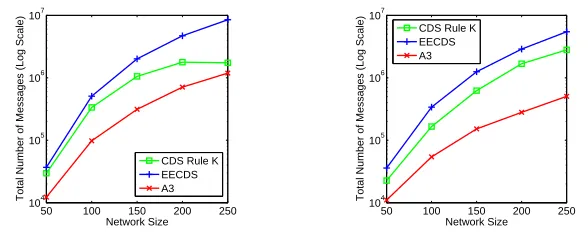
Fig. 1. Total number of exchanged messages under varying network sizes.
50 100 150 200 250
0 0.05 0.1 0.15 0.2 Network Size Energy overhead
CDS Rule K EECDS A3
(a) Static Topology Maintenance
50 100 150 200 250
0.4 0.5 0.6 0.7 0.8 0.9 Network Size Energy overhead
CDS Rule K EECDS A3
(b) Dynamic Topology Maintenance
50 100 150 200 250
0.5 0.55 0.6 0.65 0.7 0.75 0.8 0.85 0.9 Network Size Energy overhead
CDS Rule K EECDS A3
(c) Hybrid Topology Maintenance
Fig. 2. Energy overhead under varying network sizes.
signaling overhead in order to keep the network operational for an extended period of time. Secondly, we would also like to gain maximum network connectivity under topology maintenance. Keeping in view of all these considerations, we carefully select a set of metrics that cover almost every aspect of topology control protocols. The definition of performance metrics are given below.
Definition 1: Message overhead is defined as the total
num-ber of control packets–sent or received–generated during one run of an experiment.
Definition 2: Energy overhead is defined as the fraction (or
percentage) of the total network energy consumed during one run of an experiment.
Definition 3: Unconnected nodes refers to the number of
nodes which are disconnected from the sink node at the end of an experiment.
Definition 4: Residual energy is defined as the minimum
node energy in the CDS tree at the end of an experiment.
Definition 5: Convergence time is defined as the time taken
for the execution of a protocol until the finishing criteria.
C. Simulation Results
We have divided our discussion on simulation results into four subsections. First, we discuss the results of message overhead for all the three protocols using static, dynamic and hybrid topology maintenance techniques. Subsequently, we elaborate the performance of the protocols under the remaining (energy efficiency, number of unconnected nodes and convergence time) metrics.
1) Message overhead: Fig. 1 shows the metric values for
[image:6.612.231.525.72.195.2]1 2 3 4 5 6 7 8 9 10 11 12 13 14 15 16 17 18 19 20 21 22 23 24 25 26 27 28 29 30 31 32 33 34 35 36 37 38 39 40 41 42 43 44 45 46 47 48 49 50 51 52 53 54 55 56 57 58 59 60 61 62 5
50 100 150 200 250
0 0.02 0.04 0.06 0.08 0.1 0.12 Network Size
Residual Energy In CDS
CDS Rule K EECDS A3
(a) Static Topology Maintenance
50 100 150 200 250
0 0.05 0.1 0.15 0.2 Network Size
Residual Energy In CDS CDS Rule K
EECDS A3
(b) Dynamic Topology Maintenance
50 100 150 200 250
0 0.05 0.1 0.15 0.2 0.25 Network Size
Residual Energy In CDS CDS Rule K
EECDS A3
(c) Hybrid Topology Maintenance
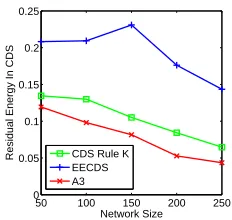
Fig. 3. Residual energy under varying network sizes.
50 100 150 200 250
0 50 100 150 200 Network Size
Number of Unconnected Nodes
CDS Rule K EECDS A3
(a) Static Topology Maintenance
50 100 150 200 250
0 50 100 150 200 250 Network Size
Number of Unconnected Nodes
CDS Rule K EECDS A3
(b) Dynamic Topology Maintenance
50 100 150 200 250
20 40 60 80 100 120 140 160 180 Network Size
Number of Unconnected Nodes
CDS Rule K EECDS A3
[image:7.612.75.527.64.410.2](c) Hybrid Topology Maintenance
Fig. 4. Number of unconnected nodes under varying network sizes.
tree (see Fig.4(b)).
2) Energy Overhead and Residual Energy: Figs. 2 and 3
show energy overhead and residual energy for the three pro-tocols under static, dynamic and hybrid topology maintenance with energy-based triggering.
The CDS-Rule K protocol uses marking and pruning rules while EECDS uses a two-phase process for topology con-struction which leads to higher energy overhead. This trend is visible in Fig. 2(a). Remember that in static maintenance we restricted the number of reduced topologies to three. Moreover, in static topology maintenance the reduced topologies are pre-constructed. A3 protocol constructs the topology more efficiently when compared with the other two protocols. This process allows A3 protocol to have more residual energy when compared with EECDS and CDS-Rule K protocol as shown in Fig.3(a). Therefore it can be concluded that protocols with efficient topology construction techniques are well suited with static maintenance techniques.
Fig. 2(b) shows the energy overhead for all the three protocols under dynamic topology maintenance. An interesting observation is that, although EECDS consumes higher total energy, it has significantly better residual energy (Fig.3(b)). On the other hand, A3 consumes lesser total energy but its
TABLE I
AVERAGECONVERGENCETIME FORVARYINGNODEDENSITIES
CDS RuleK EECDS A3 Static 109.8456964 145.138414 35.74191423 Dynamic 110.8741247 144.4409789 35.77106899 Hybrid 110.2951523 145.0747253 35.88940367
residual energy is lower than EECDS and CDS-Rule K. This is due to non-uniform distribution of communication overhead which drains the battery of fewer nodes resulting in lower residual energy level.
[image:7.612.400.516.76.186.2] [image:7.612.231.347.76.188.2]2 3 4 5 6 7 8 9 10 11 12 13 14 15 16 17 18 19 20 21 22 23 24 25 26 27 28 29 30 31 32 33 34 35 36 37 38 39 40 41 42 43 44 45 46 47 48 49 50 51 52 53 54 55 56 57 58 59 60 61 62
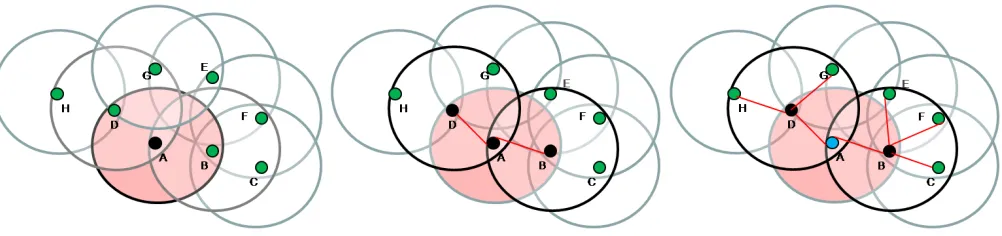
(a) Sink node initiates a clique discovery message.
(b) Neighboring nodes receive clique discov-ery message and rebroadcast it with their Node IDs which are received by A.
(c) A recognizes B and D as a clique whereas uncovered nodes receive broadcasted clique discovery message from covered nodes.
(d) Uncovered nodes check the Node ID and rebroadcast clique discovery message with their Node IDs.
[image:8.612.58.559.62.180.2](e) Nodes not receiving any response to their clique discovery message set a timeout period and go into sleep mode by sending a sleep message to the active clique set.
Fig. 5. An example of CDS discovery using the CCDS Protocol.
3) Number of unconnected nodes: The number of
uncon-nected nodes with energy-based triggering for all the three protocols are shown in Fig. 4. A3 protocol have less number of unconnected nodes in the case of static and dynamic topol-ogy maintenance schemes. In CDS-Rule K, nodes remained marked if there is at least one pair of unconnected neighbor. The energy depletion of the marked node causes more number of unconnected nodes as shown in Fig. 4(a) and Fig. 4(b) respectively. On the other hand, new nodes become part of CDS due to maximal independent set formation in EECDS which allows to have more connected neighbors. Fig. 4(c) shows the number of unconnected nodes for hybrid topology maintenance. The number of unconnected nodes increases exponentially for all the three protocols and shows almost similar trend in case of all the three protocols.
4) Convergence time: The convergence time for all the
three protocols are tabulated in Table.I.
A3 takes less execution time due to its nodes selection pro-cedure which is based on signal strength. Since A3 converges quickly, its message overhead in the topology construction process is low as well. Consequently, it incurs less energy overhead leading to longer network lifetime.
IV. PERFORMANCEGUIDELINES FORCDS-BASED TOPOLOGYCONSTRUCTIONPROTOCOLS
To learn from the performance evaluation of the last section, we now rephrase and summarize our deductions in terms of design guidelines that should be followed by a CDS-based topology control protocol.
Guideline 1: CDS must be formed with a large set of
nodes–preferably proportional to the network size–in order to extend the network lifetime.
Inclusion of fewer nodes in the CDS tree results in a non-uniform distribution of energy overhead. Consequently, the active nodes run out of battery leading to a network partition.
Guideline 2: Instead of relying only on connectivity
prop-erties of nodes, it is important that CDS nodes are chosen based on high energy nodes.
For instance, EECDS forms a maximal independent set and then nodes form a CDS which is more energy efficient than A3.
Guideline 3: Network connectivity can be improved by
choosing diverse nodes to form the CDS.
1 2 3 4 5 6 7 8 9 10 11 12 13 14 15 16 17 18 19 20 21 22 23 24 25 26 27 28 29 30 31 32 33 34 35 36 37 38 39 40 41 42 43 44 45 46 47 48 49 50 51 52 53 54 55 56 57 58 59 60 61 62 7
50 100 150 200 250
103 104 105 106 107 Network Size
Total Number of Messages (Log Scale)
CDS Rule K EECDS A3 CCDS
(a) Total Number of exchanged messages
50 100 150 200 250
0.05 0.1 0.15 0.2 0.25 0.3 Network Size
Residual Energy In CDS
CDS Rule K EECDS A3 CCDS
(b) Residual Energy in CDS
50 100 150 200 250
0.4 0.5 0.6 0.7 0.8 0.9 Network Size Energy overhead
CDS Rule K EECDS A3 CCDS
(c) Energy overhead
50 100 150 200 250
0 50 100 150 200 250 Network Size
Number of Unconnected Nodes
CDS Rule K EECDS A3 CCDS
[image:9.612.137.459.78.388.2](d) Number of Unconnected Nodes
Fig. 6. Message overhead, Energy overhead and Unconnected nodes Vs. network size.
new set of nodes under maintenance operation. The CDS-Rule K (through marking and pruning rule) form a new CDS by selecting a similar set of nodes which remain active causing more unconnected nodes.
Guideline 4: Dynamic topology maintenance must be
con-sidered during the design of a topology control protocol. Most contemporary protocols only focus on energy efficiency during topology construction protocols under static mainte-nance. However, it is equally important for a protocol to consider the dynamic maintenance operation. Recall that A3 performs differently under static and dynamic environment [see Fig.3].
Guideline 5: Message overhead is a critical parameter
which must be reduced by an efficient topology control protocol.
Message overhead is an extremely important parameter and sensor network protocols should be optimized in this respect. It will not only result in optimal usage of network resources but also lead to stable and efficient protocol performance. EECDS and CDS-Rule K has highest message overhead which is partly responsible for their poor (unstable) performance.
In the following section, we utilize these insights to propose a new CDS-based topology construction protocol that outper-forms existing protocols under different evaluation metrics.
V. THECCDSPROTOCOL
In this section, we introduce a Clique-based CDS Discovery (CCDS) protocol which is inspired from the performance guidelines learnt from existing protocols.
A. CCDS Protocol Description
Cliques comprise parts of a graph in which all nodes are connected with each other. A simple arrangement for a node is to form a clique with its one hop neighbors by message broadcast which reduces the number of messages. A CCDS assumes no prior knowledge about the position or orientation of the nodes. However, nodes are aware of other nodes’ IDs contained in the received network messages. This information is used to select a clique on first-come-first-serve basis; i.e., nodes in the selected clique receive and process messages in the order of delivery. The CCDS protocol is executed by selecting a node called an initiator node to be a clique of size
1. As the nodes get aware of the total number of nodes in the network, the initiator node then covers the clique of size 2, as discussed below, which is ultimately transformed into an active clique set henceforth referred to as the backbone nodes or CDS.
2 3 4 5 6 7 8 9 10 11 12 13 14 15 16 17 18 19 20 21 22 23 24 25 26 27 28 29 30 31 32 33 34 35 36 37 38 39 40 41 42 43 44 45 46 47 48 49 50 51 52 53 54 55 56 57 58 59 60 61 62
50 100 150 200 250
102 103 104 105 106 Network Size
Total Number of Messages (Log Scale)
CDS Rule K EECDS A3 CCDS
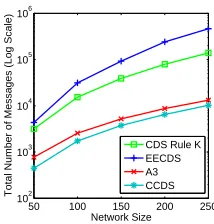
(a) Total Number of exchanged messages
50 100 150 200 250
10−4 10−3 10−2 10−1 Network Size Energy overhead
CDS Rule K EECDS A3 CCDS
(b) Energy overhead in CDS creation
50 100 150 200 250
0.05 0.1 0.15 0.2 0.25 0.3 0.35 0.4 Network Size
Residual Energy In CDS
CDS Rule K EECDS A3
(c) Residual Energy in CDS Tree
Fig. 7. CCDS analysis under varying network sizes.
the example shown in Fig. 5. In this example, Node A acts as an initiator node and broadcasts a clique discovery message to all its neighbors to announce itself as a clique node. The message will be received by node B and node D located in the transmission range of Node A (see Fig. 5(b)). The nodes on reception of the discovery message, append their IDs and residual energy level to the message and broadcast it further. Note that neighbors of node A do not send any explicit response to node A. Instead, they simply repeat the broadcast of clique discovery message which allows node A to be aware of its neighbors. In this way, CCDS takes advantage of the broadcast mechanism for reducing the total number of messages exchanged during CDS discovery.
The broadcasts of nodes B and D are received by their neighbors enabling node A to recognize the clique of size 2
with node B and node D as shown in Fig. 5(c). Neighbors of node B and node D repeat the broadcast in a similar way and the process continues till the network is completely covered. We also point out here that the node sending a clique discovery message sets a timeout period to be aware of their neighbors. If no discovery message is received during this time interval, the node assumes itself as a leaf node. As the messages are exchanged, nodes send a recognition message back to the nodes from which they first received the message; in Fig. 5(d), uncovered nodes (e.g., nodes E, F and C in the present example) send a clique discovery message back to node B. Similarly, nodes G and H form a clique of size 2 after the exchange of messages with node D. As the nodes get aware of different cliques, they may go into sleep mode by setting up a wakeup timer. This is shown in Fig. 5(e) in which nodes H, G, E, F and C send a sleep message to backbone nodes by setting up a wakeup timer.
This completes the description of the protocol. We now provide the results for all the three protocols with CCDS in the next subsection.
B. Performance Evaluation of CCDS
We evaluated the CCDS protocol with dynamic topology maintenance on the performance metrics defined earlier.
Re-TABLE II
AVERAGECONVERGENCETIMEONVARYINGNODEDENSITY
CCDS Static 3.344072933 Dynamic 3.352350818 Hybrid 3.328147193
sults shown in Fig. 6 demonstrate that the underlying protocol achieves energy efficiency with low message complexity. The use of the broadcast nature of wireless channels allows the protocol to cover the end nodes, providing better information in constructing a new CDS tree. It also leads to uniform distribution of energy resources [see Fig. 6(b) and Fig. 6(c)]. Moreover, it has less number of unconnected nodes when compared with the other three protocols as shown in Fig. 6(d). As discussed before, if a protocol constructs the reduced topologies efficiently then it is likely to perform better under static maintenance as CDS trees are rotated. The results shown in Fig.7 demonstrate that CCDS has low message complexity and hence is energy efficient. The convergence time of CCDS is also much lower than the other three protocols [see Table II].
VI. CONCLUSION
Performance evaluation is one of the critical component of a protocol engineering cycle. In this paper, we performed simulations to compare the performance of three prominent topology construction protocols; CDS-Rule K, A3 and EECDS over a large operational landscape. Our extensive empirical results demonstrated that A3 consumes less amount of energy due to its low message overhead. On the other hand, EECDS and CDS-Rule K, although consume higher energy than A3, achieve better residual levels that extend the overall network lifetime. We also showed that A3 converges quickly than the other two protocols.
[image:10.612.68.175.75.187.2]1 2 3 4 5 6 7 8 9 10 11 12 13 14 15 16 17 18 19 20 21 22 23 24 25 26 27 28 29 30 31 32 33 34 35 36 37 38 39 40 41 42 43 44 45 46 47 48 49 50 51 52 53 54 55 56 57 58 59 60 61 62
9
proof of concept, we utilized these guidelines to propose a novel CDS-based protocol using2-cliques in the network. We have shown through simulations that CCDS - the proposed protocol - performs efficiently and have less associated mes-sage overhead.
REFERENCES
[1] P. J. Wan, K. M. Alzoubi, and O. Frieder, “Distributed Construction of Connected Dominating Sets in Wireless Ad Hoc Networks,”IEEE INFOCOM, 2002.
[2] J. Wu and H. Li, “On calculating connected dominating set for efficient routing in ad hoc wireless networks,” In Proceedings of the ACM international Workshop on Discrete Algorithms and Methods for Mobile Computing and Communications, pp. 7-14, 1999.
[3] J. Wu and F. Dai, “An extended localized algorithm for connected dominating set formation in ad hoc wireless networks,” In Proceedings of theIEEE Transactions on Parallel and Distributed Systems, pages 908-920, 2004.
[4] H. Yanxiang and Z. Yuanyuan, “Topology Control in Wireless Sensor Networks with Interference Consideration,” Springer Lecture Notes in Control and Information Sciences, vol. 344, pp. 202-206, October, 2006. [5] R. Ramanathan and R. Rosales-Hain, “Topology control of Multihop Wireless Networks Using Transmit Power adjustment,”IEEE Infocom, pp. 404-413, 2000.
[6] V. Rodoplu and T. H. Meng, “Minimum Energy Mobile Wireless Networks,”IEEE J. Selected Areas in Comm., vol. 17(8), pp. 1333-1344, August, 1999.
[7] D. J. Baker and A. Ephremides, “The architectural organization of a mobile radio network via a distributed algorithm,”IEEE Transactions on Communications, pp. 1694-1701, 1981.
[8] M. Gerla and J. T. Tsai, “Multicluster mobile multimedia radio network,“
ACM Wireless Networks, vol. 1(3), pp. 255-265, 1995.
[9] J. Wu, M. Cardei, F. Dai, and S. Yang, “Extended dominating set and its applications in ad hoc networks using cooperative communication,”
IEEE Trans. on Parallel and Distributed Systems, vol. 17(8), pp. 851-864, 2006.
[10] Z. Yuanyuan, X. Jia, and H. Yanxiang, “Energy efficient distributed connected dominating sets construction in wireless sensor networks,” In Proceedings of theACM International Conference on Communications and Mobile Computing, pp. 797-802, 2006.
[11] P. M. Wightman and M. A. Labrador, “A3: A Topology Construction Algorithm for Wireless Sensor Network,” Proc.IEEE Globecom, 2008. [12] P. M. Wightman and M. A. Labrador, “Atarraya: A Simulation Tool to Teach and Research Topology Control Algorithms for Wireless Sensor Networks,” Create-Net 2nd International Conference on Simulation Tools and Techniq, SIMUTools, 2009.
[13] Y. Xu, J. Heidemann, and D. Estrin, “Adaptive Energy-Conserving Routing for Multihop Ad Hoc Networks,” Research Report 527, USC/Information Sciences Institute, October, 2000.
[14] Y. Xu, J. Heidemann, and D. Estrin, “Geography-informed Energy Conservation for Ad Hoc Routing,” In Proceedings of the 7th Annual
International Conference on Mobile Computing and Networking, pp. 70-84, 2001.
[15] B. Chen, K. Jamieson, H. Balakrishnan, and R. Morris, “Span: An Energy-Efficient Coordination Algorithm for Topology Maintenance in Ad Hoc Wireless Networks,” Wireless Networks, vol. 8(5), pp. 481-494, 2002.
[16] R. Iyengar, K. Kar, and S. Banerjee, “Low-coordination Topologies for Redundancy in Sensor Networks,” In Proceedings of the 6th ACM
International Symposium on Mobile Ad Hoc Networking and Computing, pp. 332-342, 2005.
[17] W. B. Heinzelman, A. P. Chandrakasan, and H. Balakrishnan, “Energy-Efficient Communication Protocol for Wireless Microsensor Networks,” In Proceedings of 33rd Hawaii International Conference on System Sciences, January, 2000.