0022-538X/96/$04.0010
Copyrightq1996, American Society for Microbiology
Interaction of the Human T-Lymphotropic Virus Type 1 Tax
Dimer with CREB and the Viral 21-Base-Pair Repeat
FENG TIE,1NEERAJ ADYA,1† WARNER C. GREENE,3ANDCHOU-ZEN GIAM1,2*
Division of Infectious Diseases, Department of Medicine,1and Department of Molecular Biology and Microbiology,2
Case Western Reserve University, Cleveland, Ohio 44106, and Gladstone Institute of Virology and Immunology,
University of California, San Francisco, California 941413
Received 15 May 1996/Accepted 8 August 1996
Human T-lymphotropic virus type 1 Tax interacts specifically with the cellular transcription factor CREB and the viral 21-bp repeat element to form a Tax-CREB-DNA ternary complex which mediates activation of viral mRNA transcription. Analyses of Tax and Tax mutants indicate that, like CREB, Tax incorporates into the ternary complex as a dimer. The ability of Tax to form a dimer is necessary for its interaction with CREB and the 21-bp element. Analyses of several Tax mutants with amino acid substitutions spanning residues 123 to 204 indicate that intersubunit Tax dimerization correlates with its ability to assemble into the ternary complex and activate transcription. Tax also enhances the DNA binding activities of specific bZip domains in vitro. The ability of Tax to enhance DNA binding of bZip proteins can be explained in part by Tax dimerization. This activity alone is not sufficient for transactivation. A dual amino acid substitution mutant of Tax, M47 (L319R, L320S), completely abrogated for activation of the human T-lymphotropic virus type 1 long terminal repeat as a result of a defect in the transactivation domain, continues to stimulate binding of bZip proteins to DNA.
The human T-lymphotropic virus type 1 (HTLV-1) tran-scriptional activator, Tax, is a 40-kDa nuclear protein crucial for HTLV-1 viral gene expression (10, 25, 38, 44). Tax does not bind DNA directly (19, 33). Rather, it interacts with myriad cellular transcription factors to bring about transactivation (for a review, see reference 11). The ability of Tax to affect multiple cellular transcription pathways is most likely responsible for the uncontrolled growth of the HTLV-1-infected T cells, which eventually leads to adult T-cell leukemia (23, 51) and a neu-rological disorder called tropical spastic paraparesis/HTLV-1-associated myelopathy (18, 26, 34).
Tax transactivation of HTLV-1 viral mRNA expression is mediated by three imperfect cyclic AMP response element (CRE)-containing 21-bp repeat elements in the viral long ter-minal repeat (LTR) (8, 12, 16, 19, 37). We and others have demonstrated that Tax interacts specifically with CREB and the 21-bp repeat to assemble a ternary complex important for HTLV-1 transactivation (21, 35, 46, 52, 53). In addition, by
facilitating the phosphorylation and degradation of IkBa (9,
27, 28), and possibly through interactions with IkBaor NF-kB
precursors (24, 30, 32, 45, 48), Tax is able to increase the
nuclear localization of the NF-kB family of transcription
fac-tors. This results in increased expression of a large collection of cytokines and some cytokine receptors which appear to play an important role in the activation of HTLV-1-infected T cells (5, 29). Finally, Tax has been shown to interact directly with
p67SRF(14) to stimulate the expression of the cellular
proto-oncogene c-fos (13).
The pleiotropic effects exerted by Tax over the various cel-lular transcription factors are mediated by distinct domains in
Tax. Smith and Greene have previously produced a series of HTLV-1 Tax mutants with amino acid substitutions through-out the entire length of Tax (42). These mutants can be clas-sified into three categories: (i) mutants that fail to localize to the nucleus and are unable to activate transcription from either
NF-kB binding sites in the human immunodeficiency virus
(HIV) LTR or the CRE in the HTLV-1 21-bp repeats, (ii)
mutants that activate transcription from NF-kB sites but not
from the HTLV-1 21-bp repeats, and (iii) mutants that activate
the HTLV-1 21-bp repeats but not the NF-kB binding sites.
The biochemical characteristics of several of the mutants im-paired or defective in the activation of the HTLV-1 LTR have been defined in terms of their interaction with CREB (1). These studies indicate that the amino-terminal region of Tax is important for its interaction with CREB, while the carboxyl-terminal region contains a transactivation domain (1). Similar studies of a different set of Tax mutants have led to the same conclusion (21, 41).
The assembly of a ternary Tax–CREB–21-bp-repeat com-plex involves highly specific protein-protein and protein-DNA interactions. Despite extensive amino acid sequence similari-ties, ATF1 is weaker than CREB in interacting with Tax in vitro (2, 53). Likewise, DNA elements competent in collabo-rating with CREB to recruit Tax have been identified by in vitro selection (35). These elements invariably contain a CRE
motif flanked by 59G-rich and/or 39C-rich sequences
resem-bling the HTLV-1 21-bp repeats (35). These specific flanking sequences are critical for Tax assembly into the ternary com-plex and transactivation (17, 31, 35). Under in vitro conditions, Tax increases binding of CREB and other related bZip pro-teins to their cognate DNA binding sites (3, 4, 46, 47, 52, 53).
Enhanced binding of NF-kB to its recognition site by Tax has
also been reported (4). Wagner and Green have shown that the facilitated binding of CREB/ATF factors to DNA is due to a Tax-stimulated increase in the dimerization of the bZip pro-teins (47). The interaction between Tax and CREB is mediated via the basic domain of CREB and amino acid residues in its
* Corresponding author. Present address: Department of Microbiol-ogy and ImmunolMicrobiol-ogy, Uniformed Services University of the Health Sciences, 4301 Jones Bridge Rd., Bethesda, MD 20814. Phone: (301) 295-3400. Fax: (301) 295-1545.
† Present address: Laboratory of Gene Transfer, National Center for Human Genome Research, Bethesda, MD 20892.
8368
on November 9, 2019 by guest
http://jvi.asm.org/
respectively (1). As a result, neither mutant is able to transac-tivate the HTLV 21-bp repeats. M47, like wild-type Tax, con-tinues to enhance DNA binding of several bZip domains, in-dicating that Tax does not function like a chaperone or an enzyme to stimulate binding of bZip protein to DNA. Rather, Tax participates in forming the Tax–CREB–21-bp-repeat ter-nary complex and most likely engages the basal transcriptional factors via its carboxyl transactivation domain.
MATERIALS AND METHODS
Expression and purification of HTLV-1 Tax and its mutants.Mutant Tax constructs were made by replacing the AccI-SmaI fragment containing the ma-jority of the Tax coding sequence. Escherichia coli BL21(DE3) cells transformed with the Tax expression plasmids pET11-TaxH6, -M1 (H3S), -M7 (C29A, P30S), -M22 (T130A, L131S), and -M47 (L319R, L320S) were each grown at 378C in 2 liters of Terrific broth medium containing 100mg of ampicillin per ml to an A600 of 1.0 to 1.5 and then induced for Tax expression with 40mM IPTG (isopropyl-b-D-thiogalactopyranoside) at room temperature overnight. This induction
pro-tocol resulted in a much higher yield of intact Tax protein that was not possible with short induction at 378C using high concentrations of IPTG. Cells were harvested and resuspended in 20 ml of 50 mM phosphate-buffered saline (PBS; pH 8.0) containing 0.3 M NaCl, 0.25 mM phenylmethylsulfonyl fluoride, 0.5 mM b-mecaptoethanol, and 10 mM imidazole. The cells were ruptured by sonication over an ice-salt bath, using a Bronson Sonifier mounted with a microtip. Soni-cation was carried out at 70% duty cycle for four burst of 1 min each. After centrifugation in a Sorvall SS-34 rotor at 16,000 rpm for 50 min at 48C, the supernatant was mixed with 5 ml of Ni-nitrilotriacetic acid-agarose (Qiagen) at 48C for at least 2 h. The protein-bound gel matrix was then packed into a column (1.5 by 10 cm) and washed with 40 ml of the same buffer containing 40 mM imidazole. Tax protein was then eluted with a 60-ml gradient of 80 to 300 mM imidazole. Proteins in each fractions were analyzed by sodium dodecyl sulfate (SDS)-polyacrylamide gel electrophoresis (PAGE) (12% polyacrylamide gel) followed by immunoblotting with an anti-HTLV-1 Tax antibody generated against the C-terminal region of Tax (Tax-C Ab [22]). Fractions containing Tax were dialyzed against buffer D (20 mM N-2-hydroxyethylpiperazine-N9 -2-ethane-sulfonic acid [HEPES; pH 7.9], 150 mM KCl, 0.2 mM EDTA, 0.5 mM phenyl-methylsulfonyl fluoride, 0.5 mM dithiothreitol, 20% glycerol) and stored frozen at2708C. Similar methods were used to obtain M18 (T123A, L124S), M19 (Q126A, H127S), M24 (T145A, L146S), M28 (P176A, G177S), and M34 (G203A, A204S) mutant proteins. Protein concentrations were determined by the Bio-Rad protein assay, using bovine serum albumin (BSA) as a standard.
Chemical cross-linking of proteins.Purified wild-type or mutant Tax proteins (approximately 0.2mg in 10ml) were incubated with 1ml of freshly prepared 50 mM bissulfosuccinimidyl suberate (BS3; a cross-linking reagent from Pierce) at room temperature for 5 min. The reaction was quenched by the addition of 1ml of 1 M Tris (pH 7.8). The reaction product was then analyzed by SDS-PAGE (12% polyacrylamide gel) and immunoblotting.
Gel filtration chromatography.Gel filtration was carried out at 48C, using a Superose 12 HR 10/30 column (Pharmacia, Uppsala, Sweden) and a Pharmacia FPLC system. The purified Tax proteins (60 to 80ml) were loaded on the column preequilibrated with 50 mM PBS (pH 7.8) containing 0.3 M NaCl. Proteins were eluted in the same buffer at a flow rate of 0.3 ml/min. Eluates were collected in 0.5-ml fractions and analyzed for the presence of Tax by immunoblotting. The Superose 12 column was calibrated by using a set of molecular mass standards from Bio-Rad (bovine thyroglobulin, 670 kDa; bovine gamma globulin, 158 kDa; chicken ovalbumin, 44 kDa; horse myoglobin 17 kDa; vitamin B12, 1.35 kDa) and Pharmacia (BSA, 67 kDa).
Gel electrophoretic mobility shift assay.A 67-bp EcoRI-NcoI fragment con-taining the promoter proximal copy of the HTLV-1 21-bp repeat was labeled
with [a-32P]dCTP by using Klenow enzyme and purified by PAGE (12% poly-acrylamide gel). Protein-DNA binding reactions were carried out as described previously (1, 2). The reaction mixtures (typically 8ml) were electrophoresed on a 4.5 or 6% nondenaturing polyacrylamide gel (30:1 acrylamide to bisacrylamide; 18 by 14 cm) in Tris-glycine-EDTA buffer (25 mM Tris, 192 mM glycine, 1 mM EDTA [pH 8.5]) at 220 V and 48C for 2 to 3 h. The gel was then dried on a piece of Whatman filter paper and autoradiographed.
RESULTS
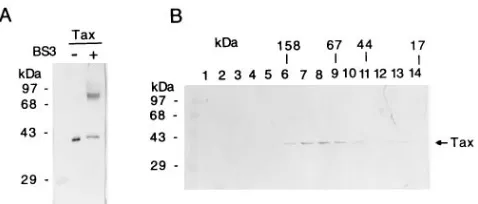
Purified Tax protein forms a dimer.Previous studies have indicated that the region in CREB that is critical for the in-termolecular Tax-CREB interaction lies in the basic domain of CREB and amino acid residues 282 to 284, Ala-Ala-Arg, im-mediately upstream (2). Since CREB is a homodimer of two identical subunits, it seems likely that at least two types of Tax-CREB complexes can exist, each with the stoichiometry of either one or two Tax molecules per Tax-CREB-DNA ternary complex. The gel electrophoretic mobility shift assay, however, detected only a single ternary complex (52, 53). This prompted us to consider the possibility that Tax is dimeric in structure. Tax is composed of 353 amino acid residues with a molecular size of approximately 40 kDa. To determine if Tax is dimeric, both chemical cross-linking and gel filtration chromatography were carried out. Treatment of Tax with a cross-linker, BS3, produced a new protein species with a molecular size of ap-proximately 80 kDa (Fig. 1A), corresponding to the size of a Tax dimer. Gel filtration chromatography using a Pharmacia Superose 12 column revealed that the major peak of Tax eluted at a position immediately preceding where the 67-kDa BSA appeared (Fig. 1B, lanes 6 to 9), consistent with the expected size of a Tax dimer. In addition to the major fraction eluting before BSA, some Tax protein trailed in fractions where the 44-kDa ovalbumin standard eluted (Fig. 1B, lanes 10 to 13). This result indicates that a portion of Tax is in the monomeric state, most likely in dynamic equilibrium with the dimeric form.
Tax mutants impaired or defective in dimerization become poor transactivators.Smith and Greene have previously gen-erated 52 Tax mutants with amino acid substitutions spanning the entire length of Tax (42). Having determined that the wild-type Tax forms a dimer, we proceeded to analyze a subset of Tax mutants (M1, M7, M22, and M47) from the Smith and Greene collection to correlate the transcriptional activities of these mutant Tax proteins with their abilities to form dimers. M1 (H3S) is a mutant defective in transactivating the HTLV-1 LTR but competent in transactivating the HIV LTR. M7
indicated.
on November 9, 2019 by guest
[image:2.612.318.557.68.170.2](C29A, P30S) is deficient in nuclear localization and fails to activate either of the LTRs. M22 (T130A, L131S) is reduced in its capacity to transactivate the HTLV-1 LTR and abrogated in transactivation of the HIV LTR. Finally, M47 (L319R, L320S) transactivates the HIV LTR but not the HTLV-1 LTR. Our published data have demonstrated that M1 and M7 are defec-tive in engaging CREB, while M22 exhibits approximately 20% of wild-type levels of activity in interacting with CREB and in ternary complex formation (1). In contrast, M47 can interact with CREB and the 21-bp repeat to form a ternary complex but is apparently impaired in the transactivation domain which interacts with the basal transcriptional machinery (1, 41). To obtain mutant proteins for biochemical characterizations, the wild-type Tax coding sequence in plasmid pET11-TaxH6 was replaced with those of the mutants. Individual mutant proteins were then expressed, purified, and analyzed by chemical cross-linking (Fig. 2A) and gel filtration chromatography (Fig. 2B). As shown in Fig. 2A, after BS3 treatment, Tax mutants M1 and
M47 each produced an 80-kDa protein species corresponding to a cross-linked dimer. Gel filtration further confirmed that both M1 and M47 proteins form dimers (Fig. 2B, M1 and M47, lanes 6 to 9). M7, in contrast, appeared as large protein ag-gregates which eluted in the void volume of the Superose 12 sizing column. After BS3 cross-linking, M7 yielded a smear of large-molecular-size protein species reactive to the Tax anti-body, indicating that it was highly aggregated. This may con-tribute to its failure to reach the nucleus and its inability to interact with CREB. Most interestingly, M22 yielded a low level of the 80-kDa species following BS3 cross-linking. Gel filtration chromatography also revealed it to be predominantly monomeric (Fig. 2B, M22, lanes 10 to 13) or aggregated (lanes 1 to 3), with a small fraction in dimer form (lanes 6 to 9).
Intersubunit Tax interaction is necessary for incorporation of Tax into a stable ternary complex with CREB and the HTLV-1 21-bp repeat.The interaction of mutant Tax proteins with CREB and the 21-bp repeat was then analyzed by the gel electrophoretic mobility shift assay to determine the effect of the respective mutations on the assembly of the Tax–CREB– 21-bp-repeat ternary complex. In two separate concentrations
(0.3mM [Fig. 3, lanes 2 to 6 and 8 to 12] and 0.15mM [lanes
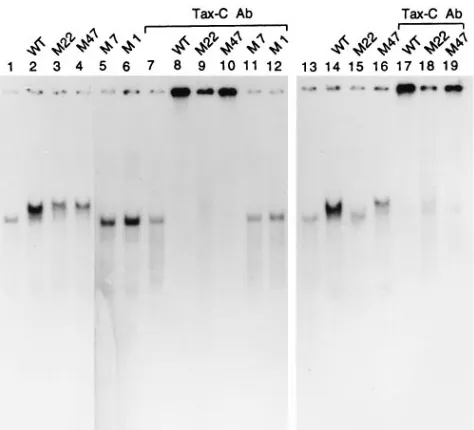
[image:3.612.317.554.68.283.2]14 to 19]), the wild-type Tax and M47 both interacted with CREB and the 21-bp repeat DNA to form more slowly mi-grating ternary complexes (lanes 2 and 4) which could be supershifted by an antibody (lanes 8 and 10), Tax-C Ab, gen-erated against the carboxyl end of Tax (22), while M22 is weakened in this capacity (compare lanes 9 and 18 with lanes 8, 10, 17, and 19). In contrast, both M1 and M7 failed to interact with the CREB-DNA complex (lanes 5 and 6) and produced no nucleoprotein complexes that reacted with Tax-C Ab (lanes 11 and 12), as a result of the defect of M1 to bind CREB as reported previously (1) and the tendency of M7 to aggregate (Fig. 2). The weakened ability of M22 to form a ternary complex is most likely because of its reduced capacity to dimerize and interact with CREB (lanes 15 and 18).
FIG. 2. Intersubunit interactions of mutant Tax proteins. Tax proteins were prepared as described in Materials and Methods. Proteins were analyzed by SDS-PAGE (12% polyacrylamide gel). Chemical cross-linking, gel filtration, and immunoblotting were carried out as described in Materials and Methods. (A) Immunoblot of wild-type (WT) and mutant Tax proteins before and after BS3 cross-linking. (B) Elution profiles of individual mutant Tax proteins (as labeled) on a Superose 12 column. Lanes 1 to 14 correspond to fractions 19 to 32.
FIG. 3. Relative efficiencies of mutant Tax proteins in forming a Tax– CREB–21-bp-repeat ternary complex. Gel electrophoretic mobility shift assays were performed as described in Materials and Methods, using 4.5% polyacryl-amide gels. Each sample contained approximately 60 ng of purified CREB and 1mg of poly(dI-dC). Amounts of wild-type (WT) and mutant Tax proteins are approximately 0.1mg in lanes 2 to 6 and 8 to 12 and 50 ng in lanes 14 to 19, respectively. Tax-C Ab (0.4ml) was added in lanes 7 to 12 and lanes 17 to 19.
on November 9, 2019 by guest
http://jvi.asm.org/
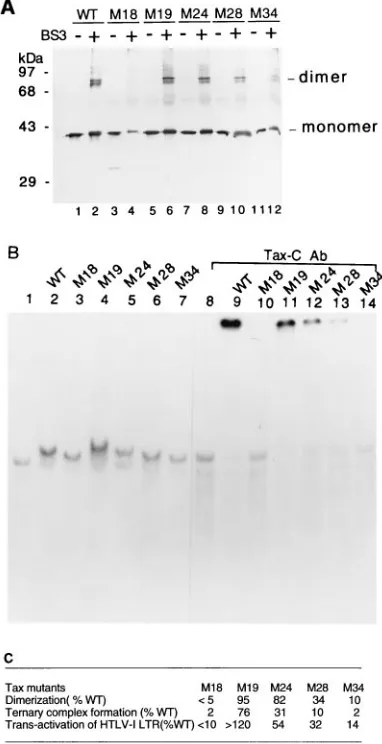
[image:3.612.72.285.72.460.2]dimer as the wild-type Tax (Fig. 4A; compare lanes 2 and 6). Further, mutants with weaker transactivation functions yielded progressively lower levels of cross-linker dimers (lanes 8, 10, and 12). The extent of Tax mutant dimerization as measured against that of the wild-type Tax is largely consistent with the degree of transactivation reported previously (Fig. 4C). For mutant M18, which is essentially inactive, little cross-linked dimer could be detected (Fig. 4A, lane 4). Although the level of M18 used may be somewhat lower, the difference from that of the other Tax species is not significant. The mutant proteins were further analyzed by the electrophoretic mobility shift assay. Again, the degrees of ternary Tax–CREB–21-bp-repeat complex formation correlated to the abilities of the mutant proteins to form dimers (compare lanes 2 to 7 for levels of the ternary complexes and supershifts of the ternary complexes with Tax-C Ab in lanes 9 to 14). These results are consistent with the notion that Tax dimerization is crucial for its interac-tion with CREB and transactivainterac-tion. Further, the region im-portant for Tax dimerization appears to extend from residues Thr-123 to Ala-204.
Enhanced DNA binding of bZip domains by Tax is not sufficient for Tax transactivation. It has been proposed that the enhancement of dimerization and DNA binding of bZip domains by Tax is responsible for transcriptional activation (36, 47). Since M47, which failed to transactivate the HTLV-1 21-bp repeats, behaved like wild-type Tax in intersubunit dimerization and assembly of ternary complexes, we tested its activity in enhancing the DNA binding of bZip proteins. Con-sistent with results in Fig. 3, both M47 and wild-type Tax interacted with glutathione S-transferase (GST)–CREB bZip and the HTLV-1 21-bp repeat to assemble ternary complexes (Fig. 5A, lanes 3 to 5), which became supershifted by Tax-C Ab (Fig. 5B, lanes 2 to 4). Also in agreement with the results in Fig. 3, the impairment in subunit dimerization of M22 renders it diminished in ability to stably interact with GST-CREB bZip to form the ternary complex (Fig. 5A, lane 4; Fig. 5B, lane 3). In contrast to when CREB was used (Fig. 3), this defect was more pronounced with GST-CREB-bZip (Fig. 5A, lane 4), in which case little ternary complex could be detected. M22, how-ever, remained able to stimulate the binding of GST-CREB-bZip, GST-ATF1-GST-CREB-bZip, and GST-ATF2-bZip to DNA (Fig. 5A, lanes 4, 8, and 12). Similarly, M47 also enhanced the binding of the bZip domains of CREB, ATF1, and ATF2 to the HTLV-1 21-bp repeat (Fig. 5A, lanes 9 and 13). Overall, the interaction of Tax (wild type or M47) with ATF1 bZip is weaker than that with CREB bZip (Fig. 5A, lanes 6 to 9) as reported previously (1, 44), with some Tax-ATF1 bZip-DNA ternary complexes detectable by antibody supershift, probably as a result of stabilization by Tax-C Ab (Fig. 5B, lanes 5 to 8). Although Tax (wild type or M47) interacted with ATF2 bZip
[image:4.612.339.530.73.445.2]to increase its binding to the probe DNA (Fig. 5A, lanes 10 to 13), no ternary complex was seen (Fig. 5B, lanes 9 to 12). Finally, no interaction between Tax (wild type or M47) and ATF3 bZip was observed (Fig. 5A, lanes 14 to 17; Fig. 5B, lanes 13 to 16). That M47 functions like wild-type Tax in stimulating binding of CREB/ATF proteins to the HTLV-1 21-bp repeat in vitro (Fig. 5A, lanes 9 and 13) and yet is completely ablated in transactivating the HTLV-1 LTR in vivo is particularly informative. This result indicates that Tax-en-hanced DNA binding of bZip proteins is not sufficient to ac-count for transactivation. Instead, the recruitment of Tax with a functional transactivation domain (which has been abrogated in mutant M47) to the viral 21-bp repeats via CREB is required for the augmentation of viral transcription.
FIG. 4. Tax mutants impaired in dimerization become defective in ternary complex formation and transactivation. Tax mutants M18, M19, M24, M28, and M34 were cloned, expressed, and purified as described in Materials and Meth-ods. (A) Immunoblot of mutant Tax proteins before (2) and after BS3 (1) cross-linking. Approximately 0.2mg of each mutant Tax protein in 10ml was used. WT, wild type. (B) Electrophoretic mobility shift assay carried out as for Fig. 3 with 0.1mg of each mutant Tax protein. (C) Quantitation of the levels of dimerization, ternary complex formation, and HTLV-1 LTR transactivation of Tax mutants. The levels of cross-linked Tax dimers were determined by densi-tometer scanning. The ternary complexes were quantified by a PhosphorImager. The levels of transactivation of Tax mutants are as reported elsewhere (42).
on November 9, 2019 by guest
DISCUSSION
The results described here, combined with published data (1, 15, 20, 21, 39–42), indicate that Tax contains several structur-ally distinct regions involved in (i) interaction with CREB (1, 21), (ii) interaction with the basal transcriptional machinery (41), and (iii) subunit dimerization. Mutations that affect indi-vidual functions can be localized to the amino-terminal, the carboxyl-terminal, and the central regions of Tax, respectively.
A zinc finger-like motif has been proposed for the NH2
termi-nus of Tax (40, 43). Analyses of Tax mutants with amino acid substitutions in the histidine and cysteine residues in this re-gion suggest that the zinc finger structure may be important for interaction with CREB (1, 21). A nuclear localization domain has also been mapped to this region (43). A deletion mutant of
Tax lacking the NH2-terminal amino acid residues 2 to 58 has
been shown previously to inhibit Tax transactivation in a trans-dominant negative manner by causing aberrant localization of wild-type Tax to the perinuclear region. That the deletion mutant forms a heterodimer with wild-type Tax to block its function has been suggested (20). That Tax forms a dimer with a dissociation constant in the nM range has also been reported recently (36).
We and others have shown previously that Tax preferentially interacts with nucleoprotein complexes formed between CREB and a subset of CRE motifs, including the viral 21-bp
repeats, which contain 59G-rich and/or 39C-rich flanking
se-quences (35). Although the molecular basis for this DNA spec-ificity is not clear at present, it appears to involve the CREB basic domain and three amino acid residues located in its vicinity which have been shown to be critical for the formation of the ternary complex (2, 49). The data reported here indicate that Tax dimerization is required for its specific contact with CREB. Two possible roles for the intersubunit Tax interaction
can be envisioned. First, it may position the NH2-terminal
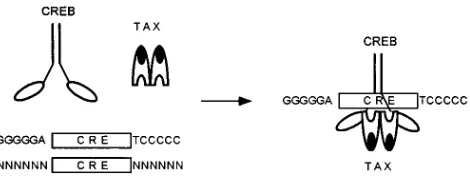
region for interaction with CREB. Second, it can strengthen the CREB interaction via a two-prong contact. The Tax-CREB-DNA interaction thus results in a stable ternary
com-plex with a stoichiometry of (Tax)2/(CREB)2/(21-bp repeat)1
(Fig. 6).
In agreement with earlier reports (4, 36), the enhanced dimerization and DNA binding of CREB/ATF-like factors as
[image:5.612.157.465.70.232.2]stimulated by Tax can be explained in part on the basis that Tax dimer serves as an anchor to bring two bZip domains together to dimerize (36). This would be consistent with the observation that Tax-enhanced DNA binding of CREB pro-teins in vitro is highly dependent on CREB concentrations (3, 7) and occurs via a biphasic process (7) possibly involving the joining of two CREB monomers and subsequent alterations of the structure of their respective DNA binding domains. The inability to detect a Tax-CREB-DNA ternary complex in the gel mobility shift assay by others is most likely a consequence of the conditions under which the experiments were carried out (3, 4, 36, 47). We think that the interaction between Tax and other bZip proteins is incomplete, with the extent of in-teraction depending on the degree of their structural similar-ities to CREB. Although the Tax-stimulated increase in bZip dimer formation and DNA binding can be quite striking, es-pecially when the concentration of CREB is low, this effect is most likely driven by the higher concentrations of Tax dimer in vitro. Our results for Tax mutant M47, which completely fails to activate the HTLV-1 LTR yet continues to enhance DNA binding of several bZip proteins, argue against the model pro-posed by Perini et al. suggesting that Tax-stimulated dimeriza-tion of bZip proteins is responsible for Tax transactivadimeriza-tion (36). On the contrary, we think that Tax does not act as a molecular chaperone or catalytically to stimulate enhancement of DNA binding of bZip proteins and/or alter their DNA
FIG. 5. Interaction of Tax and Tax mutants with bZip domains. Construction of GST-bZip fusions has been reported previously (1). Gel electrophoretic mobility shift assays were performed as for Fig. 3 except that a 6% polyacrylamide gel was used. (A) Twenty-nanogram aliquots of GST-bZip proteins (CREB, ATF1, ATF2, and ATF3) were used in each reaction with inclusion of 0.1mg of wild-type (WT) or mutant (M22 or M47) Tax protein (as labeled above each lane). The arrow marks the ternary complex formed between Tax, CREB bZip, and HTLV-1 21-bp repeat. Because of the reduced size of the GST-CREB bZip compared with CREB, the ternary complex separates better from the GST-CREB bZip-DNA complex (A, lanes 3 to 5). The increase bZip DNA binding as stimulated by Tax ranges between 2.4- and 4-fold. In the presence of Tax, a slight reduction in ATF3 bZip binding to DNA was seen. All GST-ATF2 bZip lanes contain a more slowly migrating species probably due to protein aggregation. (B) Reactions identical to those in panel A except for the addition of Tax-C Ab.
FIG. 6. A model for the mechanism of HTLV-1 Tax transactivation showing the assembly of Tax and CREB dimers on the HTLV-1 21-bp repeat. As reported before (1), Tax-CREB interaction occurs in the immediate vicinity of the CREB basic domain.
on November 9, 2019 by guest
http://jvi.asm.org/
[image:5.612.321.556.605.693.2]tropic virus type I tax mediate interactions with activator protein CREB and basal transcription factors. J. Virol. 69:1834–1841.
2. Adya, N., L. J. Zhao, W. Huang, I. Boros, and C. Z. Giam. 1994. Expansion of CREB’s DNA recognition specificity by Tax results from interaction with Ala-Ala-Arg at positions 282-284 near the conserved DNA-binding domain of CREB. Proc. Natl. Acad. Sci. USA 91:5642–5646.
3. Anderson, M. G., and W. S. Dynan. 1994. Quantitative studies of the effect of HTLV-I Tax protein on CREB protein-DNA binding. Nucleic Acids Res. 22:3194–3201.
4. Armstrong, A. P., A. A. Franklin, M. N. Uittenbogaard, H. A. Giebler, and J. K. Nyborg.1993. Pleiotropic effect of the human T-cell leukemia virus Tax protein on the DNA binding activity of eukaryotic transcription factors. Proc. Natl. Acad. Sci. USA 90:7303–7307.
5. Ballard, D. W., E. Bohnlein, J. W. Lowenthal, Y. Wano, B. R. Franza, and W. C. Greene.1988. HTLV-I tax induces cellular proteins that activate the kappa B element in the IL-2 receptor alpha gene. Science 241:1652–1655. 6. Baranger, A. M., C. R. Palmer, M. K. Hamm, H. A. Giebler, A. Brauweiler,
J. K. Nyborg, and A. Schepartz.1995. Mechanism of DNA-binding enhance-ment by the human T-cell leukaemia virus transactivator Tax. Nature (Lon-don) 376:606–608.
7. Boros, I. M., F. Tie, and C. Z. Giam. 1995. Interaction of bovine leukemia virus transactivator Tax with bZip proteins. Virology 214:207–214. 8. Brady, J., K. T. Jeang, J. Duvall, and G. Khoury. 1987. Identification of
p40x-responsive regulatory sequences within the human T-cell leukemia virus type I long terminal repeat. J. Virol. 61:2175–2181.
9. Brockman, J. A., D. C. Scherer, T. A. McKinsey, S. M. Hall, X. Qi, W. Y. Lee, and D. W. Ballard.1995. Coupling of a signal response domain in IkBato multiple pathways for NF-kB activation. Mol. Cell. Biol. 15:2809–2818. 10. Chen, I. S., D. J. Slamon, J. D. Rosenblatt, N. P. Shah, S. G. Quan, and W.
Wachsman.1985. The x gene is essential for HTLV replication. Science 229:54–58.
11. Cullen, B. R. 1992. Mechanism of action of regulatory proteins encoded by complex retroviruses. Microbiol. Rev. 56:375–394.
12. Felber, B. K., H. Paskalis, C. Kleinman Ewing, F. Wong Staal, and G. N. Pavlakis.1985. The pX protein of HTLV-I is a transcriptional activator of its long terminal repeats. Science 229:675–679.
13. Fujii, M., P. Sassone Corsi, and I. M. Verma. 1988. c-fos promoter trans-activation by the tax1 protein of human T-cell leukemia virus type I. Proc. Natl. Acad. Sci. USA 85:8526–8530.
14. Fujii, M., H. Tsuchiya, T. Chuhjo, T. Akizawa, and M. Seiki. 1992. Interac-tion of HTLV-1 Tax1 with p67SRF causes the aberrant inducInterac-tion of cellular immediate early genes through CArG boxes. Genes Dev. 6:2066–2076. 15. Fujii, M., H. Tsuchiya, and M. Seiki. 1991. HTLV-1 Tax has distinct but
overlapping domains for transcriptional activation and for enhancer speci-ficity. Oncogene 6:2349–2352.
16. Fujisawa, J., M. Seiki, M. Sato, and M. Yoshida. 1986. A transcriptional enhancer sequence of HTLV-I is responsible for trans-activation mediated by p40 chi HTLV-1. EMBO J. 5:713–718.
17. Fujisawa, J., M. Toita, and M. Yoshida. 1989. A unique enhancer element for the trans activator (p40tax) of human T-cell leukemia virus type I that is distinct from cyclic AMP- and 12-O-tetradecanoylphorbol-13-acetate-re-sponsive elements. J. Virol. 63:3234–3239.
18. Gessain, A., F. Barin, J. C. Vernant, O. Gout, L. Maurs, A. Calender, and G. de The.1985. Antibodies to human T-lymphotropic virus type-I in patients with tropical spastic paraparesis. Lancet 2:407–410.
19. Giam, C. Z., and Y. L. Xu. 1989. HTLV-I tax gene product activates tran-scription via pre-existing cellular factors and cAMP responsive element. J. Biol. Chem. 264:15236–15241.
20. Gitlin, S. D., P. F. Lindholm, S. J. Marriott, and J. N. Brady. 1991. Trans-dominant human T-cell lymphotropic virus type I TAX1 mutant that fails to localize to the nucleus. J. Virol. 65:2612–2621.
21. Goren, I., O. J. Semmes, K. T. Jeang, and K. Moelling. 1995. The amino
26. Jacobson, S., C. S. Raine, E. S. Mingioli, and D. E. McFarlin. 1988. Isolation of an HTLV-1-like retrovirus from patients with tropical spastic paraparesis. Nature (London) 331:540–543.
27. Kanno, T., K. Brown, G. Franzoso, and U. Siebenlist. 1994. Kinetic analysis of human T-cell leukemia virus type I Tax-mediated activation of NF-kB. Mol. Cell. Biol. 14:6443–6451.
28. Kanno, T., K. Brown, and U. Siebenlist. 1995. Evidence in support of a role for human T-cell leukemia virus type I Tax in activating NF-kappa B via stimulation of signaling pathways. J. Biol. Chem. 270:11745–11748. 29. Kelly, K., P. Davis, H. Mitsuya, S. Irving, J. Wright, R. Grassmann, B.
Fleckenstein, Y. Wano, W. Greene, and U. Siebenlist.1992. A high propor-tion of early response genes are constitutively activated in T cells by HTLV-I. Oncogene 7:1463–1470.
30. Lanoix, J., J. Lacoste, N. Pepin, N. Rice, and J. Hiscott. 1994. Overproduc-tion of NFKB2 (lyt-10) and c-Rel: a mechanism for HTLV-I Tax-mediated trans-activation via the NF-kappa B signalling pathway. Oncogene 9:841– 852.
31. Montagne, J., C. Beraud, I. Crenon, G. Lombard Platet, L. Gazzolo, A. Sergeant, and P. Jalinot.1990. Tax1 induction of the HTLV-I 21 bp en-hancer requires cooperation between two cellular DNA-binding proteins. EMBO J. 9:957–964.
32. Munoz, E., G. Courtois, P. Veschambre, P. Jalinot, and A. Israel. 1994. Tax induces nuclear translocation of NF-kB through dissociation of cytoplasmic complexes containing p105 or p100 but does not induce degradation of IkBa/MAD3. J. Virol. 68:8035–8044.
33. Nyborg, J. K., W. S. Dynan, I. S. Chen, and W. Wachsman. 1988. Binding of host-cell factors to DNA sequences in the long terminal repeat of human T-cell leukemia virus type I: implications for viral gene expression. Proc. Natl. Acad. Sci. USA 85:1457–1461.
34. Osame, M., M. Matsumoto, K. Usuku, S. Izumo, N. Ijichi, H. Amitani, M. Tara, and A. Igata.1987. Chronic progressive myelopathy associated with elevated antibodies to human T-lymphotropic virus type I and adult T-cell leukemialike cells. Ann. Neurol. 21:117–122.
35. Paca Uccaralertkun, S., L. J. Zhao, N. Adya, J. V. Cross, B. R. Cullen, I. M. Boros, and C. Z. Giam.1994. In vitro selection of DNA elements highly responsive to the human T-cell lymphotropic virus type I transcriptional activator, Tax. Mol. Cell. Biol. 14:456–462.
36. Perini, G., S. Wagner, and M. R. Green. 1995. Recognition of bZip proteins by the human T-cell leukaemia virus transactivator Tax. Nature (London) 376:602–605.
37. Rosen, C. A., R. Park, J. G. Sodroski, and W. A. Haseltine. 1987. Multiple sequence elements are required for regulation of human T-cell leukemia virus gene expression. Proc. Natl. Acad. Sci. USA 84:4919–4923. 38. Rosen, C. A., J. G. Sodroski, and W. A. Haseltine. 1985. Location of
cis-acting regulatory sequences in the human T-cell leukemia virus type I long terminal repeat. Proc. Natl. Acad. Sci. USA 82:6502–6506.
39. Semmes, O. J., and K. T. Jeang. 1992. Mutational analysis of human T-cell leukemia virus type I Tax: regions necessary for function determined with 47 mutant proteins. J. Virol. 66:7183–7192.
40. Semmes, O. J., and K. T. Jeang. 1992. HTLV-I Tax is a zinc-binding protein: role of zinc in Tax structure and function. Virology 188:754–764. 41. Semmes, O. J., and K. T. Jeang. 1995. Definition of a minimal activation
domain in human T-cell leukemia virus type I Tax. J. Virol. 69:1827–1833. 42. Smith, M. R., and W. C. Greene. 1990. Identification of HTLV-I tax trans-activator mutants exhibiting novel transcriptional phenotypes. Genes Dev. 4:1875–1885.
43. Smith, M. R., and W. C. Greene. 1992. Characterization of a novel nuclear localization signal in the HTLV-I tax transactivator protein. Virology 187: 316–320.
44. Sodroski, J. G., C. A. Rosen, and W. A. Haseltine. 1984. Trans-acting tran-scriptional activation of the long terminal repeat of human T lymphotropic viruses in infected cells. Science 225:381–385.
on November 9, 2019 by guest
45. Sun, S. C., J. Elwood, C. Beraud, and W. C. Greene. 1994. Human T-cell leukemia virus type I Tax activation of NF-kB/Rel involves phosphorylation and degradation of IkBaand RelA (p65)-mediated induction of the c-rel gene. Mol. Cell Biol. 14:7377–7384.
46. Suzuki, T., J. I. Fujisawa, M. Toita, and M. Yoshida. 1993. The trans-activator tax of human T-cell leukemia virus type 1 (HTLV-1) interacts with cAMP-responsive element (CRE) binding and CRE modulator proteins that bind to the 21-base-pair enhancer of HTLV-1. Proc. Natl. Acad. Sci. USA 90:610–614.
47. Wagner, S., and M. R. Green. 1993. HTLV-I Tax protein stimulation of DNA binding of bZip proteins by enhancing dimerization. Science 262:395– 399.
48. Watanabe, M., M. Muramatsu, A. Tsuboi, and K. Arai. 1994. Differential response of NF-kappa B1 p105 and NF-kappa B2 p100 to HTLV-I encoded Tax. FEBS Lett. 342:115–118.
49. Yin, M. J., E. Paulssen, J. Seeler, and R. B. Gaynor. 1995. Chimeric proteins
composed of Jun and CREB define domains required for interaction with the human T-cell leukemia virus type 1 Tax protein. J. Virol. 69:6209–6218. 50. Yin, M. J., E. J. Paulssen, J. S. Seeler, and R. B. Gaynor. 1995. Protein domains involved in both in vivo and in vitro interactions between human T-cell leukemia virus type I tax and CREB. J. Virol. 69:3420–3432. 51. Yoshida, M., I. Miyoshi, and Y. Hinuma. 1982. Isolation and characterization
of retrovirus from cell lines of human adult T-cell leukemia and its implica-tion in the disease. Proc. Natl. Acad. Sci. USA 79:2031–2035.
52. Zhao, L. J., and C. Z. Giam. 1991. Interaction of the human T-cell lympho-trophic virus type I (HTLV-I) transcriptional activator Tax with cellular factors that bind specifically to the 21-base-pair repeats in the HTLV-I enhancer. Proc. Natl. Acad. Sci. USA 88:11445–11449.
53. Zhao, L. J., and C. Z. Giam. 1992. Human T-cell lymphotropic virus type I (HTLV-I) transcriptional activator, Tax, enhances CREB binding to HTLV-I 21-base-pair repeats by protein-protein interaction. Proc. Natl. Acad. Sci. USA 89:7070–7074.